Things To Do in Panama City Beach: The 2026 Local Guide

Panama City Beach packs more activity variety into its 27 miles of Gulf Coast shoreline than most Florida beach towns manage across their entire county, and the things to do in Panama City Beach range from world-class wreck diving and serious deep-sea fishing to state park hiking, waterfront seafood, and a nightlife strip that runs well past midnight. The challenge is not finding things to do. It’s knowing which experiences are genuinely worth your time, which are tourist infrastructure dressed up as local culture, and which section of this very long, very diverse beach town actually matches your travel style.
According to Visit Panama City Beach, the official destination management organization for Bay County, the city draws roughly 13 million visitors annually and has invested substantially in family-friendly infrastructure over the past decade. What that number obscures is that PCB has two distinct seasons with dramatically different characters: the spring break period in March when the destination skews heavily toward college students, and the summer-through-fall family season when the beach town operates more like the Gulf Coast family destination its marketing suggests. Knowing which version you’re booking into is the single most practically important piece of planning intelligence for this trip.
This guide covers the specific beaches, activities, neighborhoods, dining scenes, and local alternatives to the tourist strip that make Panama City Beach genuinely worth visiting in 2026. It covers honest seasonal guidance, traveler profile distinctions, cost context, safety specifics, and the practical logistics that most PCB content ignores entirely. Whether you’re planning a first visit or returning after years away, here’s what actually helps you build a great trip.
Things to Do in Panama City Beach: What to Know First
Panama City Beach is a Gulf Coast resort destination in Bay County, Florida, built around one of the longest continuous stretches of white quartz-sand beach in the Southeast, and understanding its geography is the first practical step toward planning a trip that works.
The beach strip runs along the Gulf of Mexico primarily on Front Beach Road (also designated as Highway 98 and Highway 30A in some sections), stretching roughly 27 miles from the western tip near Laguna Beach to the eastern end near Panama City proper. This distance matters more than most travel guides acknowledge. If you’re staying at the western end of the strip and your preferred restaurants and attractions are on the eastern end, you’re looking at 20 to 30 minutes of driving each way, every day. That adds up fast.
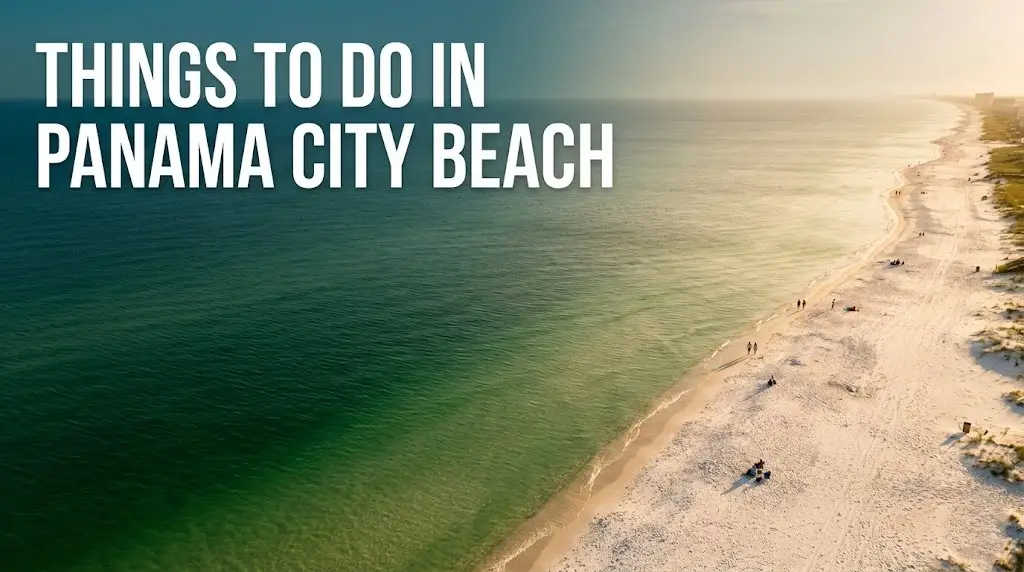
The Gulf water here takes on an emerald green color due to the white sand bottom and water depth, which is a genuinely distinctive feature of this stretch of the Panhandle coast. The beach itself is publicly accessible at numerous points along the strip, though access quality and parking availability vary significantly by location. Resort and condo complexes control private sections of beach, but public access points managed through Bay County and the city do exist throughout the strip.
For travelers visiting PCB for the first time: The destination works best when you treat it as a zone-based trip rather than a single-location stay. Identify your primary activities first, then choose accommodation accordingly. Families prioritizing St. Andrews State Park should stay on the eastern side of the strip. Visitors prioritizing the main entertainment district and Pier Park should center their accommodation in the mid-strip zone around Front Beach Road near Pier Park.
| Traveler Profile | Suitability Rating | What Works | What to Know |
|---|---|---|---|
| Families with kids | Excellent | Beaches, water parks, calm Gulf waters, family dining | Avoid March (spring break crowds); summer is peak family season |
| Couples | Good | Sunset cruises, seafood dining, dolphin tours, state park | The strip is busy; quieter experiences require intention |
| Solo travelers | Moderate | Beach access, dive trips, fishing charters | Car essential; social scene geared toward groups |
| Budget travelers | Good | Free beaches, free parks, low-cost water access | Paid attractions add up quickly; dining can be pricey near the water |
| Seniors and accessibility travelers | Moderate to good | Beach wheelchairs available at some access points, flat terrain | Some beach access points lack accessible pathways; verify before booking |
Best Things to Do in Panama City Beach by Experience Type
The best things to do in Panama City Beach divide into four genuinely strong experience categories: water-based activities, nature and outdoor access, family entertainment, and food-and-nightlife, and the destination earns its reputation most in the first two.
Water activities are the core of the PCB experience. The Gulf’s calm, warm, shallow entry makes it more accessible for casual swimmers than Atlantic-facing beaches, though rip currents are still a serious and underestimated risk (covered in the safety section below). Kayaking through St. Andrews Bay, parasailing above the emerald water, and paddleboarding along the shoreline at sunrise are the kinds of experiences that genuinely deliver on what the destination promises.
For a structured approach to the destination, a 3-day weekend covers the essential range without feeling rushed.
3-Day Panama City Beach Weekend Framework:
- Day 1: Arrive and orient. Spend the morning at your section of the beach with a late-afternoon visit to the Russell-Fields City Pier for fishing or the view. Evening at a waterfront seafood restaurant on Thomas Drive.
- Day 2: Morning ferry to Shell Island or a full-day kayak and snorkel tour through St. Andrews State Park. Afternoon at your leisure on the main beach. Evening at Pier Park for dinner and walking.
- Day 3: Choose your adventure based on traveler profile. Families: Shipwreck Island Waterpark. Couples: dolphin or sunset cruise. Adults/divers: morning wreck dive charter with afternoon beach recovery. Departure afternoon or evening.
For repeat visitors who have done the standard tourist loop: the artificial reef dive system, specifically sites like the M/V Black Bart wreck and the USS Accokeek reef site, represents a level of marine environment quality that most first-time visitors never discover. These sites require booking with a dive operator 24 to 48 hours in advance during peak season.
Panama City Beach Beaches and Shell Island
The best beach experience in Panama City Beach is not on the main strip. It’s on Shell Island, the undeveloped barrier island accessible only by ferry from St. Andrews State Park, where no hotels, no beach umbrellas for rent, and no waterpark soundtrack interrupt the experience.
Shell Island is a 7-mile undeveloped strip of Gulf barrier island sitting directly across the pass from St. Andrews State Park. The ferry operates seasonally from the park (verify 2026 schedule and pricing directly with Florida State Parks before visiting, as seasonal schedules and rates are subject to change). You bring your own gear, your own food, and your own shade. The water on the Gulf side is shallow and clear. The bay side is calmer still. Dolphins appear regularly in the pass channel, often close enough to watch from the shoreline.
For the main beach strip itself, the public access points at the western end near Laguna Beach tend to be quieter than the dense mid-strip commercial zone. The eastern beach sections near St. Andrews Park also see fewer vendors and less congestion during peak summer months.
Insider Tip:
The ferry to Shell Island sells out during peak summer weekends. If you’re visiting in June, July, or August, arrive at St. Andrews State Park by 8:00 to 8:30 AM to queue for the first ferry or purchase tickets online through the Florida State Parks system in advance. The island is genuinely worth the early start.
Solo travelers and couples will find Shell Island most rewarding, as the lack of facilities makes it less practical for families with very young children who need regular restroom access and shade infrastructure.
Beach access points along the main strip:
- Public access points along Front Beach Road, maintained by Bay County (most are free with street parking nearby, though parking availability is limited in peak season)
- M.B. Miller County Pier area for pier access and fishing
- The beach adjacent to Frank Brown Park on the mid-strip
Water Sports in Panama City Beach
Panama City Beach consistently ranks among the Southeast’s most active water sports destinations, and the range of Gulf-based activities available within a short drive of any point on the strip is one of the destination’s genuine strengths.
Parasailing operates from multiple outfitters along the strip, typically lifting passengers 400 to 800 feet above the Gulf on 10 to 15 minute flights. Jet ski rentals are widely available by the hour from beach-side outfitters. Paddleboard and kayak rentals are offered at numerous launch points, with the calmer bay-side water near St. Andrews Bay offering a better experience for beginners than the open Gulf.
Dolphin tour boats depart from the marina area and run approximately 90 minutes to 2 hours. The tours operate during peak season with multiple daily departures. Bottlenose dolphin sightings are frequent enough that most reputable operators offer a sighting guarantee. For families with children: the dolphin boat tours are one of the few water activities that work genuinely well for young kids who can’t yet manage paddleboards or kayaks.
Fishing charters divide into two main categories. Inshore fishing targets species like redfish, speckled trout, and flounder in the bays and estuaries, and these half-day trips are appropriate for families and beginners. Deep-sea charters target amberjack, grouper, mahi-mahi, and king mackerel in the Gulf, running 6 to 12 hours and requiring sea legs that young children and travelers prone to seasickness may not have.
| Water Activity | Approx. Cost Range (2026 guidance) | Best For | Advance Booking |
|---|---|---|---|
| Parasailing | $50 to $90 per person (estimate; verify with outfitter) | Couples, adults, older kids | Recommended in peak season |
| Jet ski rental | $80 to $150 per hour (estimate) | Adults, couples | Walk-up often available off-peak |
| Dolphin tour | $30 to $60 per adult (estimate) | Families, couples | Book 24 to 48 hrs in peak season |
| Inshore fishing charter | $75 to $150 per person (estimate) | Families, beginners | Book in advance |
| Deep-sea fishing charter | $120 to $200+ per person (estimate) | Adults, experienced | Book well in advance |
| Kayak/SUP rental | $20 to $50 per hour (estimate) | All profiles | Walk-up friendly |
All pricing is estimated based on general market ranges. Verify current rates directly with operators before booking.
Key Takeaway: The 27-mile length of the PCB strip is not a feature. It’s a logistical reality. Book your accommodation based on where your primary activities are located, not based on price alone, or you’ll spend a significant portion of your trip driving the same stretch of Front Beach Road in both directions.
St. Andrews State Park Panama City Beach
St. Andrews State Park is the single most underappreciated asset in Panama City Beach, a 1,260-acre Florida State Park on the eastern tip of the peninsula with genuine ecological diversity, miles of undeveloped beach, and the ferry access point for Shell Island, all accessible for a state park entry fee that is significantly lower than any paid attraction in the area.
The park sits at the eastern end of the PCB strip at the Grand Lagoon area and includes Gulf beach, bay beach, two fishing piers, hiking trails through pine flatwoods and coastal scrub, a boat launch, snorkeling opportunities in the jetty area, and the ferry terminal for Shell Island. It represents the best accessible nature experience in the area by a significant margin, and it remains one of the most genuinely local-facing attractions in a destination otherwise heavily commercialized.
The snorkeling at the jetty rocks on the Gulf side of the park can be excellent when visibility is good, with sea fans, juvenile fish, and occasional stingray sightings. The rock jetty creates a habitat break that supports more marine life than the open sand beach. Water visibility varies with wind and current conditions; calm days after a stretch of settled weather offer the best snorkeling.
For senior travelers and travelers with mobility considerations: the park has accessible restroom facilities and paved pathways to some beach areas, but the beach surface itself is loose sand. Beach wheelchairs are available to rent at some Florida State Parks; verify directly with St. Andrews about current availability before visiting. The fishing piers are accessible for anglers who prefer to avoid sand surfaces.
Entry fees are charged per vehicle; verify current rates directly with the Florida State Parks system or through the official park page before visiting, as rates are subject to change. The park sees its highest attendance during peak summer weekends and holiday periods; arriving before 9:00 AM is the most reliable strategy for securing entry without a wait.
Things to Do in Panama City Beach with Kids
Panama City Beach works well for families with children, but the specific activities that actually deliver on their promise for kids are a narrower list than the tourism marketing suggests.
Shipwreck Island Waterpark is the standout family attraction. It’s a traditional water park with age-appropriate slides, a wave pool, a lazy river, and a dedicated area for younger children. The scale is manageable (not overwhelming like a mega-resort park), the Gulf breeze keeps temperatures slightly more bearable than inland Florida parks, and the wait times, while real in peak season, are generally shorter than the major theme park circuit. Operating season is typically mid-May through early September; verify 2026 dates and hours directly before booking.
Gulf World Marine Park offers dolphin shows and animal encounter programs. It’s a smaller marine park format that tends to hold children’s attention well for 2 to 3 hours. Animal encounter programs, including dolphin interaction experiences, require advance booking and carry separate fees beyond general admission; confirm current pricing and availability directly with the venue.
ZooWorld Zoological Conservatory is a privately operated small zoo that has genuine conservation programs and a more intimate animal-viewing experience than larger facilities. It works particularly well for children ages 4 to 10 who are not yet ready for full-day theme park pacing.
For families with children under age 5: the Gulf beach itself, particularly the shallow, calm sections in the mid-strip area, is one of the best free experiences in the destination. The Gulf’s gentle wave action and warm water make it genuinely safe for supervised toddlers in a way that Atlantic-facing beaches often are not. Pack your own shade structure, sunscreen appropriate for young skin, and water shoes for the shell-studded shoreline sections.
Insider Tip:
Gulf World Marine Park’s dolphin interaction experiences book out weeks in advance during June and July. If this is a priority for your family, secure reservations before you finalize your travel dates, not after you arrive.
Cheap Family Things to Do in Panama City Beach
The cheapest and most genuinely satisfying family experience in Panama City Beach costs nothing beyond the state park entry fee: a day at St. Andrews State Park with a cooler, snorkel gear, and a few hours at the beach on both the Gulf and bay sides.
Beyond the state park, Frank Brown Park on the mid-strip is a large public recreational park with a splash pad (free to enter at time of publication; verify current status before visiting), soccer and softball fields, and picnic facilities. It gives young children who have hit their sand-and-surf limit a structured outdoor alternative without admission costs.
Free and low-cost options for families:
- Public beach access points along Front Beach Road (free to enter; parking costs vary by location)
- Russell-Fields City Pier for fishing (a small pier access fee typically applies; verify current rates)
- The waterfront walkways at Pier Park shopping complex for evening strolling, people-watching, and street performance watching (no admission cost; dining and shopping optional)
- Shell Island via the ferry (ferry fee applies; the island itself has no admission charge beyond the park entry fee for St. Andrews)
- Sunset watching at the western beach sections, where the Gulf faces west and sunsets are genuinely worth planning an evening around
For budget travelers who want to keep paid attractions to one or two per trip: prioritize Shipwreck Island Waterpark as your one paid family activity and use St. Andrews State Park and beach days as the balance of your itinerary. The math works out significantly better than trying to do every attraction on the tourist list.
Key Takeaway: St. Andrews State Park plus a cooler and snorkel gear is the highest-value, lowest-cost full day in Panama City Beach for nearly every traveler profile. The paid attractions are worth doing once. The state park is worth returning to every time you visit.
Things to Do in Panama City Beach for Couples
Panama City Beach works for couples best when they build their itinerary around the Gulf itself rather than the commercial strip, using the destination’s genuine natural assets (the water color, the evening light, the marine wildlife) as the romantic backdrop rather than relying on the restaurant row and entertainment complex.
A sunset cruise is the most reliably romantic experience the destination offers. Several operators run 2-hour Gulf cruises timed to the sunset, typically departing from the marina area around the Grand Lagoon. The quality of these experiences varies by operator; look for smaller boats with limited passenger counts rather than large party-style vessels, as the atmosphere on a 12-person pontoon is fundamentally different from a 60-person tour boat. Prices and schedules vary; book directly with the operator and confirm what is included (some include drinks, some do not).
A dolphin and snorkel combo tour, typically 3 to 4 hours, gives couples both wildlife viewing and water time in a single outing. These tours visit the sandbar areas and Shell Island’s shallow waters and are generally less crowded than the main Shell Island ferry in peak season.
For couples seeking a quieter beach experience: the Laguna Beach neighborhood at the western end of the strip operates at a noticeably lower energy level than the main mid-strip zone. The beach access points here are less crowded, the pace is slower, and the absence of the dense commercial strip creates something closer to a genuine beach town feel.
One honest note for couples: PCB is not an inherently intimate destination. It’s a high-volume beach resort town. Couples who want the white sand and emerald water without the noise, the spring break residue of the strip, and the chain restaurant density may find that Seaside or Rosemary Beach on nearby 30A delivers a significantly more curated romantic atmosphere. PCB is best for couples who want activity options and value alongside their beach time, not couples seeking a quiet, adults-only aesthetic.
Things to Do in Panama City Beach at Night
The nightlife in Panama City Beach concentrates along the main entertainment corridor of Front Beach Road and around the Pier Park complex, which operates as an outdoor shopping, dining, and entertainment district with a decent concentration of restaurants and bars accessible without a cover charge.
Schooner’s Last Local Beach Club has a reputation as one of the few genuinely local-feeling waterfront bars in PCB. It sits directly on the beach at the eastern end of the strip and hosts regular live music with a crowd that skews older and more local than the neon-lit bars near the mid-strip commercial zone. This is not a dive bar; it’s a well-established beachfront venue, but it has more personality than the generic resort-adjacent sports bars that dominate the strip.
Pineapple Willy’s is an institution in PCB terms: a large, open-air waterfront bar and restaurant that has been operating for decades. It’s tourist-facing and makes no pretense otherwise, but the waterfront view, the live music on weekends, and the cold drink in a beach setting deliver what they promise. Expect crowds in peak season and significantly shorter waits from September onward.
For adults seeking nightlife beyond the strip: the Panama City side (the separate city across the bay) has a small but more locally populated bar and restaurant scene along Harrison Avenue that PCB tourists rarely discover. The drive across the Hathaway Bridge or the bridge on Front Beach Road takes approximately 15 to 20 minutes and drops you into a different demographic and atmosphere entirely.
For families: the Pier Park complex in the evenings offers a genuinely family-accessible environment, with restaurants, ice cream, and an outdoor atmosphere that works for all ages. The Ripley’s Believe It or Not! attraction at Pier Park is open into the evening and provides a rainy-day or after-dinner option for families.
Seafood and Dining in Panama City Beach
The seafood in Panama City Beach is generally good, occasionally excellent, and frequently overpriced in the tourist-adjacent waterfront restaurants. The best meals in PCB happen at a handful of less-visible spots that the standard tourist trail misses almost entirely.
The Gulf seafood category to focus on here is fresh-caught local product: grouper, amberjack, mahi-mahi, and Gulf shrimp. At waterfront restaurants on the strip, these items frequently appear on menus but are not always sourced locally. The restaurants closest to the working fishing docks at the Grand Lagoon area and the Panama City side of the bay have historically had the most direct access to daily-caught local product.
Thomas Drive, the road that runs along the Grand Lagoon on the eastern side of PCB’s peninsula, has a cluster of local-leaning seafood restaurants and fish houses that are notably less expensive and more authentically Gulf Coast in character than the Front Beach Road tourist strip. This is where the destination’s actual local dining identity lives, and the difference in price-to-quality ratio compared to the strip is significant.
For budget travelers: the grocery stores and fish markets in the area allow you to purchase fresh Gulf shrimp and local catch at significantly lower prices than any sit-down restaurant. If your accommodation has kitchen facilities, a self-prepared Gulf shrimp boil is both cheaper and more authentic than most tourist-strip seafood dinners.
According to VISIT FLORIDA, the Gulf Coast seafood category, particularly Gulf shrimp and locally caught grouper, is one of the defining culinary characteristics of the Panhandle region. The best season for fresh local Gulf shrimp is late summer through fall, when shrimp season is in full operation.
Insider Tip:
The grouper sandwich is the single most instructive order at any PCB restaurant. If it’s priced noticeably below every other fresh fish item on the menu, ask whether it’s fresh local Gulf grouper or frozen imported fish. The gap between fresh Gulf grouper and a frozen substitute is significant. The restaurants that do it right will tell you immediately; the ones that don’t often deflect.
Key Takeaway: Dining on Thomas Drive near the Grand Lagoon rather than on the main Front Beach Road strip consistently delivers better Gulf seafood at lower prices. The view is slightly less dramatic. The food quality and the check are both better.
Best Time to Visit Panama City Beach
The best time to visit Panama City Beach in 2026 is September through mid-November or late April through May, when the weather is warm, the crowds are a fraction of peak levels, and prices drop across accommodation and activities. These are the shoulder seasons most PCB travel content undersells.
September through November: Hurricane season is technically active through November 30, and this is a real consideration for Gulf Coast travel (discussed in the safety section). However, the statistical peak of hurricane activity is August through mid-September, and from late September onward, the weather is frequently excellent: daytime temperatures in the low-to-mid 80s, water temperatures still warm enough for comfortable swimming, and beach crowd levels that make the experience feel closer to a private retreat than a resort destination. Hotel rates drop significantly after Labor Day. Restaurant wait times essentially disappear. This is the best value window in the PCB calendar for couples, solo travelers, and budget-conscious families.
Late April through May: The weather is warm but not yet the oppressive heat of July. Spring break is over. Schools in most states have not yet let out. The beach is accessible and pleasant. Water temperatures are still warming from winter lows, so swimming is possible but the Gulf is not yet at its peak warmth.
Peak season (June through August): This is when families with school-aged children must visit due to school calendar constraints, and PCB accommodates this demand well. Expect full services, every attraction operating, and prices at their annual high. July 4th weekend is the single most crowded moment of the PCB year.
March (spring break): Families with young children should avoid PCB in March, particularly mid-March, when the destination’s spring break demographic is at its peak. The beach itself remains technically accessible, but the crowd character, noise levels, and bar-scene density along the strip change in ways that are genuinely uncomfortable for families with young children.
| Season | Weather | Crowds | Prices | Verdict |
|---|---|---|---|---|
| Late April to May | Warm, 75 to 85°F | Low to moderate | Below peak | Excellent for most profiles |
| June to August | Hot, 85 to 95°F, humid | Peak | Highest | Best for families; demanding for everyone else |
| September to November | Warm to mild, 70 to 85°F | Low | Significantly below peak | Best overall value; hurricane awareness required |
| December to March | Cool to mild, 50 to 70°F | Low except March | Lowest | Off-season; some services reduced; March spring break exception |
Things to Do Near Panama City Beach (Day Trips)
Panama City Beach sits within reasonable day-trip distance of several destinations that offer a dramatically different experience from the resort strip, and adding one of these to a 4-to-5-day PCB itinerary significantly enriches the trip.
Destin, Florida is approximately 45 miles west of PCB along Highway 98 (roughly 50 to 70 minutes depending on traffic, which can be significant on summer weekends). Destin has its own distinct character: a working fishing charter hub with one of the largest fishing fleets in the South, the Destin Harbor Boardwalk for waterfront dining and boat watching, and access to Henderson Beach State Park for a less crowded beach day. The fishing scene in Destin is the main draw; if a deep-sea charter is on your PCB itinerary, consider booking out of Destin for access to a wider range of charter options.
30A and Seaside, Florida are approximately 20 to 30 miles west of PCB, accessible via the scenic coastal highway that runs through a series of planned beach communities including Seaside, Rosemary Beach, and WaterColor. This corridor is architecturally distinct from PCB, deliberately designed to feel like a coastal village, and the contrast with the commercial strip of Panama City Beach is stark. A half-day drive along 30A with lunch in Seaside and a beach access stop at one of the free public access points along the highway is worth the time for any visitor. For couples who discover they prefer the 30A aesthetic, note that accommodation in the area tends to run significantly higher than PCB comparably.
Apalachicola, Florida, approximately 90 miles east of PCB on Highway 98, is a small historic oyster town on the Apalachicola River that operates at a pace and scale entirely different from the resort coast. The oyster bars here are famous in Florida food culture; Apalachicola Bay oysters have a specific regional identity tied to the freshwater-saltwater mixing of the Apalachicola River system. A day trip for lunch, waterfront wandering, and a visit to the historic downtown takes 3 to 4 hours on the ground and about 90 minutes each way in the car.
Free Things to Do in Panama City Beach
The most substantive free experience in Panama City Beach is the beach itself, and it’s genuinely excellent: white quartz sand that stays cool enough to walk on in bare feet even in summer heat, Gulf water that ranges from clear to emerald green, and a Gulf breeze that makes the heat tolerable on most days. Public access points exist at numerous points along the strip.
Free and low-cost activities in PCB:
- Public beach access at Bay County-maintained beach access points along Front Beach Road (parking fees may apply; street parking on side roads is often free but limited)
- Watching the shrimp boats and charter boats from the Grand Lagoon marina area, no admission required
- The evening Pier Park walkthrough for atmosphere, people-watching, and free entertainment from street performers
- Sunset viewing from the western beach sections on clear evenings
- The Veterans Memorial Park on Front Beach Road, a waterfront memorial park with Gulf views and public access
- Hiking the nature trails within St. Andrews State Park (state park entry fee applies per vehicle, but the trail network is included in that fee)
- Birdwatching along the bay side of the peninsula, particularly near the Grand Lagoon area where shorebirds and wading birds concentrate
For budget travelers who want a full day of free activity: arrive at a public beach access point early, spend the morning in the water and on the sand, walk to a nearby lunch option (the strip has fast-casual options that are significantly cheaper than sit-down waterfront restaurants), and close the evening at Pier Park without spending anything beyond dinner.
Key Takeaway: The free PCB experience, beach access plus the state park trail network plus the marina area, is genuinely good and underutilized by visitors who get drawn into the paid attraction loop. Build your itinerary around the free core first, then add paid activities selectively.
Things to Do in Panama City Beach for Adults
Panama City Beach for adults without children operates best when it leans into the Gulf’s water sports capacity, the fishing charter culture, and the evening dining and music scene rather than trying to extract value from the family-oriented tourist attraction circuit.
The scuba diving scene at PCB’s artificial reef system is the single best adult-specific activity the destination offers that rarely appears in mainstream travel content. According to the Florida Fish and Wildlife Conservation Commission, Northwest Florida’s Gulf waters host one of the most extensive artificial reef programs in the state, including intentionally sunk vessels that now support dense marine ecosystems. The M/V Black Bart and the USNS General Hoyt S. Vandenberg (the latter accessible from the Key West area as a regional reference point for scale) represent the kind of wreck diving that serious divers travel internationally to experience. The PCB wreck sites are accessible to certified open-water divers on half-day charter trips and require no advanced certification for the shallower reef sites.
For adults who golf, Signal Hill Golf Course is a public course on the mid-strip that offers a Gulf-view experience without the premium pricing of resort courses. It’s not a destination golf course in the Augusta National sense, but it’s a well-maintained public track with an accessible price point relative to Florida’s resort golf market.
For the adults-only evening experience: the combination of a sunset cruise followed by dinner on Thomas Drive and a late drink at Schooner’s gives you the genuinely PCB version of an adult evening that doesn’t feel assembled from a tourist checklist. The sunset cruise provides the visual payoff. Thomas Drive provides the seafood quality. Schooner’s provides the local atmosphere.
Panama City Beach Neighborhoods and Where to Stay
Panama City Beach has four functionally distinct zones along its 27-mile strip, and choosing the wrong zone for your travel style is the most common planning mistake visitors make.
Western PCB (Laguna Beach area): The western end of the strip, roughly from the Bay/Walton county line to the areas around Laguna Beach Drive, is quieter and more residential in character. Fewer commercial attractions, less traffic density on the beach roads, and a slightly more relaxed pace. Best suited for couples, repeat visitors who want a quieter base, and budget travelers who can find lower accommodation prices here. The tradeoff is that reaching St. Andrews State Park on the eastern end requires a 20 to 30 minute drive.
Mid-Strip (Pier Park area): The area around Pier Park, roughly centered on Front Beach Road near Back Beach Road’s intersection zone, is the commercial and entertainment core. Highest concentration of restaurants, bars, family attractions, and water sports outfitters. The most convenient base for first-time visitors who want to minimize driving. The most expensive and most crowded zone in peak season.
Eastern PCB (Thomas Drive and Grand Lagoon area): The eastern section near Thomas Drive and the Grand Lagoon marina has the working waterfront character: fishing charter docks, the Grand Lagoon boat ramp, the Thomas Drive seafood restaurants, and the closest access point to St. Andrews State Park. Best for fishing enthusiasts, divers, and visitors who want easier state park access. Generally slightly lower accommodation prices than the mid-strip zone.
St. Andrews State Park vicinity: Staying near the park’s entrance gives the most direct nature access in the entire PCB footprint. Limited accommodation options immediately adjacent to the park, but the nearby residential areas have vacation rental inventory.
| Zone | Character | Best For | Peak Season Price Level | Drive to St. Andrews |
|---|---|---|---|---|
| Western / Laguna Beach | Quiet, residential | Couples, repeat visitors | Moderate to low | 25 to 35 minutes |
| Mid-Strip / Pier Park | Commercial, lively | First-timers, families | Highest | 15 to 20 minutes |
| Eastern / Thomas Drive | Working waterfront | Fishers, divers, seafood lovers | Moderate | 5 to 10 minutes |
Getting Around Panama City Beach
Getting around Panama City Beach without a car is genuinely difficult, and travelers who try to visit without one will find their activity options significantly restricted.
The destination’s 27-mile length, spread across a primarily linear coastal strip, means that the walkability model that works in compact urban beach towns is not applicable here. Even mid-strip accommodations are rarely within walking distance of more than a few restaurants and one or two attractions. Front Beach Road traffic in peak summer season can be congested enough that driving from one end of the strip to the other during midday takes significantly longer than the theoretical 30-minute drive time.
The Emerald Coast Express trolley service has historically operated along portions of the Front Beach Road corridor during peak season. Verify whether this or any comparable service is operating in summer 2026 through Visit Panama City Beach before your trip, as transit services in PCB are subject to changes in funding and route coverage. Even if operating, the trolley covers a portion of the strip rather than the full length, and service frequency in off-peak hours can be limited.
Practical getting-around guidance:
- Rent a car if visiting without one. This is not optional for a comfortable PCB trip.
- Plan your accommodation based on your primary activities to minimize daily driving distance.
- Beach cruiser bicycles are available to rent from several shops on the strip and work well for short-range movement along the beach road, particularly in the quieter western sections. They are not practical for the full strip length or for reaching St. Andrews from the western zones.
- Traffic on Front Beach Road peaks between 10:00 AM and 1:00 PM and again in the early evening. Beach outings are best started before 9:00 AM to avoid the parking and traffic scramble.
- Northwest Florida Beaches International Airport (ECP) is approximately 15 to 20 minutes from the main strip and is served by multiple major carriers. Renting a car from the airport is the most practical arrival option for most visitors.
Safety and Practical Warnings for Panama City Beach
Rip currents are the primary safety risk at Panama City Beach and are directly responsible for water-related fatalities in the Gulf along this coastline each year, including among experienced swimmers.
Key safety and practical facts every visitor should know:
- The beach flag warning system operates at PCB and is managed by lifeguards at staffed beach areas. A green flag means calm conditions. A yellow flag means moderate surf and currents: swim with caution. An orange flag (double in some systems) means high hazard. A red flag means high surf or strong currents: stay out of the water. A double red flag means the beach is closed to swimming: do not enter the water. This is not a suggestion. Double red flag conditions are enforced and carry fines in Bay County.
- If caught in a rip current, do not swim directly against it toward shore. Swim parallel to the beach until you are out of the current, then swim diagonally back to shore. Rip currents are exhausting, not usually deadly in themselves; drowning typically occurs when swimmers panic and exhaust themselves fighting directly against the current.
- Hurricane season runs June 1 through November 30. If booking travel between August and October, purchase travel insurance that covers trip interruption due to named hurricanes. Monitor the National Hurricane Center (part of NOAA) for tropical weather systems if traveling during this window.
- Sun and heat exposure from June through August are serious risks. UV index levels on the Gulf Coast frequently reach 10 to 11 (extreme) during summer midday hours. Apply high-SPF, broad-spectrum sunscreen every 90 minutes when on the beach. Children and fair-skinned individuals are at particularly elevated risk of severe sunburn within 30 to 45 minutes without protection.
- Sea turtle nesting season runs approximately May through October. During nesting season, sea turtle nests are staked and marked on the beach. Do not disturb these nests or approach nesting or hatchling activity. Beach lighting ordinances restrict certain types of artificial beach lighting during nesting season to protect disorientation-sensitive hatchlings.
- Wildlife in the water: Jellyfish are seasonally present in PCB’s Gulf waters. Check local advisories through Visit Panama City Beach or the Beach Condition Reporting System before entering the water if jellyfish have been reported.
- For water emergencies, the US Coast Guard Sector Mobile monitors VHF Channel 16. On-beach emergencies: call 911. Bay County emergency services are the primary first responder.
Frequently Asked Questions About Things To Do in Panama City Beach
What is the best time to visit Panama City Beach?
The best time to visit Panama City Beach is late April through May or September through mid-November, when temperatures are warm, crowds are thin, and accommodation prices drop significantly compared to peak summer rates.
Summer (June through August) is peak season for families with school-aged children and offers full services across every attraction, but it also brings the year’s highest prices, heaviest crowds, and most intense heat.
March visitors should be aware that spring break, particularly mid-March, brings a crowd character and atmosphere that differs significantly from the family-focused destination PCB markets itself as the rest of the year.
Is Panama City Beach good for families with young kids?
Panama City Beach is well-suited for families with children, particularly for beach-oriented trips, with the Gulf’s warm, calm, shallow entry making it more accessible for young swimmers than most Atlantic-facing beaches.
Shipwreck Island Waterpark, St. Andrews State Park, Gulf World Marine Park, and the public beach access points give families a full week of age-appropriate activity options at varying price points.
Families should avoid booking in March due to spring break crowd dynamics, and should arrive at popular access points and attractions early in the day during June through August to manage wait times.
How many days do you need in Panama City Beach?
Three to four days covers the core Panama City Beach experience comfortably for most traveler profiles, including a full day at St. Andrews State Park and Shell Island, a day of water sports or a fishing charter, and a day on the main beach strip with evening dining.
Families wanting to include Shipwreck Island Waterpark and Gulf World Marine Park in addition to beach days and the state park may find five days a more comfortable pace.
Visitors planning to add a 30A day trip or a drive to Destin should add at least one additional day to avoid a rushed itinerary.
What is Shell Island and how do you get there?
Shell Island is a 7-mile undeveloped barrier island accessible only by ferry from St. Andrews State Park, offering Gulf beach and bay-side water access with no commercial development, making it the most consistently uncrowded natural beach experience near Panama City Beach.
The ferry operates seasonally from the park’s boat basin; verify the 2026 schedule and ticket availability directly through Florida State Parks before your visit, as schedules and pricing are subject to change.
Peak summer weekend ferries sell out; arriving at the park early and purchasing tickets in advance (where the park system allows online reservation) is the most reliable strategy.
Is Panama City Beach worth visiting in September or October?
September and October offer some of the best overall value in the Panama City Beach travel calendar, with warm Gulf water temperatures, significantly reduced crowds, lower accommodation prices, and full-length beach days without peak summer heat.
The primary consideration is hurricane season, which runs through November 30; travelers booking September or October travel should purchase trip interruption insurance and monitor NOAA’s National Hurricane Center for tropical weather systems.
The local seafood scene is at its best in this period, particularly for Gulf shrimp during active shrimp season.
What should I know about the beach flag warning system in Panama City Beach?
The beach flag system at Panama City Beach uses color-coded flags to communicate current water safety conditions: green for calm, yellow for moderate caution, red for dangerous conditions (stay out of the water), and double red for beach closure (swimming prohibited and enforced by law).
Rip currents are the primary hazard the flag system communicates; if caught in a rip current, swim parallel to shore rather than directly against the current until free of it, then angle back to the beach.
Check the flag status at the access point you’re using before entering the water, as conditions can change throughout the day and vary along the beach length.
Panama City Beach rewards visitors who plan specifically rather than generally. The destination’s 27 miles of coastline, its state park, its reef dive sites, its working waterfront, and its family attraction network are each worth a different type of traveler’s time. The mistake is treating all of it as interchangeable.
Book your accommodation in the zone that minimizes driving to your priority activities. Get to St. Andrews State Park early if the ferry to Shell Island is on your itinerary. Eat on Thomas Drive at least once. And if you’re visiting between September and November, know that you’ve chosen one of the best-kept timing secrets on the Gulf Coast.
Prices, operating hours, ferry schedules, attraction seasons, and event dates change from year to year. Verify key logistics directly with venues, through Visit Panama City Beach’s official platform, and through Florida State Parks before your departure. Your trip planning is only as good as the information you confirm before you leave.