Best Things To Do in Antigua Guatemala, 2026 Edition

The best things to do in Antigua Guatemala span active volcano overnight hikes, Spanish colonial ruins, coffee farm tours, and one of Central America’s strongest food scenes.
Antigua earned its UNESCO World Heritage designation in 1979. According to INGUAT (Instituto Guatemalteco de Turismo), it remains Guatemala’s most visited destination, drawing travelers from across North America, Europe, and Australia.
This guide covers every major experience by traveler type, honest seasonal timing, practical logistics, and the specific local alternatives that most tourism content ignores.
Things To Do in Antigua Guatemala: The Essential Overview
Antigua Guatemala offers more per square block than almost any small city in the Americas for first-time visitors.
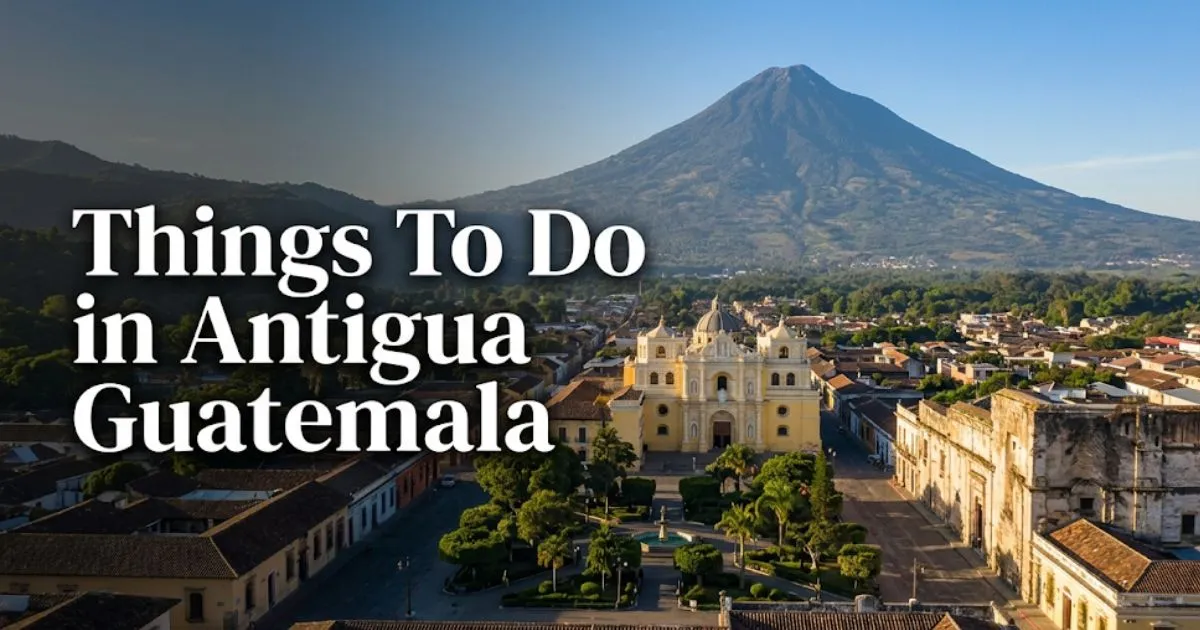
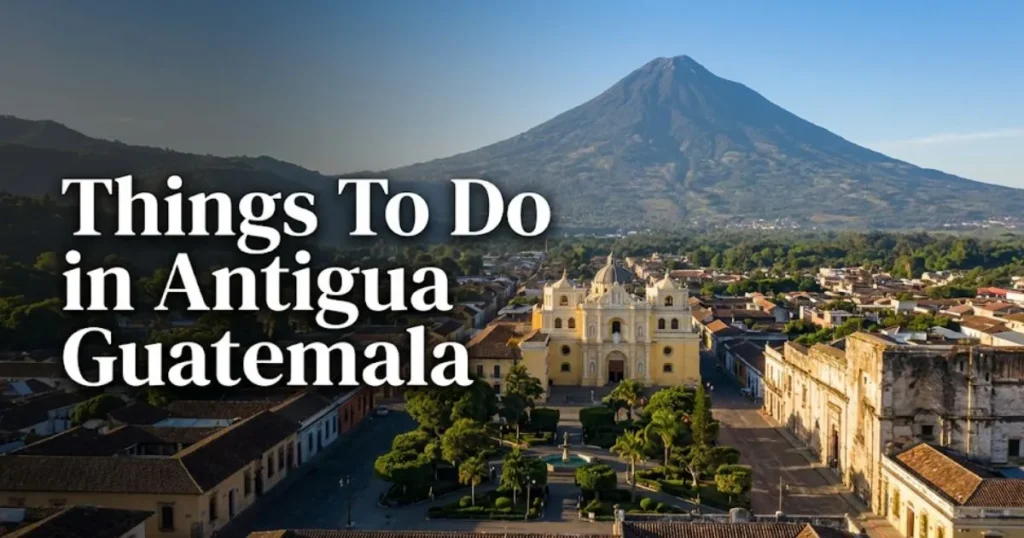
The city sits at approximately 1,530 meters (5,029 feet) elevation in a highland valley. Three volcanoes ring the skyline: Volcán Acatenango, Volcán Agua, and the perpetually active Volcán de Fuego.
The colonial center covers roughly a 10-by-10 block grid. Most key attractions are walkable from Parque Central.
Budget two to three days minimum. Four to five days lets you do a volcano overnight and a Lake Atitlán day trip without rushing.
Suggested 2-Day Framework:
Day 1: Colonial City Focus
- Morning walk to Cerro de la Cruz for the volcano skyline view (7 to 9 AM, before crowds)
- Parque Central and Cathedral of Santiago ruins (9 to 11 AM)
- La Merced Church and Convento de las Capuchinas (late morning)
- Lunch at the Mercado de Artesanías food stalls (noon)
- Finca Filadelfia coffee tour (early afternoon, book in advance)
- Dinner at a Calle del Arco restaurant (evening)
Day 2: Volcano and Adventure Focus
- Acatenango overnight departure (typically 6 to 8 AM trailhead arrival)
- Summit camp for Volcán de Fuego eruption views at sunset and dawn
- Return to Antigua by early afternoon following day
Profile note for families: Replace Day 2 volcano hike with the Volcán Pacaya day tour. It is far less demanding, takes 3 to 4 hours, and children 8 and older typically manage it comfortably.
Best Things To Do in Antigua Guatemala: Ranked by Experience Type
The best things to do in Antigua Guatemala fall into four distinct categories: volcanic adventure, colonial culture, immersive food and craft experiences, and day trips.
The table below gives a full comparison by activity, traveler profile suitability, cost range, and physical demand to help you prioritize.
| Activity | Best For | Approx. Cost (USD) | Physical Demand | Time Required |
|---|---|---|---|---|
| Acatenango Overnight Hike | Adventure travelers, fit solo/couples | $60 to $120 per person | Very High | 2 days/1 night |
| Volcán Pacaya Day Hike | Families, casual hikers | $20 to $40 per person | Moderate | 4 to 5 hours |
| Cerro de la Cruz | All profiles | Free | Low | 1 to 2 hours |
| Colonial Ruins Circuit | Culture travelers, couples, families | $2 to $8 per site | Low | Half day |
| Finca Filadelfia Coffee Tour | All profiles | $20 to $40 per person | Low to Moderate | 2 to 3 hours |
| ChocoMuseo Chocolate Tour | Families, couples | $15 to $30 per person | Very Low | 1.5 to 2 hours |
| Jade Maya Museum | Culture travelers, seniors | $3 to $6 per person | Very Low | 1 to 2 hours |
| Cooking Class | Couples, solo travelers | $40 to $80 per person | Very Low | 3 to 4 hours |
| Chichicastenango Day Trip | Culture travelers, all profiles | $20 to $45 per person | Low | Full day |
| Lake Atitlán Day Trip | All profiles | $30 to $60 per person | Low | Full day |
Budget note: Free experiences in Antigua include Parque Central, the Santa Catalina Arch view, Cerro de la Cruz (walk only), and most church exteriors.
Antigua Guatemala Colonial Architecture and Ruins
Antigua’s colonial ruins are not reconstructed tourist set pieces. They are genuine 16th and 17th-century Spanish baroque structures, many left in authentic earthquake-damaged states after the 1773 disaster.
The Cathedral of Santiago de los Caballeros on the east side of Parque Central charges a small admission. Its roofless nave and intact carved facade represent some of the finest baroque stonework in Central America.
La Merced Church on 6a Calle Oriente is arguably the most photogenic facade in the city. Its yellow-and-white stucco ornamentation is intact and floods with golden light in the early morning.
The Convento de las Capuchinas on 2a Avenida Norte is the most architecturally interesting ruin. Its circular tower structure (the “Nun’s Tower”) is unlike anything else in the city, and its garden courtyard is far less visited than the cathedral.
Casa Santo Domingo deserves specific attention. It is simultaneously a luxury boutique hotel and a legitimate museum complex built within 17th-century convent ruins. Non-guests can visit the museum sections, which include colonial art, jade artifacts, and a pharmacy collection.
Local alternative: Most visitors photograph La Merced. Experienced visitors go instead to the Ruinas del Convento de La Recolección, the largest ruin complex in Antigua, which sees far fewer tourists and has more atmospheric overgrown sections than the more manicured sites.
Senior and accessibility note: Most ruins involve uneven rubble and stone surfaces. The cathedral interior and Casa Santo Domingo museum are the most accessible. The Convento de las Capuchinas involves significant stair climbing.
Admission fees for colonial sites run approximately $2 to $8 USD per person. Verify current hours directly with INGUAT or each site, as they vary seasonally and during Guatemalan national holidays.
Insider Tip:
- Visit the Cathedral of Santiago immediately after it opens to avoid tour groups
- La Merced’s facade photographs best in the 30 minutes after sunrise, facing east
- The Convento de las Capuchinas is consistently quieter on weekday mornings than weekends
Key Takeaway: The Convento de las Capuchinas is Antigua’s most architecturally distinctive ruin and its least crowded. Start there before the cathedral circuit.
Parque Central Antigua Guatemala
Parque Central is the social and geographic heart of Antigua, and it functions as the city’s most useful orientation landmark.
The park is framed on four sides by the Cathedral of Santiago, the Palace of the Captains General, the Ayuntamiento (city hall), and the Portal del Comercio. The central fountain, the Fuente de las Sirenas, dates to 1739.
This is not a park to rush through. Locals use it as a genuine community gathering space. Weekend mornings bring vendors, marimba musicians, and school groups.
Practical logistics: The park sits at the intersection of 5a Avenida Norte and 4a Calle Oriente. It is open to the public continuously. The cathedral and Palace of the Captains General charge separate small admissions.
Couples note: The park is genuinely romantic at dusk when the cathedral facade lights up and the surrounding coffee shops and restaurants fill. The Portal del Comercio on the south side has covered outdoor seating facing the park.
Solo traveler note: The park is a natural meeting point for other travelers. Most hostel-organized walking tours depart from here.
Overrated reality: The park becomes genuinely crowded and less pleasant between 10 AM and 2 PM on weekends and during Semana Santa. The best version of Parque Central is 7 to 9 AM on a weekday, when locals outnumber tourists significantly.
Local alternative: For a less photographed but equally atmospheric square, walk three blocks north to Parque la Unión near the Escuela de Cristo Church. Almost no tourists visit it. Locals gather there on weekday evenings.
Volcano Hike From Antigua Guatemala
The Volcán Acatenango overnight hike is the single most physically demanding and most rewarding experience available from Antigua Guatemala.
The summit sits at 3,976 meters (13,041 feet). The hike gains roughly 1,600 meters of elevation from the trailhead. Most guided tours depart the trailhead between 7 and 9 AM, camp at high camp for sunset views of Volcán de Fuego‘s eruptions, and return the following morning.
Booking reality: During peak dry season (December through March), reputable guiding companies book out 4 to 8 weeks in advance. Do not assume walk-up availability. Book through licensed operators registered with INGUAT.
Physical demand warning: This is a serious high-altitude wilderness hike. Altitude sickness is a genuine risk above 3,000 meters. Trails become dangerously muddy and slippery during rainy season (June to October). Only physically fit travelers with appropriate footwear and cold-weather layers should attempt it.
What to pack:
- Waterproof hiking boots (not trail runners)
- Sleeping bag rated to 0°C / 32°F minimum
- Headlamp with extra batteries
- Warm mid-layer and windproof outer shell
- At least 3 liters of water capacity
- High-calorie snacks for the ascent
Volcán Pacaya is the family and casual hiker alternative. It is an active volcano accessible as a day trip. Children 8 and older manage it with minimal difficulty. The lava flow fields are genuinely impressive. Cost runs approximately $20 to $40 USD per person including guide transport.
Senior and accessibility note: Neither volcano is accessible for travelers with significant mobility limitations. Pacaya involves moderate uneven terrain. Acatenango is not appropriate for anyone with respiratory or cardiac conditions.
According to INGUAT, all volcano hikes must be conducted with a registered licensed guide. Solo hiking on Acatenango without a guide is not permitted and has resulted in serious incidents.
Insider Tip:
- Book Acatenango at least 6 weeks ahead if visiting December through February
- Bring significantly more warm clothing than you think you need; high camp temperatures drop below freezing
- Fuego’s eruption frequency is unpredictable; some nights are more active than others
Coffee Farm Tours Antigua Guatemala
Antigua’s highland microclimate produces some of the world’s most respected Arabica coffee, and the region’s coffee farms offer some of Central America’s most genuinely educational agricultural tours.
Finca Filadelfia is the most accessible and well-organized coffee tour operation near the city. Tours cover the full production cycle from cherry to cup. The finca sits roughly 10 minutes by tuk-tuk from the city center.
Finca Azotea combines coffee and macadamia production tours with a Guatemalan musical instrument museum on-site. It is a 15 to 20 minute drive northwest of Antigua and requires a vehicle or organized tour transport.
Practical logistics: Most coffee tours run approximately 2 to 3 hours. Prices range from approximately $20 to $40 USD per person depending on the operator and whether transport is included. Book at least 24 to 48 hours in advance. Tours typically run in the mornings.
Couples note: Finca Filadelfia’s estate grounds are genuinely beautiful. Several couples pair the tour with the finca’s on-site restaurant for lunch in the coffee fields. It is one of the more romantically atmospheric dining settings near the city.
Budget traveler note: Several smaller fincas offer free or very low-cost farm walks if you purchase directly at their farm shop. This is not a structured tour but provides similar agricultural context without the organized tour price.
Local alternative: Most visitors book the standard Finca Filadelfia tour. Experienced visitors book La Hermosa Coffee Tour, a smaller family-run finca north of the city that keeps group sizes under 10 people and includes a traditional Guatemalan breakfast as part of the experience.
The Antigua Guatemala highlands are among the five most recognized coffee-producing regions in the world by specialty coffee industry standards. The region’s combination of volcanic soil, altitude, and rainfall creates a cup profile distinct from other Guatemalan growing regions.
Key Takeaway: Book Acatenango at least six weeks out during dry season, and pack a sleeping bag rated for freezing temperatures regardless of what the forecast says at lower elevation.
Chocolate and Jade Experiences Antigua Guatemala
Guatemala has both a genuine pre-Columbian jade tradition and a Central American cacao heritage, making Antigua’s chocolate and jade experiences more culturally substantive than they appear on a surface itinerary.
ChocoMuseo on 4a Calle Oriente offers chocolate-making workshops in addition to their museum format. The hands-on truffle and chocolate bar making classes run approximately 1.5 to 2 hours. This is genuinely child-friendly and works as a rainy-afternoon option.
Choco Story Antigua is a newer competitor to ChocoMuseo and takes a more museum-focused approach before moving into workshop sessions. Both operations source cacao from Guatemalan highland and lowland producers.
Jade Maya Museum (Museo del Jade Maya) on 4a Calle Oriente is the most authoritative jade experience in the city. Guatemala holds one of the only nephrite jade deposits in the pre-Columbian Americas, and the museum’s collection of Maya jade artifacts alongside the working jade artisans is legitimately educational rather than purely commercial.
Pricing context: Chocolate workshops run approximately $15 to $30 USD per person. The Jade Maya Museum charges a small admission, typically in the $3 to $6 USD range. Verify current pricing directly before visiting.
Family note: ChocoMuseo’s chocolate workshops are among the most reliably child-engaging activities in Antigua. Children 6 and older participate meaningfully. Bring a change of shirt.
Couples note: The ChocoMuseo evening workshops sell out quickly and have a more social, wine-bar atmosphere than the daytime sessions. Book the evening workshop at least two days ahead.
Local alternative: Instead of the museum chocolate shops, visit Kakaw Chocolate on 6a Avenida Sur, a smaller producer-retailer that sells single-origin Guatemalan chocolate bars with detailed sourcing information. Less touristy, better product.
Antigua Guatemala Cooking Classes and Food Scene
Antigua has one of Central America’s strongest local food scenes, and its cooking class offerings are genuinely among the best available in the region.
La Tortilla Cooking School near Calle del Arco is consistently the most recommended cooking class operation by repeat visitors. Sessions cover traditional Guatemalan dishes including pepián (a pumpkin seed and tomato stew), kaq’ik (traditional turkey broth), and chuchitos (Guatemalan corn dumplings). Classes run 3 to 4 hours and include a full meal at completion.
Ni’tim Cooking School offers a more market-focused format. Students shop at the Mercado Central first, then prepare dishes using ingredients sourced that morning. This format is more labor-intensive but significantly more memorable.
Street food context: The stalls inside the Mercado de Artesanías and the surrounding street vendors on 4a Calle serve tostadas de frijol, rellenitos de plátano, and fresh fruit with lime and chile for less than $2 USD. This is where locals eat lunch, not the tourist restaurants on 5a Avenida Norte.
Restaurant recommendation: Sabe Rico on 6a Avenida Sur focuses on traditional Guatemalan recipes using local highland ingredients. It is not a tourist restaurant in presentation or menu and requires a reservation on weekends.
Budget traveler note: The Mercado Central food stalls represent Antigua’s best value food experience. A full lunch runs approximately $2 to $4 USD. The market itself is safe during daylight hours but watch personal belongings in the interior sections.
Couples note: Cooking classes function as genuine shared experiences. The La Tortilla evening sessions specifically cater to couples and small groups.
Overrated food experience: The mid-range tourist restaurants lining Parque Central’s Portal del Comercio are convenient and photogenic but serve generic international menus at prices that do not reflect their food quality. Walk one block in any direction for significantly better options.
Insider Tip:
- Tipico breakfast (eggs, black beans, plantains, tortillas) at any local comedor runs $2 to $4 USD and is universally better than the hotel breakfasts at mid-range properties
- Sabe Rico requires weekend reservations; walk-in at lunch on weekdays
- The market food stalls are most active and freshest between 11 AM and 1 PM
Key Takeaway: The Mercado Central food stalls are where locals eat lunch. Tostadas de frijol and rellenitos de plátano for under $2 USD are the honest highlight of Antigua’s street food scene.
Cerro de la Cruz Antigua Guatemala
Cerro de la Cruz is a hilltop viewpoint north of the city center that provides the definitive panoramic view of Antigua with all three volcanoes visible in the background.
The walk from the city center takes approximately 20 to 30 minutes on a paved trail. Tuk-tuks make the trip in 5 to 10 minutes for a nominal fare. The viewpoint features a large stone cross and open terrace with direct sightlines south toward Volcán Agua, east toward the Agua summit, and west toward Acatenango and Fuego.
Best timing: Arrive between 6:30 and 8:30 AM for clear volcano views before clouds build. Fuego emits visible eruption plumes in clear morning conditions. Afternoon clouds frequently obscure the volcano summits by noon.
Safety note: The path between the city and Cerro de la Cruz has had occasional security incidents in the past. PROATUR (Antigua Tourist Police) now organizes free morning escort walks from Parque Central. Check the current escort schedule with your hotel or the PROATUR office on Parque Central before going.
Traveler profile notes:
- Solo travelers: Use the PROATUR escort service for morning walks. Do not go alone before 7 AM.
- Families: The walk is manageable for children 5 and older. The viewpoint has a small enclosed area that is safe for young children.
- Seniors: The paved path is moderate but includes a steep final section. Tuk-tuk to the top and walk down is a practical option.
Local alternative: Most visitors stop at Cerro de la Cruz. Experienced visitors also walk to the lookout above the Cemetery of Antigua (Cementerio General) on the west side of the city. The cemetery itself is visually striking with painted tombs, and the hill above it gives a different angle on the city grid.
Semana Santa Antigua Guatemala
Semana Santa (Holy Week, the week leading to Easter Sunday) in Antigua is one of the largest and most visually spectacular Easter celebrations in the Americas.
The defining elements are the alfombras: elaborate carpets of colored sawdust, flowers, and pine needles laid on cobblestone streets the night before processions pass over them. Processions feature massive hand-carried floats (andas) carried by hundreds of costumed participants, accompanied by somber brass bands.
Crowd and logistics reality: This is not a quiet festival to observe from the sidelines. Streets close for days. The city center becomes genuinely difficult to move through during active processions. Accommodation books out 6 to 12 months in advance. Prices for hotels triple or more compared to non-festival periods.
To experience Semana Santa correctly:
- Book accommodation at least 9 months in advance for Antigua itself
- Secure a hotel within 3 blocks of the procession route (your hotel staff will advise)
- Research the specific procession schedule, which INGUAT publishes in January for the current year
- Position yourself before 6 AM for the Friday morning processions (the most dramatic)
- Stay on the sidewalk edges; do not step onto alfombras before processions pass
- Carry cash only; ATMs run out during the festival week
Couples note: Semana Santa is romantically and culturally overwhelming in the best sense. Evening candlelit processions are among the most visually atmospheric events in Central America.
Family note: Young children can find the long procession waits (2 to 4 hours) very difficult. Plan procession viewing around nap times. The Palm Sunday procession is generally considered more manageable for families than the longer Friday events.
Budget traveler note: Budget accommodation in Antigua during Semana Santa is essentially unavailable. Consider basing yourself in Guatemala City and taking a shuttle in for specific days, which costs significantly less than Antigua accommodation during peak festival week.
Key Takeaway: Semana Santa accommodation in Antigua requires booking 9 to 12 months ahead. Budget travelers should base themselves in Guatemala City and shuttle in for specific procession days.
Antigua Guatemala Bars and Nightlife
Antigua’s nightlife is concentrated on and around Calle del Arco (La Antigua’s bar street), specifically the one-block stretch of 5a Avenida Norte between 3a Calle and 4a Calle.
Café No Sé is the most famous and most genuinely good bar on this stretch. It operates as a mezcal bar with live music most nights and an adjacent underground bar, La Clandestina, which serves Ilegal Mezcal (the mezcal brand originated here). The atmosphere is genuine, not performed. It attracts a mixed local, expat, and international traveler crowd.
Reilly’s Bar functions as the social hub of the backpacker and hostel crowd. It gets loud, gets busy late, and is the easiest place in the city to meet other solo travelers. It is not a local bar. It is a traveler bar that does that job well.
Local context: Guatemalans in Antigua socialize primarily at La Antigua Cervecería on Calzada de Santa Lucía and at local cantinas that require knowing someone to find. The backpacker bar circuit and the local social scene do not overlap significantly.
Practical logistics: Most bars on Calle del Arco open around 5 PM and stay active until midnight to 2 AM on weekends. The strip is a 5 to 10 minute walk from Parque Central. Tuk-tuks are the recommended transport for the return trip, especially after midnight.
Safety note: Walk in groups after 11 PM. Do not walk north of 4a Avenida Norte alone after dark.
Solo traveler note: Café No Sé’s bar setup makes solo dining and drinking comfortable. The international crowd is genuinely social. Many solo travelers report meeting long-term travel companions here.
Couples note: For a romantic evening rather than a bar night, Mesón Panza Verde on 5a Avenida Sur has a sophisticated wine bar and jazz performance schedule in a colonial courtyard setting.
Day Trips From Antigua Guatemala
The three most valuable day trips from Antigua are Lake Atitlán, the Chichicastenango Market, and Volcán Pacaya.
Lake Atitlán sits approximately 2 to 3 hours from Antigua by shuttle. The lake is ringed by indigenous Maya communities, three volcanoes, and coffee-growing slopes. San Pedro La Laguna and Santiago Atitlán are the most accessible towns for a day visit. Budget shuttle services run from Antigua’s established shuttle hubs for approximately $15 to $25 USD one way. Most travelers return the same day, though the lake genuinely warrants an overnight stay.
Chichicastenango Market operates Thursday and Sunday only. The market is one of the largest and most authentic indigenous markets in Central America. Textiles, ceramics, jade, copal incense, and agricultural products fill a labyrinthine hilltop market space. The shuttle ride takes approximately 2 to 3 hours. Book the shuttle the evening before through your hotel or a shuttle office on Alameda de Santa Lucía.
Volcán Pacaya is the most accessible active volcano day trip. The hike from the park entrance takes 2 to 3 hours round-trip to the lava fields. Tours include transport from Antigua and a mandatory park guide. Cost runs approximately $20 to $40 USD per person.
Practical logistics for day trips:
- All three options have shuttle services departing from Antigua’s main shuttle operators on Calzada de Santa Lucía
- Book the night before minimum; same-day availability is inconsistent
- Chichicastenango requires an early departure (6 to 7 AM) to reach the market at peak activity
- Lake Atitlán day trips are long. Leave Antigua by 7 AM and return by 6 PM at the latest
Family note: Volcán Pacaya and Chichicastenango both work well for families. Lake Atitlán is best appreciated as an overnight rather than a rushed day trip with young children.
Local alternative: Most travelers take guided minibus tours to Chichicastenango. Experienced repeat visitors take the chicken bus (public bus) from Antigua’s Mercado Central terminal, which costs a fraction of the shuttle price and provides a genuinely local transit experience. Requires comfort with independent navigation.
Key Takeaway: Chichicastenango Market only operates on Thursdays and Sundays. Plan your Antigua dates around this before booking anything else.
Things To Do in Antigua Guatemala for Couples
Antigua Guatemala is one of Central America’s most genuinely romantic city destinations, combining colonial atmosphere, highland climate, and a strong culinary scene.
The Santa Catalina Arch photographic experience is the classic couples moment. The arch frames Volcán Agua perfectly. The best light for photography is early morning before 8 AM, before the street fills with tourists and tuk-tuks.
Cooking classes are Antigua’s strongest couples activity. La Tortilla Cooking School’s evening sessions specifically attract couples. Learning to make pepián together in a colonial kitchen is a more authentic shared experience than most hotel activities in comparable destinations.
Mesón Panza Verde on 5a Avenida Sur is the most complete romantic evening option. The colonial courtyard setting, wine list, and live jazz schedule make it the most intimate upscale dining experience in the city. Reserve at least 48 hours ahead.
Casa Santo Domingo deserves a daytime visit even for non-guests. Its ruined convent gardens, art collections, and multiple museum spaces make for a genuinely beautiful slow afternoon between two people with no particular agenda.
Authentic romantic experience: Take a private coffee tasting at Finca Filadelfia followed by lunch on the finca grounds. The combination of highland farm views, fresh coffee, and a quiet table in the coffee fields is difficult to replicate anywhere in the region.
What sounds romantic but underdelivers: Horse-drawn carriage tours of the city center photograph well but move slowly through tourist-heavy streets. The actual experience is significantly less atmospheric than the photos suggest.
Budget couples note: Cerro de la Cruz at sunrise with a thermos of local coffee from a Parque Central vendor costs almost nothing. The view is the same regardless of how much you spend getting there.
Things To Do in Antigua Guatemala With Kids
Antigua Guatemala works for families with children, but it requires realistic planning given the cobblestone terrain and physical demands of most adult-oriented activities.
ChocoMuseo chocolate workshops are the single strongest child-friendly activity in the city. Children 6 and older engage meaningfully with the hands-on chocolate-making process. The finished products provide immediate payoff that keeps younger children motivated throughout.
Volcán Pacaya day hike is appropriate for children 8 and older who are comfortable hiking on uneven terrain. The active lava fields provide genuinely dramatic and educational geological context. This is a far better family choice than Acatenango.
Cerro de la Cruz is accessible for children 5 and older and provides the strongest visual reward for the least physical investment. The volcanic skyline genuinely impresses children.
Practical family logistics:
- Strollers are essentially unusable on Antigua’s cobblestone streets. Bring a baby carrier for children under 3.
- Most colonial ruins involve uneven rubble surfaces. Children under 6 need close adult supervision throughout.
- Tuk-tuks are not designed for car seats. Families with infants or toddlers should use registered taxi services with proper seating.
- Public restrooms are scarce. Identify cafe and restaurant restrooms as waypoints throughout your day.
Family-appropriate restaurant: Café Condesa on 5a Avenida Norte has a reliable menu, courtyard seating, and tolerates families with children better than most upscale colonial restaurants.
What does not work for young children: Semana Santa procession watching with children under 4 is genuinely exhausting. The wait times, crowd density, and noise levels overwhelm young children consistently. This is an experience to save for school-age children who can understand and appreciate the context.
Senior and mobility note: The cobblestone challenge applies equally to seniors and travelers using mobility aids. The Cathedral of Santiago and Casa Santo Domingo have the most accessible pathways. The Jade Maya Museum is ground-floor accessible.
Key Takeaway: Bring a baby carrier instead of a stroller. Antigua’s cobblestone streets make strollers functionally unusable throughout the entire city center.
Best Time To Visit Antigua Guatemala
The best time to visit Antigua Guatemala is November through February, when the dry season brings clear skies, cool highland temperatures, and optimal conditions for Acatenango hikes and volcano photography.
Month-by-month breakdown:
| Month | Weather | Crowds | Volcano Visibility | Notes |
|---|---|---|---|---|
| November | Dry, mild | Low to Moderate | Excellent | Best value; Acatenango conditions optimal |
| December | Dry, cool | Moderate to High | Excellent | Holiday crowds; Christmas festivals |
| January | Dry, coolest | Moderate | Excellent | Best overall conditions |
| February | Dry, warming | Moderate | Very Good | Strong conditions; fewer crowds than Dec |
| March | Dry, warm | High (Semana Santa) | Good | Semana Santa crowds and prices spike |
| April | Semana Santa + early rain | Very High then drops | Variable | Book 9 to 12 months ahead for Semana Santa |
| May | Transition; rain begins | Low | Variable | Shoulder; good value |
| June | Rainy season | Low | Poor | Acatenango trails deteriorate |
| July | Heavy rain | Low | Poor | Not recommended for volcano hikes |
| August | Heavy rain | Low | Poor | Wettest period; roads can flood |
| September | Heavy rain | Low | Poor | Avoid for volcano activities |
| October | Rain tapering | Low | Variable | Early good days appear; good value |
Honest assessment: March and early April attract the highest visitor numbers due to Semana Santa. November and January offer the best balance of conditions and manageable crowds.
The rainy season is not a total loss. Colonial ruins are photogenic with dramatic cloudy skies. Afternoon rainfall usually stops by evening. Many guesthouses discount significantly from June through October. Travelers focused purely on city experiences and day trips (not volcano hikes) can visit comfortably in May or October.
Elevation and temperature note: Antigua sits at 1,530 meters. Daytime temperatures year-round range approximately 18 to 25°C (64 to 77°F). Evenings get cold, particularly November through February. Pack at least one warm layer regardless of travel month.
Antigua Guatemala Practical Travel Tips
Getting around Antigua and managing your budget effectively makes the difference between a frustrating logistical trip and a genuinely immersive one.
Getting to Antigua from Guatemala City Airport (GUA):
- Exit arrivals hall and locate the registered shuttle service desk (look for INGUAT-registered operators)
- Pre-book a shared shuttle for approximately $12 to $20 USD per person, or a private transfer for $40 to $60 USD
- Journey takes 45 to 75 minutes depending on Guatemala City traffic
- Do not take unregistered taxis from the arrivals hall; use only INGUAT-registered operators or pre-booked services
- Arrange your return transfer or shuttle the day before your departure
Getting around Antigua:
- Tuk-tuks are the primary in-city transport. Agree on the fare before boarding. Most in-city trips run approximately $1 to $3 USD.
- Walking covers most of the colonial center in under 15 minutes.
- For day trips, use shuttle services concentrated on Calzada de Santa Lucía near the main bus terminal.
Currency and payments:
- The Guatemalan currency is the quetzal (GTQ). USD is widely accepted but at poor exchange rates. Use ATMs in Antigua for quetzales.
- ATMs are available at Parque Central and on 5a Avenida Norte. Withdraw cash during business hours, as ATMs sometimes run out in evenings and during festivals.
- Most restaurants and tours accept cards, but many smaller vendors and street food stalls are cash only.
Safety practical notes:
- PROATUR (Antigua Tourist Police) operates daily in the city center and can be reached through your hotel
- Carry a photocopy of your passport rather than the original when sightseeing
- Pickpocketing occurs primarily at Mercado Central and during crowded festival processions
- Avoid displaying expensive camera equipment openly in the market area
- The US Embassy is located in Guatemala City. Register your trip at Step.state.gov before departure
Altitude note: At 1,530 meters, Antigua is at a moderate elevation. Most travelers adjust within 24 hours. If coming directly from sea level before an Acatenango hike, spend at least one full day in Antigua before attempting the summit.
What most visitors get wrong: Booking the Acatenango hike for their first day in Antigua, without altitude adjustment, and without reviewing the required gear list in advance.
Verify before visiting: Prices, tour availability, colonial site hours, shuttle schedules, and Semana Santa procession timing change annually. Confirm all logistics directly with INGUAT or specific operators before departure.
Safety and Practical Warnings for Antigua Guatemala
Antigua’s city center is one of the safer tourist environments in Central America, but specific risks require direct awareness.
Key safety and practical facts every visitor should know:
- Cobblestone streets throughout the city center create genuine trip and fall risk, especially after rain or in low light. Wear shoes with grip, not flip-flops or fashion sandals.
- Pickpocketing at Mercado Central is the most common theft scenario. Keep bags in front of your body and avoid showing phones or cameras unnecessarily in the market interior.
- Altitude at 1,530 meters causes mild symptoms for some travelers: headache, reduced appetite, mild fatigue. This typically resolves in 24 hours. Stay hydrated.
- Acatenango at 3,976 meters carries genuine altitude sickness risk. Anyone with cardiac or respiratory conditions should consult a physician before attempting the summit.
- Do not walk alone north of 4a Avenida Norte after dark. The tourist center ends there. Tuk-tuks are available and inexpensive.
- Rainy season road conditions on volcano access roads and rural day trip routes deteriorate significantly from June through September. Confirm road conditions before booking rural activities.
- Unregistered tour operators exist throughout the city. Book volcano hikes, shuttle transport, and tours only through INGUAT-registered operators.
- Water: Do not drink tap water. Bottled water is widely available. Many better guesthouses and hotels provide filtered water. Budget approximately $1 to $2 USD per day for water.
For genuine emergencies in Antigua, contact PROATUR (the Antigua Tourist Police) through your hotel or at their office on the north side of Parque Central. The nearest significant medical facilities are in Guatemala City. Travel insurance with medical evacuation coverage is strongly recommended for Acatenango and other adventure activities.
Frequently Asked Questions About Antigua Guatemala
How many days do you need in Antigua Guatemala?
Most travelers need a minimum of three days to cover Antigua’s city highlights, one volcano experience, and one day trip.
Four to five days is the more comfortable framework, allowing an Acatenango overnight hike, a Chichicastenango or Lake Atitlán day trip, and genuine time to explore the colonial center without rushing.
One day is enough to walk the city center circuit, but not enough to experience what genuinely distinguishes Antigua from other colonial destinations.
Is Antigua Guatemala safe for tourists in 2026?
Antigua’s colonial city center is one of Central America’s safer tourist environments, with active tourist police (PROATUR) patrols throughout the main areas.
The primary risks are pickpocketing at Mercado Central and during crowded festival processions, and walking alone in areas north of 4a Avenida Norte after dark.
Check the current US State Department Guatemala travel advisory before departure and register your trip at Step.state.gov for emergency contact purposes.
What is the best time of year to visit Antigua Guatemala?
The best time to visit Antigua Guatemala is November through February, when dry season conditions bring clear volcano views, cool highland temperatures, and optimal hiking conditions.
March and April bring Semana Santa, which is culturally spectacular but logistically complex, with accommodation prices tripling and streets closing for days.
June through September is the rainy season; volcano hike conditions deteriorate significantly and morning views are frequently obscured, though city-focused travel remains enjoyable.
How do you get from Guatemala City airport to Antigua?
The standard route is a pre-booked shared shuttle from La Aurora International Airport (GUA), taking approximately 45 to 75 minutes and costing approximately $12 to $20 USD per person.
Private transfers cost approximately $40 to $60 USD and are recommended for families or groups with significant luggage.
Book only through INGUAT-registered operators; do not accept rides from unregistered individuals approaching you in the arrivals hall.
Is the Acatenango volcano hike worth it?
The Acatenango overnight hike is worth it for physically fit travelers who prepare properly with cold-weather gear, appropriate footwear, and altitude acclimatization time in Antigua first.
The experience of watching Volcán de Fuego erupt from the high camp at 3,600 meters, with the entire Guatemalan highland below you, is genuinely unlike anything available elsewhere in Central America.
It is not worth it for travelers with respiratory conditions, cardiac issues, limited hiking fitness, or those who book without researching the gear requirements, as the trail and summit temperatures are far more extreme than the Antigua city climate suggests.
What should I not miss in Antigua Guatemala?
The three experiences that most consistently distinguish a trip to Antigua from a generic Central American colonial city visit are the Acatenango overnight hike, a traditional Guatemalan cooking class (specifically at La Tortilla or Ni’tim), and a morning at Cerro de la Cruz before 8 AM with clear volcano views.
The Santa Catalina Arch is the city’s most photographed sight for good reason: the framed view of Volcán Agua behind the arch is genuinely impressive at first light.
Do not skip the Convento de las Capuchinas. Most visitors walk past it for the more famous cathedral. The Capuchinas ruin is architecturally more interesting and consistently less crowded.
Plan Your Antigua Guatemala Trip With Confidence
Antigua Guatemala rewards travelers who approach it with realistic expectations and practical preparation. Book Acatenango at least six weeks ahead in dry season. Reserve Semana Santa accommodation up to a year in advance if that week is on your radar.
Confirm all tour prices, site hours, and shuttle schedules directly with operators or INGUAT before your departure date. Prices, hours, and entry requirements in Guatemala change regularly and this guide should be used as a planning framework, not as a definitive current reference.
The traveler who spends four nights in Antigua, acclimates before the volcano, eats at the market stalls, and finds Café No Sé on their second evening will leave with a genuinely different understanding of Central America than any itinerary built around a day trip from Guatemala City can provide.