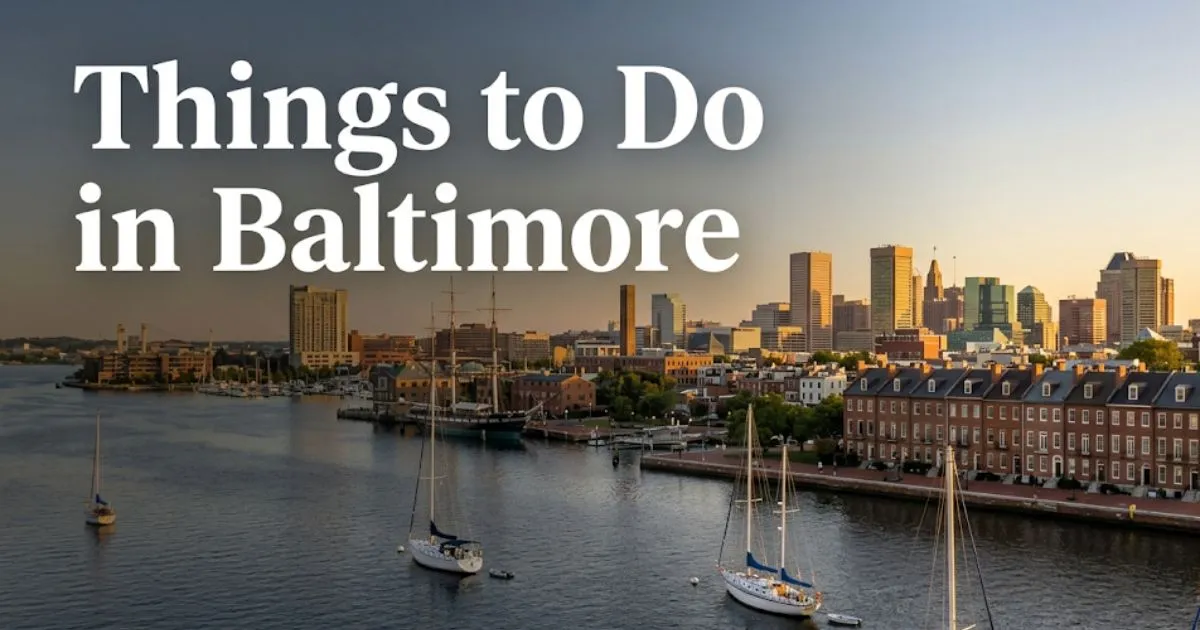
Things to Do in Baltimore: The 2026 Insider Guide

Baltimore rewards visitors who look past the Inner Harbor and into the neighborhoods. The things to do in Baltimore that actually define this city are concentrated in Fells Point, Hampden, Station North, and a food scene built around Chesapeake Bay blue crabs.
Visit Baltimore reports the city draws more than 25 million visitors annually. Most spend too much time in the commercial waterfront zone and too little in the districts where Baltimore’s real identity lives.
This guide covers the best activities, neighborhoods, restaurants, and logistics for 2026. It is structured so you can build a genuine itinerary, not just a list of attraction names.
Things to Do in Baltimore: What Makes This City Worth Your Time
Baltimore’s appeal is specific, not universal. It is a city of distinct neighborhoods, each with its own character, food culture, and energy.
It is not trying to be New York or Washington DC. That specificity is exactly what makes it worth a long weekend for travelers who appreciate genuine American city character over polished tourist infrastructure.
The Chesapeake Bay connection runs through everything here. From the blue crab season that shapes the dining calendar to the maritime museums along the waterfront, Baltimore’s identity is inseparable from the water.
For travelers coming from Washington DC, the drive runs approximately 40 to 60 minutes up I-95. The MARC Penn Line offers a direct rail connection from Union Station to Baltimore Penn Station.
Insider Tip:
- Book the National Aquarium online before arrival; summer walk-up lines can add 45 to 90 minutes to your wait
- Arrive in Fells Point before noon on weekdays to avoid weekend afternoon crowds on Thames Street
- Solo travelers: the bar culture in Fells Point is genuinely welcoming; station yourself at a tavern bar rather than a table for the most social experience
Best Things to Do in Baltimore in 2026
The best things to do in Baltimore in 2026 span three broad categories: waterfront and harbor experiences, neighborhood exploration, and the food culture centered on Chesapeake Bay seafood.
Here is how the top Baltimore experiences break down by traveler type and practical logistics:
| Activity | Best For | Cost Range (per adult) | Time Needed | Insider Note |
|---|---|---|---|---|
| National Aquarium | Families, couples | $35-$45 | 3-4 hours | Book online; timed entry required in summer |
| Fort McHenry | History travelers, all profiles | Free (grounds); $15+ for building | 1.5-2 hours | Early morning avoids tour groups |
| B&O Railroad Museum | Families, history buffs | $20-$25 | 2-3 hours | One of the finest railroad collections in the US |
| Walters Art Museum | Art travelers, budget travelers | Free | 2-3 hours | Undervisited; genuinely world-class collection |
| American Visionary Art Museum | Couples, solo travelers, art travelers | $20-$25 | 2 hours | Unlike any other museum in the mid-Atlantic |
| Fells Point exploration | All profiles | Free (self-guided) | Half day | Thames Street is the core; extend east toward Canton |
| Camden Yards game | Sports fans, families | $20-$120+ | 3-4 hours | One of the finest ballparks in American baseball |
| Peabody Library | Couples, architecture travelers | Free to enter | 30-45 min | Six stories of cast-iron balconies; genuinely spectacular |
| Hampden (The Avenue) | Solo travelers, couples | Free to browse | 2-3 hours | 36th Street has Baltimore’s best independent retail |
| LP Steamers (crabs) | Food travelers, couples | $50-$80/person | 2 hours | The authentic steamed blue crab experience |
Families with children under 5 should prioritize the Maryland Science Center and the National Aquarium over Fort McHenry, which requires sustained walking on uneven ground.
Budget travelers can assemble a full Baltimore day using only free attractions: Walters Art Museum, Baltimore Museum of Art, Fort McHenry grounds, Fells Point waterfront, and the Charm City Circulator bus.
Baltimore Inner Harbor: What to Do and What to Skip
The Inner Harbor is Baltimore’s most visited area and its most commercially generic. The waterfront promenade itself is genuinely pleasant; the pavilions on either side are largely tourist-infrastructure retail.
The National Aquarium at Pier 3 is the Inner Harbor’s anchor attraction and legitimately earns its reputation. It houses one of the finest aquatic collections in the eastern United States, with a multi-story open-ocean shark tank and a rainforest habitat.
The Maryland Science Center at the south end of the harbor is excellent for families with children aged 4 to 12. Expect two to three hours and budget approximately $20 to $30 per person (verify current pricing before visiting).
The Baltimore Maritime Museum offers access to three historic vessels: the USS Constellation, the USS Torsk, and the Lightship Chesapeake. Combined admission runs approximately $15 to $20 per adult. It is a genuine maritime history experience, not tourist theater.
Skip: The Harborplace pavilions for shopping. They offer nothing specific to Baltimore and occupy time better spent in Fells Point or Hampden.
Local alternative: After visiting the National Aquarium, walk or take the Baltimore Water Taxi east to Fells Point rather than staying in the Inner Harbor commercial zone. The 10-minute ride drops you into a neighborhood with real character.
Seniors and travelers with mobility considerations will find the Inner Harbor promenade well-paved and largely flat. The Water Taxi boarding areas have accessible ramps; verify current accessibility status with the Water Taxi operator before visiting.
Fells Point and Baltimore Neighborhoods: Where the City Actually Lives
Fells Point is the best neighborhood in Baltimore for first-time visitors. Its cobblestone streets along Thames Street are lined with Federal-period brick buildings, independent bars, seafood restaurants, and a working waterfront that has operated continuously since the 1700s.
The cobblestones are the one genuine accessibility warning: travelers with mobility aids or strollers will find Fells Point’s original brick streets challenging. The surrounding blocks have smoother pavement; the core Thames Street grid requires careful footing.
Canton, immediately east of Fells Point, is where Baltimore residents actually go on weekends. O’Sullivan’s Wharf and the Canton waterfront park represent the local version of what tourists think the Inner Harbor is.
Federal Hill sits south of the Inner Harbor. The Federal Hill Park overlook gives the best free view of the Baltimore skyline and harbor. The neighborhood’s Cross Street Market is a significantly better lunch option than any Inner Harbor restaurant.
Hampden on the north side is Baltimore’s creative neighborhood. 36th Street (“The Avenue”) has the city’s strongest concentration of independent boutiques, vintage stores, and local coffee shops. The Hon Café and Café Hon are Hampden institutions.
Station North is Baltimore’s arts and entertainment district, anchored by North Avenue and the area around Charles Street. It is where the city’s gallery openings, live music venues, and artist studios concentrate. Less polished than Fells Point, more genuinely local.
| Neighborhood | Best For | Vibe | Walking Terrain | Time Needed |
|---|---|---|---|---|
| Fells Point | First-timers, food, bar scene | Historic waterfront | Cobblestone (challenging) | Half day+ |
| Canton | Local experience, waterfront parks | Residential/social | Smooth, accessible | 2-3 hours |
| Federal Hill | Views, market dining | Residential/local | Moderate hills | 2 hours |
| Hampden | Shopping, independent dining | Creative/quirky | Flat, easy | 2-3 hours |
| Station North | Arts, music, galleries | Emerging arts | Mixed | Evening |
| Mount Vernon | Architecture, culture | Historic/elegant | Flat | 2 hours |
Mount Vernon deserves specific mention. The Washington Monument in Mount Vernon Place (the original one, completed in 1829, predating the DC monument) anchors a neighborhood of 19th-century townhouses, the Walters Art Museum, and the Peabody Library.
Key Takeaway: Fells Point and Hampden together give you more genuine Baltimore than a full day spent at the Inner Harbor.
National Aquarium Baltimore: Planning Your Visit
The National Aquarium in Baltimore is one of the ten most-visited paid attractions in the United States. It requires genuine planning to avoid significant wait times, particularly from late June through August.
Practical logistics for 2026:
- Purchase timed-entry tickets online at least 48 to 72 hours in advance during summer. Peak July and August dates can sell out days ahead.
- Choose a weekday morning arrival (when the aquarium opens) to minimize crowd density inside.
- Allow a minimum of three hours for a thorough visit; four hours is more realistic for families.
- Parking in the Inner Harbor garages runs approximately $25 to $35 for a half-day. The Baltimore Light Rail stops nearby and is significantly cheaper.
- The rooftop Australia exhibit and the dolphin presentation area are the first to reach capacity; go there first after entry.
Admission typically runs approximately $35 to $45 per adult and $25 to $35 per child (prices subject to change; verify before visiting).
Families with children under 3 enter free. Children between 3 and 12 represent the aquarium’s core audience; older teens often find the experience brief.
The local alternative: The Maryland Science Center two blocks away is less crowded, equally engaging for children aged 4 to 12, and typically costs less per person. On a crowded summer day, it is the better strategic choice.
According to the National Aquarium’s official visitor guidance, the least crowded visiting windows are Tuesday through Thursday mornings from September through May.
Baltimore History and Culture: Beyond the Surface
Baltimore carries more American history per square mile than most travelers expect. The National Anthem was written here; the first American railroad terminus was here; the city was a major Civil War flashpoint.
Fort McHenry National Monument and Historic Shrine is managed by the National Park Service. Francis Scott Key watched the British bombardment of Fort McHenry on September 14, 1814, and wrote what became the Star-Spangled Banner.
The grounds are free to access; the historic fort building itself charges admission (approximately $15 per adult as of recent years; verify before visiting). The fort sits on a peninsula in the Patapsco River with water views on three sides.
The B&O Railroad Museum at Pratt Street is genuinely exceptional and consistently undervisited by first-time Baltimore travelers. It holds the world’s largest collection of American railroad history, including locomotives dating to the 1830s.
Edgar Allan Poe lived and died in Baltimore. The Edgar Allan Poe House and Museum on North Amity Street is a small rowhouse museum. It operates with limited hours; verify before visiting.
The Maryland Historical Society on Park Avenue holds the original manuscript of the Star-Spangled Banner. It is one of Baltimore’s most historically significant and least-visited institutions.
Insider Tip:
- Fort McHenry is at its best at dawn, before tour groups arrive; the water views at sunrise are exceptional
- The B&O Railroad Museum’s turntable roundhouse is architecturally significant; architecture travelers should not miss it
- Seniors will find Fort McHenry’s paved paths and flat terrain among the most accessible outdoor history sites in the mid-Atlantic
Baltimore Food and Crab Cakes: Eating Like a Local
Baltimore’s food identity is built on Chesapeake Bay blue crabs and the crab cake. Every visitor encounters this. The difference between a tourist crab cake experience and a local one is specific.
Faidley’s Seafood in the new Lexington Market is the institutional answer to “where do locals eat crab cakes.” Faidley’s has operated since 1886. Their jumbo lump crab cake is made with minimal filler and cooked to order.
LP Steamers on Fort Avenue in South Baltimore is the answer to “where do locals eat steamed blue crabs by the dozen.” It is a paper-on-the-table, mallets-and-Old-Bay operation. Expect to spend approximately $50 to $80 per person including drinks.
G&M Restaurant in Linthicum, near BWI, is the local’s choice for the single best crab cake in the greater Baltimore area. Serious local food travelers make the drive.
The Cross Street Market in Federal Hill is Baltimore’s best market lunch option: eight to ten vendors, including seafood, Vietnamese, and local deli options, at prices well below the Inner Harbor.
Budget travelers: Lexington Market (completely renovated in recent years) is the most affordable sit-down food experience in central Baltimore, with dozens of vendor options priced well below restaurant dining.
| Restaurant/Venue | Specialty | Neighborhood | Price Range (per person) | Best For |
|---|---|---|---|---|
| Faidley’s Seafood | Crab cakes | Lexington Market | $15-$25 | Crab cake purists |
| LP Steamers | Steamed blue crabs | South Baltimore | $50-$80 | The full local crab experience |
| G&M Restaurant | Jumbo lump crab cake | Linthicum (near BWI) | $20-$35 | Serious food travelers |
| Cross Street Market | Mixed vendors | Federal Hill | $10-$20 | Budget travelers, quick lunch |
| Lexington Market | Multi-vendor | Downtown | $8-$18 | Budget, variety |
The overrated pick: The waterfront restaurants immediately adjacent to the National Aquarium. They charge premium prices for average food in premium-view real estate. Walk to Fells Point or Federal Hill for the same budget and significantly better food.
Key Takeaway: The best crab cake in Baltimore is at Faidley’s in Lexington Market or G&M in Linthicum; skipping these for an Inner Harbor restaurant is the most common food mistake visitors make.
Outdoor Activities in Baltimore
Baltimore’s outdoor options are specific and genuinely good. They are not the reason to visit, but they add real value to a multi-day stay.
Patapsco Valley State Park, approximately 15 minutes southwest of downtown, offers more than 32 miles of hiking trails along the Patapsco River. Trail difficulty ranges from flat riverside walks to moderate wooded ridge hikes. Managed by the Maryland Department of Natural Resources.
Druid Hill Park is Baltimore’s largest urban park, home to the Maryland Zoo in Baltimore. The zoo covers 135 acres; admission runs approximately $20 to $30 per adult (verify before visiting). It is particularly strong for families with children under 10.
Cylburn Arboretum on Greenspring Avenue is one of Baltimore’s most underused outdoor spaces. Forty acres of formal gardens, woodland trails, and bird habitat. Free to enter. At its best in May for azaleas and in October for fall color.
The Middle Branch Fitness and Marine Park on the south side of the harbor offers kayak and paddleboard rentals seasonally. It is the closest water-access point to downtown with a genuinely local feel.
Fort McHenry’s grounds are free and walkable at any time. The Patapsco River views from the fort’s star-shaped walls are among the best free outdoor experiences in the city.
Seniors and travelers with limited mobility will find Cylburn Arboretum and the Middle Branch waterfront path the most accessible outdoor options. Patapsco Valley State Park’s more demanding trails require sturdy footwear and are not mobility-aid friendly.
Baltimore Arts and Music Scene
Baltimore’s arts identity is centered in Station North, the officially designated arts and entertainment district along North Avenue between Charles Street and Greenmount Avenue.
The Station North district holds more than 200 artists’ studios, several independent galleries, and venues including Metro Gallery and Sidebar. The neighborhood is Baltimore’s answer to Brooklyn’s arts corridor, less polished and more genuinely active.
The American Visionary Art Museum (AVAM) on Key Highway near the Inner Harbor is one of the genuinely exceptional museums in the eastern United States. It collects self-taught and visionary art from artists working outside the mainstream art world. Plan two hours minimum; the collection is expansive and consistently surprising.
The Baltimore Museum of Art on North Charles Street holds the world’s largest collection of works by Henri Matisse, donated by the Cone sisters. Admission is free. It is one of the most significant free art museums in the United States.
Artscape, typically scheduled for summer (exact 2026 dates: verify with Visit Baltimore), is one of the largest free arts festivals in the US. It shuts down North Charles Street for an outdoor festival of visual art, live music, and performance.
The Peabody Library at Johns Hopkins is technically part of the university but open to visitors. Six stories of cast-iron balconies rising around a skylit atrium. It is not a working public library; it is one of the most architecturally significant interior spaces on the East Coast.
Local alternative to AVAM: The Motor House in Station North combines gallery space, a bar, and live performance in a converted auto garage. It represents Station North’s community arts spirit more authentically than any individual gallery.
Free Things to Do in Baltimore
Baltimore is one of the more accessible major American cities for budget travelers, with multiple significant free attractions.
Free things to do in Baltimore with specific details:
- Walters Art Museum (600 N. Charles Street): Free admission always. Ancient Egyptian, medieval, and Asian collections of genuine significance.
- Baltimore Museum of Art (10 Art Museum Drive): Free admission always. World’s largest Matisse collection.
- Fort McHenry grounds: Free access to the exterior grounds and Patapsco River waterfront at all times.
- Federal Hill Park overlook: Free. Best skyline view in Baltimore.
- Fells Point waterfront: Free self-guided walking along Thames Street and the harbor.
- Cylburn Arboretum: Free. 40 acres of gardens and woodland trails.
- Peabody Library: Free to visit as a non-student visitor during open hours (verify schedule before visiting).
- Charm City Circulator: Free bus service connecting major neighborhoods (verify current operating status before visiting).
- Mount Vernon Place and Washington Monument: Free exterior access; the monument interior may charge a small fee to climb (verify).
Budget travelers can construct a completely free two-day Baltimore itinerary using this list as a framework.
According to Visit Baltimore, the Walters Art Museum and the Baltimore Museum of Art together represent more than 55,000 works of art available at no charge to the public.
Families traveling on a budget: the Charm City Circulator’s free routes mean you can move between the Inner Harbor, Fells Point, and Mount Vernon without paying for transit or parking.
Key Takeaway: Baltimore’s two best art museums are both free; most visitors pay to enter lesser attractions while walking past the Walters and the BMA entirely.
Things to Do in Baltimore for Families
Baltimore is genuinely well-suited for families with children aged 4 to 14. The concentration of interactive, educational attractions within a compact area makes it one of the stronger family city destinations in the mid-Atlantic.
The strongest family itinerary concentrates on three anchors: the National Aquarium, the Maryland Science Center, and the B&O Railroad Museum.
The National Aquarium is the priority for children aged 3 to 14. The shark tank, jellyfish pavilion, and rainforest habitat sustain children’s attention for three to four hours. Book timed-entry tickets online in advance during school holidays.
The Maryland Science Center at the Inner Harbor has a planetarium, IMAX theater, and hands-on exhibits specifically designed for children. Allow two to three hours. Admission typically runs approximately $20 to $30 per person.
The B&O Railroad Museum on Pratt Street holds full-size historic locomotives children can climb on during specific programs. Check the museum’s 2026 programming schedule before visiting; hands-on locomotive programs require separate registration.
The Maryland Zoo in Baltimore at Druid Hill Park is a half-day commitment for families with children under 10. The zoo is one of the oldest in the United States and has undergone significant improvement in recent years.
Practical family logistics:
- Strollers are manageable on the Inner Harbor promenade and in most museums
- Fells Point’s cobblestones make stroller navigation genuinely difficult; use a carrier for infants there
- The Water Taxi is a child-friendly experience in itself; children consistently rate the harbor ride as a highlight
One honest note for families: The Inner Harbor’s commercial pavilions disappoint children who expect genuine maritime adventure. Set expectations honestly: it is a shopping area near water.
Things to Do in Baltimore for Couples
Baltimore is a stronger couples destination than its reputation suggests. The combination of Fells Point waterfront dining, the Peabody Library, Camden Yards, and the AVAM creates a genuinely varied romantic itinerary.
The Peabody Library is a specifically romantic architectural experience. Its six-story atrium is one of the most visually striking interiors on the East Coast. It takes 30 to 45 minutes and is free to visit.
A Fells Point evening is the strongest couples itinerary element Baltimore offers. Dinner along Thames Street at Ale Mary’s or The Laughing Pint, followed by a walk along the waterfront, represents an evening that feels specifically Baltimore rather than generically urban.
LP Steamers offers a famously unpretentious romantic experience for food-focused couples: newspapers on the table, wooden mallets, heaps of steamed blue crabs. It is not for couples seeking ambient elegance; it is for couples who find shared culinary effort genuinely fun.
Camden Yards, the home of the Baltimore Orioles, is arguably the most beautiful baseball park in America. An evening game with the Inner Harbor light behind the left field scoreboard is a specifically Baltimore experience.
The Harbor East neighborhood, just east of the Inner Harbor, is Baltimore’s most upscale dining and hotel zone. Restaurants including Cinghiale (northern Italian) and the Four Seasons Baltimore represent the city’s premium dining tier.
Couples seeking a genuinely romantic overnight: the Inn at the Black Olive in Fells Point is a boutique hotel set in a converted warehouse with harbor views. It positions couples at the best walking distance from Thames Street dining.
Getting Around Baltimore
Getting around Baltimore without a car is genuinely practical for Inner Harbor, Fells Point, Federal Hill, and Mount Vernon. It becomes less practical for neighborhoods like Hampden and for day trips.
The Charm City Circulator runs free bus routes connecting the Inner Harbor, Fells Point, Hampden, and Penn Station. Verify current routes and operating status at the MTA Maryland website before visiting; service levels have varied in recent years.
The Baltimore Water Taxi connects Inner Harbor piers, Fells Point, Canton, and Locust Point. It runs seasonally (generally April through October) and costs approximately $14 to $18 for an all-day pass (verify current pricing). For Inner Harbor-to-Fells Point transit, it is faster and more scenic than any bus option.
The Baltimore Light Rail runs from BWI Marshall Airport to Hunt Valley with stops including Camden Yards and Penn Station. It is the best option for travelers arriving by air at BWI or attending an Orioles or Ravens game.
From Washington DC: The MARC Penn Line runs from Union Station directly to Baltimore Penn Station approximately 15 times daily on weekdays, with reduced weekend service. The trip takes approximately 40 minutes.
Parking reality: Do not drive to Camden Yards on game days expecting affordable parking. Lots within two blocks charge $30 to $50 on game nights. Light Rail from nearby stations is the rational choice.
Seniors and travelers with mobility considerations: The Water Taxi’s boarding areas have accessibility accommodations; call ahead to confirm. The Charm City Circulator buses are ADA compliant.
For Hampden and areas north of downtown, a rideshare service or personal vehicle is the practical choice. The neighborhood is not walkable from the Inner Harbor (approximately 3 miles north).
Key Takeaway: The Baltimore Water Taxi is the single most underused piece of transportation infrastructure in the city; it eliminates Inner Harbor-to-Fells Point travel stress entirely.
Best Time to Visit Baltimore
The best time to visit Baltimore is late April through early June or September through mid-October. Both windows offer comfortable temperatures, manageable crowds, and peak versions of what the city does best.
Spring (April to early June): Temperatures range from the mid-50s to low 70s Fahrenheit. Chesapeake Bay crab season begins in April. Cherry blossoms peak around late March to mid-April at Cylburn Arboretum and Druid Hill Park. The Preakness Stakes at Pimlico Race Course typically falls in May; book hotels well in advance if your dates overlap.
Fall (September to October): Arguably Baltimore’s best travel window. Temperatures drop to the 60s and 70s Fahrenheit. The Baltimore Orioles playoff chase (when applicable) makes Camden Yards electric. The Baltimore Book Festival typically runs in September. Hotel rates often drop from summer peaks.
Summer (July and August): The most crowded and least comfortable season. Temperatures regularly reach 90 to 95 degrees Fahrenheit with humidity that makes outdoor exploration genuinely uncomfortable by early afternoon. The National Aquarium and Maryland Science Center hit their highest demand periods. Inner Harbor crowds peak. Not recommended unless you have air-conditioned indoor itinerary flexibility.
Winter (November through February): Cold, with average January lows in the mid-20s Fahrenheit. Outdoor experiences lose most of their appeal. Museums are excellent year-round; the Walters Art Museum and Baltimore Museum of Art are winter-friendly anchors. Hotel rates drop significantly. The holiday season brings light displays along the Inner Harbor promenade.
Budget travelers: winter offers Baltimore’s lowest hotel rates, often 30% to 50% below summer pricing, with no meaningful reduction in indoor attractions.
Baltimore Weekend Itinerary
A two-day Baltimore weekend itinerary can cover the city’s essential experiences without rushing.
Day 1: Waterfront and History
- Start at 9:00 AM at the National Aquarium (book timed entry in advance). Allow three to four hours.
- Walk south along the promenade to the Maryland Science Center or the Baltimore Maritime Museum for 60 to 90 minutes.
- Take the Baltimore Water Taxi east to Fells Point (10 minutes).
- Lunch at Fells Point along Thames Street. The Thames Street Oyster House for seafood or Daily Brine Oyster Bar for a more casual format.
- Spend the afternoon walking Thames Street and the Fells Point waterfront. Explore south toward the waterfront park.
- Dinner in Fells Point. The Laughing Pint for a casual pub dinner; Alize Bistro for a sit-down meal.
- Evening: walk the waterfront or take a rideshare to Federal Hill for drinks overlooking the harbor.
Day 2: Culture, Neighborhoods, and Food
- Morning: Mount Vernon neighborhood. Visit the Walters Art Museum (free; allow two hours).
- Walk two blocks to the Peabody Library (30 to 45 minutes; free to visit).
- Take a rideshare to Hampden. Walk 36th Street (The Avenue) for independent shopping and lunch.
- Afternoon: American Visionary Art Museum on Key Highway (plan two hours).
- Late afternoon: Federal Hill Park overlook for the best free harbor skyline view.
- Dinner: LP Steamers on Fort Avenue for steamed blue crabs (the essential Baltimore food experience; budget two hours and approximately $50 to $80 per person).
- Optional evening: Station North for gallery openings or live music, depending on the weekend schedule.
Families should substitute the AVAM on Day 2 with the B&O Railroad Museum and the Maryland Zoo and plan on one primary anchor attraction per half-day rather than trying to hit multiple stops.
Baltimore Safety Tips and Practical Warnings
Baltimore requires specific neighborhood awareness. The visitor-facing areas (Inner Harbor, Fells Point, Federal Hill, Mount Vernon, Hampden, Canton) are generally safe for informed travelers.
Key safety and practical facts every visitor should know:
- Do not walk west of MLK Boulevard toward areas west of downtown without local knowledge, particularly after dark. The neighborhoods immediately west of the tourist corridor have higher street crime rates.
- Fells Point and the Inner Harbor are heavily visited and generally safe; standard urban awareness applies (be aware of your surroundings, keep valuables secure in crowded areas).
- Inner Harbor parking garages have had reports of car break-ins; remove all valuables from vehicles.
- The Charm City Circulator routes do not extend to all neighborhoods; do not assume bus service reaches your destination without checking current routes.
- Fort McHenry’s grounds are a peninsula; parking at the site is limited. Arrive before 10:00 AM on summer weekends or expect to wait for a space.
- Heat and humidity in July and August are genuine physical risks for outdoor activities. Plan outdoor time before noon and after 5:00 PM during the peak summer weeks.
- Cobblestone streets in Fells Point are a genuine fall and mobility risk. Wear appropriate footwear. Travelers with mobility aids should use the surrounding smoother streets.
- The Baltimore Water Taxi has safety briefings before departure; life jackets are available and required for children under a specific age. Follow all crew instructions.
In a medical emergency in Baltimore, Johns Hopkins Hospital on Orleans Street is one of the leading medical facilities in the United States.
Key Takeaway: The single most practical safety decision in Baltimore is staying east of the Inner Harbor (Fells Point, Canton) and north toward Mount Vernon and Hampden; these corridors are where visitor infrastructure and local activity safely overlap.
Frequently Asked Questions About Things to Do in Baltimore
What are the best things to do in Baltimore for a first-time visitor?
The best things to do in Baltimore for a first-time visitor are the National Aquarium, a walking tour of Fells Point, the Walters Art Museum, and a steamed crab dinner at LP Steamers.
These four experiences cover Baltimore’s core identities: maritime culture, historic neighborhood character, world-class art at no cost, and the Chesapeake Bay food tradition that defines the city’s culinary identity.
Add Fort McHenry if you have a third day; it is the most historically significant site in Baltimore and genuinely earns its National Monument designation.
Is Baltimore worth visiting for a weekend trip?
Baltimore is genuinely worth a long weekend, particularly for travelers coming from Washington DC, Philadelphia, or New York within a two-hour drive or rail connection.
The combination of free world-class art museums, a strong seafood food culture, and distinct walkable neighborhoods like Fells Point and Hampden makes it a high-value urban destination.
It outperforms its reputation consistently for travelers who move past the Inner Harbor into the neighborhoods where the city’s real identity lives.
What is Baltimore most famous for?
Baltimore is most famous for Chesapeake Bay blue crab cuisine, the Star-Spangled Banner and Fort McHenry, the National Aquarium, and the HBO series The Wire.
Its maritime history, concentration of free world-class art museums, and the distinct character of neighborhoods like Fells Point are what experienced travelers most appreciate.
The city is also known for its hon culture (a warm, unpretentious Baltimore identity that filmmaker John Waters has documented extensively) and Oriole Park at Camden Yards, widely considered one of the finest baseball parks in America.
How do you get around Baltimore without a car?
Getting around Baltimore without a car is practical for the main visitor corridor using the free Charm City Circulator bus, the Baltimore Water Taxi, the Baltimore Light Rail, and rideshare services.
The Charm City Circulator connects the Inner Harbor, Fells Point, Mount Vernon, and Penn Station at no cost; verify current routes before visiting as service levels have changed in recent years.
For neighborhoods like Hampden, which sits approximately three miles north of the Inner Harbor, a rideshare is the practical choice.
What is the best neighborhood to stay in when visiting Baltimore?
The best neighborhood to stay in Baltimore for a first-time visitor is Fells Point, which puts you within walking distance of Thames Street dining, the Baltimore Water Taxi, and a 15-minute water ride from the Inner Harbor.
Federal Hill is the second-best choice: it offers proximity to the Inner Harbor, Cross Street Market, and the Federal Hill Park overlook without the cobblestone navigation challenges of Fells Point.
Harbor East, just east of the Inner Harbor, is Baltimore’s most upscale hotel zone and the right choice for couples seeking premium dining and hotel options within a short walk of the main waterfront.
Is Baltimore safe for tourists?
Baltimore is safe for tourists who stay within the established visitor corridors: the Inner Harbor, Fells Point, Canton, Federal Hill, Mount Vernon, and Hampden are all appropriate for informed visitors exercising standard urban awareness.
The areas immediately west of downtown Baltimore, west of MLK Boulevard, have higher crime rates and are not part of the standard visitor geography; do not navigate these areas without local guidance.
Apply the same awareness you would in any major American city: keep valuables secure in crowded areas, be aware of your surroundings after dark, and use well-lit routes between neighborhoods.
Plan Your Baltimore Trip with Confidence
The most important single decision you will make in Baltimore is how you allocate your time between the Inner Harbor and the neighborhoods. The harbor is worth a morning. Fells Point, Hampden, and Station North are worth the rest of your trip.
Book the National Aquarium first, confirm Charm City Circulator routes directly with MTA Maryland, and make a reservation at LP Steamers before you arrive on a weekend. Those three logistical steps eliminate the three most common Baltimore planning frustrations.
Travel conditions, museum hours, Water Taxi schedules, Circulator routes, and attraction pricing change regularly. Verify all logistics directly with venues and Visit Baltimore at baltimore.org before departure. The itinerary framework here holds; the specific hours and prices need a final check against 2026 conditions.
Baltimore has earned more than its reputation allows. Arrive knowing which neighborhoods to prioritize and the city will consistently outperform what you expected.