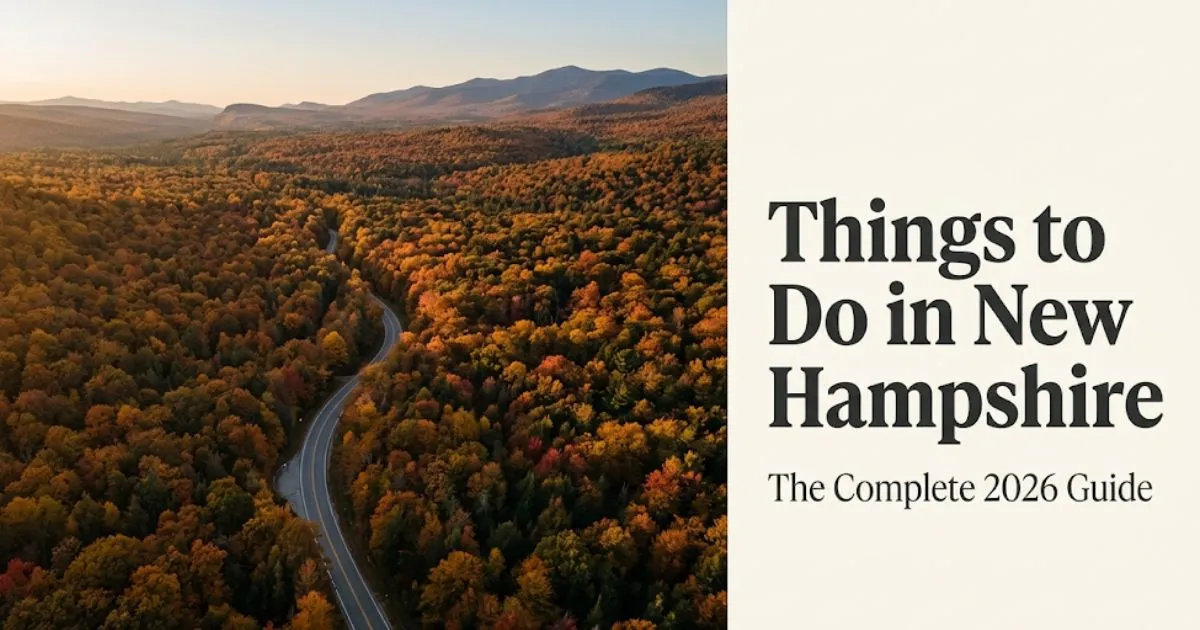
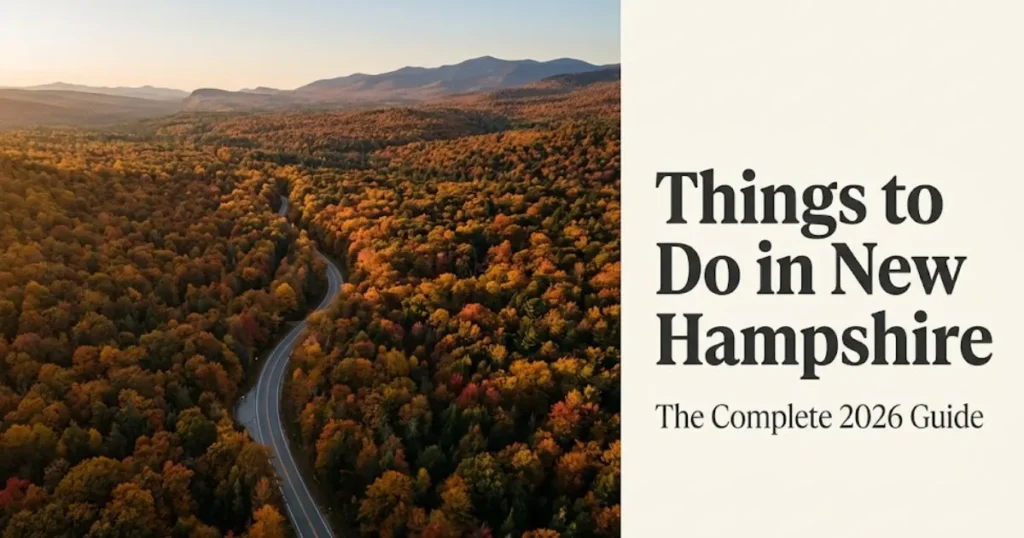
Things to Do in New Hampshire: The Complete 2026 Guide

New Hampshire packs more geographic range into its 9,349 square miles than most travelers expect from a single state. The things to do in New Hampshire span summit hiking above treeline, coastal seafood on a working waterfront, and covered bridge drives through farm country.
The White Mountain National Forest alone covers 800,000 acres of federally managed wilderness. That scale means NH rewards travelers who understand its regions before arrival, not after.
This guide covers every major region with specific named activities, honest seasonal guidance, and practical logistics. It distinguishes what genuinely earns its reputation from what underdelivers, and builds toward an actionable weekend framework.
Things to Do in New Hampshire: What Makes the Granite State Worth the Drive
New Hampshire offers a concentrated version of New England’s best outdoor and cultural experiences within driving distance of 70 million Americans.
No state sales tax means every purchase, from a hiking pass to a lobster roll, costs less than in neighboring Massachusetts or Vermont. That structural cost advantage is real and adds up meaningfully over a long weekend.
What NH does better than any neighboring state: it transitions from alpine wilderness to working coastal waterfront within two hours of driving. That range is genuinely unusual east of the Rockies.
What NH does not offer is urban density. Boston travelers expecting Portland, Maine-level restaurant density in the mountains will be disappointed.
The Granite State’s character runs from fiercely independent (the state motto is “Live Free or Die,” printed on every license plate) to genuinely welcoming to outdoor visitors. That combination shows up in the state’s practical orientation: campgrounds are well-maintained, trail systems are well-signed, and tourism infrastructure is competent without being cloying.
According to the New Hampshire Division of Travel and Tourism Development, the state hosts over 14 million visitors annually, with outdoor recreation, fall foliage, and ski season driving the largest visitor volumes.
The honest limitation: NH is almost entirely car-dependent. Travelers without a vehicle have almost no practical access to the White Mountains, Lakes Region, or northern NH. Public transit serves Manchester and Concord adequately. That is roughly it.
Insider Tip:
- Book White Mountains lodging before you book any activity. Accommodation is the limiting factor, not the trailhead.
- The state liquor stores on I-93 and I-95 near the Massachusetts border are open daily and offer significant savings on spirits.
- Solo travelers and budget visitors who plan to day-hike can keep costs extremely low. The White Mountain National Forest day-use pass is the primary access fee for most trailhead parking areas.
Top Things to Do in New Hampshire by Region
New Hampshire divides cleanly into six travel regions, each with a distinct character, activity profile, and optimal traveler fit.
The White Mountains in the north-central part of the state are the primary destination for most visitors. They offer the most dramatic scenery, the most extensive hiking trail system, and the most significant seasonal variation.
The Lakes Region, centered on Lake Winnipesaukee, is NH’s second-largest draw. It suits families, boating enthusiasts, and travelers seeking a lower-intensity version of NH’s outdoor appeal.
The Seacoast region, anchored by Portsmouth, packs remarkable cultural and culinary depth into a small geographic footprint. It is NH’s most walkable destination zone.
Northern New Hampshire (the Great North Woods region) offers genuine wilderness solitude. It suits experienced outdoors travelers willing to trade amenities for moose sightings and empty roads.
The Monadnock Region in the southwest centers on Mount Monadnock, the second most climbed mountain in the world. It suits day-trippers from Boston and Connecticut.
The Dartmouth-Lake Sunapee region in the west combines Dartmouth College’s cultural anchor with Sunapee’s lake and ski resort appeal.
| Region | Best For | Drive from Boston | Cost Tier | Peak Season |
|---|---|---|---|---|
| White Mountains | Hiking, skiing, foliage drives | 2.5 to 3 hrs | Mid to premium | Late Sept to Oct, Dec to March |
| Lakes Region | Families, boating, casual outdoors | 2 hrs | Mid-range | July to August |
| Seacoast / Portsmouth | History, dining, coastal walks | 1.25 hrs | Mid to premium | Year-round |
| Northern NH | Wilderness, moose watching | 4+ hrs | Budget to mid | July to August |
| Monadnock Region | Day hiking, rural drives | 2 hrs | Budget | May to October |
| Dartmouth-Sunapee | Cultural, skiing, lake recreation | 2.5 hrs | Mid-range | Varies by activity |
Couples and romantic travelers will find Portsmouth and the mountain inn towns of Jackson and Bethlehem the most compelling options.
Budget travelers get the best value in the Monadnock and northern NH regions, where lodging is cheaper and the primary costs are gas and trail fees.
Things to Do in White Mountains New Hampshire
The White Mountains offer the single richest concentration of outdoor activities in New England, anchored by the White Mountain National Forest and its 1,200-mile trail network.
Franconia Notch State Park sits at the center of most first-time visitors’ White Mountains experience. The park contains the Flume Gorge, the Basin (a glacially carved pothole), the Cannon Mountain Aerial Tramway, and the trailhead for the Franconia Ridge Loop.
The Flume Gorge admission runs approximately $18 to $22 per adult and $10 to $15 for children as of recent seasons. Verify current pricing at nhstateparks.org before visiting.
The Tramway to Cannon Mountain’s summit provides the most accessible alpine views in the state. Round-trip admission typically runs $25 to $35 per adult, with seasonal hours that vary significantly.
Crawford Notch State Park on US Route 302 is the local alternative that draws far smaller crowds than Franconia. The Zealand Falls trail to the Zealand Falls AMC Hut is a 5.4-mile round trip through one of the White Mountains’ most beautiful river valleys.
Families with young children get more practical value from the Flume Gorge boardwalk (stroller-friendly in sections, though narrow) than from any summit hike. The Basin loop is also accessible with young children.
Seniors and accessibility travelers should know that Cannon Mountain’s tramway provides genuine alpine access without hiking. The Franconia Notch recreation path along the valley floor is paved and flat for 9 miles.
Insider Tip:
- The White Mountain National Forest Recreation Area Day Use Pass is required for most trailhead parking. As of recent years this runs approximately $5 per day or $20 for an annual pass. Verify current requirements at the USFS website.
- Arrive at Franconia Notch trailheads before 8:00 a.m. on summer and fall weekends. By 9:30 a.m., the main lots are full and access becomes chaotic.
- The White Mountains Attractions Association website provides a consolidated activity and event calendar that competitors and tourism boards do not aggregate as clearly.
Best Hikes in New Hampshire
The most popular hike in New Hampshire is the Franconia Ridge Loop, a 9.1-mile circuit that summits Mount Lafayette (5,260 feet) and Mount Lincoln (5,089 feet) via an exposed ridgeline.
The Franconia Ridge Loop is legitimate. It earns its reputation. The views across Franconia Notch on a clear day are the best accessible ridge-walk experience in the northeastern US. Plan 6 to 8 hours for the full circuit.
The honest limitation: the Franconia Ridge Loop is crowded. On peak fall weekends, the Lafayette Place Campground trailhead lot fills before 7:00 a.m. Overflow parking along I-93 has been an ongoing issue. The loop is physically demanding; it gains roughly 3,500 feet of elevation.
The local alternative that experienced NH hikers prefer: Mount Moosilauke via the Glencliff Trail from the south side. Moosilauke (4,802 feet) sits at the edge of the Whites and offers above-treeline ridge walking with dramatically smaller crowds than the Franconia circuit. The Glencliff approach is 7.6 miles round trip.
Solo travelers should know that the Presidential Range peaks, including Mount Washington (6,288 feet), should not be attempted alone by inexperienced hikers. Weather changes on these summits are fast and severe. The Mount Washington Observatory documents summit conditions in real time; check it before any Presidential Range attempt.
Other standout hikes by experience level:
- Lonesome Lake Trail (Franconia Notch): 3.2 miles round trip, excellent for beginners, ends at a mountain lake with Franconia Ridge views. AMC hut at the lake.
- Diana’s Baths (North Conway): 1.9-mile round trip to a multi-tiered waterfall. Extremely family-friendly. Free to access with a day-use parking pass.
- Mount Monadnock (Jaffrey): 4 to 8 miles depending on route. One of the most-climbed peaks globally. Best hiked on weekdays.
- Tuckerman Ravine Trail (Pinkham Notch): 4.2 miles to the Hermit Lake Shelters. Advanced; continues to the Washington summit at 8.4 miles round trip.
- Welch-Dickey Loop (Thornton): 4.4-mile circuit with open granite slabs and exceptional views. Less crowded than Franconia, more technically engaging than Lonesome Lake.
Families with children under 10 should stick to Lonesome Lake, Diana’s Baths, and the Flume Gorge boardwalk. Mount Lafayette and Washington are not appropriate for young children unless the family has significant hiking experience.
According to the Appalachian Mountain Club, the White Mountains contain 48 peaks above 4,000 feet. Completing all 48 is a defined goal within NH’s hiking community; the AMC 4000-Footer Club tracks and certifies completions.
Key Takeaway: Book your White Mountains trailhead parking and lodging before anything else. Accommodation and parking, not trail permits, are the limiting factors for a successful NH hiking trip in 2026.
Things to Do in Portsmouth NH
Portsmouth is the most culturally dense destination in New Hampshire, packing a legitimate food scene, serious colonial history, and a working waterfront into a city of roughly 22,000 people.
Strawbery Banke Museum on Marcy Street is the anchor historic attraction. It is a 10-acre outdoor living history museum preserving structures from the 1600s through the 1950s on their original sites. Admission runs approximately $22 to $28 per adult as of recent seasons. Verify current pricing before visiting.
The museum is honest history, not costumed entertainment. This distinction matters. Visitors expecting a theme park atmosphere should recalibrate their expectations before entering.
Market Square is Portsmouth’s central gathering point. The restaurants, boutiques, and coffee shops radiating from the square represent the best concentration of quality dining in New Hampshire.
Prescott Park on the waterfront along the Piscataqua River is free to enter. The park hosts the Prescott Park Arts Festival through summer, a free outdoor theater series that locals consistently identify as one of the state’s best warm-weather events.
The Portsmouth Black Heritage Trail is an 18-stop self-guided walking tour covering African American history in the region from the 17th century forward. It is free, starts near Market Square, and is one of the best-researched heritage walks in New England.
Couples and romantic travelers will find Portsmouth the most reliable NH destination for a dinner-and-overnight trip. The combination of walkable streets, genuinely good restaurants, and historic inn lodging makes it the closest NH equivalent to Portland, Maine or Newport, Rhode Island at a consistently lower price point.
For dining specifically: Jumpin’ Jay’s Fish Cafe on Congress Street is the reliable local recommendation for seafood. The Black Trumpet on Ceres Street near the waterfront has earned consistent critical recognition for its globally influenced menu using New England ingredients.
Seniors and accessibility travelers will find Portsmouth more accessible than any other NH destination. The city center is flat, most attractions are within a half-mile radius, and the quality of restaurants and accommodations is high without requiring any physical exertion.
Insider Tip:
- Portsmouth parking is tightest in summer and on weekend evenings. The Hanover Street Parking Garage off Market Street is the most reliable option for central access.
- The Isles of Shoals Steamship Company operates ferry trips to Star Island from Portsmouth’s Ceres Street dock. The round trip takes roughly 3 hours. Star Island is a remote 43-acre island with a historic hotel and conference center that operates through summer. Verify 2026 schedules directly with the steamship company.
- Skip the tourist-oriented waterfront bar strip on Ceres Street for drinking. Walk two blocks inland to The Statesman or local bars along State Street for the version of Portsmouth that locals actually use.
Things to Do in North Conway NH
North Conway is the primary gateway town to the White Mountains and the most commercially developed mountain town in the state. It serves both as a practical base for White Mountains activities and as a shopping destination in its own right.
The town’s most distinctive feature is Echo Lake State Park, directly accessible from the town center. The park includes a sandy swimming beach on Echo Lake and the trailhead for Cathedral Ledge, a 700-foot granite cliff face popular with rock climbers and hikers seeking exceptional valley views.
The Cathedral Ledge summit is accessible by a short hike from the top of the road loop or by a more demanding trail from the base. The views across the Saco River valley are among the best easily accessible scenic overlooks in the White Mountains.
Conway Scenic Railroad departs from North Conway Village and operates two routes: the Valley Train (11 miles round trip) and the Notch Train through Crawford Notch (5 hours round trip). The Notch Train is the more dramatic option, passing through one of the White Mountains’ most historic railroad corridors. Prices vary by route and class; verify current 2026 schedules and pricing directly with the railroad.
North Conway Village also hosts a significant concentration of outlet and independent retail stores along Route 16. The tax-free shopping angle is real. New Hampshire’s lack of sales tax makes North Conway one of the most cost-efficient outlet shopping destinations in the Northeast.
Budget travelers should know that North Conway’s outlet stores, Echo Lake State Park beach, Diana’s Baths trail, and Cathedral Ledge hike collectively represent a full day of activity for minimal cost beyond the day-use parking pass.
The honest assessment of North Conway: Route 16 through town is heavily commercial and sees significant traffic congestion on summer weekends. The town itself is not particularly atmospheric. Its value is as a base and gateway, not as a cultural destination. Travelers seeking mountain town character should stay in Jackson (8 miles north) or Bartlett instead.
Insider Tip:
- Diana’s Baths is a 1.9-mile round trip on a well-maintained path to a tiered waterfall. It requires the White Mountain National Forest day-use pass for parking. Arrive before 9:00 a.m. on summer weekends.
- The local climbing community at Cathedral Ledge is active and visible at the base of the cliff on most good-weather days. Non-climbers can descend from the top to the cliff edge safely via the summit loop path.
- Moat Mountain Smoke House and Brewing Company in North Conway is the most consistently recommended local dining option among White Mountains regulars.
Things to Do at Lake Winnipesaukee NH
Lake Winnipesaukee is New Hampshire’s largest lake, stretching 21 miles long with 274 miles of shoreline and 258 named islands. It is the center of the Lakes Region, NH’s most family-oriented travel zone.
The most established Winnipesaukee town for visitors is Wolfeboro, on the eastern shore. Wolfeboro calls itself “the oldest summer resort in America,” a claim dating to Governor John Wentworth’s 18th-century summer home. The town’s Main Street is genuinely walkable with quality independent restaurants and shops.
Weirs Beach, on the western shore in Laconia, is the commercial and amusement center of Winnipesaukee. Funspot, at Weirs Beach, holds the Guinness record as the world’s largest arcade. It is genuinely worth a stop for families and retro arcade enthusiasts.
The M/S Mount Washington cruise ship operates sightseeing and themed dinner cruises on Winnipesaukee from Weirs Beach dock. A 2.5-hour scenic cruise typically runs approximately $35 to $45 per adult as of recent seasons. Verify 2026 schedules and pricing directly with Winnipesaukee Cruise Company.
Families with children get the most value from Weirs Beach’s combination of swimming beach, Funspot, mini-golf, and the cruise. Young children engage with all of it for a full day without requiring hiking capability.
The local alternative for families seeking a quieter Winnipesaukee experience: Meredith on the northwest shore. Meredith has a strong independent restaurant scene centered on Main Street, the Winnipesaukee Scenic Railroad depot, and less commercial density than Weirs Beach.
Couples and romantic travelers should choose Wolfeboro or Meredith over Weirs Beach. The eastern shore around Wolfeboro is less developed, the restaurants are better, and the atmosphere is quieter.
Seniors and accessibility travelers will find Winnipesaukee’s flat lakeside towns among NH’s most accessible destinations. The M/S Mount Washington cruise is fully accessible. Wolfeboro’s Main Street is flat and walkable.
Key Takeaway: Lake Winnipesaukee works best as a family base or couples retreat, not a White Mountains alternative. Plan for water recreation and lakeside dining rather than hiking, and choose your town based on your noise tolerance.
Kancamagus Highway Road Trip New Hampshire
The Kancamagus Highway (NH Route 112), universally called “the Kanc” by NH locals, runs 34.5 miles east to west through the heart of the White Mountain National Forest between Conway and Lincoln.
It is the most accessible fall foliage drive in New England and one of the best scenic byways in the northeastern United States. No traffic lights, no commercial development, no cell service for most of its length.
The highway crosses the Kancamagus Pass (2,855 feet elevation) at its highest point. Several viewpoints, river swimming holes, waterfall access points, and hiking trailheads line the route.
Key stops on the Kanc, east to west:
- Rocky Gorge Scenic Area (Conway side): Short boardwalk to a river gorge. Excellent swimming hole. Day-use pass required for parking.
- Lower Falls Scenic Area: Popular river swimming spot on the Swift River. Very busy on summer weekends.
- Sabbaday Falls: 0.3-mile walk to a three-tiered waterfall. One of the most accessible waterfall stops on the route.
- Kancamagus Pass Overlook: Pull-off with westward mountain views. Best photo stop on the highway.
- Loon Mountain Resort (Lincoln end): If not continuing west, Loon’s gondola operates in summer for non-skiers seeking ridge-level views. Verify current 2026 gondola hours directly with Loon Mountain.
Solo travelers and road trip enthusiasts should know that the Kanc has zero gas stations, zero food options, and unreliable cell service for its entire 34.5 miles. Fill the tank and bring food and water before entering from either end.
Fall foliage timing: peak color on the Kanc typically runs late September through mid-October, with the specific peak varying by elevation. Higher elevations turn first. The first two full weekends of October are the most congested. The highway is best driven westbound (Conway to Lincoln) in morning light for optimal lighting on the road’s curves and river crossings.
According to the New Hampshire Division of Travel and Tourism Development, the Kancamagus Highway is New Hampshire’s most-visited scenic driving route, with fall foliage season drawing the highest single-week visitor volumes of any NH tourism period.
Families with children should plan for at least two to three swimming or walking stops along the Kanc rather than a continuous drive. Children disengage from a scenic drive within 20 minutes. The river swimming holes keep them genuinely engaged.
Insider Tip:
- Drive the Kanc on a Tuesday or Wednesday in foliage season. Weekend congestion is severe. A Tuesday drive takes 75 minutes; the same route on a Saturday in October can take over four hours.
- Bring cash. Some day-use fee stations are cash-only. Verify current payment methods at USFS sites before visiting.
- The Kanc is not lit at night and has no guardrails at many cliff-edge sections. Do not attempt it after dark.
Things to Do in Northern NH
Northern New Hampshire, specifically the region north of the White Mountains along US Route 3 and NH Route 26 toward the Canadian border, is the least-visited and most genuinely wild part of the state.
The Great North Woods region covers roughly 3 million acres of largely undeveloped forest, lakes, and river valleys. Towns like Pittsburg, Colebrook, Lancaster, and Dixville Notch serve as supply points for visitors.
Pittsburg and the Connecticut Lakes chain represent the best moose-watching destination in the northeastern United States. Evening drives along US Route 3 north of Pittsburg between late May and August regularly produce moose sightings within a half-mile of the road. This is not marketing language. The moose density in this corridor is genuine.
Dixville Notch State Park centers on a dramatic cleft through a mountain wall accessed via NH Route 26. The notch itself is worth a stop for the geological drama. The Balsams Grand Resort Hotel, which anchors Dixville Notch and is famous as the first polling place to report results in US presidential elections, has undergone renovation projects; verify its current operational status before planning a stay around it.
The honest profile for northern NH: this region suits experienced outdoors travelers, hunters, fly fishers, and anyone specifically seeking genuine solitude. It does not suit travelers who want convenience, restaurant variety, or significant cultural attractions.
Cell service is limited or absent across large portions of the Great North Woods. Download offline maps before entering the region.
Budget travelers will find northern NH the lowest-cost region of the state. Campgrounds in Pittsburg area run approximately $20 to $35 per night. Fuel costs should be budgeted generously; gas stations are sparse.
Seniors and accessibility travelers: the primary access to northern NH is by car on open roads. There are no tramways, boardwalks, or developed accessibility infrastructure comparable to Franconia Notch. The terrain appeal here is driving-based wildlife watching, which is genuinely accessible for most mobility levels.
Insider Tip:
- The best moose viewing window is from 5:30 to 8:00 p.m. on calm summer evenings. Drive slowly north of Pittsburg on US Route 3 with windows down.
- Back Lake in Pittsburg is a quiet, non-motorized kayaking and fishing lake that experienced northern NH visitors consistently prefer to the more-developed Connecticut Lakes for a relaxed afternoon on the water.
- Bring three days’ worth of food. Grocery options in Colebrook and Pittsburg are limited.
Things to Do in New Hampshire in Fall
Fall is New Hampshire’s most photographed and most visited season. Peak foliage in the White Mountains typically runs from late September through mid-October, with exact timing varying by elevation and year.
Higher elevations (above 3,000 feet) peak first, usually in late September. Lower valleys and the Lakes Region lag by one to two weeks, often showing peak color in mid-October.
The three best fall foliage experiences in NH, ranked by accessibility:
- Kancamagus Highway drive (Conway to Lincoln): The benchmark NH foliage drive. Most accessible, most scenic, most crowded.
- Franconia Notch State Park: The combination of the Flume Gorge, the Profile Lake view, and the tramway summit creates a full fall day itinerary. The valley’s protected geography concentrates color particularly well.
- Sugar Hill and Bethlehem loop: Two small towns west of Franconia offer classic white-church-with-fall-foliage scenery that photographers specifically seek. Sugar Hill’s Harman’s Cheese and Country Store is the local landmark.
The honest crowd reality: the first Saturday and Sunday of October are the most congested days of NH’s entire year. Route 112, Route 16, and I-93 north of Lincoln all experience severe traffic delays. Lodging booked less than 6 months in advance for peak foliage weekends will find extremely limited availability at reasonable prices.
Couples and romantic travelers should book a mountain inn for mid-week foliage. The Jackson area, specifically The Inn at Thorn Hill and Wentworth Resort, offers the classic New England fall romance atmosphere with significantly smaller weekday crowds.
Budget travelers should target the third week of October. Foliage is past peak in the mountains but still excellent in the Lakes Region, lodging prices drop significantly, and the crowds are gone.
Key Takeaway: For fall foliage in New Hampshire, book accommodation 4 to 6 months in advance for peak October weekends. Mid-week visits cut crowd levels by roughly 70 percent with comparable color quality.
Things to Do in New Hampshire in Summer
Summer in New Hampshire runs from late June through Labor Day weekend, with July and August representing the peak season for lake recreation, White Mountains hiking, and Seacoast beach visits.
Hampton Beach State Park on the Atlantic coast is NH’s only ocean beach destination. The beach itself is a 2.5-mile barrier strand. Hampton Beach the town is a classic New England summer resort strip with arcades, seafood shacks, and the Hampton Beach Casino Ballroom for concerts.
The honest assessment: Hampton Beach is not a premium coastal experience. It is a nostalgic working-class beach resort with a specific atmosphere that either appeals or it does not. Families with young children who like beach boardwalk culture will enjoy it. Travelers seeking quiet coastal beauty should look at the smaller beaches in Rye and Wallis Sands State Beach, both within 10 miles north.
Odiorne Point State Park in Rye is the local alternative that repeat NH coastal visitors consistently prefer. It has rocky tidal pools, a salt marsh trail, and a science center. It is far less crowded than Hampton Beach and better for wildlife observation.
Summer hiking in the White Mountains peaks in July and August with the best trail conditions. The exception: above-treeline hiking on the Presidential Range should be approached with weather monitoring. Summer afternoon thunderstorms on Mount Washington are a genuine safety consideration.
Families with children get excellent summer value from the combination of White Mountains day hikes, Winnipesaukee swimming, and Hampton Beach for a full week itinerary. No single NH region covers all three; plan driving time between zones accordingly.
Solo travelers will find the White Mountains trail system, the Portsmouth food and bar scene, and the AMC hut system all well-suited to independent visitors. The AMC huts (staffed backcountry lodges) are particularly good for solo hikers who want mountain access without wilderness tent camping experience.
According to the Appalachian Mountain Club, the White Mountains AMC hut system operates eight full-service huts along the Appalachian Trail corridor from spring through fall, with bunk accommodations and meals. Advance reservation through the AMC website is required and should be made months ahead for summer dates.
Things to Do in New Hampshire in Winter
Winter transforms New Hampshire into the best alpine ski destination in New England, with six major ski resorts operating across the state from December through March or April depending on conditions.
Bretton Woods Mountain Resort at the foot of Mount Washington is the largest ski area in New England by trail count, with 464 skiable acres. The Omni Mount Washington Hotel adjacent to the resort provides the most atmospheric mountain lodge stay in the state.
Cannon Mountain in Franconia Notch is the state-owned ski area. It is smaller than Bretton Woods but has steeper terrain and a more local-oriented character. The aerial tramway operates in winter for sightseeing on days when skiing is not the priority.
Gunstock Mountain Resort in Gilford overlooks Lake Winnipesaukee. It is the best option for families and beginners, with good ski school infrastructure and a lower overall price point than Bretton Woods.
Other notable winter activities:
- Snowshoeing on Franconia Notch State Park’s valley floor path: free with snowshoes, which can be rented in Lincoln.
- Ice skating at Everett Ice Arena in Concord and various outdoor rinks that form on community ponds.
- Dog sledding: several Great North Woods operators offer sled dog tours; verify 2026 availability directly with operators in the Pittsburg area.
- Mount Washington winter hiking: for experienced winter mountaineers only. The summit sees among the highest wind speeds ever recorded on Earth. This is not a casual winter hike under any circumstances.
Budget travelers should note that Gunstock’s lift tickets generally run lower than Bretton Woods. Multi-day passes at any NH resort offer the best per-day value. Look for early-season and midweek pricing, which drops significantly from peak weekend rates.
Families with children should prioritize Gunstock or Loon Mountain for ski instruction quality and beginner terrain variety. Bretton Woods’ size can overwhelm young beginners.
Insider Tip:
- Bretton Woods gets the most reliable natural snowfall of any NH resort due to its northern position and Mount Washington’s weather-generating topography. It is the best choice for late-season skiing into April.
- Winter on the Kancamagus Highway is a completely different experience. The highway stays open year-round but requires four-wheel drive or chains in winter conditions. Ice fishers use the Swift River valley access roads.
Things to Do in New Hampshire with Kids
New Hampshire is genuinely strong as a family destination when the itinerary is built around the right activities for the age group.
Children under 8 engage best with Story Land in Glen, the Flume Gorge boardwalk, Funspot at Weirs Beach, and the M/S Mount Washington cruise. All four are structured, bounded, and paced for young children without requiring hiking endurance.
Story Land is a theme park operating in Glen, directly on Route 16 near North Conway, specifically designed for children aged 2 to 12. It is not a large-scale park competing with Disney or Universal. It is the right scale for its age group and worth a full day for families with young children visiting the White Mountains corridor. Verify 2026 season dates and ticket pricing directly with Story Land before visiting.
For children aged 8 to 14, the White Mountains hiking experience becomes genuinely viable. The Lonesome Lake Trail (3.2 miles, moderate), Diana’s Baths (1.9 miles, easy), and Welch-Dickey Loop (4.4 miles, moderate with open rock slabs) are all appropriate for this age group with capable parents.
The Conway Scenic Railroad Notch Train is a strong option for families with children who have railroad interest. The five-hour round trip through Crawford Notch is a substantial time commitment; bring snacks and plan for young children to engage intermittently rather than continuously.
Clark’s Trading Post in Lincoln is a long-standing NH family attraction with performing bears, a water bumper boat ride, and a steam-powered train. The honest assessment: it is a nostalgic tourist attraction that has been operating since 1928. Children under 10 generally enjoy it. Experienced repeat NH visitors with older children typically skip it.
The local alternative to Clark’s: Lost River Gorge and Boulder Caves in North Woodstock. It is a 1-mile self-guided walk through a glacial gorge with boulder caves children can physically crawl through. It is more genuinely engaging for children ages 6 to 14 than most adults expect.
Practical family logistics: White Mountains trailhead parking fills early. For family hiking days, depart your lodging before 7:30 a.m. Many NH family attractions are seasonal (May through October). Verify operating dates directly before building a winter or spring itinerary around them.
Key Takeaway: For families with children under 8, build the NH itinerary around Story Land, Funspot, and the Flume Gorge. For children over 8, replace Story Land with a real hike and Lost River Gorge. The experiences that work for one age group actively disappoint the other.
Romantic Things to Do in New Hampshire
New Hampshire’s most compelling romantic experiences center on mountain inn culture, private lake settings, and the specific combination of excellent food and dramatic natural scenery that characterizes the state at its best.
The White Mountains mountain inn circuit is the strongest romantic offering in NH. Towns like Jackson, Bethlehem, and Sugar Hill contain historic country inns where a room with a fireplace, mountain views, and proximity to trail access creates a genuinely compelling couples escape.
Jackson specifically is worth naming as NH’s most romantic village. The covered bridge entering the village, the White Mountain scenery surrounding it, and the concentration of inn-quality lodging make it the closest NH equivalent to a Vermont romantic getaway, typically at a lower price point.
For a romantic dinner in the White Mountains corridor: Whitaker’s at the Bernerhof Inn in Glen has maintained a reputation for quality dining in a mountain setting for decades. In North Conway, Elvio’s Pizzeria is the locals’ consistent recommendation for a relaxed and genuinely good casual dinner without tourist pricing.
Couples visiting the Seacoast should know that Portsmouth’s The Black Trumpet on Ceres Street is the most reliably romantic restaurant in the state’s coastal zone, combining a historic building, intimate lighting, and a menu that reflects genuine culinary craft.
Lake Winnipesaukee couples should consider a private cottage rental in Wolfeboro or Center Harbor over hotel lodging. The experience of waking up to private lake access on a quiet morning is considerably more romantic than a chain hotel room, and weekly or weekend cottage rentals in the $400 to $800 per night range exist across the lake’s eastern shore. Verify availability well in advance for summer dates.
The honest caveat for romantic travelers: NH does not have a wine-and-dine urban density. The romantic experiences here are nature-anchored and require comfort with rural settings. Couples who prefer urban cultural density should look at Portsmouth as their primary base and treat mountain day trips as excursions rather than overnight destinations.
Insider Tip:
- Sugar Hill’s Harman’s Cheese and Country Store is a genuinely special stop for a picnic-style date. Pick up local cheese, maple products, and wine for a trailside or lakeside spread.
- The Mount Washington Hotel at Bretton Woods is NH’s most iconic romantic accommodation. It is genuinely impressive in its Grand Hotel scale. Book early; it sells out months in advance for peak summer and fall weekends.
Free Things to Do in New Hampshire
New Hampshire’s combination of public land access, no sales tax, and a well-maintained state park system makes it one of the most budget-accessible outdoor destinations in the northeastern United States.
Genuinely free experiences (no entry fee, verify current conditions before visiting):
- Diana’s Baths waterfall (North Conway): Free trail access; White Mountain National Forest day-use parking pass required for the trailhead lot.
- Prescott Park (Portsmouth): Free waterfront park with Piscataqua River views and the Prescott Park Arts Festival summer outdoor theater series.
- Portsmouth Black Heritage Trail: Free 18-stop self-guided walking tour of Portsmouth’s city center.
- Hampton Beach State Park beach access: The beach itself is free to walk. Parking fees apply.
- Odiorne Point State Park: Small day-use fee per vehicle; verify current pricing at nhstateparks.org.
- Franconia Ridge Trail (hike only): Trail use is free; parking requires the WMNF day-use pass.
- Robert Frost Farm (Derry): The farm of America’s most famous New England poet is a state historic site with modest entry fees; grounds access is low-cost.
- Covered bridge drives: New Hampshire maintains more than 50 historic covered bridges. The Swanzey cluster in Cheshire County has five within a short drive. Zero entry fee.
- Market Square (Portsmouth): Free to walk, browse, and sit.
- Profile Lake (Franconia Notch): The reflective lake below Cannon Mountain offers a free viewpoint. It is within Franconia Notch State Park, accessible by the recreation path.
Budget travelers should structure their NH trip around WMNF trail access, state park beach days, and Portsmouth’s walkable free public spaces. The primary unavoidable costs are gas, lodging, and the day-use parking pass for WMNF trailheads.
Families on a budget get the most free-activity value from covered bridge drives combined with river swimming at Kancamagus Highway access points (Lower Falls, Rocky Gorge). Both are low-cost or free beyond parking.
New Hampshire Itinerary and Trip Planning Tips
The most common mistake NH first-timers make is treating the state as one contiguous destination. It is not. The White Mountains, Portsmouth, and Lake Winnipesaukee are each multi-hour drives from each other. Plan for one region per trip, not a greatest-hits lap of all three.
Suggested Weekend Framework: White Mountains Focus (2 Days)
Day 1: White Mountains Hiking and Franconia Notch
- Depart Boston or southern NH by 6:30 a.m. on Saturday. This is not optional if you want trailhead parking.
- Arrive Lafayette Place Campground trailhead by 8:00 a.m. for the Franconia Ridge Loop.
- Complete the 9.1-mile loop over Lafayette and Lincoln (allow 6 to 8 hours).
- Descend and drive to your Jackson or Bethlehem lodging by 4:30 to 5:00 p.m.
- Dinner at a mountain inn restaurant. Rest.
Day 2: Kancamagus Highway and North Conway
- Depart Jackson by 8:00 a.m. Drive south to Conway.
- Enter the Kancamagus Highway from the Conway (east) end. Drive westbound toward Lincoln.
- Stop at Sabbaday Falls, the Kancamagus Pass overlook, and one river swimming spot.
- Complete the 34.5-mile drive by noon. Lunch in Lincoln.
- Optional: visit Flume Gorge or Cathedral Ledge in the afternoon.
- Return to Boston via I-93 south. Depart by 3:00 p.m. on Sunday to avoid I-93 southbound congestion.
Suggested Weekend Framework: Portsmouth and Seacoast (2 Days)
Day 1: Portsmouth
- Arrive by late morning. Park at the Hanover Street Garage.
- Spend 2 to 3 hours at Strawbery Banke Museum.
- Walk Market Square and the waterfront. Lunch at Jumpin’ Jay’s or The Black Trumpet.
- Walk the Portsmouth Black Heritage Trail (self-guided, 1.5 to 2 hours).
- Evening at Prescott Park if summer; dinner at The Black Trumpet.
Day 2: Seacoast and Departure
- Morning at Odiorne Point State Park for tidal pool exploration.
- Drive to Rye Beach or Wallis Sands for beach time (quieter than Hampton).
- Optional: Hampton Beach boardwalk for nostalgia value.
- Return south by early afternoon.
Key planning logistics:
- The WMNF Recreation Area Day Use Pass is required for most White Mountains trailhead parking. Purchase at trailhead fee stations, USFS offices, or online.
- I-93 northbound from Concord to the Franconia exit sees extreme congestion every Friday from 3:00 to 8:00 p.m. throughout summer and foliage season. Leave before noon or after 8:00 p.m.
- Cell service on the Kancamagus Highway and in northern NH is unreliable. Download offline maps via Google Maps or Gaia GPS before entering these zones.
- Fall foliage lodging in the White Mountains requires booking 4 to 6 months in advance for peak October weekends. Mid-week alternatives are available with 4 to 8 weeks’ lead time.
- The Mount Washington Auto Road toll and the Cog Railway both require advance booking in peak season. Check the official Mount Washington Auto Road site and Cog Railway site for 2026 schedules and pricing.
For seniors and accessibility travelers: Structure an NH trip around Portsmouth, Wolfeboro, and the Cannon Mountain Tramway. All three are accessible without significant walking demands. The valley recreation path in Franconia Notch (paved and flat for 9 miles) is the best accessibility-friendly outdoor experience in the White Mountains.
Insider Tip:
- New Hampshire state liquor stores operate at several highway rest stops near the Massachusetts border on I-93 and I-95. They are open seven days a week and offer some of the best spirits pricing in New England.
- The AMC Highland Center at Crawford Notch is the best single resource for White Mountains trip planning. It functions as a visitor center, gear shop, and accommodation booking point with staff who know current trail and weather conditions in real time.
Safety and Practical Warnings for New Hampshire Travelers
New Hampshire’s outdoor activities carry genuine risks that no visitor, regardless of experience level, should underestimate.
Key safety and practical facts every visitor should know:
- Mount Washington summit weather is genuinely life-threatening in any season. The summit holds the world record for surface wind speed (231 mph, recorded in 1934). Temperatures can drop 30 degrees Fahrenheit within an hour. Never hike above treeline on the Presidential Range without checking the Mount Washington Observatory forecast first. The Observatory’s summit forecast is updated multiple times daily at mountwashington.org.
- Hypothermia risk on above-treeline trails exists even in July and August. Bring a wind layer and rain shell regardless of valley temperature. Many White Mountains rescues occur because hikers in shorts and T-shirts encounter 40-degree winds with rain on summit ridges.
- Blackfly season in New Hampshire runs from approximately late May through mid-June at lower elevations and into early July above 3,000 feet. Blackflies are aggressive biters that make hiking miserable without a head net and DEET-based repellent. This is not a minor inconvenience. Plan accordingly.
- Bear awareness: Black bears are present throughout NH’s forests. Store food properly in camp and do not leave food in vehicles overnight at trailhead parking areas.
- Trail parking lot break-ins occur occasionally at popular White Mountains trailheads. Leave no valuables visible in vehicles. The Lafayette Place lot and Pinkham Notch lots have historical incidents.
- River swimming spots on the Kancamagus Highway are beautiful but carry drowning risk in high-water conditions, typically spring through early summer. Check Swift River conditions before swimming at Lower Falls or Rocky Gorge after significant rainfall.
- Cell service is absent on the Kancamagus Highway and in northern NH’s Great North Woods region. Download offline maps and share your itinerary with someone not on the trip.
- I-93 northbound congestion on Friday afternoons during summer and fall foliage season creates frustrating delays. Build a departure buffer of at least 2 hours from your expected arrival time if leaving Boston on a Friday afternoon.
For emergencies in the White Mountain National Forest, contact New Hampshire Fish and Game Department’s dispatch at 1-800-852-3411. For general emergencies, call 911.
Frequently Asked Questions About Things to Do in New Hampshire
What is the best time of year to visit New Hampshire?
The best time to visit New Hampshire depends on your primary activity. For hiking, late June through mid-October offers the best trail conditions.
Fall foliage peaks between late September and mid-October, making it the most visually dramatic season.
Ski season at major resorts typically runs late December through late March, with Bretton Woods often extending into April due to its northern snowpack reliability.
How far is New Hampshire from Boston?
The New Hampshire border is approximately 45 minutes from Boston via I-93 north.
The White Mountains (Franconia Notch area) are approximately 2.5 to 3 hours from Boston depending on traffic.
Portsmouth, NH, is approximately 1 hour and 15 minutes from Boston via I-95 north.
Do you need a pass to hike in White Mountain National Forest?
A White Mountain National Forest Recreation Area Day Use Pass is required for most trailhead parking areas within the national forest.
As of recent years, the day-use pass runs approximately $5 per day or $20 for an annual pass for the vehicle, not per person.
Verify current pass requirements and pricing at the official USFS White Mountain National Forest website before your visit, as fee structures are subject to change.
What is the most popular hike in New Hampshire?
The most popular hike in New Hampshire is the Franconia Ridge Loop, a 9.1-mile circuit summiting Mount Lafayette (5,260 feet) and Mount Lincoln (5,089 feet).
The loop offers the best above-treeline ridge walking experience in the northeastern United States on a clear-weather day.
Plan 6 to 8 hours for the full circuit and arrive at Lafayette Place Campground trailhead before 8:00 a.m. on summer or fall weekends to secure parking.
Is New Hampshire good for a family vacation?
New Hampshire is an excellent family destination when the itinerary is matched to the children’s ages.
Families with children under 8 should prioritize Story Land in Glen, Funspot at Weirs Beach, the Flume Gorge boardwalk, and the M/S Mount Washington cruise.
Families with children over 8 can add White Mountains day hikes, Lost River Gorge, the Conway Scenic Railroad, and lake kayaking to build a more active itinerary.
What should I not miss on a first trip to New Hampshire?
On a first trip to New Hampshire, the Kancamagus Highway drive and a White Mountains hike at Franconia Notch State Park are the two experiences that best represent the state’s character.
Add Portsmouth’s Strawbery Banke Museum and Market Square if your trip allows a coastal day.
These three experiences, done correctly with early starts and advance planning, provide a complete introduction to what makes New Hampshire genuinely worth repeat visits.
Plan Your 2026 New Hampshire Trip with Confidence
New Hampshire rewards travelers who commit to a single region and go deep rather than skimming across the state’s geography in a frantic greatest-hits itinerary. Book your White Mountains lodging first. Everything else, the hike, the highway drive, the scenic railroad, follows from where you sleep.
Verify all trail pass requirements, Mount Washington Auto Road toll pricing, Cog Railway schedules, and Story Land operating dates directly with official sources before departure. Prices, hours, and access requirements change annually, and 2026 conditions should be confirmed through visitnh.gov, nhstateparks.org, and the individual attraction websites.
The reader who finishes this guide knows which NH region fits their travel style, what to book first, and exactly what to expect when they arrive. That is the practical foundation for a genuinely satisfying Granite State trip.