Best Things To Do in Olympia, WA: Your 2026 Travel Guide

Olympia, Washington packs more genuine Pacific Northwest character into a single weekend than most travelers expect from a state capital of its size. The best things to do in Olympia range from world-class wildlife refuges to an authentic farmers market that locals treat as a weekly social ritual.
Washington’s state capital sits at the southern tip of Puget Sound, just 60 miles from Seattle but without Seattle’s prices or crowds. The Visit Olympia tourism office identifies the city as one of the most walkable and outdoor-accessible small capitals in the Pacific Northwest.
This guide covers every major activity category in Olympia for 2026. It distinguishes what genuinely earns its reputation from what’s mostly tourist infrastructure, and it tells you exactly who each experience suits best.
Things To Do in Olympia WA: What the City Actually Offers
Olympia, WA offers a genuinely local Pacific Northwest experience built around its capitol campus, waterfront, independent food and brewery culture, and extraordinary nature access within 30 minutes of downtown.
This is not a destination engineered for tourism. That’s its main strength.
Unlike Seattle or Portland, Olympia hasn’t been reshaped by mass tourism infrastructure. The downtown along 4th Avenue and Capitol Way is primarily a working city with an independent-business culture.
The waterfront at Percival Landing operates as a genuine community gathering space. It’s not a polished tourist boardwalk.
The Olympia Farmers Market on the north end of downtown is one of the most legitimate year-round markets in Washington. Locals shop there weekly, not just on vacation Saturdays.
Nature access is where Olympia genuinely overdelivers. The Billy Frank Jr. Nisqually National Wildlife Refuge and the Mima Mounds Natural Area Preserve are both within a 30-minute drive and offer ecosystems you cannot experience anywhere near Seattle.
Honest assessment: The capitol building and waterfront together take three to four hours maximum. Visitors who only do those two things leave with an incomplete picture. The nature sites are what make Olympia worth a full weekend.
| Experience Category | Time Needed | Cost Range | Best For |
|---|---|---|---|
| Capitol Campus | 1.5 to 3 hrs | Free | History lovers, couples |
| Percival Landing | 1 to 2 hrs | Free | All profiles |
| Olympia Farmers Market | 1 to 2 hrs | Free to browse | Foodies, families |
| Nisqually Refuge | 2 to 4 hrs | Free to low | Birders, nature lovers |
| Mima Mounds | 1.5 to 2.5 hrs | Free | Curious travelers |
| Wolf Haven International | 1.5 to 2 hrs | Paid admission | Families, wildlife fans |
| Downtown brewery scene | 2 to 3 hrs | $20 to $50/person | Adults, solo travelers |
Best Things To Do in Olympia Washington for Every Travel Style
The best things to do in Olympia, Washington differ significantly depending on whether you’re visiting as a solo traveler, couple, family, or outdoor enthusiast.
No single itinerary serves all five traveler profiles equally here.
Solo travelers find Olympia unusually comfortable for independent navigation. The downtown core is compact and walkable. The brewery scene on and around 4th Avenue is social without being rowdy.
Couples get the most from a combination of the capitol grounds walk, a farmers market morning, and a waterfront dinner. The city has genuine intimacy without the manufactured “romance destination” packaging common in tourist towns.
Families with young children have two anchor experiences: the Hands-On Children’s Museum of Olympia on Franklin Street and a Wolf Haven visit. Both hold children’s attention reliably. The Nisqually refuge boardwalk trail also works well for families with children over five.
Budget travelers will find Olympia genuinely one of the most affordable Pacific Northwest weekend destinations. The top four natural attractions are either free or low-cost. Mid-range dinners on 4th Avenue run approximately $15 to $35 per person.
Seniors and accessibility travelers should note that Percival Landing boardwalk is flat and paved. The capitol campus grounds are largely accessible. Nisqually refuge has a flat, well-maintained boardwalk trail. Mima Mounds involves an unpaved loop trail that can be uneven.
Insider Tip:
- Book Wolf Haven tours at least two weeks in advance during summer months. Walk-in capacity is limited.
- The farmers market is open Thursdays and Fridays as well as weekends. Thursday morning crowds are significantly lighter than Saturday.
- Solo travelers: the bar at Fish Tale Brew Pub on Jefferson Street is genuinely locals-first and easy to strike up conversation.
Olympia WA Waterfront Things To Do
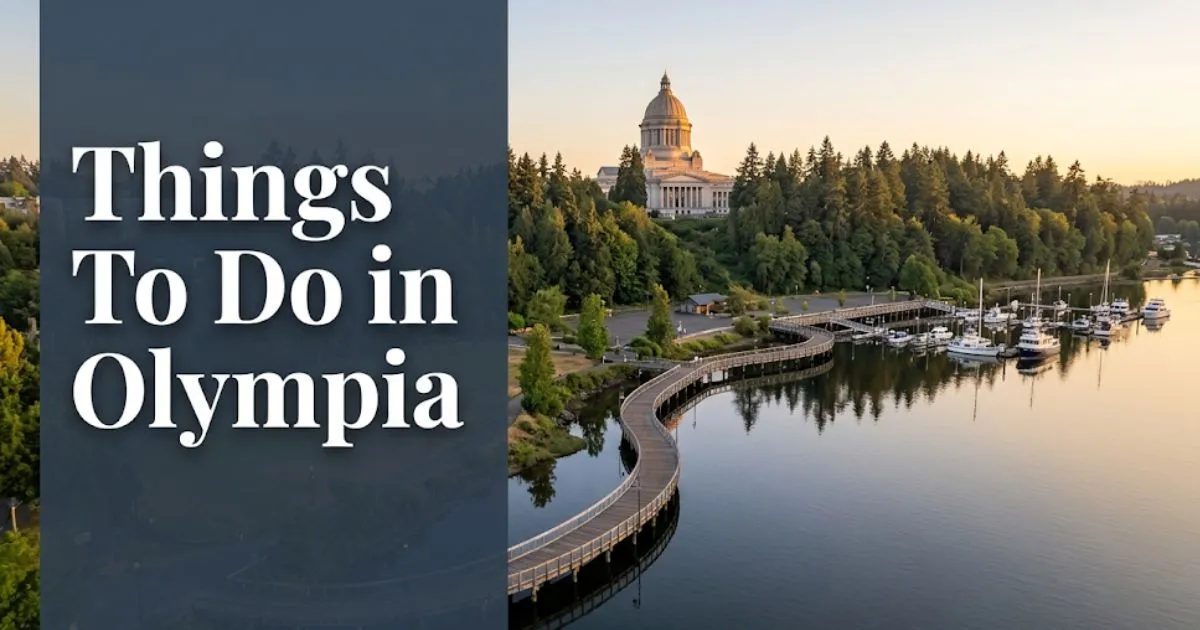
The best waterfront experience in Olympia centers on Percival Landing Park, a 1.5-mile boardwalk along Budd Inlet that connects downtown to the north end of the city near the farmers market.
This is not a sanitized tourist pier. It’s a genuine working waterfront with commercial vessels, kayakers, and locals on lunch walks.
The boardwalk offers direct views of Budd Inlet and, on clear days, views toward the Olympic Mountains to the northwest. Access is free and open year-round.
Capitol Lake, the freshwater impoundment south of downtown, is a different waterfront character entirely. The lake is visible from multiple points on Capitol Way but swimming is not permitted. The lakeside walking path offers views of the capitol dome reflected in the water on calm mornings.
For couples, the Percival Landing evening walk before or after dinner is the most genuinely romantic sequence available in Olympia. The light on Budd Inlet at dusk in summer is legitimately striking.
Families should know the northern end of the boardwalk connects directly to the Olympia Farmers Market grounds, making it a natural combination. Stroller access is fully navigable along the paved boardwalk.
What most waterfront guides miss: The Artesian Commons park at Artesian Road and Jefferson Street is two blocks from Percival Landing. A free-flowing natural artesian well there has become a community gathering point. Locals fill water jugs there. It’s an odd, genuine piece of Olympia’s local character that no tourist guide covers.
Kayak and stand-up paddleboard rentals are periodically available from outfitters near the marina area. Verify current rental operators through Visit Olympia before your visit, as providers have changed in recent years.
Capitol Campus Olympia: The State Capitol and Grounds
The Washington State Capitol Building, completed in 1928, is one of the most architecturally significant state capitol buildings in the United States, with a sandstone dome that ranks among the largest masonry domes in the world.
Free guided tours run regularly on weekdays and select weekends. Verify the 2026 tour schedule directly with the Washington State Legislature’s tour office before visiting, as schedules change seasonally.
The 30-acre Capitol Campus surrounding the building includes sunken rose gardens, war memorials, and the Capitol Conservatory greenhouse. The grounds are free to walk anytime.
The Tivoli Fountain on the west side of the campus is modeled on the Tivoli Gardens fountain in Copenhagen. It’s a detail most visitors walk past without noticing.
For history enthusiasts: The campus also includes the Temple of Justice, the Insurance Building, and the Governor’s Mansion. The mansion has limited public tour availability. Check the official Washington State Capitol website for 2026 access.
For couples: The capitol grounds are particularly good in late May and early June when the rose gardens are in bloom. Early morning on weekdays, the entire campus is nearly empty.
For seniors and accessibility travelers: The main capitol building has elevator access. The outdoor grounds involve some gentle slopes. Overall accessibility is good. Mobility aid users should confirm specific access points before visiting.
According to the Washington State Legislature’s visitor services, the capitol dome interior tour provides access to the 287-foot-high rotunda and is available on select tour types. Confirm availability for 2026 directly before planning.
Local alternative: Most visitors go directly to the capitol and miss the State Capitol Museum (Washington State Historical Society’s Olympia location) on West 21st Avenue, about six blocks south of the capitol. It covers Washington territorial and state history with genuine depth and typically draws few crowds.
Key Takeaway: The capitol building tour is free but time-limited by tour schedules. Pair it with the Artesian Commons and Percival Landing boardwalk on the same morning to cover all three efficiently without doubling back across downtown.
Olympia Farmers Market: The Local Institution
The Olympia Farmers Market operates Thursday through Sunday from April through mid-December, making it one of the longest-running and most active markets in Washington State.
It’s located at the north end of downtown on Capitol Way N, directly adjacent to Percival Landing. The combination walk is the single most efficient morning activity sequence in Olympia.
The market runs approximately 100 vendors during peak summer season. Local oysters from South Puget Sound farms, Dungeness crab, fresh produce from Thurston County farms, and handmade crafts dominate the vendor mix.
This is not a tourist market. The vendor base is primarily working regional farmers and food producers. Prices reflect that.
For food travelers: The ready-to-eat food vendor section along the southern end of the market is the best low-cost meal option in Olympia. Budget approximately $8 to $16 per person for a market breakfast or lunch.
For families: The market is stroller-friendly. Saturday mornings bring live music at the covered performance area. Children’s activity programming varies by weekend. Check the Olympia Farmers Market website for 2026 specific programming.
For budget travelers: The market is free to enter and browse. Prices on direct-farm produce are genuinely competitive with grocery store alternatives for the quality level.
Seasonal note: The market’s Thursday and Friday hours typically run shorter than weekend hours. Winter hours (mid-November through December) are reduced. Verify the 2026 seasonal schedule before planning a winter visit specifically around the market.
What experienced visitors do differently: They arrive at 9 AM on Thursday instead of 10 AM on Saturday. The vendor selection is nearly identical. The crowd is a fraction of the size.
Downtown Olympia WA: Neighborhoods, Streets, and Local Life
Downtown Olympia’s most interesting street-level activity concentrates along 4th Avenue East, from Capitol Way toward Eastside Street, and on Capitol Way between State Avenue and the waterfront.
This corridor functions as the genuine local commercial and social heart of the city.
The Eastside neighborhood, east of Capitol Way and centered around Eastside Street and 4th Avenue E, has a distinctly different character from the capitol-adjacent tourist zone. It’s where independent bookstores, used record shops, and local coffee culture concentrate.
Last Word Books on 4th Avenue E is an independent bookstore with a strong local following and a selection that reflects the city’s progressive academic character. This is the kind of shop that makes a city feel real.
Darby’s Cafe on Capitol Way has been a genuine neighborhood breakfast institution for years. It’s the kind of place where local government workers eat before 8 AM and tourists rarely find it.
For solo travelers: The 4th Avenue corridor from Plum Street to Jefferson Street is the most walkable and independently interesting stretch in the city. A two-hour walk with stops takes you through the brewery scene, independent retail, and the cafe culture that defines local Olympia life.
For couples: An evening dinner reservation at one of the farm-to-table restaurants in the 4th Avenue area followed by a walk to the waterfront at dusk is the most authentically Olympian date-night sequence available.
What the tourist-facing content misses: There are two distinct Olympias operating simultaneously. The Capitol Campus zone serves visitors. The Eastside corridor serves the city itself. Both are worth your time. But only one of them tells you what Olympia actually is.
Outdoor Things To Do in Olympia WA
Olympia’s outdoor activity options extend well beyond the downtown waterfront. The Chehalis Western Trail is a paved rail-trail running approximately 22 miles north from Olympia toward Lacey.
It’s flat, well-maintained, and one of the best cycling and walking corridors in Thurston County.
The Woodard Bay Natural Resources Conservation Area, about 7 miles northeast of downtown via Shincke Road, offers quiet forest and shoreline trails along the Henderson Inlet. This is a genuine local birding and walking site that almost no visitor content covers.
Capitol State Forest begins about 10 miles west of downtown. The forest offers mountain biking trails, hiking, and unpaved forest roads. The Capitol Peak area, at roughly 2,658 feet, is the highest accessible point in the forest and offers views of the Olympic Mountains and Mount Rainier on clear days.
For families: The Chehalis Western Trail is the best outdoor activity for families with young children. It’s flat, paved, and stroller-accessible. Bikes can be rented; verify current Olympia-area rental operators through Visit Olympia for 2026.
For seniors and accessibility travelers: The paved Chehalis Western Trail sections near Olympia and Lacey are fully accessible and flat. Woodard Bay’s main trail involves some uneven terrain. Capitol State Forest is not recommended for limited-mobility visitors.
Insider Tip:
- The Woodard Bay area has a resident harbor seal colony that hauls out on logs near the old mill pilings. Best viewing is low tide on quiet weekday mornings.
- Capitol Peak access road is unpaved and requires a vehicle with moderate clearance. Do not attempt in a standard sedan after heavy rain.
- The Chehalis Western Trail connects to Grass Lake Nature Park near Lacey, which has a short boardwalk loop over wetlands worth the 15-minute detour.
Key Takeaway: Olympia’s best outdoor experiences sit just outside the downtown core. Combining the Chehalis Western Trail with a Woodard Bay morning walk gives you a full outdoor day without driving more than 10 miles from downtown.
Billy Frank Jr. Nisqually National Wildlife Refuge
The Billy Frank Jr. Nisqually National Wildlife Refuge, managed by the U.S. Fish and Wildlife Service, sits approximately 10 miles northeast of downtown Olympia via Exit 114 on I-5.
It protects the largest river delta on Puget Sound and is one of the most significant Pacific flyway birding sites in the Pacific Northwest.
The refuge’s signature feature is a 1-mile boardwalk trail across the Nisqually River delta’s tidal flats. The 5.5-mile Twin Barns Loop extends further into the mixed habitat. Entrance fees are minimal; verify current rates with the U.S. Fish and Wildlife Service before visiting.
For birders: the refuge hosts over 300 documented bird species throughout the year. Peak waterfowl migration runs October through March. Bald eagles are resident year-round and consistently visible from the boardwalk.
For families: The boardwalk trail is flat and mostly suitable for older strollers. The visitor center has interpretive exhibits appropriate for children aged 5 and up. Allow 90 minutes minimum for the boardwalk loop.
For seniors and accessibility travelers: The main boardwalk is flat and paved. The Twin Barns Loop involves unpaved sections that can be muddy in winter. The paved boardwalk alone is fully wheelchair-accessible.
What most visitor guides get wrong: They list Nisqually as a nice day trip add-on. It is not an add-on. If wildlife and nature are any part of your travel interest, the refuge is the single strongest reason to include Olympia on a Pacific Northwest itinerary.
The refuge is significantly less visited than Olympic National Park or Mount Rainier. On weekday mornings, you may have the boardwalk almost entirely to yourself.
Seasonal note: Visit from October through March for waterfowl peak. Summer brings fewer birds but more comfortable walking conditions. Waterproof footwear is strongly recommended October through April regardless of forecast.
Wolf Haven International Olympia
Wolf Haven International is a nonprofit wolf sanctuary located approximately 12 miles south of downtown Olympia near Tenino, off Offut Lake Road.
It houses rescued gray wolves in naturalistic habitats and runs public tours that allow close-range observation of wolf packs in their living areas.
General admission covers a guided walking tour of the sanctuary grounds. Tour frequency and hours are seasonal. Advance reservations are strongly recommended in summer and on weekends year-round. Verify 2026 tour schedules and admission rates directly with Wolf Haven before visiting.
For families: Wolf Haven is the single best family-oriented paid attraction within 30 miles of Olympia. Children from age 4 upward typically find the experience genuinely engaging. The wolves are often active and visible during morning tours.
For couples: The sanctuary’s “Howl-In” programs, typically offered on select summer evenings, combine a tour with a bonfire and howling experience. These sell out weeks in advance. Check the 2026 event calendar well before planning.
For seniors and accessibility travelers: The tour route involves walking on gravel paths with some uneven sections. Overall terrain is relatively gentle. Contact Wolf Haven directly about specific accessibility accommodations.
The honest logistics reality: Wolf Haven is not on a public transit route. A car is required. From downtown Olympia, allow 20 to 25 minutes each way. Plan the visit as a morning activity and pair it with Tumwater Historical Park on the return to downtown, which adds only 10 minutes to the drive.
Insider Tip:
- Morning tours before 10 AM consistently produce more wolf activity than afternoon tours.
- The gift shop proceeds support sanctuary operations directly. It’s worth a browse even if you’re not a gift-shop person.
Mima Mounds Natural Area: The Prairie Mystery Near Olympia
The Mima Mounds Natural Area Preserve, managed by the Washington Department of Natural Resources, is one of the most geologically unusual landscapes in the Pacific Northwest.
It lies approximately 20 miles southwest of downtown Olympia via Highway 121.
The preserve protects a native prairie covered in thousands of rounded earthen mounds, each standing two to seven feet high and ten to thirty feet across. Their origin remains geologically debated. Leading theories involve frost heaving, gopher activity, or seismic processes over thousands of years.
The trail system is a 1-mile interpretive loop on a mostly flat but uneven natural surface. Access is free. Cell service is limited. Parking is at the trailhead off Waddell Creek Road SW.
For curious travelers: Mima Mounds is the single most unusual natural experience available within a day trip of Seattle. Nothing else in the Pacific Northwest looks like it.
For families: The mounds themselves fascinate most children aged 6 and up. The flat terrain makes it accessible. Bring snacks. The site has no on-site food or services.
Honest assessment of what to expect: This is not a dramatic landscape in the Mount Rainier or Olympic Coast sense. It is subtle and genuinely strange. Travelers who appreciate ecological curiosity will find it memorable. Those expecting dramatic scenery may feel underwhelmed.
Seasonal note: Spring (late March through May) is the best time to visit. Native wildflowers, including camas and chocolate lily, bloom across the prairie floor. Summer visits offer full trail accessibility. November through February can be very muddy. Waterproof boots are essential in wet months.
According to the Washington Department of Natural Resources, the Mima Mounds preserve is classified as a National Natural Landmark and is one of fewer than 600 such designations in the United States.
Key Takeaway: Mima Mounds and Nisqually refuge can be combined into a single day trip from downtown Olympia. Drive Nisqually first (northeast on I-5), then Mima Mounds (southwest on Highway 121). Total drive time is under two hours combined.
Olympia Breweries and Beer Scene
Olympia’s craft brewery scene is genuinely rooted in the city’s independent culture, not assembled for tourism. The scene concentrates primarily in the downtown core and is walkable if you base yourself near 4th Avenue.
Fish Tale Brew Pub on Jefferson Street is the anchor of the local scene. Owned by Fish Brewing Company, it has been operating in Olympia since the early 1990s. The pub serves a rotating selection of Fish Brewing’s ales and lagers alongside pub food. The back bar is local-facing and unpretentious.
Brotherhood Brewery on Capitol Way N operates as both a production brewery and taproom. Their location near the farmers market makes it a natural afternoon stop after a market morning.
The broader South Puget Sound craft beer corridor also includes options in nearby Tumwater and Lacey. A car or rideshare expands the options significantly.
For solo travelers: The bar seating at Fish Tale Brew Pub is the most socially comfortable solo drinking environment in Olympia. Staff are genuinely friendly rather than performatively so.
For couples: The Brotherhood taproom has more relaxed evening seating and a slightly more date-appropriate atmosphere than Fish Tale’s pub setting.
For budget travelers: Both establishments serve pints at typical Pacific Northwest craft beer prices, generally in the $6 to $9 range per pint as of recent years. Verify current pricing before visiting.
What the visitor content misses: Olympia has a genuine brewing history predating the craft beer movement. The historic Olympia Brewing Company (founded 1896) operated in Tumwater before eventually closing. The Tumwater Historical Park near the old brewery site commemorates that history. It’s worth a 45-minute visit for anyone interested in the city’s industrial character.
Insider Tip:
- Fish Tale Brew Pub gets busiest Thursday through Saturday after 6 PM. Arrive before 5:30 PM for easier seating.
- Brotherhood Brewery’s taproom hours can vary seasonally. Call ahead or check their current schedule before making it a primary destination.
Free Things To Do in Olympia WA
Olympia is one of the most budget-friendly Pacific Northwest destinations for free and low-cost activity. The majority of its highest-quality experiences cost nothing.
Free activities concentrate in four areas: the capitol campus, the waterfront, the natural areas, and the market.
Fully free experiences in Olympia:
- Percival Landing boardwalk: open year-round, no cost
- Washington State Capitol grounds: free to walk any time; guided interior tours are free but verify tour schedule before visiting
- Artesian Commons: free, always open
- Chehalis Western Trail: free for walking and running; cycling requires a bike
- Woodard Bay Natural Resources Conservation Area: free access
- Mima Mounds Natural Area Preserve: free access
- Capitol Lake walking paths: free access
- Olympia Farmers Market: free to enter and browse
Low-cost experiences (minimal admission):
- Billy Frank Jr. Nisqually National Wildlife Refuge: minimal day-use fee; verify 2026 rates with U.S. Fish and Wildlife Service
- State Capitol Museum: low admission; verify current rates
- Hands-On Children’s Museum: moderate admission; free for children under two
For budget travelers: A full day in Olympia combining the capitol campus, Percival Landing, the artesian well, and the farmers market costs literally nothing beyond food and transportation.
The Chehalis Western Trail plus Woodard Bay adds a second full free day.
Nisqually refuge is the only natural site with a meaningful admission consideration. It remains exceptional value for what it delivers.
Honest note for budget travelers: Olympia’s paid accommodation options are adequate but not cheap relative to the city’s size. Budget travelers doing the math should compare Airbnb options in Olympia with the Hampton Inn and Holiday Inn Express options, which frequently run competitive rates and include parking.
Family Things To Do in Olympia WA
Olympia is genuinely good for families with children aged 4 and up. It’s less immediately obvious than a beach destination but rewards families who engage with its specific mix of nature, history, and hands-on experiences.
The Hands-On Children’s Museum of Olympia on Franklin Street NE is the primary purpose-built family attraction downtown. It features interactive exhibits designed for children roughly ages 2 through 10. Admission is charged. Verify 2026 pricing and hours directly with the museum before visiting.
Wolf Haven International is the second anchor family experience. Children consistently engage with the close-range wolf observation. Morning tours produce the best activity levels. Book ahead.
The Billy Frank Jr. Nisqually National Wildlife Refuge boardwalk works for families with children ages 5 and up. Binoculars make the bird observation more engaging for older kids. The visitor center has exhibits appropriate for children.
For families with toddlers: Percival Landing boardwalk and the Olympia Farmers Market (with its food stalls and occasional weekend entertainment) are the most toddler-tolerant options. Both are flat, open, and easy to exit if a meltdown occurs.
For families with teens: Capitol State Forest’s mountain biking trails add an adrenaline option. Mima Mounds’ geological strangeness tends to capture curious older children more than younger ones.
What family content gets wrong about Olympia: Most lists suggest the capitol building tour for families with young children. In practice, children under 10 typically disengage within 20 minutes of a government history tour. Wolf Haven and Nisqually are significantly more effective at holding children’s genuine attention.
Suggested family sequence for a single day:
- Olympia Farmers Market (breakfast, 9 to 10:30 AM)
- Hands-On Children’s Museum (10:30 AM to 12:30 PM)
- Lunch on 4th Avenue
- Percival Landing walk (early afternoon)
- Nisqually refuge boardwalk (late afternoon, allow 90 minutes)
Key Takeaway: Families get more from Olympia by anchoring the day at Wolf Haven or Nisqually first, then returning to downtown for the market and museum. Reversing the typical tourist order prevents afternoon fatigue from ruining the outdoor portion.
Day Trips From Olympia WA
Olympia’s I-5 corridor location makes it one of the most strategically placed day trip bases in Washington State. Mount Rainier, the Olympic Peninsula, and the coast are all within 90 to 150 minutes.
Mount Rainier National Park: The Nisqually Entrance at the park’s southwest corner is approximately 65 to 70 miles east of Olympia via Highway 7 and Highway 706. Drive time runs 90 to 120 minutes depending on traffic. Entry requires a park pass; the America the Beautiful annual pass covers all federal sites and pays for itself quickly if you visit more than one national park in a year.
The Olympic Peninsula: The drive to Port Townsend or the Hurricane Ridge area of Olympic National Park runs approximately 90 to 120 minutes from Olympia via US-101 north. Hood Canal along this route offers additional stops including the Theler Wetlands in Union and the towns of Shelton and Hoodsport.
Long Beach Peninsula: Washington’s Pacific coast beaches begin approximately 90 miles southwest of Olympia via US-101 and Highway 4. Long Beach is the most accessible coastal town. Cape Disappointment State Park at the southwest tip offers Lewis and Clark history and dramatic Pacific surf.
Tacoma: Just 30 miles north on I-5. The Museum of Glass in downtown Tacoma and the Washington State History Museum are both genuinely strong one-day destinations accessible without a full day’s drive.
For budget travelers: The Tacoma day trip is the most cost-efficient. Free parking is available near the waterfront. Museum admission is modest. The drive is under 45 minutes.
For families: Mount Rainier’s Longmire area and Paradise visitor center are well-suited for families. Confirm 2026 timed-entry permit requirements directly with the National Park Service before visiting; Mount Rainier has introduced reservation systems that change periodically.
What most day trip guides miss: The Olympia to Shelton route via Highway 101 passes through Mason County’s working oyster farms and small waterfront communities. Shelton itself has a modest downtown and the Skookum Inlet tideflats visible from several pullouts. It’s a genuinely Pacific Northwest drive without the crowds of the Olympic Peninsula proper.
Best Time To Visit Olympia WA
The best time to visit Olympia, WA is late June through September, when rainfall drops significantly, temperatures reach the comfortable 65 to 80°F range, and all outdoor sites operate at full capacity.
This is also when the farmers market hits its peak vendor count and the Capitol grounds rose gardens are in full bloom (late May through June).
Month-by-month honest breakdown:
| Month | Weather Reality | Crowds | Best Activity |
|---|---|---|---|
| Jan–Feb | Cold, frequently rainy | Very low | Indoor sites only |
| March | Cool, rain easing | Low | Capitol Museum, breweries |
| April–May | Mild, occasional rain | Moderate | Mima Mounds wildflowers, Nisqually |
| June | Warming, drying | Moderate-high | All activities at good levels |
| July–Aug | Warm, dry, sunny | Peak | Everything; book Wolf Haven early |
| September | Excellent, drying | Moderate | Best balance of weather and crowds |
| October | Cooling, rain returning | Low-moderate | Nisqually peak waterfowl season |
| Nov–Dec | Rainy, cool | Low | Farmers market (limited), indoor focus |
The worst time to visit for outdoor-focused travelers is November through February. The city doesn’t shut down, but persistent grey skies and rain make the natural sites significantly less enjoyable. Capitol Lake and Percival Landing lose their visual appeal in heavy overcast.
The contrarian case for October: Nisqually refuge’s waterfowl migration peaks October through November. Birders specifically targeting the refuge should consider October despite the wetter conditions. Crowds are minimal.
Booking lead time guidance: Summer weekends (July and August) require advance hotel reservations, particularly if a festival or legislative event coincides with your visit. Most Olympia accommodation books out faster than travelers expect for a city its size. Reserve 4 to 6 weeks ahead for summer weekend visits.
For families: July offers the most predictably dry weather and the most consistent activity access across all sites. August runs a close second.
Safety and Practical Warnings for Olympia WA
Olympia is a low-risk urban destination by Pacific Northwest standards, but several specific practical conditions affect the visitor experience in ways most travel guides don’t address.
Key safety and practical facts every visitor should know:
- Swimming in Capitol Lake is not permitted. The lake’s water quality and dam management make it unsuitable for swimming or water contact. This catches visitors off guard.
- Trail conditions at Nisqually refuge can be slippery October through March. Waterproof footwear with grip is essential. Worn sneakers on wet wooden boardwalk sections are a genuine fall risk.
- Mima Mounds has no cell service and no on-site facilities. Carry water, bring a paper map or download an offline map before arriving, and let someone know your plans if visiting alone.
- Capitol State Forest roads are unpaved. Do not access forest roads in a standard low-clearance sedan after rain. Mud conditions can trap vehicles quickly.
- Downtown Olympia has localized urban safety considerations. The area around 4th Avenue and Jefferson Street near the artesian well and Transit Center has a visible homeless population. The area is not dangerous by Pacific Northwest urban standards but can feel uncomfortable for travelers unfamiliar with West Coast urban environments.
- Wolf Haven’s gravel paths can be uneven. Visitors with mobility limitations should contact the sanctuary in advance to discuss route options.
- Weather changes rapidly in the South Puget Sound lowlands. Even in summer, mornings can be foggy and cool. Always carry a waterproof layer.
Thurston County Emergency Management provides local emergency information. For national park emergencies during Mount Rainier day trips, contact the National Park Service at the park’s ranger station.
Frequently Asked Questions About Things To Do in Olympia WA
What is Olympia WA known for?
Olympia, WA is known as Washington State’s capital city, home to the Washington State Capitol Building and the Olympia Farmers Market.
It’s also known for its proximity to exceptional natural sites including the Billy Frank Jr. Nisqually National Wildlife Refuge and the Mima Mounds Natural Area Preserve.
The city has an established independent craft brewery culture and a walkable downtown with a distinctly local, non-touristy character.
How many days do you need in Olympia Washington?
Two full days is the right amount for a complete Olympia visit that covers the city’s top experiences without rushing.
Day one covers the capitol campus, Percival Landing, the farmers market, and downtown. Day two covers Nisqually refuge and either Mima Mounds or Wolf Haven depending on traveler preference.
A single day is enough if you focus exclusively on downtown and skip the nature sites, but you’ll leave having missed Olympia’s strongest experiences.
Is Olympia WA worth visiting?
Olympia is worth visiting for budget-conscious Pacific Northwest travelers, nature enthusiasts, families, and anyone wanting an authentic small-city experience without Seattle’s prices or crowds.
It’s not worth a dedicated trip for luxury travelers or those expecting a dense urban entertainment scene.
The combination of free natural access at Nisqually and Mima Mounds with a genuinely local food and brewery culture makes it one of the most undervalued weekend destinations in western Washington.
What is the best time of year to visit Olympia Washington?
The best time to visit Olympia, Washington is June through September, when rainfall is minimal and temperatures are comfortable.
Late May and early June are also excellent for the capitol rose gardens and the start of Mima Mounds wildflower season.
October is the best month specifically for birding at Nisqually refuge, despite the wetter conditions.
Is Olympia Washington good for families?
Olympia is a good family destination for children aged 4 and up, primarily because of Wolf Haven International, the Hands-On Children’s Museum, and the accessible nature trails at Nisqually National Wildlife Refuge.
Families with toddlers find the farmers market and Percival Landing boardwalk the most practical options. The overall pace of Olympia suits young children better than a dense urban destination.
Book Wolf Haven tours in advance for summer visits. Walk-in availability is limited on summer weekends.
What are the best free things to do in Olympia WA?
The best free things to do in Olympia include the Percival Landing boardwalk, the Washington State Capitol grounds and free interior tours, the Artesian Commons natural spring, the Chehalis Western Trail, Mima Mounds Natural Area Preserve, and browsing the Olympia Farmers Market.
The Woodard Bay Natural Resources Conservation Area provides free trail access to forested shoreline less than 10 miles from downtown.
Combining these free sites across two days gives budget travelers a full Olympia experience at essentially no cost beyond food and transportation.
Plan Your Olympia Trip with the Right First Move
Start your Olympia planning by reserving Wolf Haven tours and any Mount Rainier day-trip logistics first. Both book up faster than travelers expect, particularly from June through August.
Book accommodations at least four to six weeks ahead for summer weekend visits. Hotel inventory in Olympia is limited relative to demand during peak season.
Prices, tour schedules, farmers market hours, refuge entry fees, and trail conditions all change seasonally. Verify key logistics directly with each venue, the Visit Olympia tourism office, and official agency websites before departure. This guide reflects 2026 conditions as of research, but travel details shift.
Olympia rewards the traveler who looks past the capitol dome. The city’s real value sits in its wildlife refuges, its prairie preserve, and its genuinely local street-level culture. Go with that knowledge, and you’ll leave having seen the actual city.