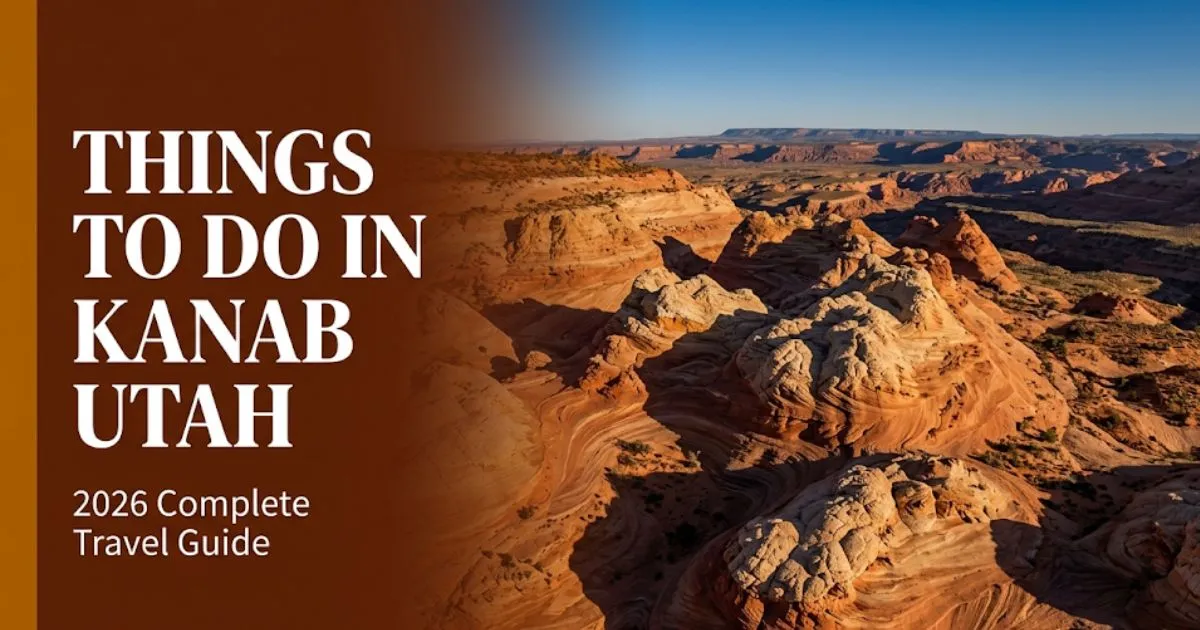
Things to Do in Kanab, Utah: The 2026 Complete Guide

The best things to do in Kanab, Utah extend far beyond any single national park. This small southern Utah town of roughly 5,000 residents sits within a two-hour drive of five distinct natural wonder zones.
Kanab is the practical basecamp for one of North America’s most concentrated corridors of canyon country geology. The Bureau of Land Management administers some of its most extraordinary formations directly from this area.
This guide covers outdoor activities, permit logistics, day trip strategy, town culture, dining, lodging, seasonal timing, and a two-to-three day itinerary framework. Every section names specific places with specific practical detail.
Things to Do in Kanab, Utah: What Makes This Town Different
Kanab, Utah sits at the geographic center of the American Southwest’s most dramatic canyon country. No comparable town gives a visitor simultaneous access to Zion, Bryce Canyon, the Grand Canyon North Rim, and the Vermilion Cliffs from one address.
The town itself is small. One main commercial corridor runs along Center Street and US-89.
What surrounds it is genuinely extraordinary. Slot canyons, rolling sandstone formations, pink sand dunes, and ancient geological strata extend in every direction from the town limits.
This is not a resort destination. Kanab rewards travelers who come prepared with permits, a capable vehicle, and respect for desert conditions.
Kanab Visitor Center, managed by Kane County, sits at 78 S. 100 E. in the center of town. Staff there provide current road condition reports and BLM permit updates.
Insider Tip:
- Stop at the Visitor Center on day one. Road conditions on dirt routes to White Pocket and other BLM sites change after rain.
- Ask specifically about current wire pass trailhead access. It sometimes closes without wide notice.
- Solo travelers especially benefit from this stop. Cell service disappears within miles of most trailheads.
Best Things to Do in Kanab for Every Traveler Type
Kanab’s activity range is genuinely wide, but each experience suits a specific traveler profile rather than all visitors equally.
The table below maps the top activities to the traveler types they suit best.
| Activity | Best For | Cost Range (Approx.) | Time Required | Key Logistics |
|---|---|---|---|---|
| The Wave / Coyote Buttes North | Experienced hikers, photographers | Permit fee approx. $7-9/person plus lottery time | Full day | BLM permit required; Recreation.gov lottery |
| White Pocket | Photographers, 4WD enthusiasts | Free entry (BLM land) | Half to full day | High-clearance 4WD required; no permit |
| Buckskin Gulch | Experienced hikers | Day permit approx. $6-8/person | Full day | Wire Pass trailhead; flash flood risk |
| Coral Pink Sand Dunes | Families, seniors, budget travelers | State park day-use fee approx. $15-20/vehicle | 2-4 hours | Paved access; ADA restrooms; OHV rentals available |
| Moqui Cave | Families, history buffs, rainy day | Admission approx. $5-8/person | 1-2 hours | Privately operated; paved access; climate-controlled |
| Johnson Canyon Road | Couples, road trippers, casual hikers | Free | 1-3 hours | Paved with some dirt sections; Gunsmoke film set ruins |
| Grand Staircase-Escalante hiking | Serious hikers, photographers | Free (some trailheads) | Variable | Cottonwood Canyon Road requires high clearance |
| Zion National Park day trip | All profiles with planning | Park entrance fee applies | Full day | East entrance 80 miles; shuttle required in peak season |
Solo travelers find Kanab’s outdoor activities safest when paired with a trail buddy or guided tour. Remote trailheads have no emergency services.
Families with young children should prioritize Coral Pink Sand Dunes and Moqui Cave. Most slot canyon hikes are not stroller-accessible and involve scrambling.
Hiking Near Kanab, Utah
The best hiking near Kanab, Utah centers on BLM-managed public lands and the eastern edges of Grand Staircase-Escalante National Monument. These are not manicured trail systems.
Wire Pass Trailhead, located approximately 40 miles south of Kanab on House Rock Valley Road, provides the most accessible slot canyon experience in the region.
The Wire Pass to Buckskin Gulch route covers roughly 1.7 miles one-way before entering the main Buckskin Gulch narrows. The slot canyon walls reach 500 feet in height and as narrow as 3 feet in width.
Day permits are required for this trailhead. Purchase through Recreation.gov in advance or at the BLM Kanab Field Office.
Seniors and accessibility travelers should note that Buckskin Gulch involves boulder obstacles, log jams, and standing water depending on season. This is not a mobility-aid-accessible route.
Budget travelers will find Wire Pass one of the most cost-effective slot canyon experiences in southern Utah. The permit fee is minimal compared to the commercial slot canyon tours near Page, Arizona.
Insider Tip:
- Start Wire Pass before 8:00 a.m. in spring and fall. The light inside the narrows is best in mid-morning.
- Buckskin Gulch is the longest slot canyon in North America. Many visitors hike only the first mile and miss the most dramatic narrows section.
- Check weather for a 100-mile radius before entering. Flash floods in distant rainstorms can reach Buckskin Gulch with no local warning.
The Wave Permit and Coyote Buttes North Access
The Wave, located within Coyote Buttes North in the Vermilion Cliffs National Monument, is the single most visually iconic formation accessible from Kanab. Getting there requires a BLM permit that most visitors never obtain.
The Bureau of Land Management manages 64 permits per day for Coyote Buttes North. Demand exceeds supply by a factor of hundreds to one during peak season.
How to apply for The Wave permit:
- Create a free Recreation.gov account at least one day before your desired entry date.
- Enter the advance online lottery, which opens four months before the desired date. Results are announced approximately one month after the lottery closes.
- If unsuccessful in the advance lottery, enter the day-before online lottery. Results are announced the evening before the hike date.
- If a permit is secured, download the map PDF provided by BLM. There is no trail marking at The Wave.
- Arrive at the Wire Pass trailhead by 7:00 a.m. The round-trip hike is approximately 6 miles with no shade.
According to the Bureau of Land Management Utah, the advance online lottery for Coyote Buttes North receives thousands of applications for 48 permits per lottery period (the remaining permits go to in-person and day-before lotteries).
Couples who enter the lottery together as a group have better odds than solo applicants statistically, since group permits cover multiple people without proportional competition increase.
Most first-time visitors to Kanab do not get a Wave permit. Plan White Pocket as your primary geological photography destination and treat The Wave as a bonus if luck favors your application.
Slot Canyons Near Kanab
The slot canyons accessible from Kanab, Utah include some of the most dramatic narrow canyon formations in the American Southwest, with far fewer crowds than the commercial Antelope Canyon operations near Page, Arizona.
Buckskin Gulch is the premier slot canyon experience in this region. At approximately 21 miles total length, it is the longest slot canyon in North America.
Wire Pass slot canyon, accessed from the same trailhead as Buckskin Gulch, provides a shorter and equally dramatic narrow canyon section. The Wire Pass narrows begin within half a mile of the trailhead.
Both require day-use permits from the BLM Kanab Field Office, located at 669 S. Highway 89A in Kanab. Purchase permits in advance on busy spring weekends.
Budget travelers comparing Kanab slot canyons to Antelope Canyon near Page should note a significant difference. Antelope Canyon tours run approximately $80 to $100 per person through commercial operators. BLM day permits for Wire Pass and Buckskin Gulch run a fraction of that cost.
The honest comparison: Antelope Canyon’s Upper section delivers easier access, guided explanation, and longer light beam windows. Buckskin Gulch delivers longer, deeper, more solitary, and arguably more authentic slot canyon immersion for experienced hikers.
Insider Tip:
- The Paria Canyon-Vermilion Cliffs Wilderness also includes a multi-day backpacking route through Paria Canyon itself, 38 miles from White House Trailhead to Lee’s Ferry.
- Paria Canyon requires an overnight permit and a shuttle vehicle. It is one of the most spectacular multi-day desert canyon hikes in North America.
- This experience suits experienced backcountry hikers only. No water sources should be assumed safe without filtration.
Key Takeaway: Wire Pass is the fastest way to experience a genuine slot canyon from Kanab. Book a BLM day permit in advance for spring and fall weekends or plan to arrive at the trailhead before 7:00 a.m.
White Pocket and Vermilion Cliffs National Monument
White Pocket is the most underrated geological photography destination near Kanab, and the best alternative for visitors who do not obtain a Wave permit. It sits within Vermilion Cliffs National Monument in northern Arizona, approximately 55 miles south of Kanab.
No permit is required for White Pocket. A high-clearance 4WD vehicle is essential. The access road is deep sand for the final several miles.
The formations at White Pocket include swirling polished sandstone in cream, rust, and burgundy tones. The landscape looks structurally different from The Wave but delivers comparable visual impact.
According to the Bureau of Land Management Arizona Strip Field Office, White Pocket is managed as a primitive recreation area with no facilities, no water, and no cell service.
Photography travelers will find White Pocket superior to The Wave in one practical respect. No time pressure exists. Visitors can spend the full day exploring the formation without a lottery clock running.
Rental car travelers should verify their vehicle’s 4WD capability before booking this route. Most standard rental SUVs are not rated for deep sand. Kanab has no local 4WD-specific rental operators as of this writing. Las Vegas rental agencies offer more capable options.
The Paria Plateau overlook, accessible on the paved Paria Road (Scenic Byway) off US-89, provides a no-4WD viewpoint across the Vermilion Cliffs for travelers without a capable vehicle.
Insider Tip:
- Go to White Pocket on a weekday. Spring weekends bring small but growing crowds, even without a permit requirement.
- The golden hour light at White Pocket is at its most dramatic in late afternoon. Plan to arrive by 3:00 p.m. for a two-hour sunset session.
- Bring at least two gallons of water per person. No water is available within 30 miles.
Coral Pink Sand Dunes State Park
Coral Pink Sand Dunes State Park is the most accessible major natural attraction near Kanab, requiring no permit, no 4WD vehicle, and minimal hiking ability. It sits approximately 12 miles southwest of Kanab via Hancock Road.
The dunes rise up to 700 feet and glow in shades of apricot and salmon in direct afternoon light. The coloring comes from iron oxide in the Navajo sandstone that forms the dune field.
Utah State Parks operates the area with a paved entrance road, ADA-accessible restrooms, and a campground. Day-use fees apply and are payable at the entrance kiosk.
Families with young children will find Coral Pink Sand Dunes the most practical major activity near Kanab. Children can run freely on the dunes, and the soft sand surface is forgiving for falls. OHV and ATV rentals are available in the area for a more active experience.
Seniors and accessibility travelers should note that the paved parking area and restroom facilities are wheelchair accessible. The dunes themselves require walking on soft sand, which can challenge mobility aids, but the view from the paved overlook is worthwhile without dune walking.
According to Utah State Parks, the dunes are most photographically active in morning and late afternoon light when the low angle emphasizes the color and texture.
Insider Tip:
- Visit early morning on a summer day. By noon, the sand surface temperature can reach extreme levels underfoot.
- Sandboarding on the dunes is informally practiced but boards are not rented at the park itself. Bring your own or check Kanab’s outdoor retailers.
- The dunes are less crowded on weekday mornings even during peak season.
Key Takeaway: Coral Pink Sand Dunes is the best choice for families, seniors, or any traveler who needs a no-permit, no-4WD, high-visual-impact experience within 20 minutes of Kanab.
Grand Staircase-Escalante National Monument
Grand Staircase-Escalante National Monument covers 1.87 million acres of Utah canyon country with its western edge approximately 20 miles east of Kanab. It offers multi-day backcountry hiking, geological layer exploration, and paleontological sites accessible without permits on most day hikes.
Cottonwood Canyon Road is the primary access route from the Kanab area. It runs approximately 46 miles between Kanab and Cannonville and crosses some of the monument’s most dramatic geology. A high-clearance vehicle is strongly recommended. The road becomes impassable after rain.
The Wahweap Hoodoos trailhead sits approximately 20 miles northeast of Kanab off US-89. The 5.5-mile round-trip hike leads to a cluster of white rock hoodoos rising from red canyon terrain. No permit required.
Serious hikers should note that Calf Creek Falls in the Escalante River corridor (approximately 85 miles northeast of Kanab) is among the most dramatic waterfall hikes in Utah. The 5.5-mile round-trip route passes petroglyphs and ends at a 126-foot waterfall. Day-use fees apply.
Budget travelers will find Grand Staircase-Escalante the best free or low-cost outdoor experience near Kanab. Most trailheads charge no fee. The Kanab Visitor Center distributes free monument maps.
According to the National Park Service, which co-administers the monument with the BLM, visitor facilities at Grand Staircase-Escalante are minimal. No visitor centers are located within the monument itself near Kanab. The Big Water Visitor Center on US-89 east of Kanab provides the most accessible information stop.
Insider Tip:
- Cottonwood Canyon Road after rain is genuinely dangerous. The road turns to deep clay mud that traps vehicles regardless of 4WD capability.
- Ask at the Kanab Visitor Center about current road conditions each morning before driving into the monument.
- Spring wildflower blooms at Grand Staircase from late April through May rival anything in the Utah canyon country corridor.
Kanab Day Trips: Zion, Bryce Canyon, and the North Rim
Kanab’s geographic position makes it the most strategically located basecamp in the entire Utah and northern Arizona canyon corridor. Three of the American West’s most iconic national parks sit within 80 to 85 miles.
| Day Trip Destination | Distance from Kanab | Drive Time (Approx.) | Best Season | Key Note |
|---|---|---|---|---|
| Zion National Park (East Entrance) | ~80 miles west | 1.5 hours | March-May, Sept-Nov | Shuttle required in peak season; East entrance avoids main canyon traffic |
| Bryce Canyon National Park | ~80 miles north | 1.5 hours | May-Oct; snowshoe in winter | Elevation 8,000+ feet; significantly cooler than Kanab |
| Grand Canyon North Rim | ~80 miles south | 1.5 hours | Mid-May through Oct | North Rim closes approximately Nov 1; lodge reservations scarce |
| Page, Arizona (Lake Powell, Antelope Canyon) | ~75 miles east | 1.25 hours | Year-round | Antelope Canyon tours book weeks in advance |
| Vermilion Cliffs Scenic Highway (US-89A) | Begins 5 miles south | 30 min to Jacob Lake | Year-round (check winter) | Free scenic drive; no permits; dramatic cliff views |
Families planning a Zion day trip from Kanab should enter via the east (Zion-Mt. Carmel Highway) side. This avoids the main canyon shuttle parking congestion. The Canyon Overlook Trail near the east entrance is 1 mile round-trip and genuinely suitable for children over age 6.
Couples choosing between Bryce Canyon and the North Rim should consider this: Bryce Canyon’s hoodoo rim walk at sunrise is operationally easy and visually exceptional. The North Rim rewards travelers with fewer people, more wildlife, and a rawer canyon experience.
The North Rim closes approximately November 1 each year. Verify the exact 2026 opening and closing dates with the National Park Service before including it in a late-season itinerary.
Key Takeaway: Structure Kanab day trips so no two destinations are in the same direction on the same day. Zion goes west, Bryce goes north, the North Rim goes south. Each direction requires a full day.
Kanab’s Town Culture, History, and Little Hollywood
Kanab has a genuine film history that most outdoor-focused visitors overlook. More than 200 Western films and television productions used the canyon country outside Kanab as a set from the 1920s through the 1970s.
Parry Lodge on Center Street served as the lodging headquarters for Hollywood productions shooting in the area. Room placards identify which actors stayed in each room. Ronald Reagan, John Wayne, Frank Sinatra, and Clint Eastwood all spent production time in Kanab.
The Johnson Canyon Road ghost town set, accessible approximately 10 miles north of Kanab on Johnson Canyon Road, contains the remains of a Western town built for film productions. The ruins are on private land with posted viewing access from the road. Verify current access status before visiting.
Moqui Cave, located 5 miles north of Kanab on US-89, is a privately operated sandstone cave filled with fluorescent minerals, Native American artifacts, and dinosaur tracks. It runs approximately 90 to 120 minutes and operates on seasonal hours. Verify current hours before visiting.
Families and rainy-day visitors should prioritize Moqui Cave when weather prevents outdoor activities. It is climate-controlled and genuinely interesting for children interested in geology and natural history.
Budget travelers note that Moqui Cave admission is modest. It delivers more education per dollar than most of Kanab’s paid experiences. The admission fee was in the range of $5 to $8 per person as of recent years.
Insider Tip:
- Kanab’s annual Western Legends Roundup (held in August, typically) brings cowboy music, Western art, and film history events to town.
- The Kane County Hospital is Kanab’s primary medical facility. For serious emergencies, St. George Regional Medical Center is approximately 75 miles away.
- Downtown Kanab is walkable on Center Street. The entire commercial district covers roughly four blocks.
Where to Eat in Kanab, Utah
Kanab’s dining scene is limited in quantity but has two standout options that consistently exceed expectations for a town of its size.
Rocking V Cafe, at 97 W. Center Street, is the town’s most respected full-service restaurant. The menu leans toward New American with locally sourced ingredients. Expect entree prices in the $18 to $30 range as of recent years. Reservations are advised for dinner.
Nedra’s Too, at 310 S. 100 E., is the local choice for casual Mexican food with a loyal local following. Portions are large, prices are low, and it operates earlier hours than most town restaurants.
Willow Canyon Outdoor, at 263 S. 100 E., functions as both an outdoor gear shop and a coffee and breakfast counter. It is the most useful single stop on a Kanab departure morning.
Budget travelers should note that Kanab has no significant fast food corridor. Grocery stocking at the local City Market on Center Street is the most cost-effective approach for multi-day canyon trips.
Solo travelers will find Rocking V Cafe genuinely comfortable for solo dining. The bar seating and relaxed pacing make it less awkward than many destination dinner experiences.
Insider Tip:
- Rocking V Cafe fills up fast on Friday and Saturday nights in spring and fall. Call ahead or arrive before 6:00 p.m.
- The cafe closes seasonally. Verify current operating hours before planning an arrival or departure dinner there.
- Several Kanab restaurants close in January and February. Confirm hours before your trip during winter months.
Key Takeaway: Rocking V Cafe is worth planning dinner around. Call ahead for spring weekend reservations and arrive early. It is the only full-service dinner destination in town that consistently delivers.
Where to Stay in Kanab, Utah
Kanab’s lodging is dominated by independent motels, a handful of newer boutique-style properties, and campgrounds for self-contained travelers.
Parry Lodge, at 89 E. Center Street, is the historic choice. The 1929 property is modest in amenities but high in character. It is the only Kanab lodging with a genuine historical connection to the film era.
Canyons Boutique Hotel, at 190 N. 300 W., is the most polished independent property in town. Room rates run approximately $150 to $250 per night in peak season as of recent years. It books out weeks in advance for spring weekends.
The Coral Cliffs and Quail Park Lodge offer mid-range options with outdoor pools, which matter significantly in summer months.
Budget travelers and self-contained vehicle campers will find Coral Pink Sand Dunes State Park Campground the most scenic overnight option near town. Reserve through Utah State Parks in advance for spring and fall weekends.
Families should confirm child policies and bed configurations when booking Kanab properties. Several smaller motels have limited family room options.
According to the Kane County Office of Tourism, Kanab’s peak lodging demand runs from mid-March through Memorial Day and from Labor Day through mid-October. Book lodging a minimum of six to eight weeks in advance for these periods.
Insider Tip:
- Several Kanab properties have strict no-pet policies despite the outdoors-focused visitor base. Verify pet policies before booking if traveling with a dog.
- RV travelers will find more hook-up options at Kanab RV Corral at 483 S. 100 E. than at the state park campground.
Best Time to Visit Kanab, Utah
The best time to visit Kanab, Utah is mid-March through early June or mid-September through early November.
| Month | Temp Range (Approx.) | Crowds | Access | Key Consideration |
|---|---|---|---|---|
| Jan-Feb | 20-50°F | Low | Limited backcountry | Many restaurants reduce hours; North Rim closed |
| March | 35-65°F | Moderate, rising | Full | Wave lottery competitive; wildflowers beginning |
| April-May | 50-80°F | High | Full | Best overall conditions; Grand Staircase wildflowers peak |
| June | 70-100°F | Moderate | Full | Heat building; early morning hikes essential |
| July-Aug | 85-105°F | High | Full (with heat risk) | Flash flood season; extreme heat; avoid midday outdoor activity |
| September | 60-90°F | Moderate | Full | Excellent light; temperatures dropping; one of the best months |
| October | 45-75°F | Moderate-Low | Mostly full | North Rim closes approximately Nov 1; fall foliage in Bryce |
| Nov | 30-55°F | Low | Reduced backcountry | Some roads close post-rain |
| December | 20-45°F | Very Low | Limited backcountry | Fewest services; quiet; some closures |
Photography travelers consistently rate October as the single best month. The light quality, reduced crowds, and comfortable temperatures combine most favorably.
Families with children will find April and May the most practical months. Temperatures allow full-day outdoor activity without extreme heat management. Spring wildflowers at Grand Staircase add a visual bonus unavailable in fall.
Budget travelers benefit from late October through early November. Lodging rates drop as peak season ends. Most major attractions remain open, and crowds are minimal.
Kanab, Utah Itinerary: How to Plan 2 to 3 Days
A two-to-three day Kanab itinerary works best when organized by geographic direction from town. This prevents doubling back and maximizes daily drive efficiency.
Day 1: South and West (Slot Canyons and Vermilion Cliffs)
- Depart Kanab by 6:30 a.m. Head south on US-89A toward House Rock Valley Road.
- Hike Wire Pass to Buckskin Gulch narrows. Plan 3 to 4 hours for the round trip to the main narrows.
- Return to US-89A. Take the Paria Road scenic byway for a Vermilion Cliffs viewpoint drive.
- If you have a 4WD vehicle, take the late afternoon drive to White Pocket. Arrive by 3:00 p.m. for golden hour.
- Return to Kanab for dinner at Rocking V Cafe. Reserve a table before departing in the morning.
Day 2: North and East (Grand Staircase and Hoodoos)
- Stop at Willow Canyon Outdoor by 7:00 a.m. for coffee and a quick gear check.
- Drive northeast on US-89 toward the Wahweap Hoodoos trailhead (approximately 20 miles).
- Hike Wahweap Hoodoos. Allow 3 to 4 hours round-trip for the 5.5-mile route.
- Afternoon: drive Cottonwood Canyon Road if conditions are dry. Ask the Visitor Center each morning.
- Evening: visit Moqui Cave (verify current hours) or walk Kanab’s Center Street.
Day 3: Day Trip to Zion, Bryce, or the North Rim
- Choose one major national park based on your profile. Do not attempt two in one day.
- Depart by 7:00 a.m. for any direction. Peak season shuttle queues at Zion begin early.
- Return to Kanab by 5:00 p.m. to allow time for gear packing and next-destination prep.
Seniors and accessibility travelers should replace Day 1’s slot canyon hike with a Coral Pink Sand Dunes morning and a Paria Contact Station viewpoint stop. Both are paved-accessible and deliver strong visual impact with minimal physical demand.
Safety and Practical Warnings for Kanab and the Surrounding Desert
Desert canyon country near Kanab carries real physical risks that are frequently underestimated by first-time visitors from non-desert regions.
Key safety and practical facts every visitor should know:
- Flash flood risk in all slot canyons is serious. Buckskin Gulch and Paria Canyon flood rapidly from storms miles away. Check weather for a 100-mile radius before entering any slot canyon. Do not enter if rain is forecast anywhere in the upstream watershed.
- Heat above 100°F is routine from late June through August. Schedule all strenuous activity before 10:00 a.m. or after 4:00 p.m. Carry a minimum of two liters of water per person per hour of hiking.
- Cell service is unreliable or absent on all backcountry routes, including White Pocket, Cottonwood Canyon Road, and House Rock Valley Road. Download offline maps via Gaia GPS or a comparable navigation app before departure.
- High-clearance 4WD is genuinely required for White Pocket and sections of Cottonwood Canyon Road. Standard all-wheel-drive passenger vehicles have become stuck and required towing on these routes.
- Altitude variation is significant. Kanab sits at approximately 4,925 feet. Bryce Canyon’s rim is above 8,000 feet. Travelers arriving from sea level should plan for adjustment.
- Sun exposure on exposed sandstone is more intense than most visitors anticipate. Sandstone reflects UV radiation. Wear sun-protective clothing and reapply sunscreen every 90 minutes.
- Carry a paper map and a BLM route map for all backcountry drives. GPS signals can be imprecise in canyon terrain.
For emergencies near Kanab, the Kane County Sheriff is reachable at (435) 644-2349. The nearest trauma center is Dixie Regional Medical Center in St. George, approximately 75 miles northwest.
Key Takeaway: The single most underestimated risk in Kanab’s canyon country is flash flooding in slot canyons during distant rainstorms. Check weather for a 100-mile radius, not just the local forecast. Every time.
Frequently Asked Questions About Things to Do in Kanab, Utah
What is Kanab, Utah known for?
Kanab is known for access to canyon country geology, slot canyons, and proximity to Zion, Bryce Canyon, and the Grand Canyon North Rim.
The town is also recognized for its Western film history, with more than 200 movies and television productions filmed in the surrounding area from the 1920s through the 1970s.
Parry Lodge on Center Street served as the production headquarters for most of those productions and remains a key piece of the town’s historical identity.
Do you need a permit to hike The Wave near Kanab?
Yes, The Wave at Coyote Buttes North requires a permit obtained through a Bureau of Land Management lottery via Recreation.gov.
The advance lottery opens four months before the desired entry date, and the day-before lottery releases any remaining permits the evening prior to the hike.
Permit competition is intense, particularly from March through May. Most first-time applicants do not obtain a permit on their first attempt, and planning White Pocket as an alternative is strongly recommended.
What is the best time of year to visit Kanab, Utah?
The best time to visit Kanab, Utah is mid-March through early June and mid-September through early November.
Spring brings wildflowers at Grand Staircase-Escalante, full access to all attractions including the Grand Canyon North Rim, and comfortable hiking temperatures.
July and August bring temperatures above 100°F, significant flash flood risk in slot canyons, and peak visitor pressure at all major sites. These months require extra precautions and early-morning activity scheduling.
How far is Kanab from Zion National Park?
Kanab is approximately 80 miles from Zion National Park’s east entrance via US-89, a drive of roughly 80 to 90 minutes under normal conditions.
The east entrance approach to Zion bypasses the main canyon’s most congested shuttle parking areas, which is a practical advantage when visiting from Kanab.
During peak season, the Zion Canyon shuttle is required for access to most major trail heads within the canyon, so arrive at the shuttle stop early or plan for queuing time.
Is Kanab worth visiting without a Wave permit?
Yes, Kanab is worth visiting without a Wave permit because White Pocket, Buckskin Gulch, Coral Pink Sand Dunes, and the day trip network to four major national parks all remain fully accessible.
White Pocket in particular delivers a comparable geological photography experience to The Wave without any permit requirement, though it does require a high-clearance 4WD vehicle for the final miles of access road.
The Wave is the most visually iconic single formation, but it represents only a fraction of what makes the Kanab area one of the most visually dramatic destinations in North America.
What do you need a 4WD vehicle for in Kanab?
A high-clearance 4WD vehicle is required to reach White Pocket via the Paria Plateau roads and to safely drive Cottonwood Canyon Road within Grand Staircase-Escalante National Monument.
Standard all-wheel-drive crossover vehicles and passenger cars have become stuck on these routes, particularly on the deep sand approach to White Pocket.
If your rental or personal vehicle is not rated for deep sand and high-clearance terrain, plan your Kanab itinerary around BLM routes accessible from paved roads, including Wire Pass Trailhead and Wahweap Hoodoos.
Plan Your Kanab Trip: The Practical Closing Word
Kanab rewards preparation more directly than almost any other destination in the American Southwest. Book lodging at least six to eight weeks in advance for spring and fall trips. Enter the BLM lottery for The Wave four months before your visit date, and plan White Pocket as your primary geological photography destination regardless of lottery outcome.
Verify road conditions at the Kanab Visitor Center each morning before driving any dirt route. Flash flood risk, road closures, and backcountry conditions change faster than any website updates.
Travel conditions, permit fees, state park entry fees, restaurant hours, and North Rim opening dates all change year to year. Confirm key logistics directly with the Bureau of Land Management Kanab Field Office, Utah State Parks, and the National Park Service before departure in 2026. The traveler who arrives with confirmed permits, verified road conditions, and a reserved dinner table has a fundamentally different Kanab experience than one who arrives hoping things will work out.