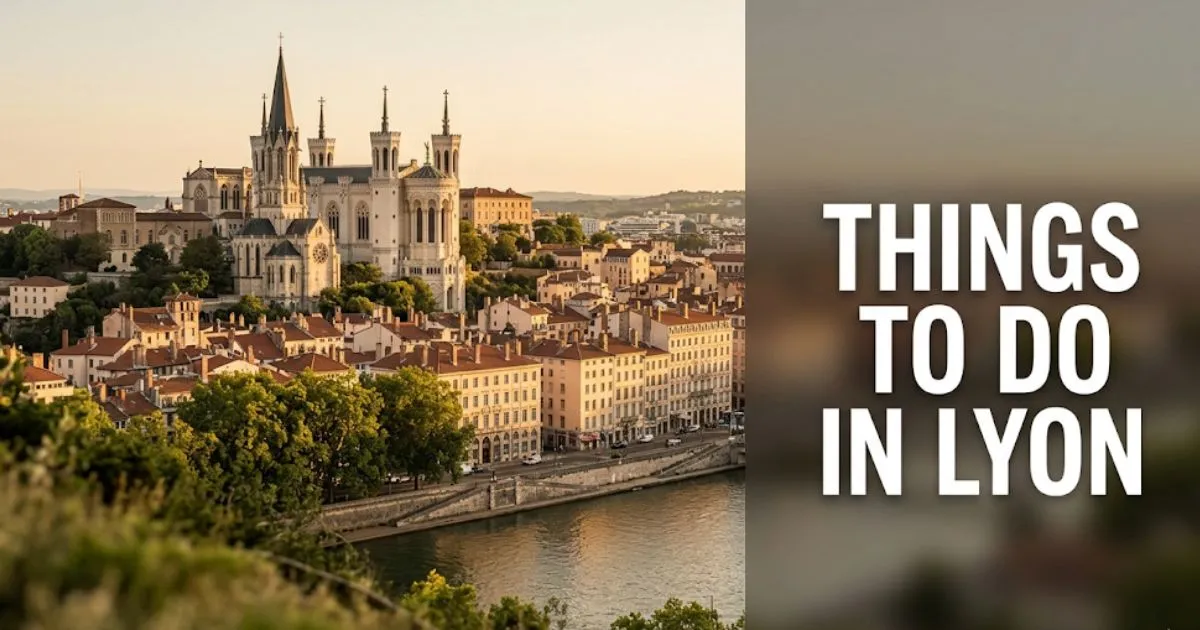
Things to Do in Lyon, France: Your 2026 Travel Guide

Lyon sits at a different tier than most French cities tourists visit. It delivers France’s greatest culinary culture, UNESCO-listed Roman streets, and a genuinely livable urban character that Paris no longer offers.
The Office de Tourisme et des Congrès du Grand Lyon identifies the city as one of Europe’s top gastronomic capitals, a claim supported by more Michelin-starred restaurants per capita than almost any comparable French city.
This guide covers every major district, the specific bouchons worth booking, how to find the traboules, what Fête des Lumières actually requires logistically, and how to structure your days for 2026.
Things to Do in Lyon: What Makes This City Worth Your Trip
The best things to do in Lyon reward travelers who stay at least three days and explore beyond the obvious tourist corridor of Vieux-Lyon.
Lyon operates on a different frequency than Paris. It is quieter, more specifically French, and considerably more honest about what it values, which is almost always food, history, and the pleasure of a slow afternoon.
Two rivers define the city’s geography. The Saône runs along the western edge of Vieux-Lyon. The Rhône runs along the eastern edge of the Presqu’île peninsula before both rivers converge at the Confluence district.
This river-and-hill structure creates five distinct zones with completely different characters. Understanding those zones before you arrive makes the difference between a rushed sightseeing trip and a genuinely satisfying visit.
Traveler profile note: Solo travelers find Lyon socially manageable. English is spoken in tourist zones but less reliably in La Croix-Rousse and Confluence. Basic French phrases help considerably.
Insider Tip:
- Lyon’s most-photographed view is not from the Basilica of Notre-Dame de Fourvière. It is from the esplanade directly below it, the Jardins du Rosaire, which most visitors bypass entirely.
- The second-best view is from the rooftop of the Musée des Confluences at dusk.
- Budget travelers can see both views at no charge beyond the funicular fare and museum admission.
Best Things to Do in Lyon France: The Essential First-Timer’s Framework
First-time visitors to Lyon should structure their stay as three full days, with each day anchored to one primary zone and one exceptional meal.
According to the Office de Tourisme et des Congrès du Grand Lyon, fewer than 30% of international visitors who stay only one or two nights reach La Croix-Rousse, which means the majority miss the city’s most authentic contemporary neighborhood.
Suggested 3-Day Framework:
Day 1: Vieux-Lyon and Fourvière
- Start at Place Saint-Jean in the morning before tour groups arrive (before 9:30 a.m.)
- Walk the traboule route from Rue Saint-Jean through to Rue du Boeuf
- Take the funicular from Vieux-Lyon station to the Fourvière esplanade
- Visit the Basilica of Notre-Dame de Fourvière and the adjacent Roman theaters
- Descend on foot via the Jardins du Rosaire for the best river view in the city
- Dinner at a traditional bouchon on Rue des Marronniers or Rue du Garet
Day 2: Presqu’île and La Croix-Rousse
- Morning at Les Halles de Lyon Paul Bocuse (arrive by 9 a.m. for the best energy)
- Walk Place des Terreaux and visit the Musée des Beaux-Arts de Lyon
- Climb to La Croix-Rousse via the Montée de la Grande-Côte steps
- Explore Boulevard de la Croix-Rousse and the covered market passages
- Lunch at a Croix-Rousse café (not a bouchon: this neighborhood does casual better)
- Return to Presqu’île for evening aperitifs along the Rhône riverbank promenades
Day 3: Confluence and Institut Lumière
- Morning at the Musée des Confluences (allow 2.5 to 3 hours)
- Walk the Confluence waterfront along the Rhône
- Afternoon at the Institut Lumière in the 8th arrondissement (birthplace of cinema)
- Evening dinner reservation at a neighborhood restaurant in the 6th arrondissement (Brotteaux)
Cost overview:
| Item | Estimated Range | Notes |
|---|---|---|
| Lyon City Card (3-day) | approx. 55 to 65 euros | Covers transit and most museums |
| Bouchon prix fixe lunch | approx. 20 to 35 euros per person | Dinner runs higher |
| Musée des Confluences | approx. 9 to 12 euros | Check City Card coverage |
| Funicular (single) | included in TCL pass | Part of standard transit network |
| Parc de la Tête d’Or | free entry | Rose garden included |
Prices are general estimates for 2026. Verify current rates before visiting.
Vieux-Lyon: Navigating the UNESCO Old Town Like a Local
Vieux-Lyon is one of the largest Renaissance urban districts in Europe and the core of Lyon’s 1998 UNESCO World Heritage designation.
The neighborhood occupies the 5th arrondissement, pressed between the Saône river to the east and the Fourvière hill rising to the west. Its streets, particularly Rue Saint-Jean, Rue du Boeuf, and Rue de la Bombarde, are almost entirely pedestrianized.
The tourist pressure concentrates on Rue Saint-Jean between 10 a.m. and 4 p.m. Arriving before 9:30 a.m. or after 5 p.m. gives you the same streets at a fraction of the crowd density.
Traveler profile note: Senior and mobility travelers should know that Vieux-Lyon’s cobblestone streets are genuine Renaissance paving, uneven and slippery in rain. Flat-soled rubber-grip shoes are essential. Wheelchair access is extremely limited throughout this district.
The local alternative to the tourist-crowded main Rue Saint-Jean route is the parallel Rue du Boeuf, which runs one block to the east and carries perhaps 20% of the foot traffic while hosting several of the same architectural details and better bouchon options.
Neighborhood Comparison Table:
| Zone | Character | Best For | Key Attractions | Terrain |
|---|---|---|---|---|
| Vieux-Lyon | Renaissance heritage, tourist-active | History, architecture | Traboules, Saint-Jean Cathedral | Cobblestone, hilly |
| Presqu’île | Commercial, cultural center | Shopping, dining, museums | Place Bellecour, Musée des Beaux-Arts | Flat, walkable |
| La Croix-Rousse | Artisan, residential, market culture | Local life, markets, café culture | Boulevard market, canuts history | Steep climb, plateau |
| Confluence | Contemporary, waterfront | Modern architecture, families | Musée des Confluences, riverfront | Flat, modern |
| Fourvière | Hill, historic, panoramic | Views, Roman ruins, basilica | Basilica, Roman theaters | Steep, rocky paths |
Insider Tip:
- The Cathédrale Saint-Jean-Baptiste at the southern end of Vieux-Lyon contains an astronomical clock from the 14th century. It strikes at noon, 2 p.m., 3 p.m., and 4 p.m. on the hour, drawing almost no queue compared to the traboule lines.
- Entry to the cathedral is free. Verify seasonal hours before visiting.
- Couples find early morning walks through Vieux-Lyon before the tourist bustle genuinely atmospheric and worth setting an alarm for.
Key Takeaway: In Vieux-Lyon, arrive before 9:30 a.m. or after 5 p.m. to experience the same UNESCO streets at a fraction of the midday crowd.
Traboules in Lyon: How to Actually Find and Enter the Secret Passageways
Lyon’s traboules are interconnected covered passageways that cut through residential buildings, allowing passage between parallel streets without stepping outside.
There are approximately 40 publicly accessible traboules in Vieux-Lyon and around 80 in La Croix-Rousse, though the two districts use them very differently. In Vieux-Lyon, traboules are primarily Renaissance merchant shortcuts. In La Croix-Rousse, they were built by the canuts silk workers to transport silk without weather damage.
The Office de Tourisme et des Congrès du Grand Lyon provides a free traboule map available at their office on Place Bellecour. This is the single most useful piece of paper you can pick up in Lyon.
To use the traboules independently:
- Download or pick up the official traboule map from the Office de Tourisme
- Look for the standard wooden door handles with a small information plaque, usually brass or enamel
- Push open the unmarked door during daylight hours (most close between 5 p.m. and 8 p.m.)
- Pass through the courtyard or corridor to the exit on the opposite street
- Note that you are passing through the ground floor of private residential buildings. Silence and respect are expected.
Traveler profile note: Families with young children should be particularly quiet and careful in traboules. These are not tourist attractions maintained by a management company. Residents live above them and use them daily.
The most impressive Vieux-Lyon traboule sequence runs from 27 Rue Saint-Jean through to 6 Rue des Trois Maries. The courtyard in the middle contains a Renaissance well that most visitors, even those who find the passage, photograph without reading the date on the stonework: 1393.
The local alternative to independently wandering traboules is a guided traboule tour through the Office de Tourisme. These run most mornings in season and provide access to a handful of normally closed passages opened specifically for the group.
La Croix-Rousse: Lyon’s Most Interesting Neighborhood Nobody Tells You About
La Croix-Rousse is the neighborhood that separates travelers who truly experience Lyon from those who only visit its monuments.
The 4th arrondissement sits on a plateau above the Presqu’île, reached by a steep climb up the Montée de la Grande-Côte steps or by the C13 or C14 bus routes. The funicular does not serve this district. The climb takes about 20 minutes on foot and is entirely worth it.
This neighborhood was historically the center of Lyon’s silk-weaving industry. The canuts, as the silk workers were called, lived and worked in these buildings. The wide windows still visible on upper floors were designed specifically to admit maximum light for the looms.
According to Condé Nast Traveler, La Croix-Rousse represents one of Paris’s closest rivals for authentic neighborhood café culture outside the French capital.
The Tuesday and Saturday morning market on Boulevard de la Croix-Rousse is one of the best food markets in France. Local producers sell Bresse chickens, Beaujolais wines, mountain cheeses, and the pink praline tarts that define Lyonnaise pastry culture.
Traveler profile note: Budget travelers will find La Croix-Rousse more economical than the Presqu’île. Café lunches here run 12 to 18 euros. Wine by the glass at neighborhood bars costs noticeably less than comparable spots near Place Bellecour.
Insider Tip:
- The Maison des Canuts on Rue d’Ivry is a small silk-weaving museum and boutique that demonstrates working looms. It is not on most visitors’ lists and is far more illuminating than it sounds.
- The traboules in La Croix-Rousse are longer than those in Vieux-Lyon. The passage at 9 Place Colbert runs 120 meters through multiple courtyards.
- Solo travelers find the neighborhood café culture genuinely welcoming for solo seating. Most bars have counter space designed for single drinkers.
Presqu’île Lyon: The City’s Commercial and Cultural Center
The Presqu’île is the elongated peninsula between the Rhône and the Saône, forming the 1st and 2nd arrondissements and containing Lyon’s most visited public squares, shopping streets, and museums.
Place Bellecour is the geographic heart of the Presqu’île and one of the largest pedestrian squares in Europe. The bronze equestrian statue of Louis XIV at its center is less interesting than the view southward toward the two rivers converging at the Confluence. The Office de Tourisme office is on the north side of Place Bellecour: useful for maps, City Cards, and traboule guides.
Place des Terreaux, at the northern end of the Presqu’île, is the city’s cultural anchor. The Fontaine Bartholdi, created by the same sculptor who designed the Statue of Liberty, occupies the center of the square. The Musée des Beaux-Arts de Lyon occupies the former Benedictine abbey on the square’s eastern side.
Traveler profile note: Couples find the Presqu’île’s evening atmosphere ideal for pre-dinner aperitifs along the Rhône riverbank promenades between Pont de la Guillotière and Pont Wilson. These quais transform into an informal outdoor social scene from spring through early autumn.
Rue de la République, the Presqu’île’s main pedestrian shopping artery, is functional rather than interesting. The more characterful shopping is along Rue Auguste Comte in the 2nd arrondissement, which specializes in antique dealers and independent design boutiques.
Insider Tip:
- The Opéra de Lyon, renovated by Jean Nouvel in the 1990s, is worth entering even without a performance ticket. The lobby and rooftop (accessible during certain hours) give an architectural experience few visitors seek out.
- Evening concerts at the Opéra are consistently praised in French cultural press and cost less than comparable Paris performances. Check the 2026 season schedule in advance.
- Senior travelers find the Presqu’île terrain by far the most accessible in Lyon. It is flat, paved, and well-served by metro lines A and D.
Key Takeaway: The Presqu’île’s Rhône riverbank promenades between Pont de la Guillotière and Pont Wilson are Lyon’s best free evening social experience, especially for couples.
Fourvière Basilica and Hill: What to Expect Beyond the Famous Skyline View
The Basilica of Notre-Dame de Fourvière is Lyon’s most recognized landmark, visible from virtually every point in the city below.
The basilica itself was constructed between 1872 and 1884 on the site of a Roman forum. Its interior is among the most ornate in France: Byzantine mosaics, gilded altars, and a crypt dedicated to the Virgin Mary. Entry is free, though donations are requested. Verify current access hours before visiting.
The view from the esplanade in front of the basilica is genuinely impressive. On clear days, the Alps are visible to the east. However, the better photographic position is actually from the Jardins du Rosaire terrace garden below the esplanade, which most visitors skip entirely in their rush to reach the top.
The Théâtres Gallo-Romains de Fourvière sit directly adjacent to the basilica. These Roman amphitheaters date to approximately 15 BC. The larger theater held up to 10,000 spectators. The Musée Gallo-Romain de Fourvière, partly embedded in the hillside, contextualizes the site with exceptional Roman artifact collections.
Traveler profile note: Families with children over age 8 typically find the Roman theater ruins genuinely engaging, particularly when staff provide interpretive context. Children under 6 tend to lose interest within 15 minutes. The funicular ride itself is often a highlight for younger children.
The funicular from the Vieux-Lyon metro station to the Fourvière stop operates as part of the standard TCL transit network. A standard TCL ticket covers the ride. The walk back down through the Jardins du Rosaire takes approximately 25 minutes and passes several hidden viewpoints.
Insider Tip:
- The Fourvière esplanade is heavily crowded between 10 a.m. and 3 p.m. Arriving before 9 a.m. or after 4:30 p.m. gives you the view without the tour groups.
- The Nuits de Fourvière festival uses the Roman amphitheaters for outdoor concerts each summer. Attending a concert here is one of the most distinctive experiences in the city. Dates and programming for summer 2026 should be checked on the official Nuits de Fourvière website.
- Senior travelers can use the funicular in both directions to avoid the steep terrain entirely.
Musée des Confluences: Lyon’s Most Architecturally Striking Museum
The Musée des Confluences is one of Europe’s most architecturally bold science and anthropology museums, situated at the very tip of the Presqu’île peninsula where the Rhône and Saône rivers meet.
The building, designed by Coop Himmelblau and completed in 2014, is a steel and glass structure that looks like a crystal perched on a cloud. It is a genuine architectural achievement and worth visiting for the building alone, before you even enter. Admission costs run approximately 9 to 12 euros per adult as of recent years. Verify current pricing before visiting.
Inside, the permanent collection covers human origins, the diversity of living species, societies and their cultures, and the concept of eternity. It reads like a broad brief but the curation is specific, intelligent, and considerably more engaging than typical natural history museum formats.
According to the Office de Tourisme et des Congrès du Grand Lyon, the Musée des Confluences is among the most visited cultural institutions in the Auvergne-Rhône-Alpes region.
Traveler profile note: Families with children find the Musée des Confluences among Lyon’s best options for mixed-age engagement. Interactive exhibits on human evolution and animal biology tend to hold children’s attention in ways that strictly archaeological or fine arts museums do not.
Allow 2 to 3 hours for a thorough visit. The ground-floor atrium alone warrants 20 minutes. The rooftop walkway, when accessible, delivers one of the city’s best river junction views.
Insider Tip:
- The museum’s permanent collection is included in the Lyon City Card.
- The café inside the museum has better-than-expected food and extraordinary river views. It is a legitimate lunch stop, not just a museum catery.
- The surrounding Confluence district has transformed significantly since 2010. The riverfront promenade south of the museum is Lyon’s newest urban regeneration zone and worth a 30-minute walk.
Key Takeaway: The Musée des Confluences earns its reputation for families and architecture enthusiasts. Allow 2.5 hours minimum and do not skip the rooftop view.
Parc de la Tête d’Or: Lyon’s Underused Urban Escape
Parc de la Tête d’Or is one of the largest urban parks in France, covering approximately 117 hectares in Lyon’s 6th arrondissement along the Rhône’s east bank.
Entry is free. The park contains a lake with rowing boats available for hire, a botanical garden with a notable rose collection that peaks in late May and June, a small zoo with no admission fee (verify current access before visiting), and several greenhouse complexes that house tropical plant collections. It is genuinely extraordinary for a free urban park.
Most international visitors do not reach Parc de la Tête d’Or because it sits east of the Presqu’île, requiring a metro ride to the Masséna or Part-Dieu stations or a pleasant 20-minute walk from Place Bellecour along the Rhône quais.
Traveler profile note: Families with young children will find Parc de la Tête d’Or the single most child-friendly destination in Lyon. The zoo, the lake boats, the open lawns, and the playground areas provide several hours of genuine engagement without cost beyond the boat rentals.
Budget travelers should know that a half-day at Parc de la Tête d’Or is genuinely free. Bringing food from Les Halles de Lyon Paul Bocuse or the Croix-Rousse market for a picnic here is one of Lyon’s great low-cost pleasures.
Insider Tip:
- The rose garden peaks between mid-May and mid-June. Arriving on a weekday morning before 10 a.m. gives you the garden largely to yourself.
- The park hosts occasional outdoor concerts and cultural events in summer. Check the City of Lyon parks calendar for 2026 programming.
- Senior travelers find the main paths through the park well-paved and flat, making it one of the most accessible green spaces in the city.
Les Halles de Lyon Paul Bocuse: The Right Way to Spend a Morning Here
Les Halles de Lyon Paul Bocuse is Lyon’s premier covered food market and the most concentrated expression of Lyonnaise gastronomic culture in a single building.
Located on Cours Lafayette in the 3rd arrondissement, the market houses approximately 50 permanent stalls. These include cheese specialists, charcuterie counters, fresh fish merchants, bakers, pastry makers, wine merchants, chocolate shops, and several eat-in counters serving cooked food. Paul Bocuse himself established the market’s legacy before his death in 2018.
The right way to visit is before 11 a.m. on a weekday. Saturdays are the busiest day by a significant margin. The market typically opens at 7 a.m. and closes in the early afternoon on most days. Verify current hours before visiting, as individual stall hours vary.
Key experiences to seek inside:
- Mère Richard for Saint-Marcellin and Époisses cheese: possibly the best cheese counter in France by reputation
- Charcuterie Bobosse for Lyonnaise saucisson and rosette de Lyon
- The cooked quenelle counters for a standing breakfast or mid-morning snack
- The praline tart pastry stalls for the bright pink Lyonnaise specialty
- Any of the wine merchants for a glass of Beaujolais alongside charcuterie
Traveler profile note: Solo travelers are entirely comfortable eating at the stand-up counters inside the market. This is one of Lyon’s most solo-friendly food experiences. No reservation required, no prix fixe pressure, no formal service.
Budget travelers should know that shopping the market for cheese, charcuterie, and bread and eating at a nearby park or along the Rhône costs a fraction of any restaurant meal and delivers equivalent gastronomic quality.
Bouchon Lyonnais: How to Find a Real One and What to Order
A bouchon lyonnais is a type of traditional Lyonnaise restaurant defined by communal tables, high-quality offal-forward Lyonnaise cooking, abundant wine, and a specific informal social atmosphere that has no real equivalent in other French cities.
The word comes from an old term for an inn where travelers could water their horses. Today the authentic bouchon is defined by specific criteria maintained by the Association de Défense des Bouchons Lyonnais, which certifies genuine establishments with a Gnafron puppet plaque near the entrance.
How to identify an authentic bouchon:
- Look for the Gnafron plaque (or the word “bouchon authentique” on official certification materials)
- Check that the menu includes Lyonnaise staples: salade lyonnaise, quenelle de brochet, tablier de sapeur, cervelle de canut, andouillette
- Confirm that the prix fixe lunch option exists (a strong signal of a working local bouchon, not a tourist simulacrum)
- Verify that the wine list leads with Beaujolais, Côtes du Rhône, and Mâcon by the pot (46cl ceramic carafe)
- Accept that the service will be direct, occasionally brusque, and entirely French. This is not a flaw.
Specific named bouchons worth booking:
- Daniel et Denise (Rue de Créqui, 3rd arrondissement): Chef Joseph Viola’s interpretation of bouchon cuisine, technically flawless. Book several days in advance. Considered by many food writers to be the finest bouchon currently operating.
- Café des Fédérations (Rue du Major Martin, 1st arrondissement): Traditional, unpretentious, excellent andouillette and oeufs en meurette.
- Chez Hugon (Rue Pizay, 1st arrondissement): Family-run, genuinely cramped, excellent saucisson en brioche and mâchon breakfast service on Friday mornings.
Traveler profile note: Solo travelers should know that bouchon communal tables mean you will likely share space with strangers. This is by design and part of the experience. Embrace it.
The overrated warning: Many restaurants near Rue des Marronniers in Vieux-Lyon trade on the bouchon name without the certification, the cooking quality, or the authentic atmosphere. The location is convenient. The food is frequently mediocre at elevated prices.
Key Takeaway: Book Daniel et Denise or Café des Fédérations before you arrive in Lyon. Walking in without a reservation at genuine bouchons is a reliable path to disappointment.
Fête des Lumières Lyon: The Most Spectacular Event in France’s Calendar
Fête des Lumières (Festival of Lights) transforms Lyon into what is genuinely one of the most extraordinary large-scale public art events in Europe for four nights each December.
The festival typically runs for four nights in early December, centered around December 8th, the feast of the Immaculate Conception, which has been celebrated with lights in Lyon since 1852. In 2026, verify the exact dates with the Office de Tourisme et des Congrès du Grand Lyon, as the specific weekend positioning shifts by year.
During the festival, monumental light installations are projected onto facades throughout Vieux-Lyon, the Presqu’île, Fourvière, and La Croix-Rousse. The Basilica of Notre-Dame de Fourvière is typically one of the most dramatically illuminated surfaces in the program. Each year features entirely new artworks.
What makes this logistically demanding:
- Hotel rooms in central Lyon during Fête des Lumières book out 6 to 9 months in advance. Prices during this period are typically 200% to 400% above standard rates. If your 2026 dates include early December, book accommodation immediately.
- Crowds during peak viewing nights (the Saturday of the festival weekend) reach several hundred thousand people concentrated in a small urban geography.
- The metro and funicular operate extended hours but run at extreme capacity.
- Many restaurants also require advance booking during festival week.
Traveler profile note: Families with young children should be realistic. The crowds during peak festival nights are intense, the hours run late, and the sensory environment is overwhelming for children under 5. Consider the Wednesday or Thursday evening of the festival week, which has meaningfully lower crowd levels.
Senior and mobility travelers should plan viewing routes in advance using the official map published by the Office de Tourisme. Some installations are in areas with restricted access or very high crowd compression.
Lyon Day Trips: Beaujolais, Pérouges, and Vienne
Lyon is one of France’s best day-trip base cities, with three distinct destinations reachable within 30 to 60 minutes.
Beaujolais wine country lies approximately 30 to 50 kilometers north of Lyon. The villages of Oingt, Theizé, and the wine capital of Villefranche-sur-Saône are accessible by regional train or car. The Beaujolais harvest festival in late October draws visitors from across France. This region suits wine-focused travelers and couples seeking half-day countryside excursions without a full rental car.
Pérouges is a medieval walled village in the Ain department, approximately 35 kilometers northeast of Lyon. It is one of the best-preserved medieval villages in France. The central Place de la Halle hosts a famous galette de Pérouges bakery, serving the village’s signature sugar pastry with local white wine. The drive or taxi takes roughly 45 minutes. No direct train service runs to Pérouges village itself: the nearest station is Meximieux-Pérouges on the TER regional network.
Vienne lies 30 kilometers south of Lyon along the Rhône by TER train (approximately 20 minutes). The Roman theater at Vienne rivals the Fourvière theaters in scale and surpasses them in preservation quality. The Jazz à Vienne festival in late June and early July is one of Europe’s significant summer jazz events. The town’s Roman temple, the Temple d’Auguste et de Livie, stands in the town center in near-perfect preservation.
Traveler profile note: Couples find the Beaujolais villages and Pérouges ideal for romantic half-day escapes. History travelers should prioritize Vienne for its superior Roman site access over what Lyon itself offers.
Insider Tip:
- For Beaujolais, consider hiring a local guide or joining a small-group wine tour departing from Lyon. Driving the narrow Beaujolais roads after tastings is inadvisable.
- The Pérouges galette is worth the trip on its own. It is nothing like any other French pastry and is essentially impossible to replicate outside the village.
Key Takeaway: Pérouges requires only a half-day and is the most distinctive day trip from Lyon. Plan lunch there around the galette at Place de la Halle.
Best Time to Visit Lyon: Month-by-Month Honest Assessment
The best time to visit Lyon is April through June or September through October.
Spring (April to June) brings temperatures in the 55 to 70°F range, full outdoor terrace culture, the rose garden at Parc de la Tête d’Or near its May and June peak, and hotel rates below summer peak. The city is active without the August restaurant closures.
Summer (July to August) is the most difficult season for food travelers. Many traditional bouchons close for three to four weeks for summer vacation, particularly in August. Temperatures can reach 85 to 95°F during heat events. The Nuits de Fourvière outdoor festival runs through summer and is a genuine draw for culture travelers. Check the 2026 program schedule before booking.
Autumn (September to October) is arguably the finest season for a combination of food, wine, and mild weather. Beaujolais harvest activity peaks in October. Temperatures drop to a comfortable 55 to 68°F range. Restaurant terraces remain open through October on most days.
Early December (Fête des Lumières) is spectacular and logistically demanding. Hotels require booking six to nine months in advance. See the dedicated Fête des Lumières section for full crowd and logistics detail.
Winter (January to March) brings Lyon’s quietest and cheapest hotel rates. Temperatures are cold (38 to 48°F range). The bouchons are fully operational. Museums are open. For budget travelers who prioritize food and culture over outdoor activities, January and February offer real value.
Traveler profile note: Families with young children get the most from Lyon in May or June, when Parc de la Tête d’Or is at its best and school holiday crowds have not yet peaked.
Getting Around Lyon: The TCL Metro, Funicular, and Riverbank Cycling
The TCL (Transports en Commun Lyonnais) network covers Lyon with four metro lines, two funicular lines, multiple tram lines, and an extensive bus network.
The metro is clean, frequent, and easy to navigate. Line D connects Lyon Saint-Exupéry Airport (LYS) to the city center in approximately 30 minutes. Line A serves the Presqu’île and connects at Perrache to the main rail station. Line B serves the university district and Part-Dieu train station.
The two funicular lines (F1 and F2) depart from the Vieux-Lyon metro station. F1 serves the Fourvière esplanade. F2 serves the Saint-Just plateau. Both are part of the standard TCL network and use the same ticket.
Cycling is a practical option for the flat terrain of the Presqu’île and along the Rhône riverbank. Vélo’v, Lyon’s public bike-share system, operates stations throughout the city. Day and week passes are available. The Rhône riverbank cycling path connects the Confluence district northward to Parc de la Tête d’Or almost entirely without vehicle traffic.
Traveler profile note: Senior and mobility travelers should note that the Presqu’île and Confluence are the most wheelchair-friendly zones. Vieux-Lyon and La Croix-Rousse involve terrain that is challenging to impossible for mobility aids. The funicular provides the primary accessible route to Fourvière.
Getting from Paris to Lyon by TGV takes approximately 2 hours from Paris Gare de Lyon station. This is considerably faster and often cheaper than flying when you factor in airport transit time. Trains run frequently throughout the day.
Lyon Travel Tips and Practical Logistics: What to Know Before You Arrive
The single most useful logistics investment in Lyon is purchasing the Lyon City Card before or immediately upon arrival.
The card covers unlimited TCL transit (including metro, funicular, trams, and buses), free or reduced entry to most major museums (including Musée des Confluences, Institut Lumière, and Musée Gallo-Romain), and various partner discounts. It comes in 1, 2, 3, and 4-day versions. For most visitors staying three or more days, the 3-day card pays for itself within the first full day.
Practical pre-departure checklist:
- Book bouchon reservations (especially Daniel et Denise) before you leave home
- Book accommodation well in advance for Fête des Lumières dates in December
- Purchase or plan to purchase the Lyon City Card at the airport or Office de Tourisme
- Download the TCL transit app for real-time metro and tram information
- Obtain the traboule map from the Office de Tourisme upon arrival at Place Bellecour
- Note that many shops, including some bouchons, close between noon and 2 p.m. on Sundays and may have reduced hours on Mondays
Language note: Lyon is a French city. English is spoken reliably in major hotels, tourist zone restaurants, and museum staff. In La Croix-Rousse cafes, local markets, and neighborhood restaurants, basic French courtesies make a significant practical difference.
Currency: France uses the euro. Credit cards are broadly accepted. Some market stalls and small bouchons prefer cash. Carry 20 to 40 euros in cash as a baseline.
Traveler profile note: Budget travelers should know that Lyon’s free offerings, Parc de la Tête d’Or, the traboule walking routes, the Jardins du Rosaire, and the Rhône and Saône riverbank promenades, constitute a full day of quality experience without spending beyond transit fares.
Safety note: Pickpocket risk is real in the Presqu’île shopping district (Rue de la République and surrounding streets) and on Fête des Lumières crowd nights. Use a front-pocket wallet or anti-theft bag in these specific contexts.
Safety and Practical Warnings for Lyon
Lyon is a safe city by most standards, but several specific practical risks affect travelers who are not prepared.
Key safety and practical facts every visitor should know:
- Cobblestone terrain throughout Vieux-Lyon is uneven and slippery when wet. Wear flat-soled, rubber-grip shoes. Do not wear heels or smooth-soled dress shoes for walking days in this district.
- The Fourvière hillside paths are steep and can be muddy after rain. The funicular is the recommended route down for anyone uncertain about footing.
- Pickpocket risk concentrates in Presqu’île shopping streets (Rue de la République) and during Fête des Lumières crowd nights. Use front-pocket wallets and keep bags zipped and held in front of the body.
- Rhône riverbank cycling requires awareness of shared paths. Pedestrians and cyclists share the quai promenades. Vélo’v bikes have bells: use them when approaching pedestrian groups.
- Extreme heat events in July and August are increasingly common in Lyon. If visiting in summer, carry water, plan outdoor activities for morning hours, and note that some museum spaces are air-conditioned while others are not.
- Many bouchons and independent restaurants close in August for summer holidays. Verify operating status before planning any specific dining experience in July or August.
- Fête des Lumières crowd compression on peak Saturday nights is intense. Do not bring strollers into the most crowded viewing areas. Identify meeting points with travel companions in advance. Cell service can be degraded in crowd-dense areas.
For medical emergencies in Lyon, the Centre Hospitalier Lyon Sud and Hôpital Edouard Herriot are the primary public hospital facilities. The European emergency number is 112.
Key Takeaway: Book your bouchon reservation before leaving home and buy the Lyon City Card on arrival day. These two steps alone prevent the two most common Lyon planning failures.
Frequently Asked Questions About Things to Do in Lyon
How many days do you need in Lyon?
Three days is the minimum to experience Lyon’s main districts without feeling rushed.
Two days covers Vieux-Lyon, the Presqu’île, and one excellent meal, but forces you to skip La Croix-Rousse, the Musée des Confluences, and most day trip options.
Five days allows full neighborhood immersion plus at least one day trip to Beaujolais, Pérouges, or Vienne.
Is Lyon worth visiting for food?
Lyon is worth visiting specifically for food more than almost any other city in France outside Paris.
The bouchon tradition, Les Halles de Lyon Paul Bocuse, the Croix-Rousse market, and the concentration of Michelin-starred restaurants in a compact area make it one of Europe’s most rewarding culinary destinations.
Travelers who do not prioritize food will still find Lyon engaging through its Roman heritage, UNESCO architecture, and museum culture, but the city’s singular advantage is its cuisine.
What is a bouchon restaurant in Lyon?
A bouchon lyonnais is a traditional Lyonnaise restaurant characterized by communal tables, hearty offal-forward cooking, wine served in ceramic pots, and an informal social atmosphere unique to Lyon.
Authentic bouchons are certified by the Association de Défense des Bouchons Lyonnais and display a Gnafron puppet plaque near the entrance.
Classic dishes include salade lyonnaise, quenelle de brochet, tablier de sapeur, andouillette, and cervelle de canut.
What are the traboules in Lyon and can tourists enter them?
The traboules are covered passageways that run through the ground floors of residential buildings, connecting parallel streets through interior courtyards.
Tourists can enter the publicly accessible traboules during daylight hours, typically by pushing open unmarked wooden doors identified on the official map provided free by the Office de Tourisme et des Congrès du Grand Lyon.
Because traboules pass through active residential buildings, silence and respect for residents are expected and genuinely required.
When is the Fête des Lumières in Lyon in 2026?
The Fête des Lumières traditionally takes place over four nights in early December, centered on December 8th.
For 2026 exact dates, verify with the Office de Tourisme et des Congrès du Grand Lyon at lyon-france.com, as the specific weekend positioning changes each year.
Book accommodation immediately if your travel dates fall in early December: central Lyon hotels for this festival sell out six to nine months in advance.
Is Lyon easy to get to from Paris?
Lyon is one of the easiest French cities to reach from Paris, with TGV trains running from Paris Gare de Lyon to Lyon Part-Dieu in approximately 2 hours.
Trains run frequently throughout the day and early evening, with multiple daily departures making same-day arrival and departure possible.
Flying from Paris to Lyon is almost never the better option once airport transit times are factored in: the TGV delivers you to the city center directly.
Closing
Lyon rewards the traveler who comes with specific intentions: a reservation at a certified bouchon, a morning at Les Halles de Lyon Paul Bocuse, an unhurried afternoon in La Croix-Rousse. The city has no interest in performing for visitors who give it a rushed half-day between Paris and the Riviera.
Book Daniel et Denise before you leave home. Buy the Lyon City Card on arrival day. Collect the traboule map from the Office de Tourisme on Place Bellecour within your first hour in the city. These three actions structure the rest of your visit more effectively than any itinerary can.
All prices, museum hours, festival dates, restaurant operating schedules, and transit fares in this guide are based on current general conditions and should be verified directly with venues and official sources before departure. Conditions for 2026 may differ. Your specific Lyon trip starts the moment you make that first bouchon reservation.