Best Things To Do in Savannah GA: 2026 Local Guide

Savannah is one of the most genuinely atmospheric cities in the American South, and the things to do in Savannah GA cover a wider range than most visitors expect.
The National Historic Landmark District packs 22 original city squares, centuries of antebellum architecture, and one of the most walkable historic cores in the United States into a few square miles.
This guide covers specific named experiences across history, food, arts, outdoor recreation, and nightlife. It also tells you honestly what to skip and where to go instead.
Things To Do in Savannah GA: What Makes This City Worth Your Time
Savannah rewards travelers who slow down. The city’s layout, designed by James Oglethorpe in 1733, organizes life around a network of shaded squares that function as outdoor living rooms for the whole city.
That design is not just photogenic. It is a functional reason to walk instead of drive, to stop and sit instead of rush, and to absorb the city’s character at the pace it was built for.
Visit Savannah, the city’s official Convention and Visitors Bureau, notes that Savannah hosts more than 14 million visitors annually. That volume means some tourist areas feel crowded and commercial.
The city’s authentic core sits one or two blocks off the obvious tourist corridors. Knowing where to look is the difference between a generic Southern city trip and one of the best long weekends in the American South.
Savannah’s strengths are specifically: walkable historic architecture, a dense concentration of independent restaurants, an arts community anchored by the Savannah College of Art and Design (SCAD), and a ghost-story culture that is partly theatrical and partly grounded in genuine Civil War-era history.
Its limitations are equally specific. Summer heat from June through August is brutal. The waterfront corridor on River Street is heavily commercialized.
Insider Tip:
- Walk Bull Street from Madison Square south to Forsyth Park at dusk. This one-mile corridor shows you the city’s real character better than any tour.
- Plan your outdoor time for before 10 a.m. from June through August.
- Couples get the most from this city. Solo travelers and history enthusiasts follow closely.
Best Things To Do in Savannah Georgia: The Essential Experiences
The best things to do in Savannah Georgia center on six core categories that define why the city has a genuine reputation among serious American travel destinations.
| Activity | Best For | Cost Range | Time Needed | Insider Note |
|---|---|---|---|---|
| Savannah Squares Walking Tour | All profiles | Free | 2 to 3 hours | Bull Street route beats any guided tour |
| Bonaventure Cemetery | Couples, solo, history fans | Free | 1.5 to 2 hours | Go morning, not afternoon heat |
| Wormsloe Historic Site | History, families, outdoors | Low admission | 2 hours | Spanish moss corridor is the real draw |
| Telfair Museums (3 sites) | Arts, culture, seniors | Mid-range admission | Half day | Jepson Center has the strongest collection |
| Savannah food tour | Couples, adults, foodies | Mid-range fee | 2 to 3 hours | Broughton Street area tours are most substantive |
| Ghost tours | Adults, couples, older kids | Mid-range fee | 1.5 to 2 hours | Walking tours beat bus tours for atmosphere |
| Forsyth Park | All profiles | Free | 1 hour | Saturday Farmers Market adds a full morning |
| SCAD Museum of Art | Arts travelers, adults | Low admission | 1 to 2 hours | Often less crowded than Telfair |
These eight experiences cover the essential Savannah. Each one appears in its own section below with specific logistics and local alternatives.
Couples will find the most concentrated satisfaction here, given Savannah’s intimate scale and atmospheric streets. Families with children under 10 should focus on Forsyth Park, Wormsloe, and the waterfront, skipping museum-heavy days.
Budget travelers can cover the core Savannah experience almost entirely for free or low-cost, since the squares, parks, and waterfront charge nothing.
Savannah Historic District: Where To Start and What Not To Miss
The Savannah Historic District is the organizing framework for everything in the city. It covers approximately 2.5 square miles and contains 22 of the original 24 city squares designed by Oglethorpe.
Start at Johnson Square on Bull Street. It is the oldest and largest of the squares, and walking south on Bull Street from here takes you through Chippewa, Madison, Monterey, and Calhoun Squares in sequence.
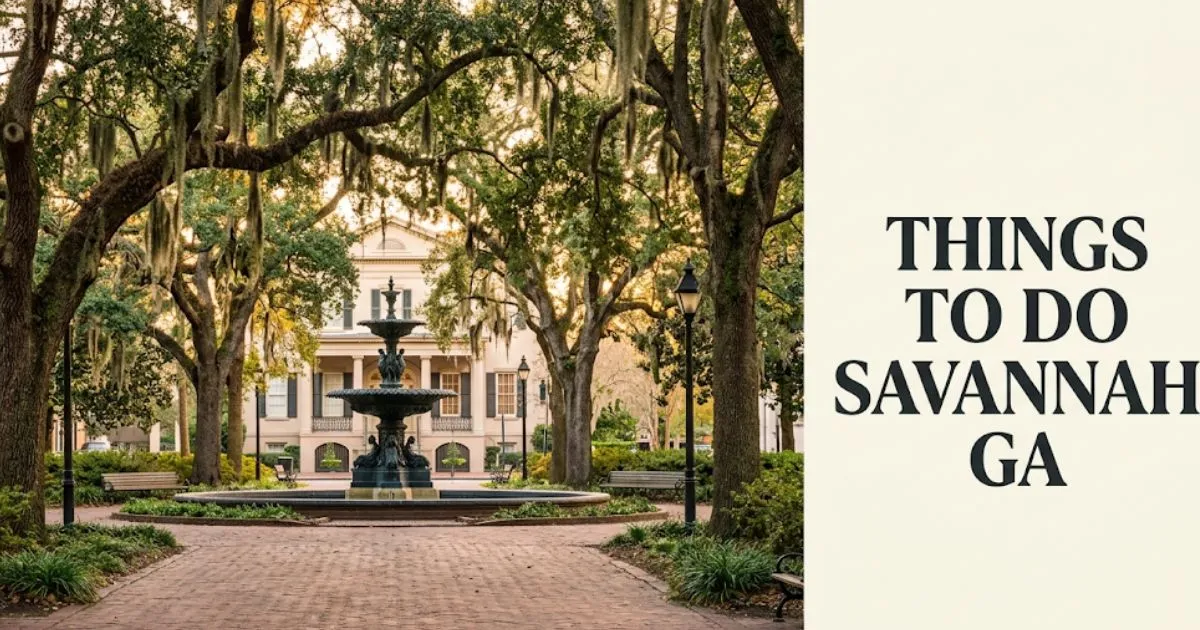
Each square has a different character. Monterey Square on Bull Street is arguably the most architecturally intact and photogenic, flanked by the Mercer Williams House Museum on one side and mature live oaks draped in Spanish moss overhead.
Chippewa Square is where the bench scenes from Forrest Gump were filmed. The bench itself is now at the Savannah History Museum on Martin Luther King Jr. Boulevard.
Admission to the Historic District is free. Individual attractions within it carry separate fees, typically running in the $10 to $20 per adult range as of recent years. Verify before visiting.
Seniors and accessibility travelers should note that Bull Street’s squares have paved paths, though some surrounding streets have uneven brick pavers that can be challenging for mobility aids.
The most overrated stop in the Historic District is the Cathedral of St. John the Baptist as a standalone visit. It is architecturally impressive from outside but brief inside.
The local alternative: Walk Oglethorpe Avenue from Abercorn Street west toward Martin Luther King Jr. Boulevard. This quieter corridor passes Colonial Park Cemetery, the city’s oldest public burying ground dating to 1750, with none of the crowds that concentrate on Bull Street.
Insider Tip:
- The Historic District is best explored before 9 a.m. or after 4 p.m. to avoid tour group concentrations.
- The free DOT Shuttle runs along Congress Street and connects the Historic District to the western edge efficiently.
- First-time visitors: resist the urge to cover all 22 squares in one day. Eight to ten squares done slowly reveals far more than all 22 done rushed.
Key Takeaway: Walk Bull Street from Johnson Square to Forsyth Park at dusk. That single route teaches you more about Savannah than any organized tour.
Top Things To Do in Savannah Georgia Ranked by Experience Type
The top things to do in Savannah Georgia break cleanly into four experience types. Knowing which type matches your travel style prevents wasted time.
Experience Type 1: Architecture and Walking
Bull Street squares corridor, Factors Walk along the bluff above River Street, Jones Street (frequently cited as one of the most beautiful streets in America), and the Victorian District south of Forsyth Park.
Experience Type 2: History and Museums
Owens-Thomas House and Slave Quarters, managed by the Telfair Museums, provides the most historically substantive museum experience in Savannah. Its interpretation of enslaved life on the property is more honest and complete than most comparable Southern house museums. Admission runs in the mid-range; verify current pricing with the Telfair Museums directly.
Experience Type 3: Food and Drink
Broughton Street is Savannah’s primary commercial corridor. The Olde Pink House on Abercorn Street anchors the fine dining scene in a 1789 mansion. Leopold’s Ice Cream on Broughton Street has been operating since 1919 and remains genuinely worth the line.
Experience Type 4: Nature and Outdoor
Forsyth Park covers 30 acres at the southern end of the Historic District. Wormsloe Historic Site off the Isle of Hope is a 1.5-mile dirt avenue flanked by 400 live oaks. The entry road photograph at Wormsloe is one of the most replicated images in Georgia travel.
Suggested 2-Day Weekend Framework:
Day 1:
- Morning: Walk Bull Street squares corridor, starting at Johnson Square (7 to 9 a.m.)
- Mid-morning: Owens-Thomas House tour (timed entry, book in advance)
- Lunch: Leopold’s Ice Cream or Zunzi’s on York Street for the Conquistador sandwich
- Afternoon: SCAD Museum of Art, then Forsyth Park
- Evening: Dinner at The Olde Pink House; walk Factors Walk at night
Day 2:
- Morning: Forsyth Farmers Market (Saturdays only, 9 a.m. to 1 p.m.)
- Mid-morning: Drive to Wormsloe Historic Site (20 minutes from downtown)
- Lunch: Back in the city, explore Broughton Street
- Afternoon: Ghost tour booking for evening; City Market exploration
- Evening: Ghost walking tour; Artillery Bar or El-Rocko Lounge for nightcaps
Savannah Squares Walking Tour: The Real Heart of the City
Savannah’s 22 city squares are the single most distinctive feature of any American city grid. No comparable urban design exists at this scale in the United States.
Each square is a public park, a neighborhood focal point, and a living architectural museum simultaneously. Walking them requires no ticket, no guide, and no reservation.
The Bull Street Corridor (Johnson, Wright, Chippewa, Madison, Monterey, Calhoun Squares in succession) is the most cohesive walking route. It takes approximately 90 minutes at a deliberate pace.
Lafayette Square on Abercorn Street offers a different atmosphere: smaller scale, residential streets on all four sides, and the Cathedral of St. John the Baptist anchoring the northeast corner.
The full 22-square self-guided tour takes a full day comfortably. The Visit Savannah CVB offers free printable square maps from their official website.
Solo travelers find the squares ideal for self-guided exploration. The city’s tight grid means getting genuinely lost is nearly impossible.
Families with strollers should know that many surrounding street crossings use brick pavers, which can make stroller navigation uneven. The squares themselves have smooth paths.
Spring is the best season for square walking. Azaleas bloom across the Historic District from late February through April, and temperatures stay manageable in the 65 to 75 degree range.
The local alternative to guided trolley tours: The Savannah Slow Ride is a pedal-assist group bike experience that covers more ground than walking and avoids the stop-and-start of bus trolleys. It reaches neighborhoods the trolley routes skip entirely.
Insider Tip:
- Arrive at Monterey Square exactly at dusk when the gas lamp streetlights come on. The effect against the live oaks is the best free moment in Savannah.
- Avoid the squares on St. Patrick’s Day week unless you specifically want festival crowds.
- Seniors should note that the squares are flat but surrounding streets have uneven brick surfaces. Comfortable, supportive footwear is not optional.
Things To Do in Savannah GA for Adults
The best things to do in Savannah GA for adults center on culinary experiences, arts immersion, evening atmosphere, and historical depth that genuinely rewards adult attention.
Broughton Street functions as Savannah’s main commercial and dining corridor. It runs east-west through the heart of the Historic District and concentrates independent boutiques, SCAD student-influenced galleries, and restaurants in a walkable strip.
Adults specifically benefit from Savannah’s open-container alcohol law in the downtown area. Savannah permits single drinks in approved cups to be carried on city streets within designated zones, a policy that makes evening walking tours and square-hopping distinctly more social than in most American cities.
The Savannah Bee Company on Broughton Street is not just a retail shop. It runs guided honey-tasting sessions that function as genuine food education and pair well with the city’s broader culinary culture.
Adults without children have access to Savannah’s cocktail scene, which extends well beyond River Street. The Artillery Bar on Bull Street operates in a converted armory building and serves well-crafted cocktails in a space with genuine architectural character.
For food-focused adults, a guided food tour through the Savannah Food and Wine Festival footprint (held annually in fall; verify 2026 dates with the event organizer) or a private culinary walking tour of Broughton and Jones Streets covers more ground than any restaurant reservation alone.
The SCAD Museum of Art on Turner Boulevard consistently hosts exhibitions with genuine curatorial ambition. It draws a different audience than the Telfair and often runs stronger contemporary programming.
Insider Tip:
- Book a table at The Grey on Martin Luther King Jr. Boulevard well in advance. This James Beard Award-winning restaurant operates in a restored 1938 Greyhound bus terminal. It is the single most specific dining experience Savannah offers adults.
- The open-container zone does not extend to all streets. Pick up a zone map from the Visit Savannah visitor center on Liberty Street.
- Adults visiting in fall get the best combination of weather and dining event programming.
Key Takeaway: Book The Grey on Martin Luther King Jr. Boulevard before anything else. It books weeks out and defines what Savannah’s adult food scene actually is.
Cool Things To Do in Savannah GA Beyond the Tourist Circuit
The coolest things to do in Savannah GA for travelers who have already covered the obvious list involve three neighborhoods most first-timers never reach.
The Starland District, centered on Bull Street south of 36th Street, is where Savannah’s creative and independent community concentrates. It has independent coffee shops, local art galleries, small-batch bottle shops, and a neighborhood energy that feels nothing like the tourist core.
Thomas Square, just west of Bull Street and slightly north of Starland, has seen a concentration of independent restaurants open in recent years. Cotton and Rye on Drayton Street consistently draws attention for its approach to Southern cooking with genuine technique behind it.
The Victorian District between Forsyth Park and the Starland District contains some of Savannah’s most architecturally ornate residential streets. Walking Gordon Street or 38th Street reveals Victorian-era homes with wraparound porches and original ironwork that the Historic District’s grander buildings sometimes overshadow.
Oatland Island Wildlife Center on Islands Expressway is off most tourist itineraries but offers close-range encounters with native Georgia wildlife including timber wolves, bald eagles, and white-tailed deer on a forested trail system.
For something genuinely different: rent a kayak or stand-up paddleboard on the Wilmington River east of downtown. Several outfitters operate near the islands and provide a Savannah experience that has nothing to do with squares or ghosts.
Budget travelers find the Starland District and Thomas Square far more affordable than Historic District dining and drinking. The neighborhood’s smaller venues have lower price points across the board.
Insider Tip:
- The Forsyth Farmers Market on Saturday mornings in Forsyth Park is genuinely a local gathering, not a tourist market. Arrive by 9 a.m.
- Zunzi’s on York Street is a South African-influenced sandwich counter that has cult status among Savannah regulars. The Conquistador sandwich is the correct order.
- First-timers who skip Starland miss the version of Savannah that residents actually live in.
Romantic Things To Do in Savannah GA
Savannah is one of the most consistently romantic city destinations in the American South. The combination of atmospheric squares, candlelit restaurants, and slow-paced evening culture works specifically well for couples.
The most romantic walk in Savannah is Jones Street between Whitaker and Abercorn Streets at dusk. Brick-paved, gas-lamp lit, canopied by live oaks, and lined with Federal-style townhouses, it is the street that appears in most serious Savannah photography for a specific reason: it earns the image.
A horse-drawn carriage tour through the squares is the Savannah experience most marketed to couples. It genuinely delivers on atmosphere, though you should know that tours depart from City Market and follow fixed routes. Book in advance for weekend evenings, particularly in spring.
Dinner at The Olde Pink House on Reynolds Square deserves specific mention for couples. The 1789 mansion atmosphere, candlelit interior, and Southern-accented menu create a complete evening rather than just a meal. Reservations are strongly recommended; book several weeks out for spring and holiday weekends.
The Grey serves as the alternative for couples who want a more contemporary dining experience with equally strong atmosphere. The restored bus terminal setting is intimate and distinctive.
For a daytime romantic experience, rent bikes and ride from the Historic District south through Ardsley Park toward the Isle of Hope. The Isle of Hope neighborhood’s waterfront bluff views across the Intracoastal Waterway are among the quietest and most genuinely beautiful spots within easy reach of downtown.
Couples visiting in spring should secure accommodation three to four months in advance. Savannah’s boutique hotels in restored historic mansions fill quickly for March through May weekends.
Insider Tip:
- Request a table on the lower level at The Olde Pink House for the most intimate setting.
- The Savannah Riverboat Company offers sunset dinner cruises on the Savannah River. The atmosphere is pleasant; the food is secondary.
- Avoid River Street for a romantic evening. It is loud, crowded on weekends, and feels more like a festival strip than the quiet, atmospheric Savannah that couples come here for.
Key Takeaway: Jones Street at dusk and dinner at The Olde Pink House in sequence is the single most effective romantic evening Savannah offers. No tour replaces it.
Things To Do in Savannah GA with Kids
Savannah with children works best for families with kids aged 7 and older who can handle moderate walking and have some interest in history and outdoor exploration.
Forsyth Park is the single best starting point for families. The 30-acre park has open lawn space, a splash pad in the summer months (verify operating status for 2026 with the City of Savannah Parks and Recreation), a large playground, and the park’s famous fountain at the north end.
Wormsloe Historic Site on the Isle of Hope is genuinely engaging for older children. The 1.5-mile canopied live oak avenue is visually dramatic, and the site includes a small museum about colonial Georgia history and a recreated Colonial Life Area with demonstrations.
The Savannah History Museum at the Savannah Visitors Center on Martin Luther King Jr. Boulevard has exhibits on Georgia’s Civil War history, the original Forrest Gump bench, and locomotive displays that tend to hold children’s attention better than house museum formats.
Oatland Island Wildlife Center on Islands Expressway is genuinely underused by visiting families. Native Georgia wildlife in natural habitat enclosures, accessible walking trails, and no large crowds make it a strong half-day for kids aged 5 and up.
Families with young children in summer face a genuine heat challenge. Plan outdoor activities before 10 a.m. or after 5 p.m. and schedule indoor stops at the Jepson Center for the Arts or the Savannah History Museum during peak heat hours.
The River Street waterfront is fine for families during daylight hours for the views, novelty, and a quick stop at a candy or praline shop. Do not build an evening around it with children, as the nighttime scene skews adult.
Insider Tip:
- The Savannah Children’s Museum operates within the Savannah Botanical Gardens on Eisenhower Drive. It is worth checking current programming for 2026.
- Plan for food stops on Broughton Street, which has enough variety to handle picky eaters.
- Families with children under 5 should prioritize Forsyth Park, the waterfront walkway, and Wormsloe over house museums and cemetery visits.
Free Things To Do in Savannah GA
The best free things to do in Savannah GA are genuinely among the best things the city offers, not concessions to budget constraints.
The 22 city squares are entirely free to enter, explore, and sit in. They are the city’s defining feature. No admission, no reservation, no time limit.
Forsyth Park is free. The fountain, the grounds, the Saturday Farmers Market, and the park’s perimeter walk along Gaston Street all cost nothing.
Bonaventure Cemetery on Bonaventure Road is free to enter during operating hours. This Victorian-era cemetery became internationally known after appearing in John Berendt’s book “Midnight in the Garden of Good and Evil.” The combination of Spanish moss, sculpted monuments, and marsh views makes it one of the most atmospheric public spaces in the South.
Free experiences in Savannah:
- Walking the Bull Street squares corridor
- Forsyth Park and its Saturday Farmers Market
- Bonaventure Cemetery (free entry, verify hours before visiting)
- Factors Walk along the bluff above River Street
- The Savannah River waterfront promenade
- Architectural walking of Jones Street and Gaston Street
- SCAD student gallery exhibitions (many are free; check the SCAD website for 2026 schedules)
- Exploring the Starland District and Thomas Square neighborhoods
Budget travelers should know that Savannah’s free offerings are substantive enough to fill a full two-day visit without spending on any paid attraction. The paid experiences (Telfair Museums, Owens-Thomas House, Wormsloe) add depth but are not required to understand the city.
The DOT Shuttle along Congress Street is free. It connects the Historic District to the western museum corridor efficiently and eliminates parking costs in that area.
Insider Tip:
- Colonial Park Cemetery on Abercorn Street is free, open to the public, and far less visited than Bonaventure. It dates to 1750 and contains the graves of signers of the Declaration of Independence.
- The Savannah waterfront promenade below Factors Walk is a free and underused alternative to the River Street tourist strip immediately adjacent to it.
Key Takeaway: Bonaventure Cemetery and the Bull Street squares corridor are both free and both genuinely excellent. They belong at the top of any Savannah itinerary regardless of budget.
Savannah GA Ghost Tours: What They Offer and Which Are Worth It
Savannah ghost tours are a genuine and historically grounded part of the city’s tourism culture, not just a novelty gimmick. The city’s history of yellow fever epidemics, Civil War occupation, and centuries of death in a compact urban grid gives the ghost narrative real historical substance.
Walking ghost tours beat bus ghost tours for atmosphere, specificity, and genuine engagement. Bus tours deliver narrated drives past buildings. Walking tours put you inside the squares and alleys where the stories actually happened.
Several operators run walking tours in the Historic District. Savannah Ghost Tours and Cobblestone Tours both have long operating histories. Verify current 2026 availability and pricing directly with operators, as the ghost tour market in Savannah sees regular new entrants and some closures.
Typical walking ghost tours run 90 minutes to two hours. Pricing generally falls in the $20 to $35 per adult range as of recent years. Verify current rates before booking.
Colonial Park Cemetery features prominently in most ghost tour narratives and warrants a daytime visit as well. The cemetery’s genuine historical depth, including graves that predate American independence, makes it substantive beyond its ghost-story reputation.
Adults get the most from ghost tours. Children under 10 may find the pace and content challenging, though some family-friendly daytime tours exist. Check with operators about age-appropriate options.
The honest assessment: Some Savannah ghost tours are theatrical performances with loose historical accuracy. The better operators ground their narratives in documented historical events and architectural history. Ask operators specifically about their research basis before booking.
Insider Tip:
- The Owens-Thomas House ghost narrative is particularly well-documented and grounded in the building’s verified history. Ask your walking tour guide about it specifically.
- Book ghost tours 48 to 72 hours in advance for spring and fall weekends. They sell out.
- The best ghost tour experience in Savannah is one that teaches you actual history. The theaters-only approach gets old fast.
Outdoor Things To Do in Savannah GA
Outdoor things to do in Savannah GA extend well beyond the squares and parks into a coastal Georgia ecosystem that most visitors never reach.
Forsyth Park is the entry point, covering 30 walkable acres at the edge of the Historic District. Its perimeter loop is approximately one mile and passes through the most intact Victorian residential streetscape in Savannah.
Skidaway Island State Park, about 14 miles southeast of downtown, offers 22 miles of hiking trails through coastal Georgia’s maritime forest, marsh, and bluff ecosystems. The park’s trails pass archaeological sites and have genuine wildlife encounter potential including white-tailed deer, armadillos, and coastal birds.
Savannah National Wildlife Refuge, across the Georgia-South Carolina border on Highway 17, covers more than 29,000 acres of tidal rivers, bottomland hardwoods, and managed wetlands. The Wildlife Drive is a 4-mile loop accessible by car or bike. Migratory waterfowl numbers in fall and winter are significant.
Kayaking the Back River near Tybee Island puts you in a salt marsh ecosystem that looks nothing like the city a few miles away. Several outfitters on Tybee Island and near the Wilmington River rent equipment and offer guided tours.
Fort Pulaski National Monument on Cockspur Island, managed by the National Park Service, combines Civil War military history with coastal Georgia landscape. The earthwork fortifications and surrounding marsh are distinctive. Admission typically runs in the $5 to $15 per adult range; verify with the National Park Service before visiting.
Summer outdoor visitors face serious heat challenges. Plan trail activities for before 9 a.m. from June through August. Carry significantly more water than you think you need.
Insider Tip:
- Skidaway Island State Park requires a Georgia State Parks parking pass. Purchase online before arrival.
- The Savannah National Wildlife Refuge’s Wildlife Drive is best at dawn in November through February for migratory bird concentrations.
- Tybee Island is covered in the day trips section. It is the most popular outdoor escape from Savannah and warrants its own planning.
Key Takeaway: Skidaway Island State Park is 14 miles from downtown Savannah and genuinely excellent. Almost no first-time visitor goes there, and it is better than most of the city’s paid outdoor experiences.
Savannah Food Scene: Where to Eat Like a Local
Savannah’s food scene is built on a foundation of low country Georgia cooking with genuine culinary ambition layered over it in recent years, largely driven by the SCAD community and a wave of chef-driven restaurants opening outside the Historic District’s obvious tourist corridors.
The Grey on Martin Luther King Jr. Boulevard is the reference point. Chef Mashama Bailey’s James Beard Award-winning restaurant serves a Gulf Coast-influenced menu in a 1938 Greyhound bus terminal. It is the specific restaurant that put Savannah’s culinary reputation into national conversation. Book weeks in advance for weekend seatings.
The Olde Pink House on Reynolds Square serves classic Savannah-style Southern food in the city’s most atmospherically complete dining room. The she-crab soup and pecan-crusted flounder are the orders with the longest track record. Reservations strongly recommended.
Cotton and Rye on Drayton Street in the Thomas Square neighborhood serves Southern food with serious technique. It is less formal than The Grey and consistently delivers. The pork chop and the cast iron cornbread are recurring strengths.
Zunzi’s on York Street is a South African-influenced sandwich counter that has been in Savannah long enough to have genuine local institution status. The Conquistador is a grilled chicken sandwich with a specific sauce that has no direct equivalent in American fast-casual dining.
Leopold’s Ice Cream on Broughton Street opened in 1919 and has been making the same ice cream recipes across the family’s ownership. The Tutti Frutti flavor is their signature. The line can run 20 to 30 minutes on weekend afternoons. Go before noon or after 5 p.m.
Budget travelers should explore the food truck scene on Savannah’s eastern edge and the lunch menus on Broughton Street, where several restaurants offer their dinner-quality cooking at lunch pricing.
Insider Tip:
- The Forsyth Farmers Market on Saturday mornings has prepared food vendors alongside produce. It is the best cheap breakfast in Savannah.
- Savannah’s brunch culture is strong. The wait at popular brunch spots on Saturdays and Sundays can exceed 45 minutes. Eat early or eat late.
- Pralines from River Street Sweets on River Street are the default tourist purchase. The same quality praline is available at Savannah’s Candy Kitchen with shorter lines.
Savannah Nightlife: Where the Actual Evenings Happen
Savannah’s nightlife has two distinct versions. The tourist version concentrates on River Street. The actual Savannah evening happens on Congress Street, Bull Street, and in the Starland District.
River Street at night is loud, crowded on weekends, and oriented toward large bars and souvenir shops. It has its advocates. Families with older kids find it entertaining for its energy. Adults seeking a quieter evening will find it grating within 30 minutes.
Artillery Bar on Bull Street operates in a converted armory vault with exposed brick, high ceilings, and a cocktail menu that represents genuine bar craft. It is the most recommended first stop for adults who want a drink in a room with character.
El-Rocko Lounge on Congress Street is a dive bar with strong local following, vinyl record decor, and a complete absence of tourist-facing performance. It opens late and runs later.
Congress Street between Barnard and Whitaker has several independent bars and music venues within one block of each other. The Wormhole and Barrelhouse South both draw local and visiting crowds for live music on weekends.
Savannah’s open-container law in the designated downtown zone means that walking between bars with a drink is legal and extremely common. This makes evening movements through the squares and along Congress Street feel social in a specific way that very few American cities replicate.
Solo travelers find Savannah’s nightlife more accessible than most mid-sized cities because of the open-container culture. Standing in a square with a drink from a nearby bar is a completely normal Savannah evening.
Couples who want a quieter evening should look at late-night dessert at Leopold’s (check 2026 hours) or a rooftop drink at the Rocks on the Roof bar atop the Bohemian Hotel on the riverfront, which has River Street views without River Street noise.
Insider Tip:
- The Savannah nightlife scene gets genuinely late. Many bars do not hit peak energy until 11 p.m. or later on weekends.
- Uber and Lyft operate in Savannah but availability drops significantly after 1 a.m. Plan your return accordingly.
- Thursday nights have become a strong live music night throughout the city, with smaller crowds than weekends and more local attendance.
Key Takeaway: Skip River Street for your evening. Congress Street between Barnard and Whitaker is where Savannah’s actual nightlife lives, and it is one block from the tourist circuit.
Things To Do Near Savannah Georgia: Day Trips Worth the Drive
The best things to do near Savannah Georgia are within a 30 to 90-minute drive and add coastal Georgia and Low Country experiences the city itself cannot provide.
| Day Trip | Distance from Savannah | Best For | Drive Time | Key Experience |
|---|---|---|---|---|
| Tybee Island | 18 miles east | Families, couples, beach | 30 minutes | Beach, lighthouse, fishing |
| Hilton Head Island, SC | 40 miles north | Couples, seniors, golfers | 45 minutes | Beaches, bike trails, resort scale |
| Beaufort, SC | 70 miles north | History, couples, slow travel | 75 minutes | Antebellum downtown, waterfront park |
| Jekyll Island, GA | 80 miles south | Families, nature travelers | 85 minutes | State park beaches, wildlife, bike paths |
| Charleston, SC | 110 miles north | History, food, arts | 2 hours | Full city experience |
Tybee Island is the most obvious and most visited day trip from Savannah. The 18-mile drive east on US-80 ends at a barrier island with a genuine beach, the Tybee Island Lighthouse (one of the oldest lighthouses in America), and a low-key beach town atmosphere. Parking fills fast on summer weekends. Arrive by 9 a.m. or face a significant wait.
Beaufort, South Carolina is the most underused day trip in the Savannah orbit. The town’s antebellum waterfront district, Henry C. Chambers Waterfront Park, and historic downtown feel closer to 18th-century America than most preserved towns in the South. The drive on US-278 north takes about 75 minutes.
Jekyll Island, Georgia is a state-managed barrier island with 10 miles of beach, 20 miles of bike paths, and a historic district centered on the Jekyll Island Club, a Gilded Age resort compound now operating as a hotel. Day-use parking fees apply; verify with Georgia State Parks before visiting.
Families should prioritize Tybee Island and Jekyll Island. Couples with more flexibility get more from Beaufort and the Jekyll Island Club’s atmosphere.
Insider Tip:
- The drive to Tybee Island on US-80 is itself scenic, passing through salt marsh and tidal creek ecosystems. Drive slowly across the bridges.
- Beaufort’s downtown is completely walkable and has excellent independent restaurants on Bay Street.
- For Charleston as a day trip: it works as a long day but genuinely deserves its own overnight. Two hours each way is a lot of driving for a four-hour visit.
Best Time To Visit Savannah Georgia
The best time to visit Savannah Georgia is mid-March through May and late September through November, when temperatures are manageable and the city’s outdoor character is fully accessible.
| Season | Months | Temps (F) | Crowds | Notes |
|---|---|---|---|---|
| Spring (Best) | March to May | 65 to 82 | High | Azalea blooms; St. Patrick’s Day peak in March |
| Summer (Hardest) | June to August | 88 to 96 | High | Extreme heat, high humidity, afternoon storms |
| Fall (Second Best) | September to November | 68 to 82 | Moderate | Comfortable temps, fewer tourists, best food events |
| Winter (Quietest) | December to February | 45 to 62 | Low | Cool but not cold; lowest hotel rates; holiday decor in December |
Spring brings Savannah’s most photogenic conditions. Azaleas bloom across the squares and residential streets from late February through April. Temperatures in the 68 to 78 degree range make all-day walking entirely comfortable.
The exception: St. Patrick’s Day week in Savannah is the single most crowded period of the year. Savannah’s St. Patrick’s Day Parade is consistently ranked among the largest in the United States. River Street and City Market become extremely congested. Hotel rates triple. Book 3 to 6 months in advance if visiting this week, or specifically avoid it if crowds are not your preference.
Fall is arguably the more knowledgeable traveler’s preferred season. The Savannah Food and Wine Festival (typically October; verify 2026 dates), the SCAD Sidewalk Arts Festival (September; verify 2026 dates), and the Savannah Film Festival (October; verify 2026 dates) all fall within a six-week window. Temperatures drop to the 70s and tourist volumes moderate noticeably after Labor Day.
Summer visitors face genuine challenges. June through August heat regularly exceeds 95 degrees Fahrenheit with high humidity. Afternoon thunderstorms are common. The experience is manageable with aggressive morning scheduling and indoor midday breaks, but it is not Savannah at its best.
Winter offers the lowest hotel rates and the smallest crowds. The Historic District’s tree-lined squares look different without full foliage, but the city’s restaurant scene, museum offerings, and architectural walks are all fully available.
Seniors and accessibility travelers should specifically avoid July and August due to heat exposure risk on outdoor walks.
Insider Tip:
- Book accommodation 8 to 12 weeks in advance for any spring weekend outside of St. Patrick’s Day week.
- The Savannah Film Festival in October brings programming to venues across the Historic District and is one of the most genuinely local-feeling events of the year.
- Late October through November is the least-crowded, most comfortable period with the strongest local event calendar.
Safety and Practical Warnings for Savannah GA
Savannah is a safe destination for most travelers, but specific practical risks deserve direct attention before you plan your visit.
Key safety and practical facts every visitor should know:
- Summer heat is a genuine health risk. June through August temperatures regularly exceed 95 degrees Fahrenheit with humidity that makes heat index values significantly higher. Carry water constantly. Schedule outdoor activities before 10 a.m. and after 5 p.m.
- Hydration is not optional in summer. Heat exhaustion is a documented risk for visitors walking the squares in July and August without adequate water intake.
- River Street at night on weekends skews heavily intoxicated. The open-container atmosphere and concentration of bars create crowds that solo travelers and families with children should factor into their evening planning.
- Brick paver streets present a trip hazard. Most streets in the Historic District use original brick pavers that are uneven and can be slippery after rain. This is a meaningful consideration for seniors and travelers with mobility concerns.
- Parking in the Historic District is limited and competitive. The city-operated Bryan Street Garage and State Street Garage are the most accessible paid options near the squares. Street parking meters run throughout the Historic District. Do not rely on finding free street parking on weekends.
- The free DOT Shuttle on Congress Street is the most practical way to move between the Historic District and the western museum corridor. It runs on a regular schedule; verify 2026 hours with the City of Savannah.
- Bonaventure Cemetery hours are limited. The cemetery closes in the late afternoon. Verify exact 2026 closing times directly with the City of Savannah.
- Cell service is generally reliable throughout Savannah and the day-trip destinations. Coverage gaps can occur on the more remote sections of the Savannah National Wildlife Refuge driving route.
For emergencies, the Memorial Health University Medical Center on Waters Avenue is Savannah’s primary acute care facility. The non-emergency city line is accessible through the City of Savannah’s official website.
Frequently Asked Questions About Things To Do in Savannah GA
What are the best free things to do in Savannah GA?
The best free things to do in Savannah GA are walking the 22 city squares, visiting Forsyth Park, and exploring Bonaventure Cemetery.
Colonial Park Cemetery, Factors Walk, the Savannah River waterfront promenade, and the Saturday Forsyth Farmers Market are also entirely free.
The free DOT Shuttle on Congress Street costs nothing and connects key points of the Historic District without parking costs.
How many days do you need in Savannah Georgia?
Two full days cover Savannah’s core experiences comfortably. Three days allow you to add a day trip to Tybee Island or Wormsloe Historic Site.
Four to five days suit travelers who want to explore the Starland District, attend a food or ghost tour, and spend meaningful time at each museum.
First-time visitors who try to do Savannah in a single day consistently report feeling rushed at every stop.
Is Savannah Georgia worth visiting?
Savannah is genuinely worth visiting for travelers who want history, architecture, food culture, and a slower-paced Southern city experience.
It is one of the most intact antebellum historic districts in the United States, and the concentration of independent restaurants and arts programming makes it substantive beyond its visual appeal.
It is not a strong fit for travelers seeking active outdoor adventure or theme park-style entertainment.
What is Savannah Georgia best known for?
Savannah is best known for its 22 historic city squares, moss-draped live oak streets, antebellum architecture, ghost tour culture, and its role in John Berendt’s book “Midnight in the Garden of Good and Evil.”
The Savannah College of Art and Design has also made the city a recognized arts education destination with significant influence on the city’s gallery and creative scene.
St. Patrick’s Day in Savannah consistently draws national attention as one of the largest celebrations in the United States.
What is the best neighborhood to stay in in Savannah GA?
The best neighborhood to stay in Savannah GA is the Historic District, specifically within walking distance of Forsyth Park or Monterey Square.
Staying in this zone puts you within walking distance of the squares, major restaurants, museums, and evening destinations without needing a car for most activities.
Boutique inns in restored historic mansions on Jones Street, Gordon Street, and Gaston Street offer the most atmospheric accommodation experience in the city.
What is there to do in Savannah GA at night?
Savannah at night is centered on the open-container corridor along Congress Street, ghost walking tours through the historic squares, and dinner at the city’s established restaurants.
The Artillery Bar on Bull Street, El-Rocko Lounge on Congress Street, and the Rocks on the Roof rooftop bar at the Bohemian Hotel are the most consistently recommended evening stops.
River Street has the most activity but the least atmosphere. Congress Street is where most repeat visitors and locals spend their evenings.
Plan Your 2026 Savannah Trip with Confidence
Savannah’s core is walkable, historically rich, and genuinely rewarding for travelers who give it at least two full days. Book The Grey and The Olde Pink House before you book your accommodation. Both fill weeks out on spring and fall weekends, and missing them means missing two of the strongest specific reasons to come to Savannah in the first place.
Before you depart, verify current operating hours for Bonaventure Cemetery, Wormsloe Historic Site, and any ticketed museum. Prices, seasonal hours, and event schedules change. The Visit Savannah CVB at visitsavannah.com is the most current official source.
Walk Bull Street at dusk on your first evening. Everything else will make more sense after that.