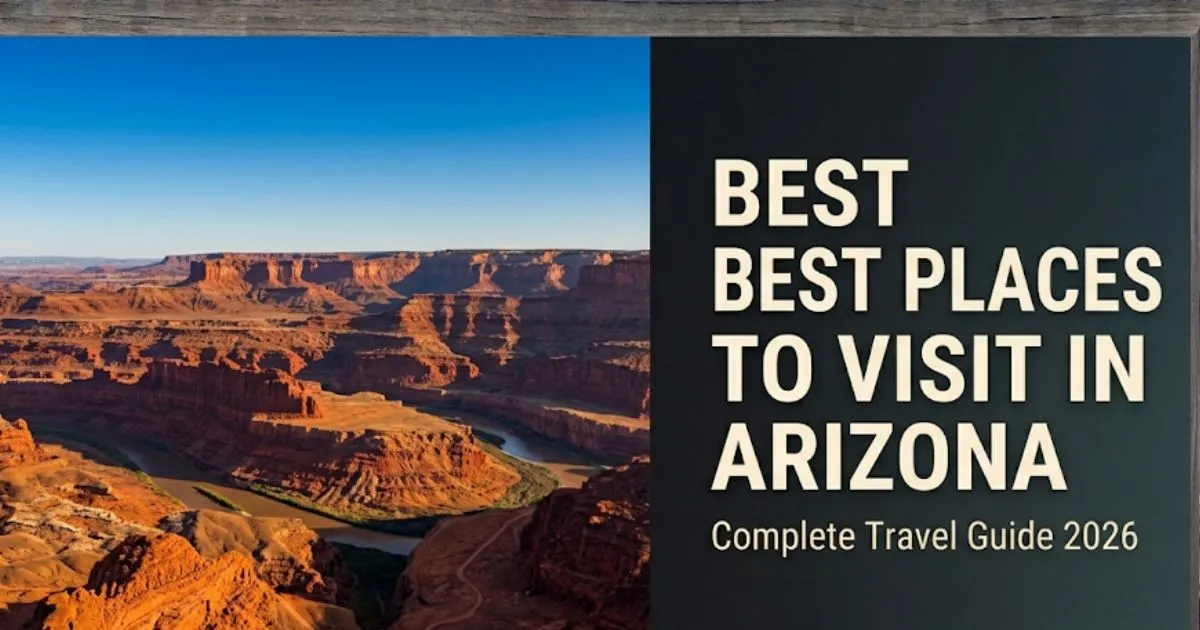
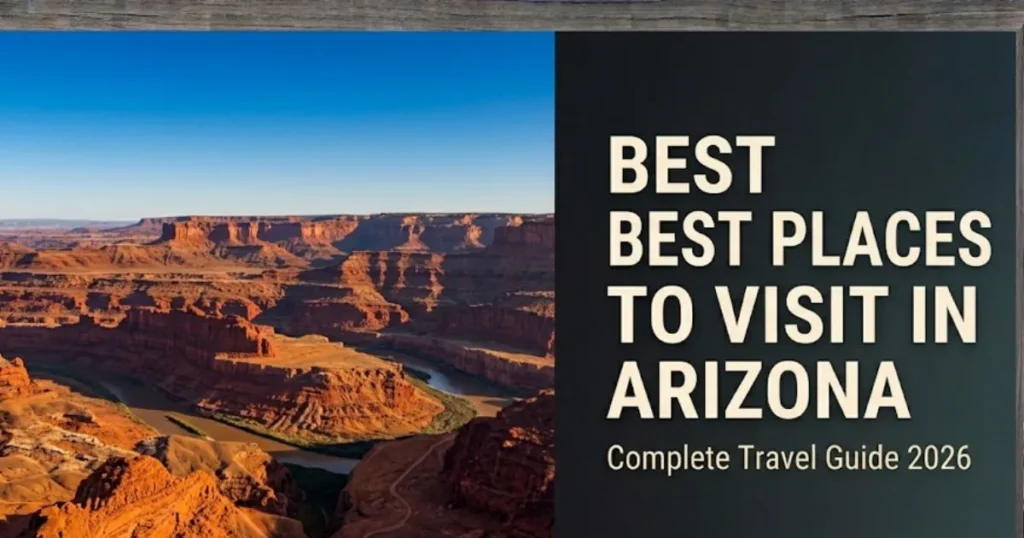
Best Places to Visit in Arizona: The 2026 Travel Guide

The best places to visit in Arizona span some of the most geologically dramatic terrain on Earth, from slot canyon walls glowing amber at midday to red rock formations rising 1,500 feet above the desert floor.
Arizona’s Grand Canyon National Park alone draws over 6 million visitors per year, according to the National Park Service. The state beyond it is just as extraordinary.
This guide covers 14 specific destinations across the state. It gives you the seasonal truth, the booking realities, and the traveler-profile matching that most Arizona guides skip entirely.
Best Places to Visit in Arizona: How to Use This Guide
The best places to visit in Arizona divide clearly into four geographic regions, each with a distinct character and a different ideal visitor type.
Northern Arizona holds the state’s most famous natural landmarks: the Grand Canyon, Antelope Canyon, Monument Valley, and Horseshoe Bend. Central Arizona includes Sedona’s red rock country, Scottsdale’s resort corridor, and the artisan hill towns of Jerome and Prescott. Southern Arizona centers on Tucson, Bisbee, and Saguaro National Park. Western Arizona borders Nevada and California along the Colorado River, anchored by Lake Havasu City.
Understanding which region fits your priorities saves you from the most common Arizona planning mistake: building a route that looks logical on a map but requires 10-plus hours of daily driving.
Here’s a quick comparison to orient your planning before diving into individual destinations:
| Destination | Best For | Season | Cost Tier | Advance Booking Needed |
|---|---|---|---|---|
| Grand Canyon South Rim | First-timers, families | Mar–May, Sep–Nov | Premium | Yes, 6–13 months for lodging |
| Sedona | Couples, hikers, wellness | Mar–May, Oct–Nov | Premium | Recommended |
| Scottsdale | Couples, resort travelers | Oct–Apr | Premium | Yes for peak season |
| Tucson | Food/culture travelers, budget | Oct–Mar | Mid-range | Not usually |
| Flagstaff | Families, stargazers, skiers | May–Oct | Mid-range | For busy weekends |
| Antelope Canyon | First-timers, photographers | Mar–Nov | Mid-range | Yes, months in advance |
| Monument Valley | Cultural travelers, road trippers | Apr–Oct | Mid-range | For Goulding’s Lodge |
| Bisbee | Solo travelers, art seekers | Oct–May | Budget–Mid | Not usually |
| Jerome | Day-trippers, couples | Year-round | Budget–Mid | No |
| Prescott | Families, seniors | May–Oct | Mid-range | For Whiskey Row weekends |
Arizona Destinations Overview and How to Choose
Choosing the right Arizona destination depends on three factors: your preferred activity type, your travel party’s physical comfort threshold, and your elevation preference.
Arizona’s elevations range from the low desert floor around Phoenix and Tucson at under 1,100 feet to Flagstaff at 7,000 feet and the Grand Canyon’s North Rim above 8,000 feet. This elevation spread creates completely different climates within a single state.
For travelers whose priority is iconic natural scenery with minimal physical demand, the Grand Canyon South Rim’s Rim Trail is fully paved and accessible. For travelers willing to hike, Sedona’s Cathedral Rock Trail delivers a climb of roughly 600 feet in under 1.5 miles with views that rival anything in Utah’s canyon country.
Couples seeking a resort-and-wine-country experience should anchor in Scottsdale or the Verde Valley Wine Trail area. Families with young children are better served in Flagstaff, where temperatures in summer stay below 80 degrees Fahrenheit and the Museum of Northern Arizona genuinely holds children’s attention.
Budget travelers should know that Tucson offers the most honest value in the state. The Arizona-Sonora Desert Museum near Tucson runs approximately $20 to $25 per adult as of recent years and delivers a wildlife and botanical garden experience that costs three times as much at comparable facilities in other states.
According to Visit Arizona, the state’s official tourism organization, the shoulder seasons of March through May and September through November represent the most consistently comfortable travel window across all elevations and regions.
Grand Canyon: South Rim vs. North Rim
The Grand Canyon’s South Rim is the right choice for first-time visitors. The North Rim is the right choice for everyone else.
South Rim is open year-round. It hosts over 90% of Grand Canyon visitors. The Bright Angel Trail descends from the rim to the Colorado River at the bottom over a 9.5-mile one-way route. Most day visitors hike 1.5 miles to the 1.5-Mile Resthouse with a water refill station, which is entirely reasonable in spring and fall but genuinely dangerous in summer heat.
North Rim is open mid-May through mid-October. It sits 1,000 feet higher than the South Rim and receives a fraction of the crowds. The North Rim Lodge and the Bright Angel Point Trail offer views into a different angle of the canyon that experienced hikers consistently describe as more dramatic.
South Rim lodging inside the park, including the historic El Tovar Hotel, books 6 to 13 months in advance through National Park Service concessions. Show up in August expecting availability and you will be staying in Williams or Tusayan, 60 miles away.
For families with young children: The South Rim’s free Grand Canyon Shuttle system makes car-free exploration genuinely manageable. Park the car, ride the shuttle, and spend the day moving between viewpoints without the parking nightmare.
For seniors and accessibility travelers: The Rim Trail is the most accessible long-distance paved trail at any national park in the American Southwest. Wheelchairs and mobility aids move freely along most of its 13-mile length.
The honest overrated assessment: the Mather Point overlook is the most photographed spot at the South Rim and also the most crowded. Walk 10 minutes west to Yavapai Point and the view is equally dramatic with dramatically fewer people.
Insider Tip:
- Enter through the Desert View Entrance on the east side of the park to avoid the primary Mather Point traffic congestion
- The Desert View Watchtower at the park’s eastern boundary offers canyon views that rival Mather Point with a fraction of the foot traffic
- Families visiting in shoulder season should target the Bright Angel Bicycles rental program at Bright Angel Lodge for rim exploration without hiking demands
Sedona Red Rock Country
Sedona is the single most visually concentrated travel destination in Arizona, where red sandstone buttes rise 1,500 feet from the high desert floor in formations that look deliberately theatrical.
The hiking here is genuinely exceptional, not tourism board hyperbole. The Bell Rock Pathway is a 3.6-mile moderate trail that non-hikers can walk the first half-mile of comfortably. Cathedral Rock Trail is 1.2 miles to the summit saddle and involves hand-over-foot scrambling at the top. The views from Cathedral Rock’s saddle are among the best in the state.
Tlaquepaque Arts and Shopping Village in Sedona is a legitimately interesting arts district built within a walled compound meant to evoke a traditional Mexican village. Individual galleries here represent serious regional artists. Prices reflect it.
The tourist-infrastructure problem in Sedona is real. Uptown Sedona along Highway 89A concentrates souvenir shops, Jeep tour operators, and vortex tour companies into a strip that reads more like a theme park entrance than an authentic town center. The local alternative is West Sedona along Highway 89A west of the Y intersection, where coffee shops, local restaurants, and neighborhood bakeries outnumber tourist operations.
For couples: The L’Auberge de Sedona resort on Oak Creek is a genuinely romantic property. The open-air dining here puts a creek 15 feet from your table. It is premium-priced and earns it.
For budget travelers: Sedona’s national forest trail system is free to hike, but the Red Rock Pass (approximately $12 per day as of recent years) is required to park at most trailheads. Avoid the marked vortex sites near Airport Road at peak hours — the crowds reduce the experience to something closer to a stadium queue.
The best time for Sedona is October through November. Crowds are lower than spring. Temperatures average in the 60s and 70s. The cottonwood trees along Oak Creek Canyon turn gold, adding a color contrast to the red rock that you don’t get in any other season.
Scottsdale: Desert Resort City
Scottsdale is one of the few American cities where the resort experience is the authentic local experience, not a tourism overlay on top of something else.
Old Town Scottsdale around Scottsdale Road and Main Avenue concentrates galleries, mid-century architecture, and restaurants into a walkable district that most visitors underestimate. The Scottsdale Museum of Contemporary Art (SMoCA) on Marshall Way is a genuinely serious contemporary art institution, not a tourist filler museum.
Camelback Mountain sits directly within the city. The Echo Canyon Trail to the summit is 1.3 miles at a very steep grade and classified strenuous. Summit views over the Phoenix metro area are extraordinary on clear days. Start before 7 a.m. between May and October.
The resort corridor along Scottsdale Road between Old Town and North Scottsdale includes some of the most acclaimed spa properties in the continental United States. The Phoenician, Four Seasons Resort Scottsdale at Troon North, and Sanctuary on Camelback Mountain consistently appear in national spa rankings. All three are premium-priced, with resort fees that often run $50 to $80 per night on top of the room rate.
For budget travelers: Scottsdale is candidly not a budget destination. The value lies in experiencing the resort scene through day spa passes rather than overnight rates, or visiting in summer when rates drop significantly as temperatures regularly exceed 110 degrees Fahrenheit.
For couples: The Heard Museum in adjacent Phoenix, a 20-minute drive from Old Town, is a legitimate world-level museum of Native American art and culture. Most Scottsdale resort visitors miss it entirely.
Key Takeaway: The Grand Canyon’s most crowded viewpoint is Mather Point. Walk 10 minutes west to Yavapai Point for an equally dramatic view with dramatically fewer people.
Tucson and Southern Arizona
Tucson is the most consistently underestimated major city in Arizona. Its food culture, cultural institutions, and natural setting are all significantly better than its tourist-destination reputation suggests.
The Arizona-Sonora Desert Museum west of Tucson is technically a zoo, botanical garden, and natural history museum combined. It covers 21 acres and features over 230 animal species in naturalistic habitats. It genuinely earns its admission price and then some.
Barrio Viejo, Tucson’s historic Mexican-American neighborhood south of downtown, is the right place to eat. Elvira’s on North Oracle Road is a regional institution for Sonoran Mexican cuisine, the regional style that differs from Tex-Mex and California Mexican in its use of carne seca, Sonoran hot dogs, and mesquite-grilled meats. The Congress Hotel on East Congress Street is the historic downtown anchor, dating to 1919, and the bar scene in its lobby is legitimately local.
Saguaro National Park wraps around Tucson in two districts. The Rincon Mountain District to the east is the better hiking option. The Tucson Mountain District to the west is more accessible by car. The famous saguaro cacti are iconic Arizona imagery, and here you see them in actual wilderness, not manicured landscaping.
For solo travelers: Tucson’s 4th Avenue district is the best street in Arizona for solo dining, bar-hopping, and bookshop browsing without feeling conspicuous. The density of locally owned businesses is genuinely high.
For families: Kartchner Caverns State Park south of Tucson is a show cave system discovered in 1974. Tours run approximately 45 minutes and are fully accessible by standard footwear. The living cave formations here are genuinely impressive for children who have never been underground.
The Sonoita-Elgin wine region 40 miles southeast of Tucson is one of the most legitimate wine-growing regions in the American Southwest. Vineyards at 4,000 to 5,000 feet elevation produce Rhone and Spanish varietal wines that earned Sonoita recognition as Arizona’s first AVA (American Viticultural Area). Most tasting rooms charge $10 to $20 for tastings as of recent years.
Flagstaff and Northern Arizona Gateway
Flagstaff is simultaneously a college town, a national park gateway, a dark sky astronomy center, and a genuine mountain destination with over 300 inches of snowfall annually.
The International Dark-Sky Association designated Flagstaff the world’s first International Dark Sky City. Lowell Observatory on Mars Hill Road, where Pluto was discovered in 1930, offers public telescope viewing nights. The experience is specifically excellent for families and astronomy-curious travelers who expect the desert to be flat and uninteresting at night.
Downtown Flagstaff along Heritage Square and San Francisco Street has a density of independent restaurants, craft breweries, and bookshops that feels more like a Pacific Northwest college town than what most visitors picture when they think of Northern Arizona. Biff’s Bagels, Diablo Burger, and the Historic Brewing Company taproom are specific local institutions that locals use weekly.
Humphreys Peak, at 12,633 feet, is Arizona’s highest point. The summit trail is 9 miles round-trip and gains 3,300 feet. It is an appropriate objective for fit hikers in July and August when the lower desert is inhospitable. Snow can fall on Humphreys at any month of the year.
For families: The Museum of Northern Arizona on Fort Valley Road houses one of the most respected collections of Colorado Plateau natural history, anthropology, and fine art in the region. Admission runs approximately $15 to $20 per adult as of recent years.
For budget travelers: Flagstaff is genuinely more affordable than Sedona or Scottsdale. Motel options along Route 66 in town range from historic roadside motor lodges to well-maintained national chain properties. The Coconino National Forest around Flagstaff offers free dispersed camping within specific zones.
Key Takeaway: Flagstaff’s temperatures in summer average 20 to 30 degrees cooler than Phoenix, making it a legitimate escape from low-desert heat rather than just a Grand Canyon stopover.
Antelope Canyon and Page, Arizona
Antelope Canyon is one of the most photographed slot canyons in the world, and it requires advance booking through authorized Navajo Nation tour operators regardless of season.
Upper Antelope Canyon is the more photographed of the two sections. The famous light beam photographs, where shafts of light pierce the narrow canyon walls, occur at midday between approximately March and October. Tour operators offering “photography tours” of Upper Canyon include dedicated tripod time in the price. Standard tours run 1 to 1.5 hours and cost approximately $60 to $90 per person as of recent years, plus the Navajo Nation permit fee.
Lower Antelope Canyon involves a steeper descent with ladders and is physically more demanding. It is less crowded than Upper Canyon, allows for more self-paced movement, and is preferred by repeat visitors for its less processed touring experience.
Horseshoe Bend, where the Colorado River makes a near-complete loop below sandstone cliffs, is 3 miles south of Page on Highway 89. The Horseshoe Bend State Park now charges a day-use fee of approximately $10 per vehicle as of recent years. The overlook is a 1.5-mile round-trip walk from the parking area over sandy, exposed terrain.
For families with young children: Upper Antelope Canyon’s tour format keeps groups moving in a single direction, which is manageable with children who can walk for 90 minutes. The canyon floor is sandy and mostly flat inside Upper Canyon.
For budget travelers: The Antelope Canyon tour fees are fixed by Navajo Nation tour operators. There is no cheaper legitimate option. Attempting to enter the canyons without an authorized tour is prohibited on Navajo Nation land.
The most common mistake at Antelope Canyon: booking tours in the last week before your trip. Upper Canyon tour slots for midday light conditions book weeks to months in advance. Book the moment you have a firm travel date.
Insider Tip:
- Book through Antelope Canyon Navajo Tours or Ken’s Tours for Upper Canyon — both are established authorized operators
- For Lower Canyon, Chief Tsosie’s Lower Antelope Canyon Tours is a consistently reviewed authorized operator
- Visit Horseshoe Bend at sunrise for the clearest light and the smallest crowds — the midday sun creates harsh shadows across the canyon walls that reduce photographic quality
Monument Valley and Navajo Nation
Monument Valley is one of the most recognizable landscapes in the world: three Mitten Buttes and Merrick Butte rising from the valley floor in a scene that has appeared in more Western films than any other American location.
Monument Valley Navajo Tribal Park is managed by the Navajo Nation Parks and Recreation department, not the National Park Service. Entry fees are approximately $20 per vehicle as of recent years. The 17-mile Valley Drive is a self-drive dirt road passable by standard vehicles in dry conditions. The road is rough — budget at least 2 hours to complete it properly.
Goulding’s Lodge and Trading Post at the park entrance is the most historic lodging option and a genuine landmark. John Ford used Goulding’s as a base camp during the filming of Stagecoach in 1939. Rooms here book quickly in peak season.
Guided valley tours into areas beyond the Valley Drive road are available through authorized Navajo guides at the visitor center. These tours access Mystery Valley and Hunt’s Mesa, areas with archaeological sites and views that the Valley Drive does not reach.
For cultural heritage travelers: Monument Valley sits within the Navajo Nation, the largest Native American territory in the United States. Purchasing crafts, jewelry, and art directly from Navajo vendors at the park visitor center puts money directly into the tribal economy. Do not purchase “Navajo-made” items from non-tribal roadside vendors outside the park boundary.
For families: The Valley Drive is accessible with standard vehicles. Children are generally fascinated by the scale of the formations and the landscape’s resemblance to the backdrop of every classic Western film they’ve seen in cartoons and movies.
The honest seasonal reality: Monument Valley in summer is extremely hot and dusty. Spring and fall are significantly more comfortable, and the light quality during golden hour in October is extraordinary.
Key Takeaway: Monument Valley’s Valley Drive takes a minimum of 2 hours to complete properly. Budget half a day, not a quick drive-through, if you want to actually experience the scale of the formations.
Arizona Small Towns: Bisbee, Jerome, and Prescott
Arizona’s three most rewarding small towns each occupy a distinct character and serve a different traveler type, but all three reward visitors who were told to stay on the Interstate 10 or Interstate 17 corridor.
Bisbee in Cochise County, 90 miles southeast of Tucson near the Mexican border, was a copper mining boomtown. The Queen Mine Tour descends into an actual working-era mine on a train. Tours run approximately 75 minutes and cost around $14 to $18 per adult as of recent years. The Bisbee Copper Queen Hotel dates to 1902 and is the oldest continuously operating hotel in Arizona.
Bisbee’s hillside historic district, called Old Bisbee, has steep staircases and switchback streets that make exploration genuinely physical. The art gallery density per block rivals Sedona at a fraction of the price. Bisbee Coffee Company on Main Street and the Stock & Trade bar on Brewery Gulch are specific local institutions.
Jerome sits at 5,000 feet on Cleopatra Hill above the Verde Valley. Its main street, Hull Avenue, runs through a historic district where Victorian mining-era buildings now hold galleries, restaurants, and wine bars. The Jerome State Historic Park occupies the former mansion of mine owner “Rawhide Jimmy” Douglas. The Haunted Hamburger on Jerome Avenue is a tourist-known spot, but Mile High Grill and Inn serves the same view with better food and fewer selfie sticks.
Prescott is the most family-friendly of the three towns. Whiskey Row on Montezuma Street is a historic bar street that has operated continuously since the 1860s and is genuinely lively on weekend evenings. Sharlot Hall Museum is a 3.5-acre outdoor history museum complex with original territorial-era buildings that holds up well for children ages 8 and older.
For solo travelers: Bisbee’s walkable scale, bar culture, and art community make it the most social of the three for solo visitors. The Bisbee Grand Hotel hosts weekend performances and events that create natural social gathering points.
Arizona Road Trip Routes and Stops
Arizona’s road trip infrastructure is genuinely exceptional. The state has more named scenic byways than nearly any other in the American West.
The most efficient Northern Arizona circuit begins in Flagstaff and loops through Sedona via Oak Creek Canyon Scenic Road (Highway 89A), then north to the Grand Canyon South Rim, east to Cameron, south to Flagstaff via Highway 89. This loop covers approximately 250 miles and works as a 3-day itinerary.
For a 2-day weekend framework from Phoenix:
Day 1:
- Depart Phoenix early, targeting Sedona by 9 a.m. on Highway 17 north to Highway 179
- Hike the Bell Rock Pathway (2 hours) or Cathedral Rock Trail (3 hours with summit)
- Lunch in West Sedona at Indian Gardens Oak Creek Market on Highway 89A
- Drive Oak Creek Canyon north on Highway 89A to Flagstaff (45 minutes)
- Evening at Flagstaff’s Heritage Square district; dinner at Brix Restaurant and Wine Bar on San Francisco Street
- Optional: Lowell Observatory evening telescope viewing (book in advance)
Day 2:
- Depart Flagstaff early, drive Highway 180 west then Highway 64 south to Grand Canyon South Rim (80 miles, 90 minutes)
- Walk east from Mather Point to Yavapai Point and Yavapai Geology Museum (2 hours)
- Shuttle west to Hermits Rest for the widest canyon views of the rim drive
- Return to Phoenix via Highway 64 south to Interstate 40 east then Interstate 17 south (approximately 3.5 to 4 hours)
For road-trippers without a car: Phoenix Sky Harbor Airport has car rental from all major agencies. Arizona road trips genuinely require a vehicle. Public transit between destinations is minimal outside the Phoenix metro area.
For budget travelers: Fuel costs are the primary road trip variable. Budget approximately $0.25 to $0.30 per mile for a standard sedan. The America the Beautiful Annual Pass (approximately $80) covers entrance fees at Grand Canyon and Petrified Forest, typically paying for itself within a single Arizona trip.
Best Time to Visit Arizona by Month
The best time to visit Arizona is October through November or March through May, when temperatures across most of the state fall into the most comfortable range for outdoor activity.
Here is what to expect month by month:
| Month | Low Desert (Phoenix, Tucson) | High Desert (Sedona, Flagstaff) | Crowds | Notes |
|---|---|---|---|---|
| January | Cool, 45–65°F | Cold, 20–50°F | Low | Peak season for Scottsdale/Tucson snowbirds |
| February | Mild, 50–70°F | Cold–cool, 25–55°F | Low–Moderate | Good for southern destinations |
| March | Warm, 65–80°F | Mild, 35–65°F | Moderate–High | Spring break peak; wildflowers possible |
| April | Warm–Hot, 75–90°F | Comfortable, 45–70°F | Moderate | Ideal statewide |
| May | Hot, 90–100°F | Comfortable, 55–80°F | Moderate | Strong for high-elevation destinations |
| June | Very Hot, 100–110°F+ | Warm, 65–85°F | Low–Moderate | Avoid low desert; good for Flagstaff |
| July | Extreme, 105–115°F | Warm with monsoon, 65–85°F | Low (heat) | Monsoon season; flash flood risk |
| August | Extreme, 103–115°F | Warm with monsoon, 65–85°F | Low (heat) | Monsoon continues |
| September | Hot, 95–105°F | Comfortable, 55–80°F | Low–Moderate | Late month becomes very good |
| October | Warm, 75–90°F | Comfortable, 45–75°F | Moderate | Best month statewide for most travelers |
| November | Cool–Mild, 55–75°F | Cool, 30–60°F | Low–Moderate | Strong for low-elevation destinations |
| December | Cool, 45–65°F | Cold, 20–50°F | Low | Holiday period spikes at Scottsdale |
For families with young children: Avoid low-elevation destinations from June through August. Flagstaff and the Grand Canyon North Rim remain manageable in summer but require early morning activity starts.
For seniors and accessibility travelers: January through March in Tucson and Scottsdale represents the best physical comfort window. The combination of mild temperatures and lower peak-season crowds than October makes this period the strongest for visitors who prefer not to compete with spring outdoor recreation crowds.
Key Takeaway: Arizona’s summer heat is not evenly distributed. Flagstaff at 7,000 feet averages 30 degrees cooler than Phoenix in July, making it a legitimate summer destination when the low desert is genuinely inhospitable.
Arizona National Parks and Outdoor Adventures
Arizona holds more national park units than any state except California and Alaska. The outdoor adventure range here is specific and exceptionally varied.
Petrified Forest National Park in northeastern Arizona protects the world’s largest collection of fossilized wood, with logs over 200 million years old preserved in jasper, quartz, and obsidian. The Painted Desert section of the park offers views across a badlands landscape in purple, red, and ochre that photographs do not fully capture. The park is typically open year-round and entry runs approximately $25 per vehicle as of recent years.
Saguaro National Park, split across two districts flanking Tucson, protects the Sonoran Desert’s iconic columnar cacti. The Cactus Forest Drive in the Rincon Mountain District is a paved 8-mile loop accessible to all vehicles and makes the park genuinely accessible to travelers who cannot hike.
The Wave in the Vermilion Cliffs Wilderness north of Page is the single most coveted permit-restricted hiking experience in Arizona. The sandstone formation’s layered curves are unlike anything else in the Southwest. The permit lottery through Recreation.gov is fiercely competitive: the advance lottery for permits 4 months ahead sees thousands of applications for 64 daily spots. Apply early and apply repeatedly.
Havasu Falls, accessed through Havasupai Tribal Land west of the Grand Canyon, requires a tribal camping or lodge reservation. Reservations open in February and historically sell out within hours. The hike into Havasupai Village is approximately 10 miles each way. This is not a day-use destination.
For adventure hikers: The Arizona Trail runs 800 miles from the Mexican border to Utah. It passes through five of Arizona’s life zones, two national parks, and multiple wilderness areas. Section hiking rather than thru-hiking is practical for most travelers.
For families: The Petrified Forest and the South Rim’s Rim Trail are the most accessible national park experiences for families with children ages 4 and older. Both involve paved surfaces and meaningful scenery without requiring serious athletic capacity.
Arizona Travel for Families, Couples, and Solo Travelers
Arizona’s destinations sort clearly by traveler profile, and the right match makes a genuine difference in the quality of the experience.
For families with children: Flagstaff is the top family base. Summer temperatures are manageable, the Museum of Northern Arizona delivers genuine educational content for children, and the Grand Canyon is 90 minutes away. Slide Rock State Park in Oak Creek Canyon, where the creek runs over natural rock slides, is specifically excellent for children ages 5 and older. Entry runs approximately $30 per vehicle as of recent years.
For couples: Sedona’s combination of visual drama, hiking, spa infrastructure, and intimate dining makes it the strongest couples destination in the state. L’Auberge de Sedona and Enchantment Resort (in Boynton Canyon) both offer experiences built specifically for couples seeking privacy and natural setting. Scottsdale offers more cosmopolitan resort energy if the preference leans toward spa days and urban dining over hiking.
For solo travelers: Tucson is the most genuinely solo-travel-friendly city in Arizona. The 4th Avenue district, the University of Arizona campus area, and the Congress Street corridor all have the independent restaurant and bar density that makes solo dining and exploration feel natural rather than awkward. Bisbee is the second-best solo destination for its walkability and arts community.
According to Arizona Office of Tourism, visitation by solo travelers to Tucson has grown consistently over the past several years as the city’s food and cultural identity has gained national recognition.
For seniors and accessibility travelers: Scottsdale’s flat topography and resort infrastructure make it the most physically accessible major destination in the state. The Scottsdale Trolley and rideshare access reduce the need for rental car navigation. At the Grand Canyon, the Rim Trail and the South Rim accessible viewpoints accommodate wheelchairs and mobility aids far better than any trail system in the park’s interior.
Arizona Budget Travel and Where to Find Real Value
Arizona’s most expensive destinations, Sedona and Scottsdale, do not represent the whole state. Genuine value exists in specific destinations and with specific strategies.
Tucson is the most budget-honest major Arizona city. Hotel rates average significantly lower than Scottsdale. The Arizona-Sonora Desert Museum and Saguaro National Park together deliver a full day of exceptional natural and cultural content at a fraction of what comparable experiences cost in other Arizona regions.
Flagstaff offers a second strong value case. The downtown dining and brewing scene on San Francisco Street and Route 66 competes with Sedona in quality at a fraction of the price. Dispersed camping in Coconino National Forest is available for free within designated zones (confirm current regulations with the US Forest Service Coconino National Forest office before camping).
Free and low-cost Arizona experiences:
- Jerome main street walking and gallery browsing: free to explore, though parking can be tight on weekends
- Painted Desert Vista along Interstate 40 near Petrified Forest: accessible without park entry fee
- Horseshoe Bend State Park: approximately $10 per vehicle, one of the most dramatic viewpoints in the state at minimal cost
- Sedona’s Red Rock Pass trail system: approximately $12 per day for trail access, covering multiple hikes
- Prescott’s Whiskey Row evening atmosphere: free to walk and enjoy
- Lowell Observatory public viewing nights: approximately $18 to $25 per adult as of recent years
For budget families: The America the Beautiful Annual Pass (approximately $80 for the annual pass) is the single best budget travel purchase for any Arizona trip including more than one national park or monument. It covers entrance fees at Grand Canyon, Saguaro, Petrified Forest, and Vermilion Cliffs National Monument among others.
Insider Tip:
- Scottsdale hotel rates in June through August drop dramatically as low-season pricing kicks in — if you can tolerate 110-degree temperatures and commit to morning outdoor activities only, you can access premium resorts at mid-range rates
- Sedona’s dining scene is significantly cheaper at lunch than dinner; the same kitchens, half the bill
- Bisbee lodging runs genuinely reasonable rates year-round compared to any comparable arts town in New Mexico or Colorado
Safety and Practical Warnings for Arizona Travel
Arizona’s primary travel risk is extreme heat at low elevations. Between June and mid-September, Phoenix and Tucson regularly record temperatures above 110 degrees Fahrenheit. This is not theoretical heat. People die of heat-related illness in Arizona every summer, including experienced hikers who underestimate conditions.
Key safety and practical facts every visitor should know:
- Carry more water than you think you need. The standard guidance in Arizona desert hiking is one liter per hour of activity. This is not excessive. It is minimum adequate.
- Avoid hiking below the rim at the Grand Canyon between 10 a.m. and 4 p.m. from May through September. The National Park Service posts signage and issues warnings regularly. Ignore neither.
- Flash flood risk in slot canyons is real. Antelope Canyon has experienced fatal flooding events. If your tour operator postpones due to upstream storm activity, that decision is not optional for you to override.
- Altitude adjustment is required at Flagstaff and the Grand Canyon rim. At 7,000 feet, physical exertion is harder. Headaches and shortness of breath are common on day one. Hydrate more than usual and do not begin with peak physical activity on arrival day.
- Cell service is limited or absent in Monument Valley, on the Grand Canyon’s inner canyon trails, and throughout much of the Navajo Nation. Download offline maps before departure via apps like Gaia GPS or Google Maps offline.
- Road distances in Arizona are longer than they appear on standard map views. Phoenix to Monument Valley is over 5 hours. Plan driving time realistically.
- Sun exposure at high-altitude desert locations is more intense than at sea level. SPF 50 sunscreen, a wide-brimmed hat, and sun-protective clothing are not optional accessories on Arizona outdoor days.
In case of emergency at the Grand Canyon, the National Park Service emergency line is accessible from rim areas. In areas with no cell service, personal locator beacons (PLBs) are a practical safety investment for serious backcountry hiking.
Key Takeaway: Arizona summer heat kills. The safety guidance is not excessive caution. Begin all outdoor activity before 9 a.m. from May through September at low-elevation destinations, carry at least two liters of water per person, and never attempt Grand Canyon below-rim hiking in midday summer conditions.
Frequently Asked Questions About Arizona Travel
What is the best time of year to visit Arizona?
The best time to visit Arizona is October through November or March through early May.
Temperatures are comfortable across most elevations during these months, with low-desert highs generally staying below 90 degrees Fahrenheit.
March through April adds the possibility of desert wildflower blooms in southern Arizona, while October through November brings fall color to Oak Creek Canyon near Sedona and consistently clear skies statewide.
How many days do you need to see Arizona?
Seven to ten days is the realistic minimum to experience Arizona’s distinct regions without spending most of your time driving.
A 5-day trip can cover one or two regions well: Sedona and the Grand Canyon, or Tucson and the Sonoran Desert, as examples.
Attempting to combine Grand Canyon, Antelope Canyon, Monument Valley, Sedona, and Scottsdale in under a week results in a driving itinerary with very little actual destination time at each stop.
Is Arizona worth visiting in the summer?
Arizona is worth visiting in the summer only if you target high-elevation destinations or plan activities exclusively in the early morning hours.
Flagstaff, at 7,000 feet, averages highs around 75 to 80 degrees Fahrenheit in July and is a genuine summer destination.
Phoenix, Tucson, and Page in summer are genuinely difficult for travelers unaccustomed to extreme heat: plan outdoor activity before 9 a.m. and accept that midday outdoor time is not practical.
What is the best place to visit in Arizona for first-timers?
The Grand Canyon’s South Rim is the strongest single first-timer destination in Arizona, providing the state’s most iconic scenery with well-developed visitor infrastructure.
Pair it with one night in Sedona and a night in Flagstaff for a 3-destination introduction to the state’s northern region.
If a first-timer cannot commit to Northern Arizona logistics, Scottsdale combined with a Sedona day trip delivers a strong introduction with more comfortable resort infrastructure.
Do you need to book Antelope Canyon in advance?
Yes. Antelope Canyon requires advance booking through authorized Navajo Nation tour operators.
Walk-up access is not available, and midday tour slots at Upper Antelope Canyon — the ones that produce the famous light beam photographs — book weeks to months in advance during peak season.
Book through operators like Antelope Canyon Navajo Tours or Ken’s Tours as soon as your travel dates are confirmed.
What is the most underrated place to visit in Arizona?
Bisbee, in Cochise County near the Mexican border, is the most consistently underestimated destination in the state.
Its steep historic district, serious art gallery scene, copper mine history, and genuinely local bar culture offer an Arizona experience that shares nothing with the resort-and-red-rock narrative that dominates most Arizona travel content.
The Queen Mine Tour alone is one of the most interesting industrial heritage experiences in the American Southwest, delivered at a fraction of the admission cost of comparable heritage attractions in other states.
Where to Start Planning Your Arizona Trip
The single most practical first step for any Arizona trip is identifying your primary region. Trying to cover the whole state in one trip is the most common planning mistake, and it produces a windshield tour rather than actual destination experiences.
Book Antelope Canyon tours and Grand Canyon South Rim lodging before anything else. These fill first and create the least flexibility when left to late planning.
Verify all entry fees, tour prices, permit lottery procedures, and seasonal operating hours directly with the National Park Service, Navajo Nation tour operators, Recreation.gov, and individual attractions before departure. Conditions, prices, and access requirements change regularly. The most current information lives on official venue and agency websites, not on travel guides published six months ago.
Arizona rewards the traveler who plans specifically and honestly. Pick your region, book what requires advance booking, carry more water than you think you need, and go.