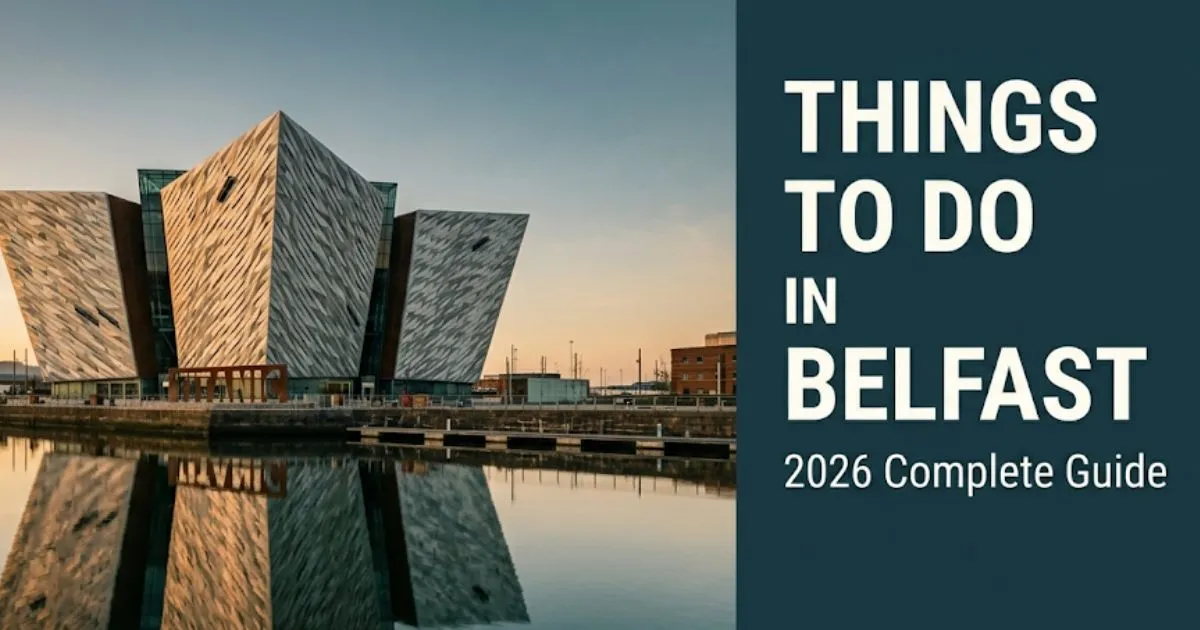
Best Things to Do in Belfast: Your Complete 2026 Guide

Belfast is one of Europe’s most underestimated city travel destinations, and the things to do in Belfast go far deeper than the one famous museum most visitors put on their list.
The city rebuilt itself from a complex political history into a genuinely confident, specific place. Visit Belfast reports consistent year-on-year growth in international visitors, with American travelers now among the fastest-growing arrival groups.
This guide covers Belfast’s top attractions with honest cost context, the neighborhoods worth your time, itinerary structure for a 2-day visit, and specific guidance by traveler type. Nothing generic. Nothing promotional.
Things to Do in Belfast: What Makes This City Worth Your Time
Belfast offers a combination of 20th-century political history, Victorian architecture, waterfront heritage, and a food and pub culture that no other city replicates.
It is compact enough to navigate on foot between the Cathedral Quarter and the city centre. It is affordable by the standards of London, Dublin, or Edinburgh.
The honest caveat is the weather. Belfast sits on the Atlantic edge of Northern Ireland and receives rain in every month of the year.
Even June and July, the warmest months, deliver significant rainfall alongside genuinely long daylight hours. Pack a waterproof layer regardless of the season.
What Belfast does not do well is resort-style comfort or manufactured charm. It is a real working city with a genuine character, and that is precisely its appeal.
Insider Tip:
- Start your visit in the Cathedral Quarter to orient yourself. Ann Street and Hill Street form the social and cultural core of the city.
- Do not confuse a Belfast visit with a Dublin visit. The cultural rhythm, political identity, and hospitality style are distinct and specific.
- Solo travelers will find Belfast unusually easy to navigate alone. Locals are direct, helpful, and notably unbothered by tourists eating or drinking alone.
Best Things to Do in Belfast: The Non-Negotiable Experiences
The best things to do in Belfast include Titanic Belfast, a Black Taxi Tour of the political murals, St. George’s Market on a Saturday morning, and an evening in the Cathedral Quarter pubs.
These four experiences cover the city’s defining identities: maritime industrial heritage, political history, food culture, and pub culture. Together they give a complete portrait of Belfast.
The overrated experience worth naming honestly: Belfast City Hall tours. The building itself is impressive from Donegall Square, but the interior tour is genuinely secondary to most of what Belfast offers.
Experienced repeat visitors consistently skip the City Hall interior and spend that time at the Ulster Museum instead. Free entry, world-class collections, and a fraction of the crowds.
| Experience | Best For | Cost Range | Booking Required |
|---|---|---|---|
| Titanic Belfast | All profiles | £20-£25 per adult | Yes, advance online booking |
| Black Taxi Tour | Couples, solo, adults | £35-£50 per person | Yes, advance booking |
| St. George’s Market | All profiles, families | Free entry | No |
| Ulster Museum | All profiles | Free | No |
| Crumlin Road Gaol | History travelers, adults | £12-£16 per adult | Yes, guided tour slot |
| Cave Hill walk | Active travelers | Free | No |
| Crown Liquor Saloon | Couples, pub culture fans | Cost of drinks | No |
| Cathedral Quarter evening | Adults, solo, couples | Variable | Pub-by-pub |
Top Things to Do in Belfast for Every Traveler Type
Belfast suits different traveler types in genuinely different ways, and the experience changes significantly based on who you are traveling with.
Solo travelers find Belfast among the friendliest cities in the British Isles for independent travel. The pub culture encourages conversation, and the compact city centre means getting lost is useful rather than stressful.
Couples get the most out of the Cathedral Quarter’s atmospheric bars, the Crown Liquor Saloon’s ornate Victorian snugs, and the coastal scenery on day trips toward the Causeway Coast.
Families with children will find St. George’s Market, the Titanic Belfast interactive exhibits, and the SS Nomadic genuinely child-engaging. The political mural districts require adult guidance and context for younger visitors.
Budget travelers will find Belfast among Europe’s most affordable city destinations. The Ulster Museum is free. Botanic Gardens is free. Cave Hill Country Park is free.
Seniors and accessibility travelers should note that the Cathedral Quarter has cobblestone surfaces on several streets. Cave Hill involves steep terrain. Titanic Belfast has full elevator access throughout its modern museum structure.
Insider Tip:
- The Belfast Glider rapid transit connects the Titanic Quarter to the city centre efficiently. A day ticket covers unlimited rides on Translink Metro and Glider services.
- Families should book the SS Nomadic alongside Titanic Belfast tickets. Children engage more directly with the physical ship than with the museum exhibits.
- Seniors visiting in summer should time outdoor walking to mornings before 11am, when the temperature is most comfortable and streets are quietest.
Key Takeaway: Belfast is one of Europe’s most walkable mid-sized cities. Book Titanic Belfast and Crumlin Road Gaol in advance. Everything else is accessible without pre-booking.
Titanic Belfast and the Titanic Quarter
Titanic Belfast is the world’s largest Titanic museum and sits on the exact slipways where the ship was built, making it historically irreplaceable rather than merely commemorative.
The nine-gallery experience covers the ship’s design, construction, launch, maiden voyage, and sinking. The interactive ride through a recreation of the shipyard is the exhibit that consistently resonates most with visitors of all ages.
Plan two to three hours minimum for the museum itself. Add another 45 minutes if you visit the SS Nomadic, the last surviving White Star Line vessel, docked adjacent to the main building.
Admission for Titanic Belfast runs approximately £20 to £25 per adult and around £11 to £15 for children as of recent years. Always verify current pricing directly with the venue before visiting.
Book online in advance. Peak summer weekends regularly sell out morning entry slots. Arriving without a booking on a July Saturday guarantees a significant wait or a turned-away visit.
The Titanic Quarter itself is worth a waterfront walk regardless of museum plans. The Hamilton Dock, the Pump House, and the Drawing Offices are all accessible as part of the broader Titanic Dock experience.
The local alternative that experienced visitors prefer: combine your Titanic Quarter visit with a walk along the Lagan Towpath toward the Odyssey Pavilion. The Lagan waterfront perspective gives the industrial scale of this district its proper context.
Families with children under 7 may find the museum’s heavy text-based galleries less engaging than the physical experience of the SS Nomadic’s deck and hull. Plan the ship visit first to hold younger children’s interest.
Insider Tip:
- The museum’s fourth-floor gallery, covering the discovery of the wreck, is the most visually immersive section. Time your visit to reach it without rushing.
- Last entry slots are typically less crowded than the 10am to 12pm rush. Check last-entry timing when booking.
- Photography is permitted throughout most of the museum. The re-creation ride is the one area where photography is restricted.
Black Taxi Tours and the Political Murals
A Black Taxi Tour of the Falls Road and Shankill Road murals is the most direct and contextually honest way to understand Belfast’s recent political history.
Local driver-guides, many of whom grew up during the Troubles, narrate the murals, the Peace Wall, and the divided community geography that shaped Belfast from the late 1960s through the 1998 Good Friday Agreement.
Tours typically last 90 minutes to two hours and cover both the Republican murals of Falls Road and the Loyalist murals of Shankill Road. Prices generally run approximately £35 to £50 per person for private tours, with shared group rates available.
Book in advance through named operators including Original Black Cab Tours and Black Taxi Belfast. Weekend availability fills quickly, particularly in summer.
The murals are on residential streets in active neighborhoods. Walking the area without a guide is possible but misses the lived-experience context that makes the tour genuinely valuable rather than merely photographic.
The honest note for families: the tour covers political violence, hunger strikes, and community trauma with adult directness. It is not appropriate for children under 12 and requires careful parental judgment for young teenagers.
The local alternative that adds depth: after the taxi tour, walk Northumberland Street where the Peace Wall gates open daily. The gates close at night. Reading the messages written on the wall by visitors from around the world is a quietly powerful complement to the structured tour.
According to Tourism Northern Ireland, the political mural tours are consistently among the top-rated cultural experiences in Belfast, cited by international visitors for their educational value and local authenticity.
Couples find the experience among Belfast’s most affecting shared moments. Solo travelers often report it as the experience that most changes their understanding of the city.
Cathedral Quarter Belfast
The Cathedral Quarter is Belfast’s most walkable cultural and social district, centered on the area around St. Anne’s Cathedral and running through Hill Street, Commercial Court, and Exchange Street.
This is where Belfast’s independent bar, music, and arts scene concentrates. The Black Box venue on Hill Street hosts live music, spoken word, and performance art. Oh Yeah Music Centre on Gordon Street documents Northern Ireland’s popular music history with free daytime access.
Kelly’s Cellars on Bank Street is one of the oldest pubs in Belfast, trading since 1720. It is the most historically grounded pub experience in the Cathedral Quarter and consistently preferred by locals over the tourist-busier options nearby.
The Duke of York on Commercial Court is the most photographed pub exterior in Belfast, with its barrel-lined alleyway providing an atmospheric setting particularly in evening light.
For solo travelers, the Cathedral Quarter operates as an effective social destination. Pubs here are smaller and conversation-friendly rather than the large barn-style venues that populate the city centre’s main strips.
For couples, an evening beginning at The John Hewitt Bar on Donegall Street, continuing to Kelly’s Cellars, and ending at one of the whiskey bars on Commercial Court represents the best version of Belfast pub culture.
The Cathedral Quarter is at its most interesting Thursday through Saturday evenings. Sunday mornings, when St. George’s Market runs nearby, create a pleasant low-key counterpart to the nighttime scene.
Insider Tip:
- Commercial Court’s cobblestone alleyway gets crowded on Friday and Saturday evenings. Arrive before 7pm for the atmosphere without the press of bodies.
- The Cathedral Quarter Arts Festival, held annually in late April and early May, transforms this district and is worth planning a visit around.
- The John Hewitt Bar is named after the Northern Irish poet. It is run by the Belfast Unemployed Resource Centre and operates a genuinely community-minded ethos distinct from commercial pubs.
Key Takeaway: The Cathedral Quarter is the social heart of Belfast. Kelly’s Cellars on Bank Street is the single best pub in the district for local atmosphere, history, and an honest pint.
St. George’s Market and the Belfast Food Scene
St. George’s Market on May Street is the oldest covered market in Ireland and the best single place to understand Belfast’s current food culture in one visit.
The Friday market focuses on fresh food, fish, and local produce. The Saturday City Food and Garden Market brings together street food vendors, local artisan producers, and live music from around 9am to 3pm.
Entry to St. George’s Market is free. Food spending is genuinely affordable by any European city standard.
The Saturday market is the one not to miss. Local vendors include Broughgher Mountain Farm for artisan cheeses, dedicated Belfast-sourced smoked salmon stalls, and rotating street food from Northern Irish and international kitchens.
Belfast’s wider restaurant scene has evolved significantly over the past decade. Ox on Oxford Street holds a long-running reputation as the city’s most acclaimed restaurant, with a river-facing room and a tasting menu focused on Northern Irish produce.
Mourne Seafood Bar on Bank Street is the best-known seafood option in the city centre and delivers reliably on fresh-caught shellfish and Atlantic fish. Booking is recommended for weekend dinner service.
For budget travelers, St. George’s Market provides an excellent Saturday lunch for under £10. The city centre also supports strong cafe culture, with General Merchants in the Botanic Quarter offering one of the best flat white and brunch combinations in the city.
Families with children will find St. George’s Market the most practical food destination: outdoor stalls, flexible food choices, and space that accommodates strollers and variable eating paces.
Insider Tip:
- Arrive at St. George’s Market before 10am on Saturdays. The best stalls sell out of smoked fish and artisan cheese by late morning.
- The market’s permanent structure is a Victorian iron-and-glass building worth pausing to appreciate architecturally. It is Grade B+ listed.
- The area around May Street between the market and the Lagan River is quieter than the city centre and offers a more relaxed walking route back toward the Titanic Quarter.
Cave Hill and Outdoor Things to Do in Belfast
Cave Hill Country Park provides Belfast’s best urban hiking and the panoramic viewpoint that gives the city its full geographic context, visible from the summit at McArt’s Fort 1,180 feet above the city.
The main hiking route from the Belfast Castle trailhead to McArt’s Fort takes approximately 45 to 60 minutes uphill on a well-marked path. The summit view covers Belfast Lough, the Titanic Quarter waterfront, and on clear days, the Scottish coast.
This is a free experience and one of the most rewarding outdoor activities in Belfast regardless of the season. The path is unpaved and moderately steep, requiring appropriate footwear.
Belfast Castle at the base of the trail is open daily and provides a cafe stop before or after the walk. The castle itself dates to 1870 and offers views over the city from its terrace gardens.
Active solo travelers and couples find Cave Hill the most genuinely satisfying outdoor experience in the city. Families with children over 8 can complete the summit route; younger children are better suited to the castle gardens and lower trails.
Seniors and mobility-limited travelers should note that the Cave Hill summit trail is steep with uneven terrain. The castle terrace and lower woodland paths provide accessible outdoor options without the climb.
The honest seasonal note: Cave Hill on a clear June or July evening, with daylight until 10pm and the city spread below, is Belfast at its most visually rewarding. In winter, the summit is exposed, wet, and frequently in cloud.
Insider Tip:
- The less-visited Black Mountain trailhead on the western edge of Belfast provides a longer ridge walk with fewer visitors than Cave Hill. Experienced hikers prefer it.
- Combine Cave Hill with a visit to Belfast Zoo at the mountain’s base. The zoo sits within the country park and is suitable for families wanting a structured outdoor half-day.
- Check the weather forecast before committing to the summit. The upper trail is exposed and genuinely dangerous in high winds or icy conditions.
Key Takeaway: Cave Hill is free, spectacular on a clear day, and one of Belfast’s most underused experiences by first-time visitors who focus exclusively on paid attractions.
Crumlin Road Gaol Belfast
Crumlin Road Gaol is one of Belfast’s most historically immersive attractions, a working Victorian prison from 1845 through 1996 that held political internees, hunger strikers, and ordinary criminals in equal measure.
It is accessible by guided tour only, and booking a specific tour slot in advance is required. Walk-up entry is not available. Tour slot availability is limited, particularly on weekends.
Standard guided tours last approximately 60 to 90 minutes. Specialist evening ghost tours and historical tours run seasonally and book out weeks ahead.
Admission typically runs approximately £12 to £16 per adult for the standard historical tour, with seasonal variations. Verify current pricing and tour schedules directly with the Gaol before visiting.
The Crumlin Road Gaol is located on Crumlin Road in North Belfast, approximately 1 mile from the city centre. The Translink Metro provides access from Donegall Square.
The experience is best suited to adults and older teenagers with genuine interest in political and criminal history. The content covers execution, internment, and Troubles-era political imprisonment directly and without softening.
For solo travelers and couples interested in the Troubles period, Crumlin Road Gaol pairs logically with a Black Taxi Tour of the murals. Together they form the most complete single-day education in Belfast’s 20th-century political history.
According to Visit Belfast, Crumlin Road Gaol is consistently rated among the top five most-visited attractions in the city, with the guided tour format cited as a particular strength.
Insider Tip:
- The tunnel connecting the gaol to the courthouse across Crumlin Road is one of the most memorable physical spaces in the building. Ask your guide to include it if the tour schedule allows.
- The Gaol runs specialist events including historical lectures and themed evenings throughout the year. Check the calendar when planning your visit.
- Photography is permitted throughout most of the tour. The condemned cell area is the most affecting physical space for most visitors.
Crown Liquor Saloon and Belfast Pub Culture
The Crown Liquor Saloon on Great Victoria Street is the finest surviving Victorian gin palace in the British Isles and is managed by the National Trust, making it both a functioning pub and a preserved national monument.
The interior features hand-carved wooden snugs with lockable doors, mosaic tile floors, painted faience columns, and gas lighting that has been operating since 1885. There is genuinely nothing else like it in Belfast or anywhere else.
Visiting the Crown costs nothing beyond what you order. A pint of Guinness or a glass of local craft beer here is one of the best-value heritage experiences in the city.
The honest note: the Crown gets very busy on Friday and Saturday evenings. The snugs seat four to six people and are first-come. Visiting at lunchtime on a weekday gives the most atmospheric experience without the crowd noise.
Belfast pub culture more broadly concentrates in three zones: the Crown and its Great Victoria Street neighbors, the Cathedral Quarter cluster around Kelly’s Cellars and the Duke of York, and the Botanic Quarter pubs near Queen’s University.
The Botanic Quarter pub scene, particularly The Eg on Eglinton Avenue and the streets surrounding Queen’s University, represents where students and local professionals drink. The crowd here skews younger and the atmosphere is less tourist-oriented.
For couples, the Crown’s private snugs provide the most romantic pub experience in Belfast. For solo travelers, the open bar area at the Crown or the John Hewitt in the Cathedral Quarter are the most conversation-friendly options.
Insider Tip:
- The National Trust has restored the Crown’s snug doors to their original locking mechanism. Slide the bolt across and you have as much privacy as a Victorian gin palace allows.
- The Crown is directly opposite the Europa Hotel. The combination of the two buildings tells the story of Belfast in one block: one bomb-damaged icon of the Troubles, one Victorian icon of the city before them.
- Order oysters at the Crown if they are available. The combination of Victorian surroundings and fresh shellfish is as Belfast as it gets.
Key Takeaway: Visit the Crown Liquor Saloon at lunchtime on a weekday to experience the snugs and the Victorian interior without competing with a Friday night crowd for the best seats.
Ulster Museum and Belfast Arts and Culture
The Ulster Museum in the Botanic Quarter is free to enter, open daily, and covers Irish art, natural history, ancient Egypt, and Troubles-era political history in a single modern building beside the Botanic Gardens.
It is the most consistently underused attraction in Belfast among first-time visitors who default to paid experiences. Repeat visitors consistently rank it alongside Titanic Belfast as the best museum experience in the city.
The Troubles gallery is particularly significant, covering the period from 1968 through 1998 with artifact-driven storytelling that complements the more structural history covered on Black Taxi Tours.
The Egyptian collection, while smaller than major London equivalents, contains genuinely significant artifacts including a complete mummy and well-preserved ceremonial objects that engage children as effectively as any paid interactive exhibit.
Budget travelers should build at least two hours into their Belfast schedule for the Ulster Museum. Combined with the adjacent Botanic Gardens, this is an outstanding free half-day in the Botanic Quarter.
Families with children will find the Ulster Museum one of Belfast’s most successful family experiences. The natural history section, the Egyptian collection, and the regular interactive programming for younger visitors are specifically cited in National Museums NI programming.
The Belfast Exposed gallery on North Street in the Cathedral Quarter provides a complementary arts experience, focusing on documentary and contemporary photography. Entry is free and the programming changes regularly.
For seniors, the Ulster Museum is one of Belfast’s most accessible major attractions. Elevator access throughout, cafe on-site, and seating in every gallery make it manageable for any mobility level.
Insider Tip:
- The Ulster Museum is quietest on weekday mornings. School groups arrive in numbers on term-time weekday afternoons.
- The museum’s cafe overlooks the Botanic Gardens. It is a genuine working lunch spot rather than a tourist-priced cafe.
- The spiral staircase at the museum’s heart is an architectural set piece worth noting. It is also bypassed by elevator if needed.
Things to Do in Belfast With Kids
Belfast with children works best when you build the itinerary around physical, interactive experiences rather than text-heavy historical exhibits.
The Titanic Belfast museum interactive sections, the physical deck of the SS Nomadic, St. George’s Market on a Saturday, Belfast Zoo on the Cave Hill, and the W5 interactive science centre at the Odyssey Pavilion form the strongest family activity base.
W5 (Who What Where When Why) is Belfast’s dedicated interactive science centre on Queen’s Quay. It targets children aged 2 to 12 with hands-on science and technology exhibits. Admission runs approximately £10 to £14 per child as of recent years.
Belfast Zoo on the Cave Hill is open daily and accessible via the Translink Metro to Antrim Road. It houses over 150 species in a setting that also provides access to the lower Cave Hill woodland trails.
St. George’s Market on a Saturday morning is family-friendly in a way few city markets are. The open layout, the mix of food vendors, and the live music provide a self-pacing experience that works for varied ages.
The Botanic Gardens beside the Ulster Museum provides free outdoor space with a Victorian glass Palm House that engages children through its dramatic tropical planting. The rose gardens and grounds are open daily without charge.
For families with teenagers, the Black Taxi Tour is worth considering from age 14 upward, with parental judgment on readiness for direct discussion of political violence and community trauma.
Insider Tip:
- W5 and Titanic Belfast are adjacent in the Titanic Quarter. Combining them makes a full family day without requiring city transport between venues.
- Belfast Zoo’s highest visitor volumes are on weekend mornings during school holidays. Weekday visits in summer are significantly less crowded.
- The Botanic Gardens Palm House typically has reduced winter hours and may close on some days for maintenance. Verify before visiting during November through February.
Free Things to Do in Belfast
Belfast offers more genuinely free, high-quality experiences than most comparable European cities, making it one of the best-value urban destinations available to budget-conscious American travelers.
Key free experiences:
- Ulster Museum: Full collections free, open daily
- Botanic Gardens: Open daily, Palm House free
- Cave Hill Country Park: Free access, including summit trail
- St. George’s Market: Free entry, cost only for food purchased
- Lagan Towpath: Free waterfront walk from city centre toward Titanic Quarter
- Political murals on Falls Road and Shankill Road: Accessible publicly (guided context recommended)
- Belfast City Hall exterior and grounds: Free to visit Donegall Square
- Oh Yeah Music Centre: Free daytime access to Northern Irish music history exhibits
- Queen’s University Belfast campus: Free to walk, architecturally significant Victorian buildings
- Belfast Exposed gallery: Free, contemporary photography, changing exhibitions
- Titanic Quarter waterfront walk: Free walking route past slipways, Hamilton Dock, and Pump House
- Black Mountain: Free trailhead access on western city edge
Budget travelers can construct a complete and genuinely satisfying two-day Belfast itinerary spending under £30 on paid attractions by combining the free experiences above with one paid entry to Crumlin Road Gaol or the Crown’s food and drink.
The single paid experience that most genuinely earns its admission fee is Titanic Belfast. Everything else on this list holds up as independent experiences.
Insider Tip:
- The Lagan Towpath walk between Donegall Quay and the Titanic Quarter takes approximately 25 minutes at an easy pace. It provides the best free perspective on Belfast’s industrial waterfront character.
- Queen’s University’s main building on University Road is modeled on Magdalen College, Oxford. The quadrangle is open to visitors and often less busy than the Botanic Gardens immediately adjacent.
Key Takeaway: The Ulster Museum alone justifies half a day in Belfast’s Botanic Quarter, costs nothing, and outperforms several paid attractions in depth and genuine interest.
Best Time to Visit Belfast
The best time to visit Belfast is May through September, with June and July offering the longest daylight hours and the widest range of outdoor activities at their most accessible.
Late September and October add the Belfast International Arts Festival, one of the largest arts festivals in Ireland and the United Kingdom, which brings international theater, music, and visual arts programming to venues across the city.
| Month | Weather | Crowds | Events | Best For |
|---|---|---|---|---|
| January-February | Cold, very wet | Low | Few | Budget rates, quiet museums |
| March-April | Cool, variable | Low-moderate | St. Patrick’s Day (March) | Value + emerging spring |
| May-June | Mild, some rain | Moderate | Cathedral Quarter Arts Festival (May) | Best all-round |
| July-August | Warmest, rain still | Peak | Féile an Phobail (August) | Longest days, highest crowds |
| September-October | Cooling, wet | Moderate | Belfast International Arts Festival (Oct) | Arts + manageable crowds |
| November-December | Cold, wet | Low | Christmas Market (Dec) | Festive atmosphere, lowest rates |
Féile an Phobail, the West Belfast Festival held in late July and early August, is Europe’s largest community arts festival and takes place in Falls Road and the surrounding area. It provides an extraordinary cultural window into West Belfast that has no equivalent at any other time of year.
The honest seasonal warning: book accommodation early for July and August. Belfast hotel rates increase significantly during peak summer, and availability around major festival dates can be limited.
Winter visits offer genuine advantages: the Ulster Museum and Crown Liquor Saloon are at their best when not competing with summer crowds, and hotel rates are substantially lower.
Insider Tip:
- The period from late May through mid-June consistently delivers the best combination of mild weather, manageable crowds, and long daylight hours.
- The Belfast Christmas Market on Donegall Square runs through most of December and is one of the most atmospheric winter markets in the British Isles. European Christmas market veterans often rank it among their favorites.
- Avoid the week surrounding the Twelfth of July parades unless you specifically want to observe the tradition. The parades are culturally significant but can affect city centre movement and accommodation availability.
Day Trips from Belfast
The most rewarding day trip from Belfast is the Causeway Coastal Route to the Giant’s Causeway, a UNESCO World Heritage Site approximately 60 miles north of the city.
The Giant’s Causeway itself, with its 40,000 interlocking basalt columns formed by ancient volcanic activity, is genuinely worth the journey. Allow 3 to 4 hours for a full day trip including driving time.
Day trip options from Belfast:
- Giant’s Causeway: 60 miles north, approximately 1.5 hours driving; accessible by Translink Ulsterbus from Europa Bus Centre
- Carrick-a-Rede Rope Bridge: 65 miles north, typically combined with Giant’s Causeway; advance booking required for the bridge crossing
- Dark Hedges: 55 miles north, the famous beech avenue from Game of Thrones filming; free access, best visited early morning before coach tours arrive
- Old Bushmills Distillery: 62 miles north, the oldest licensed whiskey distillery in the world; tours available, booking recommended
- Antrim Coast Road: The A2 coastal drive from Belfast toward Cushendall is one of the most scenic coastal drives in Europe
- Dundrum Castle and Newcastle: 30 miles south, accessible by Translink bus; medieval castle ruins above a coastal village with access to Mourne Mountains walking
- Ulster Folk Museum, Cultra: 8 miles east, an open-air museum preserving traditional Ulster buildings and rural life; strong family option and the easiest day trip from Belfast
For travelers renting a car, the Causeway Coastal Route allows stops at multiple locations including the Giant’s Causeway Visitor Centre, Carrick-a-Rede, and the Dark Hedges in a single long day.
For travelers without a car, Translink’s Causeway Rambler bus service runs seasonally along the north Antrim coast. Verify 2026 seasonal service dates with Translink before planning.
Insider Tip:
- Giant’s Causeway parking requires advance payment booking in peak season. Arriving without a parking reservation on a summer weekend creates significant delays.
- The Dark Hedges are most photogenic and manageable before 8am. By 9am, coach tours and photographers saturate the small road.
- Carrick-a-Rede Rope Bridge booking is managed by the National Trust. Slots sell out weeks ahead in summer. Book as early as your travel date allows.
Suggested 2-Day Belfast Itinerary
This framework covers the strongest Belfast experiences across two days without back-tracking between neighborhoods.
Day 1: Titanic Quarter and East Belfast
- Arrive at George Best Belfast City Airport (BHD) or city centre hotel by 9am
- Walk or take the Belfast Glider to the Titanic Quarter
- Enter Titanic Belfast at your pre-booked morning time slot (allow 2.5 hours)
- Walk to the SS Nomadic immediately adjacent (45 minutes)
- Walk the Lagan Towpath back toward the city centre (25 minutes, free)
- Lunch at St. George’s Market if visiting on Friday or Saturday, or Mourne Seafood Bar on Bank Street otherwise
- Afternoon: Ulster Museum in the Botanic Quarter (free, allow 2 hours)
- Walk through Botanic Gardens and past Queen’s University toward the Botanic Quarter pubs
- Evening: Dinner at Ox on Oxford Street (book ahead) or casual dinner in the Botanic Quarter
- End the evening at the Crown Liquor Saloon on Great Victoria Street (arrive before 7pm for snug access)
Day 2: Political History, Cathedral Quarter, and Cave Hill
- Morning: Black Taxi Tour of Falls Road and Shankill Road murals (book first slot, approximately 9am; 90 minutes)
- Walk Northumberland Street Peace Wall gates after the tour
- Coffee and late morning break in the Cathedral Quarter at any cafe on Hill Street
- Crumlin Road Gaol guided tour (pre-booked; allow 90 minutes including transit time from city centre)
- Lunch in the Cathedral Quarter: The John Hewitt Bar serves food and is one of the better lunch options in the district
- Afternoon: Cave Hill walk from Belfast Castle trailhead to McArt’s Fort (allow 2.5 to 3 hours round trip)
- Return to city centre by early evening
- Evening: Cathedral Quarter pub circuit: Kelly’s Cellars, Duke of York on Commercial Court, and one of the Cathedral Quarter whiskey bars for a closer of local Irish whiskey
Safety and Practical Warnings for Belfast Visitors
Belfast is a safe destination for international tourists in 2026, with a city centre and tourist district crime profile comparable to any mid-sized British or Irish city.
Key safety and practical facts every visitor should know:
- Book Titanic Belfast in advance. Walk-up entry on summer weekend mornings regularly results in turned-away visitors. Pre-booking is not optional for summer visits.
- Crumlin Road Gaol requires a guided tour slot booking. Arriving without a specific tour reservation means no entry.
- The Cathedral Quarter on Friday and Saturday nights is busy and lively. Normal urban awareness applies. The area is well-policed and generally safe.
- Falls Road and Shankill Road are residential communities. Visiting as part of a Black Taxi Tour with a local guide is strongly recommended over independent walking without context.
- Belfast weather requires waterproof outerwear regardless of season. Atlantic rainfall can arrive without warning. A packable waterproof layer takes minimal luggage space and prevents significantly wasted outdoor time.
- Cave Hill summit trail is steep and uneven. Trainers are inadequate in wet conditions. Hiking shoes or boots are appropriate for the summit route.
- Currency: Northern Ireland uses British Pounds Sterling (GBP), not Euros. Card payments are widely accepted, but carry some cash for market stalls and smaller pubs.
- Emergency services in Northern Ireland are reached on 999 for police, fire, or ambulance. The non-emergency police number is 101.
Always verify current conditions, attraction hours, and tour availability directly with each venue before departure. Belfast’s tourism infrastructure continues to evolve, and 2026-specific information should be confirmed with Visit Belfast or directly with individual attractions.
Frequently Asked Questions About Things to Do in Belfast
What are the best things to do in Belfast for first-time visitors?
The best things to do in Belfast for first-time visitors are Titanic Belfast, a Black Taxi Tour of the political murals, an evening in the Cathedral Quarter, and a Saturday morning at St. George’s Market.
These four experiences cover the city’s defining identities: maritime heritage, political history, pub culture, and food culture.
Together they give a complete portrait of Belfast in approximately two days, with Titanic Belfast requiring advance online booking and the Black Taxi Tour requiring advance reservation with a named operator.
How many days do you need in Belfast to see everything?
Two full days covers Belfast’s major attractions without rushing, and three days allows you to add a day trip to the Giant’s Causeway or Causeway Coastal Route.
A single day is enough to visit Titanic Belfast and the Cathedral Quarter, but leaves no time for the political mural tour, Cave Hill, or the Ulster Museum.
Four or more days is appropriate only for travelers combining Belfast with extended Northern Ireland exploration including the Antrim Coast, Mourne Mountains, and Strangford Lough.
Is Belfast safe for tourists in 2026?
Belfast is safe for tourists in 2026, with a city centre crime profile comparable to Edinburgh or Bristol.
The Falls Road and Shankill Road areas are safe to visit and are actively encouraged as tourist destinations, but benefit from the contextual guidance of a Black Taxi Tour rather than independent wandering without local knowledge.
Normal urban awareness applies in the Cathedral Quarter on busy Friday and Saturday evenings.
What is the best time of year to visit Belfast?
The best time to visit Belfast is late May through early July, when days are long, weather is at its most consistently mild, and major attractions are operating full schedules.
October is also an excellent time for the Belfast International Arts Festival, which brings significant cultural programming to the city.
The winter months from November through February offer the lowest hotel rates but consistent wet and cold weather that limits outdoor experiences including Cave Hill and the Causeway Coast day trip.
What free things can you do in Belfast?
The best free things to do in Belfast include the Ulster Museum, Botanic Gardens, Cave Hill Country Park, the Lagan Towpath waterfront walk, St. George’s Market entry, the Oh Yeah Music Centre, and the political murals on Falls Road and Shankill Road.
The Ulster Museum alone provides three to four hours of genuinely high-quality content across Irish art, natural history, and political history collections.
Belfast is one of the most free-activity-rich city destinations in the British Isles, and a complete two-day itinerary can be built around these experiences at minimal cost.
Can you do a day trip to Giant’s Causeway from Belfast?
A day trip to the Giant’s Causeway from Belfast is entirely practical, with the site approximately 60 miles north of the city and accessible in approximately 1.5 hours by car via the A26 and A44.
By public transport, Translink Ulsterbus operates services from Europa Bus Centre in Belfast to Bushmills and the Giant’s Causeway, with journey times of approximately 2 to 2.5 hours each way.
Allow a minimum of 4 to 5 hours at the site and along the Causeway Coastal Route to make the journey worthwhile, and verify the 2026 seasonal Causeway Rambler service schedule directly with Translink before planning.
Plan Your Belfast Trip With Confidence
Belfast earns its growing reputation as one of the most honest and specific city travel experiences in the British Isles. Book Titanic Belfast and Crumlin Road Gaol before anything else. Both sell out, and both genuinely require their guided or timed-entry formats to deliver their full impact.
The single most practical step for your trip is to verify current admission prices, tour slot availability, and seasonal hours directly with Visit Belfast and each individual venue before departure. Prices and schedules change annually, and 2026-specific details should come from the source.
The reader who arrives in Belfast having pre-booked two key timed experiences and left the rest flexible will have the best trip. This city rewards exploration and conversation. It does not reward rigid over-scheduling.