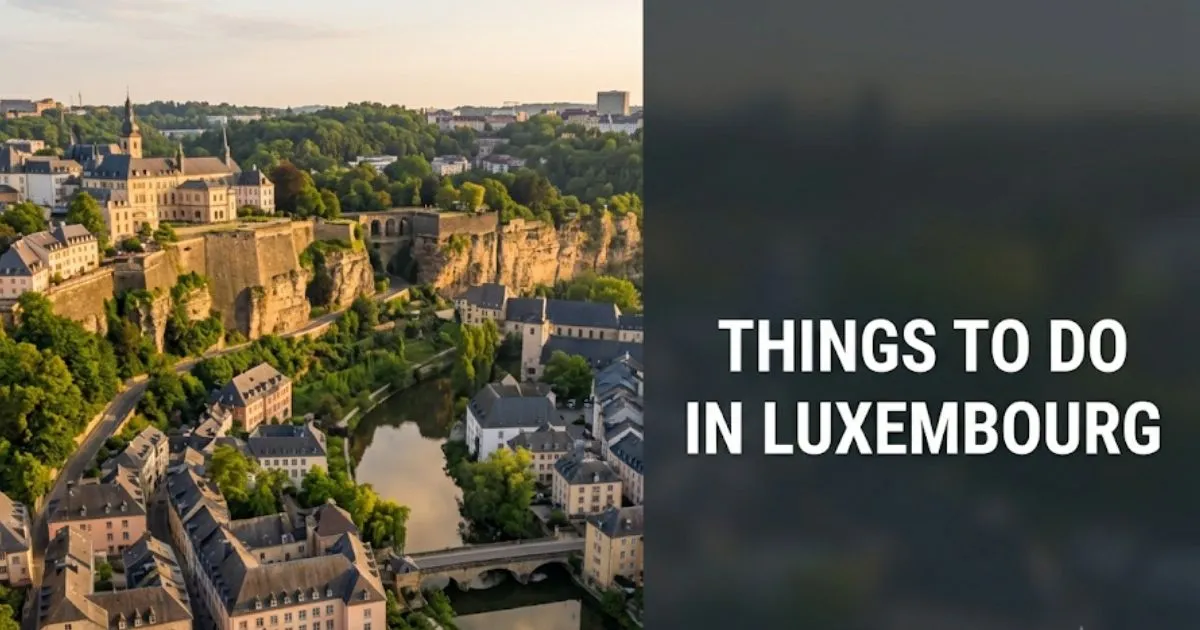
Best Things to Do in Luxembourg: 2026 Visitor Guide

Luxembourg City packs more things to do per square kilometer than most European capitals three times its size. Its UNESCO-listed fortifications, dramatic river valleys, world-class museums, and day-trip depth make it one of Western Europe’s most underestimated city-break destinations.
Visit Luxembourg, the national tourism authority, notes that the city’s medieval core sits on sandstone rock promontories above two river valleys. That geography creates a visual and physical drama that defines every experience here.
This guide covers every major activity, all key neighborhoods, honest assessments of what genuinely earns its reputation, practical logistics for 2026, and a one-day itinerary framework you can start using today.
Things to Do in Luxembourg: Why This City Rewards Serious Visitors
Luxembourg offers a rare combination of UNESCO-protected history, contemporary architecture, and accessible natural scenery within one compact capital city.
The Grand Duchy is one of the world’s smallest sovereign nations. Its capital functions simultaneously as a medieval fortress city, a modern European Union administrative center, and a river-valley hiking destination.
That contrast is what makes things to do in Luxembourg genuinely varied. You can walk Roman-era tunnel systems before lunch and visit one of Europe’s best contemporary art museums in the afternoon.
Visit Luxembourg reports that the city’s fortification system, designated a UNESCO World Heritage Site, includes over 17 kilometers of tunnels and underground galleries.
Most American visitors know Luxembourg as a transit stop between Paris, Brussels, and Frankfurt. That framing significantly undersells it.
Two to three days here reveals a city with serious depth. One full day still covers the essential highlights if your itinerary is tight.
| Traveler Profile | Best Activities | Realistic Daily Budget | Days Recommended |
|---|---|---|---|
| Couples | Chemin de la Corniche, Grund dining, Moselle wine | $180-$280/person | 2-3 days |
| Solo Travelers | Museums, Wenzel Walk, Clausen bars | $100-$160/person | 2 days |
| Families (older kids 8+) | Casemates, Vianden Castle, Mullerthal Trail | $150-$220/person | 2-3 days |
| Budget Travelers | Free transit, free museums, self-guided walks | $70-$110/person | 2 days |
| Seniors | Chemin de la Corniche, MNHA, Place d’Armes | $160-$240/person | 2-3 days |
Best Things to Do in Luxembourg City: The Core Experiences
The best things to do in Luxembourg City cluster into three distinct categories: fortification and history experiences, valley and outdoor exploration, and museum and contemporary culture.
The Chemin de la Corniche is genuinely the single best free experience in the city. Locals call it “Europe’s most beautiful balcony.” That description is specific and earned.
The promenade runs along the upper city’s fortification walls. Below, the Alzette River and the red-roofed Grund neighborhood fill the valley 60 meters down.
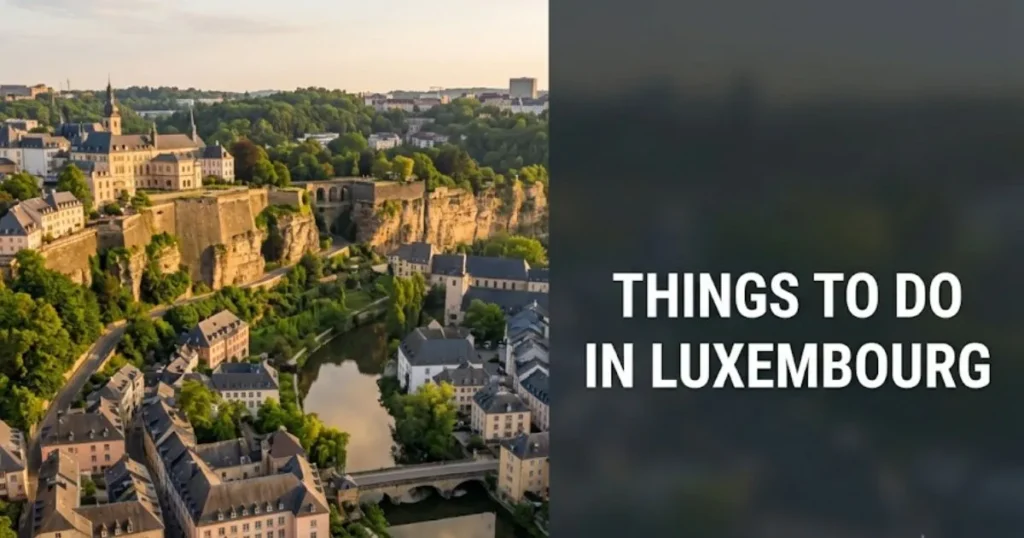
The Casemates du Bock offers the underground counterpart. These former military tunnels beneath the Bock Promontory run through solid sandstone rock.
The National Museum of History and Art anchors the city’s cultural identity. The Philharmonie Luxembourg on the Kirchberg Plateau completes the picture for music and performing arts travelers.
Insider Tip:
- Walk the Chemin de la Corniche in the morning when light hits the Alzette valley from the east
- Pair the Casemates with the adjacent Bock Promontory overlook for context before going underground
- Seniors should note the Casemates involve uneven rocky floors and narrow passages: not ideal for mobility aid users
Luxembourg City Neighborhoods to Explore
Luxembourg City divides naturally into distinct zones that feel genuinely different from each other, despite the city’s compact overall size.
The Old Town (Ville Haute) sits on the upper plateau. It contains the Grand Ducal Palace, the cathedral, Place d’Armes, and most major tourist infrastructure.
Grund occupies the Alzette valley below. It’s the city’s most atmospheric low-lying district, with stone-paved streets, riverside restaurants, and a village-within-a-city feel.
Clausen sits in a separate valley pocket and functions as Luxembourg’s primary bar and nightlife district. It’s where locals drink on weekends.
Kirchberg is the modern European Quarter, home to MUDAM, the Philharmonie, and multiple EU institutions. It feels architecturally like a different city from the medieval core.
Pfaffenthal connects the lower Alzette valley to the Kirchberg via the free funicular. It’s mostly residential but the funicular ride itself is worth taking.
| Neighborhood | Character | Best For | Physical Demand |
|---|---|---|---|
| Old Town (Ville Haute) | Historic, tourist-focused | First-time visitors | Low to moderate |
| Grund | Atmospheric, river-level | Couples, dining, evening | High (steep descent) |
| Clausen | Local bar scene | Solo travelers, nightlife | Moderate |
| Kirchberg | Modern, architectural | Art and architecture fans | Low (flat plateau) |
| Pfaffenthal | Quiet, residential | Funicular access, local feel | Low to moderate |
Chemin de la Corniche and the Old Town
The Chemin de la Corniche is Luxembourg’s single most photographed promenade. It runs approximately 800 meters along the old city wall above the Alzette valley.
Entry is free. It’s accessible from multiple points along the upper city and takes about 20 to 30 minutes to walk fully without stops.
The view from the corniche over Grund and the river is the image most people have seen of Luxembourg City before visiting. Seeing it in person still genuinely surprises.
Place d’Armes anchors the Old Town’s social life. Cafes ring the square, the Christmas market sets up here in December, and it’s where locals and visitors naturally converge.
Two blocks north, Place Guillaume II (Knuedler to locals) hosts the twice-weekly market on Wednesdays and Saturdays. The Grand Ducal Palace faces the square.
The Luxembourg Cathedral Notre-Dame, begun in 1613, sits just off Place Guillaume II. Entry is free. The crypt contains the tomb of John of Bohemia, a figure of genuine historical significance to Luxembourg’s national identity.
Insider Tip:
- Couples: Walk the Corniche at dusk when the valley lights begin. It’s the most romantic free experience in the city.
- Families: Kids engage well with the fortification walls but the corniche path has unguarded drop-offs. Keep young children close.
- The Grand Ducal Palace exterior is always visible. Interior tours run in summer only; verify dates directly with the Luxembourg City Tourist Office before planning.
Casemates du Bock
The Casemates du Bock are underground galleries carved into the sandstone Bock Promontory, used as military fortifications from the 17th through 19th centuries.
They are Luxembourg City’s single most-visited paid attraction. Admission runs approximately 10 to 12 euros per adult as of recent years; verify current pricing before visiting.
The experience involves roughly 60 meters of rock carved with tunnels, chambers, cannon emplacements, and carved windows framing valley views. It takes about 45 to 60 minutes to explore fully.
The honest assessment: The Casemates are genuinely interesting for history and military architecture enthusiasts. For casual visitors, the experience is shorter and more claustrophobic than the marketing suggests.
The local alternative preferred by repeat visitors is Casemates de la Pétrusse, a smaller tunnel network near the Constitution Bridge. It’s less crowded and equally historically significant.
Both Casemates typically open seasonally; the Bock Casemates usually operate from March through October. Verify seasonal hours before visiting, as winter access is limited.
Traveler profile note: Seniors and visitors with mobility limitations should know the Bock tunnels involve uneven stone floors, low ceilings in sections, and no elevator access. Budget travelers can skip the paid Casemates and take the free Wenzel Circular Walk instead, which covers the fortification perimeter above ground with equivalent historical context.
Luxembourg National Museum of History and Art
The National Museum of History and Art (MNHA) is Luxembourg’s premier cultural institution, housed in a historic building complex at Marché-aux-Poissons in the Old Town.
The collection spans Roman artifacts, medieval art, Luxembourg silver, and a gallery of significant European paintings. The Roman section alone justifies the visit for history travelers.
Admission runs approximately 7 to 9 euros per adult as of recent years; free entry is typically available on the last Sunday of each month. Verify current admission policy before visiting.
The MNHA is underrated relative to its actual collection quality. Most first-time visitors skip it in favor of the Casemates. That’s a mistake for anyone with genuine cultural interests.
According to Visit Luxembourg, the MNHA houses over 600,000 objects spanning Luxembourg’s history from prehistoric times through the 20th century.
The museum is fully accessible via elevator and is ideal for seniors, rainy days, and cultural travelers. Budget travelers who time their visit for free-entry Sunday gain significant value.
Traveler profile note: Families with children under 10 will find the MNHA more difficult to sustain interest through than the Casemates or Vianden Castle. Families with older children interested in history will find it genuinely rewarding.
Key Takeaway: Walk the Chemin de la Corniche free at dusk, then visit the MNHA on a free-entry Sunday to get Luxembourg’s two best cultural experiences at minimal cost.
MUDAM and the Kirchberg Plateau
MUDAM (Musée d’Art Moderne Grand-Duc Jean) is Luxembourg’s contemporary art museum, housed in a building designed by I.M. Pei at the edge of Fort Thüngen on the Kirchberg Plateau.
The architecture alone justifies the visit. Pei’s glass-and-stone design incorporates the original 18th-century fort walls into a modern structure that somehow feels both historic and strikingly current.
Admission runs approximately 9 to 11 euros per adult as of recent years; free entry on the first Sunday of each month. Verify current pricing before visiting.
MUDAM’s permanent collection focuses on contemporary art, design, and fashion from international artists. The temporary exhibitions rotate seasonally; check the MUDAM official website for the 2026 exhibition calendar.
The Kirchberg Plateau surrounding MUDAM contains the Philharmonie Luxembourg, designed by architect Christian de Portzamparc. It’s one of Europe’s finest concert halls and hosts major classical and contemporary performances.
Insider Tip:
- The free Pfaffenthal-Kirchberg Funicular connects the lower city to Kirchberg in under two minutes. Take it up from Pfaffenthal station rather than walking.
- Pair MUDAM with a walk to the nearby Three Towers (Trois Tours) for the visual contrast between medieval fortifications and modern EU architecture.
- Solo travelers and couples interested in design and contemporary art will find Kirchberg the most rewarding afternoon destination in the city.
Grund and the Pétrusse Valley
Grund is the most atmospheric neighborhood in Luxembourg City and the one most first-time visitors see only from above on the Chemin de la Corniche.
Getting down to Grund requires either the Montée du Grund staircase (steep and time-consuming) or the elevator at Pfaffenthal. Plan the descent into your itinerary explicitly.
The Alzette River runs through Grund at the base of the valley. The combination of cliff faces, the river, the Abbey of Neumünster, and stone-paved streets creates a visual environment unlike any other European capital district.
Abbey of Neumünster (CIGL) operates as a cultural center hosting exhibitions, concerts, and events. Entry to the courtyard is free. Check their 2026 event calendar for temporary exhibitions.
Grund’s restaurant strip along Rue Munster offers the most atmospheric dining in Luxembourg City. For couples, this is the evening dinner destination. Restaurants here fill quickly; reservations are strongly recommended for weekend evenings.
The Pétrusse Valley runs along the opposite side of the upper city. It’s a green park corridor accessible via the Constitution Bridge area. It’s the better choice for a quiet morning walk with less tourist foot traffic than the Alzette side.
Traveler profile note: Families with strollers face significant challenges in Grund due to the staircase descent and cobblestone streets. Seniors should verify their comfort with the ascent before committing to a Grund dinner: the return journey involves significant uphill climbing.
American Military Cemetery Luxembourg
The Luxembourg American Cemetery and Memorial at Hamm, located approximately 4 kilometers east of Luxembourg City center, is one of 26 permanent American military cemeteries in Europe maintained by the American Battle Monuments Commission.
Over 5,000 American soldiers are buried here, including General George S. Patton, who specifically requested burial among his troops after his death in December 1945.
The cemetery is free to enter and is open year-round, with seasonal hours. It’s approximately a 15-minute bus ride from the city center via public transit; verify current bus routes before visiting.
For American travelers, this is one of the most emotionally significant stops in Western Europe. The scale of the memorial and the precision of its maintenance are genuinely moving.
Insider Tip:
- Visit early in the morning before tour buses arrive. By mid-morning in peak season, the cemetery receives organized group tours.
- The visitor center provides historical context on the Battle of the Bulge and Patton’s Third Army campaign. Budget 60 to 90 minutes for a complete visit.
- Families with teenagers studying World War II history will find this the most impactful educational experience in Luxembourg.
Key Takeaway: The American Cemetery at Hamm is free, emotionally significant for American travelers, and far less crowded before 10am. Bus access makes a car unnecessary.
Mullerthal Trail and Outdoor Activities
The Mullerthal Trail is Luxembourg’s most celebrated long-distance hiking route, running approximately 112 kilometers through the Mullerthal region (also called “Little Switzerland”) east of Luxembourg City.
The trail passes through sandstone rock formations, gorges, waterfalls, and dense forest. It’s organized into three main loops, each accessible as a day trip from Luxembourg City.
Loop 1 (approximately 38 kilometers, split across multiple sections) covers the most dramatic rock formations near Echternach. Day hikers typically complete individual sections of 8 to 15 kilometers.
The trailhead town of Echternach is accessible by bus from Luxembourg City in approximately 45 minutes. Verify current bus schedules with CFL before your visit.
Trail conditions vary seasonally. Spring (April through June) offers the best combination of green foliage, manageable temperatures, and dry trail surfaces. Summer is hot and trails get crowded. Autumn is excellent for foliage and cooler temperatures.
Traveler profile note: The Mullerthal Trail is not suitable for seniors with significant mobility limitations. Sections involve scrambling over rocks and uneven terrain. Families with children ages 8 and older will find the shorter sections genuinely exciting. Solo hikers should note that cell service is inconsistent in the gorge sections.
Outdoor alternatives within Luxembourg City: The Pétrusse Valley walk is fully paved, accessible, and covers 3 to 4 kilometers of green valley. It suits seniors, families with strollers, and anyone who wants outdoor scenery without trail hiking demands.
Moselle Valley and Day Trips from Luxembourg
The Moselle Valley, Luxembourg’s wine country, runs along the eastern border with Germany. The drive from Luxembourg City takes approximately 30 to 40 minutes.
The valley produces Riesling, Pinot Gris, and Auxerrois whites that rarely appear on export markets. Trying them at their source is the primary reason to make the trip.
Remich is the most accessible Moselle town from Luxembourg City. Its riverfront promenade, wine caves, and weekly market make it the logical first stop.
Several wine estates in the Moselle offer tasting visits; contact individual producers or check the Visit Luxembourg Moselle section for 2026 producer schedules, as visiting hours vary significantly by season.
The Moselle is at its best during the September harvest season. The Schueberfouer (Luxembourg City’s historic fair) runs simultaneously in late August and early September, creating a strong dual-experience weekend in early fall.
Traveler profile note: The Moselle is primarily suited to couples and adult travelers interested in wine and scenery. Families with young children will find limited child-specific activities. Budget travelers should note that most wine estate visits include complimentary tastings with a minimum purchase expectation.
Insider Tip:
- Rent a bike from Remich and cycle the river path north toward Stadtbredimus. It’s flat, car-free along significant stretches, and passes multiple estates.
- Skip the heavily marketed boat tours on the Moselle. The cycling path delivers the same scenery at your own pace and at no cost beyond the bike rental.
Vianden Castle Day Trip
Vianden Castle in northern Luxembourg is one of the largest and best-preserved medieval castles in the Benelux region. It sits dramatically above the Our River on a hillside overlooking the town of Vianden.
The castle’s interior includes fully furnished royal apartments, a Gothic chapel, and extensive defensive architecture spanning the 10th through 14th centuries.
Admission runs approximately 9 to 12 euros per adult as of recent years; verify current pricing before visiting. The castle typically opens daily from March through November; winter hours are reduced, so verify before traveling.
From Luxembourg City, Vianden is approximately 50 kilometers north. The most practical route combines a CFL train to Ettelbruck and then a regional bus to Vianden. Total journey time runs approximately 90 minutes each way. Driving takes approximately 45 to 55 minutes.
The optional chairlift from Vianden town up the opposite hillside delivers a panoramic view of the castle from across the valley. It runs seasonally; verify 2026 operating dates before visiting.
Traveler profile note: Families with children ages 6 and older find Vianden one of the most engaging day trips from Luxembourg City. The combination of a real medieval castle with the Our River valley and the chairlift ride creates a full family day. Seniors should note that the castle involves significant stair climbing across multiple levels; elevator access is limited in parts of the structure.
Key Takeaway: Vianden Castle is Luxembourg’s best full-day family day trip. Combine the train-bus route with a picnic in the Our River valley to keep costs manageable.
Luxembourg City Restaurants and Local Food
Luxembourg’s national dish is Judd mat Gaardebounen: smoked collar of pork with broad beans in a cream sauce. Finding it on a menu in Grund or a traditional brasserie is the authentic local food experience.
Clausen and Grund are the two primary dining and drinking neighborhoods for visitors who want to eat where residents actually eat.
Avoid the restaurants immediately surrounding Place d’Armes. They cater primarily to tourists and business travelers and are priced accordingly without delivering proportional quality.
For lunch in the Old Town, the covered market halls near the train station area offer affordable local options. For evening dining, Grund’s Rue Munster stretch is the correct choice.
Luxembourg’s wine culture is underappreciated. Ordering a glass of Moselle Riesling with any fish dish is the correct local pairing, and it costs significantly less than a comparable French or German Riesling in the same glass.
Budget travelers: Luxembourg City has several good-quality lunch spots near Place d’Armes that serve set lunch menus (plat du jour format) at considerably lower prices than their evening menus. Lunch here is the strategy.
Insider Tip:
- Clausen’s bar district along Rue de la Tour Jacob and Rue du Fort Niedergrünewald is where locals go on Thursday and Friday evenings.
- For coffee: avoid chain cafes on Place d’Armes. Walk one block toward Rue du Curé for independent cafes with better quality at lower prices.
- Reservations are strongly advised for Grund restaurants on Friday and Saturday evenings, particularly April through October.
Luxembourg Card and Practical Logistics
The Luxembourg Card is a tourist pass covering unlimited use of national public transport and free or discounted entry to over 60 attractions across the country.
Cards are available in 1-day, 2-day, and 3-day versions. Pricing runs approximately 14 to 34 euros per adult (per version) as of recent years; verify current pricing with the Luxembourg City Tourist Office before purchasing.
Is it worth buying? For visitors spending two or more days and planning to visit both the Casemates and at least one major museum, plus making one day trip, it typically pays for itself. For a single-day visitor focused purely on walking and free sites, it may not.
Purchase points include the Luxembourg City Tourist Office on Place Guillaume II, Luxembourg Findel Airport arrivals hall, and some hotels. Available online in advance through the Visit Luxembourg official platform.
What the Luxembourg Card covers: Most major museums including MUDAM and the MNHA; the Casemates du Bock; admission at Vianden Castle; and unlimited rides on CFL trains, buses, and trams nationally.
National public transport in Luxembourg is already free for all passengers as a baseline national policy implemented in 2020. The Luxembourg Card’s transit benefit applies to train lines that carry a reservation surcharge for certain routes; verify inclusions before purchasing.
Getting Around Luxembourg City
Luxembourg City is one of Europe’s most walkable capitals, but its dramatic vertical terrain means “walkable” requires significant qualification.
Moving between the Old Town and the lower districts of Grund or Clausen involves either steep staircases or a significant detour via road. Factor 15 to 25 minutes to descend to Grund and significantly longer to return uphill.
The Pfaffenthal-Kirchberg Funicular is free with national public transport (which is free for everyone). It connects the lower city near Pfaffenthal to the Kirchberg Plateau in under two minutes. Use it.
The Vel’oh! bike-share system operates city-wide with docking stations throughout the Old Town and Kirchberg. Electric bikes are available. The flat sections of the city (Kirchberg Plateau and upper Old Town) suit cycling well. The valley sections are better done on foot.
Taxis from Luxembourg Findel Airport (LUX) to the city center typically take 20 to 30 minutes and cost approximately 30 to 45 euros. The public bus service (Line 16 and Airport Tram connection) is free and runs regularly but takes 30 to 40 minutes depending on connections. Verify current airport bus routes before arriving.
Traveler profile note: Seniors and travelers with mobility limitations should plan their daily routes carefully. The funicular handles the Kirchberg ascent. The Grund descent via the elevator near the Pfaffenthal station is the most accessible route to the lower city. The Casemates and several Old Town sites involve stairs with no accessible alternative.
Key Takeaway: National public transport in Luxembourg is free for all passengers. Use buses, trams, and the Pfaffenthal funicular instead of taxis for all city movement.
Free Things to Do in Luxembourg
Luxembourg’s reputation as expensive is accurate for hotels and restaurants. Its list of genuinely free experiences is longer than most visitors expect.
National public transport (all buses, trams, and trains within Luxembourg) is free for every passenger. This removes a significant budget line compared to any other European capital.
Completely free experiences:
- Chemin de la Corniche promenade walk (the single best experience in the city)
- Wenzel Circular Walk (fortification perimeter walk with UNESCO context)
- Luxembourg Cathedral Notre-Dame interior visit
- Pétrusse Valley park walk
- Place d’Armes and Place Guillaume II (people-watching, market days Wednesday and Saturday)
- MNHA on the last Sunday of each month (verify current schedule)
- MUDAM on the first Sunday of each month (verify current schedule)
- Philharmonie Luxembourg free lunchtime concerts (schedule varies; check their 2026 calendar)
- American Cemetery at Hamm (always free)
- Grand Ducal Palace exterior
- Pfaffenthal-Kirchberg Funicular ride (free with public transport)
- Vianden town center (castle admission applies but the town and Our River are free)
Budget traveler note: A visitor combining free public transit, free museum Sundays, the Chemin de la Corniche, the American Cemetery, and packed lunches from a supermarket can spend a full day in Luxembourg City for essentially accommodation costs only.
One Day in Luxembourg City Itinerary
One day in Luxembourg City is enough to cover the essential highlights if you move efficiently and prioritize correctly.
This itinerary assumes an 8am start from accommodation in or near the Old Town.
One-Day Luxembourg City Itinerary:
- 8:00am: Chemin de la Corniche at dawn or just after. Walk the full 800-meter promenade before the crowds arrive. The valley light in the morning is the best photographic opportunity of the day.
- 9:00am: Casemates du Bock opening time (verify current opening hours before visiting; typically opens mid-morning). Spend 45 to 60 minutes underground.
- 10:30am: Bock Promontory overlook and the adjacent Three Towers. Fifteen minutes of above-ground fortification context after the underground experience.
- 11:00am: Walk to Place Guillaume II and the Grand Ducal Palace exterior. Continue to the Luxembourg Cathedral Notre-Dame interior. Free. Twenty minutes combined.
- 12:00pm: Lunch in the Old Town. Target a plat du jour lunch at a cafe off Place d’Armes toward Rue du Curé, not directly on the square.
- 1:30pm: Descent to Grund. Take the Montée du Grund staircase down for the experience. Spend 60 minutes walking Rue Munster, seeing the Alzette river level, and visiting the Abbey of Neumünster courtyard.
- 3:00pm: Pfaffenthal Funicular back up to the upper city (free). Bus or tram to Kirchberg.
- 3:30pm: MUDAM and Kirchberg Plateau. Spend 90 minutes at MUDAM. Walk to the Three Towers (Trois Tours) for the contrast between medieval and modern.
- 5:30pm: Return to Old Town. Walk or take the free tram.
- 7:30pm: Dinner in Grund. Take the elevator descent rather than the stairs for the evening return. Reserve your Grund restaurant in advance.
Luxembourg Travel Tips for 2026
The single most important planning step for a 2026 Luxembourg visit is booking accommodation early. The city has a limited hotel inventory relative to its growing popularity as a European city-break destination.
Weekend accommodations from April through June and September through October fill several weeks in advance. Book 6 to 8 weeks ahead for those periods. January and February offer the most available inventory and lowest rates.
Practical tips for 2026:
- Luxembourg’s national public transport is free. Never pay for a taxi within the city unless you’re traveling with heavy luggage or very late at night.
- The Luxembourg Card is sold in physical form only at select points. Don’t count on purchasing it at attraction entrances.
- Google Maps underestimates travel times between the upper and lower city. Add 10 minutes to any route involving a valley descent.
- Many restaurants in the Old Town close between lunch service (approximately 2pm) and dinner service (approximately 6:30pm). Plan accordingly.
- The multilingual culture (Luxembourgish, French, German, English) means English is universally spoken at tourist sites and restaurants. Language is not a barrier for American visitors.
- Tipping culture in Luxembourg: rounding up is customary. Ten percent is generous. Service charges are typically included in restaurant bills; check before adding additional tip.
- Verify before visiting: Museum hours, Casemates seasonal access, Luxembourg Card pricing, and seasonal event calendars change annually. Cross-reference directly with the Visit Luxembourg official website before departure.
Weather reality: Luxembourg’s weather is genuinely unpredictable year-round. Pack a waterproof layer regardless of season. The valley walks become slippery in rain; appropriate footwear matters.
Safety and Practical Warnings for Luxembourg City
Luxembourg City is one of Europe’s safest capitals by crime statistics. Standard urban awareness applies but pickpocket risk is low compared to Paris, Barcelona, or Rome.
Key safety and practical facts every visitor should know:
- Valley terrain is the primary physical hazard. Staircases down to Grund are steep and become dangerously slippery in rain. Wear shoes with grip.
- Cell service is inconsistent in Casemates tunnels and parts of the Mullerthal gorges. Download offline maps before exploring.
- Driving in the Old Town is heavily restricted. Parking is extremely limited and expensive. Use public transit from the moment you arrive.
- The Mullerthal Trail requires appropriate footwear for rock scramble sections. Trail running shoes or light hiking boots are the minimum; sandals or flat shoes are unsafe on wet rock.
- Sun exposure in summer on the Kirchberg Plateau and Chemin de la Corniche is significant. Sunscreen and water are necessary from June through August.
- Medical facilities: Luxembourg City’s Centre Hospitalier de Luxembourg (CHL) provides emergency services. European Health Insurance Cards (EHIC) apply for EU citizens; American travelers should ensure comprehensive travel medical insurance before departure.
For seniors with mobility concerns: Contact the Luxembourg City Tourist Office in advance to request accessibility maps. Several historic sites have limited elevator access and significant stair exposure.
Frequently Asked Questions About Things to Do in Luxembourg
How many days do you need in Luxembourg City?
Two to three days is the ideal length for a thorough Luxembourg City visit.
Two full days covers the essential Old Town, Casemates, Grund, Kirchberg, and the American Cemetery without rushing.
A third day adds the best day trip, either Vianden Castle or the Mullerthal Trail, completing the experience.
Is Luxembourg City worth visiting for Americans?
Yes, Luxembourg City is genuinely worth visiting, particularly for Americans on a multi-city European itinerary.
The American Military Cemetery at Hamm, where General George S. Patton is buried, is one of the most significant American memorial sites in Europe.
The city’s compact size, UNESCO heritage sites, free public transit, and English-speaking culture make it one of Europe’s most accessible non-English-speaking capitals for American visitors.
What is the Luxembourg Card and is it worth buying?
The Luxembourg Card covers unlimited national public transit and free or discounted entry to over 60 attractions across the Grand Duchy.
It’s worth purchasing for visitors spending two or more days who plan to visit several paid attractions, including the Casemates and at least one major museum.
Single-day visitors focused on free experiences like the Chemin de la Corniche, the American Cemetery, and free museum Sundays may not recoup the cost; verify current pricing and inclusions before purchasing.
What is the best neighborhood to stay in Luxembourg City?
The Old Town (Ville Haute) is the best neighborhood for first-time visitors, placing you within walking distance of the Chemin de la Corniche, Place d’Armes, and the Casemates.
Kirchberg is better for travelers prioritizing MUDAM, the Philharmonie, and modern architecture over medieval history.
Clausen suits solo travelers and couples who want to be near the local bar district for evenings.
Is Luxembourg City walkable?
Luxembourg City’s upper districts are highly walkable on flat terrain.
The key challenge is the dramatic vertical terrain between the upper city and the Alzette and Pétrusse valleys below: the descent to Grund involves steep staircases that require appropriate footwear and physical confidence.
Free public transit (buses, tram, and the Pfaffenthal-Kirchberg Funicular) handles the vertical distances effectively when walking isn’t practical.
What is the best time of year to visit Luxembourg?
The best time to visit Luxembourg is April through June or September through October.
Spring offers mild temperatures, green valley foliage, and manageable crowds, while autumn delivers harvest season atmosphere in the Moselle Valley alongside reduced summer tourist numbers.
December is specifically worth considering for Luxembourg’s Christmas markets on Place d’Armes, though accommodation books quickly; July and August bring maximum crowds and higher prices without equivalent advantages.
Plan Your 2026 Luxembourg Trip with Confidence
Luxembourg City rewards travelers who engage with it seriously. The combination of UNESCO fortifications, walkable valley neighborhoods, world-class museums, and accessible day trips to Vianden and the Moselle makes it genuinely distinctive among European capitals.
Start your planning by booking accommodation first, particularly if you’re targeting spring or autumn weekends. The city’s limited hotel stock fills faster than its low international profile suggests.
Verify all admission prices, museum hours, Luxembourg Card inclusions, Casemates seasonal access, and day-trip transport schedules directly with Visit Luxembourg or individual venues before your departure. Conditions, pricing, and seasonal hours change annually, and the official sources are more reliable than third-party guides.
A well-planned two days here delivers more per hour than many European capitals require a full week to match