Things To Do in Myrtle Beach: The 2026 Complete Guide

Myrtle Beach rewards travelers who understand what it actually is: a 60-mile stretch of Atlantic coastline backed by one of the densest concentrations of beach entertainment, seafood restaurants, and golf courses on the Eastern Seaboard. The things to do in Myrtle Beach span from genuinely free and low-key (walking the Boardwalk, swimming the public beach, watching the sun rise over the Atlantic) to purpose-built family attractions that can run $40 to $60 per person before you’ve had lunch.
According to Visit Myrtle Beach, the official tourism organization of the Myrtle Beach Area Chamber of Commerce, the Grand Strand attracts over 19 million visitors annually, making it one of the most-visited coastal destinations in the United States. That volume of visitors shapes everything: where crowds concentrate, when traffic turns the main US-17 strip into a parking lot, and which experiences genuinely hold up under that kind of foot traffic.
This guide covers specific named activities with honest cost context, the distinct zones of the Grand Strand, what genuinely works for different traveler types, and the practical planning information that most destination coverage glosses over. You’ll also find a 3-day itinerary framework, a seasonal guide with real crowd and weather honesty, and day trip options that let you escape the commercial strip entirely.
Things To Do in Myrtle Beach: What the Grand Strand Actually Delivers
The Grand Strand, the 60-mile coastal arc anchored by Myrtle Beach, is best understood as a collection of distinct zones rather than one destination. From north to south, you move through Little River and Cherry Grove Beach (quieter, more residential), North Myrtle Beach and Ocean Drive (the historic shagging culture district), the main Myrtle Beach strip with its commercial entertainment density, the Market Common district (a walkable redeveloped former air base with a relaxed outdoor-mall feel), and finally the Murrells Inlet and Pawleys Island corridor to the south (seafood, marsh scenery, and a significantly more relaxed pace).
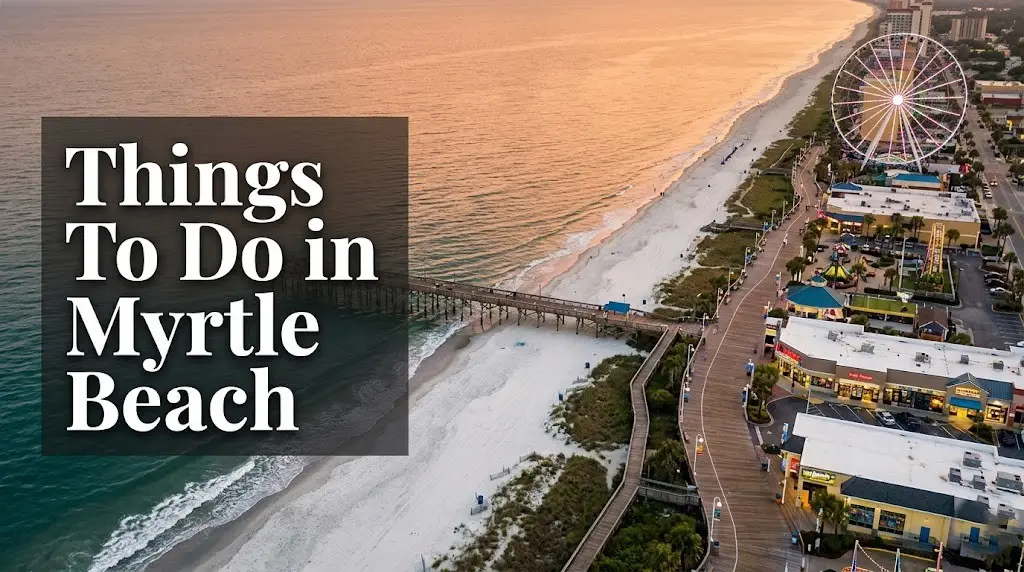
The main Myrtle Beach strip is where most first-time visitors spend all their time. It is dense, commercial, and designed for high-volume tourism. Ocean Boulevard and the Boardwalk area concentrate the SkyWheel, Ripley’s Aquarium, amusement arcades, souvenir shops, and waterfront restaurants within walking distance. For families with children between ages 5 and 12, this density is a genuine asset: everything is close, everything is designed for accessibility, and the overstimulation is part of the appeal.
For adults seeking something beyond the strip, Myrtle Beach’s real value is geographic. Drive 30 minutes south and you’re eating boiled shrimp on the Murrells Inlet Marshwalk while watching herons work the marsh grass. Drive 20 minutes north and you’re on a quieter stretch of beach in Cherry Grove. Drive 15 minutes inland and you’re in Conway, a genuine small-city riverfront with zero tourist kitsch.
The honest limitation: if you are looking for refined coastal elegance, understated natural beauty without commercial development nearby, or a quiet romantic getaway, Myrtle Beach’s main strip is not the right fit. Hilton Head Island, Kiawah Island, or the Outer Banks deliver those qualities more directly. Myrtle Beach is for people who want beach access plus volume: volume of activities, volume of dining options, volume of entertainment, and volume of golf.
Top Things To Do in Myrtle Beach for First-Time Visitors
The most important thing first-time visitors should know is that the top things to do in Myrtle Beach fall into three tiers: free and walkable, paid attractions worth the price, and paid attractions that are mostly tourist infrastructure without proportional experiential value.
Worth the time for most first-timers:
- Walking the Myrtle Beach Boardwalk from 14th Avenue North to 2nd Avenue North, especially in the evening when the crowds thin slightly and the ocean breeze makes it genuinely pleasant
- Brookgreen Gardens in Murrells Inlet, one of the most undervisited major attractions in the entire Southeast, covering 9,100 acres with sculpture gardens, a zoo, and preserved lowcountry wetlands
- Myrtle Beach State Park for beach access that is meaningfully less crowded than the main public beaches
- A seafood dinner on the Murrells Inlet Marshwalk, where multiple restaurants line the waterfront and the quality-to-price ratio far exceeds the tourist-strip options
Worth evaluating based on your group:
- SkyWheel Myrtle Beach: genuinely impressive views from the enclosed gondola, but admission runs approximately $15 to $20 per person as of recent years. Worth it for a clear-day ride at dusk; less compelling as a repeat activity.
- Ripley’s Aquarium of Myrtle Beach: good for families with children under 12, with a notable shark tunnel as the centerpiece. Admission for families runs approximately $80 to $120 for two adults and two children, verify current pricing before visiting.
Skip unless you have a specific reason:
- The souvenir shops concentrated along Ocean Boulevard: identical merchandise available everywhere, no unique local goods
- Myrtle Beach’s largest seafood buffets: volume over quality, and the better individual seafood restaurants along the Marshwalk and Calabash-style spots offer substantially better food at comparable or lower prices
| Activity | Approximate Cost | Best For | Book in Advance? |
|---|---|---|---|
| Myrtle Beach Boardwalk | Free | All profiles | No |
| Brookgreen Gardens | $20 to $25 per adult (verify) | Couples, adults, seniors | Recommended online |
| SkyWheel Myrtle Beach | $15 to $20 per person (verify) | Families, couples | Online saves time |
| Ripley’s Aquarium | $25 to $35 per adult (verify) | Families with young kids | Yes, online |
| Myrtle Beach State Park | $5 to $8 per vehicle (verify) | All profiles | No, walk-up |
| Murrells Inlet Marshwalk dining | $20 to $40 per person | Adults, couples, families | Recommended evenings |
Myrtle Beach Boardwalk and Ocean Boulevard
The Myrtle Beach Boardwalk stretches approximately 1.2 miles along the oceanfront between 2nd and 14th Avenues North, and it is the single most accessible, free, and genuinely worthwhile activity on the main strip. Walk it in the morning before the crowds arrive, or in the early evening after the worst of the day’s heat breaks, and you get unobstructed Atlantic views, ocean breeze, and a genuine sense of the coastline without paying for anything.
Ocean Boulevard runs parallel to the beach and is where the commercial strip concentrates: amusement arcades, mini golf courses, souvenir shops, and the entrances to major paid attractions. The Boardwalk itself is elevated above the beach, with beach access points at regular intervals. The area around 9th Avenue North tends to be the most crowded stretch, directly in front of the SkyWheel and several major restaurant clusters.
For couples, the Boardwalk at sunset is genuinely worth the walk, particularly on the stretch south of 8th Avenue where the commercial density thins slightly and the oceanfront benches fill with people watching the sky change color. It is not a secluded romantic setting, but it is a pleasant shared experience.
For families with children, the Boardwalk gives kids the space to move, the beach access to keep them engaged, and enough visual stimulation (the SkyWheel lights up dramatically after dark) to hold attention without requiring paid entry. Budget approximately 45 minutes to 1.5 hours for a full Boardwalk walk with stops.
Insider Tip:
The Boardwalk is most pleasant between 7 and 9 AM, before the heat and crowd peak. In summer, the beach directly below the Boardwalk fills to capacity by 10 AM. Arriving at 7 AM means a quiet beach, cooler temperatures, and the possibility of seeing brown pelicans working the surf line close to shore. For solo travelers and photography-focused visitors, morning light on the Atlantic facing east from Myrtle Beach is genuinely strong.
Things To Do in Myrtle Beach for Adults
Myrtle Beach for adults without children is a different trip than the family-focused version of the destination, and the best options shift accordingly. The SkyWheel and Ripley’s Aquarium are structurally designed for families; the live entertainment theaters, golf courses, waterfront seafood bars, and bar-and-grill scene along the North Myrtle Beach Ocean Drive district are where adults without kids find the most genuinely satisfying version of the destination.
For adults seeking a genuine cultural experience, Brookgreen Gardens in Murrells Inlet is not just a garden. It is a National Historic Landmark, the oldest public sculpture garden in the United States, set on a 9,100-acre former rice plantation. The sculptural collection includes more than 1,400 works across 20 outdoor galleries, and the surrounding lowcountry landscape with Spanish moss, live oaks, and tidal wetlands creates an atmosphere that is completely unlike the commercial strip 30 minutes north.
Adults who appreciate live music and a local bar atmosphere should spend at least one evening on the Ocean Drive strip in North Myrtle Beach, where the shag dancing culture (the state dance of South Carolina) still animates venues like Fat Harold’s Beach Club and the OD Pavilion area. This is genuinely local, specific to the Grand Strand’s cultural history, and entirely different from the tourist entertainment of the main strip.
For adults seeking an elevated dining experience, the Murrells Inlet Marshwalk’s collection of waterfront restaurants offers the best combination of setting and seafood quality on the Grand Strand. Sitting on a deck overlooking the marsh inlet at dusk with a dozen oysters and a cold beer is a more memorable adult evening in Myrtle Beach than any paid attraction on Ocean Boulevard.
| Experience | Best Adult Profile | Cost Range | Local vs. Tourist |
|---|---|---|---|
| Brookgreen Gardens | Couples, culture-focused travelers | $20 to $25 per adult (verify) | Local/regional |
| Fat Harold’s Beach Club (shag dancing) | Adults, couples, cultural travelers | Cover charge varies, verify | Genuinely local |
| Murrells Inlet Marshwalk dining | All adult profiles | $25 to $50 per person | More local than strip |
| Live music at House of Blues | Groups, music fans | Ticket price varies by show | National venue |
| Sunset cruise from Myrtle Beach | Couples, groups | $30 to $60 per person (verify) | Mixed |
Things To Do in Myrtle Beach With Kids
Myrtle Beach is one of the most consistently functional family beach destinations on the East Coast for children between 4 and 13, primarily because the infrastructure of paid attractions, beach access, and logistics is entirely built around this demographic. The question for families is not whether there is enough to do but how to sequence it without overspending or overtiring young children.
Ripley’s Aquarium of Myrtle Beach is the most consistently well-reviewed family attraction on the strip. The shark tunnel, where visitors walk through a clear underwater passageway surrounded by sand tiger sharks and manta rays, is genuinely impressive for children and adults. Plan 1.5 to 2 hours. Book tickets online in advance to avoid the line, and expect to pay approximately $80 to $120 for a family of four (verify current pricing directly with Ripley’s before visiting).
Myrtle Beach State Park is the best option for families who want a lower-cost, genuinely natural beach experience. The park’s beach section is consistently less crowded than the main public beaches, the nature trail through the maritime forest runs approximately 1.2 miles and is stroller-manageable on the flatter sections, and the fishing pier gives older kids a place to try basic pier fishing. Entry typically costs a few dollars per vehicle (verify current South Carolina State Parks pricing).
Family Kingdom Amusement Park, located on the southern end of the Boardwalk near 6th Avenue South, is a smaller traditional amusement park with rides scaled to younger children. It is not a theme park on the scale of major Orlando attractions, but for a full morning or afternoon of rides with children under 12, it functions well and the oceanfront setting is a genuine plus.
Kid-tested logistics tips for Myrtle Beach families:
- Arrive at the beach by 9 AM in summer. By 11 AM, parking at beach access points is full and the sand temperature makes barefoot walking difficult.
- Pack reef shoes or aqua socks for beach use. The sand on Myrtle Beach main strip gets extremely hot in July and August.
- Children under 48 inches may not meet the height requirements for several SkyWheel gondola configurations. Verify before purchasing tickets.
- The Boardwalk is stroller-accessible but busy. Morning visits are significantly easier with strollers than midday or evening visits.
Key Takeaway: Sequencing matters for Myrtle Beach families. Do the paid indoor attractions (Ripley’s, SkyWheel) in the heat of the midday when beach time is least comfortable, and move beach activities to early morning and late afternoon when the sand is cooler and the crowds are lighter.
Myrtle Beach Outdoor Activities and State Parks
The outdoor experience in Myrtle Beach is one of the most undersold dimensions of the destination, partly because the commercial strip gets all the attention and partly because the best outdoor spaces require driving away from Ocean Boulevard to find them. Myrtle Beach State Park and Huntington Beach State Park, both within 30 minutes of the main strip, represent genuinely significant natural assets.
Myrtle Beach State Park sits just south of the main commercial zone at the southern end of the Myrtle Beach city limits. The park preserves one of the last remaining stretches of maritime forest on the Grand Strand, a 1.2-mile nature trail winds through live oaks, longleaf pine, and yaupon holly, and the park’s beach section gives you open Atlantic swimming without the wall of high-rise hotels immediately behind you. The 750-foot fishing pier is one of the longest on the South Carolina coast. Entry requires a small vehicle fee; verify current pricing with South Carolina State Parks before visiting.
Huntington Beach State Park, located approximately 20 miles south of the main strip near Murrells Inlet, is consistently ranked among the top state parks in the Southeast by park system evaluators. The park’s beach is broader and less developed than any Grand Strand public beach, the birding along the freshwater lagoon is exceptional (over 300 species recorded), and Atalaya Castle, the Moorish-style winter home of sculptor Anna Hyatt Huntington, is open for tours at no additional charge within the park.
For water-based outdoor activities, the Intracoastal Waterway runs the full length of the Grand Strand behind the barrier island, and kayak and paddleboard rentals are available from several operators near Murrells Inlet and near Barefoot Landing in North Myrtle Beach. A guided kayak tour through the Waccamaw River marsh typically runs 2 to 3 hours and costs approximately $45 to $75 per person (verify with current operators). Dolphin watching boat tours depart from multiple points along the Grand Strand and are a consistently reliable experience from spring through early fall.
Seniors and travelers with mobility considerations should note that Myrtle Beach State Park’s nature trail has some uneven root-covered sections that are not suitable for mobility aids. The park’s beach access and pier are more accessible. Huntington Beach State Park offers a paved path along the lagoon edge that works well for travelers with limited mobility.
Things To Do in South Myrtle Beach and Murrells Inlet
South Myrtle Beach and the Murrells Inlet area represent the single best escape from the commercial density of the main strip, and for many experienced Grand Strand visitors, they are the genuine destination while the main strip is just the place to sleep. Murrells Inlet, approximately 10 miles south of the main Myrtle Beach strip, is widely known as the Seafood Capital of South Carolina, a designation that Visit Myrtle Beach supports and that local restaurant quality generally earns.
The Murrells Inlet Marshwalk is a 1-mile elevated waterfront boardwalk connecting a cluster of seafood restaurants overlooking the inlet. Unlike the Myrtle Beach Boardwalk, the Marshwalk is not lined with souvenir shops or amusement rides. The experience is specifically about eating waterfront seafood and watching the sunset over the marsh, and it delivers that experience with genuine consistency. Restaurants along the Marshwalk include a range of casual to sit-down dining options; most specialize in lowcountry seafood preparations: boiled shrimp, she-crab soup, fresh catch platters, and raw bars with local oysters.
Arrive before 6 PM if you want outdoor Marshwalk seating without a significant wait, especially from May through September. After 7 PM on weekends, most Marshwalk restaurants run 30-to-60-minute waits for outdoor tables. The view from outdoor seating at dusk, with the marsh turning gold and wading birds working the shallows, is one of the best unscripted meals of a Myrtle Beach trip.
Market Common, located on the former grounds of Myrtle Beach Air Force Base, is a planned walkable outdoor district with locally owned restaurants, retail, a cinema, and green space about 3 miles south of the main strip. It functions more as a neighborhood destination than a tourist attraction, and that is precisely what makes it useful for adult travelers who want the option of a quieter evening. The pedestrian streets, outdoor seating, and absence of commercial strip noise make it feel like a different town entirely.
Brookgreen Gardens, located in the Murrells Inlet area adjacent to Huntington Beach State Park, closes this southern zone’s case as the most substantively rewarding part of the Grand Strand. Spending a morning at Brookgreen Gardens followed by a Marshwalk dinner in the evening is, arguably, the single best day the Grand Strand offers for adult and couples travelers.
Key Takeaway: If you are driving to Myrtle Beach and only read one section of this guide, read this one. The Murrells Inlet Marshwalk and Brookgreen Gardens represent the best the destination offers for any traveler who values food quality and genuine landscape over paid entertainment attractions, and they require a 15 to 20 minute drive south of the main strip that most first-time visitors never make.
Things To Do in North Myrtle Beach
North Myrtle Beach is a separate municipality from Myrtle Beach proper, and the distinction matters practically and experientially. The stretch covering Ocean Drive Beach and the surrounding area has a specific cultural identity rooted in the shag music and beach music scene that dates to the 1940s and 1950s. For travelers interested in genuinely local South Carolina coastal culture rather than tourist-engineered entertainment, North Myrtle Beach delivers something the main strip cannot.
The shag dance, the official state dance of South Carolina, originated in the Ocean Drive area of North Myrtle Beach. Venues including Fat Harold’s Beach Club and the Spanish Galleon along Main Street still host live beach music and shag dancing on weekends, and the annual SOS (Society of Stranders) weekend events in spring and fall draw thousands of dedicated shaggers. These events are worth knowing about: SOS weekends significantly increase North Myrtle Beach accommodation demand, and rates rise accordingly.
Cherry Grove Beach, in the northernmost section of the Grand Strand, offers a more residential and quieter beach experience than any section of the main Myrtle Beach strip. The Cherry Grove Pier is a working fishing pier extending 985 feet into the Atlantic, fishing licenses are available on-site, and pier admission is minimal. For travelers who want beach access without the high-rise hotel backdrop, Cherry Grove represents the best option north of the main strip.
Barefoot Landing in North Myrtle Beach is a waterfront shopping and dining complex set on a freshwater lake connected to the Intracoastal Waterway. The setting is more pleasant than Broadway at the Beach, which is the comparable entertainment complex on the main strip. The Alabama Theatre and House of Blues Myrtle Beach are both located at or near Barefoot Landing and offer ticketed evening entertainment that draws on both country and popular music programming.
For families, North Myrtle Beach’s beach areas are less crowded than the main strip during peak summer months, and the Ocean Drive area is highly walkable. For solo travelers and couples interested in local culture, an evening in the Ocean Drive shag bars is one of the most genuinely memorable and locally specific experiences the Grand Strand offers.
Myrtle Beach Golf and Sports Activities
Myrtle Beach’s claim to being one of the golf capitals of the world is not marketing hyperbole. The Grand Strand hosts over 80 golf courses within a roughly 35-mile stretch, more courses concentrated in one geographic area than virtually any comparable zone in the United States. According to the Myrtle Beach Area Golf Course Owners Association, the region ranks as one of the top golf destinations in North America by course volume and annual rounds played.
The range of courses spans public daily-fee tracks accessible to casual players up to nationally ranked designs by Nicklaus, Fazio, and Love. Caledonia Golf and Fish Club in Pawleys Island is consistently recognized among the finest daily-fee courses in the Southeast, set on a former antebellum rice plantation with lowcountry marsh views throughout. TPC Myrtle Beach in Murrells Inlet is a PGA TOUR-affiliated design. The Dunes Golf and Beach Club is a private club that occasionally offers outside access; verify current guest play policies before planning around it.
Golf rates vary widely by season, course prestige, and tee time. In the shoulder seasons of spring and fall, rounds can be found from approximately $50 to $80 for mid-tier public courses. Premium courses like Caledonia typically run $100 to $200 or more per round (verify current rates). Summer rates at some courses drop as demand from peak visitors who are not primarily golfers reduces course pressure, though the heat makes afternoon rounds in July and August genuinely challenging.
For non-golfers seeking sports activities, the Myrtle Beach Pelicans play at Pelicans Ballpark in the Carolina League (a Texas Rangers affiliate). Evening games from April through September cost approximately $10 to $20 per ticket for most seating sections and provide a completely un-touristy, locally attended experience. TopGolf Myrtle Beach on US-17 Business is the consistent choice for adults who want a golf-adjacent social experience without a full round commitment.
Budget travelers should note that golf in Myrtle Beach can be structured affordably, especially in late fall and winter when many courses offer their lowest rates. A 3-night, 3-round golf package through area operators can be among the best per-round value of any major US golf destination.
Free Things To Do in Myrtle Beach
Myrtle Beach is one of the more budget-accessible beach destinations on the East Coast specifically because its best asset, the Atlantic Ocean and its beaches, costs nothing to access. Public beach access points are numerous across the Grand Strand, and the main Myrtle Beach Boardwalk requires no admission to walk, sit, and watch the ocean from.
Free and low-cost activities across the Grand Strand:
- Walking the full 1.2-mile Myrtle Beach Boardwalk at any time of day or evening
- Swimming and sunbathing at public beach access points (verify current parking fees at individual access points)
- Watching the SkyWheel light show from the Boardwalk below without purchasing a gondola ticket (the LED display is visible for free from the outside)
- Visiting the Atalaya Castle ruins inside Huntington Beach State Park (free with paid state park vehicle entry, which is a few dollars)
- Attending free outdoor concerts in Market Common’s green space (schedule varies by season; check Market Common’s event calendar before visiting)
- Walking the Murrells Inlet Marshwalk boardwalk without dining (the waterfront walk itself is free; you pay only if you eat)
- Pier fishing observation at any of the Grand Strand’s public fishing piers (pier fishing itself requires a ticket, but standing at the shore end and watching is free)
- Birding along Huntington Beach State Park’s lagoon path (free with park entry)
- Sunrise on any Grand Strand public beach (genuinely one of the best free experiences the destination offers; east-facing beaches catch direct sunrise light over the Atlantic from spring through fall)
According to the South Carolina Department of Parks Recreation and Tourism, state park system entry fees are among the lowest of any state in the Southeast, making Myrtle Beach State Park and Huntington Beach State Park effectively low-cost rather than free but still among the highest-value experiences on the Grand Strand.
For budget travelers with limited accommodation funds, Myrtle Beach’s campground infrastructure is worth knowing about. Myrtle Beach State Park operates a campground directly on the ocean, and several national brand campgrounds in the Myrtle Beach area offer RV and tent sites. Verify current availability and rates with individual park operators well in advance for summer visits.
Key Takeaway: The Myrtle Beach Boardwalk and the public beach immediately below it cost nothing and deliver the core experience of the destination more honestly than most paid attractions. A traveler who walks the Boardwalk at sunrise, spends the morning on the beach, drives to Huntington Beach State Park in the afternoon, and ends the day on the Murrells Inlet Marshwalk for a seafood dinner has spent very little money and had one of the best possible days the Grand Strand offers.
Best Time To Visit Myrtle Beach
The best time to visit Myrtle Beach is September through early October or March through mid-May. These shoulder windows offer temperatures in the low-to-mid 70s Fahrenheit, full access to the beach and all major attractions, meaningfully lower accommodation rates, and a crowd level that makes driving, parking, and restaurant access substantially easier than peak summer.
| Season | Months | Average Temp (°F) | Crowd Level | Accommodation Cost | Verdict |
|---|---|---|---|---|---|
| Spring shoulder | Late March to mid-May | 65 to 78 | Low to moderate | 30 to 50% below peak | Best for most travelers |
| Early summer | Late May to mid-June | 78 to 88 | Moderate to high | Rising sharply | Acceptable if booked early |
| Peak summer | Late June to late August | 88 to 95+ | Very high | Peak pricing | Avoid if crowd-sensitive |
| Fall shoulder | September to October | 72 to 82 | Low to moderate | 30 to 50% below peak | Best overall value |
| Late fall and winter | November to February | 45 to 65 | Low | Lowest rates | Beach off; golf on |
Summer in Myrtle Beach means genuine heat: daily highs regularly reach 90 to 95 degrees Fahrenheit with high humidity from late June through August. The UV index on Myrtle Beach during summer afternoons is consistently high. Heat exposure is the most underestimated practical risk for first-time summer visitors. Many summer visitors spend midday indoors at paid attractions specifically to avoid the heat, which has the effect of driving those attractions to their peak crowding exactly when the beach becomes least comfortable.
The hurricane season on the South Carolina coast runs from June 1 through November 30, with the statistical peak from late August through mid-October. Direct hits on the Myrtle Beach area are not annual occurrences, but tropical storm activity can affect beach conditions, cause coastal flooding, and prompt evacuations. Travelers planning fall shoulder season visits should monitor the National Weather Service’s tropical weather outlook and purchase travel insurance that covers weather-related cancellations.
Late fall through February is the low season for beach activity but the best season for golf. Courses are uncrowded, rates are at their lowest, and temperatures in the 50s to mid-60s are perfectly functional for golf with appropriate clothing. Restaurants and most major attractions remain open year-round, though some smaller seasonal operations close from December through February. Verify with specific venues before planning a winter visit around a particular attraction.
Things To Do Near Myrtle Beach
The Grand Strand’s geographic position between the Pee Dee region inland and a string of distinctive coastal communities makes day trips from Myrtle Beach genuinely worthwhile additions to a longer stay. The most rewarding destinations within 1 to 2 hours cover historic waterfronts, preserved lowcountry landscapes, and small-city experiences that contrast sharply with the commercial beach strip.
Conway, SC (15 to 20 minutes from the main strip): The Conway Historic District sits on the Waccamaw River and contains a walkable riverwalk, preserved 19th-century commercial architecture, antique shops, and locally owned cafes and restaurants. The Horry County Museum in Conway has free general admission and provides genuinely useful historical context for the Grand Strand region. Kayak launches into the Waccamaw River are available from outfitters in Conway for a half-day paddle through blackwater cypress and tupelo wetlands. This is the best option for travelers who want a complete break from tourist-strip environments without driving more than 30 minutes.
Georgetown, SC (approximately 60 miles south, roughly 1 hour): Georgetown is South Carolina’s third-oldest city and sits at the confluence of five rivers. Its historic downtown fronts the Sampit River with a walkable harborwalk, independent shops, and restaurants housed in preserved antebellum commercial buildings. The Georgetown County Museum covers the region’s rice plantation economy and its deep connections to African American Gullah Geechee culture. For couples and history-focused travelers, Georgetown offers a more substantively interesting day than any paid attraction on the main Myrtle Beach strip.
Wilmington, NC (approximately 75 miles north, roughly 1 to 1.5 hours): For travelers interested in a small city with a genuine arts and restaurant scene, Wilmington’s downtown waterfront along the Cape Fear River is a notable option. The USS North Carolina Battleship Memorial is open for tours and sits directly across the river from downtown. Wrightsville Beach, just east of Wilmington, is a compact barrier island with a strong local surf culture and beach access that feels meaningfully different from the Grand Strand.
Calabash, NC (approximately 35 miles north, 40 minutes): Calabash is a tiny town that gave its name to an entire style of seafood preparation: Calabash-style seafood means lightly breaded, fried fresh catch in large portions at low prices. The town has built an identity around seafood restaurants clustered along the waterfront, and a meal in Calabash is the most genuine version of this regional food tradition available within easy day-trip range.
Myrtle Beach Dining and Food Scene
The dining scene in Myrtle Beach divides cleanly into three tiers: the commercial strip restaurants that serve high-volume tourist traffic with predictable results; the seafood buffets that prioritize quantity and have a cultural following but rarely prioritize quality; and the genuinely good seafood restaurants, primarily concentrated along the Murrells Inlet Marshwalk and in smaller spots off the main tourist pathways.
The Murrells Inlet Marshwalk is the most consistently rewarding dining zone on the Grand Strand. Restaurants like Dead Dog Saloon, Wicked Tuna, and Lee’s Inlet Kitchen (a Murrells Inlet institution with a decades-long local following) anchor a collection of waterfront options that range from casual tiki-bar-style to full-service seafood dining. The shared quality is fresh seafood sourced from local and regional fisheries and the benefit of legitimate waterfront views that no Ocean Boulevard restaurant can match.
For she-crab soup, the traditional lowcountry chowder made with blue crab meat, roe, sherry, and cream, the Grand Strand offers numerous versions but quality varies significantly. Order it at Lee’s Inlet Kitchen or equivalent long-standing local establishments rather than at high-volume tourist restaurants on the strip, where it is often made from canned crab.
The seafood buffet is a specific Myrtle Beach cultural tradition worth understanding for what it is: a very high-volume, all-you-can-eat format featuring fried seafood, crab legs, and standard sides. The quality ceiling is limited by the format, but the experience has genuine enthusiasts. The best of the buffets tend to be the ones that have survived on repeat local and returning-visitor business for decades. Verify current reputation and reviews before committing, as buffet-format restaurants turn over frequently.
Budget travelers should note that lunch pricing at most Grand Strand seafood restaurants runs significantly lower than dinner, with the same menu items available at 20 to 40% less. A lunch at a Murrells Inlet waterfront restaurant during a weekday in the shoulder season can run $15 to $25 per person for a full seafood plate and drink, which represents excellent value for the quality and setting.
Families should know that most Myrtle Beach restaurants are genuinely kid-friendly in their format and menu offerings. The Marshwalk restaurants all have children’s menus, outdoor seating that gives kids room to move, and casual enough environments that minor kid chaos does not create a problem.
Myrtle Beach Live Entertainment and Nightlife
The live entertainment scene in Myrtle Beach is larger, more professionally produced, and more varied than most first-time visitors expect. The destination’s entertainment theaters specifically are a meaningful part of its identity, drawing primarily adults and families who want sit-down evening shows as an alternative to bar-scene nightlife.
The Carolina Opry, located on US-17 Business in North Myrtle Beach, has been operating since 1986 and consistently draws national attention as one of the country’s top-performing theater attractions outside of major entertainment cities. Shows cover country, gospel, comedy, and variety formats, with rotating seasonal productions. Seating is in a purpose-built 2,200-seat theater. Tickets typically range from approximately $40 to $60 per person (verify current pricing and show schedule with the Carolina Opry box office before visiting).
The Alabama Theatre at Barefoot Landing is a 2,200-seat theater presenting similar country-and-variety entertainment programming, with the flagship “One” show running as the anchor production. The venue’s production quality is notably high for a beach entertainment destination.
House of Blues Myrtle Beach, also at Barefoot Landing, operates on a different model: it books touring and regional acts across rock, country, blues, and R&B, making it the most variable and in some ways most interesting live music option on the Grand Strand for adults who prefer concert-format shows over theatrical revues. Check the current schedule before visiting, as acts range widely in genre and ticket price.
The Ocean Drive area in North Myrtle Beach offers the most genuinely local nightlife experience on the Grand Strand, centered on the beach music and shag culture venues like Fat Harold’s Beach Club. The crowd skews toward adult and middle-aged local regulars on most nights, which is either an appeal or a limitation depending on your perspective. For travelers interested in genuinely local South Carolina coastal culture, it is the most authentic nightlife option available.
Solo travelers should note that the entertainment theater scene skews toward couples and group audiences. The Ocean Drive bar scene and House of Blues are more naturally solo-friendly environments.
Myrtle Beach Itinerary for a Weekend Trip
A 3-day Myrtle Beach weekend works best when organized by zone, keeping each day’s activities geographically concentrated to minimize the US-17 traffic problem during peak hours. This framework assumes arrival Friday afternoon and departure Sunday.
Day 1 (Friday): Main Strip and Boardwalk
- Check in to accommodation, prioritizing properties near the Boardwalk or Market Common for walkability.
- Walk the Myrtle Beach Boardwalk from 14th Avenue North toward 2nd Avenue, arriving at the SkyWheel end around sunset for the best light and the best gondola views if purchasing a ride.
- Dinner at one of the Ocean Boulevard restaurants within walking distance of the Boardwalk.
- Evening walk back along the Boardwalk after dark, when the SkyWheel is illuminated and the commercial strip is lively without the midday heat.
Day 2 (Saturday): South to Murrells Inlet and Brookgreen
- Early morning beach time at Myrtle Beach State Park (arrive before 9 AM to park easily).
- Drive south to Brookgreen Gardens by mid-morning. Allow 2 to 3 hours for a thorough visit, including the sculpture gardens, zoo area, and wetland trails.
- Lunch at a casual Murrells Inlet option before the Marshwalk dinner rush begins.
- Afternoon at Huntington Beach State Park, using the quieter afternoon hours to walk the lagoon path and swim the less-crowded beach.
- Return to the Marshwalk for dinner, arriving before 6 PM for easier seating.
- Evening return north via US-17 or US-17 Bypass (choose US-17 Bypass to avoid the Business route congestion).
Day 3 (Sunday): North Myrtle Beach and Departure
- Morning drive north to Cherry Grove Pier and Cherry Grove Beach for a final quiet beach hour before the weekend crowd builds.
- Drive the Ocean Drive area of North Myrtle Beach, stopping at Barefoot Landing for a casual waterfront lunch.
- Conway Historic District for an hour’s worth of riverfront walk and a coffee stop before heading out.
- Depart via US-501 westbound (the primary inland route from Myrtle Beach to I-95 and points north and west).
Practical note for this itinerary: Do not attempt to drive US-17 Business between Myrtle Beach and North Myrtle Beach on a Saturday afternoon in summer. The congestion is extreme and genuinely adds 30 to 60 minutes to what maps show as a 15-minute drive. Use US-17 Bypass (also called Robert M. Grissom Parkway) for any north-south movement during peak hours.
Key Takeaway: The most common Myrtle Beach trip planning error is spending all 3 days on Ocean Boulevard and the main strip. The Grand Strand’s best experiences for both adults and families sit outside the strip, primarily to the south in Murrells Inlet and Brookgreen Gardens, and reaching them requires a 15 to 25 minute drive south that most first-time visitors never prioritize.
Myrtle Beach Travel Tips and Practical Planning for 2026
Getting to Myrtle Beach is straightforward by air via Myrtle Beach International Airport (MYR), which has expanded its service from northeastern and midwestern cities significantly in recent years. Charlotte Douglas International (CLT) serves as an alternative with more carrier options and sometimes lower fares; the drive from Charlotte to Myrtle Beach runs approximately 3 hours via US-74 and SC-9 or I-26 and US-501 depending on your origin.
Once in Myrtle Beach, a car is effectively required. The destination does not have a public transit system that practically connects major tourist zones. A few trolley and shuttle services operate seasonally in limited areas; verify current availability with Visit Myrtle Beach before relying on them for transportation. Ride-share services (Uber, Lyft) operate in Myrtle Beach but can have coverage gaps and longer wait times during peak summer evenings when demand surges.
Parking is free at most public beach access points but fills extremely quickly in summer. A reliable strategy: use accommodation parking as a base and walk or bike to the Boardwalk, then drive south to Murrells Inlet for the evening. Avoid moving the car during the 4 to 8 PM window in summer, when US-17 Business functions as a linear parking lot.
Practical planning checklist for Myrtle Beach 2026:
- Book accommodation at least 60 to 90 days in advance for summer visits; 30 days is generally sufficient for shoulder season
- Purchase tickets for Ripley’s Aquarium and major entertainment theaters online in advance to avoid sold-out performances and long walk-up queues
- Verify current SkyWheel operating hours, which vary seasonally and can be affected by high winds
- Check the Grand Strand beach flag system each morning; Horry County Ocean Rescue posts current beach conditions at access points
- Sunscreen is mandatory from March through October; the UV index on Myrtle Beach beaches during midday regularly reaches 9 to 11 (very high to extreme)
- Travel insurance that covers weather-related cancellation is worth purchasing for late summer and early fall visits given Atlantic hurricane season timing
Seniors and travelers with mobility requirements should note that most Myrtle Beach hotel properties on the main strip have elevator access and are ADA-compliant. The Boardwalk is fully accessible by wheelchair and mobility aid. Brookgreen Gardens provides mobility aid-friendly paved paths through most of its garden areas, though some more remote sculpture areas involve unpaved surfaces. Huntington Beach State Park’s lagoon path is paved and accessible.
For travelers concerned about medical access, Grand Strand Medical Center in Myrtle Beach is a full-service regional hospital. Urgent care facilities are distributed across the Grand Strand and are the practical resource for minor medical needs during a visit.
All prices, hours, operating schedules, and attraction information are subject to change. Verify all key details directly with individual venues and with the Visit Myrtle Beach official tourism website before departure.
Safety and Practical Warnings for Myrtle Beach
Rip currents are the primary water safety risk at Myrtle Beach and the entire Grand Strand coastline, and they are more dangerous than most beach visitors anticipate before their first visit.
Key safety and practical facts every visitor should know:
- Check the Horry County Ocean Rescue beach flag system every morning before entering the water. Green means safe conditions. Yellow means moderate risk with caution recommended. Red means high hazard, no swimming advised. Double red means the water is closed to swimmers. The flags are posted at lifeguard stands and beach access points.
- If caught in a rip current, do not swim directly against it toward shore. Swim parallel to shore until out of the current’s pull, then angle diagonally toward the beach. Rip currents exhaust swimmers who fight them directly; drowning in a rip current is caused by exhaustion, not by the current pulling you under.
- Children should only swim within arm’s reach of an adult in the Atlantic at Myrtle Beach. The wave action and rip current risk are meaningful even on moderate-surf days.
- Summer heat is a genuine health risk. July and August daily highs exceed 90 degrees Fahrenheit with humidity that raises the heat index to 100 degrees or above. Limit outdoor midday physical activity, drink water continuously, and recognize heat exhaustion symptoms: heavy sweating, dizziness, weakness, and nausea. Move to a cool environment immediately if any of these develop.
- Ocean Boulevard and the Boardwalk area have elevated petty theft risk in peak summer. Do not leave valuables in unlocked vehicles at beach parking areas. Pickpocketing in crowded Boardwalk areas is uncommon but not unknown.
- Hurricane season runs June 1 through November 30. If you are visiting in September or October, monitor the National Weather Service tropical weather outlook and know the Horry County evacuation routes before you need them.
- Jellyfish, primarily moon jellies and occasionally Portuguese man-of-war, appear along the Grand Strand from late spring through fall. Man-of-war stings are painful and require immediate rinsing with seawater (not fresh water) and removal of tentacle material without direct skin contact. If a child is stung and shows difficulty breathing or severe swelling, seek medical attention immediately.
For immediate life-threatening emergencies, call 911. For ocean rescue emergencies, Horry County Ocean Rescue operates from staffed lifeguard towers during their seasonal operating hours; verify the current operating season with Horry County before visiting. Outside of lifeguard hours, call 911 immediately for water emergencies.
Frequently Asked Questions About Things To Do in Myrtle Beach
What are the best things to do in Myrtle Beach for the first time?
First-time visitors to Myrtle Beach should prioritize the Myrtle Beach Boardwalk for a free oceanfront walk, Brookgreen Gardens for the most substantively rewarding cultural experience on the Grand Strand, Myrtle Beach State Park for beach access with less crowd density than the main strip, and a dinner on the Murrells Inlet Marshwalk for the best combination of waterfront setting and fresh seafood quality.
These four experiences cover the genuine best of what the destination offers at a range of price points and require no advance booking except for Brookgreen Gardens, where online purchase is recommended to streamline entry.
Is Myrtle Beach worth visiting in 2026?
Myrtle Beach is worth visiting in 2026 for families with children, budget-conscious beach travelers, golfers, and anyone who values high activity density and easy logistics over secluded or upscale coastal experiences.
It is not the right choice for travelers seeking a quiet, undeveloped, or refined coastal getaway; the main strip is a dense commercial environment, and the destination’s value is directly tied to whether that format suits your travel style.
How many days do you need in Myrtle Beach?
Three days is the ideal length for a first Myrtle Beach visit, allowing one day for the main Boardwalk and strip area, one day for the southern Grand Strand including Brookgreen Gardens and Murrells Inlet, and one day for North Myrtle Beach, a day trip to Conway, or a focused golf or beach day.
Two days is workable if you prioritize efficiently by zone. Five or more days is only justified for dedicated golfers working through multiple courses, or for families who are primarily using Myrtle Beach as a beach base with minimal paid-attraction focus.
What is the best time of year to visit Myrtle Beach?
The best time to visit Myrtle Beach is September through early October or late March through mid-May, when temperatures are in the low-to-mid 70s Fahrenheit, crowds are meaningfully lower than peak summer, and accommodation rates are 30 to 50% below peak pricing.
Summer (late June through August) is the most popular and most expensive period, but it brings 90-plus-degree heat, extreme beach crowding, and severe US-17 traffic congestion that significantly affects the practical experience of the destination.
What can you do in Myrtle Beach for free?
The most genuinely valuable free experiences in Myrtle Beach include walking the full 1.2-mile Boardwalk, swimming and sunbathing at public beach access points, watching the SkyWheel light display from the Boardwalk below without paying for a gondola ride, walking the Murrells Inlet Marshwalk boardwalk itself without dining, and attending free outdoor concerts at Market Common when the seasonal schedule offers them.
Myrtle Beach State Park and Huntington Beach State Park both charge small vehicle entry fees (a few dollars per vehicle; verify current pricing) but represent the highest-value low-cost experiences on the Grand Strand in terms of natural beauty and crowd contrast with the main strip.
What part of Myrtle Beach should I stay in?
The Boardwalk and Ocean Boulevard area suits first-time visitors and families who want walkability to the main attractions without using a car for every activity.
Market Common suits couples and adult travelers who want a quieter, more neighborhood-like atmosphere with walkable restaurants and green space within 5 minutes of the beach. North Myrtle Beach suits returning visitors, golfers, and travelers specifically interested in the shag culture and Ocean Drive bar scene, and it generally offers lower accommodation rates than the main strip for comparable oceanfront or near-oceanfront properties.
Planning Your Myrtle Beach Trip With Confidence
Myrtle Beach rewards travelers who approach it with clear expectations and a plan that spreads across the Grand Strand’s distinct zones. The single biggest difference between a great Myrtle Beach trip and a frustrating one is the decision to drive south to Murrells Inlet and Brookgreen Gardens rather than spending every day within walking distance of the Boardwalk.
Before you travel, book accommodation and major entertainment theater tickets at least 60 days in advance for summer visits. Verify current operating hours, admission prices, and seasonal schedules directly with individual venues, as these details change annually. Check the Horry County Ocean Rescue beach flag system every morning during your visit, and monitor the National Weather Service if your travel falls within the Atlantic hurricane season window.
Prices, hours, attraction offerings, and seasonal availability across the Grand Strand change regularly. Confirm all key logistics directly with venues and with the Visit Myrtle Beach official tourism resources before your departure date. The traveler who checks the specifics in advance is the one who spends the trip enjoying the destination rather than troubleshooting avoidable surprises.