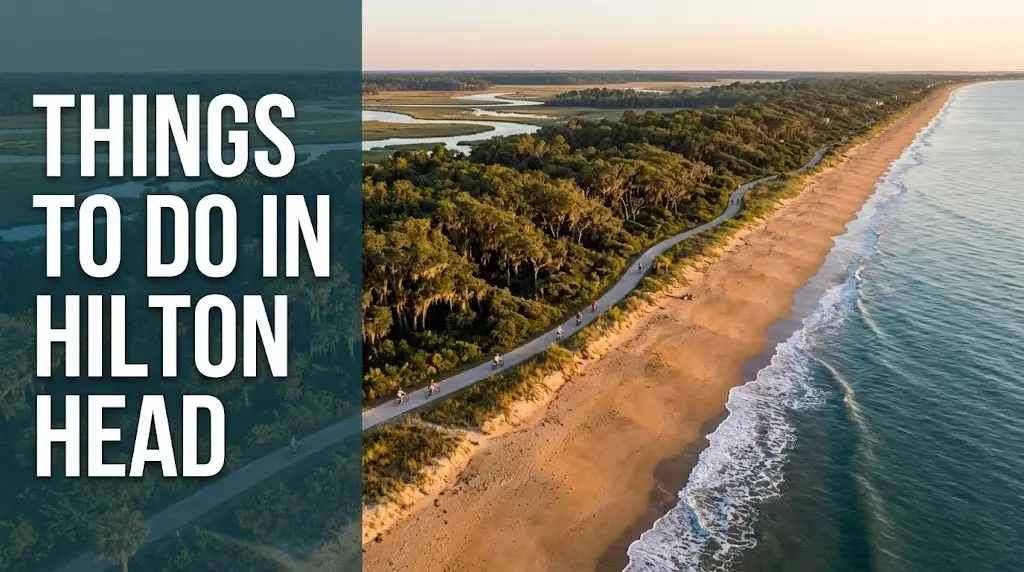
25 Best Things to Do in Hilton Head Island, SC (2026)

Hilton Head Island packs more genuine outdoor variety into 42 square miles than almost any barrier island on the East Coast. From 12 miles of Atlantic shoreline to 60-plus miles of bike paths through maritime forest, things to do in Hilton Head reward travelers who go beyond the obvious golf and beach circuit.
The island draws over 2.5 million visitors annually, according to Discover Hilton Head Island, the official destination organization. That volume means planning logistics matter as much as choosing activities.
This guide covers every major experience category: beaches, water sports, wildlife, cycling, dining, family activities, adult-focused options, free experiences, and day trips. You will also find a 2-day itinerary, traveler profile notes, and the one planning mistake that catches nearly every first-time visitor off guard.
Things to Do in Hilton Head: The Island at a Glance
Hilton Head Island is a resort barrier island in Beaufort County, South Carolina, sitting at the southern tip of the state near the Georgia border.
The island’s character divides cleanly between plantation resort communities and public areas. Knowing which is which before you arrive determines your entire itinerary.
Several large planned resort communities, including Sea Pines Plantation, Palmetto Dunes, Port Royal Plantation, and Shipyard Plantation, control significant portions of the island’s beach access, golf courses, and interior trails. Non-resort guests typically pay a per-vehicle day pass fee to enter Sea Pines. Verify current fees directly with the plantation before visiting.
Public beach accesses including Coligny Beach Park, Driessen Beach Park, and Folly Field Beach Park are available without plantation fees. These are the right starting points for day-trippers and budget-conscious visitors.
| Area | Access Type | Key Attraction | Best For |
|---|---|---|---|
| Sea Pines Plantation | Day pass fee for non-guests | Harbour Town Lighthouse, Forest Preserve | Couples, golfers |
| Coligny Beach Park | Free public access | Main beach, shops, restaurants | Families, first-timers |
| Pinckney Island NWR | Free, US federal land | Wildlife trails, birding, alligators | Nature travelers, seniors |
| Palmetto Dunes | Resort guests + some public access | Lagoon kayaking, 3 golf courses | Resort guests |
| North End (Driessen, Folly Field) | Free public beach access | Quieter beaches, local dining nearby | Budget travelers, locals |
Insider Tip:
- The north end beaches at Driessen Beach County Park have free parking that fills up later than Coligny.
- Locals avoid US-278 on summer Friday afternoons. Cross Island Parkway cuts travel time significantly.
- Seniors and visitors with mobility considerations find Pinckney Island NWR’s gravel and packed-dirt trails easier to navigate than soft sand beach surfaces.
Top Things to Do in Hilton Head Island
The top experiences in Hilton Head Island span beaches, wildlife tours, cycling, golf, kayaking, and Gullah cultural heritage. No single activity defines the island for all traveler types.
For first-time visitors, the most efficient approach is to organize activities by location on the island rather than by category. Grouping morning wildlife tours with afternoon cycling in the same zone saves significant driving time.
Discover Hilton Head Island identifies the RBC Heritage PGA Tour event at Harbour Town Golf Links as one of the island’s signature annual draws, typically held in April. Tickets sell out weeks in advance; verify 2026 dates and availability directly with the tournament.
The following table gives a practical overview of the island’s top experiences by traveler profile:
| Activity | Best For | Approx. Cost Range | Time Needed | Insider Note |
|---|---|---|---|---|
| Coligny Beach Park | Families, first-timers | Free | Half day | Arrive before 10am for parking |
| Harbour Town Lighthouse | Couples, photographers | Approx. $5-$8 to climb | 1-2 hours | Plantation day pass required for non-guests |
| Pincknight Island NWR | Nature travelers, seniors | Free | Half to full day | Best wildlife at dawn |
| Dolphin tour | All profiles | Approx. $35-$60/adult | 2 hours | Book 2-3 weeks ahead in summer |
| Bike trail cycling | Families, active travelers | Rental approx. $25-$50/day | Half to full day | Cross Island Connector trail is least crowded |
| Kayak lagoon tour | Couples, families (older kids) | Approx. $50-$80/person | 2-3 hours | Palmetto Dunes lagoon system is calm water |
| Harbour Town Golf Links | Golfers | Approx. $150-$300/round | Half day | Book 4-6 weeks ahead in peak season |
| Coastal Discovery Museum | Families, history travelers | Free-low cost | 2-3 hours | Gullah history program best for ages 8+ |
| Mitchelville Freedom Park | History travelers, all adults | Free | 1-2 hours | One of the most undervisited sites on the island |
Hilton Head Beach Things to Do
Hilton Head’s beaches offer 12 miles of Atlantic coastline with hard-packed sand that is wide at low tide and dramatically narrower at high tide.
Coligny Beach Park is the island’s primary public beach hub, with restrooms, outdoor showers, a playground, a small shopping area, and easy restaurant access along Coligny Circle. It is the right first beach for new visitors.
Parking at Coligny fills by mid-morning on summer weekends. Arriving before 9am or arriving by bike via the dedicated path network are both better strategies than driving and circling.
Families with young children find Coligny’s calm surf and shallow entry ideal in shoulder months. The Atlantic here can develop rip currents during summer storms; heed posted flag warnings at all times.
Couples seeking a quieter scene should head to Singleton Beach on the island’s north end, where crowds thin noticeably even on peak-season weekends.
Shelling is best in early morning at low tide, particularly at the north and south ends of the island where foot traffic is lightest.
Insider Tip:
- Check tide charts before choosing your beach arrival time. Low tide reveals wide, firm sand. High tide shrinks the beach significantly.
- Portuguese man-o-war jellyfish wash ashore periodically from July through September. Check beach condition reports through the Beaufort County Emergency Management website before visiting.
- Solo travelers find the beach social scene concentrated at Coligny’s north end, near the lifeguard stands and volleyball courts.
Best Beaches in Hilton Head
The best beach in Hilton Head depends more on what you want from a beach day than on any single ranking.
Coligny Beach Park wins on amenities and convenience. Driessen Beach Park and Folly Field Beach Park on the north end win on quieter conditions and less congested parking. South Beach within Sea Pines wins on scenic character, with views of Calibogue Sound and proximity to South Beach Marina Village dining.
Budget travelers should note that South Beach requires either a Sea Pines Plantation day pass or a resort stay to access without paying an entry fee. The public north-end beaches deliver strong beach quality without that cost.
According to the South Carolina Department of Parks, Recreation and Tourism, Hilton Head’s beaches are consistently ranked among the top barrier island beaches in the Southeast for water quality and sand quality. Verify current water quality conditions through the state environmental agency before swimming.
| Beach | Access | Parking | Best For | Crowd Level (Summer) |
|---|---|---|---|---|
| Coligny Beach Park | Free public | Limited, fills early | Families, first-timers | High |
| Driessen Beach Park | Free public | Moderate availability | Locals, budget travelers | Moderate |
| Folly Field Beach Park | Free public | Moderate availability | Quiet beach day | Moderate |
| South Beach (Sea Pines) | Plantation day pass | Available within plantation | Couples, scenery | Moderate to high |
| Singleton Beach | Free public | Street parking | Shelling, solitude | Low to moderate |
Seniors and travelers with mobility considerations should note that beach wheelchair rentals are available at Coligny and Driessen. Contact Discover Hilton Head Island to confirm 2026 availability and operators before your visit.
Hilton Head Water Sports and Kayaking
Hilton Head’s water sports scene covers kayaking, paddleboarding, parasailing, jet skiing, fishing charters, and sailing from multiple marinas and beach outfitters.
Palmetto Dunes Oceanfront Resort operates a well-regarded lagoon kayaking program through its 11-mile interconnected freshwater lagoon system. This is an inland calm-water experience, not ocean paddling, making it accessible for beginners and older children.
For ocean kayaking and paddleboarding, South Beach Marina within Sea Pines and Shelter Cove Marina on Broad Creek both host multiple outfitter operations. Prices vary by operator; expect to pay approximately $25 to $50 per person for a one to two-hour rental, and $50 to $100 per person for a guided tour. Verify 2026 pricing directly with operators.
Families with children benefit most from the Palmetto Dunes lagoon system. Ocean paddling requires more experience and physical strength, particularly on windy afternoons.
Couples seeking a more scenic experience should look at sunset sailing tours departing from Shelter Cove Marina or South Beach Marina. Book at least one to two weeks ahead during summer.
Fishing charters range from inshore creek fishing to offshore deep-sea trips. Inshore trips targeting red drum, flounder, and speckled trout typically run two to four hours and are well-suited for beginners and families with older children.
Insider Tip:
- Wind picks up significantly on the sound side (Calibogue Sound and Broad Creek) in the early afternoon. Morning kayak rentals provide calmer conditions and better wildlife observation.
- Solo travelers can often join small-group guided kayak eco-tours through outfitters at South Beach Marina without booking a private charter.
Key Takeaway: Book dolphin tours and kayak guides at least two weeks in advance during June through August. Same-day availability is rare in peak season and most reputable operators sell out.
Hilton Head Bike Trails and Cycling
Hilton Head Island has over 60 miles of dedicated shared-use paths, making it one of the most cycling-accessible resort islands in the United States.
The path network runs through maritime forest, alongside tidal creeks, across plantation resort communities (where public access is maintained on paths even where vehicle access requires a day pass), and parallel to the island’s main roads. This is genuinely functional transportation infrastructure, not just a recreational loop.
Bike rentals are available from multiple operators island-wide. Full-day adult bike rentals typically run approximately $20 to $40 per day. Many rental operators deliver bikes to vacation rentals and hotels. Verify 2026 rates directly with rental companies.
Families with young children find the flat terrain and separated paths ideal. Children as young as three ride comfortably in trailer attachments available from most rental operators.
Seniors benefit particularly from the flat grade throughout. The paths have minimal elevation change, and the surface quality is generally well-maintained.
The Cross Island Connector path that runs along Cross Island Parkway provides the fastest bike route across the island and is significantly less congested than paths closer to Coligny Beach in peak season. The Forest Preserve Trail within Sea Pines adds a distinctly different character, passing through 605 acres of maritime forest, an ancient Native American shell ring, and freshwater ponds where alligators bask regularly.
Insider Tip:
- Ride the path along William Hilton Parkway in early morning before motor vehicle traffic builds. The morning light through the live oaks and Spanish moss is one of the island’s most distinctive visual experiences.
- Avoid the Coligny Beach area paths between 10am and 3pm on summer weekends. Pedestrian traffic makes cycling slow and frustrating during those hours.
Hilton Head Dolphin Tours and Wildlife
Bottlenose dolphin watching is one of Hilton Head Island’s most consistently rewarding experiences, with resident dolphin populations inhabiting the island’s surrounding sounds year-round.
Multiple licensed operators run two-hour dolphin watching tours from Shelter Cove Marina, Broad Creek Marina, and South Beach Marina. Adult ticket prices typically range from approximately $35 to $60 per person; children’s rates are generally lower. Verify 2026 pricing and operator schedules before booking.
The dolphin population in Calibogue Sound and Broad Creek is resident, meaning these animals are present year-round rather than seasonally. This is a meaningful distinction from most coastal dolphin tour operations that target migratory pods.
Families with young children reliably rate dolphin tours among their top Hilton Head experiences. Children should be at least 3 years old for most operator guidelines; verify minimum age requirements when booking.
Beyond dolphins, the island’s waterways support a significant variety of coastal wildlife. Great blue herons, ospreys, brown pelicans, and roseate spoonbills are regularly observed from tour boats and kayaks in tidal creek areas.
The Coastal Discovery Museum at Honey Horn runs sea turtle programs from late May through August, when loggerhead sea turtles nest on the island’s beaches. Programs typically include nest monitoring walks and educational programs appropriate for families. Verify 2026 program dates and registration requirements directly with the museum.
Insider Tip:
- Morning dolphin tours before 9am typically encounter calmer water and less boat traffic in the sounds, improving wildlife observation quality.
- Birders should note that Pincknight Island NWR (covered in the next section) delivers more consistent and varied wildlife than most paid boat tours.
Pinckney Island National Wildlife Refuge
Pinckney Island National Wildlife Refuge is the single most undervisited major attraction on Hilton Head Island, and the gap between its quality and its tourist footfall is significant.
The refuge is a US Fish and Wildlife Service-managed area covering approximately 4,000 acres of saltmarsh, forest, and freshwater ponds accessible via free walking and cycling trails. The entrance is located directly on US-278 just before the main bridge onto Hilton Head Island, making it convenient for anyone arriving by car.
Access is free. Parking is free. Trail maps are available at the trailhead kiosk. Verify current trail conditions and any seasonal closures through the US Fish and Wildlife Service website before visiting.
The refuge hosts one of the densest concentrations of observable wildlife of any free public access site in coastal South Carolina. Alligators bask along pond edges throughout the warm months. Wood storks, great egrets, roseate spoonbills, and painted buntings are regularly observed. During spring and fall migration, shorebird concentrations on the saltmarsh impoundments attract serious birders from across the region.
Nature travelers and birders will find Pinckney Island more rewarding than most paid wildlife experiences on the island.
Families with older children (ages 7 and up) find the easy flat trails well-suited to a morning outing. The five-mile main loop to Ibis Pond and back is the recommended route. Younger children tire before the full loop; plan accordingly.
Insider Tip:
- Arrive at or before dawn on any morning from April through October. Wildlife activity peaks in the first 90 minutes of daylight.
- Cell service is limited inside the refuge. Download the trail map before leaving your vehicle.
- Summer temperatures inside the refuge can exceed 95 degrees Fahrenheit with high humidity by mid-morning. Carry significantly more water than you think you need.
Key Takeaway: Pinckney Island National Wildlife Refuge is free, wild, and genuinely better for wildlife observation than most paid tours. Visit first thing in the morning and arrive before the heat builds.
Harbour Town Hilton Head
Harbour Town is Hilton Head Island’s most photographed location, centered on the red-and-white striped Harbour Town Lighthouse at the tip of Sea Pines Plantation’s marina village.
The lighthouse is climbable for a modest fee (approximately $5 to $8 per adult as of recent years; verify 2026 pricing before visiting). The view from the top looks across Calibogue Sound toward Daufuskie Island and is genuinely scenic on clear days. Allow about 30 to 60 minutes for the lighthouse visit.
The surrounding marina area offers boutique shopping, casual dining, and views of resident sailboats and charter vessels. It is a pleasant, walkable waterfront precinct. It is not dramatically different from many other resort marina villages on the Southeast coast, and that honest context matters when planning your time.
Non-resort guests must pay the Sea Pines Plantation per-vehicle day pass to enter by car. The day pass fee varies; verify the current 2026 rate directly with Sea Pines. Arriving by bike via the shared path network bypasses the vehicle fee for cyclists.
Couples consistently rate Harbour Town among their most pleasant Hilton Head evening experiences. Sunset from the lighthouse or the marina waterfront is the island’s best organized romantic moment.
Budget travelers should weigh the plantation day pass cost against their total visit time in Sea Pines. If Harbour Town is your only destination inside the plantation, the bike path entry route is the more cost-effective option.
Insider Tip:
- The local alternative to Harbour Town’s marina dining is Skull Creek Boathouse on the island’s north side. It delivers better water views, fresher seafood at comparable prices, and a genuinely local crowd rather than a tourist-resort crowd.
Sea Pines Plantation Hilton Head
Sea Pines Plantation is Hilton Head Island’s largest resort community, covering 5,000 acres at the island’s southern tip, and it contains several of the island’s most referenced attractions within its gates.
The plantation includes Harbour Town Golf Links (home of the PGA Tour’s RBC Heritage), the Sea Pines Forest Preserve, South Beach Marina Village, and extensive beach access for resort guests.
The Sea Pines Forest Preserve is an underrated 605-acre natural area within the plantation boundaries. Trails pass through subtropical maritime forest, around freshwater ponds, and past a 4,000-year-old Native American shell ring, one of the oldest intact cultural sites on the South Carolina coast. Access requires either a plantation day pass or a resort stay.
History and culture travelers should prioritize the shell ring trail. It is a legitimate archaeological site receiving far less attention than it deserves relative to its age and significance.
Golfers planning to play Harbour Town Golf Links should book tee times four to six weeks in advance during peak season (April through June and September through October). Peak-season green fees are at the premium end of the island’s golf spectrum; verify 2026 rates directly with the course.
Families with young children will find Sea Pines’s beach access at South Beach quieter than Coligny. The South Beach Marina Village has child-friendly casual dining and an ice cream shop within walking distance.
Insider Tip:
- The shell ring at Sea Pines Forest Preserve is one of the least-crowded significant historic sites on the entire South Carolina coast. Early morning visits before 8am often mean the trail is completely empty.
Things to Do in Hilton Head With Kids
Hilton Head Island is genuinely well-designed for families with children, with flat bike paths, calm-entry beaches, wildlife programming, and multiple activity types suited to different age ranges.
The best family anchor activity is cycling. Renting bikes for the family and riding the shared-use path network to the beach, through forest preserves, and around the island’s tidal creek areas is the single activity that generates the most consistent family satisfaction across age groups from about 5 through adult.
The Coastal Discovery Museum at Honey Horn runs hands-on nature programming throughout the season. Sea turtle nest monitoring walks (late May through August), guided birding walks, and Gullah cultural heritage programs give children structured, educational experiences in the island’s natural environment. Verify 2026 program schedules directly with the museum.
Camp Hilton Head and similar organized children’s activity programs operate through several resort properties. These are relevant for families staying at resort hotels who want structured half-day programming for younger children.
For children under 8, dolphin boat tours and the Coligny Beach playground area are the two most consistently successful activities in terms of maintaining genuine engagement for the full duration.
Budget-conscious families should note that Pinckney Island NWR, Coligny Beach, Driessen Beach, and the public bike path network are all free or very low-cost. A full family day combining bike rentals with a free beach and a free wildlife refuge trailhead delivers comparable quality to most paid attraction options.
Insider Tip:
- Plan beach visits for 9am to noon. Afternoon heat and sun intensity from June through August are significant, especially for young children.
- The Coligny Beach area playground is shaded and directly adjacent to beach access, making it a natural transition point between park play and beach time.
Key Takeaway: For families, rent bikes on day one. The path network connects beaches, nature areas, and dining without requiring car trips, and it keeps children engaged across the full day in a way that driving from attraction to attraction does not.
Things to Do in Hilton Head for Adults
Hilton Head Island’s adult-oriented experience centers on golf, spa retreats, fine dining, sailing, and low-country cultural experiences, with a genuine but modest nightlife scene.
Golf is the island’s most developed adult activity category, with over 20 courses ranging from championship-caliber venues to mid-range public courses. Old South Golf Links is consistently cited among the island’s best-value courses, with scenic tidal creek and marsh views and green fees well below the plantation resort courses. Verify 2026 pricing directly with the course.
Harbour Town Golf Links offers the most prestigious playing experience, as the home of the PGA Tour RBC Heritage. Green fees reflect that prestige; budget accordingly.
The island’s spa industry is well-developed within the major resort properties. Palmetto Dunes and several luxury rental communities offer resort-guest spa access. Standalone spa day packages are available through multiple operators for non-resort visitors.
The adult nightlife scene is limited relative to the island’s overall visitor volume. The Salty Dog Cafe at South Beach Marina draws a consistent evening crowd with live music and an outdoor deck overlooking the marina. Skull Creek Boathouse hosts live music on its waterfront deck regularly in season.
Adults traveling without children who want a genuine date-caliber evening should consider sunset sailing tours from Shelter Cove Marina, followed by dinner at Lucky Rooster Kitchen and Bar in the north end. It is consistently ranked among the island’s best dining experiences for quality and atmosphere outside the plantation resort bubble.
Insider Tip:
- The RBC Heritage PGA Tour event in April is the island’s most energetic adult-focused week. It combines professional golf with a genuine festival atmosphere. Book accommodations six or more months ahead if targeting that week.
Best Restaurants in Hilton Head Island
Hilton Head Island’s restaurant scene is solid, seafood-forward, and reliably fresh, but it is island-contained rather than a destination food city.
The low-country culinary tradition is the reference point: shrimp and grits, she-crab soup, fresh oysters, fried grouper, and low-country boils are the native language of the island’s best kitchens. When restaurants stray from these strengths into generic resort menu territory, quality drops noticeably.
Hudson’s Seafood House on the Docks on Skull Creek is the island’s most respected seafood institution. It opened in 1967 and its dockside setting, where shrimp boats unload adjacent to the restaurant, gives it an authenticity that resort dining venues cannot replicate. Expect a wait on summer evenings; arrive before 5:30pm or after 8pm.
Skull Creek Boathouse, adjacent to Hudson’s, offers a more casual waterfront experience with comparable seafood quality and live music in season. It is better for groups and louder gatherings; Hudson’s is better for quieter meals.
Lucky Rooster Kitchen and Bar in the north end delivers the island’s best non-seafood-focused menu. Local sourcing and a craft cocktail program make it the closest thing Hilton Head has to a restaurant you would find highlighted in a serious food publication.
Budget travelers should know that the Coligny Plaza area around the main beach park has several mid-range casual options where a full meal runs approximately $15 to $25 per person.
| Restaurant | Style | Price Range (est.) | Best For | Reservation Needed? |
|---|---|---|---|---|
| Hudson’s Seafood House | Classic dockside seafood | $$$ | Couples, special occasions | Recommended in season |
| Skull Creek Boathouse | Casual waterfront | $$ | Groups, families | Walk-in usually available |
| Lucky Rooster Kitchen | Modern Southern | $$ | Adults, couples | Recommended evenings |
| Coligny Plaza casual options | Casual beach dining | $ | Budget travelers, families | Usually walk-in |
| Salty Dog Cafe | Casual marina | $$ | Families, casual groups | Walk-in usually available |
Key Takeaway: Eat seafood at Hudson’s on Skull Creek or Skull Creek Boathouse. These are the island’s honest best for the food Hilton Head actually does well. Resort hotel restaurants consistently underperform at similar price points.
Free Things to Do in Hilton Head
Hilton Head Island offers more genuinely worthwhile free experiences than most visitors realize.
The public beach accesses at Coligny Beach Park, Driessen Beach Park, Folly Field Beach Park, and Singleton Beach are all free to access. Coligny Beach Park has a small parking fee in peak season; the north-end beaches typically have free street or lot parking.
Pinckney Island National Wildlife Refuge is free with no reservation required. It is the best free nature experience within easy driving distance of the island.
Mitchelville Freedom Park on the north end of Hilton Head Island tells the story of Mitchelville, established in 1861 as the first self-governing community of freedpeople in the United States. Admission is free. The interpretive trails and monuments are genuinely important American history, and the site is significantly underattended relative to its historical significance.
The Coastal Discovery Museum at Honey Horn has free general admission to its grounds and some programs, with fees for specialized programs and guided tours. Verify the 2026 admission structure directly with the museum before visiting.
Free cycling on the shared-use path network (after you rent or bring a bike) covers the largest portion of the island’s best natural scenery.
- Coligny Beach Park: free beach access, free playground
- Pinckney Island NWR: free trails, free parking, world-class wildlife observation
- Mitchelville Freedom Park: free, historically significant, undervisited
- Shared-use bike path network: free to ride (bike rental separate)
- Shell Ring at Sea Pines Forest Preserve: free with Sea Pines path cyclist access
Budget travelers can build a full two-day itinerary in Hilton Head spending very little beyond bike rental, food, and accommodation.
Things to Do Near Hilton Head Island
The two best day trips from Hilton Head Island are Savannah, Georgia, approximately 45 minutes to one hour south, and Beaufort, South Carolina, approximately 35 to 40 minutes north.
Savannah offers a dramatically different experience from Hilton Head: dense urban history, one of the most intact antebellum urban grids in the American South, the Forsyth Park cultural hub, excellent restaurants along Broughton Street and in the Starland District, and a genuinely walkable historic district. It is a natural complement to a Hilton Head beach-and-nature itinerary.
Bluffton, South Carolina, just 15 to 20 minutes from the Hilton Head bridge, is often overlooked. Old Town Bluffton on the May River has a well-preserved historic district, the Church of the Cross (an 1854 antebellum church), Calhoun Street boutiques, and the Saturday Bluffton Farmers Market. It is an afternoon’s outing rather than a full day, but it provides a non-resort small-town counterpoint to Hilton Head’s resort character.
Beaufort, South Carolina, deserves more attention than it gets in Hilton Head planning guides. The historic district is among the best-preserved antebellum town centers in the country. Gullah cultural experiences at Penn Center on St. Helena Island, approximately 20 minutes from Beaufort, are more contextually immersive than anything available on Hilton Head itself.
Families with children will find Savannah’s riverfront area and trolley tours the most engaging day trip option. Beaufort’s quieter scene suits couples and history travelers more than young children.
Insider Tip:
- Drive to Savannah on a weekday if possible. Weekend Savannah draws significant crowds in the historic district and parking becomes a genuine logistics challenge.
Getting Around Hilton Head Island
Getting around Hilton Head Island requires either a car or a bike. There is no meaningful public transit system serving the island’s primary attractions.
The island’s road network centers on US-278 (William Hilton Parkway), which runs the length of the island from the bridge at the north end to Sea Pines Circle at the south. This road is the island’s primary bottleneck. In summer, Friday afternoon traffic on US-278 can extend wait times to 30 minutes or more at the main bridge.
Cross Island Parkway (SC-278 toll road) provides a faster route across the island’s middle section. The toll is modest; carry cash or confirm current electronic toll options before using it.
Driving between attractions works efficiently outside of peak summer hours. Most plantation communities have their own internal road systems once you pay the day pass or are a resort guest.
The 60-plus mile shared-use bike path network is the single most efficient way to move between northern beach areas and central island attractions in good weather. Cycling from Coligny Beach to Harbour Town via the path takes approximately 30 to 45 minutes at a comfortable pace.
Rideshare service (Uber and Lyft) operates on the island, but coverage can be inconsistent, particularly in the late evening and at plantation community gates where drivers may not be permitted to enter without a pass. Verify access logistics for your specific accommodation before relying on rideshare as your primary transport.
Most accommodations rent golf carts for island use. Golf carts are legal on the shared-use paths and within plantation communities, though rules vary by area.
Arriving through Savannah Hilton Head International Airport (SAV) is the primary commercial aviation option. The drive from SAV to the island is approximately 45 minutes to one hour depending on traffic.
Insider Tip:
- Rent bikes on arrival day and use them as your primary daily transport to beaches, restaurants, and nature areas. You will spend less time parking, less money on gas, and more time experiencing the island as its best regulars do.
Suggested 2-Day Hilton Head Weekend Itinerary
This itinerary assumes arrival on a Friday evening or Saturday morning. It balances the island’s top experiences across two days with logistics that minimize driving and maximize time on the actual activities.
Day 1: North End, Nature, and Water
- Arrive early and pick up bike rentals from your accommodation’s concierge or a delivery rental service before 9am.
- Ride or drive to Pinckney Island National Wildlife Refuge for a morning wildlife walk. Allow 2 to 3 hours. Bring water, sunscreen, and insect repellent.
- Return to the island and cycle to Driessen Beach Park or Folly Field Beach Park for a late-morning beach session. Arrive by 11am to secure a good spot.
- Lunch at Skull Creek Boathouse or Hudson’s Seafood House on the Docks on the north end. Both are within cycling distance of the north-end beaches.
- Afternoon dolphin watching tour from Shelter Cove Marina or Broad Creek Marina. Book this in advance; 2pm tours are typically available on summer days.
- Evening at Mitchelville Freedom Park for a quiet walk through the historic site as the afternoon heat breaks.
- Dinner at Lucky Rooster Kitchen and Bar in the north end.
Day 2: South End, Culture, and Harbour Town
- Early morning ride to Sea Pines Forest Preserve via the shared-use path (cyclists bypass vehicle day pass fee). Walk the shell ring trail before crowds arrive.
- Cycle through Sea Pines to Harbour Town. Climb the lighthouse before 10am when lines are short. Walk the marina village.
- Mid-morning beach time at South Beach within Sea Pines, or return north to Coligny if day pass cost is a concern.
- Lunch at The Salty Dog Cafe at South Beach Marina for the classic Hilton Head marina experience.
- Afternoon visit to the Coastal Discovery Museum at Honey Horn for a sea turtle or nature program (book ahead in summer).
- Ride the Cross Island path network as the afternoon cools.
- Farewell dinner at Hudson’s Seafood House on the Docks. Arrive by 5:30pm to minimize wait time.
Safety and Practical Warnings for Hilton Head Island
Rip currents are the primary ocean safety risk on Hilton Head’s Atlantic-facing beaches, and they are most dangerous from June through August when surf conditions are most variable.
Key safety and practical facts every visitor should know:
- Obey posted beach flag warnings at all times. Red flags indicate dangerous conditions including rip currents. Double red means the beach is closed to swimming. Check flag status at Coligny Beach’s lifeguard stations daily.
- Alligators are present throughout the island, including in roadside lagoons, golf course water hazards, Palmetto Dunes lagoon system, and Pinckney Island NWR ponds. Do not approach, feed, or attempt to photograph from close range.
- Summer heat and humidity are genuine health risks, particularly for seniors, young children, and anyone engaging in extended outdoor activity. Temperatures regularly exceed 90 degrees Fahrenheit from June through August. Humidity increases heat index significantly. Carry more water than you expect to need.
- Jellyfish, including Portuguese man-o-war, appear on beaches periodically from July through September. Check beach conditions before entering the water.
- US-278 traffic congestion on summer Friday afternoons can create significant delays at the island bridge. Plan arrivals and departures outside of 3pm to 7pm on Fridays.
- Cell service inside Pinckney Island NWR is limited. Download trail maps and any navigation before entering the refuge.
- Plantation gate access can be a source of confusion for non-resort guests. Know your entry status before driving to Sea Pines or other gated communities.
The Beaufort County Emergency Management office and Discover Hilton Head Island both maintain updated safety and weather advisories. Check both before outdoor activities, especially in summer storm season (June through October).
Frequently Asked Questions About Things to Do in Hilton Head
What are the best things to do in Hilton Head Island for first-time visitors?
First-time visitors get the most from Hilton Head by combining beach time at Coligny Beach Park, a dolphin watching tour from Shelter Cove Marina, and cycling the shared-use path network.
Add a morning visit to Pinckney Island National Wildlife Refuge before the heat builds, and a dinner at Hudson’s Seafood House on the Docks for the island’s most authentic seafood experience.
Avoid trying to see everything in one day. The island’s best experiences reward slower pacing across two or three days.
How many days do you need in Hilton Head Island?
Two full days is the minimum to experience Hilton Head Island comfortably without feeling rushed.
Three to four days allows for beach time, a dolphin or kayak tour, cycling the path network, a visit to Pinckney Island NWR, and a day trip to Savannah or Beaufort.
Golfers and families with young children typically benefit most from four to five day stays.
Is Hilton Head Island good for families with young kids?
Hilton Head is well-suited for families with children from toddlers through teenagers, with flat bike paths, calm-entry beaches, dolphin tours, and nature programming at the Coastal Discovery Museum.
The Coligny Beach area is the best family base, with a playground, beach access, and casual dining all within walking distance.
Families should plan beach time for mornings and save afternoon slots for shaded activities or indoor downtime, especially in summer heat.
What is the best time of year to visit Hilton Head Island?
The best time to visit Hilton Head Island is March through May or September through October.
Spring brings mild temperatures, smaller crowds, lower hotel rates compared to summer, and the beginning of sea turtle nesting season in late May.
Fall delivers similar crowd relief after Labor Day, comfortable temperatures for cycling and outdoor activities, and the island’s best restaurant availability without peak-season waits.
Do you need a car to get around Hilton Head Island?
A car is the most practical primary transport on Hilton Head Island, but the 60-plus mile bike path network reduces dependence on driving for most daily activities.
Rideshare service operates on the island but can be inconsistent in coverage at plantation community gates and in late evening hours.
Visitors staying at plantation resort communities with rental bikes and on-site amenities can often manage two to three days without a car for daily activities.
Are there free things to do in Hilton Head Island?
Yes. Hilton Head has a strong range of genuinely worthwhile free activities.
Pinckney Island National Wildlife Refuge, public beach accesses at Coligny, Driessen, and Folly Field beaches, Mitchelville Freedom Park, and the entire shared-use bike path network are all free to access.
Mitchelville Freedom Park is the island’s most historically significant free site and one of its most consistently underattended attractions.
Plan Your Hilton Head Island Trip With Confidence
Hilton Head Island rewards travelers who plan two steps ahead. Book dolphin tours, kayak guides, and any sea turtle programming at the Coastal Discovery Museum before you arrive, particularly if visiting between June and August.
The single logistical step that improves most Hilton Head visits most dramatically is arranging bike rentals in advance. The path network turns the island from a drive-park-walk destination into something genuinely more interesting and more comfortable.
Travel conditions, plantation day pass fees, restaurant hours, tour operator schedules, and activity pricing change annually. Verify all key logistics directly with operators and through the Discover Hilton Head Island official tourism website before your departure. The island’s best experiences are exactly as good as their reputation when you arrive prepared.