
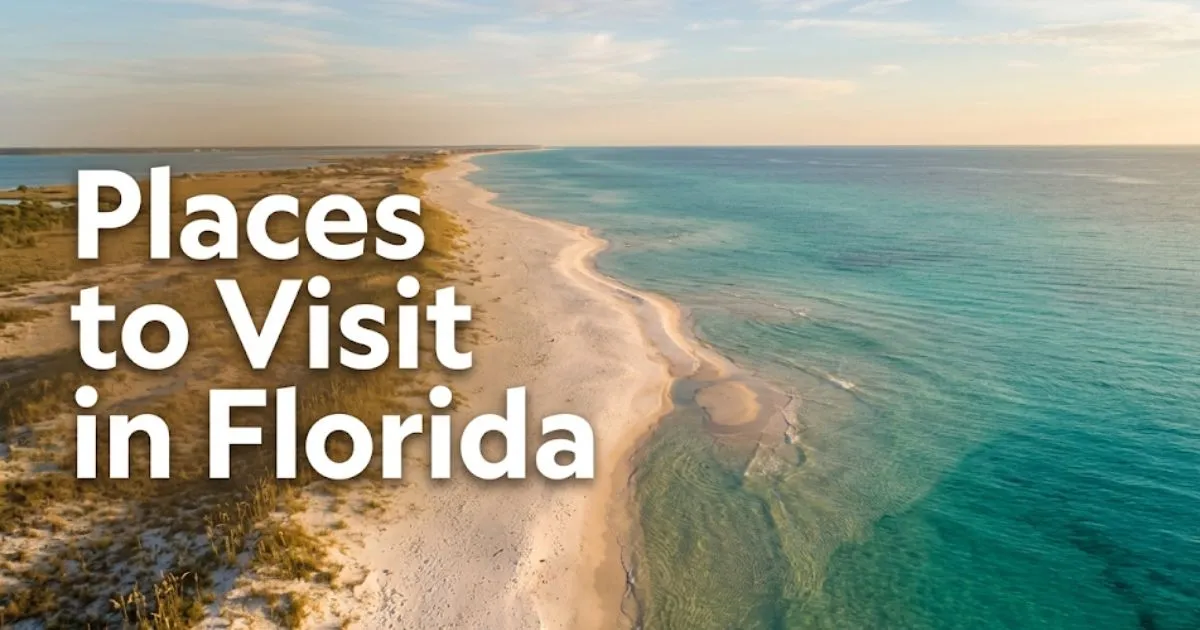
Best Places to Visit in Florida in 2026

Florida’s best places to visit span four genuinely different regions. Each rewards a different traveler with a different experience.
The state draws over 140 million visitors annually, according to Visit Florida. Most of them make the same mistake: treating Florida as a single destination rather than four distinct regional travel personalities.
This guide covers the top Florida destinations for 2026 by region, traveler type, budget, and season. It gives you the specific information needed to pick the right place and plan an actual trip.
Best Places to Visit in Florida
The best places to visit in Florida include Miami, St. Augustine, Siesta Key Beach, the Florida Keys, Sarasota, Tampa, the Everglades, Crystal River, Apalachicola, and the spring systems of North Central Florida.
Florida is not one destination. Its Atlantic coast, Gulf Coast, panhandle, and interior each operate on different weather patterns, crowd cycles, and activity types.
Miami delivers urban energy and Caribbean-influenced culture. The Gulf Coast runs quieter and warmer in feel.
St. Augustine is the oldest continuously occupied European settlement in the US. The Florida Keys offer an experience unlike any other American road trip.
The destinations covered in this guide were selected based on four criteria: genuine distinctiveness from neighboring options, traveler profile breadth, year-round or seasonal access, and honest track records with repeat visitors.
| Destination | Region | Best For | Cost Tier | Best Season |
|---|---|---|---|---|
| Miami | South Florida | Culture, nightlife, couples | Premium | Nov to April |
| Key West | Florida Keys | Couples, solo travelers | Premium | Nov to March |
| St. Augustine | North Florida | History lovers, couples | Mid-range | March to May |
| Sarasota | Gulf Coast | Culture, families, couples | Mid-range | Nov to April |
| Siesta Key | Gulf Coast | Beach lovers, families | Mid-range | Nov to March |
| Tampa | Central Gulf | Families, food lovers | Mid-range | Nov to April |
| Clearwater Beach | Gulf Coast | Families, budget travelers | Mid-range | Oct to April |
| Everglades | South Florida | Outdoor, nature | Budget to mid | Nov to March |
| Crystal River | North Central | Wildlife, divers | Budget | Nov to March |
| Apalachicola | Panhandle | Couples, food, solitude | Budget | March to May |
| Destin | Panhandle | Families, beach lovers | Mid to premium | Sept to Oct |
| Ichetucknee Springs | North Florida | Outdoor, budget | Budget | May to Sept |
How to Choose the Right Florida Destination for Your Trip
The right Florida destination depends on which of five travel experiences you are actually prioritizing: beach relaxation, urban culture, outdoor and wildlife access, family entertainment, or quiet and culinary-focused escapes.
Florida trips fail most often when travelers pick a destination based on name recognition rather than fit.
Miami suits urbanists and culture travelers more than pure beach seekers. Key West suits couples and solo travelers who want character over resort luxury.
Families with young children get the most value from Gulf Coast beach towns like Clearwater and Siesta Key, combined with Tampa’s walkable waterfront.
Budget travelers should target North Florida, the springs corridor, or the Panhandle in shoulder season. South Florida and the Keys run premium year-round.
How to narrow your Florida destination in five steps:
- Decide whether beach, nature, urban culture, or family entertainment drives the trip
- Identify your budget tier: South Florida is premium, Gulf Coast mid-range, Panhandle mixed
- Check your travel dates against crowd and weather patterns (covered below)
- Confirm whether you have a car. Florida requires a vehicle for almost every destination outside Miami’s urban core
- Match your group type to the profile notes in this guide, then pick the destination that scores highest across your criteria
Best Beach Towns in Florida to Visit in 2026
Siesta Key Beach near Sarasota holds repeated top rankings from the Dr. Beach annual survey for its quartz sand, which stays cool underfoot even in July heat.
Caladesi Island State Park, accessible only by ferry from Honeymoon Island near Dunedin, delivers Gulf Coast water and sand with a fraction of Clearwater Beach’s crowd.
Clearwater Beach is the most visited Gulf beach and earns its popularity with consistent water clarity and walkable dining on Mandalay Avenue. It is also the most crowded from December through March.
Grayton Beach State Park in the Panhandle produces some of the state’s finest sugar-white sand alongside protected coastal dune habitat. It sees nothing close to Destin’s summer crowd volumes.
For Atlantic coast beach experiences, Canaveral National Seashore north of Cocoa Beach offers 24 miles of undeveloped barrier island beach with no commercial infrastructure.
Insider Tip:
- Siesta Key’s south end near Turtle Beach has free parking and far smaller crowds than the main public beach access
- Caladesi Island’s ferry schedule is limited. Arrive at Honeymoon Island early or you risk the midday boat being sold out
- Seniors and mobility travelers should note that Caladesi and Canaveral require walking on soft sand, which is difficult with mobility aids
Best Places to Visit in South Florida
South Florida’s best destinations are Miami, the Florida Keys, and Everglades National Park, each serving a distinctly different travel purpose.
Miami is the region’s cultural and culinary center. The Wynwood Walls art district in Wynwood provides one of the most photographed public art installations in the Southeast.
Little Havana on SW 8th Street, known locally as Calle Ocho, delivers Cuban coffee, domino games at Maximo Gomez Park, and a genuine neighborhood identity that Wynwood’s tourist polish does not replicate.
The Art Deco Historic District on Ocean Drive in South Beach is Florida’s most photographed streetscape. The actual district extends 10 blocks inland along Collins and Washington Avenues, which most visitors miss entirely.
The Florida Keys begin at Key Largo, where John Pennekamp Coral Reef State Park offers the only living coral reef accessible by snorkel and glass-bottom boat in the continental US.
Key West’s Mallory Square sunset celebration happens nightly but functions primarily as tourist theater. The actual Key West is found on Whitehead Street and in the Bahama Village neighborhood.
Admission to Everglades National Park runs approximately $35 per vehicle as of recent years. Verify current fees at the National Park Service website before visiting.
Budget note: Miami hotel rates during Art Basel in December and during spring break run significantly higher than the rest of the year. Budget travelers should target May or October for South Florida visits.
Key Takeaway: South Florida has three completely different personalities: Miami’s urban culture, the Keys’ island-road character, and the Everglades’ raw subtropical wilderness. Trying to combine all three in one short trip means doing none of them properly.
Best Places to Visit in Central Florida
Central Florida’s strongest destinations beyond Orlando’s theme parks are Tampa, St. Petersburg, and the Weeki Wachee Springs corridor along the Nature Coast.
Kennedy Space Center Visitor Complex on Merritt Island is 45 minutes east of Orlando and earns genuine destination status for launch viewing events, the Space Shuttle Atlantis exhibit, and the Apollo-era Saturn V hall.
Tampa’s Ybor City historic district is Florida’s most undervalued urban neighborhood for first-time visitors. The hand-rolled cigar tradition dating from the 1880s Cuban and Spanish immigrant community still operates at El Reloj and a handful of remaining family-run shops.
The Tampa Riverwalk, a 2.6-mile waterfront promenade, connects the Tampa Museum of Art, the Armature Works food hall, and the Florida Aquarium without requiring a car or rideshare.
St. Petersburg’s Salvador Dali Museum holds the largest collection of Dali works outside of Europe. It is a genuine world-caliber art institution in a city that most Florida visitors drive past on their way to the beach.
The St. Pete Pier, rebuilt and reopened in 2020, delivers a walkable waterfront experience with fishing access, a public beach, and restaurants. It functions as a local gathering space rather than a theme park attraction.
Couples note: St. Petersburg’s EDGE District on Central Avenue runs independent restaurants, galleries, and bars that local residents actually use. It is the restaurant strip that experienced travelers choose over the tourist-oriented waterfront chains.
Best Places to Visit in North Florida and the Panhandle
North Florida’s best destinations are St. Augustine, Amelia Island, and the Panhandle stretch between Apalachicola and Pensacola.
Castillo de San Marcos in St. Augustine is the oldest masonry fort in the US, built by the Spanish beginning in 1672. Admission runs approximately $15 per adult as of recent years. Verify current fees with the National Park Service.
Flagler College‘s campus, housed in the former Ponce de León Hotel built in 1888, offers guided tours that reveal one of the most architecturally significant interiors in the American South.
The standard St. Augustine tourist experience concentrates on St. George Street’s shops and the Old Town Trolley. The more interesting local experience runs through the Lincolnville neighborhood, the historic African American community south of King Street.
Amelia Island north of Jacksonville delivers 13 miles of Atlantic beach, a Victorian-era downtown in Fernandina Beach, and an annual shrimping heritage that produces the Florida Shrimp Festival each May.
The Panhandle’s Apalachicola is the state’s most complete small-town food and character destination. The oyster industry that made it famous faces environmental pressure, but the town’s architecture, the Apalachicola National Estuarine Research Reserve, and the dining on Market Street remain exceptional.
Grayton Beach and the 30A corridor between Destin and Panama City Beach attract a decidedly different visitor than the rest of the Panhandle. The architectural new urbanist community of Seaside, featured in the film “The Truman Show,” sits along this stretch.
Solo traveler note: St. Augustine works well solo. It is walkable, the historic district is compact, and Flagler College’s architecture is best absorbed slowly and alone.
Key Takeaway: North Florida and the Panhandle are the most underestimated regions in the state. St. Augustine alone justifies a dedicated multi-night trip, and Apalachicola is the Florida that experienced travelers go back to.
Florida Nature and Outdoor Destinations Worth Visiting
Florida’s strongest outdoor destinations are Everglades National Park, the Gulf Coast estuary systems, the Ocala National Forest, and the spring-fed rivers of North Central Florida.
The Everglades is the only subtropical wilderness in North America. The Anhinga Trail at Royal Palm is the park’s most wildlife-dense short walk, averaging less than one mile.
Shark Valley in the northern Everglades offers a 15-mile paved loop accessible by tram tour or bicycle rental. Alligator sightings from the observation tower are effectively guaranteed from November through April.
Corkscrew Swamp Sanctuary near Naples, operated by the National Audubon Society, protects the largest remaining old-growth bald cypress forest in North America. Entry runs approximately $17 for adults as of recent years.
The Merritt Island National Wildlife Refuge surrounding Kennedy Space Center hosts more species of threatened and endangered wildlife than any other refuge in the continental US. Admission is free.
Crystal River National Wildlife Refuge near the city of Crystal River is the only place in the US where swimming with wild Florida manatees is legally permitted through regulated tour operators. The season concentrates from November through March when manatees aggregate around natural spring vents.
Family note: Shark Valley’s tram tour is excellent for families with children under 10 who cannot manage a 15-mile bike route. The tram guide commentary is specific and genuinely educational, not scripted tourism-board patter.
Best Florida Springs to Visit
The best Florida springs to visit are Ichetucknee Springs State Park, Blue Spring State Park, Ginnie Springs Outdoors, Devil’s Den Prehistoric Spring, Wakulla Springs State Park, and Rainbow Springs State Park.
Florida has more than 700 natural springs, more than any other state in the world. The water temperature holds at approximately 68 to 72 degrees Fahrenheit year-round, making springs the best summer swimming option in the state.
Ichetucknee Springs State Park north of Fort White offers a tubing experience down a spring-fed river through undeveloped subtropical forest. Timed-entry reservations are required from Memorial Day through Labor Day weekend. Book at least two to three weeks in advance.
Blue Spring State Park in Orange City near DeLand is the single best place in Florida to observe West Indian manatees in their natural habitat. Manatee counts from November through March regularly exceed 200 animals on cold days.
Ginnie Springs Outdoors near High Springs operates as a private spring park with camping and is one of the few Florida springs open year-round with night diving permitted.
Devil’s Den near Williston is a prehistoric underground spring inside a dry cave. Snorkeling and scuba access require advance reservation. It is one of Florida’s most photographed underwater environments.
Budget traveler note: State park springs charge entry fees that run approximately $6 to $8 per person as of recent years. Private springs like Ginnie run higher. Verify current fees before visiting. Compared to theme parks or resort beach access fees, Florida springs represent the state’s best value outdoor experience.
Best Small Towns in Florida to Visit
Florida’s best small towns are Apalachicola, Fernandina Beach on Amelia Island, Cedar Key, Mount Dora, and Seaside.
These towns serve experienced Florida travelers who have already done the standard beach and theme park circuit and want a different kind of Florida experience.
Cedar Key on the Gulf Coast west of Gainesville is a fishing village on a small island cluster accessible via US 24. The Cedar Key National Wildlife Refuge offshore is accessible only by boat. The town has resisted resort development while building a reputation for clam aquaculture and seafood restaurants on Dock Street.
Mount Dora in Lake County northwest of Orlando operates as an antiques and arts town on the shores of Lake Dora. Its brick main street, Victorian architecture, and annual lighthouse festival in February make it the most genuinely different day trip from Orlando.
Fernandina Beach on Amelia Island’s north end has a 50-block historic downtown with more antebellum and Victorian commercial architecture than any other Florida town. The Florida House Inn, reportedly Florida’s oldest continuously operating hotel, sits on 3rd Street.
Seaside on 30A is architecturally intentional in a way that most Florida towns are not. Its pastel buildings and town square have genuine community infrastructure. It is also expensive and a bit self-conscious, which experienced visitors either love or find off-putting.
Couples note: Apalachicola and Cedar Key both work exceptionally well for couples who want quiet, good food, and no agenda. Neither has a nightlife scene to speak of.
Key Takeaway: Florida’s small towns are where the state’s actual character lives. Apalachicola, Cedar Key, and Fernandina Beach deliver more genuine Florida identity in a weekend than most of Orlando’s tourist corridor delivers in a week.
Relaxing Places to Visit in Florida
The most genuinely relaxing places to visit in Florida are Sanibel Island, Anna Maria Island, Boca Grande, and Captiva Island on the Gulf Coast.
These destinations share three qualities: no high-rise development, car-optional or car-limited infrastructure, and a pace that discourages checking work email.
Sanibel Island connected to the mainland by a causeway near Fort Myers, is governed by a strict land use ordinance limiting building heights to three stories. Shell collecting on Sanibel, particularly at the eastern end near Lighthouse Beach, is the most famous such activity in the US.
Ding Darling National Wildlife Refuge on Sanibel offers a 4-mile wildlife drive through mangrove estuary. It closes on Fridays for management. Visit Tuesday through Sunday in the morning for the best bird activity.
Anna Maria Island at the northern end of Sarasota Bay runs seven miles long with three distinct small towns: Anna Maria, Holmes Beach, and Bradenton Beach. The Pine Avenue corridor in the town of Anna Maria has a walkable main street with independent restaurants.
Boca Grande on Gasparilla Island south of Fort Myers is Florida’s most genuine escape for experienced travelers seeking quiet. The absence of chain restaurants, the historic Gasparilla Inn, and the lighthouse at the island’s southern tip define a different Florida entirely.
Senior and accessibility note: Sanibel and Anna Maria Island are both relatively flat and manageable for seniors. The causeway bridge approach to Boca Grande has a $6 toll as of recent years. Verify current toll amounts before visiting.
Places to Visit in Florida for Families
The best Florida destinations for families with children are Tampa Bay (combining Tampa, St. Petersburg, and Clearwater), Orlando, Siesta Key, and Kennedy Space Center.
These destinations earn family designation for specific and honest reasons, not because they have a beach.
Tampa Bay is Florida’s most complete family destination when treated as a combined region. The Florida Aquarium on Tampa’s waterfront is walkable from the Amalie Arena and the History Center. The Clearwater Marine Aquarium, home of Winter the dolphin from the film “Dolphin Tale,” draws families specifically.
Orlando’s theme parks need no advocacy here. What most family planning guides miss is that LEGOLAND Florida in Winter Haven is significantly better suited to children ages 2 through 12 than Walt Disney World. Wait times are shorter, the park is less overwhelming, and the pricing is lower.
Siesta Key Beach eliminates two major family beach problems: the sand stays cool due to its quartz composition, and the gentle Gulf slope means very shallow water extending far from shore. Both matter enormously for young children.
Kennedy Space Center Visitor Complex is Florida’s most underrated family day trip. The Children’s Play Dome, rocket garden, and full IMAX theater with space programming hold children’s attention for a full day without the ticket price and crowd levels of theme parks.
Stroller and accessibility note: Tampa’s Riverwalk and the Kennedy Space Center grounds are both stroller-friendly and paved throughout. Everglades trails are not stroller-accessible and should not be on the agenda for families with children under four.
Places to Visit in Florida for Couples
The best Florida destinations for couples are Key West, Sarasota, Apalachicola, St. Augustine, and Miami’s Coconut Grove and Coral Gables neighborhoods.
The least useful advice for couples is to simply recommend “Miami Beach.” The most tourist-dense mile of Florida is not where good couples experiences happen.
Sarasota earns its couples designation through a specific combination: the Ringling Museum of Art and the Ca’ d’Zan mansion for afternoon culture, the Selby Botanical Gardens on Sarasota Bay for early morning walks, and the restaurant row on Main Street for evening dining.
Key West’s romantic identity lives on the quieter side of Duval Street. The Historic Seaport neighborhood around Grinnell Street and the Southernmost Point area at the intersection of Whitehead and South Streets deliver Key West character without the Duval bar-crawl noise.
St. Augustine’s Spanish Quarter at night, after the day-tripper trolleys have left, is one of Florida’s most genuinely atmospheric urban environments. The narrow streets, lit lanterns, and Castillo de San Marcos riverfront work well for couples who arrive after 4 PM and stay the night.
Miami’s Coconut Grove neighborhood runs along Bayshore Drive with waterfront parks, the Vizcaya Museum and Gardens, and independent restaurants on Grand Avenue. It functions as the city’s most adult and genuinely local-feeling neighborhood.
Honest note: Key West in March during spring break loses its romantic atmosphere entirely. Couples should target November through February or September through October for the most authentic Key West experience.
Key Takeaway: Couples who skip Miami Beach and go to Sarasota, Apalachicola, or St. Augustine at night get a Florida romance experience that no tourism brochure photograph can accurately represent.
Affordable Places to Visit in Florida
The most genuinely affordable places to visit in Florida are the North Florida springs, Cedar Key, Gainesville, the Panhandle in shoulder season, and the Florida State Park system broadly.
Budget travelers have been systematically underserved by Florida travel content that leads with Miami and the Keys. Both are among the most expensive destinations in the eastern US.
Gainesville as a base for North Florida exploration gives budget travelers access to Devil’s Den, Ginnie Springs, the Ichetucknee River, and Paynes Prairie Preserve State Park within a one-hour drive. Hotel rates in Gainesville run significantly below coastal resort towns.
The Florida State Parks system, managed by the Florida Department of Environmental Protection, covers over 175 parks with camping rates that run approximately $20 to $30 per night as of recent years. Annual camping reservations through the ReserveAmerica system for popular parks like Grayton Beach and Blue Spring should be made two months in advance.
Pensacola Beach runs at its most affordable from October through February, when Gulf water is still swimmable and hotel rates drop significantly from summer peaks.
Cedar Key has no chain hotels. Independent lodging on Dock Street runs lower than comparable Gulf Coast beach towns. Seafood restaurants here are priced for local residents, not resort tourists.
Budget traveler honest warning: “Affordable Florida” requires a car and advance research. The free Florida experience does not drive itself to you. The springs corridor, state parks, and small towns require deliberate navigation.
Safety and Practical Warnings for Florida Travel
Florida’s most commonly underestimated hazard is not alligators or sharks. It is sun exposure and heat.
Florida receives more lightning strikes than any other US state. Outdoor activity must be suspended immediately when storms develop, which in summer happens almost every afternoon between noon and 6 PM.
Key safety and practical facts every visitor should know:
- Rip currents: Present on both Gulf and Atlantic beaches. Always swim at beaches with lifeguard coverage. The United States Lifesaving Association reports that rip currents cause approximately 80% of lifeguard rescues in the US.
- Alligator proximity: Maintain a minimum 10 feet from any alligator. Never feed them. Alligators in Florida are habituated to humans in residential and recreational areas, including golf courses, canals, and retention ponds.
- Summer heat: Heat index values from June through September regularly exceed 100°F. Outdoor activity should be planned for early morning before 10 AM.
- Hurricane season: June 1 through November 30. Florida has been affected by major hurricanes in recent years. Purchase travel insurance if booking during this window.
- Water safety at springs: Spring water is approximately 68°F year-round. Hypothermia is possible for children and elderly visitors who stay in the water more than 30 to 40 minutes.
- Sun exposure: Florida’s UV index regularly reaches extreme levels year-round. Reapply SPF 30 or higher sunscreen every 90 minutes without exception.
Bold warning: Never approach or attempt to swim near a manatee without a licensed and regulated tour operator in Crystal River. Federal law prohibits harassment of manatees.
The Florida Division of Emergency Management maintains current weather and hurricane emergency information for travelers at official state government channels.
Places to Visit in Florida in Winter vs. Summer
Winter, specifically December through April, is the best time to visit most Florida destinations. Summer, June through September, is the best time for Florida springs and the worst time for outdoor urban exploration.
This is the single most important seasonal fact Florida travel content routinely softens or avoids stating directly.
Winter (December through April):
- South Florida, the Keys, and the Gulf Coast are at their best. Temperatures run 65 to 80°F with low humidity.
- Crowds and hotel rates peak in December through February in Miami, Naples, and Sarasota.
- Wildlife viewing at Everglades National Park, Blue Spring State Park, and Crystal River peaks from November through March.
- Book accommodations for the December through February window three to four months in advance for South Florida.
Summer (June through September):
- Florida springs are the season’s best activity. Water stays cool regardless of air temperature.
- Theme parks in Orlando are at maximum crowds, particularly July 4th week and mid-August.
- Hotel rates in South Florida drop 30 to 50% compared to peak winter, with corresponding risk of hurricane disruption.
- Panhandle beaches are at peak summer crowds and peak pricing in June and July.
Shoulder season (October and November, April and May):
These months represent the best combination of lower crowds, more affordable rates, and manageable weather for most Florida destinations. Visit Florida identifies October and April as the state’s most favorable shoulder season months for first-time visitors.
Senior note: Summer heat is a genuine physical risk for older travelers. Seniors visiting Florida in June through September should plan all outdoor activity before 10 AM and after 5 PM, and should have access to air-conditioned transportation at all times.
Florida Road Trip: The Best Route Between Destinations
The best Florida road trip route for first-time visitors runs from St. Augustine south to Miami via the Atlantic coast, then back north through the Everglades, up the Gulf Coast through Naples, Sarasota, Tampa, and ending in the Panhandle via the springs corridor.
This counterclockwise loop covers Florida’s full regional range without backtracking.
7-Day Florida Road Trip Framework:
- Day 1: Arrive Jacksonville or fly into St. Augustine. Spend the afternoon at Castillo de San Marcos and the Spanish Quarter. Overnight in St. Augustine.
- Day 2: Drive south on US 1 through Ormond Beach and New Smyrna Beach to Kennedy Space Center. Allow four to five hours at the complex. Overnight in Cocoa Beach.
- Day 3: Continue south on US 1 through Palm Beach and Fort Lauderdale to Miami. Check into a hotel in Miami’s Brickell or Coconut Grove rather than South Beach to avoid traffic.
- Day 4: Miami day. Morning at Vizcaya Museum and Gardens, afternoon in Wynwood, evening on Calle Ocho in Little Havana.
- Day 5: Drive the Overseas Highway (US 1) to Key West. Stop at Bahia Honda State Park on Big Pine Key for swimming. Overnight Key West.
- Day 6: Drive north on Alligator Alley (I-75) across the Everglades. Stop at Shark Valley for the tram tour. Overnight Naples or Sarasota.
- Day 7: Gulf Coast morning at Siesta Key Beach, afternoon at the Ringling Museum in Sarasota or the Salvador Dali Museum in St. Petersburg. Drive north toward Tampa or continue to the springs corridor.
Car rental note: Florida road trips require a full-size or midsize car. Compact rentals handle Florida highways adequately, but luggage for a week-long trip does not fit comfortably. Budget approximately $40 to $80 per day for car rental, plus fuel and toll costs along I-75 and the Overseas Highway.
Couples variation: Add one night on Sanibel Island between Naples and Sarasota. It requires a detour but delivers the quietest Gulf Coast experience on the route.
Key Takeaway: The counterclockwise Florida road trip loop is the best way to experience the state’s genuine regional range in one trip, but it requires seven days minimum to avoid feeling rushed through destinations that deserve time.
Frequently Asked Questions About Places to Visit in Florida
What are the best places to visit in Florida for first-time visitors?
First-time visitors to Florida should prioritize St. Augustine, Siesta Key Beach, Tampa Bay, and the Florida Keys over Miami or Orlando as their primary destinations.
St. Augustine delivers historic depth that no other Florida city offers, Siesta Key is the state’s finest accessible Gulf beach, and Tampa combines urban culture with immediate coastal access.
Miami and Orlando serve specific travel purposes well but overwhelm first-timers who have not yet developed a feel for Florida’s scale and regional diversity.
What is the best time of year to visit Florida?
The best time to visit most Florida destinations is November through April, when temperatures are comfortable and rainfall is minimal.
December through February brings peak crowds and highest prices to South Florida. October, November, March, and April offer the best combination of good weather and lower crowd levels.
Summer visits are worth considering only for Florida springs and budget travelers willing to accept intense heat, afternoon thunderstorms, and hurricane risk.
Which part of Florida has the best beaches?
The Gulf Coast consistently delivers Florida’s finest beach quality, particularly Siesta Key Beach near Sarasota, Caladesi Island State Park near Dunedin, and Grayton Beach State Park in the Panhandle.
Gulf water is calmer, warmer, and clearer than the Atlantic coast for most of the year.
Panhandle beaches between Destin and Pensacola have the state’s whitest sand, but summer crowds make them less enjoyable from June through August.
What are some underrated places to visit in Florida that aren’t overrun with tourists?
Apalachicola, Cedar Key, Fernandina Beach on Amelia Island, and the North Florida springs corridor are the state’s most consistently undervisited quality destinations.
Crystal River for manatee swimming, Corkscrew Swamp Sanctuary near Naples, and Mount Dora northwest of Orlando also receive far fewer visitors than they deserve relative to their experience quality.
None of these require a premium budget, and all are best appreciated by travelers who have already done Florida’s standard tourist circuit.
Is Florida worth visiting in the summer?
Florida in summer is worth visiting specifically for spring-fed swimming at Ichetucknee Springs, Blue Spring, and Ginnie Springs, where the water temperature stays cool regardless of air temperature.
Beach destinations in summer are genuinely difficult: extreme heat, daily afternoon thunderstorms, and peak crowds on Gulf beaches make the experience uncomfortable for most visitors.
Orlando theme parks in July represent the worst crowd conditions in the state. Summer Florida travel rewards visitors who plan for springs, early mornings, and afternoon indoor time.
What are the best places to visit in Florida without a car?
Miami is the only Florida destination where a car is genuinely optional, thanks to the Metrorail system, the Miami Trolley free routes, and the walkable connectivity between Brickell, Wynwood, and South Beach via rideshare.
Key West is car-optional once you arrive, as the island is navigable by bicycle rental from most accommodation areas.
Every other major Florida destination, including Tampa, Sarasota, St. Augustine, the Everglades, and the Panhandle, requires a car for any meaningful exploration beyond the immediate downtown area.
Plan Your Florida Trip with Confidence
Florida’s best travel experiences in 2026 belong to visitors who pick one region and go deep rather than attempting to cover the whole state in one trip.
Book spring-fed parks and Everglades tours before you arrive. Reserve Gulf Coast beach accommodations at least two months ahead for December through March travel.
Travel conditions, pricing, operating hours, and timed-entry requirements change frequently. Verify all logistics directly with venues, the Florida State Parks reservation system, and official tourism sources before departure.
The reader who matches their traveler profile to the right Florida region, books the one or two experiences that require advance reservations, and leaves the rest flexible will have a better Florida trip than any itinerary printed in a tourism brochure has ever produced.