Best Things to Do in Seoul Korea: Top 2026 Travel Guide

Seoul consistently ranks among the world’s most rewarding cities for things to do, offering ancient palaces, legendary street food, and a nightlife scene that genuinely runs until dawn.
According to the Korea Tourism Organization, Seoul welcomed over 5 million international visitors in recent years, with American travelers ranking among the top five visitor nationalities.
This guide covers the city’s best experiences district by district, with honest seasonal guidance, subway navigation basics, and specific local knowledge that most Seoul travel content skips entirely.
Things to Do in Seoul: What Makes the City Worth Your Time
Seoul stands apart from other Asian megacities because its ancient and contemporary layers exist side by side in genuinely navigable proximity.
A 600-year-old royal palace sits within walking distance of a world-class coffee roasting scene. Traditional hanok guesthouses share alleyways with Michelin-recognized restaurants.
The city’s Seoul Metro covers virtually every major attraction on 16 interlocking lines. Getting between districts takes 15 to 25 minutes on average, not the two-hour transit marathons common in comparable-size cities.
Seoul also operates with exceptional public order and cleanliness. US travelers frequently cite it as one of the safest major cities they have visited internationally.
The honest caveat: Seoul is relentlessly stimulating. It is a city of 10 million people operating at high intensity, 24 hours a day.
Travelers seeking slow-paced environments will need to plan specifically for quieter pockets. Travelers who engage actively with the city’s systems will find it rewards effort at every level.
Insider Tip:
- Download the Kakao Metro app before landing. It gives real-time Seoul subway navigation in English and is more reliable than Google Maps underground.
- Budget around $1 to $2 USD equivalent per subway journey using a T-money card. The city’s entire transit network becomes affordable immediately.
- Solo travelers will find Seoul’s solo-dining culture highly developed. Counter seating at traditional restaurants is normal, not awkward.
Top Things to Do in Seoul Korea for First-Time Visitors
The best starting framework for first-time Seoul visitors is a three-day district rotation covering the historic center, the cultural neighborhoods, and one modern district.
Day 1: Historic Center
Start at Gyeongbokgung Palace (Line 3, Gyeongbokgung Station) for a morning visit before 10am. Crowds thin significantly in the first hour after opening.
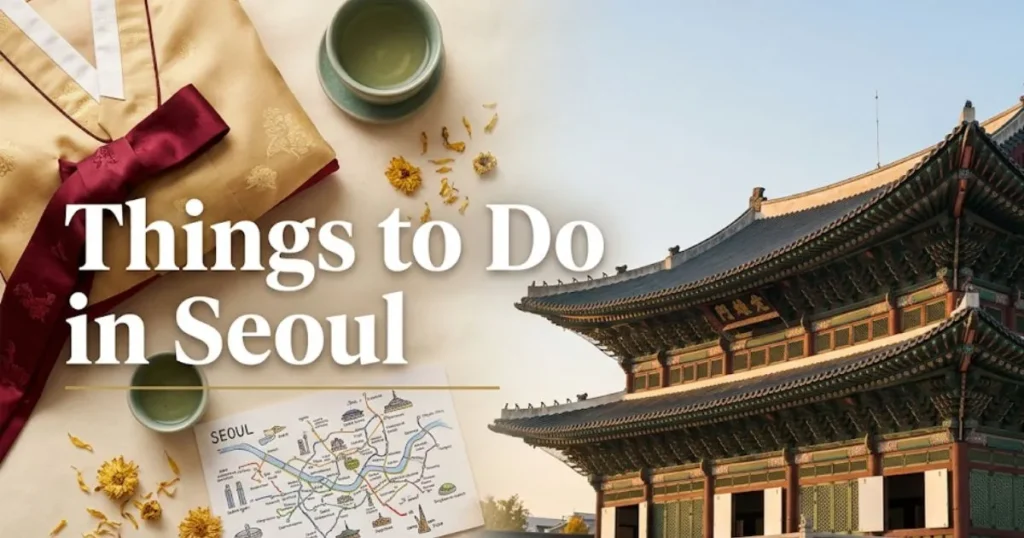
Walk north through Bukchon Hanok Village after the palace. The upper alleys near Gahoe-dong are quieter than the main tourist corridor.
Finish the afternoon in Insadong-gil for traditional tea shops, craft galleries, and the Ssamziegil courtyard market.
Day 2: Cultural Neighborhoods
Spend the morning at Gwangjang Market for bindaetteok (mung bean pancakes) and mayak gimbap. Arrive before noon to get counter seating.
Afternoon in Ikseon-dong, a preserved alley district behind Jongno, for specialty coffee and independent boutiques.
Evening in Hongdae for street performance, live music venues, and the neighborhood’s independent fashion market.
Day 3: Modern Seoul and a Day View
Visit the War Memorial of Korea in the morning. Admission is free. It covers Korean history in significant depth and takes two to three hours at a reasonable pace.
Take the afternoon to N Seoul Tower on Namsan Mountain. The cable car runs regularly; verify operating hours before visiting.
To [build a first-time Seoul itinerary efficiently]:
- Book Changdeokgung Secret Garden tickets at least one week in advance. Timed-entry fills quickly.
- Arrive at Gyeongbokgung Palace within 30 minutes of opening to beat school group crowds.
- Load a T-money card at any convenience store or subway station upon arrival.
- Reserve Korean BBQ for evenings, not lunch. Lunch service at grill restaurants is often limited.
- Plan palace visits for weekdays. Weekend crowds at Gyeongbokgung are substantially heavier.
Families should prioritize Lotte World (indoor theme park, Jamsil, Line 2 or 8) on rainy days. Seniors will find the flat Cheonggyecheon Stream walk more accessible than cobblestone hanok village routes.
Fun Things to Do in Seoul for Young Adults
Seoul’s strongest appeal for young adult travelers lives in Hongdae, Itaewon, and the rapidly developing Seongsu-dong district.
Hongdae is the city’s longtime youth culture hub, anchored by Hongik University. The neighborhood runs from Hongdae Playground (street performances most weekend evenings) through a dense network of independent clothing boutiques, live music clubs, and late-night pojangmacha (street tent bars).
Seongsu-dong is where young Seoulites increasingly spend their time. It is Seoul’s equivalent of Brooklyn’s creative district. Specialty coffee roasters, concept stores, and Korean designer boutiques line the main commercial streets near Seongsu Station (Line 2).
The Hybe Insight museum in Yongsan (Line 1 or 4, Sinyongsan Station) is a required visit for any traveler with genuine interest in K-pop’s cultural architecture. It covers BTS and the broader Korean music industry in serious depth. Admission runs approximately $20 to $28 USD equivalent; verify current pricing before visiting.
Lotte World Tower in Jamsil houses a 123-floor observation deck called the Seoul Sky. Sunset timing visits book out; plan a morning visit for reliability.
Key activities for young adult Seoul visitors:
- Seongsu-dong specialty coffee and pop-up concept stores
- Hongdae live music at Club FF or bands performing on the weekend street circuit
- Noryangjin Fish Market late-night visit (open 24 hours; choose your seafood and have it prepared upstairs)
- Hanbok rental near Gyeongbokgung for palace photography
- Korean convenience store dinner culture: GS25 or CU stores near Hongdae offer an entire local food experience at under $5 USD
Budget note: Young adult travelers on tight budgets can spend a genuinely excellent evening in Seoul for under $20 USD by combining street food, a pojangmacha beer stop, and a jjimjilbang (Korean spa) late-night visit.
Best Neighborhoods in Seoul to Explore
Seoul’s character changes dramatically by district. Choosing the right neighborhood base or day-exploration priority makes a significant difference to the quality of the visit.
| Neighborhood | Character | Best For | Nearest Metro | Crowd Level |
|---|---|---|---|---|
| Bukchon | Traditional hanok alleyways | Couples, photographers | Anguk, Line 3 | High on weekends |
| Insadong | Craft culture, teahouses | Culture travelers, families | Anguk, Line 3 | Moderate |
| Ikseon-dong | Preserved alley cafes, boutiques | Young adults, couples | Jongno 3-ga, Line 1/3/5 | Moderate |
| Hongdae | Youth culture, nightlife, music | Young adults, solo travelers | Hongik Univ., Line 2 | High on weekends |
| Seongsu-dong | Creative district, coffee | Trend-conscious, young adults | Seongsu, Line 2 | Growing rapidly |
| Mangwon-dong | Local residential, weekend market | Experienced visitors, foodies | Mangwon, Line 6 | Low to moderate |
| Yeonnam-dong | Independent restaurants, cafes | Solo diners, couples | Hongik Univ., Line 2 | Moderate |
| Itaewon | International dining, bars | Young adults, nightlife | Itaewon, Line 6 | High weekend nights |
| Gangnam | Upscale shopping, dining | Premium travelers | Gangnam, Line 2 | Moderate |
Mangwon-dong is the specific neighborhood most experienced Seoul visitors consider the city’s best-kept local secret. Its Saturday market (Mangwon Market) draws Seoul residents rather than tour groups.
Yeonnam-dong, adjacent to Hongdae but calmer, has developed one of Seoul’s strongest independent restaurant concentrations. The stretch along Yeonnam-ro is the local alternative to Insadong’s more tourist-oriented dining.
Seniors and accessibility travelers should note that Bukchon’s signature alleyways involve steep inclines and uneven cobblestone. Insadong-gil and Cheonggyecheon’s stream path are substantially more accessible.
Seoul Street Food and Markets Guide
Seoul’s street food and market scene is one of the most genuinely compelling in the world, and the city’s best markets serve locals as consistently as they serve visitors.
Gwangjang Market (Line 1, 5, Jongno 5-ga Station) is the benchmark. Opened in 1905, it is one of Korea’s oldest traditional markets. The indoor food hall on the second floor serves bindaetteok, mayak gimbap, and sundae (blood sausage) at counter stalls run by the same families for decades.
Mangwon Market (Line 6, Mangwon Station) is the local alternative. Saturday mornings are when Seoul residents shop here for produce, seafood, and street food without a tourist infrastructure layer.
Noryangjin Fish Market (Line 1, Noryangjin Station) runs 24 hours. Choose live seafood at the lower market stalls, then take it to second-floor restaurants for preparation. Best visited between 11pm and 2am for the full market atmosphere without the daytime crowds.
Tongin Market (near Gyeongbokgung; walk or short taxi from Line 3 Gyeongbokgung Station) operates a traditional lunchbox format. Visitors purchase antique coins at the market entrance and exchange them for individual dishes from vendor stalls to assemble a custom meal.
Key Seoul street food to eat specifically:
- Bindaetteok at Gwangjang Market: mung bean pancakes cooked fresh at each stall
- Tteokbokki from street carts near Sindang Station, the neighborhood considered the city’s tteokbokki origin point
- Hotteok (sweet pancake) from street vendors near Insadong in winter months
- Ganjang gejang (raw crab marinated in soy sauce) at specialty restaurants in Mapo-gu
- Grilled corn and tornado potato from Hongdae street vendors after 8pm
Budget travelers should know that a full, genuinely satisfying market meal at Gwangjang costs approximately $6 to $12 USD equivalent per person. This is not budget-by-compromise; it is among Seoul’s most authentic eating experiences regardless of price.
Key Takeaway: Load a T-money card at the airport, download Kakao Metro, and plan your first market visit to Gwangjang for breakfast. These three steps remove 90% of first-day Seoul friction.
Seoul Palaces and Historic Sites
Gyeongbokgung Palace is Seoul’s most visited historic site and legitimately earns its reputation as one of Northeast Asia’s finest surviving royal complexes.
Built in 1395 as the primary palace of the Joseon Dynasty, Gyeongbokgung covers 40 hectares in central Seoul. The Changing of the Royal Guard ceremony occurs at the main gate (Gwanghwamun) twice daily; verify current times with the Korea Tourism Organization before visiting.
Admission to Gyeongbokgung runs approximately $3 USD equivalent. Hanbok rental at vendors near the palace entrance provides free entry — a genuine local budget tip, not a gimmick.
Changdeokgung Palace holds UNESCO World Heritage designation and includes the Secret Garden (Huwon), a 78-acre landscape garden used by Joseon royalty. Secret Garden entry requires a separate timed-entry ticket. Book at least one week in advance; 2026 visitors should book two weeks ahead during spring and autumn peak seasons.
Deoksugung Palace on Jeong-dong sits in central Seoul near City Hall and differs from the others in having both traditional Korean and Western-style buildings from the late 19th century. Its surrounding walking path (Deoksugung Stonewall Walkway) is one of the city’s most atmospheric strolls in autumn foliage season.
The War Memorial of Korea in Yongsan-gu (Line 4 or 6, Samgakji Station) is technically a museum rather than a historic palace, but it provides the most complete context for understanding Korea’s 20th-century history. Admission is free. Allow two to three hours.
Insider Tip:
- Visit Gyeongbokgung on a Tuesday through Thursday for the lowest crowd density. Weekends draw school groups and domestic tour buses from early morning.
- The palace complex includes the National Folk Museum of Korea inside its grounds. Free admission. Worth 45 minutes before or after the main palace tour.
- Couples will find Deoksugung’s stonewall walkway the most genuinely romantic historic site in central Seoul.
Unique Things to Do in Seoul Beyond the Tourist Trail
Seoul’s most memorable experiences are often in the districts where tourist infrastructure ends and the city’s actual residential and creative life begins.
Seoullo 7017 is a decommissioned highway overpass converted into a 983-meter elevated park above Seoul Station. It is Seoul’s equivalent of New York’s High Line, opened in 2017. The garden path connects Seoul Station to the Namdaemun Market area and offers unexpected city perspectives from above street level.
Ihwa Mural Village on the slope of Naksan Mountain near Hyehwa (Line 4) is a hillside neighborhood covered in murals painted by Korean artists. The famous cat mural has become photogenic, but the narrow alley network above and below it contains dozens of lesser-known works and a handful of small studios open to visitors.
Jjimjilbang (Korean public spa) culture is one of Seoul’s most genuinely local experiences. Dragon Hill Spa (Line 1, Yongsan Station) is the city’s most accessible jjimjilbang for first-time visitors. It operates 24 hours and includes hot spring baths, sauna rooms at varying temperatures, sleeping rooms, and a restaurant floor. Entry runs approximately $12 to $18 USD equivalent for standard access; verify current pricing before visiting.
The Leeum Museum of Art in Hannam-dong houses one of Asia’s strongest private art collections, covering Korean national treasures and contemporary international work. Admission runs approximately $10 to $16 USD equivalent. Far fewer visitors than the national museums, and the architecture alone, designed by Mario Botta, Jean Nouvel, and Rem Koolhaas, justifies the visit.
Key unique Seoul experiences outside the standard tourist circuit:
- Noryangjin Fish Market at midnight
- Dragon Hill Spa overnight stay
- Mangwon Saturday market with no tourist infrastructure
- Leeum Museum of Art in Hannam-dong
- Ihwa Mural Village on Naksan
- Seongsu-dong pop-up concept stores and specialty roasters
Solo travelers will find jjimjilbang the city’s best social equalizer. Conversations in common areas with both locals and fellow international travelers happen naturally.
Outdoor Activities in Seoul
Seoul offers more legitimate outdoor activity than most visitors expect from a 10-million-person urban center.
Bukhansan National Park sits directly on Seoul’s northern boundary and is one of the most visited national parks in the world by visitor-per-area metric. The main hiking corridors lead to Baegundae Peak (836 meters), the park’s highest point. The summit trail from Ui Station (Line 4 extension, Bukhan Mountain line) takes approximately two to three hours up. The trail is well-marked and manageable for reasonably fit hikers; bring water, as vendors are limited above the lower trailheads.
Han River Park stretches 41.5 kilometers through central Seoul across 12 named park zones. The Yeouido section is the most developed: bike rentals, convenience store clusters, and open lawn areas draw Seoulites for picnics and evening gatherings. The Ttukseom section in Gwangjin-gu is calmer and offers better cycling paths for families.
Cheonggyecheon Stream is an urban restoration project that runs 5.8 kilometers through central Seoul. The stream-level walking path is flat, wide, and accessible. It connects Gwanghwamun area to the eastern neighborhoods near Sindang. Best walked in the early evening when lighting along the path is at its most atmospheric.
Naksan Mountain Trail connects Ihwa Mural Village to the remnants of Seoul’s ancient city wall. The trail is shorter and less strenuous than Bukhansan; it takes approximately 45 to 90 minutes at a relaxed pace with city wall views across the Dongdaemun area.
Seniors and accessibility travelers: Cheonggyecheon’s stream path is fully paved and flat. Bukhansan’s upper trails involve significant rocky scrambling and are not appropriate for travelers with mobility limitations. Han River Park bike paths have accessible sections; verify specific zone conditions before visiting.
Seoul Nightlife and Entertainment
Seoul’s nightlife has a geographic logic: the type of evening you want determines which district to be in.
Hongdae runs the city’s most accessible nightlife circuit. Live music venues, including Club FF and the street-performing circuit around Hongdae Playground, draw crowds from 9pm onwards. The atmosphere is younger and more energetic than Itaewon, and entry to many music venues runs approximately $8 to $15 USD equivalent.
Itaewon historically served as Seoul’s international nightlife district. Its main strip includes global restaurant options and late-night bars with English-speaking staff. The district operates from international bar culture rather than local Korean nightlife culture. Weekend crowd density on the main street has increased significantly in recent years; plan accordingly.
Gangnam’s Apgujeong and Cheongdam-dong areas operate Seoul’s upscale lounge and cocktail bar circuit. Less tourist-oriented than Hongdae; more expensive. The clientele skews Korean professional rather than international tourist.
Pojangmacha culture: tent bars set up along streets in various neighborhoods after dark are one of Seoul’s most distinctly local evening experiences. They serve soju, makgeolli (rice wine), and simple anju (drinking food). The Mapo-gu riverside pojangmacha cluster near Mangwon Station is the most local version of this experience.
Nanta, a Korean non-verbal percussion performance modeled loosely on the global “Stomp” format, runs at a dedicated venue near Myeongdong. Appropriate for families and non-Korean-speaking visitors. Tickets run approximately $35 to $55 USD equivalent; verify current pricing.
Couples will find Gangnam’s cocktail bar scene and Han River night views from Banpo Bridge (which runs a fountain light show on scheduled evenings) more romantic than Hongdae’s high-energy crowd.
Key Takeaway: Visit Gwangjang Market before 10am, book Changdeokgung Secret Garden tickets two weeks out in spring, and plan your evenings by district type rather than defaulting to wherever your hotel concierge suggests.
K-Pop and Korean Culture Experiences in Seoul
Seoul offers K-pop cultural experiences ranging from museum-quality to live-event, and the difference between them matters significantly to how much you enjoy the experience.
Hybe Insight in Yongsan (Line 1 or 4, Sinyongsan Station) is the serious K-pop museum experience. It covers the creative and cultural architecture of Korean pop music with permanent and rotating exhibitions. The building’s design and production quality match major international music museums. Admission runs approximately $20 to $28 USD equivalent; book tickets in advance online.
SM Town COEX Artium in Gangnam (Line 2, Samseong Station) is the entertainment complex run by SM Entertainment, one of Korea’s major talent agencies. It includes SM merchandise, a hologram theater, and an experience center. More commercial than Hybe Insight, but useful for fans of SM-managed artists specifically.
Hanbok rental near Gyeongbokgung provides one of the city’s most accessible cultural participation experiences. Rental runs approximately $10 to $20 USD equivalent for three to four hours. Palace entry is free while wearing hanbok. Multiple rental shops cluster on the streets immediately south of the palace entrance.
K-pop fansign events and idol meetups occur throughout the year but require advance knowledge of specific artist schedules. The online platform Weverse and individual agency websites are the primary scheduling sources. These events are not reliably predictable from a travel planning standpoint.
Idol cafes run by fan communities in Hongdae and Sinchon operate semi-regularly and are listed on Korean fan community platforms. They are not listed on major tourism sites. For dedicated K-pop travelers, the subreddit r/kpop and Weverse community boards are more useful than any tourism guide.
Young adult and solo travelers will find Hybe Insight the most satisfying K-pop experience regardless of specific artist preference. It works as a cultural institution, not just a fan product.
Free and Budget-Friendly Things to Do in Seoul
Seoul is one of Asia’s most genuinely affordable major cities for US travelers on a budget, and its best experiences do not cluster at the expensive end.
| Free Activity | Location | Metro Access | Time Needed |
|---|---|---|---|
| War Memorial of Korea | Yongsan | Samgakji, Line 4/6 | 2-3 hours |
| National Museum of Korea | Yongsan | Ichon, Line 4/Gyeongui-Jungang | 2-3 hours |
| Gyeonghuigung Palace | Jongno | City Hall, Line 1/2 | 1 hour |
| Cheonggyecheon Stream Walk | Jongno/Jung-gu | Gwanghwamun, Line 5 | 1-2 hours |
| Han River Park | Multiple zones | Multiple Line 2 stops | Variable |
| Bukchon Hanok Village | Jongno | Anguk, Line 3 | 1-2 hours |
| Ihwa Mural Village | Jongno | Hyehwa, Line 4 | 1 hour |
| Seoullo 7017 Skygarden | Jung-gu | Seoul Station, Line 1/4 | 45 minutes |
| Mangwon Market | Mapo | Mangwon, Line 6 | 1-2 hours |
| Gyeongbokgung in hanbok | Jongno | Gyeongbokgung, Line 3 | Free entry with hanbok rental |
Budget meal costs in Seoul run approximately $4 to $10 USD equivalent at traditional markets, convenience stores with prepared food, or neighborhood kimbap restaurants.
The National Museum of Korea permanent collection admission is free. It houses one of the most comprehensive collections of Korean artifacts in existence, covering 5,000 years of Korean cultural history.
Budget travelers should note that the city’s convenience store culture (GS25, CU, 7-Eleven Korea) provides a genuine budget food option. Korean convenience stores sell fresh triangle kimbap, hot prepared food, and snacks at prices substantially below any restaurant. This is how Seoulites eat on the go, not just a tourist shortcut.
Seoul for Families, Couples, and Solo Travelers
Seoul’s experience changes significantly by traveler profile, and most travel content ignores this entirely.
| Activity | Best For | Cost Range (USD equiv.) | Kid-Friendly | Accessibility |
|---|---|---|---|---|
| Gyeongbokgung Palace | All profiles | ~$3 per adult | Yes, wide paths | Partial (paved main areas) |
| Lotte World | Families | $40-60 per adult | Yes | Yes |
| Han River Park picnic | Families, couples | Free to $15 | Yes | Yes |
| Changdeokgung Secret Garden | Couples | ~$5 per adult | 12+ recommended | Partial (uneven paths) |
| Dragon Hill Spa | Solo travelers, couples | $12-18 | 12+ in some areas | Yes |
| Gwangjang Market | All profiles | $6-12 per person | Yes, food-focused | Partial |
| Bukhansan hiking | Solo travelers, couples | Free | 10+ recommended | No |
| Hybe Insight | Young adults, teens | $20-28 per person | 12+ recommended | Yes |
| Noryangjin Fish Market | Solo, adventurous couples | $20-40+ depending on seafood | Not recommended late night | Partial |
| Banpo Bridge night view | Couples | Free | Yes | Yes |
Families with young children: Lotte World in Jamsil is genuinely child-friendly across age groups. The indoor section operates regardless of weather. Allow a full day. The COEX Aquarium (adjacent to COEX Mall, Samseong Station) runs approximately $20 to $28 USD equivalent for adults; verify current pricing. It works well for children under 10.
Couples: Ikseon-dong’s preserved alleys and specialty coffee shops provide the most intimate daytime atmosphere in Seoul. The Deoksugung Stonewall Walkway is the city’s best walking route for couples seeking a calm, historically atmospheric experience.
Solo travelers: Seoul’s solo dining culture is one of the most accommodating in Asia. Counter seating, communal tables at pojangmacha, and single-serving restaurant formats are standard. The city’s 24-hour convenience stores and market culture mean solo travelers are never stranded for food at any hour.
Best Time to Visit Seoul and Seasonal Guide
The best time to visit Seoul is April to early June or September through November, when temperatures are comfortable and the city’s outdoor experiences are at their strongest.
| Season | Months | Temp Range | Crowd Level | Key Events | Overall |
|---|---|---|---|---|---|
| Spring | Apr-early Jun | 10-22°C (50-72°F) | High | Cherry blossoms, spring festivals | Best overall |
| Summer | Jul-Aug | 25-35°C (77-95°F) with humidity | Very high | Boryeong Mud Festival (day trip) | Challenging for outdoor activities |
| Autumn | Sep-Nov | 10-20°C (50-68°F) | High | Bukhansan foliage, lantern festivals | Best for hiking and outdoor activities |
| Winter | Dec-Feb | -5-5°C (23-41°F) | Low to moderate | Seoul Lantern Festival (Nov-Dec) | Cold but lower prices and indoor culture |
Spring: The Yeouido Cherry Blossom Festival typically runs in early April, when the cherry trees along Yeouido Hangang Park bloom. Exact dates vary annually based on temperature patterns; verify with Visit Seoul before booking. Weekend crowds during peak bloom are extremely dense.
Summer: Seoul’s jangma (monsoon season) runs from late June through late July with frequent heavy rain. The weeks immediately after jangma end bring extreme heat and humidity through August. Outdoor activities become genuinely uncomfortable. Palaces and markets remain open but the experience is significantly diminished.
Autumn: September through November is the period most experienced repeat visitors prioritize. Temperatures are cool enough for full-day walking. Bukhansan’s foliage peaks in late October to early November. The Seoul Lantern Festival on the Cheonggyecheon Stream typically runs in November; verify 2026 dates directly with Seoul Metropolitan Government.
Winter: December through February brings subzero wind chill but also Seoul’s lowest hotel rates and smaller crowds at major attractions. Indoor experiences — jjimjilbang, museum visits, restaurant culture — are at their most comfortable in winter. The N Seoul Tower ice sculpture installations (typically running in January and February) are worth checking; verify 2026 programming with the attraction directly.
Key Takeaway: Autumn is Seoul’s most reliable season for first-time visitors. Spring delivers cherry blossoms but extreme weekend crowds at Yeouido. Summer monsoon genuinely limits the experience. Book autumn travel three to four months ahead for best accommodation rates.
Getting Around Seoul: Subway, T-Money, and Transit
Seoul’s Seoul Metro is the practical foundation of any successful visit, covering virtually every major attraction across 16 lines with English signage at every station.
The T-money card is the essential tool. Purchase one at any convenience store or staffed subway ticket counter. Load it with Korean won equivalent and use it on the metro, buses, and even some taxis. Transfers between subway lines with a T-money card cost significantly less than single-journey paper tickets.
To get from Incheon International Airport (ICN) to central Seoul:
- Follow signs to the AREX (Airport Railroad Express) at the arrivals level.
- Take the All-Stop service (approximately 50-60 minutes) or the Direct Express (approximately 43 minutes, Incheon to Seoul Station).
- From Seoul Station, connect to any metro line for your accommodation area.
- Budget approximately $5 to $10 USD equivalent for the AREX journey; verify current fares before travel.
- Taxis from ICN to central Seoul run approximately $60 to $80 USD equivalent and take 60 to 90 minutes depending on traffic.
Seoul’s taxis are metered, safe, and generally honest. The Kakao T ride-hailing app provides English-language taxi booking in Seoul and is more reliable than flagging street taxis for non-Korean-speaking visitors.
Key practical transit facts:
- Subway runs approximately 5:30am to midnight daily; verify last train times for specific lines
- Most station names are displayed in Korean, English, and Chinese
- Subway station exits are numbered; know your exit number before descending
- Bus routes are harder to navigate without Korean language; stick to metro for tourism
- Bikes are available through the Seoul Bike (Ttareungi) public bike share system near Han River Park and major neighborhoods
Seniors and accessibility travelers: Newer subway stations (typically Line 5 through 9 and extensions) have elevator access. Older central stations on Lines 1 through 3 have variable elevator availability. The Seoul Metro app and accessibility maps on the official Seoul Metropolitan Government site identify elevator-equipped exits by station.
Day Trips from Seoul
Seoul’s position in northwestern South Korea makes it an efficient base for several genuinely worthwhile day trips accessible by public transit or organized tour.
Suwon Hwaseong Fortress (Gyeonggi-do Province; 45 minutes from Seoul Station by KTX or 60 minutes by subway Line 1 to Suwon Station) is a UNESCO World Heritage fortress wall encircling the historic city of Suwon. The fortress walk takes two to three hours at a relaxed pace. Admission runs approximately $2 to $4 USD equivalent.
Nami Island (Gyeonggi-do; approximately 70 minutes by ITX train from Cheongnyangni Station to Gapyeong, then ferry) is most famous for its tree-lined paths photographed during the Korean drama “Winter Sonata.” Best in autumn for foliage or spring for tree bloom. Entry includes the ferry; verify current pricing.
Panmunjom and the DMZ (Demilitarized Zone) requires booking an authorized tour operator. Tours depart from central Seoul hotels or designated meeting points. Half-day tours run approximately $45 to $75 USD equivalent; verify current pricing and availability. Tour operators require passport presentation. The experience is genuinely sobering rather than entertainment-oriented. Not appropriate for young children.
Boryeong Mud Festival site is a longer day trip (approximately 2 hours by bus or train to Daecheon Beach). The annual summer festival typically runs in July. Outside festival season, Boryeong is less compelling as a day trip destination.
Couples will find Nami Island the most visually atmospheric day trip from Seoul, particularly in autumn. Solo travelers interested in modern history will find the DMZ tour the most intellectually significant day trip option.
Families with children should prioritize Suwon Hwaseong over the DMZ. The fortress walls and traditional activities at the fortress complex are more age-appropriate and physically comfortable for young children.
Safety and Practical Tips for Visiting Seoul
Seoul is one of the safest major cities in the world for international visitors, but specific practical realities affect the quality of every visit.
Key safety and practical facts every visitor should know:
- Pickpocket risk in Myeongdong and Namdaemun Market is low by international standards but present; keep bags zipped in crowded vendor areas
- Itaewon weekend crowd density warrants awareness: the main street between Itaewon Station exits 1 and 4 becomes extremely dense on Friday and Saturday nights after 10pm; plan entry and exit routes
- K-ETA (Korean Electronic Travel Authorization) is required for US citizens as of recent years; verify current status with the US Department of State and the Korea Customs Service before booking any flights in 2026
- No tipping in South Korea: tipping at restaurants, cafes, taxis, and hotels is not practiced and can cause confusion; this is not a budget tip, it is cultural practice
- English menus are common in tourist areas but absent in residential neighborhoods; pointing at other diners’ food or using a photo-translation app (Papago is preferred over Google Translate for Korean) is standard practice
- Currency: Korean won is the only practical currency for day-to-day use; major credit cards are accepted widely, but street markets and small stalls are cash-only; exchange currency at airport exchange booths or withdraw from GS25 or CU ATMs
- Street food allergy risk: most traditional Korean dishes contain sesame, wheat, or shellfish; English allergy menus are rare at street stalls; travelers with severe food allergies should prepare allergy cards in Korean
- Medical infrastructure: Seoul’s medical infrastructure is excellent; major hospitals in Gangnam-gu and Yongsan-gu have international patient centers with English-speaking staff
The US Embassy in Seoul is located at 188 Sejong-daero, Jongno-gu. Register with the Smart Traveler Enrollment Program (STEP) through the US State Department before departure.
Key Takeaway: Check K-ETA requirements directly with the US Department of State before booking flights. Requirements changed in recent years and may change again before 2026 travel windows open.
Frequently Asked Questions About Things to Do in Seoul
What are the best things to do in Seoul for first-time visitors?
The best things to do in Seoul for first-time visitors include Gyeongbokgung Palace, Gwangjang Market for street food, Bukchon Hanok Village, and an evening in Hongdae.
Spend at least half a day at Gyeongbokgung, including the adjacent National Folk Museum, which is free inside the palace grounds.
Book Changdeokgung Secret Garden separately and in advance; it is the most architecturally and historically significant experience in Seoul for visitors who want depth beyond the main tourist circuit.
How many days do you need in Seoul to see the highlights?
Three full days covers Seoul’s major highlights at a comfortable pace; five days allows for day trips and deeper neighborhood exploration.
Day one covers the historic palace district and Insadong. Day two covers Gwangjang Market, Ikseon-dong, and Hongdae. Day three adds Han River Park, an evening at N Seoul Tower, and a jjimjilbang visit.
Add a fourth or fifth day for a DMZ tour or a day trip to Suwon Hwaseong Fortress.
Is Seoul expensive for US travelers?
Seoul is moderately affordable for US travelers compared to Tokyo, Hong Kong, or major European cities.
Street food and market meals run approximately $5 to $12 USD equivalent per person. Mid-range restaurant dinners cost approximately $15 to $30 USD per person. Subway rides are approximately $1 to $2 USD equivalent per trip.
Upscale hotels in Gangnam and Myeongdong match international luxury hotel pricing; mid-range hotels in Hongdae and Mapo-gu run substantially lower.
What is the best time of year to visit Seoul?
The best time to visit Seoul is April to early June for cherry blossoms and mild temperatures, or September through November for autumn foliage and comfortable hiking conditions.
Summer (July to August) brings heavy monsoon rain and extreme heat and humidity that significantly limits outdoor activity enjoyment.
Winter (December to February) offers the lowest hotel prices and smallest crowds but requires cold-weather preparation for subzero wind chill.
Is Seoul safe for solo travelers, including solo female travelers?
Seoul is widely regarded as one of the safest major cities in Asia for solo travelers, including solo female travelers.
Street crime is rare. Public transit is well-lit and monitored. Solo dining is culturally normal, with counter seating common at most traditional restaurants.
The main practical precaution is avoiding Itaewon’s main street during peak late-night weekend hours when crowd density is highest.
Do you need to speak Korean to get around Seoul?
You do not need to speak Korean to navigate Seoul’s major tourist areas and transit system.
Seoul Metro stations display Korean, English, and Chinese signage throughout. Most major attractions have English-language staff or audio guides. The Kakao Metro and Kakao T apps provide English navigation for subway and taxi booking.
Outside tourist zones, English menus are uncommon. The Papago translation app with photo translation handles Korean menus effectively for non-Korean-speaking visitors.
Plan Your Seoul Visit with Confidence
Seoul rewards the visitors who move beyond the first ring of tourist attractions. The palaces are worth seeing; the markets are worth eating at; the subway makes every district accessible in under 30 minutes.
Before you leave, verify K-ETA requirements with the US State Department, book Changdeokgung Secret Garden tickets in advance, and load a T-money card within 30 minutes of landing at Incheon.
Travel conditions, admission prices, operating hours, and entry requirements for Seoul change regularly. Confirm key logistics directly with Visit Seoul (visitseoul.net) and the Korea Tourism Organization before your 2026 departure date. The traveler who plans specifically for Seoul, not generically for “Asia,” consistently has the better trip.