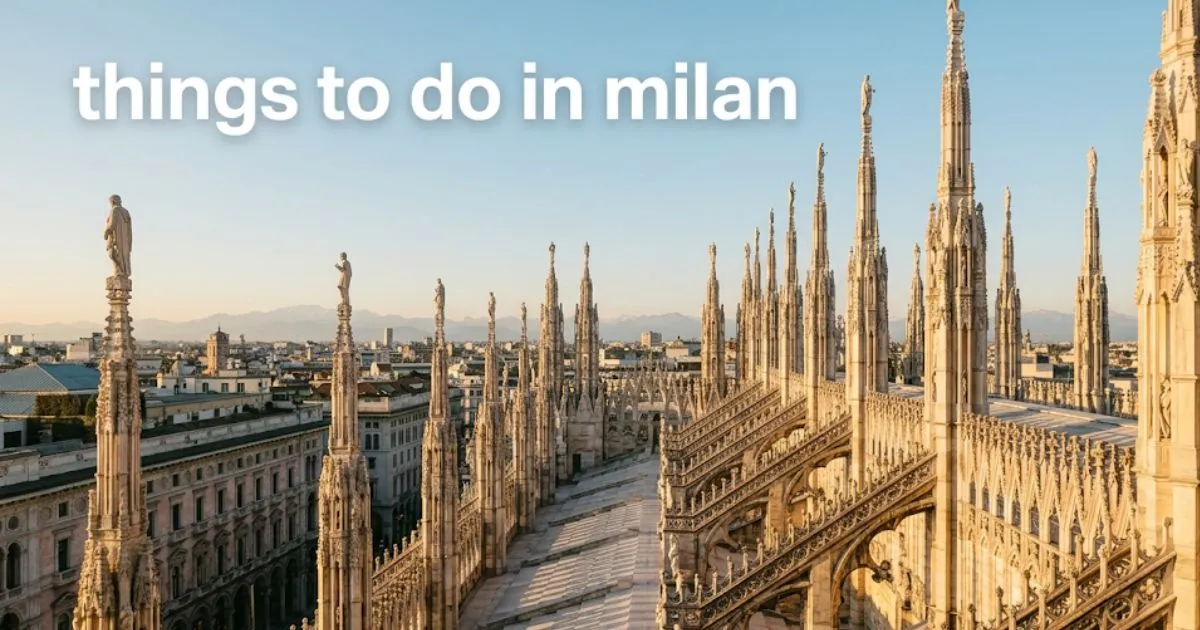
16 Best Things to Do in Milan for 2026

Milan rewards travelers who skip the postcard and book the rooftop instead.
The Duomo is just the starting point. The real city lives in residential courtyards, contemporary art spaces, and the nightly ritual of aperitivo that transforms the Navigli canals into the city’s true social center.
This guide covers what to actually do in Milan in 2026. You will learn which attractions require advance booking, which neighborhoods locals actually frequent, and how to structure a one-day or two-day itinerary that makes sense geographically and financially.
Things to Do in Milan
Milan’s essential experiences range from a Gothic cathedral rooftop walk to a 15th-century fresco that requires booking months ahead.
The city splits roughly into the historic center’s monumental core and a ring of residential neighborhoods where contemporary Milan actually unfolds. The Duomo, Galleria, and La Scala cluster within a 10-minute walk of each other. The Navigli, Isola, and Porta Romana neighborhoods hold the city’s dining culture, design showrooms, and aperitivo bars that first-time visitors rarely reach.
What surprises most travelers is how compact central Milan is. You can cross the historic core on foot in under 30 minutes. The metro system, run by ATM Milano, connects every neighborhood efficiently with single tickets running approximately €2.20 as of recent years. A 24-hour pass offers better value if you plan more than three trips.
Milan suits travelers who enjoy urban density, serious art collections, and dining that spans from €7 panzerotti to multi-course tasting menus. It disappoints visitors expecting a leisurely, postcard-pretty Italian old town. The city’s beauty is more architectural and atmospheric than quaint.
| Experience Type | Best For | Cost Range | Time Needed |
|---|---|---|---|
| Historic Landmarks | First-time visitors, couples | €15-25 per entry | 2-3 hours each |
| Art Museums | Solo travelers, art enthusiasts | €10-18 per museum | 2-4 hours each |
| Neighborhood Wandering | Repeat visitors, photographers | Free | Half day |
| Food Experiences | All traveler profiles | €7-60 per meal | 1-3 hours |
| Day Trips | Those with 3+ days in Milan | €15-40 round trip | Full day |
Insider Tip:
- Most museums close on Mondays in Milan. Plan your Monday for the Duomo rooftops, which remain open, and neighborhood wandering that requires no entry ticket.
- The Milano Cortina 2026 Winter Olympics in February will spike hotel demand dramatically. Book accommodations six months ahead if visiting that month.
Key Takeaway: Book The Last Supper first, plan around Monday closures, and split your time between the historic core and residential neighborhoods like Isola and Porta Romana.
Duomo di Milano and Rooftop Terraces
The Duomo di Milano rooftop terraces deliver the city’s single most essential experience and the view that makes sense of Milan’s layout.
Walking among the cathedral’s 3,400 statues and 135 spires places you inside the most elaborate Gothic architecture in Italy. The white Candoglia marble has weathered Milan’s industrial air for six centuries. From the highest terrace, you can trace the Alps on clear mornings and spot the Bosco Verticale towers in the Porta Nuova district to the north.
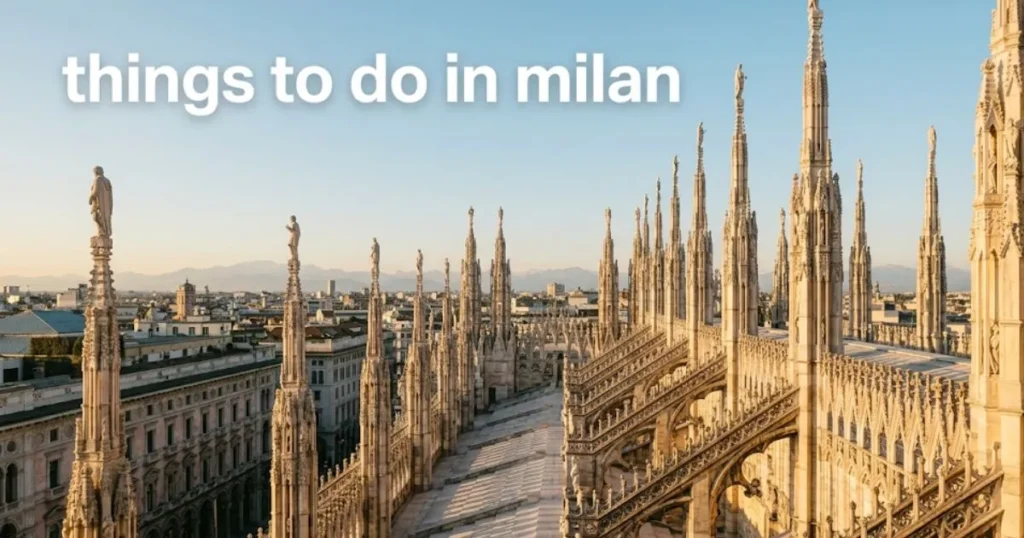
Access involves a choice that changes the experience substantially. The staircase climb of roughly 250 steps costs approximately €10 and lets you move at your own pace among the flying buttresses. The elevator, at around €15, saves knees but skips the gradual reveal of the statuary up close. Combined Duomo interior plus terrace tickets run approximately €20 to €25. The Veneranda Fabbrica del Duomo manages all ticketing and strongly recommends online advance purchase to bypass the separate ticket-office queue in Piazza del Duomo, which can exceed 45 minutes in high season.
Solo travelers will find the rooftop walk contemplative and easy to navigate at their own pace. Couples should book the first morning slot for fewer crowds and better light. Families with young children must know that the rooftop involves narrow passages, uneven stone surfaces, and stair sections with no barrier between visitors and a significant drop.
The terraces close during thunderstorms and high winds. Winter visits on clear January days offer low sun angles that turn the marble golden. July and August rooftop visits before 10:00 AM are survivable; afternoon heat on the white marble becomes genuinely punishing.
According to the Veneranda Fabbrica del Duomo, the rooftop terraces are the most visited paid attraction in Milan, receiving over 700,000 visitors annually in pre-2020 years. Evening rooftop tickets now extend access during summer months, letting you watch sunset from the spires.
Key Takeaway: Take the stairs if your knees allow it. The gradual reveal of the statuary is the point of the experience, not just the view from the top.
The Last Supper and Santa Maria delle Grazie
Leonardo da Vinci’s The Last Supper inside the refectory of Santa Maria delle Grazie is Milan’s most difficult ticket and its most rewarding 15 minutes.
The Cenacolo Vinciano is not a museum. It is a single frescoed room holding one of the most fragile artworks on earth. Visitors enter in groups of 25 to 30 for exactly 15-minute slots. The controlled microclimate inside the refectory stabilizes a painting that began deteriorating within Leonardo’s own lifetime. What you see today is the result of a 21-year restoration completed in 1999 that removed centuries of overpainting and revealed the original color palette.
Booking is the single most important logistical act of any Milan trip. Official tickets release through the Museo del Cenacolo Vinciano website in rolling windows, typically three to four months in advance. They sell out within hours of release. The standard ticket costs approximately €15, with a mandatory booking fee of roughly €2. The official website is the only legitimate direct source. Third-party resellers bundle tickets with guided tours at €60 to €90 per person and are sometimes the only option if you plan fewer than 90 days ahead.
Call the official ticket office directly if the website shows sold out. Cancellations release back into the system. Ask your hotel concierge on arrival day about last-minute availability through their local contacts. A small number of slots are sometimes held for in-person requests.
This experience is not suitable for young children. The enforced silence and 15-minute stationary viewing lose their attention within minutes. Seniors with mobility limitations should request ground-floor access information when booking. The refectory is wheelchair accessible but requires advance arrangement.
Insider Tip:
- The official ticket office phone line is +39 02 92800360. Call on Tuesday mornings Italian time when new cancellations typically process.
- If The Last Supper is sold out entirely, the Pinacoteca di Brera holds Leonardo’s preparatory sketches and offers a deeper, quieter art experience without the reservation frenzy.
Key Takeaway: Check official release windows four months before your trip. Set a calendar reminder for midnight Italian time on release day.
Galleria Vittorio Emanuele II and Piazza del Duomo
Galleria Vittorio Emanuele II is a 19th-century shopping arcade of extraordinary architecture and genuinely punishing tourist crowds.
The glass-and-iron vault soars four stories above a mosaic floor decorated with the coats of arms of Italy’s pre-unification kingdoms. The arcade connects Piazza del Duomo to Piazza della Scala and houses Prada’s original store, a historic Campari bar, and several cafes that charge approximately €8 for an espresso consumed standing at the bar and €15 or more for table service. The architecture is genuinely world-class. The commercial experience is a high-end shopping mall with extraordinary foot traffic.
There is a local tradition involving the bull mosaic on the floor near the center of the arcade. The story says placing your right heel on the bull’s testicles and spinning three times brings good luck. The mosaic is now visibly worn into a deep depression. The tradition is harmless fun. The surrounding crowd of people attempting it simultaneously creates genuine congestion.
Piazza del Duomo itself is the city’s geographic and symbolic center. It is also the epicenter of Milan’s persistent street scams, including the bracelet-tying scam and the petition-signing distraction technique. Walk with purpose. Do not accept anything handed to you. The square is at its best before 9:00 AM or after 10:00 PM when the crowds thin and the Duomo facade is dramatically lit.
Budget travelers should photograph the Galleria’s architecture, admire it thoroughly, and then drink coffee on the side streets of Brera instead. Shoppers seeking the luxury brands housed here will find the same stores with fewer crowds on Via della Spiga one block away.
| What to Do in the Galleria | Worth It? | Local Alternative |
|---|---|---|
| Photograph the architecture | Yes, free | Early morning for empty shots |
| Table-service coffee at historic cafes | No, overpriced | Caffè Cova on Via Monte Napoleone |
| Luxury shopping | Only if specific item sought | Via della Spiga for quieter browsing |
| Bull mosaic spin | Once for the photo | Do it and leave quickly |
| Browse Prada’s original store | Yes for fashion history | Fondazione Prada for the full experience |
Key Takeaway: Enter the Galleria at 8:00 AM for photographs without crowds, then leave before the tour groups arrive at 10:00 AM.
Sforza Castle and Parco Sempione
Castello Sforzesco is Milan’s 15th-century fortress turned civic museum complex, and most visitors entirely miss its best feature.
The castle’s main courtyards are free to enter and walk. The museums inside house Michelangelo’s unfinished Rondanini Pietà, the Sala delle Asse with Leonardo da Vinci’s ceiling fresco of mulberry trees, and a collection of Renaissance musical instruments. The castle museums charge approximately €5 for entry and close on Mondays. The Rondanini Pietà alone justifies the ticket. Michelangelo worked on it during the final weeks of his life, and the sculpture occupies its own dedicated room in the former Spanish Hospital wing.
Parco Sempione stretches behind the castle as Milan’s central green space, covering 95 acres of English-style landscaped grounds. The park connects the castle to the Arco della Pace, a neoclassical triumphal arch started under Napoleon. Locals use this park for morning runs, lunchtime picnics, and weekend family outings. The Triennale di Milano design museum sits at the park’s western edge with a permanent collection of Italian design history and a ground-floor cafe that serves a solid €4 espresso.
Families with children will find this the most practical green space in central Milan. The playground near the Via Gadio entrance is well-maintained. There is shade, benches, and gelato carts in the park. This is the best place in central Milan to let children burn energy between museum visits.
Solo travelers and couples should time a visit to the castle courtyards for late afternoon when the low sun hits the brick walls and the Arco della Pace frames the western sky. The castle is at its worst on summer weekends when tour groups fill the courtyards and the park becomes Milan’s primary outdoor social venue.
According to the Comune di Milano, Castello Sforzesco receives over 1.5 million visitors annually across its museums and free courtyards. The free courtyard access makes it Milan’s most visited cultural site by raw footfall.
Key Takeaway: Pay the €5 museum entry for the Rondanini Pietà. Skip the rest of the museum if you are short on time. The courtyard is free and open late.
Brera District Art and Dining
The Brera district is Milan’s most concentrated dose of the city’s art, dining, and pedestrian charm, all within a 10-minute walk of the Duomo.
Via Brera and the cobblestone streets radiating from it house the Pinacoteca di Brera, one of Italy’s finest art collections inside a former 14th-century convent. The gallery holds Mantegna’s Dead Christ, Piero della Francesca’s Montefeltro Altarpiece, and Raphael’s Marriage of the Virgin. These three paintings alone would anchor a major museum in any other city. Entry costs approximately €15, and the gallery closes on Mondays. The courtyard features a standing statue of Napoleon cast as a Roman emperor, which locals treat as a meeting point.
The streets of Brera function as an evening destination independent of the museum. Via Fiori Chiari and Via Madonnina hold small trattorias, independent jewelry shops, and wine bars that fill from about 6:00 PM onward. Osteria di Brera on Via Fiori Chiari serves a proper Risotto alla Milanese in a room that feels like a neighborhood institution. N’Ombra de Vin on Via San Marco is a wine bar set inside a former church refectory with a cellar selection strong on Lombard and Piedmontese producers.
Couples will find Brera the most romantic neighborhood for an evening walk and dinner. Solo travelers will find the bar seating at N’Ombra de Vin welcoming and the gallery contemplative. Budget travelers should know that Brera dining prices are among the highest in Milan. Aperitivo at a Brera wine bar with a single drink and buffet access runs approximately €15 to €20.
The Pinacoteca is at its quietest on weekday afternoons. Saturday mornings bring organized tour groups. The Brera streets feel nearly empty on Monday mornings when the gallery and many nearby shops are closed.
Insider Tip:
- The Orto Botanico di Brera is a small, free botanical garden hidden behind the Pinacoteca. Enter through Via Brera 28. It is quiet, shaded, and almost never crowded. Milanese university students use it as a study break.
Key Takeaway: Visit the Pinacoteca on a weekday afternoon, then stay for aperitivo. Do not come on Monday. Do not eat on the main tourist drag of Via Brera itself.
Navigli Canals and Aperitivo Culture
The Navigli canals are where Milan remembers it was once a city of water, and the aperitivo ritual along their banks is the city’s defining social experience.
Naviglio Grande and Naviglio Pavese are the two remaining canals from a medieval network that once connected Milan to Lake Como and the Po River. The rest were paved over. Along the cobblestone banks of the Naviglio Grande, bars and restaurants set up outdoor tables from about 5:00 PM onward. The aperitivo tradition, invented in Milan, offers a buffet of small plates with the purchase of a single drink, typically priced at €12 to €18 as of recent years. This is not a tourist gimmick. Milanese professionals do this after work daily.
The quality of the aperitivo buffet varies dramatically. The most famous spots along the Ripa di Porta Ticinese lean heavily on volume and atmosphere, with buffet food that is functional rather than memorable. Rita & Cocktails on Via Angelo Fumagalli serves serious mixed drinks with a smaller, higher-quality food selection. Mag Café, tucked slightly back from the main canal drag, offers a more curated aperitivo that leans toward craft cocktails and thoughtful small plates.
Solo travelers will find the Navigli bars welcoming and easy to navigate alone. The bar counter culture here is built around solo drinkers. Couples should arrive by 6:30 PM for the best canal-side tables. Families with young children should know that the Navigli gets loud and crowded after 8:00 PM and the stone embankments drop directly into the canal water with no protective barrier.
The Navigli is at its best from April through October when outdoor seating is fully open and the sunset reflects off the canal water. January and February see reduced outdoor seating, and the atmosphere is quieter and more residential.
According to the YesMilano tourism board, the aperitivo originated in Milan in the late 19th century at Caffè Cova and has since become a defining ritual of the city’s social fabric. Modern aperitivo culture in the Navigli district represents a €200 million annual hospitality segment.
Key Takeaway: Skip the first three canal-front bars with English-language menus. Walk 100 meters deeper into the neighborhood for better drinks, better food, and lower prices.
Milan Food and Traditional Trattorias
Milanese cuisine is the food of a cold-weather, landlocked, formerly industrial city, built on butter, rice, braised meats, and the singular dish that defines the city’s culinary identity.
Risotto alla Milanese is a saffron-infused risotto finished with bone marrow and butter that turns the rice a deep golden yellow. The best versions in Milan are found at Ratanà in the Isola neighborhood, where chef Cesare Battisti sources Carnaroli rice from a single producer in the Po Valley and finishes the dish with 36-month-aged Parmigiano. Trattoria Masuelli San Marco on Viale Umbria serves a more traditional version in a dining room unchanged since 1921, with white tablecloths, wood-paneled walls, and a clientele that skews heavily toward older Milanese families.
Cotoletta alla Milanese is a veal cutlet pounded thin, breaded, and fried in clarified butter. It is not Wiener Schnitzel. It is thicker and remains on the bone. Osteria dell’Acquabella on Via San Rocco serves the version most Milanese residents will send you toward. Al Matarel on Via Laura Solera Mantegazza is a family-run trattoria where the cotoletta arrives towering over the plate edge and the dining room feels like someone’s extended living room.
Budget travelers should seek out Panzerotti Luini on Via Santa Radegonda, a few steps from the Duomo. This bakery has served fried dough parcels filled with mozzarella and tomato since 1888. A panzerotto costs approximately €3 to €5 depending on the filling. The line moves quickly. Peck, on Via Spadari, is Milan’s temple of gastronomic retail, where the upstairs restaurant is expensive but the ground-floor deli sells extraordinary sandwiches for roughly €8.
Families will find Luini practical for a quick, affordable meal that children genuinely enjoy. Solo travelers can eat well at bar seating throughout the city’s trattorias. Seniors should note that traditional trattorias tend to be louder and more tightly packed than Northern European or American restaurant norms.
| Dish | Where to Eat It | Price Range | What to Know |
|---|---|---|---|
| Risotto alla Milanese | Ratanà, Trattoria Masuelli | €18-24 | Ask if saffron is pistils or powder |
| Cotoletta alla Milanese | Osteria dell’Acquabella, Al Matarel | €20-30 | Bone-in is the authentic version |
| Panzerotti | Luini | €3-5 | Sweet ricotta version also available |
| Ossobuco | Trattoria della Pesa | €22-28 | Traditionally served with risotto |
| Cassoeula | Antica Trattoria della Pesa | €18-22 | Winter-only dish of cabbage and pork |
Key Takeaway: Book Ratanà or Masuelli at least three days in advance. The best trattorias in Milan are small and fill with residents, not tourists.
Milan Shopping Beyond the Fashion Quadrilateral
Milan’s Quadrilatero della Moda, the fashion quadrilateral bounded by Via Monte Napoleone, Via della Spiga, Via Sant’Andrea, and Via Manzoni, is the most famous luxury shopping district in Italy and genuinely irrelevant to most travelers.
The quadrilateral houses every major European luxury brand in storefronts that are themselves exercises in retail architecture. Browsing costs nothing. The window displays change seasonally and reflect the city’s status as a global fashion capital. The experience is worth a walk-through for anyone interested in design or retail culture. The actual purchasing is for a specific demographic of luxury shopper who already knows what they want.
For everyone else, Milan’s more interesting shopping lives elsewhere. Corso Como connects the Porta Garibaldi station area to the city center and houses 10 Corso Como, a concept store that pioneered the retail-meets-gallery-meets-cafe format in 1990. The carefully edited selection of fashion, design objects, books, and art in a converted industrial courtyard makes the experience worthwhile even without buying.
Via Paolo Sarpi in Milan’s Chinatown is a street of Chinese restaurants, tea shops, and small independent boutiques that has become one of the city’s most dynamic retail corridors. Brera’s side streets hold independent jewelry designers, small-batch perfumers, and artisan leather workshops. The Mercato Metropolitano near Porta Genova is a covered market space that hosts rotating pop-up shops, food stalls, and weekend vintage clothing markets.
Budget travelers will find the most value at the Fiera di Sinigaglia, Milan’s Saturday flea market along the Naviglio Grande canal, where vintage clothing, used books, antique furniture, and secondhand design objects change hands every weekend morning. Arrive before 10:00 AM for the best finds.
Solo shoppers will find Corso Como and the Navigli vintage market rewarding. Couples with one shopper and one non-shopper should split up and reunite at a designated cafe. Families will find the Mercato Metropolitano practical for shopping interspersed with food breaks.
Key Takeaway: Walk through the Quadrilatero for the spectacle. Spend your actual shopping time and money on Corso Como, Brera’s side streets, or the Navigli Saturday flea market.
Fondazione Prada and Milan Contemporary Art
Fondazione Prada in a former gin distillery south of the city center is Milan’s most ambitious contemporary art institution and a destination that would anchor the art scene of any major city.
The Rem Koolhaas-designed campus spans seven buildings including a gold-leaf-covered tower that houses the permanent collection. The exhibitions rotate but consistently program major international contemporary artists in a setting that treats industrial architecture as integral to the art experience. The Wes Anderson-designed Bar Luce inside the foundation is a pastel-hued cafe that functions as both a design destination and a genuinely good place for a mid-visit coffee. Entry runs approximately €15, with reduced rates for students and seniors.
The Hangar Bicocca in the northeastern Bicocca district is Milan’s other essential contemporary art space. It is free to enter. The permanent installation by Anselm Kiefer, The Seven Heavenly Palaces, consists of seven 14- to 18-meter concrete towers installed inside a former locomotive factory. The scale is overwhelming. The space also hosts temporary exhibitions by artists at a level that rivals major museums.
Museo del Novecento, located inside the Palazzo dell’Arengario next to the Duomo, holds Milan’s collection of 20th-century Italian art, including the single best room of Futurist painting anywhere in the world. Umberto Boccioni’s Unique Forms of Continuity in Space stands on the top floor with floor-to-ceiling windows framing the Duomo spires across the piazza. Entry costs approximately €10.
Solo travelers and art-focused couples will find these spaces among Milan’s most rewarding experiences. Families with teenagers may find Hangar Bicocca’s industrial scale engaging. Young children will be bored within 20 minutes at Fondazione Prada. The Bar Luce helps.
According to the Italian Ministry of Cultural Heritage, Milan’s contemporary art institutions have seen visitor numbers rise steadily as the city has repositioned itself beyond fashion and finance as a cultural destination competitive with European peers like Berlin and London.
Key Takeaway: Pair Fondazione Prada with lunch at Bar Luce. Pair Museo del Novecento with a Duomo rooftop visit. Both combos group geographically and thematically.
Day Trips From Milan Lake Como and Bergamo
Lake Como is the most famous day trip from Milan, and the logistics of doing it right make the difference between a memorable Alpine lake experience and a frustrating day in transit.
The train from Milano Centrale to Varenna-Esino station takes approximately one hour and costs roughly €7 to €10 each way on regional Trenitalia service. Varenna is a compact lakeside town with a waterfront promenade, steep cobblestone staircases, and the Villa Monastero botanical gardens. From Varenna, a 15-minute ferry connects to Bellagio, the most famous of Como’s mid-lake towns. The ferry costs approximately €5 each way. This routing, train plus ferry, is more scenic and less crowded than the direct bus from Milan to Como town.
The mistake most day-trippers make is trying to see too many towns in one day. A sensible one-day plan: train to Varenna, explore Varenna, ferry to Bellagio, lunch in Bellagio, ferry back to Varenna, train to Milan. That fills a full day. Adding Menaggio or Como town makes the day a transit slog.
Bergamo Città Alta is the alternative day trip that many Milanese residents prefer over Como. The upper city is a walled medieval hill town reached by a funicular from the modern lower city. The train from Milano Centrale to Bergamo takes approximately 50 minutes. The funicular costs roughly €1.50. Bergamo’s Città Alta has a main square, the Piazza Vecchia, that the architect Le Corbusier called one of the most beautiful in Europe. The food is Lombard and different from Milanese: casoncelli pasta, polenta dishes, and the stracciatella gelato that originated here.
Solo travelers will find both day trips easy to navigate independently. Couples should consider Lake Como for the romantic postcard experience. Families will find Bergamo’s funicular exciting for children and the Città Alta completely pedestrianized and safe for wandering.
Day trips work best April through October when ferry schedules are full and outdoor dining is open. November through February, ferry service reduces, some lakeside restaurants close, and mountain weather can cancel Varenna views entirely.
| Day Trip | Travel Time | Cost Round Trip | Best For | Avoid When |
|---|---|---|---|---|
| Varenna & Bellagio (Lake Como) | 1 hour train + ferry | €25-35 | Couples, photographers | Rainy days |
| Bergamo Città Alta | 50 min train + funicular | €15-25 | Families, food travelers | Monday museum closures |
| Certosa di Pavia | 30 min train | €10-15 | Architecture enthusiasts | Tuesday (closed) |
| Franciacorta Wine Region | 1 hour train + taxi | €40-60 | Wine-focused travelers | Sunday (closed wineries) |
Key Takeaway: Book Trenitalia regional trains on the day of travel. No advance booking needed. Validate your paper ticket in the green machines on the platform before boarding.
Porta Romana and Isola Local Neighborhoods
Porta Romana and Isola are where the actual Milanese live, eat, and conduct their daily lives, yet both neighborhoods sit less than 15 minutes by metro from the Duomo.
Porta Romana stretches south from the historic Roman gate along Corso Lodi. The neighborhood is residential, well-off without being ostentatious, and dense with the kind of trattorias, bakeries, and gelaterie that serve a local clientele. Pasticceria Sissi on Piazza Risorgimento is a neighborhood institution for morning espresso and cornetto. Trattoria della Pesa on Viale Pasubio serves classic Milanese dishes in a room that has operated since 1880. The QC Termemilano spa inside the old tram depot on Via Meda is a thermal bath complex that draws Milanese couples and groups of friends on winter weekends.
Isola sits directly behind the Porta Nuova business district and its glass towers, including Bosco Verticale. Until the 2000s, Isola was a working-class district physically cut off from the city by the raised railway tracks. Today it is Milan’s most interesting dining neighborhood. Ratanà anchors the modern end of the spectrum with its refined Risotto alla Milanese. Osteria dei Vecchi Sapori on Via Thaon di Revel serves a €10 lunch pasta in a room of communal tables. Frida on Via Pollaiuolo is a bar-gallery-community space that hosts live music and serves affordable aperitivo.
Bosco Verticale stands at the edge of Isola as the most famous example of Milan’s contemporary architecture. The two towers planted with over 900 trees and 20,000 plants are not open to the public. Photograph them from the Piazza Gae Aulenti plaza below.
Solo travelers will find Isola’s bar dining and energetic street life ideal for an evening. Couples seeking a quieter, more romantic neighborhood should choose Porta Romana. Families will find the QC Termemilano surprisingly accommodating with family hours on weekend mornings.
According to YesMilano, the Isola neighborhood has been recognized in European urban planning awards for its transformation from an isolated working-class district to a model of mixed-use residential regeneration while retaining its community character.
Key Takeaway: Plan one dinner in Isola and one dinner in Porta Romana. These two meals will teach you more about contemporary Milan than all the guidebook attractions combined.
San Siro Stadium and Modern Milan
Stadio Giuseppe Meazza, known universally as San Siro, is one of European football’s most atmospheric venues and the shared home of AC Milan and Inter Milan.
The stadium tour operates on non-match days and includes access to the dressing rooms, the tunnel, and the pitchside area. The tour costs approximately €20 for adults. The museum inside the stadium holds trophies, historic jerseys, and memorabilia from both clubs. On match days, the experience transforms entirely. San Siro holds 75,000 spectators, and a Derby della Madonnina between Inter and AC Milan is one of the loudest sporting experiences in Europe.
Match tickets require advance purchase through the clubs’ official websites or the Vivaticket platform. Serie A schedule announcements typically happen a few weeks before match weekends. Ticket prices range from roughly €30 for upper-tier end seats to €200 or more for sideline seats near midfield.
Modern Milan stands in sharp contrast to San Siro’s aging concrete. The Porta Nuova district surrounding the Piazza Gae Aulenti pedestrian square is Milan’s vertical business center, built on former railway yards. The area is safe to walk day or night, lined with cafes, and the fountain plaza is popular with families. CityLife, further west, is a residential and commercial district built around the former trade fair grounds, anchored by towers designed by Zaha Hadid, Arata Isozaki, and Daniel Libeskind.
Solo travelers and groups of friends will enjoy a San Siro match or tour. Couples uninterested in football should skip it. Families with sports-obsessed teenagers will find the stadium tour a highlight. Seniors should know that upper-tier seating involves steep stairs with handrails.
Insider Tip:
- The San Siro stadium tour runs only on days without a home match. Check the Serie A fixture list before planning your visit. The Inter and AC Milan club websites both publish stadium tour availability and blackout dates.
Key Takeaway: If your dates align with a match, go. If they do not, the stadium tour is worth it for football fans but skip it otherwise.
Milan Public Transport and Getting Around
The ATM Milano public transport system runs four metro lines, an extensive tram network, and city buses that together make Milan one of Italy’s most navigable cities without a car.
The metro system operates from approximately 6:00 AM to 12:30 AM, with the M1 red line, M2 green line, M3 yellow line, and M5 purple line covering the city center and radiating into residential neighborhoods. The M5 serves the Isola and Bicocca areas and connects to the San Siro stadium on match days. A single ride ticket costs approximately €2.20 and is valid for 90 minutes on the metro and surface transport. A 24-hour pass at roughly €7.60 and a 48-hour pass at about €14.50 offer better value for visitors using transport more than three times daily.
The ATM Milano app allows ticket purchase directly on a smartphone with contactless validation at metro gates. The paper ticket system still functions but requires validation in the green machines on trams and at metro entrances. Unvalidated tickets risk fines of approximately €35.
Milan’s tram network is historic and functional. Lines 1, 2, and 4 serve the city center and are useful for visitors. The orange ATM Class 1500 trams dating from the 1920s still operate on certain lines and are a piece of transit history, with wooden interiors and manual doors.
Taxis in Milan are metered and expensive relative to public transport but cheaper than New York or London. The fixed-rate fare from Malpensa Airport to central Milan is approximately €100 to €110. Ride-hailing app FreeNow operates in Milan and connects to the city’s licensed taxi network.
Solo travelers will find the metro efficient and safe with standard urban awareness. Families should know that not all metro stations have elevator access. Seniors and travelers with mobility needs should check the ATM accessibility map for elevator-equipped stations.
| From | To | Best Option | Time | Approximate Cost |
|---|---|---|---|---|
| Malpensa MXP | Milano Centrale | Malpensa Express train | 50 min | €13 |
| Malpensa MXP | Cadorna Station | Malpensa Express train | 35 min | €13 |
| Linate LIN | City center | M4 metro | 12-20 min | €2.20 |
| Bergamo BGY | Milano Centrale | Orio Shuttle bus | 50-60 min | €5-7 |
| Within central Milan | Anywhere | M1/M2/M3 metro | 5-15 min | €2.20 |
Key Takeaway: Download the ATM Milano app before arrival. Buy a 48-hour pass. The app’s route planner is functional and accurate.
Best Time to Visit Milan 2026
The best time to visit Milan in 2026 is April through early June and late September through October. These windows deliver comfortable daytime temperatures between 60°F and 75°F, manageable tourist volumes, and full seasonal restaurant and bar operations.
April and May bring Milan’s most pleasant weather and the blooming of Parco Sempione and the city’s courtyard gardens. September and October offer similar conditions with the added energy of Milan Fashion Week in September and the post-summer reopening of restaurants and galleries. These shoulder months avoid the July-August heat and humidity, when daytime temperatures regularly push above 90°F and many family-run trattorias close for the Italian ferie holiday period.
February 2026 brings a unique consideration. The Milano Cortina 2026 Winter Olympics run from February 6 through February 22. Milan will host the opening ceremony, the Athletes’ Village, and several ice sports. Hotel inventory will be severely constrained and rates will spike to several multiples of standard pricing. Book accommodations by September 2025 for February 2026 dates. If the Winter Olympics are not your reason for visiting, avoid February 2026 entirely.
Milan Design Week, known as Salone del Mobile, takes place in April 2026 and draws the global design industry to the city. Hotels book out, restaurant reservations become difficult, and the city hums with exhibitions, installations, and events open to the public in the Fuorisalone program. It is an extraordinary time to visit if you are interested in design and a poor time if you seek a quiet, uncrowded city experience.
Budget travelers will find the lowest hotel rates in January and November, excluding fashion week periods. Winter visits mean colder temperatures in the 35°F to 45°F range but open the door to quieter museums and the atmospheric fog that gives Milan its distinctive winter light.
| Season | Months | Crowds | Hotel Cost | Best For |
|---|---|---|---|---|
| Spring Shoulder | April-May | Moderate | Mid-High | Sightseeing, design week |
| Early Summer | June | High | High | Long daylight, outdoor dining |
| Summer Peak | July-August | Lower (locals leave) | Mid | Heat-tolerant, budget focused |
| Fall Shoulder | September-October | Moderate-High | High | Best weather, fashion week |
| Winter | November-January | Low | Low-Mid | Museum-focused, budget travel |
| Winter Olympics | February 2026 | Extreme | Peak | Olympic attendees only |
Key Takeaway: Target late April or late September 2026. You get the best weather, manageable crowds, and full cultural programming without Olympic or design-week pricing.
Milan Itinerary 1 Day and 2 Day Guide
A single day in Milan demands focus on the historic center with advance bookings locked in before you arrive.
For a 1-day itinerary, start at the Duomo at 8:30 AM with a pre-booked rooftop terrace plus interior ticket. You will be on the terraces before the crowds and back down to the interior by 9:45 AM. Walk through Galleria Vittorio Emanuele II to photograph the architecture in morning light, then continue to La Scala and the Brera district. Have lunch at N’Ombra de Vin in Brera. After lunch, walk through Brera’s side streets to the Sforza Castle courtyards and enter the museum to see the Rondanini Pietà. End the day with aperitivo along the Naviglio Grande canal at 6:00 PM. This route is walkable with no transport needed beyond arrival.
The critical advance booking for one day: Duomo rooftop ticket, The Last Supper if you can secure one at the four-month window, and a dinner reservation. Do not attempt The Last Supper on a one-day itinerary unless you secure a morning slot.
For a 2-day itinerary, day one follows the one-day plan above. Day two allows neighborhood exploration and contemporary Milan. Start in Porta Romana for morning coffee at Pasticceria Sissi and a walk through the residential streets. Take the M3 metro to the Porta Nuova district to photograph Bosco Verticale from Piazza Gae Aulenti. Walk into Isola for lunch at Ratanà or a casual osteria. Spend the afternoon at Fondazione Prada or Hangar Bicocca depending on your art preferences. Dinner in Isola or Porta Romana.
This two-day structure gives you the monumental historic Milan on day one and the lived-in, contemporary, residential Milan on day two. The two experiences feel like different cities and together form a more complete picture than any single-day itinerary can deliver.
Day-trippers with three or more days should add a Lake Como or Bergamo day trip on day three and use day four for shopping, the San Siro stadium, or additional art museums.
According to YesMilano tourism board, the most common visitor satisfaction complaint is attempting too many indoor attractions without time for neighborhood wandering and unplanned aperitivo stops, which represent the city’s most distinctive pleasure.
Key Takeaway: Book the Duomo and The Last Supper before arrival. Leave every late afternoon and evening open for aperitivo and neighborhood wandering. That is the actual Milan experience.
Frequently Asked Questions About Milan
How many days do you need in Milan?
Two full days covers the essential historic center and one residential neighborhood.
Three days allows a day trip to Lake Como or Bergamo.
One day is enough for the Duomo, Brera, and an evening aperitivo if you book ahead and move efficiently.
What is the best month to visit Milan in 2026?
April through June and September through October offer the best combination of weather, crowds, and operational hours.
Avoid February 2026 due to the Milano Cortina Winter Olympics unless you are attending.
July and August bring heat and restaurant closures.
How do I get tickets for The Last Supper in Milan?
Official tickets release through the Museo del Cenacolo Vinciano website in rolling windows three to four months ahead.
They sell out within hours.
Third-party guided tour packages at €60 to €90 are the backup option for last-minute planners.
Is the Milan Card worth buying?
The MilanoCard offers value only for travelers using public transport heavily and visiting multiple paid museums.
For a two-day itinerary with two museums and transport, it breaks even.
Check the specific museums you plan to visit against the card’s included list before buying.
What is the best neighborhood to stay in Milan?
Brera offers the most central, charming location with walking access to the Duomo.
Isola and Porta Venezia are more residential and less expensive while remaining on metro lines.
Stay near a metro station, not necessarily in the Duomo area itself.
How do I get from Milan Malpensa Airport to the city center?
The Malpensa Express train runs to Milano Centrale in 50 minutes and Cadorna Station in 35 minutes.
The fare is approximately €13.
Taxis cost approximately €100 to €110 with a fixed-rate airport fee.
The Orio Shuttle bus connects Bergamo Airport to Milano Centrale in about 55 minutes for roughly €5 to €7.
Milan works best when you plan the big things and leave room for the small ones. Book the Duomo and The Last Supper before you leave home. Reserve your dinner tables three days ahead. Then let the rest of each day unfold around aperitivo, neighborhood wandering, and the specific light of northern Italy.
Verify current ticket release windows, operating hours, and seasonal closures directly with venues and YesMilano before departure. The Last Supper system and Olympic-period demand in February 2026 make this year especially important for advance research.
Your next step is the Museo del Cenacolo Vinciano website. Everything else in your Milan itinerary can wait. That reservation cannot.