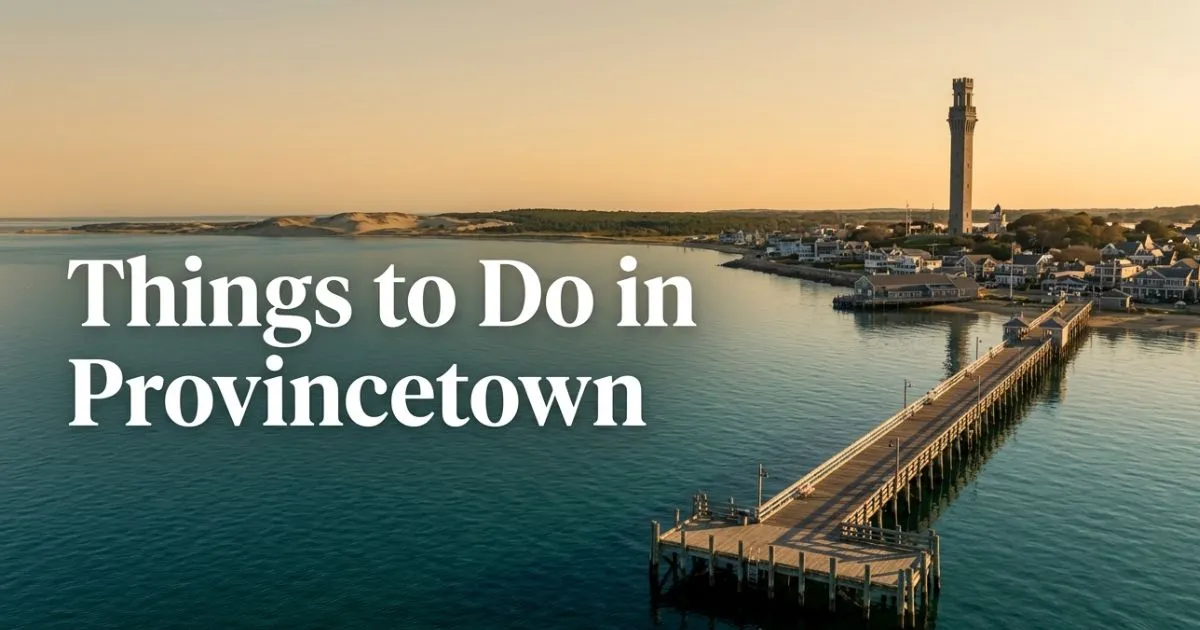
21 Best Things to Do in Provincetown, MA (2026 Guide)

The best things to do in Provincetown reward travelers who go deeper than the obvious tourist strip. This small town at the tip of Cape Cod is one of the most genuinely distinctive destinations in New England.
Provincetown holds roughly 3,000 year-round residents. It draws over a million visitors annually, according to the Cape Cod Chamber of Commerce.
This guide covers beaches, whale watching, galleries, LGBTQ+ events, dining, and exactly how to get there without spending your first hour circling for a parking space.
Things to Do in Provincetown: What Makes This Town Worth the Trip
Provincetown offers a rare combination: world-class coastal National Seashore land, a deeply rooted fine arts community, and genuine LGBTQ+ cultural identity, all within a walkable one-square-mile downtown.
This is not a manufactured resort town. It has been an artists’ colony since the early 1900s, when figures like Eugene O’Neill and Edward Hopper worked here.
The Massachusetts Office of Travel and Tourism identifies Provincetown as one of the state’s most culturally significant destinations. That designation holds up in practice.
The core of any Provincetown visit involves four things: the beaches of Cape Cod National Seashore, the gallery and dining district along Commercial Street, whale watching in Stellwagen Bank National Marine Sanctuary, and the town’s calendar of community events.
Everything is walkable or bikeable. You do not need a car once you arrive.
Couples find it intimate and easy to navigate together. Solo travelers find the social scene genuinely welcoming. Families with older children can manage it well. Families with very young children may find the commercial pace and limited specific programming a mismatch.
Insider Tip:
- Walk the full length of Commercial Street from the West End near the Provincetown Theater to the East End galleries in one direction. Do not skip the side streets like Law Street and Pearl Street, where quieter galleries and gardens sit away from foot traffic.
- Arrive before 10 AM on any summer weekend day. The town transforms dramatically once the ferry crowd lands at MacMillan Pier around 10:30 AM.
- Solo travelers: the bar and café scene along Commercial Street is easy to navigate alone, with a genuinely social atmosphere at venues like The Squealing Pig.
What Is Provincetown Known For?
Provincetown is known for three things above all: its status as the landing site of the Mayflower Pilgrims in 1620, its century-long identity as a fine arts center, and its role as one of the United States’ most significant LGBTQ+ destinations.
These three identities coexist in a town smaller than many city neighborhoods. That density is part of what makes Provincetown distinct.
The fine arts lineage runs through the Fine Arts Work Center, which has supported writers and visual artists since 1968. The Provincetown Art Association and Museum (PAAM) represents over a century of local artistic production.
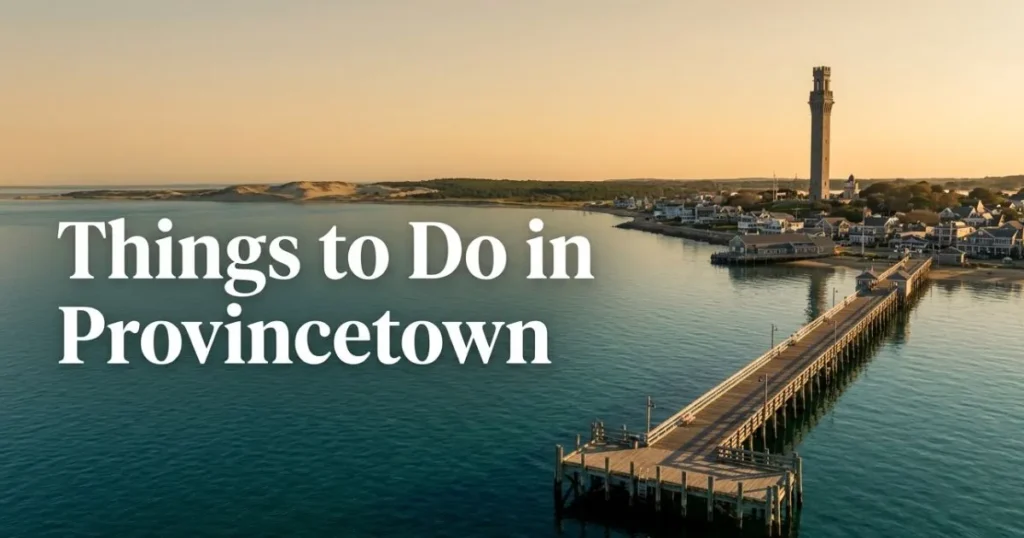
The LGBTQ+ community has been central to Provincetown’s character since at least the 1970s. Today, Carnival Week and Provincetown Pride draw tens of thousands of visitors each summer.
The Pilgrim history is commemorated at the Pilgrim Monument and Provincetown Museum, which holds the tallest all-granite structure in the United States at 252 feet.
Most visitors come for the combination rather than any single element. That layering is what justifies the trip from Boston or New York.
Budget travelers should note that much of what defines Provincetown costs little or nothing. Beach access through the National Seashore, gallery browsing, and walking Commercial Street are free. The entrance fee for the Cape Cod National Seashore beaches runs approximately $25 per vehicle on peak days; verify current rates before visiting.
Insider Tip:
- The Portuguese heritage of Provincetown is often overlooked by first-time visitors. The Provincetown Portuguese Festival, held in late June each year, is one of the most authentic cultural events on Cape Cod.
- The town’s fishing fleet still operates from MacMillan Pier. Watching the boats return in the late afternoon is free and genuinely evocative of the town’s pre-tourism identity.
Commercial Street Provincetown: The Town’s Living Main Street
Commercial Street is the spine of Provincetown, running roughly three miles from the West End to the East End along the harbor side of the peninsula.
This is where galleries, restaurants, shops, and the town’s social life concentrate. It is, by most measures, the most visually interesting main street in New England.
The street divides roughly into three zones. The West End is quieter, with boutique accommodations and residential character. The center block near MacMillan Pier is the most tourist-dense. The East End Gallery District is where the serious art community operates.
Peak summer days see Commercial Street become a pedestrian spectacle. This is genuinely worth experiencing once. Returning to the same street at 7 AM before crowds arrive reveals a completely different town.
Couples will find early evenings on Commercial Street romantic in a way that peak afternoon crowds obscure. Solo travelers find the afternoon crowd easy to join without feeling like an outsider.
The local alternative to peak Commercial Street: Walk Bradford Street, which runs parallel one block inland. Same length, a fraction of the foot traffic, local residents’ cafés and gardens visible, and a more honest version of daily Provincetown life.
| Zone | Character | Best For | Crowd Level |
|---|---|---|---|
| West End | Quiet, residential | Couples, photographers | Low even in peak season |
| Center (near MacMillan Pier) | High tourist density | First-timers, dining, shopping | Very high July–August |
| East End Gallery District | Art-focused, walkable | Culture travelers, art buyers | Moderate |
| Bradford Street (parallel) | Local, quieter | Repeat visitors, locals | Low year-round |
Seniors and accessibility travelers: Commercial Street is paved and relatively flat through the center and East End sections. Some side streets and West End sections have uneven brick or cobblestone surfaces. The center block is wheelchair accessible in most sections; verify specific venue access before visiting.
Key Takeaway: Take the ferry from Boston to bypass parking entirely. Walk Bradford Street parallel to Commercial Street to see the town locals actually live in.
Provincetown Beaches: Race Point, Herring Cove, and What to Know
The best beach in Provincetown depends on what you want: Race Point Beach is ocean-facing, wild, and the best spot for watching whales from shore. Herring Cove Beach faces west, making it the superior choice for sunsets.
Both beaches sit within Cape Cod National Seashore and are among the most ecologically protected coastline stretches in the northeastern United States.
Race Point Beach is roughly a 10-minute drive or 45-minute bike ride from the center of town via Province Lands Road. The ocean-facing exposure means stronger surf and stronger rip currents. Lifeguards are on duty during summer daytime hours; swim only in designated areas.
Herring Cove Beach is closer to town, approximately 15 minutes by bike. The bay-side exposure creates calmer water, making it more suitable for families and less confident swimmers. Sunset views from Herring Cove are genuinely exceptional.
Families with children should default to Herring Cove for calmer water and easier beach logistics. Race Point is better for teenagers and adults comfortable in open ocean conditions.
Vehicle access to both beaches requires a National Seashore vehicle pass or daily fee. Fees and pass options change; verify current pricing at the National Park Service website or the Province Lands Visitor Center before arriving.
Budget travelers: Arrive by bike or on foot and the beach access fee drops significantly versus the vehicle pass rate. Bike rental shops on Bradford Street near the center of town are the practical solution.
Insider Tip:
- Sunrise at Race Point is one of the few things in Provincetown that genuinely justifies the phrase “worth the early alarm.” Arrive by 5:30 AM in summer to have the beach to yourself.
- Whale sightings from the Race Point shoreline are not uncommon, particularly in September and October when humpbacks move closer to shore.
- Seniors and mobility travelers: The parking areas at both beaches have accessible paths to the sand surface, though soft sand makes wheeled mobility aids challenging beyond the hardpack near the water’s edge.
Cape Cod National Seashore Provincetown: Trails, Dunes, and Bike Routes
Cape Cod National Seashore encompasses most of the Province Lands area at Provincetown’s northern tip, protecting over 44,000 acres of beaches, dunes, forests, and ponds.
Within the Provincetown portion, the Province Lands Bike Trail is the single most underused great outdoor experience in the area. This 7-mile loop through coastal dunes and pitch pine forest is available to cyclists of all levels.
The Beech Forest Trail is a 1.2-mile loop through a rare Atlantic beech forest near Bennett Pond. It takes roughly 30 to 45 minutes at a relaxed pace. This trail feels genuinely remote despite being five minutes from town.
Art’s Dune Tours offers guided vehicle tours through the Province Lands dunes, including stops at the historic dune shacks where figures like Eugene O’Neill and Jack Kerouac worked. Tours run seasonally; advance reservation is typically required during summer.
Families with older children (10 and up) will find the bike trail a genuine highlight. Young children in bike trailers can manage the paved trail sections. The dune shack tours are better suited to adults and older teens interested in literary history.
According to the National Park Service, the Province Lands area contains some of the most active coastal dune systems in North America. The dunes shift measurably each year.
Insider Tip:
- The Province Lands Bike Trail’s highest dune viewpoint, near the Beech Forest parking area, offers an unobstructed view of the outer Cape that most visitors driving straight to the beach never see.
- Stay on marked trails in the dunes. Disorientation is a documented problem; the dune landscape is more uniform than it appears from a trail junction.
- Solo travelers find the bike trail comfortable and well-marked for independent riding. Cell service is limited in some dune sections.
Provincetown Whale Watching: What to Expect and Which Tours to Book
Provincetown whale watching is among the most productive in the world because the town sits adjacent to Stellwagen Bank National Marine Sanctuary, a highly fertile marine feeding ground just six miles offshore.
Humpback, fin, and minke whales feed in Stellwagen Bank from late April through late October. Humpbacks are the most commonly sighted species and are reliably present from May through mid-October.
The primary whale watch operators departing from MacMillan Pier include Dolphin Fleet Whale Watch and Portuguese Princess Whale Watch. Both operate multiple daily departures during peak season. The Center for Coastal Studies partners with Dolphin Fleet on research-based tours that include narration from marine biologists.
Tours run approximately three to four hours. Admission runs approximately $55 to $75 per adult as of recent seasons; verify current pricing directly with operators before booking.
Advance booking is strongly recommended from late June through August. Same-day tickets are often unavailable during peak weeks.
Families with children: Most operators welcome children. Bring layers regardless of air temperature; the ocean six miles offshore is considerably colder and windier than the beach. Motion sickness medication is worth considering for children prone to seasickness.
Budget travelers: The per-person cost is significant but the experience has no real equivalent on land. This is worth the price if you visit only once. The research-narrated Dolphin Fleet tours with the Center for Coastal Studies naturalists add genuine educational depth at no additional cost.
| Operator | Departs From | Tour Type | Notes |
|---|---|---|---|
| Dolphin Fleet Whale Watch | MacMillan Pier | Research-based with naturalists | Center for Coastal Studies partnership |
| Portuguese Princess Whale Watch | MacMillan Pier | Standard whale watch tours | Family-friendly; multiple daily departures |
Insider Tip:
- September whale watching is frequently better than July whale watching. Water temperatures concentrate baitfish near Stellwagen Bank in fall, which draws larger aggregations of humpbacks. Crowds are also dramatically smaller.
- Afternoon departures in summer often provide calmer water conditions than morning departures.
Key Takeaway: Book whale watching at least a week ahead in summer and consider the September window for the best combination of whale activity and manageable crowds.
Provincetown Art Galleries and Culture: The East End District and PAAM
The East End Gallery District along Commercial Street between roughly Conant Street and Bangs Street is the heart of Provincetown’s working art community, with over 20 galleries operating within a few blocks.
This is not a decorative shopping district. The galleries represent working artists with serious exhibition histories, and the quality of work on display is consistently higher than what most visitors expect from a tourist town.
The Provincetown Art Association and Museum (PAAM), located at 460 Commercial Street, is the institutional center of this community. Founded in 1914, PAAM maintains a permanent collection of over 3,000 works by artists associated with the Provincetown tradition and mounts rotating contemporary exhibitions throughout the season.
Admission to PAAM runs approximately $10 to $15 per adult as of recent seasons; verify current rates before visiting. PAAM typically operates on expanded summer hours and reduced fall and winter hours.
The Fine Arts Work Center on Miller Hill Road operates a fellowship program supporting writers and visual artists in residence. Public readings and exhibitions are held throughout the season; check their current schedule directly.
Solo travelers and couples who care about contemporary art will find the East End gallery walk one of Provincetown’s genuinely rewarding several-hour activities. Families with young children will find the gallery environment less suitable for energetic children.
According to the Massachusetts Cultural Council, Provincetown has produced more American visual artists per capita than any other community in New England over the past century. That claim has genuine supporting evidence in the PAAM permanent collection.
Insider Tip:
- Gallery openings in summer season (typically Thursday or Friday evenings) are free, social, and attended by artists and community members. This is the local alternative to buying a gallery tour ticket.
- The Rice Polak Gallery and DNA Galeria on Commercial Street’s East End consistently show work that holds up beyond tourist context. Both are worth an hour.
Pilgrim Monument Provincetown: Is the Climb Worth It?
The Pilgrim Monument and Provincetown Museum is the tallest all-granite structure in the United States, standing 252 feet at the top of High Pole Hill above downtown.
The climb involves 116 steps and 60 ramps. It takes most visitors 15 to 25 minutes to reach the top. The view from the observation deck encompasses the entire Cape Cod peninsula, the harbor, and on clear days, the Boston skyline.
The museum at the base covers Provincetown’s Pilgrim history, fishing heritage, and LGBTQ+ civil rights history in well-organized, genuinely informative exhibitions. This is one of the most honest and substantive small-town museums in New England.
Admission to the Monument and Museum combined runs approximately $15 to $22 per adult as of recent seasons; verify current rates before visiting. The site is typically open daily from late spring through mid-autumn.
Seniors and accessibility travelers: The ramp sections of the climb are more manageable than stairs alone, but the full ascent is physically demanding. The museum at the base is fully accessible and worth the visit independently if the climb is not feasible.
The honest assessment: The view from the top is genuinely worth the admission cost for first-time visitors. The museum is more substantive than most visitors expect and worth 45 minutes of attention separately from the climb.
Insider Tip:
- Visit the Monument in the early morning when crowds are thin and light on the harbor is at its most photogenic from the observation deck.
- The west-facing view from the top of the Monument toward Herring Cove Beach and the Province Lands is the single best overview perspective of the Provincetown landscape available anywhere.
Provincetown LGBTQ Travel: Why This Town Is a Community Landmark
Provincetown has been one of the most welcoming and prominent LGBTQ+ destinations in the United States since at least the 1970s, with roots in a queer artistic community that stretches back decades further.
This is not a destination that is merely “gay-friendly” in the general sense. The town’s political leadership, business community, and year-round resident population are majority LGBTQ+. Queer identity is woven into the town’s normal operating character.
LGBTQ+ couples will find Provincetown one of the most genuinely comfortable destinations in the US. Public displays of affection are entirely normalized. The social environment is inclusive across age, presentation, and community subset.
Several annual weeks draw specific LGBTQ+ communities. Bear Week, typically in July, draws a large gay men’s community. Women’s Week, typically in October, is one of the largest women’s travel events in the country. Carnival Week in August is the town’s largest single-week event.
According to the Provincetown Tourism Office, the town hosts over 40 LGBTQ+ centered events annually across the calendar year.
The gay bar scene concentrates along Commercial Street near Gifford Street and the center of town. The Crown and Anchor complex is the largest entertainment venue, hosting multiple bar environments, a nightclub, and performance spaces.
Solo LGBTQ+ travelers will find Provincetown one of the easiest and most socially welcoming solo destinations in New England. The social infrastructure for meeting people is well-developed.
Insider Tip:
- Provincetown is also a place where LGBTQ+ seniors find genuine community. The LGBTQ Generations programming that operates in Provincetown specifically addresses older queer travelers in ways that most destinations do not.
Key Takeaway: Provincetown’s LGBTQ+ identity is structural, not performative. This is the actual community town, not a resort with a rainbow flag out front.
Provincetown Pride Week and Carnival Week: What to Know Before You Go
Provincetown Pride typically takes place in June, and Carnival Week, the town’s largest annual event, runs in August. Exact 2026 dates should be confirmed directly with the Provincetown Business Guild, which organizes both events.
Carnival Week draws estimated crowds of 60,000 to 80,000 visitors to a town with a normal summer population of roughly 20,000. Accommodation rates during Carnival Week often run two to three times standard summer rates.
Book accommodation for Carnival Week a minimum of six months in advance. Many properties require full-week minimum stays during these events. Waiting until April to book a Carnival Week room in August typically means finding nothing available at reasonable rates.
The Carnival parade runs through Commercial Street and is free to watch. Theme costumes are taken seriously; the quality of community costuming rivals large city Pride parades.
Budget travelers should honestly assess whether Carnival Week aligns with their accommodation budget. The shoulder weeks immediately before and after Carnival offer some of the same social energy at dramatically lower accommodation costs.
Couples who are not specifically interested in the event programming may find non-event weeks in summer more intimate and manageable. The town in mid-July, outside of specific event weeks, is busy but not overwhelmed.
To plan for a major event week:
- Confirm exact 2026 dates with the Provincetown Business Guild directly.
- Book accommodation immediately after confirming dates, ideally six or more months out.
- Arrange transportation by ferry rather than car; parking during event weeks is effectively nonexistent.
- Book restaurant reservations in advance for the specific evenings you want.
- Build in flexibility; street events and parade timing shift with weather and logistics.
Provincetown Restaurants and Nightlife: Where to Actually Eat and Drink
The Lobster Pot at 321 Commercial Street is the most consistently reliable seafood restaurant in Provincetown, operating since 1979 and deservedly popular without being tourist-trap quality. The clam chowder and whole lobster are the baseline standards against which every other Provincetown seafood meal is measured.
Fanizzi’s by the Sea on Commercial Street near the East End offers harbor views with genuinely good seasonal New England cooking at prices that feel reasonable relative to Provincetown standards. It is the local alternative to The Lobster Pot for visitors who want a quieter, less crowded table.
The Canteen on Commercial Street near Standish Street runs a tight, locally sourced menu in a casual setting and has become a genuine community fixture. Lines form during peak lunch hours; arrive before noon or after 1:30 PM.
Spiritus Pizza at 190 Commercial Street is Provincetown’s late-night institution. The pizza is serviceable; the real function is social. After 11 PM in summer, the sidewalk in front of Spiritus is where the town’s nightlife effectively moves outdoors.
Budget travelers can eat well without spending heavily. The Portuguese Bakery on Commercial Street (operated by various names over the years; look for the storefront near the center of town) serves malasadas and Portuguese bread at prices that feel anachronistic relative to the rest of the street.
Nightlife centers on the Crown and Anchor complex, The Gifford House, and The Squealing Pig bar, which offers live music and a more neighborly atmosphere than the larger club venues.
| Venue | Type | Price Range | Best For |
|---|---|---|---|
| The Lobster Pot | Seafood restaurant | $$$: mid-range to splurge | First-timers; classic Provincetown meal |
| Fanizzi’s by the Sea | New England seasonal | $$: moderate | Couples; quieter harbor dinner |
| The Canteen | Casual local | $$: moderate | Lunch; locals’ favorite |
| Spiritus Pizza | Late-night pizza | $: budget-friendly | Solo travelers; social late night |
| Crown and Anchor | Entertainment complex | $$: moderate bar prices | LGBTQ+ nightlife; performance shows |
Seniors and accessibility travelers: Fanizzi’s by the Sea and The Canteen are both accessible and manageable in terms of noise level. Crown and Anchor’s performance venues can run loud; earlier dinner shows are less intense than late-night club programming.
Key Takeaway: Eat lunch at The Canteen early, dinner at Fanizzi’s for harbor views, and end the evening at Spiritus Pizza. This three-venue circuit is what experienced repeat visitors actually do.
Provincetown Things to Do in Fall: The Shoulder Season Case
Provincetown in September and October is a genuinely different town from its July and August version, and experienced repeat visitors consistently say the fall visit is the superior one.
The specific reasons are practical: accommodation rates drop 30% to 50% after Labor Day. Restaurant tables are available without advance reservations. Parking opens up. The light shifts to a lower, more golden quality that makes the harbor and dune landscape exceptionally photogenic.
Women’s Week in October brings one of the largest LGBTQ+ women’s travel events in the US to Provincetown each fall. The town’s social energy returns to near-peak levels during that specific week without the full summer pricing structure.
Whale watching in September and October is frequently more productive than summer tours. Humpback concentrations near Stellwagen Bank intensify as water temperatures cool and baitfish aggregate.
The Beech Forest Trail and Province Lands Bike Trail in late September and October offer fall foliage color in a coastal dune and pitch pine forest context that is visually unusual by New England standards.
Budget travelers should build their Provincetown trip around September or October if accommodation cost is a significant factor. The savings relative to July can cover most of a round-trip ferry ticket from Boston.
Seniors and accessibility travelers will find fall Provincetown significantly more comfortable than summer. Lower crowd density, easier parking access, and cooler temperatures all improve the accessibility and pacing of the visit.
Note: Some restaurants and galleries begin reducing hours or closing from mid-October onward. Verify individual venue hours before visiting in late fall.
Insider Tip:
- The Provincetown Portuguese Festival in late June sits just before peak summer pricing kicks in fully. This is the best single-event week to target for visitors who want cultural programming and manageable crowds at still-reasonable rates.
Best Time to Visit Provincetown, MA: An Honest Seasonal Guide
The best time to visit Provincetown is late May through mid-June or September through mid-October. These windows offer the full range of activities with dramatically lower crowd levels and more reasonable accommodation pricing.
Here is what each season actually delivers:
| Season | Crowd Level | Accommodation Cost | Key Activities Available | Honest Notes |
|---|---|---|---|---|
| Late May to mid-June | Low to moderate | Below peak pricing | Beaches, whale watching, galleries, dining | Best weather before crowds; some restaurants still opening for season |
| Late June to August | Peak: very high | Premium; event weeks 2-3x higher | All activities at full operation | Parking is a genuine problem; book everything far ahead |
| September to mid-October | Moderate | 30-50% below peak | All activities; whale watching excellent | Best overall value window; Women’s Week adds event energy |
| Late October to April | Very low; many venues closed | Off-season low rates | Limited; ferry may not run | Some year-round residents find this peaceful; most visitors find it too quiet |
July and August are when most visitors arrive. They are not the best months for most traveler profiles. They work best for travelers committed to specific event weeks or for those who have booked months in advance and want the full Provincetown social scene at peak energy.
According to the National Park Service, Cape Cod National Seashore beaches are at maximum attendance from late June through Labor Day. This directly affects parking, beach capacity, and the quality of the experience at Race Point and Herring Cove.
Solo travelers tend to find July and August socially rewarding despite the crowds. The social infrastructure of the town is at its most active during peak season.
Families with children should strongly consider late May or early September for manageable beach days and lower pricing. School schedule constraints aside, these are clearly the superior family windows.
How to Get to Provincetown from Boston: Ferry, Car, and Flight Options
The fastest and most practical way to get to Provincetown from Boston is the ferry, which takes approximately 90 minutes and eliminates the parking problem entirely.
Bay State Cruise Company and Boston Harbor Cruises both operate seasonal high-speed ferry service from Boston’s World Trade Center Pier (South Boston waterfront) to MacMillan Pier in Provincetown. The ferry typically operates from May through October; exact seasonal start and end dates for 2026 should be confirmed directly with operators.
Round-trip ferry fares run approximately $55 to $85 per adult as of recent seasons. Bikes can typically be transported for an additional fee. Reserve tickets in advance for summer weekends; same-day tickets sell out.
Driving to Provincetown from Boston takes approximately 1.5 to 2.5 hours depending on traffic, via Route 3 South to Route 6 across the Cape. Summer Saturday traffic on Route 6 through Eastham and Wellfleet can add 45 minutes to an hour during peak season.
Provincetown Municipal Airport (PVC) receives small charter and private aircraft. Commercial service to the Cape routes through Barnstable Municipal Airport (HYA), approximately 40 miles from Provincetown. Cape Air operates regional service to HYA from Boston Logan (BOS) and other New England cities.
To get to Provincetown from Boston by ferry:
- Book round-trip ferry tickets online directly through Bay State Cruise Company or Boston Harbor Cruises. Book at least two weeks ahead for summer weekends.
- Arrive at Black Falcon Terminal or Rowe’s Wharf (verify exact departure pier with your operator) at least 30 minutes before departure.
- Bring layers; the open-water crossing is colder and windier than the Boston waterfront.
- Disembark at MacMillan Pier in Provincetown. The center of town is a 5-minute walk.
- Rent a bike from a Bradford Street rental shop immediately on arrival if you plan to reach the beaches or bike trail.
Budget travelers: The ferry plus bike rental combination is often cheaper than parking a car in Provincetown for two days during peak season.
Provincetown Weekend Itinerary: A 2-Day Plan That Actually Works
A two-day Provincetown weekend works best when you separate the outdoor and nature activities from the cultural and dining activities, and when you front-load the mornings before crowds arrive.
Day 1: Beaches, Dunes, and Whale Watching
- Arrive via the morning ferry from Boston (approximately 9 AM arrival at MacMillan Pier). Collect a bike rental from a Bradford Street shop.
- Ride the Province Lands Bike Trail loop (7 miles, approximately 45 to 90 minutes depending on pace and stops). Stop at the highest dune viewpoint near the Beech Forest parking area.
- Spend late morning at Race Point Beach (approximately 10 minutes by bike from the Beech Forest area). Swim, walk the shoreline, watch for whale spouts offshore.
- Return to town for lunch at The Canteen (arrive before noon or after 1:30 PM to avoid peak wait).
- Afternoon whale watching tour from MacMillan Pier (book the 2 PM or 3 PM departure in advance; allow 3 to 4 hours).
- Evening: walk Commercial Street’s East End galleries during the early evening gallery hours. Dinner at Fanizzi’s by the Sea (harbor view table; reserve ahead for summer).
- Late night: Spiritus Pizza sidewalk and the Crown and Anchor bar complex if nightlife is relevant to your group.
Day 2: Culture, History, and Herring Cove
- Early morning: climb Pilgrim Monument before 10 AM when morning light is best from the observation deck. Allow 45 minutes for the climb and museum.
- Walk the East End Gallery District along Commercial Street. Stop at PAAM for at least an hour.
- Lunch at The Lobster Pot (arrive at 11:30 AM before the lunch crowd peaks).
- Afternoon at Herring Cove Beach for calmer water and sunset positioning. Bring a picnic; the snack bar facilities at Herring Cove are functional but not compelling.
- Watch the sunset from Herring Cove (among the best on the Cape, facing west across the bay). Return to town for a final dinner.
- Depart on the late afternoon or early evening ferry back to Boston.
This itinerary works for couples and solo travelers. Families with older children should replace the whale watching with an Art’s Dune Tour for a more manageable three-to-four-hour afternoon activity.
Key Takeaway: Front-load outdoor activities in the morning before the ferry crowd arrives. Use the afternoon ferry back to Boston to save a night of accommodation costs.
Provincetown Travel Tips and Practical Logistics
The most important Provincetown logistics fact is this: parking in peak season is genuinely difficult, and the ferry from Boston is the smarter solution for most visitors.
If you drive, the primary parking options are the MacMillan Pier lot, the Bradford Street lot, and street metering through downtown. All fill before 9 AM on peak summer weekends. Arrive by 8 AM if driving, or budget for parking apps and overflow lot shuttles.
The town is 1.5 miles end to end. Walking it is practical and faster than driving through summer traffic.
Bike rentals are available from multiple shops on Bradford Street and near the center of town. Half-day and full-day rates run approximately $20 to $35 as of recent seasons; verify current pricing with rental shops. Electric bike options are increasingly available.
Safety and Practical Warnings for Provincetown:
- Sun and heat exposure at Race Point and Herring Cove is intense on clear summer days. Bring sunscreen, water, and shade provisions; the beaches have limited shade infrastructure.
- Rip currents at ocean-facing Race Point Beach can be strong. Swim only in lifeguard-supervised areas during staffed hours.
- Fog can delay or cancel ferry service. Check the ferry operator’s weather communication channels before departure day, especially in June when fog is most common on the outer Cape.
- The Province Lands dune system is disorienting. Stay on marked trails. Cell service is limited in some dune trail areas.
- Medical infrastructure in Provincetown is limited to urgent care level. Cape Cod Hospital in Hyannis is the nearest full-service facility, approximately 40 miles away. For anything beyond minor injury or illness, plan accordingly.
Seniors and accessibility travelers: The center of Commercial Street is accessible by wheelchair. The Pilgrim Monument museum is accessible. Both National Seashore beaches have accessible parking and hardpack paths near the water. The ferry has accessible boarding accommodations; confirm specific boarding assistance needs directly with the operator when booking.
Insider Tip:
- Thursday arrivals are dramatically better than Saturday arrivals for nearly every logistical dimension: parking, restaurant availability, accommodation value, and beach crowd levels.
- Many Provincetown accommodations require minimum two or three-night stays in peak season. Build your trip around this reality rather than fighting it.
- The Provincetown Information Center at MacMillan Pier is genuinely useful for same-day activity information and current restaurant hours.
Safety and Practical Warnings for Provincetown
Provincetown’s primary safety risks are ocean swimming conditions, sun exposure, and limited medical infrastructure at the outer Cape location.
Key safety and practical facts every visitor should know:
- Ocean swimming at Race Point Beach requires caution. Rip currents form regularly at this ocean-facing beach. Swim only in designated lifeguard zones during staffed hours. Lifeguard coverage is seasonal and limited to peak hours; verify current staffing before entering the water.
- Sun exposure is underestimated on the Province Lands beaches and dune trails. The open landscape and salt air environment make UV exposure more intense than it feels in the moment. Apply high-SPF sunscreen before arriving and reapply every 90 minutes.
- Ferry service can be disrupted by fog and weather. The outer Cape is prone to sudden fog conditions, particularly in June. Build flexibility into any ferry-dependent itinerary.
- Limited cell service exists in parts of the Province Lands Bike Trail and dune areas. Download offline maps before entering the dune trail system.
- Nearest full-service hospital: Cape Cod Hospital, 27 Park Street, Hyannis, MA, approximately 40 miles from Provincetown. Plan for this distance if any member of your group has significant medical needs.
- Water and hydration: Carry water on any trail or beach activity. The Province Lands trails and beaches have very limited potable water access points.
The US Coast Guard Sector Southeastern New England responds to ocean emergencies in this area. Emergency services in Provincetown are available through the Provincetown Police Department and Fire Department, both locally staffed year-round.
Frequently Asked Questions About Things to Do in Provincetown
What are the best things to do in Provincetown for first-time visitors?
First-time visitors to Provincetown should prioritize whale watching from MacMillan Pier, a beach day at Herring Cove or Race Point within Cape Cod National Seashore, the Pilgrim Monument climb, and a gallery walk through the East End District along Commercial Street.
These four activities together cover the outdoor, cultural, and historical dimensions that define the town’s character.
Add dinner at The Lobster Pot and a late evening on Commercial Street to complete the first-timer experience.
How do I get to Provincetown from Boston without a car?
Take the high-speed ferry operated by Bay State Cruise Company or Boston Harbor Cruises from Boston’s World Trade Center Pier.
The crossing takes approximately 90 minutes and deposits you at MacMillan Pier in the center of Provincetown.
Ferries operate seasonally from approximately May through October; verify 2026 schedules and book tickets directly through the operators well in advance for summer weekends.
Is Provincetown worth visiting in the fall or off-season?
Provincetown in September and October offers the same beaches, whale watching, galleries, and dining as summer at significantly lower prices and with far more manageable crowds.
Fall is when experienced repeat visitors consistently choose to go, particularly for whale watching and beach photography.
Note that some restaurants and galleries reduce hours or close from mid-October onward; verify venue hours before planning a late-fall visit.
What is the best beach in Provincetown?
The best beach in Provincetown depends on your priorities: Race Point Beach is the superior choice for ocean swimming, whale spotting from shore, and dramatic landscape photography.
Herring Cove Beach faces west across the bay, offers calmer water more suitable for families and less confident swimmers, and delivers the town’s best sunset views.
Both beaches are within Cape Cod National Seashore and require a vehicle entrance fee or National Seashore pass if arriving by car.
When is Carnival Week in Provincetown in 2026?
Carnival Week in Provincetown typically runs in August, but exact 2026 dates should be confirmed directly with the Provincetown Business Guild, which organizes the event.
Accommodation for Carnival Week books out many months in advance, often requiring minimum week-long stays.
Book as early as possible if this event is your travel purpose; waiting until spring typically means finding no availability at reasonable prices.
Is Provincetown expensive to visit?
Provincetown is expensive during peak summer, particularly during major event weeks when accommodation rates can run two to three times normal summer pricing.
The shoulder seasons of late May through mid-June and September through mid-October offer the same core experiences at dramatically lower accommodation and dining costs.
Many of Provincetown’s best activities, including beach access by bike, gallery browsing, and walking the Province Lands trails, cost little to nothing regardless of season.
Plan Your Provincetown Visit with Confidence
Provincetown rewards travelers who plan specifically. Take the ferry from Boston rather than driving. Arrive on a Thursday rather than a Saturday. Choose September over August if summer event pricing is not your goal.
The single logistical step that makes the biggest difference is booking the ferry and accommodation together before anything else. Both sell out faster than first-time visitors expect.
Verify ferry schedules, restaurant hours, National Seashore entrance fees, and event dates directly with operators and the Provincetown Tourism Office before departure. Prices and schedules change seasonally and annually. This guide reflects conditions as researched for 2026 planning, but confirmation before your trip is always the right final step.
Provincetown is one of the genuinely distinctive destinations in the northeastern United States. Plan it right, and it delivers.