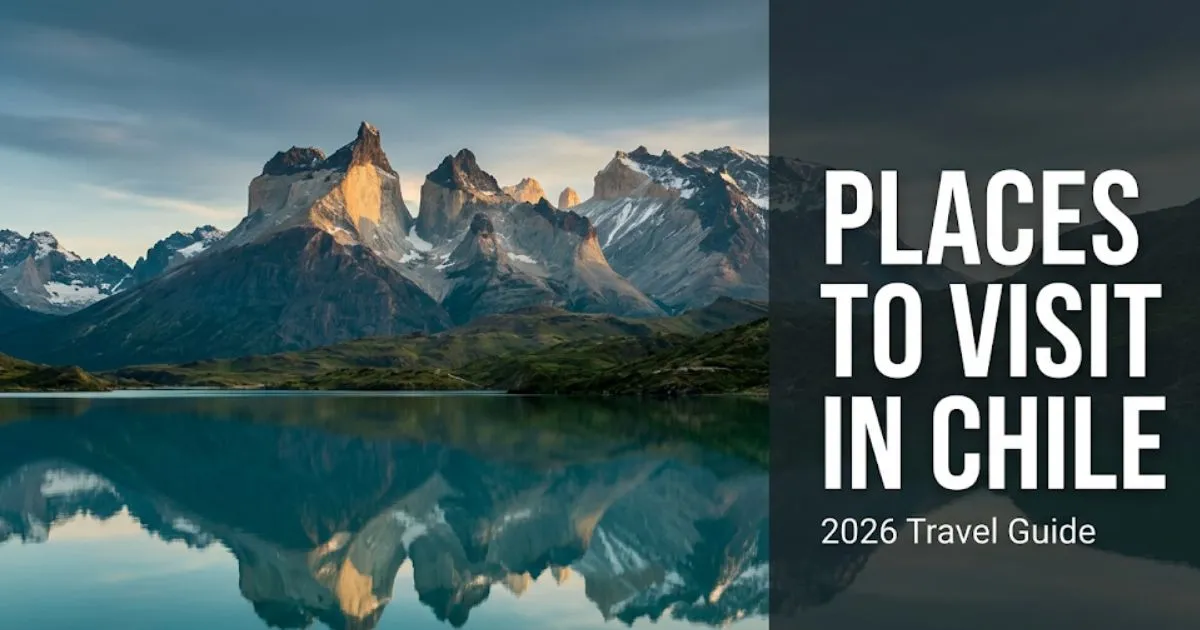
Chile Places to Visit: The Complete 2026 Travel Guide

Chile’s places to visit span 4,300 kilometers of the most geographically varied terrain on Earth. One country holds the world’s driest desert, active Andean volcanoes, ancient Polynesian ruins, and Patagonia’s raw southern ice fields.
Sernatur, Chile’s national tourism body, estimates the country receives over 5 million international visitors annually. That number is growing, and permit systems for the most popular destinations are tightening in response.
This guide covers every major region honestly: what each destination actually delivers, what it genuinely costs in effort and money, and which traveler profile it suits. You’ll have a working trip framework before you finish reading.
Places to Visit in Chile: What Makes This Country Worth a Long Flight
Chile is one of the few countries where you can genuinely stand in a desert that receives less than a millimeter of rain per year, then fly two hours south to glaciers that calve into fjords.
That geographic range is the honest answer to why Chile earns the flight. No other South American country packs this kind of extreme contrast into a single itinerary.
The country also has practical advantages other South American destinations lack. US citizens do not need a visa. English is spoken in most tourist zones and major hotels.
Santiago is a genuinely world-class urban hub by South American standards. Its food scene, metro system, and hotel infrastructure reduce the friction that tires travelers out in less-developed destinations.
Chile also ranks consistently as one of South America’s safest countries for international visitors. The US State Department rates Chile at Level 1 (Exercise Normal Precautions) as of recent assessments, the best possible designation.
The honest limitation: Chile is long. Moving between regions takes time and money. Budget for internal flights and plan your regions carefully.
Insider Tip:
- Santiago is the hub. Nearly every regional flight routes through Arturo Merino Benítez Airport (SCL). Build at least one full Santiago day into any itinerary.
- Fly to your farthest destination first, then work back toward Santiago. This reduces backtracking significantly.
- Senior travelers and those with altitude sensitivity should prioritize Patagonia and central Chile over the Atacama without a proper acclimatization plan.
Best Places to Visit in Chile: How to Choose the Right Region
The best places to visit in Chile depend entirely on three factors: how much time you have, how physically fit you are, and how much of your budget you’re willing to spend on a single destination.
Chile is not a country you sample broadly in 10 days without spending most of that time in airports. Choose 2 to 3 regions maximum for any trip under 3 weeks.
Here is the destination comparison every competitor fails to provide:
| Destination | Best For | Budget Tier | Physical Demand | Best Season |
|---|---|---|---|---|
| Santiago | Culture, food, city exploration | Mid-range | Low | Year-round |
| Valparaíso | Art, bohemian culture, coastal | Budget to mid | Low | Oct to Apr |
| Atacama Desert | Stargazing, desert landscapes | Premium | Moderate (altitude) | May to Oct |
| Torres del Paine | Trekking, glaciers, wildlife | Premium | High | Nov to Mar |
| Carretera Austral | Scenic driving, isolation | Mid-range | Moderate | Nov to Mar |
| Chiloé Island | Folklore, food, quiet travel | Budget to mid | Low | Oct to Apr |
| Easter Island | Archaeology, bucket list | Very premium | Low to moderate | Year-round |
| Wine Regions | Gastronomy, wine tours | Mid to premium | Low | Sep to May |
For first-time visitors with 10 to 14 days: Santiago plus either Atacama or Patagonia is the most honest recommendation. Not both.
For repeat visitors or longer trips: Add Carretera Austral, Chiloé, or Easter Island to a second Chile trip.
Top Places to Visit in Chile by Travel Style
Chile’s top places to visit break cleanly by what kind of traveler you are. The country does not do “a little bit of everything in one week” well.
Adventure travelers should prioritize Torres del Paine (W Circuit trekking), Atacama Desert (multi-day excursions from San Pedro), and the Carretera Austral (4WD self-drive).
Cultural travelers get the most from Santiago’s barrios (Lastarria, Italia, Bellavista), Valparaíso’s cerros (Alegre, Concepción), and Chiloé Island’s mythology-driven architecture.
Couples seeking a romantic but active trip will find the Lake District around Puerto Varas ideal. Volcanic lake views, German-influenced food culture, and boat crossings to Argentina make it a less crowded alternative to Patagonia.
Budget travelers can do Chile affordably in Santiago, Valparaíso, and Chiloé. Patagonia and Easter Island are not budget destinations. Trying to do them cheaply means cutting corners on safety or comfort in places where conditions are genuinely demanding.
Families with children over 10 will handle Santiago, Valparaíso, and the wine regions well. Younger children face real challenges with Patagonia trail distances and Atacama’s altitude.
Seniors and accessibility travelers: Santiago’s Metro is wheelchair accessible. Many cerros in Valparaíso are not. Patagonia’s terrain varies, but CONAF maintains some accessible viewpoints. Verify specific trail conditions with CONAF before departure.
Key Takeaway: Chile rewards travelers who pick 2 to 3 regions and go deep. Attempting all of Chile in under 2 weeks means you’ll see everything badly and nothing well.
Santiago, Chile: Places to Visit in the Capital
Santiago is the most underestimated capital city in South America for culture, food, and urban sophistication. Most visitors treat it as a layover. That is a serious planning error.
The city’s best neighborhoods each have a distinct identity. Barrio Lastarria is the literary and gallery district, centered on Calle Lastarria and Plaza Mulato Gil de Castro. Expect bookshops, art houses, and the city’s strongest café culture.
Barrio Italia replaced Bellavista as the city’s creative hub for residents and in-the-know visitors. Avenida Italia and Avenida Condell host independent design shops, natural wine bars, and no-sign restaurants that don’t appear on most travel maps.
Cerro San Cristóbal, accessed by funicular from Barrio Bellavista, gives the clearest Andean backdrop view of the city when skies are clear. Mornings before 10am offer the best visibility before smog builds.
La Chascona, Pablo Neruda’s Santiago home, is one of three Neruda houses in Chile and the most accessible. Tours run regularly; advance booking is strongly recommended during December through February.
Mercado Central, Santiago’s historic fish market on Calle Ismael Valdés Vergara, is both a tourist landmark and a working market. The restaurant stalls inside serve excellent caldillo de congrio (conger eel soup). Arrive before noon to avoid the worst tourist-hour pricing.
Insider Tip:
- The Santiago Metro (5 CLP per ride equivalent, though fares change, verify before visiting) connects every major neighborhood efficiently. Skip taxis for most intra-city movement.
- Barrio Italia restaurants don’t serve dinner until 8pm at earliest. Plan accordingly.
- Solo travelers: Barrio Lastarria’s Plaza Mulato Gil de Castro is safe, well-lit, and full of social energy every evening.
Valparaíso: Places to Visit on Chile’s Pacific Coast
Valparaíso is 75 minutes from Santiago by bus or car and operates as one of South America’s most photogenic port cities. Its 42 hills, called cerros, are covered in street art, colonial architecture, and funicular lifts called ascensores.
Cerro Alegre and Cerro Concepción are the two cerros most visitors explore first. They contain the densest concentration of boutique hotels, street art murals, and café terraces with Pacific views.
Ascensor Artillería, one of the oldest surviving funiculars dating to 1893, lifts visitors from the port district to an elevated terrace viewpoint. Admission is minimal; verify current hours before visiting as mechanical maintenance closures occur.
The honest assessment: Valparaíso’s most photographed streets (Cerro Alegre’s painted staircases, particularly Escalera Beethoven) are genuinely worth the visit. They are not tourist trap infrastructure.
Viña del Mar, Valparaíso’s wealthier neighbor 20 minutes north by bus, is where Chileans vacation. Its beaches are busiest from December through February. Off-season, the flower clock (Reloj de Flores) and Casino Municipal give it a slightly faded resort elegance that some travelers find appealing.
Pairs best with a Santiago base. A single full day in Valparaíso is enough for first-timers. Two days allows the cerros and Viña del Mar both.
Couples find Cerro Alegre’s terrace restaurants among the most romantic settings in Chile. Budget travelers will note that bus transit between Santiago and Valparaíso (Turbus or Condor Bus from Alameda Terminal) runs approximately every 30 minutes and costs a fraction of a taxi.
The Atacama Desert, Chile: What to Expect and Plan For
The Atacama Desert in northern Chile is the driest non-polar desert on Earth and home to some of the most extreme stargazing conditions anywhere. It sits at an average elevation of 7,900 feet above sea level.
That altitude is the detail most visitors don’t adequately prepare for. San Pedro de Atacama, the main base town, sits at 7,900 feet. Physical exertion feels noticeably harder for the first 24 to 48 hours.
According to Sernatur, the Atacama region receives over 300 clear nights per year, making it the global standard for astronomical observation. The Atacama Large Millimeter Array (ALMA) operates from the plateau above the town.
Tour operators based in San Pedro offer stargazing excursions nightly. The ALMA Visitor Center offers weekend public access. Book these tours in advance during peak season (July through September).
Key sites include Valle de la Luna (Moon Valley), El Tatio Geysers (visited at dawn when steam activity peaks), Laguna Cejar (hypersaline lake where you float without effort), and the vast Salar de Atacama salt flat.
Adventure travelers can add multi-day trekking programs into the Andean altiplano from San Pedro. Seniors and those with heart or respiratory conditions should consult a physician before visiting at this altitude. Altitude sickness (soroche) is common and occasionally serious.
Budget travelers should know that San Pedro de Atacama’s lodge market skews heavily luxury. Budget hostels exist but fill early. Book accommodations at least 6 to 8 weeks ahead for July through September visits.
Key Takeaway: Book San Pedro de Atacama stargazing tours before you land in Chile. They sell out weeks ahead during June through October, which is the clearest-sky season.
San Pedro de Atacama: The Gateway Town You’ll Base From
San Pedro de Atacama is the small adobe town that serves as the launch point for every Atacama Desert excursion. Its main street, Caracoles, runs about 400 meters and contains most of the tour operators, restaurants, and shops visitors need.
The town is genuinely small. You can walk from one end to the other in 10 minutes. That compactness makes logistics easy, but accommodation fills quickly during peak season (July through September and December through February).
The Atacama deserves a minimum of 3 full days to cover its key sites without rushing. Four to five days allows the major excursions plus a recovery day at altitude.
El Tatio Geysers require a 4am departure from San Pedro. The geysers are at 14,000 feet above sea level, significantly higher than the town. Altitude symptoms are more pronounced there. Dress in multiple warm layers regardless of what month you visit.
Valle de la Luna is 15 kilometers from San Pedro and accessible by bike or tour vehicle. Sunset tours are the standard choice. Morning tours are shorter in duration and significantly less crowded.
Laguna Cejar requires a guided tour; it is not independently accessible. The saltwater concentration allows you to float without swimming. Reserve a morning slot to avoid afternoon winds that reduce visibility.
Couples find the sunset Valle de la Luna tour among Chile’s most romantic experiences. The landscape shifts from gold to deep purple as the sun drops behind the Andes. Solo travelers should join group tours here; the cost is similar and the social dynamic is easy.
Torres del Paine National Park: Chile’s Most Famous Trek
Torres del Paine National Park in Chilean Patagonia is the most famous place to visit in Chile for trekking, and it requires more advance planning than any other destination in this guide.
CONAF, the Chilean national parks authority, manages a strict permit and camping reservation system for both the W Circuit (4 to 5 days) and the O Circuit (8 to 9 days). These permits sell out months in advance for November through February.
The W Circuit is the standard choice for most visitors. It covers the park’s four signature experiences: the Base Torres viewpoint (the granite towers), Valle del Francés (hanging glaciers and condors), Grey Glacier, and the Paine Grande ridge traverse.
The O Circuit adds the park’s remote eastern side and requires 8 to 9 days. It’s genuinely more isolated and physically demanding. Only experienced multi-day trekkers with proper gear should attempt it.
Booking the W Circuit for 2026:
- Visit CONAF’s official reservation platform (vertice patagonia and fantastico sur manage the private camp sites within the park)
- Select your entry date and number of nights
- Book all camping or refugio beds simultaneously; the W Circuit refugios connect via Fantastico Sur and Vertice Patagonia systems
- Confirm a hotel stay in Puerto Natales (the gateway town, 112 kilometers from the park) for pre and post-trek nights
- Book your flight to Punta Arenas (PMC) at least 3 to 4 months ahead for peak season
Adventure travelers in good physical condition are the primary profile for this experience. Families with children under 14 should consider the park’s day hikes from the main lodge areas rather than the full W Circuit. Seniors should honestly assess the 8 to 10 hour daily hiking demand before committing.
Patagonia weather is the single biggest variable. Winds exceeding 60 mph on exposed ridgelines are common even in summer. Rain can appear without warning. Every piece of gear must be waterproof.
Patagonia, Chile: What Travel Here Actually Requires
Patagonia, Chile is genuinely one of the most dramatic natural environments on Earth, and it genuinely demands physical readiness, proper gear, and a flexible mindset about weather-related changes to plans.
The region encompasses Torres del Paine, Bernardo O’Higgins National Park, the Carretera Austral’s southern section, and dozens of glacial fjords accessible only by boat.
Puerto Natales is the primary base for Torres del Paine visitors. It’s a small, functional town with good gear shops, solid mid-range restaurants, and a growing number of quality boutique hotels. Singular Patagonia (outside town on Last Hope Sound) is the area’s most acclaimed luxury property, though rates run several hundred dollars per night.
Cueva del Milodón (Milodón Cave), 26 kilometers from Puerto Natales, is where a prehistoric ground sloth was discovered in 1895. It’s a quick half-day stop worth the detour en route to or from the national park.
The honest logistical reality of Patagonia: flights from Santiago to Punta Arenas take approximately 3.5 hours. The bus from Punta Arenas to Puerto Natales takes approximately 3 more hours. You spend a full travel day just reaching the starting point.
Budget travelers should know that accommodation and food in Patagonia costs significantly more than Santiago or Valparaíso. Expect mid-range meals at roughly double Santiago prices. Self-catering in Puerto Natales reduces costs meaningfully.
Families with children over 12 who are comfortable with multi-hour hikes will find Patagonia genuinely rewarding. Under 12, the park’s distances and weather unpredictability make planning very difficult.
Key Takeaway: Book Torres del Paine W Circuit permits the moment the system opens for your travel month, often 6 months in advance. Waiting until 3 months out means starting dates are already gone.
The Carretera Austral: Chile’s Most Rewarding Road
The Carretera Austral is Chile’s legendary Highway 7, a 1,240-kilometer route through southern Chilean Patagonia that connects Puerto Montt in the north to Villa O’Higgins in the south.
It passes through some of the least-visited wilderness in the Southern Hemisphere. Marble caves at Lago General Carrera, hanging glaciers at Queulat National Park, the wild rivers of Palena, and the German-influenced town of Futaleufú (world-renowned for whitewater rafting) anchor the route.
This route is not a highway in any conventional sense. Large sections are unpaved gravel. A high-clearance 4WD vehicle is required for most of the southern sections. Rental 4WD vehicles from Puerto Montt are the standard approach.
The journey from Puerto Montt to Cochrane (a reasonable southern endpoint for most travelers) takes 4 to 5 days of driving at a reasonable pace. Allow one full week minimum to do the route justice.
Cell service is extremely limited or absent for long stretches. Download offline maps and carry a paper backup. Fuel stations are spaced far apart; fill up whenever the opportunity presents itself.
Adventure travelers and couples seeking an off-grid self-drive experience will find this one of the most rewarding drives in South America. Budget travelers can manage the Carretera Austral affordably by camping in designated sites and self-catering. Seniors with mobility limitations or medical needs should note that medical facilities are minimal between major towns.
According to Lonely Planet, the Carretera Austral ranks among South America’s top scenic drives. What that designation doesn’t convey is the genuine logistical effort required. Prepare accordingly.
Chiloé Island, Chile: The Destination Most Visitors Skip
Chiloé Island in Chile’s Lake District region is the most underrated destination in this guide. It’s the one major Chilean destination that the vast majority of first-time visitors skip entirely. That is their loss.
Chiloé is reached by a 30-minute ferry crossing from Pargua (near Puerto Montt) to Chacao, or by flight to Castro (the island’s main city). It sits at a latitude where mist, rain, and brooding skies are part of the aesthetic.
The island’s architecture is its most distinct feature. Palafitos, stilt houses built directly over the water’s edge, line the shores of Castro‘s harbor in colors that range from deep red to seafoam green. They are Chiloé’s most photographed image, and they earn the attention.
The island’s 16 wooden churches, collectively a UNESCO World Heritage Site, are scattered across the archipelago. The church at Dalcahue and the Iglesia de Achao on nearby Quinchao Island are the two most architecturally impressive outside of Castro itself.
Chiloé mythology is genuinely embedded in local culture. The Trauco (a forest spirit that seduces women), the Caleuche (a ghost ship), and the Brujos de Chiloé (local witchcraft tradition) are not tourist fabrications. They’re living folklore that shapes how islanders talk about their landscape.
Families with children who appreciate folklore, seafood, and quiet exploration will find Chiloé more accessible and genuinely engaging than Patagonia. Budget travelers will appreciate that Chiloé is among Chile’s most affordable regions for accommodation and food.
Curanto, the island’s signature dish (shellfish, meat, and potatoes slow-cooked in an underground pit), is Chiloé’s most authentic culinary experience. Look for it at family-run restaurants in Castro’s market district, not at tourist-facing hotels.
Key Takeaway: Chiloé Island is the most logical add-on for travelers already visiting the Lake District. Two nights in Castro adds cultural depth that no other Chilean destination offers at this price point.
Easter Island, Chile: Worth It or Overhyped?
Easter Island (officially Rapa Nui, and officially part of Chile’s Valparaíso Region) is 3,700 kilometers off Chile’s coast in the Pacific Ocean. It is genuinely one of the world’s most extraordinary archaeological sites. It is also genuinely expensive and time-consuming to visit.
The honest verdict: Easter Island is worth it if you allocate sufficient time and budget. It is not worth it as a rushed 2-day stopover.
The 887 moai (stone statues) scattered across the island are physically arresting in a way photographs do not convey. Ahu Tongariki, the largest restored moai platform with 15 standing figures, at sunrise with the Rano Raraku quarry behind it, is among the most powerful landscape experiences in the Southern Hemisphere.
Rapa Nui National Park covers a large portion of the island and requires a separate entry fee from your airfare. This fee, paid on arrival or online, must be verified annually for current amounts. The park includes Ahu Akivi (seven moai facing the ocean), Anakena Beach (the island’s main swimming beach, with a moai platform nearby), and Orongo Ceremonial Village on the rim of a volcanic crater overlooking three offshore islets.
LATAM Airlines flies from Santiago to Mataveri Airport (IPC) on Easter Island. The flight takes approximately 5.5 hours. Flights are expensive relative to Chilean domestic routes; book well in advance.
Budget for 4 to 5 nights minimum. Three days covers the major sites adequately. The fourth and fifth days allow for scuba diving (the underwater visibility is exceptional) and deeper cultural engagement with the Rapanui community in Hanga Roa, the island’s only town.
Budget travelers should honestly reconsider this destination. Accommodation, food, and tours on Easter Island run at significant premiums. There is no budget option that maintains adequate comfort on Rapa Nui.
Chile’s Wine Regions: Where to Go and What to Drink
Chile’s wine regions are concentrated in the central valley between Santiago and the Bio-Bío River. Three valleys dominate: Maipo Valley (closest to Santiago), Casablanca Valley (between Santiago and Valparaíso), and Colchagua Valley (2.5 hours south of Santiago).
Each valley has a different character. Maipo produces the country’s benchmark Cabernet Sauvignon. Casablanca, with Pacific Ocean influence, excels at Sauvignon Blanc and Chardonnay. Colchagua is warmer and produces Carménère (Chile’s signature red grape) and Syrah.
Viña Concha y Toro in Maipo Valley (Pirque, 30 minutes from Santiago) is Chile’s largest winery and the most visited. Tours run regularly; book online in advance. It’s a good introduction but operates at a large commercial scale.
Viña Santa Cruz in Colchagua Valley offers a more intimate experience and includes a cable car to a hilltop observatory. The Colchagua Valley town of Santa Cruz itself has a notable regional museum (Museo de Colchagua) worth a half-day.
Casablanca Valley is the most practical choice for travelers combining wine tasting with a Santiago-to-Valparaíso journey. The valley lies directly along that route. Vineyards including Viña Casas del Bosque and Emiliana Organic Vineyards offer tastings with advance booking.
Couples find Colchagua Valley’s boutique winery experiences among Chile’s most romantic options. Budget travelers can self-drive Casablanca Valley affordably; tastings range from modest to mid-range fees depending on the winery.
Insider Tip:
- Chilean wine tours are best visited Tuesday through Saturday; many boutique operations close Sunday and Monday.
- Carménère is Chile’s most distinctive grape variety. It was thought extinct in Europe until its rediscovery in Chile in the 1990s. Order it specifically.
- Maipo Valley’s best wine experiences are not at the large commercial wineries. Viña Almaviva and Viña Aquitania produce wine at a quality level equal to the best in South America, with tastings by appointment.
Key Takeaway: Pair the Casablanca Valley with a Valparaíso day trip. You pass directly through wine country on the same route. It adds wine tasting to an already-worthwhile journey for no extra travel time.
Best Time to Visit Chile by Region
The best time to visit Chile varies dramatically by region because the country spans 38 degrees of latitude. What’s peak season in Patagonia is low season in Santiago.
| Region | Best Months | Why | What to Avoid |
|---|---|---|---|
| Santiago | Sep to Nov, Mar to May | Mild weather, no rain, festivals | Dec to Feb (heat, crowds) |
| Valparaíso | Oct to Apr | Warm, clear skies, coastal season | May to Aug (cold, grey) |
| Atacama Desert | May to Oct | Driest skies, best stargazing | Feb to Apr (Altiplanic winter rains) |
| Torres del Paine | Nov to Mar | Accessible trails, long daylight | Apr to Oct (closures, extreme wind) |
| Carretera Austral | Nov to Mar | Road passable, weather manageable | Apr to Oct (road closures, mud) |
| Chiloé Island | Oct to Apr | Mist is atmospheric; ferries run fully | Jun to Aug (grey and cold) |
| Easter Island | Year-round | Subtropical; February hosts Tapati Festival | Dec to Feb (peak prices, book early) |
| Wine Regions | Sep to May | Harvest season (Mar to Apr is peak) | Jun to Aug (cold, many wineries reduced hours) |
The most common mistake US travelers make is planning a Chile trip around Northern Hemisphere school holidays (June through August) without checking that this is Chilean winter in the south.
Patagonia in July is cold, wet, windy, and partially closed. Atacama in July, conversely, is one of the best months for stargazing and clear skies.
Family travelers planning around US school schedules will find December through February works well for Atacama and Easter Island. It’s the worst possible time for Patagonia crowds and prices, however. Permits sell out months earlier.
Chile Travel Itinerary: How to Structure Your Trip
A well-structured Chile itinerary for 2026 follows the rule of regional concentration: pick 2 to 3 connected regions and go deep into each.
10-Day Chile Itinerary (First-Time Visitors):
- Days 1 to 2: Arrive Santiago. Recover from flight. Explore Barrio Lastarria and Barrio Italia. Day 2: Cerro San Cristóbal and Mercado Central.
- Days 3 to 4: Casablanca Valley wine tasting en route to Valparaíso. Two nights on Cerro Alegre.
- Days 5 to 6: Return to Santiago and fly to Calama (Atacama gateway). Arrive San Pedro de Atacama. Day 6: Valle de la Luna sunset tour.
- Days 7 to 8: El Tatio Geysers (4am departure, day 7). Laguna Cejar tour. Day 8: Full rest and acclimatization; optional stargazing tour.
- Days 9 to 10: Fly back via Santiago. Final night in Santiago. Depart day 10.
14-Day Chile Itinerary (Patagonia Focus):
- Days 1 to 2: Santiago (same as above)
- Day 3: Day trip to Valparaíso and Casablanca Valley
- Days 4 to 8: Fly Punta Arenas. Transfer Puerto Natales. Day 5 to 8: W Circuit trekking in Torres del Paine (pre-booked permits essential)
- Day 9: Return Puerto Natales. Rest. Visit Cueva del Milodón.
- Days 10 to 12: Fly Santiago, then Calama. San Pedro de Atacama for 3 nights.
- Days 13 to 14: Return Santiago. Final night. Depart.
Families with children should replace the W Circuit section with a 3-night base in Puerto Natales with day hikes into the park’s accessible areas. The full circuit is not practical for under-14s.
Budget travelers can reduce costs significantly by replacing Easter Island with Chiloé Island (similar sense of remoteness at a fraction of the price and flight cost).
Chile Travel Tips and Planning Essentials for 2026
Successful Chile travel in 2026 requires advance planning in four specific areas: permits, flights, altitude, and packing.
Permits and Reservations:
- Torres del Paine W Circuit camping: Book through Fantastico Sur and Vertice Patagonia platforms. Open booking for the following season typically begins mid-year. November through February dates go first.
- Easter Island Rapa Nui National Park fee: Verify current fee structure and purchase requirements through official Rapa Nui National Park channels before departure.
- El Tatio Geysers and Valle de la Luna: Tour operators in San Pedro de Atacama book these. Confirm your tour before leaving Santiago if traveling in high season.
Flights:
- LATAM Airlines, Sky Airline, and JetSMART cover domestic Chilean routes. Compare across all three for pricing.
- Punta Arenas (PMC) is the Patagonia gateway. Calama (CJC) is the Atacama gateway. Mataveri (IPC) is Easter Island.
- Book all domestic legs when you book international flights. Prices increase as departure approaches.
Altitude Preparation:
- Arrive in San Pedro de Atacama with no strenuous activity planned for the first 24 hours.
- Hydrate heavily. Alcohol at altitude hits harder and faster than at sea level.
- Consult a physician about acetazolamide (altitude medication) if you have a history of altitude sensitivity.
Packing Essentials for Patagonia:
- Full waterproof outer layer (jacket and pants) rated for sustained rain and wind
- Trekking poles (mandatory for the W Circuit’s steep terrain)
- Merino wool base layers
- Sunscreen SPF 50 or higher (UV at southern latitudes is intense even on overcast days)
Currency and Payments:
- Chilean Peso (CLP) is the local currency. ATMs in Santiago, San Pedro, and Puerto Natales are reliable. In remote Carretera Austral towns, carry cash.
- Major credit cards are accepted at hotels and larger restaurants. Small vendors and rural areas are cash only.
Language:
- Spanish is the language of Chile. English is spoken in tourist zones of Santiago, San Pedro, Patagonia lodges, and Easter Island. Outside those zones, basic Spanish is genuinely useful.
Solo travelers should note that Chile’s major tourist circuits (Atacama tours, Patagonia treks) run heavily in group formats, making it socially easy to connect with other travelers. Santiago’s hostel scene in Barrio Bellavista is particularly social.
Safety and Practical Warnings for Chile
Chile is one of South America’s safest countries for international visitors. Genuine risks exist and are specific to certain regions.
Key safety and practical facts every visitor should know:
- Altitude sickness at San Pedro de Atacama (7,900 feet): Rest for the first 24 hours. Do not attempt El Tatio (14,000 feet) on day one. Symptoms include headache, nausea, and fatigue.
- Patagonia weather: Even in summer (December through February), winds on exposed trails in Torres del Paine can exceed 60 mph. Never hike in exposed areas during sustained wind warnings issued by park rangers.
- UV radiation in Atacama: Among the highest measured anywhere on Earth. Apply SPF 50 sunscreen even on overcast days. Wear a wide-brim hat.
- Petty theft in Santiago: Pickpockets operate in crowded areas of Plaza de Armas, the Mercado Central, and on the Metro during rush hours. Use a front-facing crossbody bag. Do not display expensive cameras or phones in Santiago’s Centro district.
- Cell service on Carretera Austral: Expect long stretches (50 to 100 kilometers) with no signal. Download offline maps through Google Maps or Maps.me before departure. Inform someone of your route and expected arrival times.
- Rip currents on Pacific coast beaches: Chile’s Pacific coastline has strong and unpredictable rip currents. Swim only at beaches with lifeguards on duty. Do not swim at unmonitored beaches regardless of how calm the water appears.
- Medical infrastructure in remote areas: Santiago has excellent hospitals. Puerto Natales has a basic clinic. Remote Carretera Austral and the far southern sections of Patagonia have minimal medical facilities. Comprehensive travel insurance with emergency evacuation coverage is not optional for remote-area travel.
The US Embassy in Santiago (Avenida Andrés Bello 2800) provides consular services and emergency assistance for US citizens.
Frequently Asked Questions About Places to Visit in Chile
What are the best places to visit in Chile for first-time visitors?
The best places to visit in Chile for first-time visitors are Santiago, Valparaíso, and either the Atacama Desert or Torres del Paine, depending on available time.
First-timers with 10 days should choose one major natural region and combine it with Santiago and Valparaíso rather than attempting both Atacama and Patagonia.
Santiago and Valparaíso together with the Casablanca wine valley form a coherent 4-day first chapter before heading north to Atacama or south to Patagonia.
How many days do you need to visit Chile?
A minimum of 10 days gives you enough time to explore Santiago, make one day trip to Valparaíso, and spend 3 to 4 meaningful days in one natural region.
Fourteen days is the practical minimum for combining Santiago, Valparaíso, Atacama, and a wine region without rushed transitions.
Twenty-one days or more is required to genuinely combine Patagonia, Atacama, and central Chile without spending an excessive proportion of your trip in transit.
Is Chile safe for tourists in 2026?
Chile is one of South America’s safest countries for international visitors.
The US State Department has consistently rated Chile at Level 1 (Exercise Normal Precautions), its lowest risk designation, in recent travel advisories.
Standard urban precautions apply in Santiago’s Centro and tourist-heavy districts; verify the current advisory status at travel.state.gov before departure.
Do US citizens need a visa to visit Chile?
US citizens do not need a visa to visit Chile for tourism stays up to 90 days.
A valid US passport is sufficient for entry; no advance visa application is required.
Entry requirements can change, so verify current conditions through the Chilean Embassy or the US State Department’s Chile country page before your travel date.
When is the best time to visit Torres del Paine?
The best time to visit Torres del Paine is November through March, which is Chilean summer and the only period when the W Circuit trails are fully accessible and manageable.
December through February is peak season with the longest daylight hours but also the highest prices and strongest competition for permits.
November and March offer slightly less crowded conditions with similar weather quality to the peak months, making them the optimal window for most visitors.
How far in advance do you need to book Torres del Paine permits?
W Circuit permits for Torres del Paine during peak season (December through February) should be booked 5 to 6 months in advance.
CONAF manages camping allocation through the Fantastico Sur and Vertice Patagonia reservation platforms, both of which open booking for the following season mid-year.
Waiting until 2 to 3 months before your intended travel date for peak-season dates means the most popular starting dates are already fully booked.
Plan Your Chile Trip with Confidence
Chile’s places to visit demand specific decisions, not vague inspiration. Pick your region, lock in your permits early, and build your itinerary around Chile’s geography rather than against it.
Before you depart, verify Torres del Paine permit availability, Easter Island’s Rapa Nui entry fee structure, and domestic flight pricing through current official channels. All of these change seasonally and annually.
The single logistical step that makes the biggest difference: book your Torres del Paine permits and Patagonia flights before you book anything else. Everything else in Chile is bookable 4 to 6 weeks out. Patagonia in peak season is not.
Travel conditions, permit systems, entry fees, operating hours, and transport schedules in Chile are subject to change. Verify all key logistics directly with CONAF, Sernatur, and your specific accommodation providers before departure. The traveler who verifies before leaving spends their time in Chile rather than solving problems that planning would have prevented.