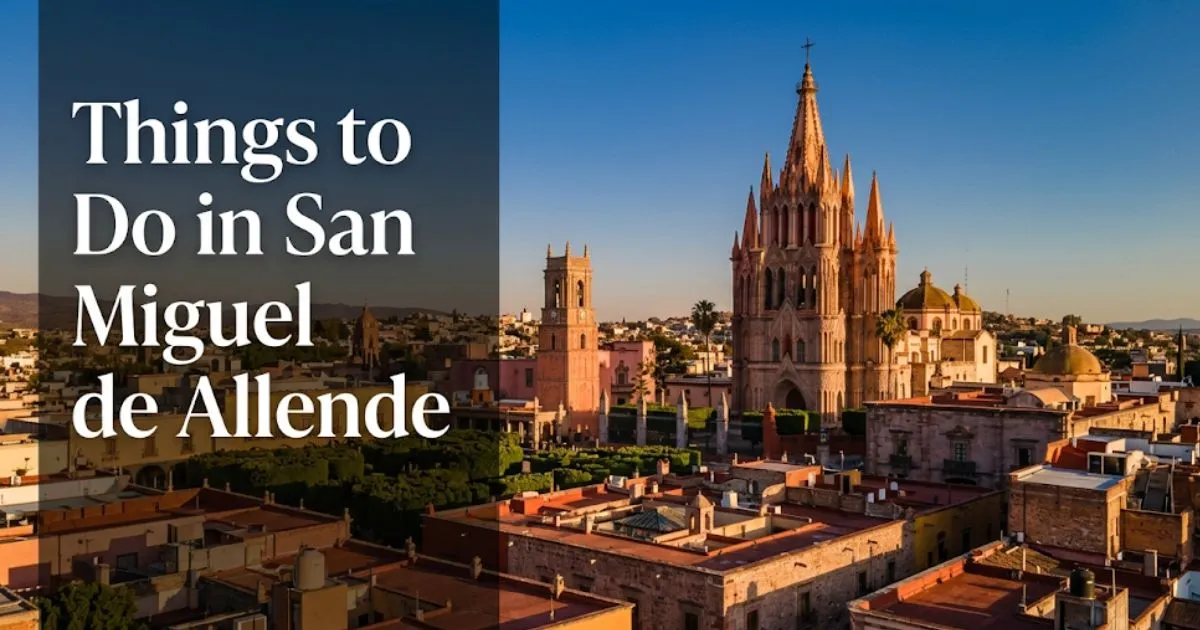
Things to Do in San Miguel de Allende: 2026 Guide

San Miguel de Allende delivers more concentrated colonial beauty, cultural depth, and culinary quality per city block than almost any destination in Mexico. The things to do in San Miguel de Allende range from morning walks past centuries-old stone churches to mezcal tastings at rooftop bars as the sun drops behind the Parroquia’s spires.
UNESCO designated San Miguel de Allende and the nearby Santuario de Atotonilco as a World Heritage Site in 2008. Condé Nast Traveler readers have repeatedly ranked it among the world’s best cities.
This guide covers specific named activities, honest crowd and cost realities, a practical 3-day itinerary, and guidance for every traveler type. You will finish knowing exactly what to do and what to skip.
Things to Do in San Miguel de Allende: The Essential Overview
The best things to do in San Miguel de Allende center on its walkable historic center, its world-class food scene, hot springs in the surrounding hills, and a cultural calendar that runs year-round.
San Miguel de Allende sits at approximately 6,200 feet in the state of Guanajuato, central Mexico. The city is compact enough to walk most attractions but steep enough that the cobblestone streets demand sturdy footwear.
The city’s core identity rests on three pillars. Colonial architecture, living artisan craft traditions, and a culinary scene that outperforms cities three times its size.
The largest mistake first-time visitors make is budgeting too little time. Four to six days is the honest minimum to experience the city without rushing.
Here is a high-level framework of the top activity categories:
| Activity Category | Best For | Cost Range (USD) | Time to Allow |
|---|---|---|---|
| Jardín Principal and Parroquia walk | All profiles | Free | 1 to 2 hours |
| Cooking class (full day) | Couples, solo travelers | $80 to $150 per person | 4 to 5 hours |
| La Gruta Hot Springs | Couples, families (older kids) | $15 to $30 per person | 2 to 4 hours |
| Fábrica La Aurora art galleries | Arts travelers, solo travelers | Free to enter complex | 1 to 2 hours |
| Day trip to Guanajuato city | All profiles | $15 to $30 transport + expenses | Full day |
| Festival Internacional Cervantino | Cultural travelers | Free outdoor events + ticketed shows | 2 to 10 days |
| Mercado de Artesanías shopping | Budget travelers, families | Free to browse | 1 to 2 hours |
| El Charco del Ingenio hike | Outdoor and nature travelers | $5 to $10 entry | 2 to 3 hours |
Insider Tip:
- Most museums and many galleries close on Mondays. Plan heavier walking days for Tuesday through Sunday.
- The city is notably quieter and more affordable from June through August, despite the rainy season’s afternoon showers.
- Seniors and travelers with mobility concerns should specifically request ground-floor hotel rooms. Many boutique hotels in the historic center have no elevators.
San Miguel de Allende Travel Guide for First-Time Visitors
First-time visitors to San Miguel de Allende should orient their entire first morning around the Jardín Principal and then walk within a six-block radius before venturing to outlying neighborhoods. The historic center is dense with quality experiences and easy to cover on foot.
The city sits in a high-altitude semi-arid zone. Expect intense midday sun, cooler evenings year-round, and almost no humidity from November through May.
Altitude is a genuine first-day factor. Drink more water than usual. Avoid heavy alcohol consumption on arrival night. Most visitors feel fully adjusted within 24 to 48 hours.
Here is a practical 3-day first-timer itinerary:
Day 1: The Historic Center on Foot
- Begin at Jardín Principal at 9 AM. Photograph the Parroquia from the northeast corner of the square for the best early light.
- Walk two blocks northeast to the Centro Cultural El Nigromante (Bellas Artes). Check the gallery and courtyard mural by Diego Rivera student Juan O’Gorman.
- Head to Mercado de Artesanías on Loreto street for handmade textiles, silver, and Talavera pottery.
- Lunch at Lavanda Café or Moxi restaurant in Hotel Matilda for a mid-range to premium experience.
- Afternoon: walk up Calle Recreo toward the Instituto Allende campus and its gallery spaces.
- Sunset rooftop drinks at La Azotea rooftop bar for the iconic Parroquia view from above.
Day 2: Culture, Art, and Hot Springs
- Morning: Fábrica La Aurora in the Aurora neighborhood. Arrive by 10 AM before tour groups.
- Mid-morning: drive or taxi 15 minutes to La Gruta Hot Springs for a thermal soak.
- Afternoon back in Centro: browse Calle Mesones and Calle Umarán for gallery-hopping.
- Evening: try chiles en nogada (seasonal, September) or mole negro at Hecho en Mexico restaurant.
Day 3: Day Trip to Guanajuato or Dolores Hidalgo
- Depart by 9 AM. Guanajuato is approximately 90 minutes by road.
- Walk the Callejón del Beso (Alley of the Kiss) and visit the Museo de las Momias.
- Return to San Miguel by late afternoon.
- Final night: mezcal tasting at El Manantial or Quince wine bar.
Budget travelers note: many of Day 1’s best experiences are free. Cost spikes come from restaurants and accommodation, not attractions.
San Miguel de Allende Neighborhoods to Explore
San Miguel de Allende’s most rewarding neighborhoods divide clearly into the walkable historic center and three surrounding districts, each with a distinct identity.
El Centro is the primary hub. It contains the Jardín Principal, the Parroquia, the majority of colonial churches, and most tourist-facing restaurants and shops.
Aurora sits northeast of the center, a 15-minute walk or 5-minute taxi from the Jardín. The neighborhood’s anchor is Fábrica La Aurora, a converted 19th-century textile factory turned gallery and design complex.
Fábrica La Aurora houses approximately 30 galleries, antique dealers, and design studios. It is where San Miguel’s serious art community actually congregates. Tourists tend to cluster in Centro; locals and working artists prefer Aurora.
San Antonio neighborhood lies south of Centro. It is primarily residential, quieter, and home to the Instituto Allende, one of Mexico’s oldest fine arts schools. The Instituto’s architecture and courtyard garden are worth the walk alone.
Ojo de Agua sits on the western hills above the city. It offers some of the best views back over the Parroquia skyline. It is largely residential but has several boutique hotels with rooftop terraces open to non-guests for drinks.
| Neighborhood | Best For | Character | Walking Distance from Jardín |
|---|---|---|---|
| El Centro | First-timers, all profiles | Historic, dense, tourist-facing | You are already here |
| Aurora | Art lovers, repeat visitors | Creative, gallery-focused, local | 15-minute walk or 5-min taxi |
| San Antonio | Architectural interest, peace | Residential, campus feel | 10-minute walk south |
| Ojo de Agua | Views, boutique hotels | Quiet, elevated, residential | 20-minute walk or taxi |
Couples seeking a quieter evening experience should head to San Antonio’s smaller cafes on Calle Pila Seca. The crowd skews local and the atmosphere is noticeably less tourist-saturated than Centro.
Parroquia de San Miguel Arcángel and Jardín Principal
The Parroquia de San Miguel Arcángel is San Miguel de Allende’s defining landmark, a 17th-century parish church whose neo-Gothic pink-stone facade was redesigned in the late 1800s by local self-taught architect Zeferino Gutiérrez. It is the single most photographed structure in all of Guanajuato state.
The church anchors the Jardín Principal, the city’s central plaza and the social heart of daily life. The Jardín is where locals gather every evening, vendors sell roasted corn and churros, and mariachi groups perform on weekend nights.
Entry to the Parroquia church interior is free and generally open daily, though access may be restricted during services. Verify hours with local information upon arrival.
The best photography light falls on the Parroquia facade in the early morning, roughly 7 to 9 AM, when the eastern sun hits the pink stone directly. Midday light flattens the facade significantly.
The single most overrated experience at the Parroquia: the interior. The outside is the architectural achievement. The interior is beautiful but not exceptional by Mexican church standards. The Oratorio de San Felipe Neri, two blocks away on Calle Insurgentes, has an interior that outperforms many churches three times its fame.
Insider Tip:
- Sunday at 11 AM brings a brass band to the Jardín. It is free, genuinely local, and completely unphotographed by most guides.
- Arrive at the Jardín before 8 AM for a nearly crowd-free experience. By 10 AM, tour groups have arrived.
- Solo travelers will find the Jardín exceptionally safe and social. Sitting with a coffee at the outdoor tables of Café Monet on the plaza’s northwest corner is one of the better people-watching experiences in Mexico.
Key Takeaway: Arrive at the Jardín Principal before 8 AM for crowd-free photography and the best Parroquia light. Return on Sunday at 11 AM for the free brass band performance.
San Miguel de Allende Food and Dining Scene
San Miguel de Allende’s food scene punches well above the city’s size, with serious restaurants focused on regional Mexican cuisine alongside an international dining culture driven by the city’s large expat community.
The strongest local dining category is regional Guanajuato cuisine: enchiladas mineras (stacked enchiladas with cheese and pickled vegetables), chiles en nogada during September, and excellent mole preparations available year-round.
Hecho en Mexico on Ancha de San Antonio is consistently recommended by local chefs and longtime residents for traditional regional cooking at mid-range prices. It is the restaurant most locals would send a first-time visitor to before anywhere else.
El Correo on Calle Correo serves a solid mid-range comida corrida (prix fixe lunch) beloved by locals for its value. It is the honest local alternative to the hotel restaurant lunch scene.
For premium dining, Moxi inside Hotel Matilda and Bovine have the strongest kitchens in the city’s upper tier. Both require reservations, especially on weekends.
The Thursday Organic Market (Mercado Orgánico) near the Parque Juárez runs weekly. It is the single best food experience for budget travelers, selling fresh produce, artisan cheeses, tamales, and prepared foods at local prices.
Rooftop bar options by traveler profile:
| Venue | Best For | Atmosphere | Price Range |
|---|---|---|---|
| La Azotea | Couples, first-timers | Classic tourist-facing rooftop | $$ |
| Luna Rooftop Tapas Bar (Rosewood) | Premium couples, anniversaries | Luxury, panoramic | $$$$ |
| El Pescador rooftop | Budget travelers, solo | Casual, local crowd | $ |
| Bar Pata Negra | Solo travelers, social | Lively, mixed crowd | $$ |
Budget travelers should prioritize the Thursday Organic Market for lunch and save restaurant spending for one or two genuinely special dinners.
Cooking Classes in San Miguel de Allende
Cooking classes in San Miguel de Allende are one of the city’s strongest activities for couples, solo travelers, and food-focused visitors, combining hands-on instruction in traditional Mexican techniques with market visits and full sit-down meals.
Sazón Cooking School is the most established and consistently recommended cooking school in the city. Classes typically include a morning market visit, hands-on mole, tamale, or regional dish preparation, and a full meal of what you cooked.
Classes at Sazón and comparable schools typically run 4 to 5 hours and cost approximately $80 to $130 USD per person as of recent years. Verify current pricing and availability directly with each school before booking.
Most quality cooking schools require advance booking of at least 3 to 5 days. During Cervantino and Holy Week, booking 2 to 3 weeks ahead is advisable.
Casa de Sierra Nevada also offers culinary experiences as part of their hotel programming. These tend toward a higher price point and a more intimate group size.
Cooking classes are among the best value-for-experience activities in San Miguel. A 5-hour class, including a full meal, represents stronger value than most restaurant dinners at comparable price points.
Insider Tip:
- Classes that include a market visit to Mercado Ignacio Ramírez (the main indoor market) provide the most complete picture of local food culture.
- Couples report cooking classes as one of the strongest shared experiences in San Miguel. The format naturally generates conversation and collaboration.
- Solo travelers who are uncomfortable dining alone find cooking classes a natural social setting. Most classes draw 6 to 10 participants from varied countries.
San Miguel de Allende Art Scene and Artisan Markets
San Miguel de Allende’s art scene is built on a genuine infrastructure of working artists, active galleries, and fine arts education that predates the city’s tourism boom. It is not decorative. It is substantive.
Fábrica La Aurora, the converted textile factory in the Aurora neighborhood, is the primary anchor of this scene. Approximately 30 galleries and design studios operate inside the factory complex, ranging from contemporary painting to antique furniture and fiber arts.
Centro Cultural El Nigromante (commonly called Bellas Artes) on Calle Hernández Macías houses gallery exhibitions, art classes, and a courtyard with murals by artists trained under Diego Rivera. Entry is generally low-cost or free; verify current fees on arrival.
Instituto Allende, founded in 1951, is one of Mexico’s oldest fine arts schools still operating. Its campus is architecturally significant and its gallery spaces show student and faculty work.
For artisan markets, Mercado de Artesanías on Loreto is the dedicated craft market with textiles, silver jewelry, leather goods, and Talavera pottery. Quality varies significantly by stall. Experienced buyers spend time comparing before purchasing.
The local alternative to the Mercado de Artesanías: the workshops on Calle Zacateros and Calle Relox in the historic center, where individual artisans sell directly from studio storefronts. Prices are similar; quality is more consistently high.
According to the Secretaría de Turismo del Estado de Guanajuato, San Miguel de Allende has one of the highest concentrations of working visual artists per capita of any city in Mexico.
Key Takeaway: Skip generic souvenir stalls at Mercado de Artesanías. Walk Calle Zacateros for studio-direct artisan purchases with verifiably higher quality.
Hot Springs Near San Miguel de Allende
The hot springs near San Miguel de Allende are a genuinely distinctive regional feature, fed by geothermal springs in the surrounding hills, and represent one of the most relaxing half-day activities available from the city center.
La Gruta is the best-known thermal complex, located approximately 9 miles (15 km) from San Miguel toward Dolores Hidalgo. It features three interconnected thermal pools, including a tunnel pool inside a natural cave formation.
La Gruta entry typically runs approximately $15 to $30 USD per person for general access. Restaurant service operates poolside. Verify current pricing and hours directly before visiting, as both change seasonally.
Escondido Place is the local alternative preferred by repeat visitors and San Miguel residents. It is smaller, less crowded than La Gruta on weekends, and set in a more natural garden environment.
Both hot springs are reachable by taxi from San Miguel in approximately 20 minutes. Rental cars and organized day tours also serve both sites.
Best timing guidance:
- Weekday mornings at La Gruta are significantly quieter than Saturday or Sunday.
- Holiday weekends (Mexican national holidays, Cervantino) see La Gruta fill to capacity by 11 AM.
- The rainy season (June through September) brings warm temperatures and reduced crowds at both sites. Afternoon thunderstorms are possible but typically brief.
Couples: La Gruta’s cave tunnel pool offers genuine atmosphere. It is one of the more genuinely romantic afternoon experiences in the region.
Families with older children (8 and above) typically enjoy La Gruta well. The multi-pool format gives kids variety. Very young children may find the hot water temperature uncomfortable.
San Miguel de Allende Festivals and Cultural Events
San Miguel de Allende’s festival calendar is one of the most active of any city its size in Mexico, with major events spanning the full calendar year and several requiring advance hotel booking months ahead.
The Festival Internacional Cervantino is the anchor event. Held annually in October (typically over three weeks), it is one of Latin America’s most significant performing arts festivals, drawing theater, music, dance, and visual arts programming from across the world.
Cervantino hosts both free outdoor events in the Jardín Principal and ticketed performances in San Miguel and nearby Guanajuato city. The festival’s free programming is genuinely excellent. Paid performances require booking weeks in advance.
Hotels during Cervantino book out 3 to 6 months in advance. Rates increase significantly. If Cervantino is your reason for visiting, book accommodation the moment you commit.
Día de los Muertos in San Miguel (October 31 through November 2) has grown into a major event. Candlelit processions, cemetery altars, and street markets make it one of the more authentic celebrations accessible to international visitors.
Semana Santa (Holy Week, typically March or April depending on the calendar year) brings some of the most elaborate religious processions in Mexico to San Miguel’s streets. It also brings the city’s peak tourist crowds. Expect higher prices and fully booked hotels.
| Festival | Month | Crowd Level | Hotel Booking Lead Time |
|---|---|---|---|
| Festival Internacional Cervantino | October | Very High | 3 to 6 months |
| Día de los Muertos | Late Oct to early Nov | High | 2 to 3 months |
| Semana Santa (Holy Week) | March or April | Very High | 3 to 4 months |
| Independence Day (San Miguel’s) | September 29 | High | 1 to 2 months |
| Fiesta de San Miguel (patron saint) | Late September | Moderate to High | 1 to 2 months |
Verify 2026-specific festival dates directly with the Festival Internacional Cervantino’s official organization and San Miguel’s municipal tourism office before booking travel.
Key Takeaway: Festival Internacional Cervantino in October is extraordinary, but book hotels 4 to 6 months ahead. The free outdoor programming alone justifies the trip.
Best Time to Visit San Miguel de Allende
The best time to visit San Miguel de Allende is from mid-January through early April, when the dry season delivers reliably clear skies, comfortable daytime temperatures, and manageable tourist volumes outside of Semana Santa.
November and December are also excellent. The city decorates elaborately for Día de los Muertos and the Christmas-New Year period. December brings cooler evenings (occasionally near 40°F) that reward packing a warm layer.
May and early June represent a transitional sweet spot. Crowds thin as the rainy season approaches, prices soften slightly, and temperatures are warm but not extreme.
Rainy season runs from June through September. Afternoon thundershowers are common, typically lasting 1 to 2 hours. Mornings are clear and pleasant. This period brings the lowest hotel rates and fewest international tourists.
October is complicated. Cervantino makes it extraordinary for cultural travelers but genuinely difficult for budget and logistics reasons.
Month-by-month guide:
| Month | Weather | Crowds | Hotel Rates | Notes |
|---|---|---|---|---|
| Jan | Clear, cool (50s to 70s°F) | Low to moderate | Low to mid | Best value period |
| Feb | Clear, warming | Moderate | Moderate | Sweet spot |
| Mar | Warm, clear | High (Semana Santa risk) | High to peak | Check Easter dates |
| Apr | Warm, dry ending | Moderate post-Easter | Moderate | Post-Easter quiet |
| May | Warm, some clouds | Low | Low | Good value |
| Jun | Warm, rainy afternoons | Low | Low | Budget-friendly |
| Jul | Warm, daily rain | Low | Low | Local summer |
| Aug | Warm, daily rain | Low | Low | Very quiet |
| Sep | Warming, festival prep | Moderate | Moderate | Cervantino buildup |
| Oct | Warm | Very high (Cervantino) | Peak | Book months ahead |
| Nov | Cool, clear | High (Día de los Muertos) | High early, moderate late | Beautiful period |
| Dec | Cool to cold evenings | High Dec 20 to Jan 2 | High | Christmas decorations |
According to SECTUR (Mexico’s federal tourism ministry), San Miguel de Allende sees its highest international visitor volumes in October and during Semana Santa, with occupancy often reaching 95% or above in the historic center.
Day Trips from San Miguel de Allende
The best day trips from San Miguel de Allende are to Guanajuato city, Dolores Hidalgo, and the Santuario de Atotonilco, each reachable within 30 to 90 minutes by road.
Guanajuato city is the strongest day trip. It is a UNESCO World Heritage city in its own right. The underground road system (tunnels carved through former flood channels), the Callejón del Beso, the Museo de las Momias, and the Teatro Juárez opera house make it a genuinely full-day destination.
Guanajuato is approximately 90 minutes from San Miguel by road. Buses depart from San Miguel’s central bus terminal. Taxis and private drivers are also commonly used for more flexibility.
Dolores Hidalgo is 45 minutes from San Miguel and holds the title of Cuna de la Independencia Nacional (Cradle of National Independence). Father Miguel Hidalgo delivered the Grito de Independencia from its main plaza church in 1810. The town is also famous for unusual ice cream flavors including tequila, mole, and shrimp.
Santuario de Atotonilco is the closest excursion at approximately 15 minutes by road. This 18th-century sanctuary is itself a UNESCO World Heritage Site and contains one of the most significant collections of colonial religious murals in Mexico. It is often skipped by first-timers and deeply rewarding for those who go.
| Day Trip | Distance | Travel Time | Best For | Highlight |
|---|---|---|---|---|
| Guanajuato city | 55 miles | 90 min by road | All profiles | UNESCO city, underground tunnels, Callejón del Beso |
| Dolores Hidalgo | 28 miles | 45 min by road | History buffs, families | Independence history, unusual ice cream |
| Santuario de Atotonilco | 9 miles | 15 min by road | Cultural, arts travelers | UNESCO murals, colonial sanctuary |
| La Gruta Hot Springs | 9 miles | 20 min by taxi | Couples, relaxation travelers | Thermal cave pool |
Insider Tip:
- Combine Dolores Hidalgo and Atotonilco in a single half-day trip. The two sites are natural complements and leave your afternoon free.
- Guanajuato deserves a full day. Do not attempt it as a half-day side trip; you will see only a fraction of what makes the city worth visiting.
- For families with children, Dolores Hidalgo’s ice cream market on the main plaza is a genuine hit. Guanajuato’s underground tunnels are exciting for older kids.
Key Takeaway: Santuario de Atotonilco is a 15-minute drive and a UNESCO site most first-timers skip entirely. It is the single most overlooked experience in the San Miguel region.
San Miguel de Allende for Couples and Romantic Travel
San Miguel de Allende is one of the strongest romantic destinations in the Americas for couples who define romance through atmosphere, food, and cultural immersion rather than beach or resort settings.
The city’s colonial streetscapes, candlelit restaurants, boutique hotel courtyards, and rooftop sunset bars create an environment that sustains romantic energy throughout the day without requiring planned “romantic experiences.”
Rosewood San Miguel de Allende and Dos Casas boutique hotel represent the premium end of the romantic accommodation spectrum. Both have rooftop pools, exceptional restaurants, and the kind of intimate scale that supports a couple rather than surrounding them with conference groups.
For a more affordable romantic stay, Casa de la Noche and similar boutique guesthouses in El Centro offer colonial courtyard rooms at mid-range prices with far more character than comparable hotel rooms in US cities.
Most romantic specific experiences by category:
- Sunrise walk to the Mirador San Miguel viewpoint on Calle Stirling before the city wakes up
- Couples cooking class at Sazón (hands-on mole preparation is a natural shared experience)
- La Gruta cave tunnel thermal pool, especially on a weekday morning with low crowds
- Sunset cocktails at Luna Rooftop Tapas Bar inside the Rosewood
- Private mezcal tasting at El Manantial mezcalería on Calle Umárán
The most overrated romantic experience in San Miguel: the horse-drawn carriage rides offered near the Jardín. They are tourist infrastructure, not local culture. The cobblestone rattle kills the atmosphere within the first two blocks.
Couples who visit during November or February find the optimal balance: genuine romantic atmosphere without the crowds of Cervantino or Semana Santa inflating prices and filling every restaurant.
San Miguel de Allende for Families and Solo Travelers
San Miguel de Allende works well for solo travelers and moderately well for families, but the experience differs enough by profile that the distinction matters for planning.
For solo travelers: San Miguel is one of the more naturally social cities in Mexico for international visitors. The large expat community, active language school scene, and cooking class and art workshop culture create organic social structures. Solo travelers rarely feel isolated.
The Instituto Allende offers short-format art and Spanish language classes open to visitors. A week-long enrollment drops a solo traveler directly into a community of like-minded people.
The city’s compact historic center means solo travelers can walk everywhere safely during daylight and early evening hours. Exercise the same street-awareness you would in any city after dark.
For families:
The honest assessment is mixed. San Miguel’s cobblestone streets are genuinely difficult for strollers. Young children (under 5) will find the terrain frustrating. Older children (8 and above) who can walk independently handle the city well.
El Charco del Ingenio Botanical Garden and Nature Reserve is the strongest family-friendly outdoor activity. The trails are wide, the bird life is excellent, and children can move freely in a contained natural space.
Families with children should base themselves in a hotel with a courtyard pool. Many boutique hotels have small pools. This gives young children a reliable reset point on hot afternoons.
Insider Tip:
- Solo travelers: Tuesday nights at Bar Pata Negra on Calle Hernández Macías draw a social mixed-age crowd. It is one of the better organic social settings in the city.
- Families: the Thursday Organic Market near Parque Juárez is genuinely child-friendly. It is open air, walkable, and has a diverse range of prepared foods kids will actually eat.
- Families with very young children (under 3) should honestly evaluate whether a cobblestone colonial city serves their travel style. A beach resort destination may deliver more manageable logistics for this age group.
San Miguel de Allende Accessibility and Cobblestone Realities
San Miguel de Allende’s cobblestone streets are the single most significant physical challenge the city presents, and no honest guide should minimize this reality for travelers with mobility considerations.
The historic center, including the primary route from any hotel to the Jardín Principal, is paved entirely in irregular stone cobbles. These range from moderately uneven to genuinely difficult to navigate at pace.
For seniors: San Miguel is manageable with appropriate preparation. The key factors are footwear (sturdy flat shoes with grip, never sandals or heels on cobblestones), pacing (plan shorter distances than you would in a flat city), and hotel selection (ground-floor rooms, hotels within one to two blocks of the Jardín to minimize walking distance on uneven terrain).
For travelers using wheelchairs or mobility aids: The historic center presents serious challenges. The uneven cobblestones and narrow sidewalks are not consistently navigable by standard wheelchair. Powered mobility aids with larger wheels are more manageable than manual chairs. Taxis can transport visitors directly to specific attractions, reducing walking distance.
The Jardín Principal itself has smoother paving than surrounding streets. Several indoor venues, including Fábrica La Aurora, have smooth concrete or tile flooring once inside.
For travelers with rolling luggage: This is a universally underestimated problem. Wheeled luggage on cobblestones is exhausting and damages equipment. Use a backpack or soft-sided luggage for San Miguel travel. If arriving with wheeled luggage, taxi directly to your hotel.
Accessibility summary:
- Strollers: not recommended for primary use in Centro. Carrier or backpack-style baby carriers work better.
- Wheelchairs: challenging but not impossible with planning and taxi use.
- Walking sticks or canes: highly recommended for all seniors visiting for the first time.
- Medical services: San Miguel has a private hospital (Hospital General San Miguel de Allende) and several English-speaking physicians. The medical infrastructure is adequate for non-emergency care.
Key Takeaway: Pack sturdy grip-soled flat shoes before anything else. Cobblestone San Miguel will ruin sandals, defeat rolling luggage, and punish heels within the first hour.
How to Get to San Miguel de Allende from the US
Getting to San Miguel de Allende from the US requires either flying into Del Bajío International Airport (BJX) near León, Guanajuato, or into Mexico City’s Benito Juárez International Airport (MEX) and continuing by ground transportation.
Del Bajío (BJX) is the closer option, approximately 90 minutes by road from San Miguel. Several US carriers serve BJX from major hubs. Verify current route availability for 2026 directly with airlines, as service levels change seasonally.
From BJX, options include:
- Pre-arranged private transfer (most convenient, typically $60 to $100 USD one-way for a car)
- Shared shuttle services (lower cost, may add stops, approximately $25 to $40 USD per person)
- Rental car from León (approximately 90-minute drive on Highway 45D, a toll road)
Mexico City (MEX) is the alternative, used by travelers with better flight connections to that hub. From MEX, Primera Plus and ETN luxury bus lines operate direct service to San Miguel de Allende in approximately 3 to 3.5 hours. The bus terminal in Mexico City serving these routes is Terminal Central del Norte. Bus tickets typically run approximately $20 to $40 USD depending on class and timing.
US passport and Mexican entry requirements apply. As of 2026 guidance, US citizens do not require a visa for tourist visits to Mexico under 180 days. However, all travelers must complete a Forma Migratoria Múltiple (FMM) tourist card. Verify current entry requirements with the US Department of State Mexico Country Information page before travel.
No direct train or Amtrak-connected service exists to San Miguel from the US border.
Getting around San Miguel once there:
- Walking covers 90% of the historic center.
- Taxis are abundant and metered or fixed-rate for local trips.
- Uber operates in San Miguel and is often preferred for ease of pricing transparency.
- Rental cars are useful for day trips to Guanajuato, Dolores Hidalgo, and La Gruta. Driving within Centro is not recommended due to narrow streets and parking scarcity.
San Miguel de Allende Safety and Practical Warnings
San Miguel de Allende’s historic center is generally considered safe for tourists, but the broader state of Guanajuato carries a US State Department travel advisory that visitors must check and evaluate before booking.
Verify the current US Department of State travel advisory level for Guanajuato state at the official State Department website before your 2026 trip. Advisory levels change and the current level at time of reading may differ from any level cited in this article.
The city center of San Miguel has a sustained international tourism presence and a visible local police presence. Violent incidents in Centro are not common. The risk profile increases in areas outside the tourist zone, particularly after dark.
Key safety and practical facts every visitor should know:
- Petty theft (bag snatching, pickpocketing) occurs in crowded market areas and during festivals. Use a crossbody bag worn in front. Do not display expensive camera equipment or jewelry in crowded public areas.
- Sun intensity at 6,200 feet is significantly higher than at sea level. Apply SPF 50 sunscreen daily, including on overcast days. Wear a hat for any extended outdoor time.
- Altitude adjustment is real. Avoid strenuous hiking on your first day. Drink twice your normal water intake. Alcohol affects you more quickly at altitude.
- Tap water is not safe for drinking. Use bottled or filtered water consistently. Most hotels provide purified water stations.
- Cobblestone injuries are common. Sprained ankles and falls happen to visitors in sandals or heels. Proper footwear is not optional.
- Medical facilities: Hospital General San Miguel de Allende provides emergency care. Several clinics with English-speaking staff operate near the city center. Carry adequate travel health insurance.
- Currency: The Mexican peso is the local currency. US dollars are accepted at many tourist-facing businesses but at unfavorable rates. Withdraw pesos from ATMs at your hotel or major bank branches (Banamex, BBVA) for the best rates.
Bold warning: Do not use unmarked or street-side currency exchange services. Use bank ATMs or your hotel’s front desk for currency guidance.
For non-emergency assistance, the US Consulate General in Guadalajara serves American citizens in Guanajuato state. The US Embassy in Mexico City handles emergency consular services.
Frequently Asked Questions About Things to Do in San Miguel de Allende
What are the best things to do in San Miguel de Allende?
The best things to do in San Miguel de Allende include walking the Jardín Principal and photographing the Parroquia, taking a cooking class at Sazón, visiting Fábrica La Aurora for gallery-hopping, soaking at La Gruta hot springs, and day-tripping to Guanajuato city or Santuario de Atotonilco.
The city’s cultural calendar adds Festival Internacional Cervantino in October and Día de los Muertos in late October and early November.
No single list covers every traveler type equally: couples should prioritize the rooftop mezcal bar scene and La Gruta, while solo travelers benefit most from cooking classes and Instituto Allende’s short workshop enrollment.
How many days do you need in San Miguel de Allende?
Four to six days is the honest minimum to experience San Miguel de Allende without feeling rushed.
A three-day weekend covers the major historic center highlights and one day trip, but leaves little room for the slower cultural immersion that makes the city genuinely rewarding.
First-time visitors who arrive for fewer than three days typically report wishing they had stayed longer.
Is San Miguel de Allende safe for tourists in 2026?
San Miguel de Allende’s historic center is generally considered safe for tourists, with a consistent international visitor presence and visible local security.
The broader state of Guanajuato carries a US State Department travel advisory; verify the current advisory level at the official State Department website before your trip, as levels change.
Standard urban precautions apply: use crossbody bags in markets, avoid displaying expensive equipment in crowds, and stay in well-lit areas after dark.
What is the best time of year to visit San Miguel de Allende?
The best time to visit San Miguel de Allende is mid-January through early April, when dry-season weather, clear skies, and comfortable temperatures coincide with manageable tourist volumes.
November is also excellent for Día de los Muertos atmosphere and cooler, clear weather after the rainy season ends.
Avoid October if you cannot secure accommodation months in advance; Festival Internacional Cervantino fills the city completely, with hotel rates at their annual peak.
How do I get to San Miguel de Allende from the United States?
Fly into Del Bajío International Airport (BJX) near León, Guanajuato, which is approximately 90 minutes by road from San Miguel de Allende.
From BJX, take a pre-arranged private transfer, shared shuttle, or rental car. Mexico City’s MEX airport is an alternative, with Primera Plus and ETN buses serving San Miguel in approximately 3 to 3.5 hours from Terminal Central del Norte.
US citizens need a valid passport and a completed FMM tourist card for entry into Mexico; verify current entry requirements with the US Department of State before travel.
Is San Miguel de Allende worth visiting?
San Miguel de Allende is worth visiting for travelers who want colonial architecture, serious culinary experiences, active arts culture, and proximity to the best day-trip circuit in central Mexico.
It is not the right choice for budget travelers expecting typical Mexican pricing, families with very young children who need stroller-friendly infrastructure, or travelers whose primary interest is beach relaxation.
For its target traveler, couples, cultural enthusiasts, food-focused visitors, and artistically inclined solo travelers, it is one of the most rewarding city experiences available in the Americas.
Plan Your San Miguel de Allende Trip
San Miguel de Allende rewards careful pre-trip planning more than almost any other destination its size. Book accommodation first, especially if your dates overlap with Cervantino or Semana Santa. Then build your activity framework around which neighborhoods and day trips matter most to your specific travel profile.
Before departure, verify your hotel’s cancellation policy, check the current US State Department advisory for Guanajuato state, and confirm operating hours for key attractions directly with each venue. Festival dates, market schedules, and gallery hours all change from year to year.
Pack grip-soled flat shoes, book at least one cooking class in advance, and give yourself one completely unscheduled morning to sit in the Jardín with a coffee. That unscheduled morning will likely become your strongest memory of the city.
Travel conditions, prices, entry requirements, festival schedules, and US State Department advisory levels for Mexico are subject to change. Verify all key logistics directly with venues and official sources before your 2026 departure.