Best Places in Florida to Visit in 2026: The Real Guide

Florida’s best places to visit are not all on the same map most tourists are handed. The state stretches 500 miles from Pensacola to Key West, and the difference between its regions is as significant as the difference between destinations in different countries.
Florida draws over 135 million visitors per year, according to Visit Florida, the state’s official tourism corporation. Most cluster around Orlando, Miami, and a handful of Gulf Coast beach towns, leaving entire regions genuinely undervisited.
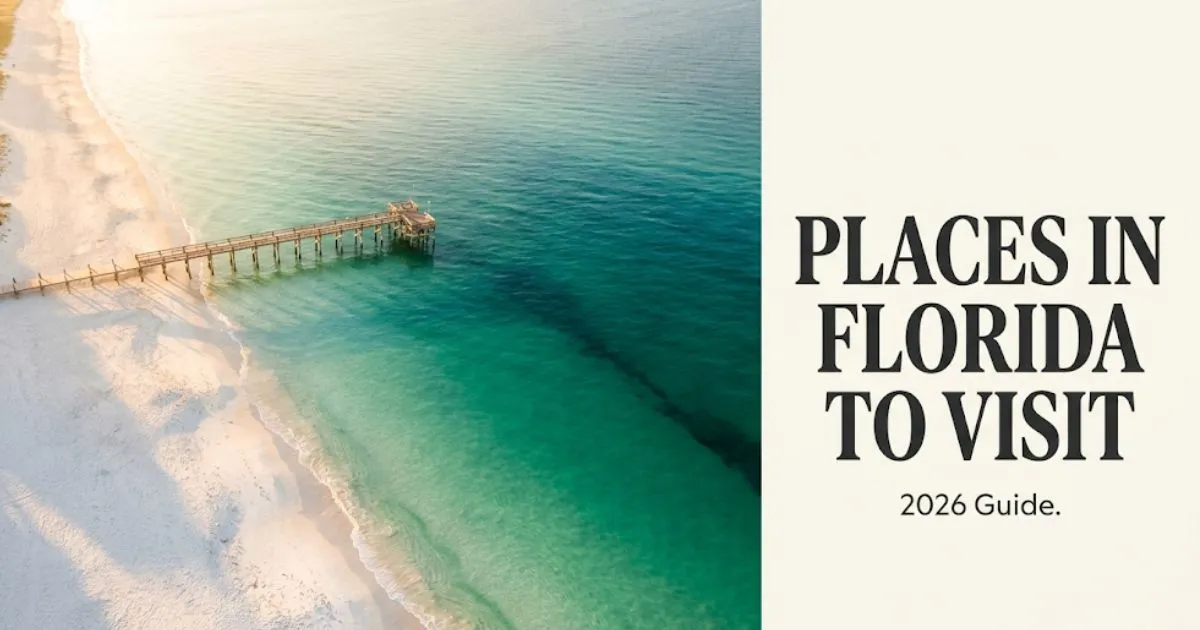
This guide covers the coolest, most interesting, and most fun places in Florida to visit in 2026. It is organized by travel style, region, season, and traveler profile so you finish reading knowing exactly where to go.
Places in Florida to Visit: How to Choose the Right Destination
The most important decision in planning a Florida trip is choosing which part of the state matches your priorities, not just which city sounds familiar.
Florida divides into six distinct travel zones. The Gulf Coast delivers calm, warm water and the state’s most praised sunsets. The Atlantic Coast offers stronger surf and a different beach town energy.
Central Florida is theme park country, centered on the I-4 Corridor from Orlando to Tampa. North Florida holds the state’s history capital in St. Augustine and its freshwater springs systems inland.
South Florida means Miami, the Everglades, and a cosmopolitan energy unlike anywhere else in the state. The Florida Keys form their own world: a 113-mile island chain that requires a specific logistical approach and a higher travel budget.
Use the table below to match your travel priorities to the right destination zone.
| Destination Zone | Best For | Cost Tier | Peak Season | Standout Feature |
|---|---|---|---|---|
| Gulf Coast | Beach vacations, families, couples | Mid to premium | Nov to April | Calm water, white sand, sunsets |
| Atlantic Coast | Surfing, history, budget beach | Budget to mid | Year-round | St. Augustine, surf culture |
| Central Florida | Theme parks, first-time families | Mid to premium | Summer, school breaks | Walt Disney World, Kennedy Space Center |
| North Florida | Springs, nature, budget | Budget to mid | Spring and fall | Crystal River, Ichetucknee Springs |
| South Florida | Urban culture, art, nightlife | Premium | Nov to April | Wynwood Walls, Everglades, Biscayne |
| Florida Keys | Reef snorkeling, diving, romance | Premium | Nov to April | Dry Tortugas, John Pennekamp reef |
Solo travelers benefit from Miami and St. Petersburg’s walkable urban cores. Families get the most logistical ease from Gulf Coast beach towns and Central Florida. Seniors traveling in winter find the Gulf Coast’s calm water and flat terrain the most accessible option statewide.
Coolest Places to Visit in Florida Right Now
The coolest places to visit in Florida in 2026 are the ones that most travel content has been slow to cover: St. Petersburg, Apalachicola, and Tarpon Springs represent the state at its most interesting.
St. Petersburg on Tampa Bay has built one of the strongest arts and food districts in the Southeast over the past decade. The Salvador Dali Museum on Beach Drive holds the largest collection of Dali’s work outside of Europe. The Imagine Museum nearby focuses on contemporary glass art and has no equivalent in Florida.
Admission to the Dali Museum runs approximately $25 to $30 per adult as of recent years. Downtown St. Pete is walkable, parking is manageable off Beach Drive, and the Tampa Bay ferry provides a scenic connection to Tampa’s Riverwalk.
Apalachicola on the Forgotten Coast suits couples and food-focused travelers best. Its oyster culture is specific to this estuary and has no equivalent elsewhere in Florida. The town has fewer than 2,500 residents but a restaurant quality-to-size ratio that challenges cities ten times its population.
Tarpon Springs on the Gulf Coast north of Tampa retains an active Greek sponge-diving heritage along the Dodecanese Boulevard sponge docks. It is not a recreated tourist experience. The Greek community has operated here continuously since the early 1900s.
Insider Tip:
- Visit St. Pete’s arts district on a Saturday when the St. Pete Saturday Morning Market runs along First Avenue Southeast from October through May
- Apalachicola oyster season peaks in fall and winter. Summer visits are warm and the oysters are good, but fall is the ideal pairing of weather and harvest
- Seniors traveling with mobility concerns will find St. Pete’s flat waterfront and Beach Drive the most accessible of these three options
Unique Places to Visit in Florida Beyond the Obvious Circuit
The most unique places to visit in Florida are those built around experiences you genuinely cannot replicate elsewhere in the continental United States.
Crystal River in Citrus County is the only place in the US where you can legally swim with wild manatees in their natural habitat. The Crystal River National Wildlife Refuge, managed by the US Fish and Wildlife Service, protects the freshwater springs where manatees winter from November through March. Guided tours from Kings Bay launch ramps operate with strict wildlife interaction guidelines.
Advance booking for manatee swim tours is essential from December through February. Tour prices run approximately $50 to $85 per person for a guided in-water experience. The experience is unsuitable for non-swimmers and requires comfort in open freshwater.
Dry Tortugas National Park, 70 miles west of Key West, is accessible only by the Yankee Freedom III ferry or by seaplane. The park contains Fort Jefferson, a 19th-century military fortification built on a coral island. The reef surrounding it ranks among the most pristine in North American waters.
Ferry reservations to Dry Tortugas sell out months in advance during peak season. Budget approximately $225 to $250 per adult for the round-trip Yankee Freedom III ferry as of recent pricing. Confirm current rates and availability directly with Yankee Freedom III before planning.
Weeki Wachee Springs State Park in Hernando County maintains an active mermaid show that has run continuously since 1947. It is genuinely unusual. The park also offers kayak rentals on the Weeki Wachee River, which flows through old-growth cypress corridor.
Insider Tip:
- Crystal River manatee numbers peak after the first cold snap of fall. Call Crystal River National Wildlife Refuge before booking to confirm current manatee presence
- Dry Tortugas is genuinely remote. Cell service is absent on the island. Bring everything you need, including sunscreen, in larger quantities than you think necessary
- Families with children under 5 should know the Dry Tortugas ferry is a 2.5-hour open-water crossing each way
Key Takeaway: Crystal River’s wild manatee swims and Dry Tortugas’ pristine reef are the two Florida experiences with no continental US equivalent. Both require advance booking well before your trip date.
Cool Places to Visit in Florida for Every Travel Style
Cool places to visit in Florida exist across every budget level and travel style. The state’s range is genuinely wide, from urban art districts to wilderness paddling routes.
Miami’s Wynwood neighborhood centers on the Wynwood Walls, a curated outdoor mural installation that has transformed a former warehouse district into the most photographed arts destination in Florida. Access to the Walls themselves is free during open hours. The surrounding Wynwood Walls Shop and Museum charge admission, running approximately $12 to $18 per adult as of recent years.
For couples seeking the Miami experience without the South Beach pricing and noise, Coconut Grove on Biscayne Bay offers waterfront dining, marina culture, and a genuinely quieter urban atmosphere. It is 15 minutes from South Beach but operates at a different register entirely.
Tampa’s Ybor City is the most historically specific neighborhood in Central Florida. The district’s Cuban cigar-manufacturing heritage from the late 1800s is documented at the Ybor City Museum State Park, with admission running approximately $4 to $5 per adult. The 7th Avenue entertainment corridor is the local bar and dining strip.
Pensacola on the Northwest Florida coast combines Gulf Islands National Seashore beach access (among the whitest sand in the state) with a Palafox Street arts and dining district. Fort Pickens, accessible via ferry from Pensacola Beach, is a Civil War-era fortification with some of the best sunset views in the Florida Panhandle.
Seniors and accessibility travelers should know that Pensacola’s Palafox Street is flat and walkable with accessible restaurant entrances. Gulf Islands National Seashore provides beach wheelchairs at Fort Pickens area on a first-come basis. Confirm availability with the National Park Service before visiting.
Fun Places to Visit in Florida for an Actual Good Time
Fun places to visit in Florida cover a wider range than the theme park-to-beach spectrum most people default to.
Clearwater Beach on the Gulf Coast delivers one of the most reliably pleasant Florida beach experiences without the premium pricing of Sarasota or Naples. Pier 60 at the center of the beach runs a nightly Sunsets at Pier 60 festival with street performers, artisan vendors, and a consistent crowd energy that requires no ticket and no planning. It runs every evening weather permitting.
Fort Lauderdale gets dismissed as Miami’s less-famous neighbor, but the Las Olas Boulevard dining and bar district and the city’s 165-mile inland waterway system make it a genuinely different experience. Water taxi access to restaurants along the waterway runs approximately $35 to $50 for a day pass.
St. Pete Beach maintains the classic Gulf beach town atmosphere that Clearwater Beach has partially lost to resort development. The Don CeSar Hotel, the pink landmark on the beach, offers bar access to non-guests and a swimming pool day-pass that runs approximately $50 to $60, which includes food and beverage credit.
Solo travelers in the 25-to-40 age range consistently identify St. Petersburg’s Central Avenue bar and restaurant corridor as one of Florida’s better scenes for meeting other travelers. The walkability and density of small independent bars and restaurants along Central Avenue between 9th and 4th Streets make it genuinely social in a way that resort beach towns are not.
| Fun Florida Destination | Best For | Cost Range Per Day | Insider Angle |
|---|---|---|---|
| Clearwater Beach | Families, couples, first-timers | $80 to $180 | Sunsets at Pier 60 is free nightly |
| Fort Lauderdale | Adults, water-lovers, couples | $100 to $220 | Water taxi all-day pass beats Uber costs |
| St. Pete Beach | Mixed groups, budget-conscious | $70 to $160 | Don CeSar pool day pass available to non-guests |
| Sanibel Island | Shell collectors, nature lovers | $120 to $250 | Lee Island Coast shell guide available free from Lee County Visitor Bureau |
| Dunedin | Couples, craft beer fans | $60 to $140 | Caladesi Island State Park ferry departs from Honeymoon Island |
Key Takeaway: Clearwater Beach’s free Sunsets at Pier 60 is one of Florida’s best no-cost evening experiences and beats any paid attraction in the immediate area for crowd energy and local character.
Interesting Places to Visit in Florida: History, Art, and Culture
The most interesting places to visit in Florida for history and culture are rarely the ones most heavily marketed.
St. Augustine is the oldest continuously occupied European settlement in the United States, established in 1565. The Castillo de San Marcos National Monument, managed by the National Park Service, is the oldest masonry fort in the continental US. Admission runs approximately $15 per adult as of recent years. The fort itself, not the tourist shops on St. George Street, is the reason to visit.
St. George Street is worth one walk-through, but experienced travelers know the better St. Augustine is found on Aviles Street (the oldest street in the US), in the Flagler College campus architecture, and at the Lightner Museum, housed in the former Alcazar Hotel built by Henry Flagler in 1888.
Sarasota holds two of Florida’s most credible cultural institutions. The Ringling Museum of Art on the former estate of circus magnate John Ringling houses a significant European art collection, a circus museum, and the Ca’ d’Zan mansion on Sarasota Bay. Admission runs approximately $25 to $30 per adult and covers all three sites.
According to Visit Florida, the Ringling complex draws over 400,000 visitors annually. The circus museum alone is one of the most specific cultural experiences in the state.
Couples find the Ca’ d’Zan mansion and Sarasota Bay views to be among the most genuinely atmospheric experiences in Southwest Florida. Solo travelers with an interest in art history should plan two to three hours for the art museum alone.
The honest assessment: Key West’s Duval Street is the most overrated “cultural” experience in Florida. It is a bar strip with a historic name. The genuinely interesting Key West is found at the Ernest Hemingway Home and Museum, the Key West Cemetery, and the quiet streets of the Bahama Village neighborhood south of Duval.
Places to Visit in Central Florida Beyond the Theme Parks
Central Florida’s best places to visit extend well beyond the I-4 Corridor theme park zone, but the theme parks are also not the monolith most travel content treats them as.
Kennedy Space Center Visitor Complex on Florida’s Space Coast (a 45-minute drive east of Orlando on State Road 528) is one of the genuinely irreplaceable Florida experiences. The Artemis-era launch viewing program, when launches are scheduled, represents an experience with no tourist equivalent anywhere in the civilian travel landscape. Admission runs approximately $75 to $80 per adult as of recent years.
New Smyrna Beach, 60 miles east of Orlando on the Atlantic Coast, is what Daytona Beach used to be before it became a racing destination. It has a downtown arts district on Flagler Avenue, consistently calm surf conditions, and a genuine small-town character that Central Florida’s theme park corridor entirely lacks.
Blue Spring State Park in Orange City (45 minutes north of Orlando) is the designated winter refuge for the St. Johns River manatee population. From November through March, the spring run is typically crowded with manatees. Swimming is permitted in summer. Admission runs approximately $6 to $13 per vehicle as of recent years.
Families using Orlando as a base should know that Kennedy Space Center is the single best full-day alternative to a theme park for children over age 7. Younger children get less from the experience. Budget travelers should note that Blue Spring State Park’s vehicle admission divided across a carload makes it one of the best-value nature days in Central Florida.
Insider Tip:
- Kennedy Space Center launch schedules are not guaranteed. Check NASA’s public launch schedule within 72 hours of your planned visit date
- New Smyrna Beach has a documented history of shark encounters, among the highest rates of any Florida beach. Avoid swimming at dawn, dusk, and directly in channel waters near the inlet
- The International Drive tourist corridor in Orlando is the area’s most overrated experience. Skip it unless a specific restaurant or attraction requires it
Key Takeaway: Kennedy Space Center is the most underutilized day trip from Orlando. It consistently outperforms the theme parks for travelers without young children and rivals them for families with kids over age 7.
Places to Visit on Florida’s Gulf Coast
Florida’s Gulf Coast places to visit stretch from Pensacola in the northwest to Marco Island in the southwest, covering five distinctly different travel zones.
The Emerald Coast from Destin to Panama City Beach in the Florida Panhandle delivers the Gulf’s most striking water color. The quartz-sand beaches at Henderson Beach State Park in Destin and Grayton Beach State Park near Santa Rosa Beach produce the water clarity that photographs at a Caribbean register. State park admission runs approximately $4 to $6 per vehicle.
Grayton Beach and neighboring Seaside (the master-planned community used as the filming location for “The Truman Show”) give travelers within the same beach corridor a choice between genuine natural beach character and an architecturally curated small town experience.
South of Tampa, Anna Maria Island sits between Bradenton and the Gulf. It retains a no-chain-restaurant, no-high-rise policy that most Gulf towns abandoned decades ago. Pine Avenue is the island’s commercial strip. It has eight miles of beach with free public access and free trolley service along the island’s length.
Sanibel Island, accessible via the Sanibel Causeway (toll approximately $6 to $7 per vehicle round-trip), holds the most shell-collecting beaches in North America. The “Sanibel stoop” is what locals call the characteristic bent-over posture of shell-hunting visitors along Bowman’s Beach and Turner Beach.
Couples consistently identify Anna Maria Island as one of the Gulf Coast’s best choices. It lacks the spring break crowds that hit Clearwater and Fort Myers Beach. Budget travelers should know that the island’s free trolley eliminates parking costs, which run $5 to $8 per hour at beach lots on competing Gulf towns.
According to Visit St. Pete/Clearwater, Clearwater Beach has ranked in the top five US beaches in the TripAdvisor Traveler’s Choice Awards for multiple consecutive years. That popularity is real. So is the summer crowd density.
Places to Visit in the Florida Keys
The Florida Keys require more planning than any other Florida destination, and that planning is worth doing correctly.
The Keys run 113 miles from Key Largo to Key West along the Overseas Highway (US-1). There is one road in and one road out. Hurricane evacuations and major events create traffic backups that can make a 30-mile drive take three hours. Plan accordingly.
Key Largo is the best Keys destination for underwater experiences. John Pennekamp Coral Reef State Park is the first undersea park in the US. It offers snorkel and dive trips directly from the park marina, with snorkel tours running approximately $30 to $45 per adult as of recent years. The park’s glass-bottom boat tours are the best option for non-snorkelers.
Islamorada calls itself the “Sport Fishing Capital of the World.” The claim is supported by the concentration of professional fishing guides, world-record catches documented by the International Game Fish Association, and the Florida Keys fishing tournament calendar. It suits fishing-focused travelers more directly than any other Keys destination.
Key West is the most visited and most tourist-priced destination in the Keys. The honest assessment is that Duval Street at night during spring break represents the least authentic version of Key West. The best Key West is the Bahama Village neighborhood for morning coffee at a local spot, the Hemingway Home for a legitimate historic experience, and the Mallory Square sunset celebration for a crowd scene that, despite its tourist nature, actually delivers.
Budget travelers should know the Keys are not the right choice for their profile. Mid-range hotel rooms in Key West run $250 to $450 per night during high season. The cheapest legitimate approach is camping at Bahia Honda State Park in the Middle Keys, which delivers one of the best beach views in Florida for the price of a state park campsite reservation.
Seniors should know that Key West’s Old Town is flat and walkable, but the heat from May through September makes midday outdoor activity genuinely uncomfortable for anyone with heat sensitivity. November through March is the ideal window.
Cool Places in Florida to Visit for Nature Lovers
Florida’s nature-based destinations are among the most underused travel resources in the continental US.
The Florida springs system includes over 1,000 natural springs statewide, with the highest concentration in the Suwannee River basin and the Ocala region. Ichetucknee Springs State Park near Fort White offers a 3-mile tube float down a spring-fed river through old-growth forest, with water temperatures holding at a consistent 68 degrees year-round. Admission runs approximately $6 per vehicle.
Ichetucknee is genuinely one of the best free-floating experiences in the US. The catch: tube rental requires advance planning (tubes are rented at access points but sell out on weekends). Arrive before 9 a.m. on summer and spring weekends. The park closes when it reaches daily capacity.
Silver Springs State Park near Ocala offers glass-bottom boat tours over the largest first-magnitude spring system in the world. The springs produce 550 million gallons of water daily, according to the Florida Department of Environmental Protection. Tours run approximately $12 to $15 per adult.
Corkscrew Swamp Sanctuary, managed by the Audubon Society near Naples, protects the largest remaining old-growth bald cypress forest in North America. The 2.5-mile boardwalk through the swamp is one of the genuinely irreplaceable Florida experiences. Admission runs approximately $14 to $17 per adult as of recent years.
Fakahatchee Strand Preserve State Park adjacent to the Big Cypress region is where Florida’s ghost orchid grows. It is a serious wilderness. Boardwalk access is provided, but the deeper swamp requires guided exploration.
Families with children should note that Ichetucknee Springs tube float requires children to be comfortable in open water. Life jackets are mandatory for children under a specific weight threshold. Confirm current guidelines with the park directly.
Key Takeaway: Ichetucknee Springs is Florida’s best nature experience per dollar spent. A family of four can spend a full day for the cost of one theme park ticket.
Unique Places in Florida to Visit for History and Culture
Florida’s history runs deeper and stranger than most visitors realize, and the best historical destinations are specific enough to be genuinely engaging.
Pensacola’s Historic Pensacola Village preserves structures dating to Florida’s British and Spanish colonial periods. The district is managed by the University of West Florida and contains the oldest building in Pensacola, the 1800s-era Lavalle House. The village admission runs approximately $8 to $10 per adult as of recent years.
Pensacola’s Palafox Street gives history travelers a walkable urban spine connecting the historic village with the downtown arts district. The National Naval Aviation Museum at Naval Air Station Pensacola is free to enter and holds one of the most comprehensive collections of US naval aircraft in the world, with over 150 restored aircraft displayed.
Ybor City in Tampa tells a specific American immigrant story. The neighborhood was built by Cuban, Spanish, and Italian cigar workers in the 1880s and 1890s. At its peak, Ybor City factories produced over 500 million cigars per year. The Ybor City Museum State Park on 9th Avenue documents this history with admission running approximately $4 to $5.
The Ybor City Historic District on 7th Avenue is now primarily an entertainment corridor. The genuine historical substance is in the morning hours before the bars open, when the architecture and museum context are primary.
Couples focused on history and culture will find Pensacola and St. Augustine the two most substantive Florida destinations for this travel type. Both are walkable, both have serious historical depth, and both have quality restaurant options concentrated enough to build a trip around.
According to the St. Augustine, Ponte Vedra and The Beaches Visitors and Convention Bureau, the Castillo de San Marcos receives over 600,000 visitors per year, making it one of the most-visited national monuments in the Southeast. The site earns that number.
Best Small Towns in Florida to Visit
Florida’s best small towns offer the state’s most authentic travel experiences, typically at a fraction of the cost of its major destinations.
Cedar Key, a cluster of barrier islands in Levy County on the Gulf Coast, sits at the end of State Road 24, 60 miles west of Gainesville. It has 700 residents, a commercial clam aquaculture industry, and a waterfront district on Dock Street that runs roughly four blocks. The Cedar Key Museum State Park tells the story of the town’s pencil manufacturing history, which once supplied a significant portion of American pencil production.
Cedar Key suits couples, solo travelers, and anyone who finds the phrase “completely authentic fishing village” meaningful. It does not suit travelers who want amenities, reliable cell service, or more than one evening’s entertainment options.
Fernandina Beach on Amelia Island in northeast Florida is the most polished small town in the state. Centre Street is the commercial heart. The town has a working shrimp boat fleet at the harbor, a Victorian historic district, and Fort Clinch State Park at the north end of the island with Civil War-era fortifications accessible for approximately $6 per vehicle.
Everglades City at the western edge of Everglades National Park serves as the Gulf Coast entry point to the Ten Thousand Islands, one of the largest mangrove estuaries in the world. Kayak and canoe rentals are available through multiple outfitters in town. It is not a tourist town that happens to have a park nearby. It is a gateway community where the park is genuinely the entire reason to be there.
Budget travelers should note that Cedar Key and Everglades City both operate at a lower price point than any beach town of similar character. The trade-off is limited accommodation options, requiring advance booking even in shoulder season.
Places to Visit in Florida in Winter vs. Summer
The best time to visit Florida depends entirely on where you are going and what you can tolerate.
Winter (November through April) is the correct answer for the Gulf Coast, the Florida Keys, Miami, and any outdoor-focused itinerary. Temperatures run 65 to 80 degrees across most of the state. Humidity drops to manageable levels. Hurricane risk is minimal. The trade-off is peak pricing and maximum snowbird crowds at Gulf Coast beach towns.
Visit Florida identifies the December through February window as high season for Gulf Coast and Keys destinations, with hotel rates running 40 to 80 percent above off-season pricing at comparable properties.
Summer (June through August) is when Florida’s springs shine brightest. The 68-degree spring water contrasts sharply with 95-degree air temperatures, making a float down Ichetucknee or a swim at Ginnie Springs one of the most genuinely refreshing experiences available anywhere in the US Southeast.
The honest reality of Florida summer: Atlantic and Gulf beach destinations are manageable in the morning hours. By midday, heat and humidity make extended beach time uncomfortable for most travelers who are not acclimatized. Plan outdoor activity before 11 a.m. and after 4 p.m.
Spring break (late February through mid-March) turns Panama City Beach, Fort Lauderdale beach, and Key West’s Duval Street into scenes that do not match most travel itineraries outside the 18-to-24 demographic. The Panhandle beaches and South Beach are genuinely impacted. Gulf Coast towns from Sarasota south are less affected.
Families traveling in summer get better value and fewer crowds at springs destinations than beach towns. Seniors should plan Gulf Coast and Keys trips firmly in the November through March window and avoid outdoor activity in Florida between June and September.
| Season | Best Florida Destinations | Worst Florida Destinations | Reason |
|---|---|---|---|
| Nov to April | Gulf Coast, Keys, Miami | N/A | Mild temps, low humidity, manageable crowds |
| June to August | Florida Springs, Space Coast | Gulf beach towns at midday | Springs are refreshing; beach towns are brutal in peak heat |
| Spring Break | Any non-beach destination | PCB, Fort Lauderdale Beach, Duval St | Crowd density at party destinations |
| September to October | Any destination | Hurricane-risk coastal areas | Shoulder pricing, lower crowds, but storm risk remains |
Key Takeaway: October is the single best month for Gulf Coast travel: summer pricing has dropped, crowds have thinned, water temperatures are still warm, and hurricane frequency decreases significantly after mid-October.
Fun Places to Visit in Florida for Families
Florida’s most fun places to visit for families are not always the most expensive ones, and the theme parks are not always the best choice for every family configuration.
Disney World’s Magic Kingdom in Lake Buena Vista remains the highest-capacity family attraction in Florida and delivers what it promises for children aged 4 to 12 with genuine consistency. Admission runs approximately $109 to $200 per adult per day as of recent pricing tiers, with pricing varying by date. Book as far in advance as possible. The Lightning Lane systems require planning beyond the gate admission.
The honest comparison: one day at Kennedy Space Center at approximately $75 to $80 per adult delivers a more substantive educational experience for children over 8 than many theme park days at twice the cost.
Fort Wilderness at Walt Disney World and Bahia Honda State Park in the Middle Keys offer camping experiences that reduce Florida family vacation costs dramatically while delivering legitimate outdoor access.
Homosassa Springs Wildlife State Park north of Tampa is one of Florida’s most underrated family destinations. The park provides rehabilitation habitat for injured manatees, black bears, Florida panthers, and West Indian flamingos. Admission runs approximately $13 per adult and $5 per child as of recent years. Children consistently rate the manatee underwater viewing area as a highlight.
Families with children under 5 should prioritize Gulf Coast beach towns with calm, shallow water entry over Atlantic Coast beaches. The Gulf’s gentle surf at Clearwater Beach, Siesta Key, and Anna Maria Island is significantly safer for toddlers than Atlantic beach break.
Insider Tip:
- Disney World’s rope drop strategy (arriving at park open and targeting the highest-demand rides first) still outperforms Lightning Lane purchases for families arriving on time
- Homosassa Springs Wildlife State Park is the best Florida family destination that no major travel publication has covered at its actual quality level
- Families staying in the Kissimmee corridor south of Orlando get cheaper accommodation than staying on I-Drive, with comparable theme park access
Affordable Places to Visit in Florida
Affordable places to visit in Florida exist across the state, but they require knowing which experiences deliver value and which tourist pricing offers nothing proportional to the cost.
Florida’s State Parks system is the foundation of budget Florida travel. The system includes over 175 parks with admission typically running $4 to $8 per vehicle. Caladesi Island State Park near Dunedin, reachable by ferry from Honeymoon Island State Park (ferry approximately $12 to $14 per adult round-trip as of recent years), consistently ranks among the top US beaches and charges a fraction of what any private resort nearby costs.
Ginnie Springs in Gilchrist County near High Springs charges approximately $15 to $20 per adult for full-day access to a freshwater spring system with tubing, snorkeling, and cave diving. It is privately operated and open year-round. The spring water clarity makes it one of the most photographed freshwater sites in Florida.
St. Petersburg’s free cultural access includes the Florida Holocaust Museum (admission approximately $14 to $16 per adult, with some free hours monthly), the waterfront Vinoy Park for sunset gathering, and the Saturday Morning Market on First Avenue Southeast from October through May with no admission fee.
Budget travelers should know that the worst value in Florida is a Gulf beach rental from Memorial Day through Labor Day weekend. The same property at the same quality level runs 50 to 60 percent less in September and October, and the beach experience is materially better with fewer people on it.
Panama City Beach offers the lowest accommodation pricing of any Florida Gulf beach destination. Outside of spring break, the pricing is budget-friendly. The beach quality at St. Andrews State Park within Panama City Beach is genuine. The International Drive-style commercial strip along Front Beach Road is not worth your time.
The Florida Trail system offers free hiking access across the state, with the Apalachicola National Forest section providing multi-day backpacking routes through longleaf pine habitat that most Florida visitors have never considered.
Safety and Practical Warnings for Florida Travel
Florida’s physical environment presents specific risks that travel brochures consistently understate.
Rip currents are the leading cause of coastal rescue calls at Florida beaches. Atlantic Coast beaches carry higher rip current risk than Gulf beaches due to wave energy and underwater topography. Always swim near a lifeguard station and look for posted flag warnings before entering the water.
Key safety and practical facts every Florida visitor should know:
- Never enter freshwater bodies in Florida without checking for alligator activity. Alligators inhabit every body of freshwater in the state, including retention ponds in suburban areas
- Sun exposure in Florida is more intense than most visitors anticipate. SPF 50 sunscreen applied every 90 minutes is the standard recommendation, not the cautious one
- Hurricane season runs June 1 through November 30. Travel insurance covering trip cancellation and evacuation is strongly advisable for Florida travel during this period
- New Smyrna Beach near the Ponce de Leon Inlet has documented high shark encounter rates. Avoid swimming near channel entrances, at dawn, or at dusk
- Florida panther crossing zones on US-41 (Tamiami Trail) and SR-29 in South Florida require reduced nighttime speeds. Vehicle collisions are the primary cause of Florida panther mortality
- Cell service in Everglades National Park and Fakahatchee Strand is unreliable to absent. Download offline maps and inform someone of your route before entering
For emergencies in Florida state parks, contact the Florida State Parks system at 850-245-2157. For marine emergencies off Florida’s coast, contact the US Coast Guard at 305-535-4300 (Miami sector) or 850-453-8545 (Pensacola sector).
Frequently Asked Questions About Places in Florida to Visit
What are the best places to visit in Florida for the first time?
First-time visitors to Florida get the most complete picture of the state from a combination of St. Augustine, Clearwater Beach, and the Everglades.
These three destinations represent Florida’s history, its Gulf Coast beach character, and its natural ecosystem in distinct and non-overlapping ways.
A road trip connecting Jacksonville to St. Augustine to Tampa to Clearwater to Naples to the Everglades can be completed in 7 to 10 days with genuine depth at each stop.
What is the most unique place to visit in Florida?
The most unique place to visit in Florida is Crystal River, where wild manatee swims in the Crystal River National Wildlife Refuge are legal and guided.
No other location in the continental United States offers a managed wild encounter with West Indian manatees in their natural freshwater habitat.
Dry Tortugas National Park is a close second, accessible only by ferry or seaplane 70 miles from Key West.
What part of Florida has the best beaches?
The Gulf Coast has the best beaches for calm water, white sand, and sunset views, with Siesta Key, Caladesi Island, and Anna Maria Island consistently outperforming more crowded Gulf options.
The Panhandle beaches at Grayton Beach State Park and Henderson Beach State Park in Destin match the Gulf’s best for sand quality.
Atlantic Coast beaches have stronger surf, with Cocoa Beach and New Smyrna Beach offering a different character better suited to surfing than swimming.
What are the best places to visit in Florida in winter?
The best places to visit in Florida in winter are the Gulf Coast beach towns from Clearwater to Naples, the Florida Keys, and Miami, all accessible from November through April at their most comfortable temperatures.
Winter is peak season for these destinations, which means advance hotel booking is necessary, and pricing runs at its annual high.
Blue Spring State Park in Orange City is the single best winter-specific experience in Florida: manatee numbers peak from December through February in the warm spring run.
What are the cheapest places to visit in Florida?
The cheapest Florida destinations are those centered on the state parks system, including Ichetucknee Springs State Park, Caladesi Island State Park, and Bahia Honda State Park in the Middle Keys.
Cedar Key on the Gulf Coast and Everglades City at the park’s western entrance operate at budget pricing with genuine character and no resort markup.
Florida’s shoulder seasons of September through October and April through May deliver the best value across all destinations, with prices 30 to 50 percent below peak rates and meaningfully smaller crowds.
What are the most fun places in Florida to visit with kids?
The most fun Florida destinations for families with children are Clearwater Beach for Gulf swimming, Kennedy Space Center for kids over 7, and Homosassa Springs Wildlife State Park for animal encounters.
Walt Disney World’s Magic Kingdom delivers for children aged 4 to 12, but at a significantly higher daily cost than most alternatives.
Families with toddlers specifically should prioritize calm Gulf water entry at Clearwater or Anna Maria Island over Atlantic beaches, where wave conditions are more challenging for young swimmers.
Planning Your Florida Trip: Start Here
Florida rewards planning more than almost any other US destination. The gap between a trip built around advance reservations for Dry Tortugas, Ichetucknee’s weekend capacity limits, and the right seasonal timing, versus a trip booked last-minute to a resort corridor in July, is the difference between an extraordinary experience and an expensive one.
Book the Yankee Freedom III ferry to Dry Tortugas and Ichetucknee Springs timed-entry weekends as far in advance as your schedule allows. Confirm manatee presence at Crystal River and Blue Spring directly with each park before travel. For Gulf Coast beach towns, the October to November window delivers the best combination of lower pricing, manageable crowds, and warm water.
Travel conditions, park hours, ferry schedules, admission prices, and seasonal availability change year to year. Verify all logistics directly with Visit Florida, the Florida State Parks system, and each attraction’s official website before your departure. Your best Florida trip starts with a plan built around what genuinely interests you, not what’s most advertised.