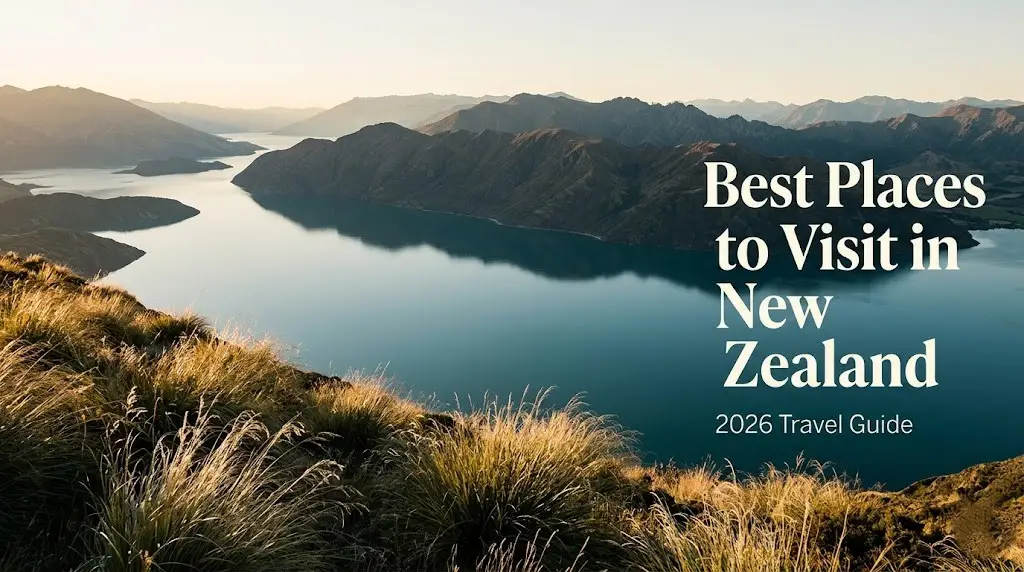
Best Places to Visit in New Zealand: 2026 Travel Guide

New Zealand packs more geographic variety into its two main islands than most countries manage across an entire continent, and knowing which of its best places to visit actually matches your travel style is the difference between a trip that exceeds expectations and one that costs a great deal for a generic outdoor holiday. The country’s most marketed destinations, Queenstown above all, are genuinely worth visiting, but New Zealand’s real range runs from the geothermal drama of Rotorua’s volcanic plateau to the Maori cultural depth of the Bay of Islands, from Wellington’s compact, serious restaurant and museum scene to the whale-filled waters off Kaikoura’s Seaward Kaikoura Range coast.
According to Tourism New Zealand, the country receives well over four million international visitors annually in pre-pandemic years, with US travelers consistently representing one of the top five source markets. The country operates on a late spring through summer peak between December and February (the Southern Hemisphere summer), which matters significantly for planning because Great Walk bookings through the Department of Conservation New Zealand (DOC) fill months in advance for that window, and Queenstown and Milford Sound prices spike considerably.
This guide covers the country’s standout destinations for 2026 travel, organized by region and traveler profile, with honest seasonal guidance, cost context, and the practical logistics that most New Zealand travel content glosses over. It also addresses what most visitors get wrong, which destinations are genuinely overused relative to better alternatives nearby, and how to structure a trip that covers the country’s range without the rushed quality of a greatest-hits circuit.
Best Places to Visit in New Zealand: How to Choose Where to Go
The best places to visit in New Zealand depend almost entirely on what kind of traveler you are, how much time you have, and which season you’re traveling in.
New Zealand divides cleanly into two main island experiences. The North Island is warmer, more culturally layered, and easier to navigate with young children or travelers who want a mix of cities, Maori cultural experiences, geothermal landscapes, and beach time. The South Island is where the country’s alpine drama concentrates: Fiordland, the Southern Alps, the Marlborough wine country, and the wildlife-dense coastline around Kaikoura. Most international visitors with two weeks try to cover both islands, which is achievable but requires disciplined itinerary planning.
Think of the choice this way: if you visited New Zealand and only saw the South Island, you’d see some of the most dramatic mountain and fjord scenery in the Southern Hemisphere but miss the volcanic landscapes, Maori cultural depth, and city character that make the North Island genuinely different from any other destination on earth. If you only saw the North Island, you’d miss the alpine scenery that defines New Zealand’s international image entirely.
Destination Overview by Traveler Profile:
| Destination | Best For | Cost Tier | Best Season | Key Access Note |
|---|---|---|---|---|
| Queenstown | Adventure travelers, couples | Premium | Oct to Apr | Flies direct from AKL, CHC |
| Auckland | First-timers, families | Mid-range | Year-round | Main international gateway |
| Rotorua | Families, cultural travelers | Mid-range | Year-round | 3 hours from Auckland |
| Wellington | Culture, food travelers | Mid-range | Oct to Apr | Ferry hub to South Island |
| Milford Sound | All types (day trip) | Premium | Oct to Apr | Book cruises 4 to 8 weeks out |
| Wanaka | Couples, hikers | Mid-range | Oct to Apr | 1 hour from Queenstown |
| Kaikoura | Wildlife travelers, couples | Mid-range | Year-round | 2.5 hours from Christchurch |
| Abel Tasman | Kayakers, hikers, couples | Mid-range | Nov to Apr | Ferry or water taxi from Marahau |
| Bay of Islands | Families, sailors | Mid-range | Nov to Apr | Fly from Auckland to Kerikeri |
| Christchurch | First-timers, families | Mid-range to budget | Year-round | South Island gateway |
North Island vs South Island New Zealand: Which to Prioritize
Deciding between the North Island and South Island of New Zealand is the single most important structural decision in any New Zealand trip, and most travel guides handle it vaguely.
The North Island covers roughly 44,000 square miles and holds Auckland, Rotorua, Wellington, the Bay of Islands, the Coromandel Peninsula, and Tongariro National Park. The South Island covers about 58,000 square miles and holds Queenstown, Milford Sound, Fiordland, Abel Tasman, Kaikoura, Christchurch, Nelson, Wanaka, and the Marlborough wine region. The South Island has more of what defines New Zealand’s international image. The North Island has more of what makes New Zealand genuinely distinct from other alpine destinations.
Travelers with less than 10 days face a real choice. A focused North Island trip (seven to eight days) covering Auckland, Rotorua, Tongariro, and Wellington is coherent and deeply satisfying. A focused South Island trip (seven to eight days) covering Christchurch, Kaikoura, Queenstown, Milford Sound, and Wanaka is equally coherent. Attempting to cover both islands in under 10 days produces a rushed experience that does justice to neither.
Honest assessment for families with young children: The North Island is the stronger family choice. Auckland has kid-accessible aquariums and parks. Rotorua’s geothermal parks and Hobbiton are universally engaging for children old enough to walk tours. The South Island’s most iconic experiences, including the Milford Track, the Tongariro Alpine Crossing, and extended Fiordland hiking, require physical capabilities beyond most children under 10.
For adventure-seeking couples or solo travelers in their 20s and 30s: The South Island prioritization is natural, with Queenstown as the base and Wanaka, Fiordland, and Kaikoura as day trips and short extensions.
Insider Tip:
Connect the two islands via the Interislander or Bluebridge ferry between Wellington and Picton. The three-hour Cook Strait crossing itself is a scenic experience through the Marlborough Sounds, and it saves a domestic flight. Book vehicle spaces on the ferry well in advance for the December through February period, when the crossing is popular with both tourists and New Zealanders taking summer holidays.
Auckland New Zealand: The Country’s Gateway City
Auckland is New Zealand’s largest city and the entry point for most international visitors, but staying too long or dismissing it too quickly are equally common mistakes.
The city sits on a narrow isthmus between the Waitemata Harbour and the Manukau Harbour, surrounded by 53 volcanic cones including the distinctive Rangitoto Island visible from the waterfront. The central Viaduct Harbour area has evolved well beyond its original America’s Cup marina reputation into a genuine restaurant and bar district with serious seafood and a waterfront character unlike any other New Zealand city. The Ponsonby Road neighborhood, a 20-minute walk west of the CBD, is where Auckland’s independent café culture, weekend farmers markets, and genuinely good Thai, Mexican, and Pacific Rim restaurants concentrate.
For most international itineraries, two days in Auckland strikes the right balance. A half-day spent at Auckland Museum in the Auckland Domain covers the country’s Maori and Pacific heritage with depth and quality that rivals Te Papa in Wellington. The Sky Tower observation deck is worth the admission for orientation, but avoid the in-house restaurant. Waiheke Island, a 35-minute ferry ride from the Quay Street ferry terminal, is Auckland’s genuinely distinctive day trip: an island with boutique wineries, olive groves, and pohutukawa-lined beaches that bears no resemblance to anything else in the North Island.
For families with children: Auckland Zoo and Kelly Tarlton’s Sea Life Aquarium are both genuinely well-programmed and worth a half-day each. The waterfront playgrounds near the Wynyard Quarter are excellent for children under eight.
For budget travelers: The Auckland Domain, Ponsonby Road’s café strip, and the Waiheke Island ferry are among the best-value experiences the city offers. The Sky Tower admission is the one cost worth absorbing for orientation purposes.
According to Auckland Tourism Events and Economic Development (ATEED), Auckland hosts more than 40% of New Zealand’s population, giving it a multicultural food scene that genuinely reflects the Pacific, Maori, Asian, and European communities that define the city.
Rotorua New Zealand: Geothermal Landscapes and Maori Culture
Rotorua offers a combination of geothermal activity, Maori cultural experience, and adventure tourism that has no equivalent anywhere else in New Zealand and few equivalents globally.
The city sits on the southern shore of Lake Rotorua in the heart of the Taupo Volcanic Zone, and its geothermal character is not subtle. Sulfur steam rises from roadside vents. The lake’s thermal springs are visible from the main street. Wai-O-Tapu Thermal Wonderland, about 30 kilometers south of the city center, is the region’s most visually dramatic geothermal park: the Champagne Pool’s orange-rimmed volcanic crater and the Lady Knox Geyser’s daily eruption are both specific experiences that earn descriptions you won’t find elsewhere in the country.
Te Puia in Rotorua itself combines a living geothermal environment with the New Zealand Maori Arts and Crafts Institute, where visitors can watch master carvers and weavers working in traditional forms. This is not a performance for tourists. The institute is a functioning school for traditional Maori arts with a 60-year history, and the quality of work on display reflects that. An evening hangi feast with cultural performance at Te Puia or at Tamaki Maori Village gives New Zealand-specific cultural depth that no other destination in the country provides at the same scale.
For families: Rotorua is one of New Zealand’s strongest family destinations. The geothermal parks engage children of nearly any age. The luge run on Ngongotaha Mountain is a specific hit with children aged seven and older. Hobbiton in Matamata, 45 minutes west of Rotorua, draws every traveler with any connection to Peter Jackson’s films but genuinely delivers as a production-quality experience for non-fans as well.
Practical logistics: Rotorua sits roughly three hours south of Auckland by road, or 45 minutes by domestic flight. Most geothermal parks charge admission in the range of NZD 35 to NZD 50 per adult, with family rates available. Verify current pricing directly with each attraction before visiting, as rates adjust periodically.
Key Takeaway: Rotorua is New Zealand’s strongest destination for families and cultural travelers, and combining it with Hobbiton and Wai-O-Tapu makes a two-day North Island segment that no comparable destination in the country matches for variety.
Bay of Islands New Zealand: Maritime History and Subtropical Coastline
The Bay of Islands sits at New Zealand’s subtropical north, about 240 kilometers north of Auckland, and its character is genuinely different from any other New Zealand destination.
The bay holds 144 islands and a coastline with a warmth and water clarity that the rest of New Zealand’s coast rarely matches. Paihia is the primary visitor base, a small town on the western shore with ferry access to Russell, the country’s first European settlement and now a remarkably well-preserved historic town with colonial-era buildings and a remarkably good restaurant scene for its size. The Waitangi Treaty Grounds on the Paihia waterfront is the site where the 1840 treaty between the British Crown and Maori iwi was signed, making it the most historically significant site in New Zealand. The cultural performances and grounds are genuinely moving and substantively informative in ways that most tourism sites are not.
Sailing and boat excursions through the bay are the region’s primary draw, and they are specific and worth the investment. A full-day sailing trip to the Cape Brett Lighthouse or through the Hole in the Rock at Piercy Island north of Russell covers scenery that is unique in New Zealand: subtropical coastline, resident bottlenose dolphin pods, and the kind of maritime wilderness that requires a boat to access.
For solo travelers and couples: The Bay of Islands is one of New Zealand’s more romantic and independent-travel-friendly destinations. The ferry between Paihia and Russell is cheap and runs frequently. The walking track along the Paihia Beach and through the Waitangi grounds can be done without a guide.
For families: The region’s relatively calm bay waters make kayak rentals and boat tours accessible for children old enough to participate in water activities. Russell’s beach is calm and child-friendly.
Practical access: Fly from Auckland to Kerikeri Airport (25 kilometers from Paihia) or drive approximately three hours from Auckland via State Highway 1. The drive is worthwhile for flexibility, as public transit options in the Bay of Islands are limited.
Wellington New Zealand: The Capital’s Serious Cultural Credentials
Wellington is consistently underestimated by first-time visitors to New Zealand who fly into Auckland, loop through Rotorua, and take the ferry south without spending real time in the capital.
The city is compact, genuinely walkable, and punches significantly above its size in museum quality, restaurant depth, and café culture. Te Papa Tongarewa, the Museum of New Zealand, sits on the Wellington waterfront and is one of the strongest national museums in the Southern Hemisphere: the Maori cultural collection, the geology and natural history exhibits, and the temporary exhibitions program are all at a standard that justifies half a day minimum. Admission is generally free for the permanent collection, though temporary exhibitions typically charge separately. Verify current access details before visiting.
Cuba Street is Wellington’s most characterful commercial strip: independent coffee roasters, secondhand bookshops, small live music venues, and a density of genuinely good restaurants per city block that is higher than anywhere else in New Zealand. The city’s coffee culture is specific and well-developed, the result of a long-established café scene that pre-dates the global specialty coffee wave. Arrive expecting good espresso from roasters who take the process seriously.
Wellington serves as the primary hub for the Interislander and Bluebridge ferry crossings to Picton on the South Island’s Marlborough Sounds shore. Crossing Cook Strait on a clear day is a specific scenic experience in its own right.
For culture and food travelers: Wellington is New Zealand’s strongest city for both. The restaurant scene is genuinely diverse and high-quality in ways that Queenstown’s tourist-oriented food infrastructure rarely is.
For budget travelers: Wellington’s free museum culture (Te Papa permanent collection), free waterfront access, and the walkability of the Cuba Street restaurant district make it one of New Zealand’s more budget-accessible cities for day activities.
For senior travelers and accessibility-focused visitors: Wellington’s flat waterfront area, accessible waterfront path, and low-step Te Papa access make it one of New Zealand’s most accessible cities for travelers with mobility considerations.
Queenstown New Zealand: The Adventure Capital and Its Honest Assessment
Queenstown is New Zealand’s most marketed destination and, for the right traveler, genuinely earns its international reputation as a center of adventure tourism.
The town sits on the shores of Lake Wakatipu with the Remarkables mountain range rising directly above the southern shore. The setting is dramatic in a specific way that photographs accurately represent. What photographs do not represent is that Queenstown’s main commercial strip, Shotover Street and the Mall, is now a dense tourist zone with international chains, activity booking desks, and queue-dependent restaurants that feels less like a New Zealand mountain town and more like a well-landscaped theme park approach. This is not a reason to skip it. It is a reason to plan around it.
The activities that make Queenstown worth the premium cost are specific and genuinely deliver. AJ Hackett’s Kawarau Bridge bungee at the historic Kawarau Gorge Suspension Bridge is the original commercial bungee jumping site in the world, and the 43-meter drop above the turquoise Kawarau River remains a distinctive experience after 35-plus years of operation. Shotover Jet on the Shotover River, carving through a narrow schist rock canyon at speed, is the single most viscerally thrilling water activity in New Zealand. The Remarkables and Coronet Peak ski areas provide world-class snow sport conditions from approximately June through September, with the Remarkables offering better intermediate terrain and Coronet Peak offering better access to groomed runs for mixed-ability groups.
For solo adventure travelers aged 20 to 40: Queenstown is the right choice and the social infrastructure of the hostel scene, the bar strip, and the activity booking culture supports solo travel well.
For families with young children under 10: Queenstown’s primary draws are adult-oriented. Most bungee, jet boat, and white-water operations have minimum age or weight requirements. The Queenstown Gardens and gondola to Bob’s Peak (with luge access) are family-appropriate alternatives.
For budget travelers: Queenstown is New Zealand’s most expensive town. Accommodation and restaurant costs run significantly higher than any other New Zealand destination. Travelers who want the alpine scenery without Queenstown’s price structure should seriously consider Wanaka, covered in the next section.
Key Takeaway: Queenstown genuinely delivers for adventure travelers and couples who plan specific activities rather than simply staying in the town itself. Budget at least three nights to absorb the activity schedule without feeling rushed.
Milford Sound and Fiordland National Park: What the Experience Actually Delivers
Milford Sound is New Zealand’s most visited natural attraction and one of the genuinely spectacular places in the Southern Hemisphere, but the gap between expectation and experience depends almost entirely on weather and advance planning.
Fiordland National Park, which contains Milford Sound (technically a fjord, not a sound), occupies the southwestern corner of the South Island and covers 1.2 million hectares of temperate rainforest, glacially carved fjords, waterfalls, and mountain terrain that receives minimal visitation compared to its scale. The drive from Te Anau to Milford Sound along the Milford Road is itself a significant part of the experience: the Homer Tunnel, the Gertrude Valley lookout, and the views across Lake Gunn deserve time. Allow at least three hours one way.
A Milford Sound cruise is the primary visitor activity and is worth doing, with one honest caveat: Milford Sound receives some of the highest rainfall of any inhabited place in New Zealand, and a grey, low-cloud day on the water still delivers impressive scale but none of the photographic drama that defines its international image. The waterfalls, including Stirling Falls and Bowen Falls, are actually more dramatic in heavy rain than on clear days because rainfall volume increases their output significantly. The fjord has its own character in any conditions.
Practical booking reality: According to the Department of Conservation New Zealand, the Milford Track (the four-day Great Walk through Fiordland) requires advance booking through the DOC system, typically opening in May or June for the October through April season. Bookings for the December through February window fill within hours of opening. Milford Sound cruise operators also run high occupancy in peak season. Book cruises four to eight weeks ahead for November through March travel.
For senior travelers: The cruise experience is fully accessible and requires no hiking. The Milford Road drive is manageable in a standard vehicle with careful attention to weather and rock fall advisories, which DOC posts at the tunnel entrance.
For solo travelers: Day tours from Queenstown or Te Anau include the drive and cruise in a single day. The journey is long (approximately five hours from Queenstown each way), but organized tour options manage the driving and timing efficiently.
Wanaka New Zealand: The Intelligent Alternative to Queenstown
Wanaka sits 68 kilometers northeast of Queenstown on the shore of Lake Wanaka, offers almost identical alpine scenery with none of Queenstown’s tourist infrastructure density, and costs meaningfully less for accommodation and dining.
The lake itself is large, calm, and surrounded by the Mount Aspiring National Park range in a visual configuration that many travelers who have visited both towns honestly prefer to Queenstown’s more dramatic but more crowded lakefront. The town has a genuine community character: independent coffee shops, quality restaurants that primarily serve locals alongside visitors, and a social pace that does not feel managed for throughput the way Queenstown increasingly does.
Roys Peak Track is Wanaka’s signature hike: an 8-kilometer trail with 1,279 meters of elevation gain that reaches a ridgeline view across Lake Wanaka and the Mount Aspiring range that is among the most rewarding day hikes in New Zealand. The track is not technically difficult but is physically demanding. Allow five to six hours return. Start early to avoid afternoon heat in summer and to beat the crowd that collects at the famous tree photograph spot halfway up.
Practical note: Roys Peak Track was operating a seasonal management system with a shuttle recommendation for peak summer months as of recent years. Check DOC’s current guidance before visiting, as crowd management policies at popular New Zealand tracks evolve regularly.
For couples: Wanaka is one of New Zealand’s strongest choices for a romantic short stay. The lakefront town character, accessible hiking, quality restaurant scene, and lack of the bachelor party and activity-booking-desk atmosphere that defines central Queenstown make it a genuinely more intimate environment.
For budget travelers: Accommodation in Wanaka generally runs 15 to 30% lower than equivalent options in Queenstown for the same travel period, making it a meaningful budget decision without sacrificing quality of experience.
Insider Tip:
Puzzling World in Wanaka is a specific and genuinely odd attraction that families and curious adults find more engaging than its name suggests. The Hologram Hall and tilted room installations are well-constructed. It is also significantly cheaper than most Wanaka and Queenstown paid activities.
Abel Tasman National Park: New Zealand’s Most Accessible Coastal Wilderness
Abel Tasman National Park on the northern tip of the South Island is New Zealand’s smallest national park by area and arguably its most accessible Great Walk destination, combining golden sand beaches, native bush, and protected coastal waters that are reached by sea kayak or water taxi rather than alpine terrain.
The Abel Tasman Coastal Track is one of New Zealand’s nine Great Walks and runs 60 kilometers along the coastline from Wainui Inlet in the north to Marahau in the south. Most visitors complete it over three to five days, staying at DOC huts and campsites. Unlike the Milford Track or Routeburn Track, which require significant alpine fitness and weather preparation, the Abel Tasman Coastal Track is almost entirely at sea level with moderate elevation changes, making it accessible to a broader range of fitness levels.
Sea kayaking the park’s coastline is the single most immersive way to experience it. Guided multi-day kayak tours operate from Marahau and allow access to beaches and coves that are impossible to reach by land. Fur seals haul out on rock platforms throughout the park’s coastline. The park’s marine reserve protects the waters around Tonga Island, where snorkeling near a seal colony is a specific and memorable experience.
For couples: Abel Tasman combines the romance of secluded beaches with genuine physical activity in a way that suits fit, active couples particularly well. A two-night guided kayak trip covering 40 to 50 kilometers of coastline is one of New Zealand’s better adventure-romance experiences.
For families with older children (10 and up): The Coastal Track’s gentler terrain and the water taxi option (which allows families to access specific beaches without completing the full track) make it workable for families with children who have reasonable hiking stamina.
Booking note: Great Walk hut and campsite bookings open through the DOC booking system in advance. For December through February travel, expect huts to fill within days of the booking window opening. Water taxi and guided kayak operators should be booked weeks ahead for peak season.
Key Takeaway: Abel Tasman is New Zealand’s most approachable multi-day wilderness experience and is genuinely better suited to fit couples and adventurous families than the more demanding Fiordland tracks.
Kaikoura New Zealand: Wildlife Encounters Without the Marketing Noise
Kaikoura sits on the South Island’s northeastern coast, two and a half hours north of Christchurch and three hours south of Nelson, and offers one of the most legitimate wildlife-watching experiences in the Southern Hemisphere with far less infrastructure and visitor volume than any equivalent New Zealand destination.
The town’s marine environment is exceptional for a specific oceanographic reason: the Kaikoura Canyon, a deep-sea trench that runs close to the shore, creates an upwelling of nutrient-rich water that supports year-round populations of sperm whales, pods of dusky dolphins, New Zealand fur seals, and seasonal visits from humpback and blue whales. Whale Watch Kaikoura operates whale watching tours that have a strong record of sperm whale encounters at close range. The company is Ngai Tahu Maori-owned and uses viewing protocols that minimize disturbance. Booking ahead is essential, as tours run on a limited-capacity model.
Dolphin swimming with Kaikoura’s resident dusky dolphin pods is a specific and high-quality experience for travelers comfortable in open water. The dolphins are genuinely curious and interactive in ways that managed aquarium and resort dolphin experiences cannot replicate.
The Kaikoura Peninsula Walkway is a three to four hour coastal circuit track that passes through fur seal haul-out areas, provides elevated views of the Seaward Kaikoura Range (snow-capped for most of the year), and requires no booking or admission. It’s one of New Zealand’s better free half-day experiences.
For senior travelers and accessibility-focused visitors: The whale watching boat tour is accessible for most mobility levels, as the catamaran vessel is stable and has indoor seating. The coastal walkway involves some uneven coastal terrain; the southern section is more accessible than the northern cliff sections.
For couples: Kaikoura has a quiet, working-town quality without Queenstown’s tourist saturation. A night or two on the coast, with whale watching in the morning and fresh crayfish (locally known as rock lobster) from one of the roadside seafood stalls for dinner, is a specifically satisfying New Zealand experience.
Christchurch and Canterbury New Zealand: The South Island Gateway Rebuilt
Christchurch is the South Island’s largest city and primary gateway, and its post-earthquake rebuilding over the past decade has produced a city with some of the most interesting contemporary architecture in the Southern Hemisphere alongside the historic stone remnants and gardens that defined it before the 2011 earthquake sequence.
The Christchurch Botanic Gardens in Hagley Park remain one of the city’s most reliable and genuinely beautiful free spaces. The gardens cover 21 hectares along the Avon River, and the rose gardens, conservatories, and river punting access make them worth at least two hours. The Avon River precinct (known locally as the Ōtākaro Avon River Corridor) is the most visible symbol of the post-earthquake rebuild: a former residential area transformed into a riverfront park with public art, native plantings, and community gathering spaces.
The International Antarctic Centre near Christchurch Airport is one of the better-programmed visitor attractions in the country and is particularly strong for families: the Hagglund vehicle rides, the Antarctic storm simulation room, and the resident little blue penguin colony (one of the few places to see this species reliably without a boat trip) make it a full half-day. Christchurch is the primary logistics hub for Antarctic expedition support, giving the centre a genuine operational context.
For families: Christchurch is one of New Zealand’s more family-friendly cities. The gardens, the Antarctic Centre, the free entry to the Canterbury Museum, and the flat central city terrain make it practically manageable with young children.
For budget travelers: Christchurch’s accommodation costs run lower than Queenstown and Wanaka. The city’s free cultural offerings (Botanic Gardens, Canterbury Museum permanent collection, Avon River precinct) make it one of New Zealand’s more budget-manageable urban stops.
Day trip potential: Akaroa, a French-influenced small town on the Banks Peninsula 80 kilometers from Christchurch, offers Hector’s dolphin swimming (the world’s smallest dolphin species) and harbor cruises in a setting that feels entirely unlike anywhere else in New Zealand.
Key Takeaway: Christchurch is the practical and logistical launch point for South Island travel, but it deserves at least two full days of its own, not just a one-night transit stop on the way to Queenstown.
Underrated Places to Visit in New Zealand
New Zealand’s most visited destinations are genuinely good, but several of the country’s most distinctive experiences concentrate in places that receive a fraction of the visitor attention of Queenstown or Milford Sound.
Dunedin and the Otago Peninsula deserve far more international attention than they receive. Dunedin is a Scottish-founded university city in the far south of the South Island with Victorian and Edwardian heritage architecture, a craft beer and specialty coffee scene driven by the student population, and the genuinely exceptional Otago Peninsula 20 kilometers from the city center. The peninsula is one of the few places on earth where visitors can observe royal albatross, yellow-eyed penguins, and New Zealand fur seals within a single day’s outing from a city. The Royal Albatross Centre at Taiaroa Head is the only mainland royal albatross breeding colony in the world. This is the kind of specific, irreplaceable wildlife experience that travelers fly to remote island destinations to find, available an hour from a city center.
Napier on the North Island’s Hawke’s Bay coast is New Zealand’s Art Deco capital: rebuilt almost entirely after a devastating 1931 earthquake, the city’s commercial center is one of the most intact collections of Art Deco architecture in the world, recognized by the New Zealand Historic Places Trust as a heritage of national significance. The annual Hawke’s Bay Art Deco Festival draws dress-up participants from across the country, but the architecture is worth visiting independently of any event. The wine region surrounding Napier produces some of New Zealand’s best Syrah and Chardonnay alongside the Marlborough-dominated Sauvignon Blanc narrative.
Golden Bay, at the northern tip of the South Island beyond Nelson and Takaka, has a remote, alternative-community character that attracts independent travelers willing to manage a winding mountain road crossing. The bay’s shallow, warm waters, forested hinterland, and the extraordinary Farewell Spit (a 26-kilometer sand spit that is one of New Zealand’s most significant bird habitats) make it a destination that rewards travelers who get there.
Taranaki on the North Island’s western coast centers on the perfectly conical Mount Taranaki, a dormant stratovolcano whose symmetrical profile genuinely earns the comparisons to Mount Fuji. The regional town of New Plymouth has a coastal walkway and an excellent art museum.
Best Time to Visit New Zealand
The best time to visit New Zealand is March through May or October through November, when shoulder-season conditions offer smaller crowds, lower prices, and weather that is comfortable for most outdoor activities.
Seasonal breakdown by travel priority:
| Season | Months | North Island | South Island | Crowd Level | Price Level |
|---|---|---|---|---|---|
| Summer (peak) | Dec to Feb | Hot, dry, busy | Warm, crowded hiking season | Very high | Premium |
| Autumn (shoulder) | Mar to May | Warm, golden foliage | Excellent hiking, quieter | Moderate | Mid-range |
| Winter | Jun to Aug | Cool, some rain | South Island skiing season | Low (except ski towns) | Lower (non-ski) |
| Spring (shoulder) | Sep to Nov | Warming, wildflowers | Opening of Great Walks season | Moderate | Mid-range to high |
December through February is peak season for a reason: New Zealand’s alpine environment is most reliably accessible for hiking, its beaches are warm, and its days are long. But the practical cost of peak season is significant: Great Walk bookings through the DOC system fill months in advance for this window, accommodation in Queenstown and Wanaka reaches peak pricing, and the most popular trails like the Tongariro Alpine Crossing experience daily traffic that reduces the sense of wilderness considerably.
March through April is New Zealand’s most underappreciated travel window. Autumn brings golden deciduous color (introduced European trees line many South Island roads), temperatures remain comfortable for hiking, Great Walk huts have availability, and accommodation pricing drops noticeably from the December through February peak.
For US travelers facing school holiday constraints: If you must travel in December through January, book accommodation and DOC Great Walk huts the moment the booking window opens (typically June for the upcoming summer season). Any delay risks either losing your preferred dates or paying significantly above median accommodation rates.
Winter caution for the South Island: June through August brings heavy snow to Fiordland passes and mountain roads. The Milford Road can close temporarily due to avalanche risk. South Island winter travel is suited to skiers based in Queenstown and Wanaka; it is not suited to travelers whose primary goals are Milford Sound, the Great Walks, or extended alpine hiking.
How to Get Around New Zealand
Getting around New Zealand requires a specific understanding of its road network and inter-island logistics that most travel guides understate significantly.
New Zealand drives on the left side of the road. For US drivers, the adjustment is manageable but requires conscious attention for the first day, particularly at intersections where the habit of looking left before right is the wrong instinct. International visitors may drive on a valid US driver’s license for up to 12 months, but carrying an International Driving Permit alongside your license is recommended and inexpensive to obtain through the American Automobile Association (AAA) before departure.
Renting a car or campervan is the practical standard for independent New Zealand travel and allows flexibility that domestic flights and bus passes cannot match. Rental cars are available from Auckland, Christchurch, and Queenstown airports. Campervans offer a combined transport and accommodation solution that suits travelers planning to move through multiple regions over 10 or more days. Book both well ahead for December through February travel, as rental stock is genuinely limited in peak season.
Driving time estimates require honest adjustment. A Google Maps estimate of two hours on a New Zealand road often takes two hours 45 minutes in practice, due to narrow roads, single-lane bridges (common on rural South Island roads, with passing rules posted at each bridge), mountain pass terrain, and stop frequency at viewpoints and wildlife areas.
Inter-island transport options:
- Interislander ferry: Wellington to Picton, approximately three hours. Vehicle and foot passenger bookings available. Scenic Marlborough Sounds entrance is a genuine highlight of the crossing.
- Bluebridge ferry: Same crossing route, typically slightly cheaper but with a less scenic Picton approach. Both operators require advance booking for vehicle spaces.
- Domestic flights: Air New Zealand and Jetstar operate services between Auckland, Wellington, Christchurch, Queenstown, Dunedin, and several regional airports. Flying between islands saves half a day versus the ferry but adds airport logistics and costs.
For senior travelers and accessibility-focused visitors: Rental car mobility gives access to destinations and flexibility that coach tours do not. However, driving on the left on unfamiliar mountain roads requires honest self-assessment of comfort level. Some travelers find a combination of self-drive for urban and coastal areas and guided transport for alpine sections (Milford Road, Tongariro access) to be the most practical approach.
Key Takeaway: Book your rental car or campervan at the same time you book your flights. New Zealand rental vehicle supply is genuinely constrained in peak season, and waiting until two months before departure for December through January travel risks either no availability or significantly elevated pricing.
New Zealand Travel Tips for First-Time Visitors
First-time visitors to New Zealand consistently make the same planning mistakes, and addressing them before you book saves both time and money.
Before you travel: US passport holders need a New Zealand Electronic Travel Authority (NZeTA) and must pay the International Visitor Conservation and Tourism Levy (IVL) before boarding a flight to New Zealand. Both are obtained online through the official Immigration New Zealand system. The process is straightforward but must be completed before departure. Attempting to sort this at the airport creates real problems. The IVL fee and NZeTA should be verified for current amounts directly with Immigration New Zealand, as fees are subject to adjustment.
Essential pre-departure bookings:
- Great Walk hut or campsite bookings through the DOC system (if hiking is planned)
- Milford Sound cruise operator reservation
- Interislander or Bluebridge ferry vehicle space
- Rental car or campervan (book early for Dec through Feb travel)
- Whale Watch Kaikoura (if Kaikoura is on the itinerary)
- Hobbiton Movie Set tours (sells out regularly in peak season)
Sun protection: New Zealand’s UV radiation levels are significantly higher than equivalent latitudes in the Northern Hemisphere due to lower ozone layer density in the Southern Hemisphere. The New Zealand Cancer Society consistently identifies New Zealand as having some of the highest melanoma rates in the world, in part because outdoor culture combines with intense UV exposure. Apply SPF 50 sunscreen daily, including overcast days. This is a genuine health point, not a routine travel recommendation.
Cell coverage: Mobile coverage in New Zealand’s urban areas and main highways is good. Coverage in Fiordland, Westland, and other remote areas is effectively absent. Download offline maps via Google Maps or Maps.me before entering areas like the Milford Road. Carry a paper map for remote South Island driving.
Currency and payment: The New Zealand dollar (NZD) is the local currency. Credit cards are widely accepted in cities and tourist areas. Carry some cash for freedom camping fees, rural accommodation, and farmers markets where card readers are less reliable.
For first-time visitors uncertain about the North Island versus South Island decision: The most consistently satisfying two-week first-timer itinerary concentrates on both islands with roughly five days on the North Island (Auckland, Rotorua, Wellington) and nine days on the South Island (Christchurch, Kaikoura, Queenstown, Wanaka, Milford Sound), connected by the Cook Strait ferry crossing. This is not the only valid structure, but it covers the country’s essential range without sacrificing depth at any single destination.
Safety and Practical Warnings for New Zealand Travel
New Zealand’s natural environments are genuinely spectacular, but several specific risks affect travelers who underestimate the country’s alpine weather patterns, UV intensity, and road conditions.
New Zealand’s mountain and coastal weather can change from clear to severe within hours, and the consequences of being caught unprepared on an exposed alpine track are serious.
Key safety and practical facts every visitor should know:
- Alpine weather changes rapidly. The Tongariro Alpine Crossing, Milford Road, and all South Island alpine tracks are subject to severe weather shifts with little warning. Check weather forecasts from MetService New Zealand on the morning of any alpine activity. Turn back if conditions deteriorate, regardless of how far into the track you are.
- The Tongariro Alpine Crossing is not a casual walk. The crossing is 19.4 kilometers with 1,200 meters of elevation change at volcanic terrain that reaches 1,886 meters at the Red Crater rim. It requires genuine hiking fitness, appropriate footwear (trail running shoes are the minimum; hiking boots are better), wind and waterproof layers, and at least six to eight hours of walking time. Shuttle booking is required as no private vehicle parking exists at the trailhead. Book the shuttle in advance.
- Sun exposure in New Zealand is more intense than most US travelers anticipate. Apply SPF 50 sunscreen daily, reapply every two hours outdoors, and wear a hat and UV-protective clothing for extended outdoor days.
- Rip currents affect New Zealand’s west coast and open-ocean beaches. New Zealand’s iconic surf beaches, including Piha west of Auckland and the South Island’s West Coast beaches, carry significant rip current risk. Swim between the flags at patrolled beaches only. Many New Zealand beaches are not patrolled and are not safe for swimming.
- Freedom camping regulations are location-specific and enforced. Not all New Zealand public land permits freedom camping. Using a self-contained vehicle with appropriate waste facilities is required at most freedom camping locations. Fines apply for non-compliance. Check the CamperMate app or DOC’s official freedom camping guidance before parking overnight in any unsignposted location.
- Drive rest requirements are serious on long South Island routes. The Milford Road is approximately 120 kilometers from Te Anau and involves mountain pass terrain where driver fatigue is a genuine accident risk. Stop at designated rest areas. Do not attempt long drives immediately after a long-haul international flight.
In any backcountry or remote area emergency, contact New Zealand emergency services on 111 (police, fire, ambulance). For mountain search and rescue, this number also coordinates the response. Carry a personal locator beacon (PLB) for multi-day backcountry hiking; PLBs are available for hire at outdoor equipment retailers throughout New Zealand.
Frequently Asked Questions About the Best Places to Visit in New Zealand
What are the best places to visit in New Zealand for first-time visitors?
For first-time visitors, the strongest New Zealand itinerary concentrates on Auckland, Rotorua, and Wellington on the North Island and Christchurch, Kaikoura, Queenstown, and Milford Sound on the South Island.
This combination covers the country’s geothermal landscapes, Maori cultural experiences, alpine scenery, wildlife encounters, and both of its most characterful cities.
Two weeks is the minimum time to cover both islands without feeling rushed.
How many days do you need to see New Zealand properly?
Two weeks (14 days) is the practical minimum to see both the North Island and South Island meaningfully.
Less than 10 days forces a choice between islands; choosing one and doing it well is preferable to rushing through both.
Travelers with three weeks can add the Marlborough wine region, Abel Tasman, and Dunedin without compromising depth at the primary destinations.
Should I visit the North Island or South Island first?
Most travelers visit the North Island first, flying into Auckland and working south before crossing to the South Island via the Cook Strait ferry from Wellington to Picton.
This route flows logically, saves on domestic flights, and includes the ferry crossing as a scenic experience rather than a logistics chore.
Travelers flying into Queenstown or Christchurch directly can reverse the order with no practical disadvantage.
What is the best time of year to visit New Zealand?
March through May and October through November are the best times to visit New Zealand for most travelers, offering shoulder-season pricing, smaller crowds, and comfortable temperatures for hiking.
December through February is peak season with the best beach and alpine trail weather but the highest prices and the most competitive Great Walk booking conditions.
June through August suits South Island skiers but limits Fiordland and Great Walk access.
Is New Zealand expensive to travel?
New Zealand is a mid-range to premium destination for US travelers, broadly comparable in daily costs to expensive US cities or Western Europe.
Queenstown is the most expensive destination in the country; travelers on tighter budgets who want alpine scenery will find Wanaka meaningfully more affordable.
Self-catering, freedom camping with a self-contained vehicle, and shoulder-season travel are the most effective ways to reduce costs without sacrificing the quality of core experiences.
Do US travelers need a visa to visit New Zealand?
US passport holders do not need a visa for New Zealand visits of up to 90 days but do need a New Zealand Electronic Travel Authority (NZeTA) and must pay the International Visitor Conservation and Tourism Levy (IVL) before departure.
Both are obtained online through the official Immigration New Zealand website and should be completed well before your travel date.
Verify current NZeTA requirements and IVL fee amounts directly with Immigration New Zealand, as requirements and fees are subject to change.
New Zealand trip planning rewards early action more than almost any other international destination from the US, specifically because Great Walk bookings, Milford Sound cruises, Interislander ferry vehicle spaces, and rental cars all have finite capacity that fills significantly ahead of the December through February peak season. Book the DOC huts and the ferry vehicle space as the first two logistical steps after your flights are confirmed, not as an afterthought after accommodation is sorted.
From there, the structure of a genuinely satisfying New Zealand trip becomes clear: choose your island emphasis based on your travel profile, build in more driving time than map distances suggest, carry sun protection at all times, and let the country’s range surprise you. Visitors who expect only alpine drama discover the warmth of the Bay of Islands and the cultural depth of Rotorua. Those who come for adventure in Queenstown often find that Wanaka and Kaikoura end up as the more memorable stops.
All pricing, entry requirements, Great Walk booking windows, NZeTA details, and seasonal access conditions should be verified directly with Tourism New Zealand, the Department of Conservation, and individual operators before your departure date in 2026, as these details change with some regularity.