The Best Places to Visit in Scotland: A 2026 Travel Guide

Scotland rewards travelers who choose deliberately rather than trying to cover everything. The best places to visit in Scotland range from Edinburgh’s medieval Old Town and Glasgow’s world-class free museums to the raw Atlantic coastline of the Outer Hebrides and the Neolithic archaeology of Orkney, and each of these places serves a different traveler and requires a different amount of time to do properly.
What makes Scotland unusual among European destinations is the genuine diversity packed into a relatively compact geography. According to VisitScotland, the country’s official national tourism body, Scotland is home to two UNESCO World Heritage Sites (Edinburgh’s Old and New Towns and the Orkney Heart of Neolithic Orkney), two national parks, and more than 30,000 freshwater lochs. Its total land area is roughly comparable to the state of South Carolina, but the travel time between its extremities exceeds nine hours by road.
This guide covers the destinations that genuinely earn their reputations, the ones that are oversold relative to the experience they deliver, the honest seasonal reality of traveling in Scotland in 2026, and the specific planning decisions that separate a Scotland trip that feels effortless from one that feels like a schedule you never caught up with.
Best Places to Visit in Scotland
Scotland’s best places to visit sort into four distinct geographic categories: its two major cities (Edinburgh and Glasgow), the mainland Highlands and national parks, the inner and outer islands, and the small towns and heritage corridors that connect them.
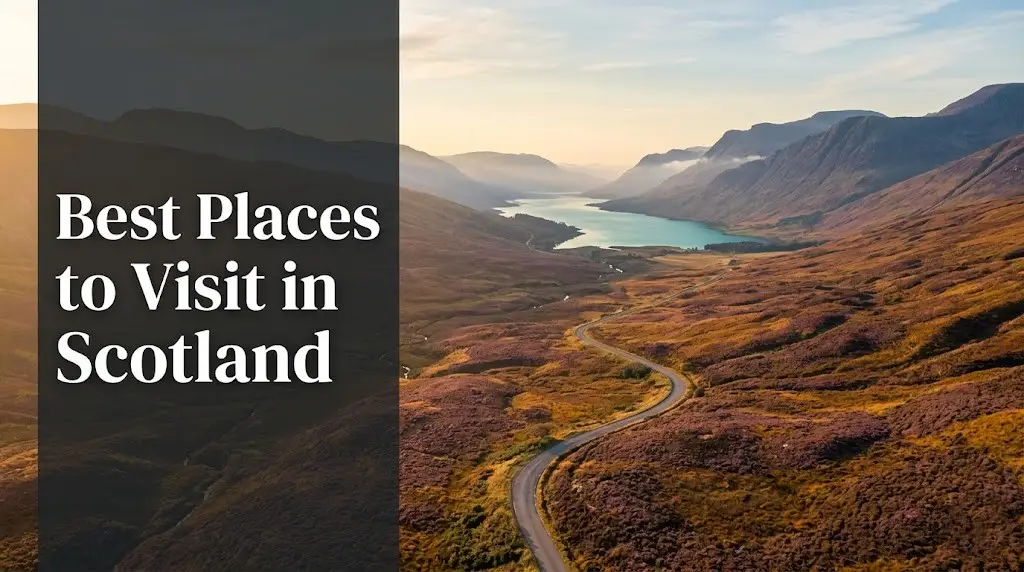
No single Scotland trip hits all four categories well without losing the quality of each experience to the pace of a schedule. The most common mistake American travelers make is treating Scotland like a checklist European destination when it functions better as a place to go deep rather than wide. A week spent unhurried in Edinburgh, the Highlands, and Skye will be more memorable than two weeks that try to add Orkney, the Outer Hebrides, and a North Coast 500 circuit on top.
| Destination | Best For | Cost Tier | Best Season | Min. Days | Physical Demand |
|---|---|---|---|---|---|
| Edinburgh | First-timers, culture, history | Mid to high | April-June, Sept-Oct | 3-4 | Low to moderate |
| Glasgow | Culture, budget travelers, music | Budget to mid | Year-round | 2-3 | Low |
| Scottish Highlands | Outdoor travelers, road trippers | Mid | Sept-Oct, April-May | 4-7 | Moderate to high |
| Isle of Skye | Landscape photography, hikers | Mid | May, Sept-Oct | 2-3 | Moderate to high |
| Orkney Islands | Archaeology, history, birding | Mid to high | May-Sept | 2-4 | Low to moderate |
| Outer Hebrides | Remote travel, beaches, solitude | Mid to high | June-Sept | 3-5 | Low to high (variable) |
| St Andrews | Golf, coastal history | Mid | May-Sept | 1-2 | Low |
| Speyside | Whisky tourism, food | Mid | April-Oct | 2-3 | Low |
| North Coast 500 | Road trips, full experience | Mid to high | May-Sept | 5-7 minimum | Low (driving) |
The selection above reflects destinations that consistently deliver on their specific promise to a specific traveler type. Destinations are omitted not because they lack merit but because this guide prioritizes depth of recommendation over exhaustive geography coverage.
Places to Visit in Scotland for First-Timers
For a first visit to Scotland, the Edinburgh-Highlands-Skye corridor gives the clearest and most concentrated introduction to what Scotland actually is: medieval urban history, dramatic mountain terrain, and Atlantic island scenery within a single connected route.
A practical one-week first-timer framework:
- Days 1-3: Edinburgh. Arrive via Edinburgh Airport (EDI), which receives direct transatlantic service from select US east coast cities, or via London Heathrow with a domestic connection. Edinburgh’s Old Town contains the core of the first-timer experience: Edinburgh Castle, the Royal Mile, and the Palace of Holyroodhouse at the Mile’s eastern end. Allow a half-day for Edinburgh Castle alone if you go inside. Arthur’s Seat, the extinct volcano rising from Holyrood Park, takes approximately 45 minutes to climb from the park entrance and gives the best view over the city without any admission cost.
- Days 4-5: Highlands base at Aviemore or Pitlochry. Either town works as a Highlands base. Aviemore gives access to Cairngorms National Park. Pitlochry sits in Perthshire and is better suited to travelers who want a smaller, more manageable Highland town experience with river walks and the Pitlochry Festival Theatre for evening programming. Drive time from Edinburgh to either is approximately 90 minutes to two hours.
- Days 6-7: Isle of Skye. Drive west from Aviemore or north-west from Pitlochry, crossing the Skye Bridge at Kyle of Lochalsh. The bridge crossing is free. Budget two full days minimum: the Fairy Pools and the Old Man of Storr each require approximately two to three hours including parking and the walk itself. Base in Portree, Skye’s main village.
Best for families with children: This itinerary suits families reasonably well through the Edinburgh section. The Highlands and Skye sections involve long car journeys and hiking terrain that suits children aged eight and above better than younger children. Plan rest stops every 90 minutes on Highland roads.
Best for seniors and accessibility travelers: Edinburgh Castle has significant cobblestone and stair terrain inside; wheelchair access is partial. The Palace of Holyroodhouse is more accessible. Cairngorms National Park has accessible walking trails at Rothiemurchus Estate. Skye’s main viewpoints involve unpaved, uneven paths; the Old Man of Storr trail is not suitable for mobility aids.
Edinburgh: Scotland’s Most Visited City
Edinburgh is Scotland’s most visited destination and one of the most historically dense cities in the British Isles, with a medieval Old Town that predates most American cities by several centuries and a Georgian New Town that ranks among the best-preserved examples of 18th-century urban planning in Europe.
Edinburgh Castle sits at the top of the Royal Mile on a volcanic plug and contains the Scottish Crown Jewels (the Honours of Scotland) and the Stone of Destiny. Admission is charged; expect to budget in the range of £18 to £22 per adult as of recent years, though prices are updated annually by Historic Environment Scotland, which manages the site. Book in advance during summer and Festival periods: walk-up entry during August is genuinely difficult.
The Royal Mile is the tourist core, and like most tourist cores, it delivers a mixed experience. The historic closes (the narrow alleyways branching off the main street) are worth exploring: Victoria Close, Whitehorse Close, and Riddle’s Court offer architecture that has barely changed since the 16th century. The street-level shops and restaurants on the Mile itself skew heavily toward tartan souvenirs and tourist-facing pricing. For dinner, move to the Grassmarket area or the Canonmills neighborhood for better value and fewer visitors.
The Scottish National Museum on Chambers Street is free to enter (verify current admission status before visiting) and covers Scottish history from the Pictish era through the industrial age with a depth that exceeds what most visitors expect from a national history museum. Allow three hours minimum.
Insider Tip:
- August in Edinburgh is Edinburgh Festival Fringe month: the city’s accommodation prices roughly double or triple, and the population temporarily swells by hundreds of thousands. Unless attending the Fringe specifically, plan your Edinburgh visit for May, June, September, or October.
- The Scottish National Portrait Gallery on Queen Street is free to enter, less crowded than the main museum cluster, and contains a photography collection that documents Scottish cultural history with genuine editorial quality.
- For solo travelers: Edinburgh has a strong café culture and a genuine pub scene. The Grassmarket and Cowgate area offers evening options ranging from historic pub settings to live music venues that draw local audiences alongside tourists.
Glasgow: Scotland’s Underrated Urban Destination
Glasgow delivers more cultural depth per pound spent than any other Scottish city, and most American first-timers skip it entirely in favor of spending all their urban time in Edinburgh. That’s a planning mistake worth correcting.
The Kelvingrove Art Gallery and Museum is free to enter (verify current admission status before visiting), houses one of the finest civic art collections in the UK, and takes a full half-day to see properly. Salvador Dalí’s Christ of Saint John of the Cross hangs here. The building itself, a Spanish Baroque structure completed in 1901, is worth visiting as architecture alone. According to VisitScotland, Kelvingrove is consistently one of the most visited free attractions in Scotland.
Glasgow’s Merchant City neighborhood, immediately east of the city center, is where the food and bar scene that locals actually use concentrates: smaller restaurants with genuine chef ambition, cocktail bars, and live music venues in converted Victorian merchant warehouses. The Barrowlands Ballroom on Gallowgate has hosted nearly every major British and international touring act for decades and remains one of the most respected mid-size concert venues in the UK. The music calendar changes seasonally; check the venue’s own programming before your visit.
The city’s West End neighborhood, centered on Byres Road and surrounding Glasgow University, is where to base yourself if you prefer a neighborhood feel over city-center convenience. The independent shops, coffee houses, and restaurants on Byres Road and Great Western Road are almost entirely local businesses without the tourist-facing pricing of Edinburgh’s Royal Mile equivalent.
Best for budget travelers: Glasgow is the most budget-accessible major Scottish destination. Free world-class museums, lower accommodation rates than Edinburgh, and a pub culture that prices pints at rates significantly below London or Edinburgh make it a genuinely strong choice for cost-conscious travelers. A full day of quality experiences in Glasgow costs far less than a comparable day in Edinburgh.
Best for couples: The Merchant City restaurant scene suits a date-style evening well. The Ashton Lane cobblestone alley in the West End is narrow, covered by fairy lights after dark, and genuinely atmospheric without being artificially manufactured. It’s the kind of place you photograph and then stay for another drink.
Key Takeaway: Glasgow and Edinburgh serve fundamentally different travel experiences. Edinburgh is world-class for medieval history, festival culture, and castle tourism. Glasgow is Scotland’s city for art, music, food, and genuine urban character at a fraction of Edinburgh’s cost. Both are worth your time; neither replaces the other.
Best Places to Visit in the Scottish Highlands
The Scottish Highlands cover roughly the northern two-thirds of mainland Scotland and contain the country’s most dramatic terrain: mountain ranges, deep glacial lochs, ancient pine forests, and a coastline that alternates between sea cliffs and sandy beaches.
The practical question isn’t whether to visit the Highlands but which part. The Highlands are not a single destination. They’re a region the size of Belgium with dramatically different characters depending on which direction you travel from Inverness.
Glen Coe, the most photographed Highland valley, sits approximately 90 minutes south of Inverness and about the same distance north of Glasgow. Its scale is hard to convey before you see it: walls of mountain rising almost vertically from the valley floor, particularly the Three Sisters formation on the south side of the glen. Parking at the National Trust for Scotland visitor area at the floor of Glen Coe provides access to short walks; the ridge routes (including the Aonach Eagach, one of the most technically demanding mainland ridges in Scotland) require serious hillwalking experience.
Cairngorms National Park, the largest national park in the UK by area, centers on the Cairngorm plateau and has a more accessible character than Glen Coe. The Rothiemurchus Estate near Aviemore offers accessible forest paths. The Cairngorm Mountain funicular railway (verify current operational status before visiting) reaches close to the plateau summit.
Torridon, in the northwest Highlands, is where experienced hillwalkers and photographers go when they want Highlands scenery without the Glen Coe crowd levels. The mountain landscape here is among the oldest exposed rock on Earth, Torridonian sandstone estimated at roughly 750 million years old, and the visual effect is unlike any other Highland terrain.
| Highland Area | Best For | Drive from Edinburgh | Crowd Level (Summer) | Physical Demand |
|---|---|---|---|---|
| Glen Coe | Photography, short walks | 2.5-3 hours | High | Low to very high (route-dependent) |
| Cairngorms | Families, accessible walks | 2-2.5 hours | Moderate-High | Low to high |
| Torridon | Experienced hikers, solitude | 4.5-5 hours | Low | High |
| Applecross | Road trippers, seafood | 5-5.5 hours | Low-Moderate | Low (driving) |
| Glencoe Village | Overnight base, history | 2.5 hours | High | Low |
Isle of Skye
The Isle of Skye is Scotland’s most visited island and the destination most likely to disappoint travelers who arrive in July or August with no advance planning. In late May, September, or October, Skye is extraordinary. In peak summer, its most famous viewpoints are congested with tour buses, rental cars, and photography queues.
The Fairy Pools at the base of the Cuillins are a series of clear mountain pools connected by small waterfalls and fed by snowmelt from the Black Cuillin ridge above. The walk from the Glenbrittle road parking area takes approximately 45 minutes each way on a path that is well-maintained but uneven in places. Early morning arrival (before 9am) dramatically reduces the crowd experience, particularly in summer months. The pools are cold enough to make swimming genuinely bracing; the water is clean. This experience suits confident walkers of most age groups; the path is not suitable for wheelchairs or strollers.
The Old Man of Storr, a distinctive rock pinnacle on the Trotternish peninsula, is the island’s most recognizable image. VisitScotland notes that parking management at the Storr car park has been subject to timed-entry and fee systems in recent seasons; verify the current access arrangement before visiting. The climb to the base of the pinnacle takes approximately 45 to 60 minutes from the car park. The terrain is steep and exposed in wet weather.
Portree is Skye’s main village and the best base for an island stay. It has the island’s strongest concentration of restaurants, accommodation options, and practical services. The harbor area is the photogenic core: colored houses along the waterfront reflected in the tidal harbor is the image that appears in most Skye photography. Portree suits couples particularly well for an evening meal and overnight stay. Solo travelers will find it social during shoulder season and genuinely quiet in winter.
Insider Tip:
- The Quiraing, another landslip formation on the Trotternish peninsula, offers hiking and photography of equal quality to the Old Man of Storr with consistently lower visitor numbers. Access is via a narrow single-track road; arrive early and park only in designated areas.
- The village of Carbost near Loch Harport is home to the Talisker Distillery, Skye’s only single malt distillery. Tours are offered on a reservable basis and give a genuinely interesting window into island whisky production.
- For families with children: Skye is better suited to older children (10 and above) who can manage the walk distances and uneven terrain at the main sites. The village life in Portree gives younger children a manageable base, but the island’s signature experiences are primarily walking-based.
Orkney Islands
Orkney, the archipelago of approximately 70 islands 10 miles north of mainland Scotland, is Scotland’s most archaeologically significant destination and the one most consistently underestimated by first-timers who don’t realize what they’re skipping.
The Heart of Neolithic Orkney is a UNESCO World Heritage Site comprising four sites: Skara Brae (a preserved Neolithic village older than Stonehenge), Maeshowe (a chambered cairn aligned with the winter solstice), and the stone circles of the Ring of Brodgar and the Stones of Stenness. These are not minor sites with museum-quality reproductions. Historic Environment Scotland describes Skara Brae as one of the best-preserved prehistoric villages in northern Europe; walking through it is the closest experience most travelers will have to actual Neolithic daily life, with stone furniture, hearths, and drainage systems intact under thousands of years of sand.
Getting to Orkney requires either a flight from Edinburgh, Glasgow, Inverness, or Aberdeen (Loganair operates these routes; verify schedules and book in advance) or a ferry from Scrabster (near Thurso in northern Scotland), Gills Bay, or Aberdeen, operated by NorthLink Ferries. The ferry from Scrabster to Stromness takes approximately 90 minutes. Advance booking is strongly recommended for summer crossings.
The main town, Kirkwall, has the 12th-century St Magnus Cathedral (free to enter; verify current access before visiting), a genuinely fine example of Norse Romanesque architecture that most visitors have never seen a photograph of before arriving. The Italian Chapel on Lamb Holm, built by Italian prisoners of war from scavenged materials during World War II, is a small and unexpectedly moving site.
Best for heritage travelers: Orkney is the strongest heritage destination in Scotland for travelers genuinely interested in prehistory, Norse history, and World War II maritime history. The Scapa Flow museum covers the extraordinary story of the German naval fleet scuttled here in 1919.
Best for seniors and accessibility travelers: Orkney’s archaeological sites are generally more accessible than Highland hiking destinations. Skara Brae involves a short flat walk; Maeshowe requires ducking into a low entrance passage that may challenge visitors with back conditions. The island terrain is rolling rather than mountainous.
Key Takeaway: If you have to choose between Orkney and the Outer Hebrides for a single island add-on to a Scotland trip, choose based on your primary interest. Orkney for archaeology and history; the Outer Hebrides for beaches, remoteness, and Gaelic culture.
Outer Hebrides and the Western Isles
The Outer Hebrides, a chain of islands stretching approximately 130 miles off Scotland’s northwest coast, offer a travel experience that has almost nothing in common with the rest of Scotland and genuinely little in common with anywhere else in the British Isles.
The main islands, from north to south: Lewis and Harris (one island, two distinct areas), North Uist, Benbecula, South Uist, and Barra. Lewis and Harris form the largest and most visited section. Harris’s beaches, particularly Luskentyre and Scarista, rank among the finest in Europe: wide white sand with turquoise Atlantic water, typically empty, and accessible by car via a single-track road. The water temperature is cold by any objective measure; swimming is for the willing, not the faint-hearted.
The Callanish Standing Stones on the Isle of Lewis predate Stonehenge and occupy a hillside with views across the surrounding moorland that make the site feel genuinely remote rather than managed. Access is via a short walk from the visitor center; free to enter the stones themselves (verify current status). The visitor center has a small café and exhibition.
Harris Tweed, the hand-woven wool cloth produced exclusively in the Outer Hebrides, is still made by weavers working from their own homes under the protection of the Harris Tweed Act 1993. Several weavers in Harris and Lewis accept visitors by appointment; this is a genuinely local craft tradition rather than a manufactured tourist experience.
Ferry access from the mainland is via Caledonian MacBrayne (CalMac), operating from Ullapool (to Stornoway, Lewis) and Uig on Skye (to Tarbert, Harris, and Lochmaddy, North Uist). Ferry crossings run approximately two to three hours depending on route. CalMac ferry bookings for summer travel should be made months in advance; these routes fill completely for vehicle bookings.
Best for solo travelers seeking genuine remoteness: The Outer Hebrides have a scale, pace, and atmosphere unlike any other destination on this list. Accommodation is limited; book well ahead. The social experience is quieter and more self-directed than Edinburgh or Glasgow. Cell service is limited across significant portions of the islands.
Best Small Towns in Scotland
Scotland’s small towns offer the most genuine access to local Scottish life and some of the country’s best food, without the crowd levels of its headline destinations.
St Andrews in Fife sits approximately an hour northeast of Edinburgh by road and is internationally known for two things: golf (the Old Course at St Andrews Links is the spiritual home of the game) and its medieval university. Beyond the golf tourism, St Andrews has a well-preserved medieval streetscape, the ruins of a once-enormous cathedral, and a harbor beach called the East Sands that families find genuinely usable in warmer months. The St Andrews Links Trust manages the public golf courses, and the Old Course requires either a ballot entry (applied for months in advance) or booking through specific channels; walk-on play is not reliably available for the Old Course specifically.
Pitlochry in Perthshire sits at the edge of the Highland line and functions as an excellent self-contained destination: distillery visits (Edradour, one of the smallest distilleries in Scotland, is within walking distance), dam and fish ladder walks, and the Pitlochry Festival Theatre offering professional productions from spring through autumn. It suits couples and families well and is more affordable than Edinburgh or Skye.
Oban on the west coast is the departure point for ferries to Mull, Islay, Colonsay, and other Inner Hebrides islands, but it earns its place as a destination in its own right. The fresh seafood, particularly from the seafood stalls and modest restaurants near the harbor, is some of the best-value seafood available in Scotland. McCaig’s Tower, a Victorian colosseum-style folly on the hill above town, is free to visit and gives views over the harbor and to the islands beyond. Oban suits budget travelers well relative to other west coast destinations.
Ullapool in the northwest Highlands is a small fishing village that doubles as the ferry terminal for Stornoway (Lewis) and as one of the most atmospheric overnight stops on the North Coast 500. The Ceilidh Place is a bookshop-café-hotel-bar combination that has functioned as a cultural community hub for decades; it’s the kind of place that makes a small town feel larger than its population.
Scotland Whisky Regions and Speyside
Scotland produces the world’s most exported Scotch whisky, and the Speyside region in the northeast, centered on the towns of Dufftown and Craigellachie along the River Spey, is where the highest concentration of distilleries in Scotland operates within the smallest geographic footprint.
Approximately half of Scotland’s active distilleries are located in Speyside. The region produces the style of whisky most commonly associated with the category internationally: fruity, accessible, often sherry-cask influenced. Glenfiddich Distillery in Dufftown is the world’s best-selling single malt and offers tours from introductory to highly detailed; book in advance during peak months. The Glenlivet, Aberlour, and Macallan are also within easy driving distance of Dufftown.
The Speyside Whisky Festival runs annually each spring, typically in late April or early May, and offers distillery open days, masterclasses, and events across the region. This is the best time of year to visit Speyside specifically for whisky immersion, with many distilleries opening experiences not available at other times. Verify 2026 dates and ticket availability directly with the festival organizers well in advance.
Beyond Speyside, the Islay island distilleries (Laphroaig, Ardbeg, Bowmore, and others) produce a dramatically different style: heavily peated, smoky, maritime. Islay requires a ferry crossing from Kennacraig on the Kintyre peninsula and is a worthwhile extension for serious whisky travelers. The Islay Festival of Malt and Music (Fèis Ìle) runs annually in late May and follows a similar format to Speyside’s festival.
Best for culinary travelers: Speyside is not only about whisky. The Craigellachie Hotel has hosted whisky enthusiasts for over a century and its bar stocks one of the most extensive ranges of Scotch whisky in Scotland. The local food scene in the region leans toward traditional Scottish ingredients: local game, Aberdeen Angus beef, and River Spey salmon.
Best for budget travelers: A self-guided Speyside distillery drive is one of Scotland’s more affordable specialist experiences relative to the quality. Many distilleries offer paid tours in the £15 to £25 per person range (verify current pricing directly with each distillery), and driving between them requires a designated driver or split schedule. Craigellachie and Dufftown have affordable accommodation options compared to Edinburgh or Skye.
North Coast 500 Road Trip
The North Coast 500 is a 516-mile circular driving route that begins and ends at Inverness Castle and loops around the northern and northwestern Highland coast of Scotland. It was created in 2015 by the North Highland Initiative and has since become Scotland’s most discussed driving route, often compared to Ireland’s Wild Atlantic Way or America’s Pacific Coast Highway.
The comparison to the Pacific Coast Highway is useful but misleading in one important way: a significant portion of the North Coast 500 runs on single-track roads with passing places. These are genuinely narrow roads, one vehicle wide, where pulling into a passing place to allow oncoming traffic to pass is both courtesy and necessity. Rental car drivers unfamiliar with this system, or large vehicles (motorhomes in particular), can create serious difficulty on the narrowest sections. This reality is consistently understated in the promotional coverage the route receives.
A minimum of five to seven days is required to drive the route without rushing. Seven to ten days is the realistic window for travelers who want to stop, walk, and experience the communities along the route rather than simply complete the drive.
Key stages of the route:
- Inverness to Applecross via Torridon (west coast south section): The Bealach na Bà mountain pass above Applecross is one of the most dramatic road drives in Scotland with gradients reaching 20%. Not suitable in ice or heavy snow. Inverness to Applecross via Torridon takes approximately four to five hours of actual driving time without stops.
- Applecross to Ullapool: The coastal stretch through Shieldaig and along Loch Broom to Ullapool passes some of the least-visited Highland scenery on the route.
- Ullapool to Durness (northwest corner): This section passes the Knockan Crag National Nature Reserve, the Kylesku Bridge, and Cape Wrath (accessible by ferry and minibus from Durness; vehicle access is not public). The Smoo Cave near Durness is free to visit.
- Durness to John o’ Groats (north coast): The north coast passes Dunnet Head (mainland Britain’s most northerly point, not John o’ Groats despite popular belief) and offers cliff scenery over the Pentland Firth.
- John o’ Groats to Inverness (east coast return): The east coast section is the least dramatic visually but passes Black Isle, Cromarty Firth, and the outskirts of the Cairngorms.
Best for road trip travelers: The NC500 is specifically designed for this traveler profile. Self-drive is the only practical way to complete it. Public transport does not serve most of the route.
Not recommended for: Travelers with under five days, travelers driving large vehicles on their first experience of single-track roads, or travelers who want a passenger experience rather than active driving engagement.
Key Takeaway: The North Coast 500 is genuinely extraordinary in the right season with the right vehicle and enough time. In July and August it is also the busiest it has ever been, with accommodation along the route booking out months in advance. September is the consistently recommended month by experienced route drivers for reduced traffic, good light, and lower advance booking pressure.
Best Scottish Castles and Heritage Sites
Scotland has over 2,000 castles, making it the most castle-dense country in Europe relative to its land area, and the honest answer to “which should I visit” depends entirely on what kind of castle experience you’re actually looking for.
Edinburgh Castle is the most visited castle in Scotland and worth it specifically for the Honours of Scotland, the Crown Jewels that survived Commonwealth-era Scotland and predate the English Crown Jewels. The military history sections are detailed and genuinely interesting for travelers who care about Scottish history. The One O’Clock Gun fires daily (except Sundays and public holidays; verify the current schedule). The crowds in summer are significant; a morning arrival on a weekday beats an afternoon arrival at weekends by a wide margin.
Stirling Castle, often called Edinburgh’s less-visited equal, sits on a comparable volcanic plug 35 miles north of Edinburgh and commands views over the Forth Valley and the Wallace Monument below. The Great Hall and Royal Palace interiors have been extensively restored and give the clearest picture of what a functioning Scottish royal castle looked like in the 16th century. Historic Environment Scotland manages the site.
Eilean Donan Castle near Dornie in the western Highlands is the most photographed castle in Scotland. It sits at the confluence of three sea lochs on a small tidal island connected to the road by a stone bridge. The interior is smaller than first-time visitors expect. The real experience here is the exterior setting; most visitors spend as much time photographing it from the roadside as exploring inside. Admission is charged; verify current pricing with the castle directly.
Culloden Battlefield, managed by the National Trust for Scotland, is where the last pitched battle on British soil was fought in April 1746. The site is not dramatic landscape. It’s a flat moorland. The power of the visit is entirely historical: the scale of what happened on this ground in 40 minutes, and the visitor center exhibition that frames it, is genuinely affecting. This site suits heritage travelers and history enthusiasts specifically; it is not a children’s or casual-visitor priority without prior contextual knowledge.
Best for families with children: Stirling Castle’s great hall, dungeon area, and interactive historical displays are better calibrated for younger visitors than Edinburgh Castle’s military museum-heavy content.
Best Time to Visit Scotland
The best time to visit Scotland for most travelers is September and early October, or late April through May. Both windows avoid peak summer crowds, minimize midge exposure in Highland and island areas, and deliver weather that is genuinely functional for outdoor activities.
| Season | Weather | Crowd Level | Midges | Cost Level | Verdict |
|---|---|---|---|---|---|
| January-February | Cold (1-7°C), short daylight, snow possible | Very low | None | Low | Suits winter landscape photographers only; many rural sites closed |
| March-April | Cool (5-12°C), unpredictable, spring green begins | Low-Moderate | Minimal | Moderate | Good for Edinburgh; early Highland walking possible |
| May-June | Mild (10-17°C), long daylight begins | Moderate-High | Begins May-June | Moderate-High | Excellent for Orkney, St Andrews, Speyside; Skye getting busy |
| July-August | Warmest (15-20°C max), longest days | Very High | Peak (severe in Highlands and islands) | Peak | Best daylight; worst crowds and midges; book months ahead |
| September-October | Mild cooling (10-15°C), autumn color | Moderate-Low | Ending | Moderate | Best overall month for most travelers; September optimal |
| November-December | Cold, short days, wet | Very Low | None | Low | Edinburgh Christmas markets (November-December) are the exception |
On midges specifically: The Scottish midge (Culicoides impunctatus) is a very small biting insect that appears in clouds in Highland and island areas from approximately late May through mid-September, peaking in July and August. Still, overcast, humid evenings are the worst conditions. Midge repellent (DEET-based or Smidge brand, which is specifically formulated for Scottish midges) is genuinely effective when applied properly. This is not a minor inconvenience. Travelers who have tried to wild camp, hike, or sit outside at a Highland loch at dusk in July without repellent describe the experience as one that ended the activity.
For festival travelers: Edinburgh’s Festival Fringe runs through August and is one of the largest arts festivals in the world. If attending the Fringe is the trip’s purpose, August is correct despite the cost and crowds. Book accommodation six to twelve months in advance.
Getting Around Scotland Without a Car
Traveling Scotland without a car is genuinely possible for the Edinburgh-Glasgow corridor and the main Highland rail routes, but genuinely limiting for island, coastal, and deep Highland destinations.
ScotRail operates the primary rail network. The Edinburgh-Glasgow route runs frequently (approximately every 15 minutes at peak times) and takes around 50 minutes. The Highland Main Line connects Edinburgh and Glasgow to Inverness and Aviemore. The West Highland Line from Glasgow to Fort William and Mallaig (with the Glenfinnan Viaduct, made famous by the Hogwarts Express film scenes) is regarded by many rail travelers as one of the most scenic rail journeys in Europe. The Kyle of Lochalsh Line from Inverness to the Skye Bridge is similarly scenic.
The Caledonian Sleeper runs overnight from London Euston to Edinburgh, Glasgow, Inverness, Fort William, and Aberdeen. For American travelers arriving via London, the sleeper service to Inverness or Fort William is a genuinely useful option that saves a night’s accommodation and positions you in the Highlands on arrival morning.
Caledonian MacBrayne ferries serve most of the Hebridean islands from mainland ports. Without a car on CalMac ferries, you pay foot passenger fares and explore islands on foot, by bicycle (bike hire is available on some islands), or via local bus services (which are limited on smaller islands). Walking-on is generally easier than vehicle booking and requires less advance planning.
What you genuinely cannot do without a car:
- The North Coast 500
- Drive the Applecross Pass or Torridon coast road
- Efficiently cover multiple Highland glens
- Reach most wild beach or coastal viewpoint car parks that serve as the starting point for non-organized walks
Best for solo travelers: Train travel in Scotland is well-suited to solo travelers who want to meet other people, travel sustainably, and focus on the main Highland destinations. The West Highland Line and Caledonian Sleeper in particular have a genuine social atmosphere.
Scotland Travel Budget and Costs
Scotland is a mid-range to premium international destination for American travelers once transatlantic flights are factored in, but within Scotland, the daily cost of travel varies significantly by destination and travel style.
Rough cost framework for 2026 (verify current prices before travel; these are general guidance ranges):
| Category | Budget Tier | Mid-Range | Premium |
|---|---|---|---|
| Accommodation per night | £50-£80 (hostel/B&B) | £100-£180 (mid hotel/guesthouse) | £200+ (boutique/hotel) |
| Daily meals | £20-£35 (self-cater + one pub meal) | £50-£80 (café lunch + restaurant dinner) | £100+ (restaurant every meal) |
| Key attraction entry | £0-£15 (free museums, short walks) | £15-£30 (castle, distillery tour) | £30-£100+ (premium whisky experience) |
| Rental car per day | £40-£70 (compact) | £70-£110 (medium/SUV) | £120+ (premium/automatic) |
| Ferry (Skye Bridge) | Free | N/A | N/A |
| CalMac ferry (Ullapool to Stornoway, vehicle) | Varies by season; approximately £50-£80+ per vehicle one way | Verify with CalMac directly |
Scotland’s cost pressure points for American travelers are accommodation during August (Festival period in Edinburgh specifically), island ferry vehicle bookings during summer, and the general cost of remote island accommodation where limited competition keeps prices firm.
Best for budget travelers: Glasgow is Scotland’s most budget-accessible major destination. Free world-class museums, affordable restaurants in the West End and Merchant City, and lower hotel rates than Edinburgh make it the single best choice for cost-conscious travelers who want urban Scotland.
Freebies worth noting (verify current status before visiting): Kelvingrove Art Gallery and Museum, the Scottish National Museum (Edinburgh), the Scottish National Gallery (Edinburgh), the Scottish National Portrait Gallery (Edinburgh), access to most of Scotland’s countryside under the Scottish Outdoor Access Code (which grants responsible access to most land and inland water in Scotland under the Land Reform (Scotland) Act 2003).
Scotland Travel Tips and What Most Visitors Get Wrong
The single most common planning mistake Americans make in Scotland is underestimating travel time between destinations on Highland roads. Google Maps driving estimates for Highland and island routes assume average road speeds that do not account for single-track road delays, sheep crossings, landscape stops, or the physical reality of narrow roads that require you to slow to a walking pace through passing places.
A practical rule: multiply Google Maps driving estimates by 1.3 to 1.5 for any route that includes Highland single-track roads, and by 1.5 to 2 for routes including ferry connections to islands.
Other things experienced Scotland travelers know that first-timers consistently do not:
- Book accommodation well ahead. Scotland’s most desirable guesthouses and hotels in Skye, Orkney, and the Outer Hebrides are small, limited in number, and book out months before peak season. In Edinburgh during August, accommodation that has not been pre-booked at the beginning of the year is a genuine problem.
- Carry midge repellent from May through September. Pack it before you go; do not rely on finding it locally in remote areas.
- Driving on the left requires focus. Most American rental car drivers adapt within an hour. The specific challenge in Scotland is that the left-side driving norm combines with single-track roads where pulling left into a passing place is the correct response to oncoming traffic, not a frightening deviation.
- Dress in layers at all times of year. Scottish weather at any elevation changes multiple times per day. July hiking in shorts and a t-shirt has ended in hypothermia for visitors who underestimated afternoon cloud and wind. A waterproof layer and insulating mid-layer are non-negotiable for any activity above valley level.
- The Loch Ness monster is not Scotland’s best Highlands experience. Loch Ness as a destination is scenically fine and the Urquhart Castle ruins on its western shore are genuinely impressive. But traveling to Loch Ness primarily for monster-spotting infrastructure is a genuine misallocation of a Scotland trip. The monster tourism industry around Drumnadrochit is exactly what you would expect of a destination built primarily on a mythology.
- Phone signal is limited in most Highland and island areas. Download offline maps (Google Maps offline, Maps.me, or OS Maps for UK topographic coverage) before leaving any main town. Do not rely on live navigation in the Outer Hebrides or remote Highland zones.
For seniors and accessibility travelers: Scotland’s outdoor and heritage attractions vary enormously in physical accessibility. Many castle sites involve significant stair climbing and cobblestone terrain. Request accessibility information directly from each attraction before visiting. Urban Scotland (Edinburgh and Glasgow) has reasonable but not universal wheelchair access infrastructure; the Old Town Edinburgh cobblestones specifically are difficult for mobility aids.
Safety and Practical Warnings for Scotland
Mountain weather in Scotland changes rapidly and without reliable warning, and several visitors are rescued from Scottish hills every year as a result of underestimating conditions or overestimating their preparation.
Key safety and practical facts every visitor should know:
- Mountain weather is unpredictable at all times of year. Even in July, exposed ridges in the Highlands and Cairngorms can experience wind, cloud, and temperatures that require proper layering. A waterproof outer layer, insulating mid-layer, hat, and gloves should be carried for any walk above valley level regardless of the forecast.
- Single-track road etiquette is not optional. Pull fully into passing places to allow oncoming traffic to pass. Do not park in passing places overnight. Failing to yield on a single-track road is dangerous and a genuine cause of accidents on Highland roads.
- Cold water shock is a genuine risk in Highland lochs. Wild swimming is popular in Scotland, but water temperatures even in summer can cause involuntary gasping and muscle incapacitation. Enter cold water slowly and progressively rather than jumping in. Do not swim alone in remote locations.
- Tick awareness is required in grassland and heather areas from spring through autumn. The deer tick (Ixodes ricinus) is widespread in Scottish countryside. Check your body for ticks after walks in long vegetation. The NHS Scotland website provides guidance on correct tick removal technique. Lyme disease risk is real; seek medical advice if a ring-shaped rash develops after a tick bite.
- Sunset times are late in summer and very early in winter. In June, daylight extends past 10pm in northern Scotland. In December, daylight is limited to approximately seven hours at Highland latitudes. Plan outdoor activity timing accordingly.
- Cape Wrath and the Duncansby Head sea cliffs have no guardrails. Extreme care is required near the cliff edges in windy conditions, which are frequent on Scotland’s north coast.
For mountain emergencies in Scotland, call 999 (the UK emergency number) and ask for Police Scotland, which coordinates Mountain Rescue. For maritime emergencies, contact HM Coastguard via VHF Channel 16 or by calling 999.
Frequently Asked Questions About Scotland
What is the best place to visit in Scotland for first-timers?
Edinburgh is the strongest starting point for a first Scotland visit, giving immediate access to medieval history, accessible cultural infrastructure, and a functioning transport hub for onward travel to the Highlands and Skye.
Most first-timers find that a route covering Edinburgh, at least one Highland area, and the Isle of Skye captures Scotland’s urban, mountain, and island characters within a seven-to-ten-day window.
Prioritize quality of experience over number of destinations: three areas visited well will consistently outperform six areas visited briefly.
How many days do you need to see Scotland properly?
Seven to ten days is the minimum for a meaningful first Scotland trip covering Edinburgh, the Highlands, and one island destination.
Two weeks allows for a more comfortable pace that includes Glasgow, Speyside, a more thorough Highlands experience, and potentially Orkney or the Outer Hebrides alongside the core route.
Travelers with fewer than five days are best served by focusing entirely on Edinburgh and one day trip into the Highlands rather than attempting to add island or far-north destinations.
When is the best time of year to visit Scotland?
September and early October are the best months for most travelers: midge levels drop significantly, crowds reduce from the summer peak, autumn color arrives in Highland and Perthshire landscapes, and accommodation is more available than in July and August.
Late April and May are the second-best window: longer days are returning, midge season has not fully arrived, and spring green in the glens is visually striking.
August delivers the longest daylight hours but also peak crowds, peak prices, and peak midge exposure, and Edinburgh specifically in August operates on Festival Fringe pricing that makes accommodation significantly more expensive than any other month.
Is Scotland worth visiting without a car?
Scotland is worth visiting without a car if your focus is Edinburgh, Glasgow, and the main Highland rail corridor including Aviemore and Inverness via ScotRail.
The West Highland Line from Glasgow to Fort William is one of the most scenic rail journeys in Europe and is entirely accessible without a car.
The North Coast 500, most island destinations (including the inner reaches of Skye beyond Portree), and the northwest Highland coastline are genuinely difficult to experience properly without a vehicle; for these destinations, renting a car is strongly recommended.
What is the best Scottish island to visit?
The best Scottish island depends entirely on your primary interest: Isle of Skye for dramatic mountain and coastal scenery within easy reach of the mainland; Orkney for prehistoric and Norse archaeology; the Outer Hebrides for remote Atlantic beaches and Gaelic culture.
Skye is the most accessible island for first-timers (connected to the mainland by road bridge) and delivers the most concentrated mix of scenery, accommodation options, and practical services.
Orkney and the Outer Hebrides require more advance planning, ferry bookings, and travel time but reward travelers with an experience that is genuinely unlike mainland Scotland.
What should I not miss in the Scottish Highlands?
Glen Coe is the Highland experience most likely to produce the visual impact travelers come to Scotland expecting: a glacial valley enclosed by mountain walls that gives an immediate and unambiguous sense of Highland scale.
Beyond Glen Coe, Cairngorms National Park gives the most accessible Highland experience for a range of physical abilities, and the Applecross Peninsula via the Bealach na Bà mountain pass gives the most dramatic coastal Highland drive in Scotland without the crowd levels of the NC500’s most popular segments.
Any traveler with serious outdoor walking experience should consider Torridon in the northwest Highlands, where the mountain landscape is genuinely older than anything in the Alps and the trails are almost entirely uncrowded compared to the central Highlands.
Planning Your Scotland Trip: The Practical Next Steps
Scotland rewards preparation in specific, practical ways: book your August Edinburgh accommodation well before the Festival season fills it, secure your CalMac ferry vehicle slots for Hebridean crossings months ahead, and build driving time estimates that account for the single-track road reality rather than map-distance assumptions. The traveler who arrives in Scotland with the right expectations about pace, the right gear for weather variability, and midge repellent in their bag will have a substantially better trip than the one who doesn’t.
Start with the anchor decision: which Scotland you’re visiting. Edinburgh-and-Highlands Scotland has a completely different logistical profile from Islands Scotland. Trying to combine both fully within a ten-day trip is how well-intentioned itineraries collapse into a feeling of constant transit. Choose your depth, choose your region, and build outward from there.
Travel conditions, admission prices, ferry schedules, and entry requirements for Scotland in 2026 are subject to change. Confirm key logistics directly with VisitScotland, CalMac, Historic Environment Scotland, and the UK Home Office before you travel. Scotland will be there in whatever season you choose. The only variable is how well you’ve prepared to actually experience it.