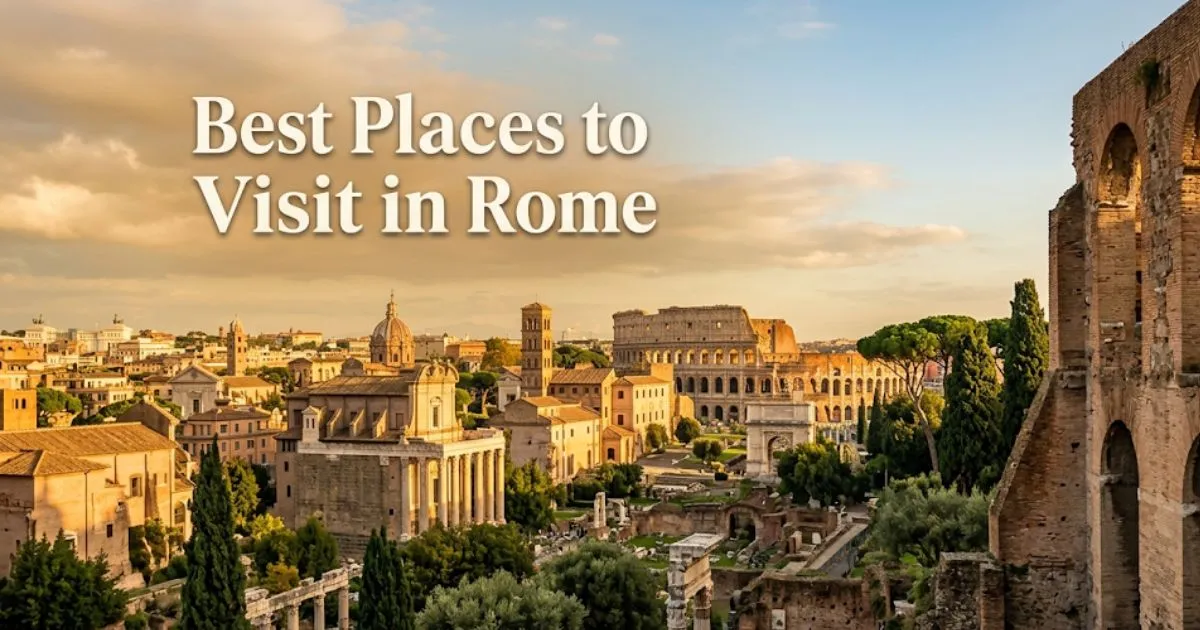
places to visit in rome

Rome is a city where you must choose carefully. You cannot see everything in one trip.
The most common mistake is trying to check off a list of 20 landmarks in 48 hours. Your reward for that approach is exhaustion and blurry photos.
Rome rewards selectivity. Pick four or five genuine priorities per day. Walk between them through neighborhoods that are themselves the point.
The rest of this guide organizes Rome by what is actually worth your limited time. Every recommendation comes with advance booking requirements and local alternatives.
| Priority Level | Landmark | Advance Booking Required | Best For |
|---|---|---|---|
| Essential | Colosseum + Forum | Yes, 30 days out | History, First-timers |
| Essential | Pantheon | Yes, weekends/holidays | Architecture, All |
| Essential | Vatican Museums | Yes, 60 days out | Art, Early risers |
| Essential | Galleria Borghese | Yes, mandatory | Art lovers, Couples |
| High | Capitoline Museums | No | History, Families |
| High | Basilica di San Clemente | No | Curious travelers |
| Worthwhile | Castel Sant’Angelo | No | Views, Couples |
| Overrated | Spanish Steps | No | Only if passing by |
Insider Tip:
- Book Colosseum and Vatican tickets the day they release. They sell out.
- The Pantheon is free on weekdays but requires paid reservation on weekends and holidays.
- Visit the Trevi Fountain at 6:30 AM or after 11 PM. Any other hour is a wall of selfie sticks.
Key Takeaway: Rome punishes spontaneity. Book the Colosseum and Vatican before you book your flight.
best places to visit in rome
The best places in Rome fall into three distinct layers of history. Ancient Roman ruins form the first layer. Renaissance and Baroque churches and palazzos form the second. The living city of neighborhoods, markets, and aperitivo culture forms the third.
Most visitors only experience the first layer. That is a mistake.
The single best experience in Rome is the layered view from Janiculum Hill at sunset. You see the ancient Forum, Renaissance domes, and modern rooftops in one glance.
The Pantheon is the best-preserved ancient building in Rome. Its concrete dome remains the largest unreinforced concrete dome ever built.
Visit at noon when the oculus light beam is most dramatic. The building is a tomb for Raphael and Italian kings.
The Galleria Borghese delivers the highest concentration of artistic brilliance per square foot. Bernini’s sculptures here capture motion in marble.
Caravaggio’s paintings hang in the same villa. Book this first if you care about art.
Rome’s best experiences are not all ticketed monuments. The walk from Campo de’ Fiori to Trastevere on a June evening, with a supplì in hand from Supplizio, rivals any museum.
According to Roma Capitale tourism data, the historic center absorbs over 10 million visitors annually. Most of them crowd into the same four blocks between Trevi, Pantheon, Piazza Navona, and the Spanish Steps.
The best places in Rome are evenly distributed across the city. You need a neighborhood strategy to reach them.
Key Takeaway: Skip one blockbuster landmark per day. Replace it with a neighborhood walk and a long lunch.
rome places to visit
Rome places to visit cluster naturally into geographic zones. Do not plan your day by theme. Plan it by map.
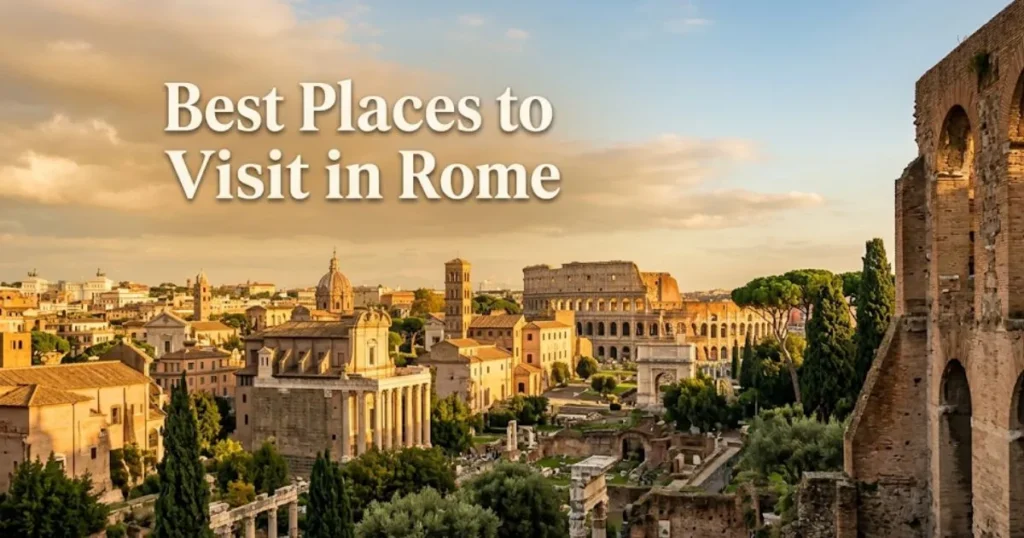
The Ancient Rome zone covers the Colosseum, Roman Forum, and Palatine Hill. These share a single ticket and are physically connected.
You cannot reasonably combine these with the Vatican in one day. The Forum alone is a sun-exposed two-hour walk.
The Vatican zone includes the Vatican Museums, Sistine Chapel, and St. Peter’s Basilica. Budget a full morning here with an early entry booking.
The afternoon should be loose. The neighborhood around the Vatican offers little worth lingering over.
The Centro Storico zone is the dense tangle of streets between Piazza Navona, the Pantheon, and the Trevi Fountain. This is best walked in early morning or late evening.
Midday here is a slow-moving human traffic jam. Restaurant quality in this zone drops proportionally to proximity to a major piazza.
The Trastevere and Jewish Ghetto zone works for a late afternoon and evening. Walk through the Ghetto, stop at the Portico d’Ottavia, then cross the Tiber into Trastevere for dinner.
The Testaccio and Aventine zone is where Romans go. Mercato Testaccio is a food destination. The Aventine keyhole at Piazza dei Cavalieri di Malta frames St. Peter’s dome perfectly.
No ticket is required. The line moves quickly.
| Zone | Best Time of Day | Food Strategy |
|---|---|---|
| Ancient Rome | 8:30 AM entry | Pack snacks, eat in Monti afterward |
| Vatican | 7:30 AM entry | Avoid eating near Vatican Museums |
| Centro Storico | Before 9 AM or after 8 PM | Walk 5+ blocks from piazzas for real food |
| Trastevere/Ghetto | Late afternoon into evening | Dinner here, book ahead |
| Testaccio/Aventine | Late morning or sunset | Mercato Testaccio for lunch |
Key Takeaway: Geographically, Rome is small. Combine neighborhoods that touch. Never schedule the Colosseum and Vatican on the same day.
places to visit in rome italy
Rome is Italy’s capital of layered history. Every piazza sits on top of earlier versions of itself.
The most literal example is the Basilica di San Clemente. The 12th-century church sits on top of a 4th-century basilica.
That 4th-century church sits on top of a 1st-century Roman house and Mithraic temple. You descend through centuries via a staircase inside the church.
Admission runs approximately €10 to €12 per adult. It is rarely crowded.
The Appian Way is Rome’s oldest road. The Catacombs of San Callisto branch off beneath it.
The catacombs require a guided tour. The temperature underground stays cool even in August, which makes this a strategic afternoon activity during summer.
Rome Italy is also a city of water. The nasoni are the cast-iron drinking fountains scattered across every neighborhood.
The water is cold, clean, and free. Bring a reusable bottle and refill constantly.
According to ENIT, the Italian national tourist board, Rome’s historic center was inscribed as a UNESCO World Heritage site in 1980. The site includes the Vatican City property as an extraterritorial zone.
This designation covers nearly everything a first-time visitor will want to see. The practical implication is that Rome’s center is legally protected from the kind of development that has homogenized other European capitals.
Rome feels like Rome because it is legally required to. That is worth appreciating while you walk it.
The most Roman experience costs nothing. Cross the Tiber River on the footbridge at Ponte Sisto just before sunset.
Face north. Watch the dome of St. Peter’s catch the last light. This specific view has looked roughly identical for 400 years.
Insider Tip:
- The Basilica di San Clemente is a 7-minute walk from the Colosseum. Almost no one goes.
- The Appian Way is best visited on Sunday when the road is closed to car traffic.
- Nasoni fountains are safe to drink from. The water flows continuously, so it never stagnates.
top places to visit in rome
The top places in Rome are top for a reason. The Colosseum, the Vatican Museums, and the Pantheon genuinely earn their status.
The Colosseum is not overrated. It is a structural miracle that held 50,000 spectators with an efficient entry and exit system modern stadiums still study.
Book the SUPER ticket for access to the arena floor and underground levels. The standard entry ticket sees maybe 40% of the structure.
The Sistine Chapel inside the Vatican Museums is a masterpiece. The experience of seeing it is not.
You will be herded through crowded galleries. The chapel itself is packed shoulder-to-shoulder with guards shushing the crowd.
Accept this reality going in. The ceiling is still worth it.
The Pantheon is the top place that requires the least logistical effort. It sits in the middle of the Centro Storico.
You walk in. You look up. You leave changed. The experience takes 20 to 30 minutes.
Two top places are surprisingly divisive. The Spanish Steps are a staircase where sitting is now prohibited by municipal law.
They are lovely at 7:00 AM in spring. They are a tedious crush at noon in July.
The Trevi Fountain is genuinely beautiful. It is also the densest concentration of tourist congestion in Rome.
See it. Take your photo. Leave through the side streets toward the Quirinale neighborhood.
Borghese Gallery is the top place for art-focused travelers. The collection is manageable in two hours.
The villa setting in Villa Borghese park gives you a green escape from stone and crowds. This is the single best afternoon in Rome for couples.
| Top Place | Worth the Hype? | The Catch |
|---|---|---|
| Colosseum | Yes | Book SUPER ticket or miss half |
| Vatican Museums | Yes, once | The crowd in the Sistine Chapel is intense |
| Pantheon | Yes | Weekend/holiday reservation now required |
| Trevi Fountain | Yes, for 5 minutes | Crowded every waking hour |
| Spanish Steps | No, unless passing by | Sitting prohibited, shopping only reason to linger |
| Borghese Gallery | Yes, unreservedly | Mandatory reservation, sells out |
Key Takeaway: The Colosseum, Pantheon, and Borghese Gallery are the three top places that deliver without caveats.
rome italy places to visit
Rome Italy places to visit extend well beyond the famous list. The Capitoline Museums occupy the Piazza del Campidoglio designed by Michelangelo.
The collection includes the original bronze she-wolf statue that is Rome’s civic symbol. The view over the Forum from the museum’s Tabularium gallery is one of the best in the city.
The Palazzo Massimo alle Terme holds the finest Roman frescoes and mosaics anywhere. The garden room frescoes from the Villa di Livia are here.
You walk into a climate-controlled room and stand inside a 2,000-year-old Roman garden illusion. The museum is rarely crowded.
The Galleria Doria Pamphilj is a privately-owned palazzo gallery on Via del Corso. The collection hangs floor-to-ceiling in the original family arrangement.
The Velázquez portrait of Pope Innocent X is the star. The audio guide is narrated by a living member of the Pamphilj family.
This is the most underrated art experience in Rome. The gallery offers a quiet, aristocratic contrast to the Vatican’s queues.
The Quartiere Coppedè is a tiny architectural fantasy district in the Trieste neighborhood. Art Nouveau, Gothic, and Baroque elements collide in about two blocks of eccentric buildings.
It is free. It is surreal. It photographs beautifully in morning light.
Rome Italy places to visit also include the Protestant Cemetery in Testaccio. Keats and Shelley are buried here.
The cemetery is a shaded garden of cypress trees and cats. It is genuinely peaceful.
The shadow of the Pyramid of Cestius falls across the graves. This ancient Roman pyramid was built around 12 BC.
Insider Tip:
- Capitoline Museums are free on the first Sunday of the month. Expect crowds.
- Palazzo Massimo is a 5-minute walk from Termini station. Perfect for arrival or departure day.
- Galleria Doria Pamphilj is closed on Thursdays. Confirm hours before going.
places in rome to visit
Places in Rome to visit include a category most tourists skip entirely: the layered churches. Santa Maria della Vittoria holds Bernini’s Ecstasy of Saint Teresa.
The sculpture is in the Cornaro Chapel to the left of the altar. Drop a coin to light it up.
The church is small and free. It is a 5-minute walk from Termini.
San Luigi dei Francesi near Piazza Navona holds three Caravaggio paintings. The Calling of Saint Matthew is the most famous.
The chapel is dark. Bring coins for the light box.
Sant’Ignazio di Loyola near the Pantheon has a fake dome. Andrea Pozzo painted a flat ceiling to look like a soaring cupola.
Stand on the marble disk marked on the floor. The illusion snaps into perfect perspective.
Places in Rome to visit at night are a different category entirely. The Colosseum lit from below is better than the Colosseum at noon.
The Trevi Fountain after 11 PM is nearly empty. The Piazza Navona fountains glow under floodlights.
Restaurant terraces on Via della Pace behind Piazza Navona fill with Romans, not tourists. This is where the evening city lives.
The Tiber Island is a summer evening destination. The Isola Tiberina hosts an outdoor cinema and pop-up bars from June through September.
The river embankment transforms into a festival ground. The seasonal event is called Lungo il Tevere.
| Church | What to See | Location | Cost |
|---|---|---|---|
| Santa Maria della Vittoria | Bernini’s Ecstasy of Saint Teresa | Near Termini | Free |
| San Luigi dei Francesi | Three Caravaggios | Near Piazza Navona | Free |
| Sant’Ignazio di Loyola | Pozzo’s fake dome illusion | Near Pantheon | Free |
| Santa Maria del Popolo | Two more Caravaggios | Piazza del Popolo | Free |
| Basilica di San Clemente | Layered underground excavations | Near Colosseum | €10-12 |
Key Takeaway: Rome’s best art sits in free churches, not just in ticketed museums. Bring euro coins for light boxes.
places to visit rome
Places to visit Rome successfully requires understanding a fundamental scheduling truth. Rome’s major attractions operate on timed-entry systems that punish last-minute planning.
The Colosseum releases tickets 30 days in advance through CoopCulture. Full-experience tickets with underground access sell out within hours during high season.
The Vatican Museums release tickets 60 days in advance. Prime early morning slots disappear the day they are released.
The Borghese Gallery only admits visitors with a reservation. Walk-up entry does not exist.
Book this at least two weeks ahead in shoulder season. Book it a month ahead in summer.
The Scavi tour beneath St. Peter’s Basilica is the hardest ticket in Rome. Only about 250 people per day visit the necropolis excavations.
Apply through the Vatican Excavations Office website. Request dates six months in advance if possible.
Places to visit Rome without tickets exist. The Pantheon is free on weekdays.
St. Peter’s Basilica is free to enter. The dome climb costs cash only, approximately €8 for stairs or €10 for the elevator partway.
The city’s piazzas, fountains, and neighborhood walks cost nothing. You can fill a remarkable day in Rome without spending a single euro on admission.
What you cannot do is see the blockbusters without planning. Every year, thousands of visitors stand outside the Colosseum at 10 AM staring at a “sold out” sign.
Do not be one of them. Rome rewards the prepared.
Insider Tip:
- If Colosseum tickets sell out on CoopCulture, check for “Colosseum by Night” tours. These offer evening access and are easier to book.
- St. Peter’s dome climb line starts forming by 7:30 AM. Join it by 7:15 AM or wait until after 3 PM.
- Set a calendar reminder to book Vatican tickets 60 days before your visit date.
rome best places to visit
Rome’s best places to visit depend on who you are traveling with. A solo traveler wants a different Rome than a family with young children.
For solo travelers, Rome’s best place is the Monti neighborhood. It is a warren of vintage shops, wine bars, and small trattorias wedged between the Colosseum and Via Nazionale.
The streets are narrow and pedestrian-dominant. Dining alone at a bar counter with a glass of Frascati and a plate of cacio e pepe is perfectly natural here.
For couples, the best place in Rome is the Villa Borghese park at golden hour. Rent a small rowboat on the pond at the Tempio di Esculapio.
Then walk to the Pincio Terrace above Piazza del Popolo. The sunset view from the Pincio sweeps across the entire historic center.
For families, Rome’s best place is the Borghese Gallery by mandatory reservation followed by the Bioparco zoo in Villa Borghese park. The gallery is small enough for a child’s attention span.
The zoo is a shaded walk away. Together they fill a perfect family day.
For budget travelers, Rome’s best place is the Testaccio neighborhood. Stay in a guesthouse here.
Eat at the Mercato Testaccio food stalls for lunch. The sandwich at Mordi e Vai costs a few euros and is one of the best meals in Rome.
For seniors and accessibility travelers, Rome’s best place is the Capitoline Museums. The museum has an elevator from the street level.
The rooftop cafe has one of the best views of the city. The Forum is visible from a seated position with a coffee in hand.
| Traveler Profile | Best Neighborhood | Best Activity | Key Tip |
|---|---|---|---|
| Solo | Monti | Evening aperitivo crawl | Sit at the bar, not a table |
| Couples | Villa Borghese area | Rowboat + Pincio sunset | Book Borghese Gallery first |
| Families | Villa Borghese | Gallery + Bioparco zoo | Book kids’ audio guide |
| Budget | Testaccio | Mercato Testaccio lunch | Avoid centro storico dining |
| Seniors/Accessibility | Campidoglio area | Capitoline Museums elevator | Rooftop cafe saves walking |
Key Takeaway: Rome changes completely depending on your base neighborhood. Choose where you sleep based on who you are traveling with, not just price.
best places to visit in rome italy
The best places to visit in Rome Italy include several sites that require you to look down, not up. The underground city is as extraordinary as the skyline.
The Basilica di San Clemente is the essential underground experience. The excavated Vicus Caprarius near the Trevi Fountain is less known.
It is an archaeological site beneath the modern street level. You see the ancient water system that fed the Trevi Fountain’s predecessor.
The site is small. Book a timed entry in advance during high season.
The Domus Aurea is Nero’s buried palace on the Oppian Hill across from the Colosseum. The vast halls were buried after Nero’s death and rediscovered during the Renaissance.
Visits require hard hats. The underground chambers are cool in summer and atmospheric in any season.
Tours run only on weekends. Book through CoopCulture.
Best places to visit in Rome Italy also means best viewpoints. The dome of St. Peter’s offers the highest publicly accessible view of the city.
The climb is 551 steps if you skip the elevator. The staircase narrows and tilts as you ascend.
It is physically demanding. It is not suitable for claustrophobic travelers or those with mobility limitations.
The Vittoriano monument in Piazza Venezia has a glass elevator to its rooftop terrace. The elevator ride costs approximately €10 to €12.
The view is unobstructed and fully accessible. This is the best viewpoint for travelers who cannot manage stairs.
The Orange Garden on the Aventine Hill is the best free viewpoint. The terrace overlooks the Tiber and the Trastevere rooftops.
It is a favorite for proposal photos. Arrive at sunset for the golden light.
Insider Tip:
- Vicus Caprarius is a 2-minute walk from the Trevi Fountain and receives maybe 5% of the fountain’s foot traffic.
- The Domus Aurea requires online booking. Saturday and Sunday only.
- The Vittoriano elevator is included with some Roma Pass configurations. Check your pass terms.
ancient rome sites and ruins
The ancient Rome sites cluster along the Via dei Fori Imperiali. This is the broad avenue Mussolini carved through the Imperial Forums.
The Colosseum anchors the southern end. The Roman Forum spreads west toward the Capitoline Hill.
The Palatine Hill rises above the Forum to the south. These three sites operate on a single combined ticket.
Visit them in order: Palatine Hill first, then the Forum, then the Colosseum. This sequence spares you the worst of the crowds.
Enter at the Palatine Hill entrance on Via di San Gregorio. This entrance rarely has a line.
The Colosseum main entrance has the longest queue. Your timed Colosseum entry is set so you end at the amphitheater.
The ancient Rome sites also include the Imperial Forums along Via dei Fori Imperiali. These are the forums of Caesar, Augustus, Trajan, and Nerva.
You view them largely from the street. Trajan’s Column and Trajan’s Market are the highlights.
The Baths of Caracalla sit south of the Colosseum in a quiet residential zone. These are the best-preserved imperial bath ruins in Rome.
The scale is staggering. The caldarium dome was nearly as large as the Pantheon’s.
The site is open-air and rarely crowded. It is particularly atmospheric on a summer evening during the opera season.
Ancient Rome sites and ruins extend underground at the Basilica of San Clemente. The Case Romane del Celio are another underground option on the Caelian Hill.
These are decorated Roman houses beneath the Basilica of Saints John and Paul. The frescoes include pagan and Christian imagery side by side.
| Ancient Site | Ticket Type | Best Time | Time Required |
|---|---|---|---|
| Colosseum + Forum + Palatine | Combined 24-hour | 8:30 AM entry | 3-4 hours total |
| Baths of Caracalla | Separate or combined | Late afternoon | 1-1.5 hours |
| Trajan’s Market | Separate | Morning | 45 minutes |
| Basilica di San Clemente | Separate | Anytime | 30-45 minutes |
| Domus Aurea | Separate, weekends | Book ahead | 1.5 hours guided |
| Case Romane del Celio | Separate | Morning | 45 minutes |
Key Takeaway: Enter the Palatine Hill entrance on Via di San Gregorio at 8:30 AM. You will walk through the Forum and into the Colosseum with minimal crowding.
vatican city and st peter’s basilica
The Vatican City is a sovereign state inside Rome. It contains the Vatican Museums, Sistine Chapel, St. Peter’s Basilica, and St. Peter’s Square.
You can visit the basilica and square for free. The museums and Sistine Chapel require a timed-entry ticket.
Book the earliest morning slot available, ideally 7:45 AM or 8:00 AM. The Sistine Chapel is marginally quieter in the first hour.
The Vatican Museums are a one-way five-mile walk. You cannot skip to the Sistine Chapel.
You must walk the entire gallery sequence. The map gallery, the Raphael Rooms, and the modern religious art collection all come before the chapel.
Pace yourself. The Sistine Chapel is near the end.
St. Peter’s Basilica opens at 7:00 AM. Visit the basilica separately from the museums, ideally on a different morning.
The basilica is free but there is a security line. This line can stretch across the square by 9:00 AM.
The dome climb entrance is to the right of the basilica portico. It opens at 7:30 AM.
The Scavi tour beneath the basilica accesses the necropolis and the tomb of St. Peter. Apply for tickets through the Vatican Excavations Office.
State your preferred dates and number of visitors. They email you if you are approved.
According to the Vatican Museums official website, modest dress covering shoulders and knees is required for entry to the museums, Sistine Chapel, and basilica. This is enforced.
Shorts above the knee, sleeveless tops, and miniskirts result in denied entry. Carry a scarf or light wrap.
Insider Tip:
- Use the Sistine Chapel exit door marked for tour groups on the right. It leads directly to St. Peter’s Basilica and skips the basilica security line. This exit is technically for guided tours but is inconsistently enforced.
- The Vatican Museums are closed on Sundays except the last Sunday of the month, when admission is free and the crowd is punishing.
- St. Peter’s Basilica is open daily and is genuinely less crowded during the Wednesday papal audience because everyone is in the square.
rome neighborhoods and piazzas
Rome is a city of neighborhoods, not just monuments. The piazza is the fundamental unit of Roman social life.
Trastevere is the postcard neighborhood. It has ivy-covered lanes and piazzas that fill with young Romans every evening.
The Piazza di Santa Maria in Trastevere is the neighborhood heart. The basilica here has 12th-century mosaics.
Trastevere by day is quiet and lovely. Trastevere by night is a raucous outdoor party.
It is not the neighborhood for a quiet romantic dinner. It is the neighborhood for drinks and people-watching.
Monti is the neighborhood Romans recommend to visitors. It sits between the Colosseum and Termini.
Piazza della Madonna dei Monti is the local living room. The fountain steps fill with people drinking beer from the corner shop.
Monti has vintage boutiques on Via del Boschetto and small trattorias on Via Urbana. It feels like a village inside the city.
Testaccio is the working-class food neighborhood. It has no major monuments.
It has the Mercato Testaccio, the Monte dei Cocci (an ancient Roman pottery dump that is now a hill), and the authentic Roman trattorias where carbonara was perfected. The nightlife clusters around Via di Monte Testaccio.
Prati is the bourgeois residential neighborhood near the Vatican. Via Cola di Rienzo is the shopping street Romans use instead of Via del Corso.
Prati has excellent restaurants that serve Vatican employees and local families. It is a smart base for families.
The Jewish Ghetto is a small, atmospheric zone along the Tiber. The Portico d’Ottavia is the central landmark.
The neighborhood has kosher bakeries and Roman-Jewish trattorias. The fried artichoke, carciofo alla giudia, is the signature dish.
| Neighborhood | Vibe | Best For | Evening Activity |
|---|---|---|---|
| Trastevere | Boisterous, young | Nightlife, drinking | Bar crawl and piazza sitting |
| Monti | Village-local, cool | Solo travelers, couples | Aperitivo and boutique shopping |
| Testaccio | Authentic, food-first | Food travelers, budget | Dinner and club night |
| Prati | Residential, upscale | Families, seniors | Shopping and quiet dinner |
| Jewish Ghetto | Historic, intimate | Couples, history buffs | Dinner at a kosher trattoria |
Key Takeaway: Choose your neighborhood base based on your travel personality, not proximity to a monument. Rome is a walking city no matter where you stay.
rome food markets and dining districts
Rome’s food markets and dining districts are where the city’s reputation lives or dies for visitors. Eat near a major piazza and you will conclude Roman food is mediocre.
Eat in the right neighborhoods and you will plan your return trip around meals.
The Mercato Testaccio is the essential food market. Stalls sell sandwiches, pasta, pastries, and produce.
Mordi e Vai makes sandwiches from Roman classics like allesso di scottona (braised beef). Da Artenio serves rustic Roman lunch plates.
Go between 10:00 AM and 2:00 PM. The market is closed on Sundays.
The Mercato Centrale at Termini station is a polished food hall. It is open daily from morning until midnight.
The pasta station, the pizza al taglio counter, and the Trapizzino stall are all excellent. This is a strategic meal solution on arrival or departure day.
The dining districts worth targeting for dinner are Testaccio, Monti, and Prati. In Testaccio, Felice a Testaccio and Flavio al Velavevodetto are classic Roman trattorias.
In Monti, La Carbonara on Via Panisperna and L’Asino d’Oro are neighborhood staples. In Prati, Il Sorpasso and Pizzarium (takeaway pizza al taglio only) draw locals.
Trastevere has hundreds of restaurants. Quality is wildly inconsistent.
Avoid any restaurant with a menu in six languages and a greeter pulling you in. Walk to side streets like Via della Pelliccia or Vicolo del Cinque.
Roman food means specific dishes. Carbonara is made with guanciale, egg, pecorino, and pepper.
There is no cream. Cacio e pepe is pecorino cheese and black pepper with pasta water.
Supplì are fried rice croquettes with a molten mozzarella center. Eat them as street food.
Gelato is serious business. Gelateria del Teatro near Via dei Coronari makes gelato in a windowed workshop.
Fatamorgana and Gelateria dei Gracchi are other top-tier choices. Avoid gelato piled high in fluorescent colors.
| Roman Dish | What It Is | Where to Try It |
|---|---|---|
| Carbonara | Egg, guanciale, pecorino, pepper | Roscioli Salumeria, Felice |
| Cacio e Pepe | Pecorino, black pepper, pasta water | Flavio al Velavevodetto |
| Amatriciana | Tomato, guanciale, pecorino | Da Enzo al 29 |
| Supplì | Fried rice croquette with mozzarella | Supplizio, Mercato Testaccio |
| Carciofo alla Giudia | Fried artichoke, Jewish Ghetto style | Nonna Betta, Ba’Ghetto |
| Maritozzo | Sweet bun with whipped cream | Regoli Pasticceria |
Insider Tip:
- Romans eat dinner late. Restaurants fill after 8:30 PM. Book ahead for dinner, especially Thursday through Saturday.
- Lunch is the budget move. Many top trattorias offer a fixed-price lunch menu at roughly half the dinner cost.
- The house wine in a Roman trattoria is often excellent and costs a fraction of bottled wine.
rome museums and art galleries
Rome’s museums and art galleries are a tiered system. The Vatican Museums sit in a category of their own.
Everything below them competes for your limited time and energy.
The Galleria Borghese is the single best museum visit in Rome. The collection is manageable in a two-hour timed slot.
Bernini’s Apollo and Daphne, Pluto and Proserpina, and David are here. Caravaggio’s Boy with a Basket of Fruit and David with the Head of Goliath hang here.
The villa itself is a work of art. The ground floor sculpture gallery has ancient Roman mosaics in the floor and ceiling frescoes above.
Booking is mandatory. You reserve a specific two-hour entry window.
The Capitoline Museums occupy two palazzi facing each other across the Campidoglio piazza. The Palazzo dei Conservatori and Palazzo Nuovo are connected by an underground gallery.
The underground passage leads to the Tabularium with its Forum view. The collection includes the Dying Gaul, the Capitoline Wolf, and the Equestrian Statue of Marcus Aurelius.
This museum works well for travelers who want a comprehensive Roman art collection without Vatican-level crowds.
The Palazzo Massimo alle Terme is part of the National Roman Museum. The frescoes from the Villa of Livia are preserved in a climate-controlled room.
The Boxer at Rest bronze sculpture alone justifies the visit. The museum is near Termini and perfect for an arrival or departure day.
The Galleria Doria Pamphilj is a private collection in a lived-in palazzo. The audio guide narrated by a Pamphilj family descendant adds a personal dimension no other museum offers.
The MAXXI is Rome’s contemporary art museum in the Flaminio neighborhood. The Zaha Hadid building is itself the main draw.
Insider Tip:
- Borghese Gallery tickets release roughly 30 to 60 days ahead. Book the earliest morning slot.
- The Capitoline Museums are free on the first Sunday of the month. The crowd is significant.
- The National Roman Museum has four sites. Choose Palazzo Massimo if you visit only one.
rome day trips and nearby destinations
Rome day trips and nearby destinations offer a break from the city’s intensity. The two standouts are Ostia Antica and Tivoli.
Ostia Antica is Rome’s ancient port city. It is a 30-minute train ride from the Piramide station on the Metro B line.
The Rome metro ticket covers the train. You do not need a special fare.
The site is a full Roman town. You walk streets with shops, apartments, public latrines, baths, a theater, and temples.
The preservation rivals Pompeii. The crowds are a fraction of Pompeii’s.
The site has limited shade. Bring water and a hat.
Ostia Antica is particularly good for families. Children can run through the ruins more freely than in the roped-off Forum.
Tivoli is a hill town east of Rome. Villa d’Este is the Renaissance villa with the famous water gardens.
The fountains operate on gravity-fed hydraulics. The Organ Fountain plays music from water pressure alone.
Hadrian’s Villa is a separate site in Tivoli. It was Emperor Hadrian’s sprawling country retreat.
The Maritime Theater is the iconic circular island villa within the complex. The Canopus is a long reflecting pool lined with statues.
Hadrian’s Villa is vast. Allow at least two hours.
Both Tivoli sites can be combined in one day trip. Take the train from Tiburtina station to Tivoli, then a local bus.
Orvieto in Umbria is a longer day trip. The Duomo has a polychrome marble facade that rivals Siena’s cathedral.
The town sits on a volcanic plateau. The setting is dramatic.
| Day Trip | Travel Time | Best For | Key Tip |
|---|---|---|---|
| Ostia Antica | 30 minutes | Families, history | Pack lunch, limited food options |
| Tivoli Villa d’Este | 1 hour | Couples, garden lovers | Go early, gardens get crowded |
| Hadrian’s Villa | 1 hour + bus | History buffs | Combine with Villa d’Este |
| Orvieto | 1.5 hours | Couples, food/wine | Full day, book return train |
Key Takeaway: Ostia Antica is the easiest and most rewarding day trip from Rome for most travelers. It is closer, cheaper, and freer than the Forum.
rome walking routes and itineraries
Rome walking routes and itineraries determine whether your trip feels frantic or magical. The city is best covered on foot in neighborhood sequences.
This is a practical two-day framework that groups logically adjacent sites.
Day 1: Ancient Rome and Monti
Start at the Palatine Hill entrance on Via di San Gregorio at 8:30 AM. You pre-booked a combined Palatine-Forum-Colosseum SUPER ticket.
Walk the Palatine ruins with the early morning light. Descend into the Forum.
Exit the Forum and walk up Via dei Fori Imperiali. Your timed Colosseum entry is mid-morning.
After the Colosseum, walk five minutes to the Basilica di San Clemente. Go underground through the layers.
Lunch in Monti on Via Urbana or Via del Boschetto. The afternoon is loose for Monti vintage shopping or a rest.
Evening aperitivo at Piazza della Madonna dei Monti. Dinner in Monti.
Day 2: Centro Storico, Pantheon, and Trastevere
Start at the Trevi Fountain at 7:00 AM. It will be nearly empty.
Walk to the Pantheon by 9:00 AM opening. Then to Piazza Navona.
Mid-morning walk through Campo de’ Fiori. The market is open by 8:00 AM.
Lunch in the Jewish Ghetto. Fried artichokes at Nonna Betta or Ba’Ghetto.
Afternoon walk across Tiber Island into Trastevere. Explore the lanes and Piazza di Santa Maria in Trastevere.
Sunset at the Janiculum Hill viewpoint above Trastevere. Dinner in Trastevere or back in the Ghetto.
This framework covers the essential sights in a logical geographic flow. It leaves breathing room for gelato stops, church detours, and sitting in piazzas.
Insider Tip:
- Swap Day 1 and Day 2 if Day 1 falls on a Monday when some museums are closed.
- The Vatican requires its own third morning. Do not try to combine it with either of these days.
- Each day covers about 15,000 to 18,000 steps. Wear the most comfortable shoes you own.
rome travel tips and booking advice
Rome travel tips and booking advice in 2026 reflect a permanently changed landscape. The 2025 Jubilee infrastructure for crowd management remains in place.
Timed-entry booking is now the default for nearly every major attraction.
Colosseum tickets release 30 days in advance at 9:00 AM Rome time through CoopCulture. The full-experience SUPER ticket with arena and underground access sells out within hours.
Vatican Museums release 60 days in advance. The official site is museivaticani.va.
Early morning prime entry slots are gone within hours of release. Book a guided tour through the Vatican’s own site if individual tickets sell out.
Borghese Gallery tickets are mandatory and timed. Book through galleriaborghese.beniculturali.it.
Pantheon now requires paid weekend and holiday reservation through the official site. Weekday entry remains free but you may encounter a queue management system.
The Roma Pass is worth calculating. The 48-hour pass covers one free admission plus discounts.
The 72-hour pass covers two free admissions plus discounts. If you use it for the Colosseum and Borghese Gallery, the math works.
If you only use it for one site, it loses value. Add up your planned admissions before buying.
Public transport in Rome is functional but not fast. The Metro A and B lines cover the main tourist zones.
Buses are subject to traffic and can be unreliable. Walking is almost always faster for distances under 30 minutes.
Use the MooneyGo or TicketAppy apps for bus and metro tickets. Paper tickets require validation in machines on board.
Taxi-hailing apps include FreeNow and Uber Black (no standard UberX in Rome). Taxi stands are reliable but have lines at major hubs.
| Pass | Duration | Cost Range | Includes |
|---|---|---|---|
| Roma Pass 48h | 48 hours | ~€32-35 | 1 free site, discounts, transit |
| Roma Pass 72h | 72 hours | ~€52-55 | 2 free sites, discounts, transit |
| Omnia Card 72h | 72 hours | ~€70-80 | Vatican + Roma Pass benefits |
| Individual tickets | Variable | Sum your list | More planning, possibly cheaper |
Key Takeaway: Book the Colosseum and Vatican Museums the day they release. Build your itinerary around those confirmed time slots.
Safety and Practical Warnings for Rome
Rome is a safe city for travelers who take standard urban precautions. The primary risk is opportunistic petty theft, not violent crime.
Key safety and practical facts every visitor should know:
Pickpocketing is concentrated on the Metro A and B lines, especially at Termini, Barberini, and Ottaviano stations. Keep phones and wallets in front pockets or zippered crossbody bags.
The areas around Trevi Fountain, Spanish Steps, and the Colosseum attract distraction scammers. Rose sellers hand you a “gift” and demand payment. Bracelet scammers tie a string on your wrist and demand payment. Do not accept anything handed to you.
The ZTL limited traffic zones in the historic center are camera-enforced. Do not drive into central Rome. Fines arrive months later.
Summer heat in the Forum and Palatine Hill is intense. There is limited shade. Carry water and refill at nasoni fountains.
Cobblestone streets are uneven. Wear flat, supportive shoes. Heels and slick-soled shoes are a genuine hazard.
In any emergency, dial 112. This is the European emergency number and works throughout Italy.
Frequently Asked Questions About Rome
What is the best time of year to visit Rome?
The best time to visit Rome is April through mid-June and September through October.
Temperatures are comfortable for walking and the city’s outdoor dining terraces are open.
July and August bring extreme heat, peak crowds, and some restaurant closures, while winter offers lower hotel rates but colder temperatures and earlier sunsets.
How many days do you need to see the best places in Rome?
Four full days is the minimum to see the essential places in Rome without feeling rushed.
Two days covers Ancient Rome and the Centro Storico neighborhoods, and a third day covers the Vatican.
A fourth day allows for a day trip to Ostia Antica or Tivoli and a relaxed neighborhood evening.
Is the Roma Pass worth it in 2026?
The 72-hour Roma Pass is worth it if you use it for the Colosseum and Borghese Gallery.
These two admissions plus three days of transit roughly break even.
If you only use it for one admission, buying individual tickets costs less.
What is the dress code for Vatican City and churches?
Shoulders and knees must be covered for entry to St. Peter’s Basilica, the Vatican Museums, and all churches in Rome.
This rule is enforced at the door. Carry a scarf or light wrap to cover exposed shoulders and knees.
Shorts above the knee and sleeveless tops will result in denied entry.
Can you visit the Colosseum and Roman Forum on the same day?
Yes, the Colosseum, Roman Forum, and Palatine Hill share a single combined 24-hour ticket.
Visit them in sequence on the same day, starting with Palatine Hill to avoid the worst crowds.
The ticket activates at your chosen Colosseum entry time and is valid for one entry to each site.
Is Rome safe for solo travelers at night?
Yes, Rome is safe for solo travelers in the main tourist neighborhoods and piazzas at night.
The Centro Storico, Trastevere, Monti, and Prati are lively and well-lit after dark.
Standard urban precautions apply: avoid unlit side streets, watch your belongings on crowded transit, and use official taxi stands or FreeNow for late-night rides.
Rome gives you exactly what you give it. If you arrive with a reservation strategy and a willingness to walk between neighborhoods, the city delivers one of the richest travel experiences in the world. Book the Colosseum and Vatican Museums before you book your flight. Choose a neighborhood base that matches your travel personality, not just a bed near Termini. Walk as much as your feet allow. Eat away from the piazzas. Give the city four full days at minimum. Rome is not a checklist destination. It is a walking city that reveals itself slowly to travelers who give it time, selectivity, and genuine curiosity about the layers beneath their feet. Verify all ticket release dates, current prices, and operating hours directly with CoopCulture and the Vatican Museums before departure. Travel conditions shift, but a well-prepared traveler in Rome is a happy one.