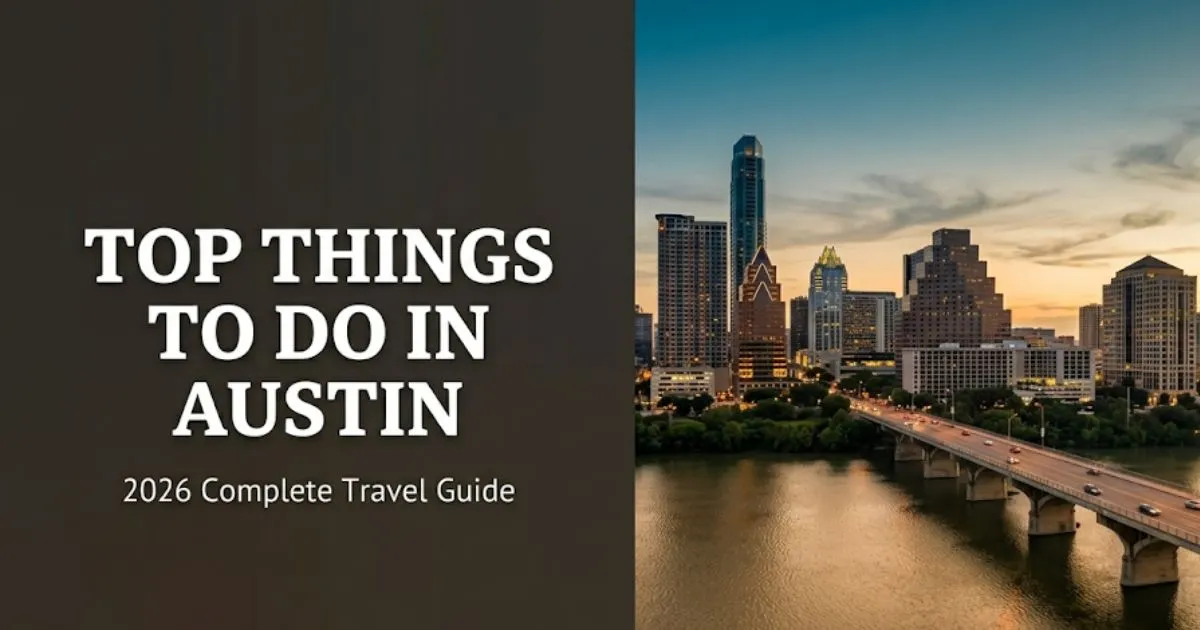
Top Things to Do in Austin: The 2026 Insider Guide

The top things to do in Austin go well beyond 6th Street bars and a bat bridge selfie. Austin delivers live music on a Tuesday night, barbecue worth a two-hour wait, and swimming holes that make a July afternoon survivable.
Visit Austin reports more than 300 live music venues operating across the city. That density makes Austin genuinely different from other American music cities, not just by marketing claim.
This guide covers every major district, outdoor experience, and dining category worth your time in 2026. It also tells you what to skip, when to go, and how to structure your days without wasting them.
Top Things to Do in Austin
The single best way to experience Austin is to divide your time across three zones: the Colorado River outdoor corridor, the East Austin cultural district, and the South Congress food and shopping strip.
Barton Springs Pool anchors the outdoor experience. It’s a three-acre spring-fed swimming pool inside Zilker Park, maintaining a steady 68 degrees Fahrenheit year-round.
The Congress Avenue Bridge delivers one of the most genuinely dramatic urban wildlife events in North America. An estimated 1.5 million Mexican free-tailed bats emerge at dusk from March through late October.
Franklin Barbecue on East 11th Street remains one of the most referenced barbecue destinations in the United States. James Beard Foundation recognition, a waiting line that starts before the doors open, and brisket that justifies the patience.
| Activity | Best For | Cost Range | Time Required | Insider Note |
|---|---|---|---|---|
| Barton Springs Pool | All profiles | Low (entry fee) | 2 to 4 hours | Arrive before 10am on summer weekends |
| Congress Avenue Bridge bats | Couples, adults | Free | 45 minutes | Best mid-August through October |
| Franklin Barbecue | Food travelers | Mid-range | 2 to 3 hours with wait | Arrive by 8:30am or expect sellout |
| Barton Creek Greenbelt | Outdoor enthusiasts | Free | 2 to 5 hours | Skip in extreme summer heat |
| East 6th Street music venues | Solo travelers, adults | Low to mid | Evening into late night | Weekdays offer smaller crowds, better sound |
| Blanton Museum of Art | Culture travelers, seniors | Low | 1.5 to 2.5 hours | Free on Thursdays |
| Rainey Street | Couples, groups | Low to mid | 2 to 4 hours | Arrive before 9pm for patio seating |
| Lady Bird Lake kayak | Families, couples | Mid-range | 1.5 to 3 hours | Morning rentals avoid afternoon heat |
Insider Tip:
- Austin’s best experiences cluster in overlapping geographic zones. Plan your days geographically, not by attraction type, to minimize driving.
- The most underused planning move: reserve Hamilton Pool Preserve permits at least 2 to 3 weeks in advance through Texas Parks and Wildlife’s online reservation system.
- Seniors and accessibility travelers will find Zilker Park and the Barton Springs Pool area far more accessible than the Barton Creek Greenbelt, which involves rocky creek crossings.
Best Things to Do in Austin TX
The best Austin experiences reward early risers, patient lunch-line waiters, and travelers willing to walk two blocks past the obvious tourist option.
A two-day weekend structure covers the essential Austin circuit without feeling rushed. This framework is built to include both the tourist-oriented anchor experiences and their genuinely better local alternatives.
Weekend Itinerary Framework for Austin:
Day 1:
- Arrive early. Get to Franklin Barbecue (900 E 11th Street) by 9am. Order brisket, ribs, and a side of sausage. The line is real and worth it.
- Walk off lunch at Zilker Park. Consider paddleboarding on Lady Bird Lake via rentals near the Barton Springs Road entrance.
- Afternoon: swim at Barton Springs Pool. Budget 2 hours minimum.
- Evening: head to South Congress Avenue for dinner. Hopdoddy Burger Bar and Elizabeth Street Cafe both anchor the strip.
- Night: walk the South Congress strip or catch the bat emergence at Congress Avenue Bridge at dusk (sunset time varies seasonally; verify departure times locally).
Day 2:
- Morning coffee at Brew and Brew on East 6th or Houndstooth Coffee on North Lamar.
- Visit the Bullock Texas State History Museum on Congress Avenue. Allow 2 hours.
- Lunch at Veracruz All Natural on Manor Road for breakfast tacos that represent Austin’s food culture more accurately than most restaurant meals.
- Afternoon: explore East 6th Street retail and gallery spaces. Visit Casa Colombia or browse the independent shops on East Cesar Chavez.
- Evening: live music on East 6th Street or at Antone’s Nightclub on West 5th. Dinner at Lenoir in South Austin if budget allows.
Couples benefit from Day 1’s outdoor and dinner combination, particularly the Lady Bird Lake sunset paddleboard window. Solo travelers get the most from Day 2’s East Austin social circuit.
Things to Do in Austin, Texas for Adults
Austin’s adult-specific appeal centers on its live music circuit, craft cocktail culture, food scene credibility, and late-night energy that extends well past midnight on weekends.
The Red River Cultural District, roughly between 6th and 10th Streets on Red River, is where Austin’s working musicians perform for audiences that actually came for the music. Emo’s Austin, Mohawk, and Stubb’s Waller Beach Amphitheater anchor this corridor.
Rainey Street delivers a more intimate adult nightlife experience than 6th Street. The street is lined with converted craftsman bungalows turned bars, and the energy feels more neighborhood gathering than tourist event.
For adults focused on food culture, Uchi on South Lamar Boulevard represents one of Austin’s most recognized dining destinations. Reservations should be made weeks ahead, especially for Friday and Saturday evenings.
According to the Austin Chronicle, Austin’s food truck scene operates at a level that rivals most brick-and-mortar markets. The South Lamar food truck park and clusters near East Cesar Chavez Street offer meals that range from $8 to $18 per person for genuinely high-quality options.
Insider Tip:
- Adults visiting for nightlife should use rideshare exclusively on 6th Street weekends. Parking is limited, enforcement is active, and surge pricing after midnight is manageable compared to parking fees.
- Budget travelers get Austin’s full adult experience for under $60 a day through free live music at smaller venues, food truck meals, and free outdoor spaces.
- The most overrated adult experience: the main 6th Street tourist corridor on a Saturday night. Overcrowded, expensive, and the music quality is secondary to the bar revenue focus.
Unique Things to Do in Austin Texas
Austin’s genuinely distinctive experiences are ones that exist nowhere else in the United States in exactly the same form.
The Congress Avenue Bridge bat colony is the largest urban bat colony in North America. Watching 1.5 million bats spiral into the Austin sky at dusk is not a staged experience. It is a natural phenomenon that happens on its own schedule every evening from March through late October.
Hamilton Pool Preserve, operated by Travis County Parks, is a collapsed grotto forming a natural swimming pool beneath a 50-foot waterfall. It looks like it belongs in Iceland, not central Texas. Timed-entry permits are required and frequently sell out weeks in advance.
The Mexic-Arte Museum on Congress Avenue is the oldest and largest multidisciplinary Mexican and Mexican American art organization in the United States. Entry runs approximately $5 to $7 per adult as of recent years; verify current pricing before visiting.
Enchanted Rock State Natural Area, about 90 minutes northwest of Austin, involves a massive pink granite dome that Texas tribes considered sacred. The summit hike is moderately demanding but delivers a 360-degree Hill Country panorama that is genuinely unlike any other Texas experience.
Insider Tip:
- Hamilton Pool Preserve permits must be reserved online through the Texas Parks and Wildlife Department reservation system. Check availability 3 to 4 weeks ahead, especially for April through June visits.
- The Keep Austin Weird sensibility is most visible on South Congress Avenue at independent shops like Uncommon Objects and Feathers Boutique. These are actual Austin institutions, not souvenir stores.
- Seniors and accessibility travelers should note that Hamilton Pool’s trail to the swimming area involves uneven terrain. Call ahead to confirm current accessibility conditions.
Key Takeaway: Book Hamilton Pool Preserve permits 3 weeks ahead. They sell out, especially April through June, with zero day-of availability.
Things to Do in Downtown Austin
Downtown Austin is denser and more walkable than most Texas cities, but its geography rewards understanding before arrival.
The Texas State Capitol Building on Congress Avenue is free to visit and genuinely worth the time. The building’s architecture is larger than the US Capitol in Washington, DC, a detail that Austin residents mention with particular satisfaction.
Congress Avenue runs due south from the Capitol to the Colorado River. Walking this corridor covers the Blanton Museum of Art at the University of Texas edge, the tourist stretch of restaurants and shops, and deposits you at the Congress Avenue Bridge.
The Blanton Museum of Art, on the University of Texas at Austin campus just north of downtown, holds one of the largest permanent collections in the American Southwest. Admission runs approximately $12 to $20 per adult as of recent years; free on Thursdays. Verify current pricing and hours before visiting.
The Bullock Texas State History Museum on Congress Avenue is one of the most genuinely engaging state history museums in the United States. The IMAX theater and permanent exhibits covering Texas from pre-Columbian culture through the oil era run approximately $9 to $15 per adult.
Insider Tip:
- Downtown Austin parking on weekends requires planning. The city-operated garages on San Jacinto and Second Street are typically less expensive than surface lots near 6th Street. Budget approximately $15 to $25 for an evening.
- Families with children find the Bullock Museum’s interactive exhibits and IMAX programming the most reliably engaging downtown option for ages 7 and up.
- The most underused downtown move: the Shoal Creek Trail parallels the western edge of downtown and connects Zilker Park to the University of Texas. It is entirely free, entirely car-free, and consistently uncrowded on weekdays.
East Austin and Rainey Street
East Austin represents the clearest example of Austin’s cultural migration away from the tourist downtown core, and understanding it is the difference between a generic Austin trip and a genuinely good one.
East 6th Street between Pedernales Street and Chicon Street is where independent bars, live music venues, and restaurants have concentrated over the past decade. Nickel City, a dive bar with an exceptional whiskey selection, and Zilker Brewing Company on East Oltorf anchor the neighborhood’s social fabric.
Rainey Street Historic District, a compact grid of converted craftsman bungalows south of downtown, operates as Austin’s most visually distinctive nightlife corridor. Bars like Banger’s Sausage House and Beer Garden (with one of Texas’s largest outdoor draft beer selections) and Whisler’s (a mezcal-focused cocktail bar) define the strip’s range.
East Austin also holds some of Austin’s most credible dining. Launderette on Airport Boulevard, and Foreign and Domestic on North Loop deliver food that locals recommend over the more tourist-facing options on South Congress.
According to Visit Austin, East Austin has grown into one of the city’s primary dining and entertainment destinations, with more than 80 independently owned restaurants and bars operating within a half-mile radius of East 6th Street.
Traveler profile note: Solo travelers and couples find East Austin’s bar-hopping circuit more socially accessible than 6th Street’s tourist corridor. Families with young children will find limited options on Rainey Street after 8pm.
South Congress Avenue Austin
South Congress Avenue, known locally as SoCo, is Austin’s most walkable commercial corridor and the one that best reflects the city’s independent retail and restaurant identity.
The strip runs from the South Congress Hotel south through a concentrated mix of vintage clothing stores, independent restaurants, galleries, and food trucks. Uncommon Objects at 1512 South Congress is a multi-dealer antique market that has operated for over 25 years; it is one of the most genuinely browsable shops in the city.
For food, Home Slice Pizza at 1415 South Congress has earned its reputation without needing tourist marketing. The line on Friday evenings is real; the more-to-go window next door at More Home Slice moves faster for solo diners.
Elizabeth Street Cafe at 1501 South First (one block west of SoCo) is the most well-regarded Vietnamese bakery and cafe in Austin. The banh mi and Vietnamese coffee represent a quality level that exceeds anything available on the main Congress strip.
Insider Tip:
- SoCo parking fills by 11am on weekends. Use the Austin B-Cycle bikeshare network to arrive from downtown or South Lamar. The ride takes 8 to 12 minutes from the Congress Avenue Bridge area.
- Budget travelers can spend an entire SoCo afternoon for under $20: coffee, a walk through Uncommon Objects (no admission), and a food truck lunch from the cluster near the Big Top Candy Shop block.
- The most overrated SoCo experience: the weekend brunch lines at well-photographed spots exceed 45 minutes to an hour. Arriving before 10am on Saturday or choosing a Tuesday visit eliminates the wait entirely.
Key Takeaway: East Austin and SoCo together represent Austin’s real cultural identity. Spending one full day in each beats two full days on 6th Street.
Outdoor Things to Do in Austin
Austin’s outdoor circuit runs from a spring-fed urban swimming pool to rocky canyon hikes to flat-water kayaking on a reservoir inside the city limits.
Barton Creek Greenbelt is an 8-mile limestone canyon trail system threading through the western edge of Austin. Multiple trailheads access swimming holes at Sculpture Falls, Twin Falls, and Campbell’s Hole. Summer water levels vary significantly based on rainfall; check Austin Parks and Recreation’s current conditions before driving out.
Lady Bird Lake is a reservoir on the Colorado River that bisects central Austin. The Ann and Roy Butler Hike-and-Bike Trail circles the lake for 10 miles. Kayak and stand-up paddleboard rentals are available near the Barton Springs Road entrance and the Hyatt Regency dock; pricing typically runs $15 to $25 per hour as of recent years.
Barton Springs Pool within Zilker Park deserves its own planning slot. The 68-degree water makes it genuinely refreshing in Austin’s brutal summer heat. Admission runs approximately $5 to $9 per adult as of recent years; closed periodically for cleaning. Verify current closure schedules before visiting.
Outdoor traveler profile table:
| Experience | Terrain Demand | Best Season | Cost | Accessibility |
|---|---|---|---|---|
| Barton Springs Pool | Minimal | Year-round | Low | High (paved entry) |
| Lady Bird Lake hike-and-bike trail | Low | Fall through Spring | Free | High (paved trail) |
| Barton Creek Greenbelt | Moderate to high | Fall through Spring | Free | Low (rocky terrain) |
| Hamilton Pool Preserve | Moderate | April through June | Low (permit required) | Moderate |
| Enchanted Rock summit | Moderate | Fall through Spring | Low (state park fee) | Moderate |
Seniors and accessibility travelers should focus on the Lady Bird Lake trail and Barton Springs Pool. Both offer paved, flat access. The Greenbelt and Enchanted Rock involve terrain that is not suitable for limited mobility.
Best Live Music Austin Texas
Austin’s live music identity is real, not just a marketing tagline. The city genuinely operates more live music venues per capita than any other US city.
The distinction that matters: the Red River Cultural District and East Austin music scene is where Austin musicians and music-focused travelers spend their time. The main 6th Street Entertainment District is where bachelor parties spend their time. Both exist; they are not the same experience.
Antone’s Nightclub on West 5th Avenue has operated since 1975 and has hosted virtually every significant blues and roots musician in American music. Current programming spans blues, soul, and Americana. Cover charges typically run $10 to $30 depending on the performer.
Stubb’s Waller Beach Amphitheater on Red River Street hosts outdoor shows from spring through fall. The outdoor stage setting, with the Austin skyline behind the stage, represents the best large-venue live music setting in the city. Tickets range from $20 to $80 or more depending on the artist.
The Parish on East 6th Street books regional and national acts in a 500-capacity room that maintains genuine intimacy. The sound system is among the best of Austin’s smaller venues.
Insider Tip:
- Free live music happens nightly at Hole in the Wall on Guadalupe Street near the University of Texas and at multiple Red River District venues. Check the Austin Chronicle’s weekly music calendar for no-cover shows.
- Solo travelers find the Red River District far more socially navigable than 6th Street. The crowds are smaller, the conversations are more music-focused, and the venues are less chaotic.
- ACL Live at the Moody Center is a premier indoor venue for national touring acts. For major artists, book tickets through official channels as soon as the on-sale date is announced.
Key Takeaway: Red River Cultural District on any Tuesday or Wednesday night delivers better live music than 6th Street on a Saturday, with a fraction of the crowd.
Best Food and BBQ in Austin
Austin’s food identity runs from Michelin-recognized Japanese-Texan fusion restaurants to food trucks that have developed national followings, with Central Texas barbecue as the connective tissue across all of it.
Franklin Barbecue at 900 East 11th Street remains the most referenced barbecue destination in Austin. The wait is real: arriving at 9am for an 11am opening is standard practice. Brisket, beef ribs, and the jalapeño cheddar sausage represent the full experience. Plan approximately $25 to $40 per person before sides and drinks.
la Barbecue on East Cesar Chavez Street operates as a food truck and often draws a comparable crowd to Franklin with slightly shorter waits. The brisket quality is in genuine competition with Franklin’s.
Terry Black’s Barbecue on Barton Springs Road offers a full-service restaurant format without the outdoor line system. The quality is high and the experience is more suitable for groups or families.
For breakfast tacos, which Austin does at a level that sets the regional standard, Veracruz All Natural on Manor Road in East Austin and Juan in a Million on East Cesar Chavez are the two most credible options.
Uchi on South Lamar Boulevard represents Austin’s fine dining peak: a James Beard Award-winning Japanese-Texan tasting menu experience running approximately $80 to $150 per person without wine. Reservations are essential and often required 2 to 3 weeks in advance.
Budget travelers eat exceptionally well in Austin through food trucks and breakfast taco spots for $8 to $18 per meal. The food truck parks around South Lamar and East Cesar Chavez Street concentrate the best options.
Things to Do in Austin for Couples
Austin suits couples well because it stacks romantic outdoor moments alongside a food and music scene that rewards shared discovery.
The Congress Avenue Bridge bat emergence at dusk is one of the most reliably dramatic shared experiences in any American city. Arriving 30 minutes early, securing a spot on the bridge or the upper deck of The Bat Bar directly below, and watching the colony spiral into the evening sky is genuinely memorable. No cost. No advance booking.
Lady Bird Lake at sunset delivers a different kind of couple moment. Renting a kayak or stand-up paddleboard for an evening session on the lake, with Austin’s downtown skyline reflecting off the water, costs approximately $15 to $30 per hour per board or kayak.
Dinner at Lenoir on South Congress delivers a farm-to-table tasting experience that represents Central Texas ingredients at a genuinely high level. The outdoor patio setting adds to the experience. Reservations recommended 1 to 2 weeks ahead.
For couples who prefer a slower daytime rhythm, the Blanton Museum of Art’s free Thursday admission, followed by coffee at Houndstooth Coffee on North Lamar, represents an ideal low-cost Austin afternoon.
Insider Tip:
- The Barton Springs Pool at night (the pool is open until 10pm on some evenings) is one of Austin’s most underused couple experiences. Fewer crowds. Same 68-degree water. Verify seasonal hours before planning this.
- Weekend evenings on Rainey Street work best for couples who arrive before 8:30pm. Patio tables at Emmer and Rye or drinks at Whisler’s are difficult to access after 9pm without a wait.
Austin Activities for Families with Kids
Austin works for families primarily through its outdoor infrastructure and museum programming. The city’s nightlife-heavy reputation doesn’t mean it ignores younger visitors.
Zilker Park is the most family-useful green space in Austin. The park contains Barton Springs Pool, the Barton Springs Nature Center, open fields, and access to the Lady Bird Lake trail. A family can spend a full day here without running out of space or options.
The Bullock Texas State History Museum on Congress Avenue has consistently high marks for family engagement. The interactive exhibits on Texas history, the IMAX theater, and the manageable size make it a 2-hour visit that holds children’s attention through the end.
Barton Springs Pool works for families with children who can swim independently. The pool’s size and the grassy surrounding park area make it genuinely enjoyable for kids ages 6 and up. Younger children and non-swimmers may find the deep spring-fed water challenging.
Traveler profile note: Families with children under 5 will find Austin’s summer heat the most significant logistical challenge. Planning outdoor activities before 10am and after 5pm from June through August is not optional. It is a genuine safety consideration.
The Austin Children’s Museum (operated as the Thinkery at 1830 Simond Avenue) is specifically designed for children ages 2 through 11. Admission runs approximately $14 to $18 per person as of recent years; verify current pricing before visiting.
Families planning Austin in October should consider timing their visit around the Austin City Limits Music Festival (ACL Fest) in Zilker Park. The family-friendly daytime programming makes it one of the most accessible major music festivals for children in the US.
Key Takeaway: Families get the most from Austin through Zilker Park and the Bullock Museum. Both work for ages 5 and up without requiring heat tolerance or late nights.
Free Things to Do in Austin
Austin’s best free experiences are substantial enough to fill a full day without spending anything beyond food costs.
The Congress Avenue Bridge bat emergence costs nothing and requires no registration. Arrive 20 to 30 minutes before local sunset from March through late October, position on the bridge or the south bank of Lady Bird Lake, and wait.
The Ann and Roy Butler Hike-and-Bike Trail around Lady Bird Lake is 10 miles of paved trail entirely free to access. The trailhead nearest Barton Springs Road is the most popular entry point.
Barton Creek Greenbelt trailheads are free to enter. The most popular entry points are the Spyglass Drive and Barton Springs Road trailheads. Swimming holes within the Greenbelt are free; water levels vary by season.
Free experiences in Austin worth planning around:
- Texas State Capitol Building: free self-guided tours, open most days; verify holiday closures before visiting
- Blanton Museum of Art: free admission every Thursday
- South Congress Avenue browsing: Uncommon Objects, Feathers Boutique, and Big Top Candy Shop have no admission fee and offer genuine browsing value
- Red River Cultural District live music: multiple venues offer no-cover shows on weeknights; check the Austin Chronicle weekly calendar
- Barton Springs Nature Center: free exhibits on central Texas ecosystems adjacent to the pool
Budget travelers can structure a complete Austin weekend using only free outdoor and cultural experiences, spending only on food. Austin’s food truck circuit provides full meals for $8 to $15 per person, keeping total daily costs well under $50.
Best Time to Visit Austin Texas
The best time to visit Austin is March through May or September through November, when temperatures are manageable and the city’s outdoor and event calendar is at full capacity.
Spring (March to May): Temperatures range from approximately 65 to 85 degrees Fahrenheit. Bluebonnet wildflower season peaks in April along Hill Country highways. Note: South by Southwest (SXSW) typically occurs in mid-March. During SXSW, downtown hotel prices triple or more, parking becomes nearly impossible, and popular venues operate at capacity. First-time visitors without SXSW credentials should avoid mid-March specifically.
Fall (September to November): Austin’s best weather window for outdoor activities. Temperatures drop from summer highs into the 75 to 85 degree range by September. Austin City Limits Music Festival (ACL Fest) occupies two consecutive weekends in early October at Zilker Park. Hotel rates rise during festival weekends; book at least 6 to 8 weeks ahead.
Summer (June to August): Temperatures regularly exceed 100 degrees Fahrenheit. Outdoor activities remain possible but require early-morning timing. Barton Springs Pool becomes particularly valuable during this period. Budget travelers may find lower hotel rates outside festival periods.
Winter (December to February): Mild compared to most US cities (temperatures typically 45 to 65 degrees Fahrenheit). Outdoor swimming is cold but the Greenbelt trails are uncrowded. Some venues reduce hours. Austin is less expensive in January and February than any other period outside major events.
According to Visit Austin, the fall festival season, specifically the October ACL Fest weekends, represents Austin’s single highest-demand hotel and accommodation period annually.
Day Trips from Austin Texas
Austin’s position in central Texas places it within driving distance of some of the most distinctive landscapes and towns in the American South.
Texas Hill Country begins approximately 45 minutes west of Austin on US Highway 290. The route through Dripping Springs, Johnson City, and Fredericksburg passes working wineries, wildflower corridors in spring, and the town of Fredericksburg itself (a German-settled community with a Main Street that operates as a genuinely worthwhile afternoon destination). Drive time to Fredericksburg: approximately 1.5 hours.
Hamilton Pool Preserve is 35 miles west of Austin off Texas Highway 71. The collapsed grotto and waterfall swimming hole is one of the most visually distinctive natural sites in Texas. Timed-entry permits are required and must be reserved in advance through the Travis County Parks reservation system. Check availability 3 to 4 weeks ahead; summer weekends sell out within hours of becoming available.
San Marcos, 30 miles south on Interstate 35, offers the San Marcos River for tubing and kayaking. The Guadalupe River tubing circuit near New Braunfels is 45 minutes south and operates as one of Central Texas’s most popular summer day activities.
Enchanted Rock State Natural Area, operated by Texas Parks and Wildlife, is 90 minutes northwest near Fredericksburg. The 425-foot pink granite dome summit hike is moderately demanding and takes approximately 45 minutes to 1 hour each way. Entry requires advance reservations during peak seasons; verify availability through Texas Parks and Wildlife before driving out.
Day trip note for families: San Marcos and New Braunfels river tubing are seasonal (typically April through September) and alcohol-permitted, making them better suited for adults and older teens than families with young children.
Key Takeaway: Hamilton Pool Preserve and Enchanted Rock both require advance reservations. Book before you leave home; neither offers reliable walk-in access on weekends.
Safety and Practical Warnings for Austin
Austin’s most significant visitor safety issue is summer heat, not crime. Temperatures exceeding 100 degrees Fahrenheit from June through August create real physical risk for outdoor activities without proper preparation.
Key safety and practical facts every Austin visitor should know:
- Heat warning: Schedule all outdoor activities (Greenbelt hiking, Lady Bird Lake paddling, Congress Avenue Bridge visits) before 10am or after 6pm during June through August. Carry water. Genuine heat exhaustion risk applies.
- 6th Street weekend crowding: The main 6th Street entertainment corridor between Red River and Lavaca Streets is pedestrian-only on weekend nights and is heavily crowded. Pickpocket risk in dense bar crowds exists; secure valuables before entering.
- Barton Creek Greenbelt trail conditions: Creek crossing points involve slippery limestone surfaces. Water sandals or water shoes are strongly recommended over bare feet or standard athletic shoes.
- Car security: Avoid leaving valuables visible in parked cars, particularly in downtown surface lots and parking structures near 6th Street. Break-ins are reported in concentrated entertainment parking areas.
- Hamilton Pool Preserve swimming: The swimming area can be closed due to water quality issues. Check Travis County Parks status updates the day before your visit, not the day of.
- Rideshare surge pricing: After midnight on 6th Street and Rainey Street, rideshare demand spikes significantly. Budget 1.5 to 2 times normal pricing for post-midnight departures from entertainment districts.
Austin’s non-emergency police line and the Austin-Travis County Emergency Management office maintain current public safety advisories. Bold safety instruction: use rideshare exclusively for downtown nightlife. Do not drive to 6th Street or Rainey Street on weekend evenings.
Frequently Asked Questions About Top Things to Do in Austin
What are the top things to do in Austin for first-time visitors?
First-time visitors to Austin should prioritize Barton Springs Pool, the Congress Avenue Bridge bat emergence, Franklin Barbecue, and an evening on East 6th Street or Rainey Street.
These four experiences represent Austin’s distinct outdoor, wildlife, barbecue, and music culture without overlapping.
Skip the main 6th Street tourist corridor on your first night; it is the least representative Austin experience despite being the most photographed.
Is Austin worth visiting for a long weekend?
Austin is one of the strongest long-weekend destinations in the American South. Two to three days is enough to cover outdoor, music, and food priorities without feeling rushed.
The city’s walkable entertainment districts and proximity to Hill Country day trips make it efficient to plan.
Avoid visiting during SXSW in mid-March or ACL Fest in early October unless you have event credentials; hotel prices and crowd levels make those weekends significantly less enjoyable for general tourists.
What is the best neighborhood to stay in Austin?
The best neighborhood to stay in Austin depends on your priorities. South Congress provides walkable access to SoCo’s restaurants and shops. East Austin puts you closest to the independent bar and music scene. Downtown gives you the most central base but the least local character.
Couples and food-focused travelers tend to prefer South Congress or South Lamar accommodations.
Solo travelers and music-focused visitors get the most from East Austin lodging, which places them within walking distance of the Red River District and East 6th Street venues.
How do I get around Austin without a car?
Austin is navigable without a car using rideshare (Uber and Lyft are both widely available) and the Capital Metro bus network for daytime travel.
The Lady Bird Lake trail and South Congress Avenue are both walkable from downtown hotels.
Rideshare is the most practical option for evening movement between entertainment districts; Capital Metro service reduces significantly after 10pm.
What should I know about Austin’s heat before visiting in summer?
Austin summer heat regularly exceeds 100 degrees Fahrenheit from June through August. Outdoor activity without planning creates a genuine risk of heat exhaustion.
Schedule outdoor activities before 10am or after 6pm. Barton Springs Pool’s 68-degree water makes it the most practical summer daytime activity.
Carry at least 24 ounces of water per person for any outdoor activity lasting more than 30 minutes, regardless of the time of day.
How far in advance do I need to book Hamilton Pool Preserve?
Hamilton Pool Preserve timed-entry permits typically need to be reserved 2 to 4 weeks in advance for spring and summer weekends.
Permits are available through the Travis County Parks online reservation system. Summer Saturdays and Sundays sell out within hours of becoming available.
Check water quality closure status through Travis County Parks the day before your visit; the swimming area closes periodically and closures are not always announced far in advance.
Plan Your Austin Trip with Confidence
Austin in 2026 rewards travelers who look past the obvious tourist circuit. The bat colony, the spring-fed swimming pool, the barbecue lines, and the genuine music venues are all real and worth your time.
Start your bookings with Hamilton Pool Preserve permits and Franklin Barbecue timing (no reservation possible; plan your arrival instead). These two logistics steps separate a well-planned Austin trip from a frustrating one.
Travel conditions, operating hours, admission prices, and permit availability change regularly in Austin. Verify key logistics with Visit Austin (austintexas.org), Travis County Parks, and Texas Parks and Wildlife before departure. The rest of your Austin trip will take care of itself