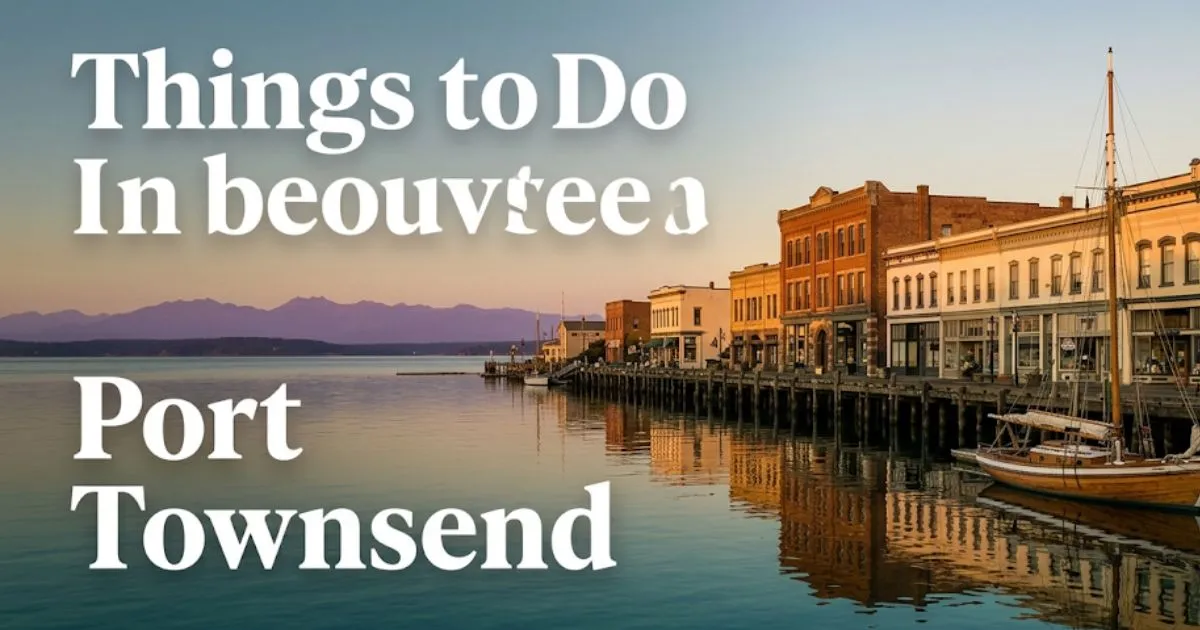
Things to Do in Port Townsend, WA: The 2026 Guide

Port Townsend packs more genuine Victorian-era character into a few walkable blocks than almost any other small town on the Pacific coast. The things to do in Port Townsend range from sea kayaking on the Strait of Juan de Fuca to attending world-caliber jazz workshops at a restored Civil War-era fort.
According to Visit Port Townsend, the town holds one of the largest intact collections of Victorian commercial architecture in the United States. That specific quality is real, earned, and worth the trip.
This guide covers every meaningful experience the town offers in 2026: two distinct neighborhoods, the best outdoor activities, where locals actually eat, honest festival guidance, and a weekend itinerary you can use immediately.
Things to Do in Port Townsend: What This Town Actually Delivers
Port Townsend delivers a genuinely rare combination: Victorian architectural preservation at city scale, a working arts residency program, and direct access to Pacific Northwest wilderness.
It is not a theme park version of the past. The Victorian buildings on Water Street are occupied by working restaurants, independent bookstores like William James Booksellers, and local breweries.
The town’s identity runs deeper than historic facades. The Centrum Foundation, based at Fort Worden State Park, hosts internationally recognized music and arts workshops year-round.
Port Townsend sits at the northeastern tip of the Olympic Peninsula. The Strait of Juan de Fuca to the north and Puget Sound to the east create a dramatic coastal setting that amplifies every outdoor experience.
Couples and solo travelers with interests in arts, history, and Pacific Northwest nature get the most from Port Townsend. Travelers expecting a beach resort or mainstream entertainment will find the town’s offering narrower than they anticipated.
Insider Tip:
- Walk uphill to the uptown district on your first afternoon. Most visitors never leave Water Street.
- The Centrum Foundation’s public events at Fort Worden are often free or low-cost and feature professional-level performances.
- Couples will find the waterfront at sunset from the Fort Worden beach genuinely rewarding with no admission charge.
Port Townsend Washington Attractions: The Essential Shortlist
Port Townsend’s top attractions cluster into three categories: Victorian heritage sites, Fort Worden State Park, and the working waterfront and marine environments.
The Jefferson County Historical Society Museum on Madison Street covers the town’s 19th-century boom history with specific detail. Admission runs approximately $5 to $10 per adult; verify current rates before visiting.
Fort Worden State Park gives you a decommissioned military reservation turned public arts campus, a lighthouse, ocean beach, historic gun batteries, and 434 acres of trails. It functions as Port Townsend’s most versatile single destination.
The Port Townsend Marine Science Center on the Fort Worden waterfront offers touch tanks, marine exhibits, and guided beach walks. It works especially well for families with children ages 5 and older.
| Attraction | Best For | Cost Range | Time to Allow |
|---|---|---|---|
| Fort Worden State Park | All profiles | Free to enter; camping extra | Half to full day |
| Jefferson County Historical Society Museum | History enthusiasts | $5-$10 per adult | 1 to 2 hours |
| Port Townsend Marine Science Center | Families, curious adults | $5-$12 per adult | 1 to 2 hours |
| Water Street Victorian walk | Couples, solo travelers | Free | 1 to 3 hours |
| Chetzemoka Park | Families, couples | Free | 1 to 2 hours |
| William James Booksellers | Solo travelers, book lovers | Free to browse | 30 to 60 minutes |
Budget travelers will find Port Townsend genuinely accessible. The majority of the town’s most distinctive experiences cost nothing beyond transportation to get there.
The Port Townsend Historic District: What to See and What to Skip
Port Townsend’s historic district holds over 70 Victorian-era commercial buildings on the National Register of Historic Places, concentrated along Water Street and the adjacent blocks between Adams and Taylor Streets.
The streetscape is the experience. Walking the five-block commercial core of Water Street between Quincy and Tyler Streets delivers the essential architectural character in about 45 minutes.
The overrated move is to spend your entire visit here. Water Street is the postcard version of Port Townsend. The actual town extends uphill and out to Fort Worden.
The most photographed building is the City Hall on Water Street, built in 1891. The most interesting building for architectural context is the Ann Starrett Mansion at Clay and Adams Streets, which offers guided tours on a seasonal schedule.
Seniors and travelers with mobility limitations will find Water Street itself flat and highly walkable. The streets leading uphill to the uptown district involve a significant grade and are less accessible without a vehicle.
Insider Tip:
- The best light for photographing Victorian facades is morning, before 10 AM, when the street faces east and catches direct sun.
- The Ann Starrett Mansion tours provide architectural and historical detail that the self-guided street walk cannot match.
- For solo travelers: the Jefferson County Historical Society Museum on Madison Street contextualizes everything you see on the street walk with specific Port Townsend history, not generic Victorian-era overview content.
Uptown and Downtown Port Townsend: Two Different Towns in One
Port Townsend divides clearly into two distinct districts with different characters, different activity profiles, and different visitor experiences.
Downtown is the commercial waterfront: Water Street, the working harbor, the ferry dock, restaurants, galleries, and the Victorian commercial buildings. This is where most visitors spend all of their time.
Uptown is the residential Victorian neighborhood on the bluff above downtown. Lawrence Street and Tyler Street uptown contain the finest Victorian residential architecture, the Uptown Arts District, and a quieter, more local-feeling version of the town.
The Uptown Pubhouse on Lawrence Street is a genuinely local neighborhood bar. It operates at a register completely removed from the tourist waterfront experience two blocks below.
Couples seeking a more intimate and less crowded version of Port Townsend should prioritize uptown. The residential streets between Lawrence and Polk Streets contain block after block of impeccably preserved Victorian homes that receive a fraction of the foot traffic of Water Street.
Families with strollers or young children should be aware that the hill connecting uptown and downtown is steep. Drive or take the short connector road rather than attempting the grade with a loaded stroller.
Key Takeaway: Port Townsend’s uptown district gives you the best Victorian residential architecture in the Pacific Northwest with almost none of the crowds that cluster on Water Street below.
Fort Worden State Park: Port Townsend’s Most Underused Major Attraction
Fort Worden State Park is Port Townsend’s best single destination and also its most underused one. Most visitors treat it as a half-hour photo stop when it warrants a full day.
The park occupies a 434-acre former US Army Coast Artillery post at the northern tip of Port Townsend. The Centrum Foundation operates an internationally recognized arts and education program from the fort’s restored Victorian officers’ quarters and performance halls.
The Point Wilson Lighthouse, operational since 1879 and managed by the US Coast Guard, stands at the park’s northern point. The beach at Point Wilson is one of the best locations on the Olympic Peninsula to watch ship traffic on the Strait of Juan de Fuca.
Fort Worden’s concrete gun batteries from the Spanish-American War era are open to explore. Battery Kinzie and Battery Stoddard are the most accessible and offer the most dramatically preserved military engineering on the site.
The park charges a Discover Pass fee for day-use parking, typically in the $10 to $12 per day range. Washington State residents can purchase an annual Discover Pass; verify current pricing and purchase options with the Washington State Parks and Recreation Commission before visiting.
Couples will find the sunset beach walk from the Marine Science Center dock to Point Wilson one of the most genuinely romantic experiences in the Olympic Peninsula. Families can combine beach time, lighthouse viewing, and fort exploration into a full-day program that holds children’s attention far more effectively than a downtown gallery walk.
Insider Tip:
- The Centrum Foundation frequently offers public performances during its resident artist workshops. Check the Centrum schedule before your visit; these events are rarely crowded and sometimes free.
- The fort’s parade ground is one of the largest flat open spaces in Port Townsend and excellent for families with young children who need to run.
- Camping at Fort Worden State Park puts you inside the park at night when the day-trippers leave and the atmosphere becomes something entirely different.
Port Townsend Arts and Culture: Deeper Than the Victorian Facade
Port Townsend’s arts scene is anchored by the Centrum Foundation at Fort Worden, which runs residency programs and public festivals in music, dance, writing, and visual arts throughout the year.
The Jazz Port Townsend festival each summer, produced by Centrum, brings internationally recognized jazz artists and educators to Fort Worden. The Centrum Blues Festival follows a similar format with equal professional caliber.
The Port Townsend Film Festival each autumn screens independent and international films at the Rose Theatre on Taylor Street. The Rose Theatre itself, built in 1907, is one of the oldest operating movie theaters in Washington State.
The gallery scene runs along Water Street and up into the uptown district. The Arts Guild of Port Townsend maintains a cooperative gallery that showcases local working artists. It is a more authentic representation of the town’s creative community than the commercial galleries selling Victorian-themed prints for the tourist trade.
According to the Centrum Foundation, more than 4,000 participants attend its programs annually, including professional artists in residence and community participants. This is not a manufactured arts destination. The residency program produces genuine creative output.
Solo travelers with interests in contemporary arts and music will find Port Townsend’s cultural programming surprisingly deep for a town of under 10,000 residents. Families traveling with arts-interested teenagers will find the Centrum programs more engaging than general sightseeing.
The Wooden Boat Festival and Port Townsend’s Major Annual Events
The Wooden Boat Festival, held each September at the Port Townsend Boat Haven, is the largest wooden boat festival in North America. It draws over 200 traditional wooden vessels and attracts maritime craftspeople, sailors, and boat builders from across the continent.
The festival weekend represents Port Townsend’s highest-demand accommodation and dining period. Book accommodation six to eight months in advance for Wooden Boat Festival weekend if that is your target visit.
Beyond the Wooden Boat Festival, the annual Port Townsend Victorian Heritage Festival in May celebrates the town’s architectural history with house tours, period-dress events, and walking tours led by local historians.
Centrum’s Jazz Port Townsend typically runs in late July. The Centrum Blues Festival typically occupies a weekend in late summer. Confirm 2026 dates directly with the Centrum Foundation, as scheduling adjusts year to year.
The Port Townsend Film Festival runs in late September or early October. It overlaps with post-Wooden Boat Festival shoulder season accommodation rates, making it one of the most cost-effective festival weekends to attend.
| Event | Typical Timing | Best For | Advance Booking Needed |
|---|---|---|---|
| Victorian Heritage Festival | May | History enthusiasts, couples | 2 to 4 weeks |
| Jazz Port Townsend (Centrum) | Late July | Music lovers, solo travelers | 4 to 6 weeks |
| Wooden Boat Festival | Early September | Maritime enthusiasts, families | 6 to 8 months |
| Port Townsend Film Festival | Late September/October | Solo travelers, cinephiles | 2 to 4 weeks |
Budget travelers should note that the Wooden Boat Festival brings significant price increases across all accommodation in Port Townsend and the surrounding area. The film festival and Victorian festival offer similar cultural richness at significantly lower accommodation rates.
Key Takeaway: Book accommodation six to eight months ahead for Wooden Boat Festival weekend. Every other Port Townsend event gives you four to six weeks of comfortable lead time.
Port Townsend Outdoor Activities: Kayaking, Hiking, and Wildlife
Port Townsend sits at the convergence of the Strait of Juan de Fuca and Puget Sound, producing one of the richest marine environments on the Pacific coast. Sea kayaking here is genuinely extraordinary.
PT Outdoors and other outfitters in Port Townsend offer guided sea kayak tours and equipment rentals. Paddling along the Fort Worden shoreline toward Point Wilson gives views of the lighthouse, passing cargo ships on the strait, and frequent harbor seal sightings.
Tidal currents at Point Wilson are among the strongest in the region. Paddlers without experience in tidal water should book a guided tour rather than renting independently. The water temperature year-round requires a wetsuit.
Hiking within Fort Worden State Park covers varied terrain from beach walks to forested bluff trails. The Artillery Hill trail connects the gun batteries to hilltop viewpoints overlooking the Strait of Juan de Fuca.
Whale watching tours operate from the Port Townsend waterfront. Orca and humpback sightings are most frequent from April through October, when whale activity along the inland waters of the Salish Sea peaks.
Outdoor Activities by Profile:
- Solo travelers: Guided kayak tours provide the safety net and local knowledge solo paddlers need in tidal waters.
- Families: Beach walks at Fort Worden and tidepooling at the Marine Science Center beach work well for children of all ages.
- Seniors: The flat beach trail along Fort Worden’s waterfront is accessible and rewards with excellent wildlife viewing without significant physical demand.
- Couples: Sunset kayak tours offer an intimate experience unique to Port Townsend’s coastal geography.
Port Townsend Marine Science Center: Best for Families and Curious Adults
The Port Townsend Marine Science Center on the Fort Worden waterfront is Port Townsend’s best family attraction and one of its most underappreciated experiences for adult visitors.
The center maintains touch tanks with local marine species including sea stars, urchins, anemones, and various invertebrates native to Puget Sound. The exhibits are oriented toward public education, not just children.
Admission typically runs in the $5 to $15 per person range; verify current pricing directly with the center before visiting, as seasonal rates and programming change. Guided beach walks and marine natural history programs run on a seasonal schedule.
The beach immediately adjacent to the Marine Science Center is one of the best low-tide tidepooling locations on the Olympic Peninsula. Low tide mornings from spring through early fall reveal a remarkable concentration of intertidal life.
The center typically closes for reduced winter hours from November through February. Verify the current schedule before visiting; arriving to find the center closed is a common first-timer mistake during off-season trips.
Insider Tip:
- Check the tide table before your visit. Low tides of minus one foot or below expose the best tidepool zones adjacent to the Marine Science Center beach.
- The guided beach naturalist programs, when offered, provide specific marine identification knowledge that transforms a beach walk into a genuinely educational experience.
- Families with children under five will find the touch tanks hold attention well. The free-range beach exploration alongside the tanks extends the visit naturally.
Chetzemoka Park: Port Townsend’s Most Overlooked Neighborhood Escape
Chetzemoka Park on Jackson Street is Port Townsend’s oldest public park and its most overlooked. It sits directly above the waterfront on a bluff with views across Puget Sound toward Whidbey Island.
The park features formal Victorian-era gardens, a gazebo that has become one of Port Townsend’s most recognized landmarks, large open lawns, and direct waterfront access via a short path to the beach below. Admission is free.
In late spring, typically May, the park’s rose garden and flowering trees are at peak bloom. This is the single best time to visit Chetzemoka specifically, and it coincides with the Victorian Heritage Festival.
The park has excellent picnic infrastructure and a children’s playground. Families visiting mid-week in summer often find Chetzemoka nearly empty compared to the crowded beach at Fort Worden.
Seniors will find Chetzemoka highly accessible. The main park level is flat, well-paved, and navigable with mobility aids. The path to the beach below involves a modest grade; assess individually based on mobility level.
According to Visit Port Townsend, Chetzemoka Park was established in 1904 and named after a local S’Klallam tribal leader. The park’s history connects directly to Port Townsend’s indigenous cultural context, which the historic district’s Victorian narrative often omits.
Key Takeaway: Chetzemoka Park in May, during peak bloom, is Port Townsend’s most photogenic experience and one of its least crowded. Pair it with the Victorian Heritage Festival for the town’s best single weekend.
Port Townsend Restaurants and Food: Where Locals Actually Eat
Port Townsend’s food scene punches well above its population size. The town has a strong farm-to-table orientation rooted in its proximity to Olympic Peninsula farms, local fishing operations, and an unusually food-literate local population.
The Spruce Goose Cafe on Water Street serves breakfast and lunch with locally sourced ingredients. It is the most consistently recommended local breakfast spot and operates on a first-come, first-served basis with no reservations.
For dinner, Alchemy Bistro and Wine Bar on Tyler Street represents the uptown dining experience. The menu changes with seasonal availability and the Pacific Northwest wine list is specifically curated, not generic.
Port Townsend Brewing Company on Washington Street serves house-crafted beers with a casual pub food menu and a waterfront-adjacent location. It is where locals actually drink and the atmosphere is completely different from the tourist-oriented bars on Water Street.
The Food Co-op of Port Townsend on Lawrence Street is where the town shops for groceries. It functions as a social space as much as a market and gives visiting budget travelers access to excellent local produce, prepared foods, and local specialty items at reasonable prices.
Aldrich’s Market on Lawrence Street is a local institution with a deli counter and specialty food selection. It is the place to build a picnic for Fort Worden or Chetzemoka Park.
Couples dining uptown at Alchemy will find the atmosphere genuinely intimate. Families eating on Water Street should note that most restaurants along the main tourist corridor operate with peak-hour waits of 30 to 60 minutes on summer weekends; arrive before noon for lunch or after 7 PM for dinner to avoid the worst crowds.
Free Things to Do in Port Townsend
Port Townsend offers a substantial program of genuinely free experiences that cover its best historic, outdoor, and cultural dimensions.
The following are free to access and represent the town’s authentic character:
- Walking Water Street’s five-block Victorian commercial district
- Walking the residential Victorian streets of the uptown district on Lawrence, Tyler, and Clay Streets
- Beach access at Fort Worden State Park (parking fee required for vehicles, but beach access itself is free on foot)
- Chetzemoka Park including the rose garden and waterfront bluff views
- Point Wilson Lighthouse exterior viewing from Fort Worden beach
- Fort Worden’s historic gun battery exploration (Battery Kinzie, Battery Stoddard)
- The Arts Guild of Port Townsend cooperative gallery on Water Street, free to browse
- The Port Townsend Farmer’s Market, typically open Saturday mornings from spring through fall at Tyler Street (verify 2026 schedule)
- Evening concerts during Centrum Foundation festival weekends, when outdoor performances frequently spill into public spaces
Budget travelers should note that parking costs are the primary free-experience barrier at Fort Worden. The Discover Pass day-use fee applies to vehicles. Arriving on foot or by bicycle eliminates this entirely if your accommodation is within walking distance of the park.
Seniors and travelers with mobility considerations will find most of Port Townsend’s free experiences highly accessible. The Fort Worden beach walk is flat and well-maintained.
Getting to Port Townsend: Ferry Routes, Drive Times, and Logistics
Getting to Port Townsend is a meaningful part of the trip and choosing your route changes the arrival experience significantly.
Washington State Ferries operates two relevant routes. The Keystone-Port Townsend Ferry runs from Keystone Harbor on Whidbey Island directly to Port Townsend. This is the most dramatic arrival option, crossing the Strait of Juan de Fuca with views of the Olympic Mountains.
The alternative is driving from Seattle via the Edmonds-Kingston Ferry and then continuing west along Highway 104 over the Hood Canal Bridge to Port Townsend. This approach takes approximately three to three and a half hours from downtown Seattle under normal conditions.
Driving all the way around without ferries, via the south end of Puget Sound through Tacoma, takes approximately three and a half to four hours from Seattle. It adds significant driving time and eliminates the scenic maritime component that makes Pacific Northwest travel memorable.
To plan your ferry arrival:
- Book Washington State Ferries reservations in advance for the Keystone-Port Townsend route, especially in summer. Walk-on passengers can typically board without reservations; vehicles require advance booking.
- Check the current WSDOT ferry schedule for 2026 sailing times before departure.
- Arrive at the ferry terminal at least 30 minutes before your scheduled sailing with a vehicle.
- Note that ferries cancel or delay during high winds on the Strait. Build flexibility into your schedule.
- The Keystone terminal is on central Whidbey Island, approximately 30 minutes from the Clinton Ferry terminal that connects Whidbey to Mukilteo near Everett.
Parking in downtown Port Townsend is free and plentiful during off-peak periods. During Wooden Boat Festival weekend and peak summer Saturdays, street parking fills completely by mid-morning. Arrive early or plan to park on residential streets uphill from the waterfront and walk down.
Port Townsend Weekend Itinerary: How to Structure Two Days
A Port Townsend weekend works best structured as a waterfront day followed by a parks and neighborhoods day. Reversing the order on a clear-sky morning works equally well.
Day 1: The Waterfront, Victorian District, and Fort Worden
- Arrive mid-morning. Walk the five-block Victorian commercial core of Water Street. Stop at William James Booksellers for genuine local browsing.
- Visit the Jefferson County Historical Society Museum on Madison Street for architectural and historical context that makes the streetscape coherent.
- Walk to the waterfront. Board the Port Townsend Marine Science Center for one to two hours.
- Drive or walk to Fort Worden State Park. Walk the beach to Point Wilson Lighthouse. Explore Battery Kinzie.
- Return to downtown for dinner. Try Port Townsend Brewing Company for a casual early dinner or Alchemy Bistro uptown if you have an evening reservation.
Day 2: Uptown, Chetzemoka Park, and Kayaking
- Breakfast at The Spruce Goose Cafe on Water Street. Arrive before 9 AM to avoid the peak-hour wait.
- Drive uphill to the uptown district. Walk Lawrence Street and Tyler Street for the best residential Victorian streetscape.
- Continue to Chetzemoka Park for the garden, gazebo, and bluff views over Puget Sound.
- Afternoon: book a guided sea kayak tour with a local outfitter. Two-hour tours cover the Fort Worden shoreline and Point Wilson.
- Evening: explore the Centrum Foundation event schedule for any public performances at Fort Worden.
This two-day framework covers Port Townsend’s essential experiences without requiring a car for every segment. Day 1 is largely walkable from a downtown hotel base.
Best Time to Visit Port Townsend in 2026
The best time to visit Port Townsend in 2026 is May through early June or September through early October.
May brings the rose garden bloom at Chetzemoka Park, the Victorian Heritage Festival, mild temperatures typically in the upper 50s to mid-60s Fahrenheit, and accommodation rates well below peak summer pricing.
September delivers the post-summer combination of comfortable temperatures, the aftermath of the Wooden Boat Festival (or the festival itself in early September), the Port Townsend Film Festival, and a noticeably quieter and more local-feeling town than August.
| Season | Typical Temp | Crowds | Accommodation Cost | Key Event |
|---|---|---|---|---|
| May-June | 55-65°F | Low to moderate | Mid-range | Victorian Heritage Festival |
| July-August | 65-75°F | High | Premium to peak | Jazz Port Townsend |
| September | 60-70°F | Moderate (festival weekend: high) | Mid-range | Wooden Boat Festival, Film Festival |
| October-November | 50-60°F | Low | Budget-friendly | Post-season |
| December-February | 40-50°F | Very low | Lowest | Quiet season |
The worst time to visit Port Townsend for a first trip is Wooden Boat Festival weekend in September, unless you have booked accommodation six or more months in advance and are specifically attending the festival. The town is extraordinary during this event but logistically strained.
Summer weekends in July and August bring peak crowds to Water Street. Traveling mid-week in summer is significantly more comfortable than weekend travel and often 20 to 30 percent cheaper for accommodation.
Port Townsend Things to Do in Winter
Port Townsend in winter, from November through February, offers a genuinely different experience from the summer arts festival circuit. The town quiets to its actual character.
The Victorian downtown does not close in winter. Water Street’s restaurants, galleries, and William James Booksellers operate year-round. Winter storms over the Strait of Juan de Fuca create dramatic weather watching from the Fort Worden beach.
Fort Worden State Park remains open year-round. The beach, lighthouse walk, and gun battery exploration are all accessible in winter. Pacific Northwest rain gear is required from November through March.
The Centrum Foundation operates year-round at Fort Worden, with winter programming that is less festival-oriented and more residency-focused. Public events are less frequent but exist; check the Centrum schedule for winter performance opportunities.
Winter accommodation rates in Port Townsend are the lowest of the year. Historic inns and bed-and-breakfast properties that run $200 to $350 in summer often drop to $120 to $180 in winter months. Verify current rates directly with properties.
What works specifically in winter:
- Whale watching: Gray whales migrate through the Strait of Juan de Fuca in late winter and early spring, typically February through April.
- Storm watching from the Fort Worden beach: The northwest swell and wind events create dramatic conditions without crowds.
- The Manresa Castle dining experience on Sheridan Street provides a Victorian-era atmospheric dinner that feels especially appropriate in winter’s quiet.
- Solo travelers and couples seeking genuine solitude and off-season Pacific Northwest atmosphere will find winter Port Townsend more rewarding than the summer version.
The practical limitation is ferry schedule reduction in winter. The Keystone-Port Townsend Ferry runs fewer daily sailings from November through February. Verify the current WSDOT schedule before planning winter travel.
Key Takeaway: Winter Port Townsend offers genuine Victorian atmosphere, gray whale migration viewing, and accommodation rates 30 to 40 percent below summer pricing, with the primary limitation of reduced ferry sailings.
Safety and Practical Warnings for Port Townsend
Port Townsend is a low-risk destination by most measures. The relevant practical warnings are environmental and logistical rather than safety-related.
Key safety and practical facts every visitor should know:
- Cold water warning: The Strait of Juan de Fuca and Puget Sound maintain water temperatures between 48 and 56 degrees Fahrenheit year-round. A wetsuit is required for sea kayaking. Immersion without proper gear in these temperatures causes rapid incapacitation.
- Tidal current warning: Point Wilson is one of the strongest tidal current zones in the Pacific Northwest. Do not kayak independently around Point Wilson without experience in tidal paddling. Book a guided tour if in doubt.
- Ferry cancellation risk: High winds on the Strait of Juan de Fuca cause ferry cancellations on the Keystone-Port Townsend route. Build schedule flexibility when relying on this crossing.
- Parking reality: Downtown parking fills completely before 10 AM on peak summer Saturdays and all Wooden Boat Festival days. Arrive early or park uphill on residential streets and walk down.
- Hill grade: The connector between downtown and uptown is steep. Seniors and travelers with mobility limitations should drive the short distance rather than walking the grade.
- Cell service: Fort Worden’s more remote beach and bluff areas have reduced cell coverage. Download offline maps before visiting.
Contact Washington State Ferries at the official WSDOT ferry information line for real-time service updates before traveling.
Frequently Asked Questions About Things to Do in Port Townsend
What is Port Townsend Washington known for?
Port Townsend is known for having one of the largest intact collections of Victorian commercial and residential architecture in the United States, along with its maritime heritage, wooden boat culture, and arts programming through the Centrum Foundation at Fort Worden State Park.
The town became a National Historic Landmark District due to its unusually complete 19th-century streetscape.
It also draws visitors for Pacific Northwest outdoor activities including sea kayaking on the Strait of Juan de Fuca, wildlife watching, and access to the Olympic Peninsula’s broader trail and park network.
How do you get to Port Townsend from Seattle?
The most direct route from Seattle to Port Townsend takes approximately three to three and a half hours via the Edmonds-Kingston Ferry and Highway 104 over the Hood Canal Bridge.
The most scenic option is taking the Edmonds-Kingston Ferry to Kingston, driving north on Whidbey Island, and crossing on the Keystone-Port Townsend Ferry directly into town.
Verify current Washington State Ferries schedules and reservation requirements through the official WSDOT ferry website before departure, as scheduling and reservation systems change seasonally.
Is Port Townsend worth visiting for a weekend?
Port Townsend is genuinely worth a full weekend for travelers interested in Victorian history, Pacific Northwest maritime culture, arts and music festivals, or coastal outdoor recreation.
Two days covers the historic district, Fort Worden State Park, Chetzemoka Park, a kayak tour, and the town’s best dining without feeling rushed.
Travelers seeking nightlife, mainstream entertainment, or beach resort amenities will find Port Townsend’s offerings limited to a handful of bars, one active live music venue, and a cultural calendar that rewards genuine curiosity over passive entertainment.
What is the best time of year to visit Port Townsend?
The best time to visit Port Townsend is May through early June or September through early October.
May offers Chetzemoka Park’s peak bloom, the Victorian Heritage Festival, comfortable temperatures, and significantly lower accommodation rates than summer peak.
September combines post-summer quiet with the Wooden Boat Festival and Port Townsend Film Festival, though Wooden Boat Festival weekend itself demands six to eight months of advance accommodation booking.
Are there free things to do in Port Townsend?
Port Townsend’s best experiences are largely free, including walking the Victorian commercial and residential districts, beach access at Fort Worden, exploring the historic gun batteries, visiting Chetzemoka Park, and browsing the Arts Guild cooperative gallery.
The primary costs are parking (Discover Pass required at Fort Worden State Park), admission to the Marine Science Center and Jefferson County Historical Society Museum, and ferry fares if arriving by boat.
Budget travelers can spend a full and genuinely rewarding day in Port Townsend spending less than $25 per person excluding transportation and food.
What is the Wooden Boat Festival in Port Townsend?
The Wooden Boat Festival is the largest traditional wooden boat festival in North America, held annually in early September at the Port Townsend Boat Haven.
Over 200 traditional wooden vessels participate, alongside wooden boat building and sailing demonstrations, maritime crafts vendors, live music, and educational programs in traditional seamanship.
The event draws tens of thousands of visitors over its three-day run and is the highest-demand weekend of Port Townsend’s calendar year; accommodation and dining reservations are essential months in advance.
Plan Your Port Townsend Visit in 2026
Port Townsend’s strongest quality is its specific combination of genuine Victorian preservation, working arts culture, and direct Pacific wilderness access. No other Pacific Northwest destination packages all three at this scale in a walkable town.
Book Fort Worden State Park camping or historic inn accommodation first. Then build your itinerary outward from the park and the waterfront. The ferry crossing from Whidbey Island is worth building into your arrival even if it requires extra planning.
Travel conditions, ferry schedules, festival dates, admission rates, and operating hours change from year to year. Confirm all logistics directly with Washington State Ferries, Visit Port Townsend, Fort Worden State Park, and individual venues before departure. With those logistics confirmed, Port Townsend rewards the traveler who shows up with specific intentions and enough time to move beyond Water Street.