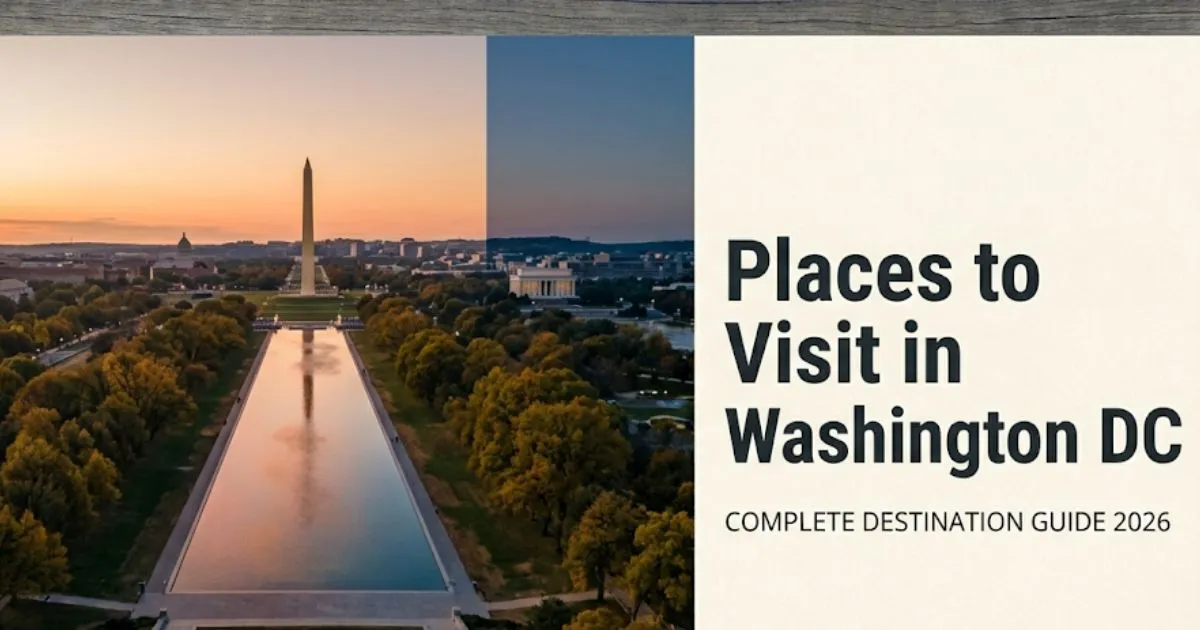
Top Places to Visit in Washington DC for Your 2026 Trip

Washington DC delivers more genuinely worthwhile places to visit than any American city of comparable size. The combination of free world-class museums, walkable monument corridors, distinct neighborhood dining scenes, and genuine political history makes it one of the country’s most rewarding urban destinations in 2026.
Destination DC estimates the city hosts more than 24 million visitors annually. Most of them never leave the National Mall, which means DC’s most interesting neighborhoods, restaurants, and experiences remain surprisingly uncrowded.
This guide covers the city’s top places and experiences by zone, with specific logistics, honest crowd assessments, traveler profile guidance, and a 3-day itinerary framework.
Places to Visit in Washington DC: What to Know First
Washington DC rewards visitors who understand its layout before they arrive. The city divides naturally into three experience zones: the National Mall corridor, the historic residential neighborhoods (Georgetown, Capitol Hill, Dupont Circle, Shaw), and the newer waterfront development at The Wharf.
The National Mall is the spine of any DC visit. It runs approximately 2 miles from the US Capitol building west to the Lincoln Memorial, with the Smithsonian museums lined along its north and south edges.
Most first-time visitors underestimate this distance badly. Planning to walk the full Mall and visit three or four museums in a single day will leave most travelers exhausted by 2pm.
The honest planning rule: split the Mall across two days. Cover the eastern half (Capitol, museums) on day one and the western half (monuments, Lincoln Memorial, Vietnam Veterans Memorial) on day two.
Insider Tip:
- DC’s traffic grid follows quadrants (NW, NE, SW, SE) radiating from the Capitol. Most visitor destinations are in the NW quadrant.
- The WMATA Metro system covers every major attraction. A SmarTrip card or mobile payment option is far more efficient than paper tickets.
- Solo travelers and couples will find the Metro extremely manageable. Families with strollers should note that some older Metro stations have unreliable elevator access; check the WMATA website before departure.
National Mall Washington DC
The National Mall is the single best reason to visit Washington DC, and it is free to access. No other American public space combines this density of historic significance, iconic architecture, and open civic landscape.
The Mall stretches from the US Capitol at the east end to the Lincoln Memorial at the west. The Washington Monument marks the midpoint, with the Tidal Basin branching south toward the Jefferson Memorial and the Franklin Delano Roosevelt Memorial.
The most photogenic time to visit the Lincoln Memorial is at dawn or after 8pm. Midday visits in spring and summer turn the Lincoln Memorial steps into one of the most crowded surfaces in the country.
The World War II Memorial, positioned between the Washington Monument and Lincoln Memorial, is frequently overlooked by visitors rushing between the two anchor points. It deserves 30 to 45 minutes of dedicated time.
| Monument or Memorial | Best Visit Time | Time Required | Crowd Level | Free Entry |
|---|---|---|---|---|
| Lincoln Memorial | Dawn or after 8pm | 20 to 30 min | Very high midday | Yes |
| Washington Monument | Reserve tickets in advance | 45 to 60 min | High | Free ticket required |
| Vietnam Veterans Memorial | Any time, quieter at dusk | 20 to 30 min | Moderate | Yes |
| Jefferson Memorial | Sunrise or evening | 20 to 30 min | Lower than Lincoln | Yes |
| World War II Memorial | Morning | 30 to 45 min | Moderate | Yes |
| Martin Luther King Jr. Memorial | Morning or evening | 20 to 30 min | Moderate | Yes |
Families with children should approach the Mall with a clear priority list. Young children lose engagement at memorials quickly. Pick two monuments maximum per outing and build in food and rest breaks.
Seniors and accessibility travelers: Most Mall pathways are paved and flat. The interior of the Washington Monument requires an elevator ride, and the timed-entry ticket system manages crowds effectively.
Washington DC Monuments and Memorials
The Vietnam Veterans Memorial, designed by Maya Lin and completed in 1982, consistently moves visitors more deeply than any other site on the Mall. The black granite wall bearing 58,000-plus names has no rival in American commemorative design.
The Korean War Veterans Memorial, positioned just southwest of the Lincoln Memorial, receives far less foot traffic than it deserves. The nineteen stainless-steel soldier figures are among the most haunting public sculptures in any American city.
Washington Monument timed-entry tickets are free but must be reserved in advance through the National Park Service website. Tickets typically release 30 days in advance and sell out quickly, especially during spring and summer.
The best single sequence for seeing western Mall monuments efficiently:
- Arrive at the Lincoln Memorial at 7am to 8am before crowds build
- Walk south along the Tidal Basin to the Martin Luther King Jr. Memorial
- Continue south to the FDR Memorial and then the Jefferson Memorial
- Loop back north past the Korean War Veterans Memorial
- End at the Vietnam Veterans Memorial before the midday rush arrives
Couples: The Jefferson Memorial at sunrise over the Tidal Basin is one of the most genuinely romantic public spaces in the country. No other monument in DC matches it for atmosphere at that hour.
Budget travelers: Every monument and memorial on this list is free to visit. The only cost is transportation to the Mall, manageable via Metro to the Smithsonian or Federal Triangle stations.
Key Takeaway: Book Washington Monument timed-entry tickets on the NPS website 30 days in advance. They are free but sell out fast during spring and summer.
Smithsonian Museums DC
The Smithsonian Institution operates 19 museums and galleries in Washington DC, and every single one is free to enter. No other city on earth offers this concentration of world-class museum access at no cost.
The most visited are the National Museum of Natural History, the National Air and Space Museum on the Mall, and the National Museum of American History. All three require timed-entry passes during peak season, typically March through August. Verify current requirements at Smithsonian.edu before visiting.
The National Museum of African American History and Culture (NMAAHC), opened in 2016, requires advance timed-entry passes booked through the Smithsonian website. These passes are genuinely difficult to obtain without planning weeks ahead during peak season.
The Hirshhorn Museum and Sculpture Garden on the Mall is one of the most undervisited Smithsonian institutions. Its contemporary art collection and sunken sculpture garden give it a completely different atmosphere from the history-focused museums.
The National Portrait Gallery, located in the Penn Quarter neighborhood, shares a building with the American Art Museum. Its “America’s Presidents” hall, displaying every official presidential portrait, is consistently one of DC’s most affecting indoor experiences.
Insider Tip:
- For NMAAHC timed-entry passes: set a calendar reminder for the first of each month at 9am ET, when new passes release. They disappear within minutes during peak season.
- The Freer Gallery of Art, connected to the Sackler Gallery, holds one of the finest collections of Asian art in the Western Hemisphere and rarely has a line.
- Solo travelers and couples will find early-morning Smithsonian visits (opening time, typically 10am) dramatically less crowded than midday arrivals.
Washington DC Neighborhoods Guide
DC’s best neighborhoods are as distinctive from each other as cities in different states. Understanding the character of each zone fundamentally changes the quality of a visit.
Capitol Hill surrounds the US Capitol building and contains the Library of Congress, the Supreme Court, and the red-brick row houses of one of DC’s oldest residential communities. Eastern Market, operating on Seventh Street SE since 1873, anchors the neighborhood’s social life on weekends.
Dupont Circle is DC’s most walkable mixed-use neighborhood. The Circle itself is a genuine public gathering space, and the surrounding streets hold independent bookstores, mid-range restaurants, and the Dupont Circle Farmers Market (operating Sunday mornings, verify seasonal schedule before visiting).
Adams Morgan, north of Dupont Circle along Columbia Road NW, is DC’s most ethnically diverse dining neighborhood. The 18th Street NW corridor holds Ethiopian, Salvadoran, and West African restaurants that have no equivalent elsewhere in the city.
Logan Circle, between Dupont Circle and Shaw, has transformed significantly since 2015. The 14th Street NW corridor running through Logan Circle now holds some of DC’s best independent restaurants and is a legitimate local gathering zone that most tourists skip entirely.
Couples will find Dupont Circle and Logan Circle the most atmospheric DC neighborhoods for an evening walk and dinner. The street-level energy is more intimate than Georgetown’s tourist-heavy M Street NW.
| Neighborhood | Character | Best For | Transit Access | Dining Quality |
|---|---|---|---|---|
| Capitol Hill | Historic, residential, civic | History enthusiasts, families | Metro: Capitol South, Eastern Market | Good, local-oriented |
| Dupont Circle | Walkable, mixed-use, social | Solo travelers, couples | Metro: Dupont Circle | Strong independent scene |
| Adams Morgan | Diverse, dining-forward, lively | Food-focused travelers | Metro: Woodley Park (walk), U Street (walk) | Excellent and underrated |
| Logan Circle | Emerging, local-favorite | Couples, food travelers | Metro: U Street | Among DC’s best |
| Georgetown | Historic, upscale, tourist-heavy | Couples, shopping | No direct Metro (DC Circulator or walk) | Strong but expensive |
| Shaw | Arts-forward, music history, local | Solo travelers, culture travelers | Metro: Shaw-Howard U | DC’s most dynamic right now |
Georgetown DC Things to Do
Georgetown is Washington DC’s oldest neighborhood and its most photographed, but it is also its most tourist-saturated. Understanding that distinction determines whether a Georgetown visit feels like a discovery or a crowded disappointment.
The C&O Canal National Historical Park towpath runs along the Potomac River through Georgetown and extends 184.5 miles northwest to Cumberland, Maryland. Even the first mile of the towpath gives visitors a completely different perspective on the neighborhood than M Street NW shopping.
Georgetown Waterfront Park, at the intersection of K Street NW and the Potomac River, is one of DC’s best free outdoor spaces. On weekday mornings, it feels like a local’s park. On summer weekend afternoons, it fills quickly.
The Georgetown University campus, perched on the bluff above the neighborhood, is open to the public and worth a 30-minute walk. The view of the Potomac from the Healy Building steps is one of the city’s best vantage points that no tourism board bothers to mention.
M Street NW and Wisconsin Avenue NW are Georgetown’s main commercial corridors. They are congested, expensive, and almost entirely oriented toward tourists and students. Lunch here costs significantly more than equivalent quality in Shaw or Adams Morgan.
Budget travelers: Georgetown is not the right neighborhood for affordable dining. Visit for the waterfront, the C&O Canal, and the historic architecture, and eat elsewhere.
Families with children: The Georgetown waterfront and canal path are stroller-accessible and give young children room to move. The neighborhood itself has no direct Metro access. Use the DC Circulator from Dupont Circle or plan a 15-minute walk from the Foggy Bottom-GWU Metro station.
Insider Tip:
- The C&O Canal towpath is flat, paved for the Georgetown section, and excellent for a 2-mile out-and-back walk with genuine historic canal lock infrastructure along the way.
- Avoid Georgetown on Saturday afternoons between April and September. The narrow sidewalks on M Street NW become genuinely unpleasant.
Key Takeaway: Georgetown’s real value is the C&O Canal towpath and the waterfront park. M Street NW shopping is the tourist version of the neighborhood.
Shaw and U Street Corridor DC
Shaw and the U Street Corridor represent the most genuinely local experience available in Washington DC right now. This is where DC residents actually spend their evenings and weekends.
U Street NW, historically known as “Black Broadway” and the neighborhood where Duke Ellington was born, anchors DC’s most historically and culturally significant music legacy. The Howard Theatre at 620 T Street NW hosted Louis Armstrong, Ella Fitzgerald, and Marvin Gaye before falling into disrepair and being restored in 2012.
Ben’s Chili Bowl at 1213 U Street NW has operated continuously since 1958, surviving riots, urban renewal, and gentrification. The half-smoke, a DC-specific smoked sausage served in a natural casing with chili, is the single most DC-specific food experience available anywhere in the city.
The restaurant scene along 7th Street NW and 9th Street NW in Shaw has become one of the strongest dining corridors in any American city. Thip Khao on Columbia Road NW brings Lao cuisine to DC in a way that has earned consistent recognition from serious food publications.
Solo travelers will find Shaw and U Street to be DC’s most comfortable neighborhood for solo dining and evening socializing. The bar scene along U Street NW is unpretentious and genuinely local-oriented.
The 9:30 Club at 815 V Street NW has been rated among the best music venues in the United States. If any act you want to see is playing here during your visit, rearrange your schedule. It is that good.
- Walk the length of U Street NW from 9th Street to 18th Street NW for the full neighborhood character
- Visit Ben’s Chili Bowl for a half-smoke at lunch, not dinner (shorter line, same food)
- Check the 9:30 Club and Howard Theatre schedules before booking your trip
The Wharf DC
The Wharf is Washington DC’s most significant waterfront development of the past decade, and most first-time visitors have no idea it exists. It runs along the Southwest Waterfront on Maine Avenue SW and fundamentally changes what’s possible for a DC evening.
Opened in phases starting in 2017, The Wharf stretches approximately one mile along the Washington Channel of the Potomac River. It holds restaurants, music venues, a fish market, a concert hall, and water taxi access.
The Municipal Fish Market at The Wharf is the oldest operating fish market in the United States, continuously operating since 1805. The open-air seafood stalls along Water Street SW sell fresh Chesapeake Bay blue crabs, fish, and shellfish at prices that undercut every restaurant in Georgetown.
The Anthem, a 6,000-capacity music venue at The Wharf, is one of the best mid-size music venues in the eastern United States. Its sightlines and acoustics are significantly better than comparable venues in the city.
Couples: The Wharf’s waterfront promenade at dusk is one of the most genuinely romantic settings in DC. The combination of water views, restaurant terraces, and live music from The Anthem gives it an atmosphere the National Mall cannot match after dark.
Families with children: The Wharf’s open waterfront spaces and fish market are excellent for families. The Municipal Fish Market is educational and engaging for children aged 7 and older. Getting there via Metro (Waterfront station on the Green Line) is straightforward.
Insider Tip:
- The Wharf’s water taxi service connects to Alexandria, Virginia and National Harbor across the Potomac. It is the most pleasant way to access Old Town Alexandria from DC without renting a car.
- Skip the higher-priced waterfront restaurants for dinner. The best meal-to-value ratio at The Wharf is a seafood lunch from the fish market stalls, eaten at the water’s edge.
Key Takeaway: The Municipal Fish Market at The Wharf, operating since 1805, is DC’s most underused local lunch destination. Fresh Chesapeake Bay seafood at the water’s edge beats Georgetown restaurant prices by a significant margin.
Best Restaurants in Washington DC
Washington DC’s dining scene in 2026 is far stronger and more diverse than its reputation among non-visitors suggests. The city’s international diplomatic population and large West African, Ethiopian, Salvadoran, and Vietnamese communities have built a genuinely global restaurant landscape.
Eastern Market on Seventh Street SE serves the Capitol Hill community on Tuesday through Sunday. The weekend farmer’s market on the south plaza and the indoor market hall make it one of the most genuinely local food experiences in the city.
Union Market at 1309 Fifth Street NE in the Edgewood neighborhood has evolved from a wholesale food distribution facility into one of DC’s best food hall experiences. It holds approximately 40 vendors under one roof. Takorean, Trickling Springs creamery, and TaKorean represent the range of quality available.
For sit-down dining, the 14th Street NW corridor through Logan Circle and the 11th Street NW strip in Columbia Heights hold DC’s strongest concentration of independent restaurant quality. Tail Up Goat on 18th Street NW in Adams Morgan has received James Beard Award attention for a category-defying menu that moves between Caribbean, Mediterranean, and Mid-Atlantic influences.
Budget travelers: Ethiopian restaurants along 9th Street NW in Adams Morgan and along 18th Street NW offer some of the best value per dollar in DC. Injera-based shared platters at places like Dukem on U Street NW feed two people generously for $25 to $40 total (verify current pricing before visiting).
Couples looking for a genuinely special DC dining experience should check José Andrés’ Minibar reservation system well in advance of travel. It is one of the most distinctive tasting menu experiences in any American city.
| Restaurant Zone | Character | Price Range Per Person | Best For | Named Example |
|---|---|---|---|---|
| Logan Circle / 14th St NW | Modern American, independent | $35 to $65 | Couples, food travelers | Tail Up Goat |
| Adams Morgan / 18th St NW | Global, diverse, local | $15 to $40 | Budget travelers, solo diners | Dukem (Ethiopian) |
| Capitol Hill / Eastern Market | Local, market-driven | $10 to $35 | Families, budget travelers | Eastern Market vendors |
| The Wharf | Seafood, waterfront | $20 to $60 | Couples, families | Municipal Fish Market |
| Shaw / U Street | Local, culturally significant | $10 to $50 | Solo travelers, culture travelers | Ben’s Chili Bowl |
Washington DC Free Things to Do
Washington DC is among the most budget-friendly major cities in the United States for attraction access. The Smithsonian Institution’s 19 DC museums and galleries are all free. Every monument and memorial on the National Mall is free to visit.
According to Destination DC, the city’s official tourism organization, the National Mall alone contains more free cultural and historical attractions than most full-destination museum cities charge admission to collectively.
Beyond the Smithsonian, the Library of Congress on First Street SE is free to enter and tour. The Great Hall of the Thomas Jefferson Building is one of the most ornate interior spaces in any American public building. Most visitors to Capitol Hill walk past it entirely.
The US Botanic Garden at 100 Maryland Avenue SW, adjacent to the US Capitol, is free and consistently undervisited. The conservatory greenhouse holds tropical plant collections that are especially striking in winter when the city is otherwise bare.
Rock Creek Park, managed by the National Park Service, runs approximately 1,754 acres through Northwest DC. The park’s trails, picnic areas, and the Carter Barron Amphitheatre (which hosts free summer concerts, verify schedule before visiting) give the city an accessible natural respite that most first-time visitors completely ignore.
Free activities every visitor should know about:
- Supreme Court of the United States public gallery (free, when in session; verify schedule)
- National Portrait Gallery and American Art Museum (free, Penn Quarter)
- Hirshhorn Museum and Sculpture Garden (free, National Mall)
- US National Arboretum (free, Northeast DC; accessible by car or DC Circulator)
- Library of Congress public tours (free; timed-entry recommended)
- Carter Barron Amphitheatre summer concert series (free; verify 2026 schedule)
Budget travelers: A 5-day DC trip built around free Smithsonian museums, free monuments, free neighborhood exploration, and budget dining in Shaw and Adams Morgan can be accomplished for significantly less than comparable cultural trips to New York or Chicago.
Washington DC With Kids
Washington DC works exceptionally well for families with children aged 6 and older. The combination of free museums, open outdoor spaces on the National Mall, and hands-on exhibits at the Smithsonian makes it one of the most child-friendly major cities in the country.
The National Museum of Natural History’s Dinosaur Hall and the Sant Ocean Hall consistently hold children’s attention longer than any other Mall museum. Budget 2 to 3 hours minimum. The museum’s interactive nature exploration lab on the ground floor is specifically designed for younger visitors.
The National Zoo on Connecticut Avenue NW in Woodstock is free and holds the Smithsonian’s National Zoological Park’s famous giant panda program alongside big cats, elephants, and a cheetah habitat. Access via Metro to Woodley Park-Zoo/Adams Morgan station. Arrive early: animals are most active in the morning.
The National Air and Space Museum on the Mall is DC’s most visited museum. Its collection includes the Wright Brothers’ Flyer, the Apollo 11 command module, and a Mars rover. Children aged 8 and older consistently engage with it for 3 hours or more.
Families with toddlers and infants face one genuine challenge: scale. The National Mall is massive. Strollers are welcome in all Smithsonian museums, but some older Metro stations have unreliable elevator access. Check WMATA’s elevator status page before planning underground transit with a stroller.
Insider Tip:
- The National Building Museum at 401 F Street NW is one of DC’s most child-friendly museums. Its scale model of Washington DC is a genuinely engaging introduction to the city’s layout for children aged 5 and older.
- Pack water, snacks, and comfortable shoes. The National Mall has limited food options that are both affordable and good. Plan lunch at Eastern Market or in the Penn Quarter before or after Mall visits.
- Summer visits with young children: start outdoor monument visits before 9am. By 11am in July and August, the Mall’s heat and humidity become genuinely difficult for small children.
Key Takeaway: Families with children should split the National Mall across two separate mornings, not one full day. The scale defeats even the most enthusiastic young travelers by early afternoon.
Washington DC for Couples
Washington DC offers a more intimate and romantically varied experience than most couples expect. The city’s combination of historic architecture, waterfront settings, world-class performing arts, and genuinely good restaurant options in low-key neighborhood settings makes it a strong choice for couples in 2026.
The Kennedy Center for the Performing Arts on New Hampshire Avenue NW offers the most distinctly Washington experience for couples with performing arts interests. The Millennium Stage hosts free daily performances at 6pm (verify 2026 schedule), and the Grand Foyer terrace overlooks the Potomac River at dusk.
The Jefferson Memorial at sunrise over the Tidal Basin is the most reliably beautiful romantic setting in Washington DC. The combination of cherry blossom trees (in season, late March to early April), the still water, and the neoclassical dome creates an atmosphere that requires no tourist infrastructure to appreciate.
For an evening that feels genuinely local rather than tourist-facing, dinner on the 14th Street NW corridor in Logan Circle followed by a show at the 9:30 Club or Lincoln Theatre (on U Street NW) gives couples the most authentic DC evening available.
Insider Tip:
- Ford’s Theatre on 10th Street NW is both a working theater and a National Historic Site. Evening performances here are significantly more intimate than Kennedy Center shows, and the historic weight of the venue adds a dimension no standard theater can match.
- The Dumbarton Oaks Gardens in Georgetown (admission typically runs approximately $8 to $12 per adult, verify current pricing) is one of DC’s most beautiful private garden spaces. It is considerably less crowded than the Tidal Basin cherry blossom spots in spring and delivers a comparable garden experience.
- Avoid planning a romantic DC weekend during cherry blossom peak weekend unless you book hotels 4 to 6 months in advance. Hotel rates spike 60% to 100% during peak bloom, and the Tidal Basin crowds remove any possibility of an intimate experience.
Getting Around Washington DC
The WMATA Metro system is the most efficient way to reach every major Washington DC attraction. The system covers 98 stations across six color-coded lines and connects directly to Reagan National Airport (DCA), Union Station, and every major visitor neighborhood.
A SmarTrip card (available at every Metro station) or the mobile WMATA app provides the lowest fare per ride compared to paper tickets. Fares are distance-based and time-of-day based. Peak-hour fares run higher than off-peak; plan sightseeing trips during off-peak hours where possible to reduce transit costs.
The DC Circulator bus system operates on key tourist routes for a flat fare significantly lower than Metro fares. The Georgetown-Union Station route and the National Mall route are the two most useful for visitors. Verify the 2026 DC Circulator route map before arrival, as routes have changed in recent years.
Capital Bikeshare operates dock-based electric-assist bikes throughout DC, Arlington, and Alexandria. For short hops between neighborhoods (Dupont Circle to Georgetown, or U Street to Shaw), bikeshare is faster than waiting for the Circulator and more enjoyable than Metro for distances under 2 miles.
Parking near the National Mall is extremely limited and expensive. Driving to the Mall on weekdays is not recommended. On weekends, some meters and parking garages in the Penn Quarter become available, but driving should be a last resort for Mall visits.
Seniors and accessibility travelers: Most Metro stations built after 1980 have elevator access, but elevator reliability across the system has been inconsistent. The WMATA website maintains a real-time elevator status page. For visitors with significant mobility limitations, the DC Circulator’s low-floor buses and Capital Bikeshare’s electric-assist adaptive bikes provide alternatives.
To navigate DC efficiently from arrival:
- Land at Reagan National Airport (DCA) for the most convenient Metro connection (Yellow and Blue Lines directly into the city)
- Load a SmarTrip card at the airport station before exiting
- Download the WMATA app for real-time arrivals and system maps
- Use Metro for cross-city travel and the DC Circulator for neighborhood hops
- Walk the National Mall rather than taking transit for internal Mall movement
Key Takeaway: Reagan National Airport (DCA) is the only major US airport with a direct Metro rail connection into the city center. Use it when flight prices are comparable to Dulles or BWI.
Best Time to Visit Washington DC
The best time to visit Washington DC in 2026 is late September through early November. Temperatures drop to the 55 to 70 degree Fahrenheit range, fall foliage adds color to the National Mall’s elm tree canopy, and visitor crowds drop significantly from summer peak levels.
The second-best window is mid-March through late March, before the Cherry Blossom Festival peak. Weather is unpredictable in this window but manageable, crowds are lower than peak bloom, and the Tidal Basin’s cherry trees begin showing color approximately two weeks before peak.
Cherry blossom peak weekend in late March to early April is the most consequential timing decision in DC travel planning. The National Cherry Blossom Festival, organized annually since 1935, draws hundreds of thousands of visitors to the Tidal Basin. Hotel prices during peak weekend frequently double from standard rates. The Tidal Basin path becomes genuinely overcrowded, making photography and reflective appreciation difficult.
Summer (June through August) is technically DC’s worst visiting period. Humidity and heat make outdoor monument visits uncomfortable between 10am and 4pm. It is also the peak season for school groups, which dramatically changes the museum experience.
| Season | Temperature Range | Crowd Level | Hotel Pricing | Best Activities |
|---|---|---|---|---|
| Spring (Mar-May) | 45 to 75°F | Very High (cherry blossoms) | Peak pricing | Tidal Basin, outdoor monuments |
| Summer (Jun-Aug) | 75 to 95°F with high humidity | High | High | Museums (air-conditioned), early morning monuments |
| Fall (Sep-Nov) | 50 to 75°F | Low to Moderate | Lower pricing | All activities, best overall season |
| Winter (Dec-Feb) | 25 to 50°F | Low | Lowest pricing | Museums, indoor culture, quieter monuments |
Budget travelers will find late January through early February and late November through mid-December to be DC’s best value windows. Hotel rates are at their lowest, and the Smithsonian museums are peaceful.
Washington DC Itinerary
A well-structured 3-day Washington DC itinerary separates the city into three distinct experience zones to avoid the exhaustion that comes from trying to cover everything in a single corridor.
Day 1: Western National Mall and Monuments
- Arrive at the Lincoln Memorial at 7:30am before tour groups arrive
- Walk east along the Reflecting Pool to the World War II Memorial
- South detour to the Vietnam Veterans Memorial and Korean War Veterans Memorial
- Walk the Tidal Basin path to the Martin Luther King Jr. Memorial and Jefferson Memorial
- Lunch at the National Museum of Natural History cafeteria or the Penn Quarter
- Afternoon: Washington Monument (timed-entry ticket required, book in advance at Recreation.gov)
- Evening: Dinner on the 14th Street NW corridor in Logan Circle
Day 2: Eastern Mall, Smithsonian, and Capitol Hill
- Morning: National Museum of African American History and Culture (timed-entry pass required, book weeks in advance)
- Late morning: National Air and Space Museum on the Mall
- Lunch at Eastern Market on Seventh Street SE
- Afternoon: Library of Congress Thomas Jefferson Building tour
- Walk to the US Botanic Garden for 30 minutes
- Evening: Shaw and U Street Corridor dinner at Ben’s Chili Bowl, then live music at 9:30 Club or Howard Theatre
Day 3: Georgetown, The Wharf, and Neighborhood DC
- Morning: Walk the C&O Canal towpath in Georgetown for 1 to 2 miles
- Mid-morning: Georgetown Waterfront Park and Georgetown University campus walk
- Lunch: Municipal Fish Market at The Wharf (fresh Chesapeake Bay seafood)
- Afternoon: National Portrait Gallery and American Art Museum in Penn Quarter
- Late afternoon: Dupont Circle neighborhood walk and Dupont Circle Farmers Market (Sundays only, verify schedule)
- Evening: Kennedy Center Millennium Stage free performance at 6pm, followed by Potomac River terrace dinner
This itinerary suits: Couples and solo travelers most directly. Families with young children should replace Day 3’s pace with additional museum time and build in more rest breaks. Budget travelers can complete all three days with minimal spending given the volume of free attractions.
Day Trips from Washington DC
Washington DC’s location on the Mid-Atlantic corridor gives it access to some of the eastern United States’ strongest day trip options within 1 to 2 hours by car or public transit.
Annapolis, Maryland, approximately 30 miles east of DC (45 minutes by car without traffic), is the state capital and one of the best-preserved 18th-century American port cities. The United States Naval Academy, the Colonial-era Maryland State House, and the waterfront City Dock make it the most worthwhile single-day trip from DC for history-focused travelers.
Old Town Alexandria, Virginia, just 7 miles south of DC and accessible by Metro (Yellow Line to King Street-Old Town station), is the most accessible DC day trip. The waterfront, the Torpedo Factory Art Center, and the King Street dining corridor offer a complete afternoon without requiring a car.
Shenandoah National Park, approximately 70 miles southwest of DC via I-66 and Route 340, puts one of the eastern US’s best ridge-top drives and hiking areas within 90 minutes of the city. Skyline Drive runs the park’s length along the Blue Ridge crest. Fall foliage (typically peak in mid to late October) makes this day trip most worthwhile in autumn.
Harper’s Ferry, West Virginia, approximately 65 miles northwest of DC, offers a combination of Civil War history, Appalachian Trail access, and a uniquely preserved 19th-century riverside town that has no equivalent in the region. MARC commuter rail from Union Station reaches Harpers Ferry on weekends (verify 2026 schedule before traveling).
Couples will find the Annapolis waterfront and Harper’s Ferry the most atmospheric day trip options. Families with children are best served by Old Town Alexandria or a morning in Annapolis. Outdoor-focused travelers should prioritize Shenandoah.
| Day Trip | Distance from DC | Best Transit Option | Time Required | Best For |
|---|---|---|---|---|
| Old Town Alexandria, VA | 7 miles | Metro: Yellow Line | Half day | Couples, solo travelers, families |
| Annapolis, MD | 30 miles | Car (no direct transit) | Full day | History travelers, couples |
| Harper’s Ferry, WV | 65 miles | MARC train (weekends) or car | Full day | Outdoor travelers, couples |
| Shenandoah National Park | 70 miles | Car required | Full day | Outdoor travelers, fall foliage |
Safety and Practical Warnings for Washington DC
Washington DC is generally a safe destination for tourists who apply standard urban awareness. The areas surrounding the National Mall, Capitol Hill, Georgetown, Dupont Circle, and The Wharf are all low-risk environments for visitors in 2026.
Key safety and practical facts every visitor should know:
- Summer heat is genuinely dangerous at the National Mall. Between late June and mid-August, midday temperatures with humidity can exceed 95°F. Carry water and schedule outdoor monument visits before 10am or after 6pm.
- The National Mall is larger than most visitors expect. The 2-mile distance from the Lincoln Memorial to the US Capitol surprises and exhausts visitors who underestimate it. Wear supportive footwear.
- Timed-entry passes are not optional. The National Museum of African American History and Culture and the Washington Monument both require advance reservations. Showing up without a pass means you will not get in during peak season.
- Metro elevator reliability varies. Visitors with mobility limitations or strollers should check WMATA’s elevator status page before using specific stations.
- Southeast DC east of the Anacostia River requires the same situational awareness as any urban neighborhood with higher crime statistics. It is not a standard tourist area, and most visitors will have no reason to travel there.
- Pickpocket risk is real in crowded spaces. The National Mall during summer and cherry blossom season, Union Station, and crowded Metro cars all present standard urban pickpocket risk. Keep valuables in front pockets or secured bags.
- For general emergencies, dial 911. The nearest emergency contact for National Mall incidents is the National Park Service US Park Police, which patrols the Mall and memorial grounds.
Frequently Asked Questions About Places to Visit in Washington DC
What are the best free places to visit in Washington DC?
Washington DC’s best free places include all 19 Smithsonian Institution museums, every monument and memorial on the National Mall, the Library of Congress, the US Botanic Garden, Rock Creek Park, and the National Zoo.
No other major American city offers this volume of genuinely free cultural and historical access.
The National Museum of African American History and Culture requires a free timed-entry pass booked in advance through the Smithsonian website, so plan accordingly.
How many days do you need in Washington DC to see everything?
Three to four days is the practical minimum to cover Washington DC’s core attractions without feeling rushed.
A first-time visitor who wants to see the major monuments, visit three to four Smithsonian museums, explore two or three distinct neighborhoods, and take one day trip can realistically accomplish this in four full days.
Five to six days allows for a genuinely relaxed pace that includes Shaw, The Wharf, Georgetown, and a proper day trip to Annapolis or Shenandoah.
What is the best time of year to visit Washington DC?
The best time to visit Washington DC is late September through early November for weather, crowds, and value.
Temperatures in this window run 50 to 75 degrees Fahrenheit, fall foliage adds color to the National Mall, and hotel rates drop from summer peak levels.
Avoid July and August if outdoor activities are a priority; the humidity and heat make monument visits genuinely uncomfortable between 10am and 4pm.
Is Washington DC safe for tourists?
Washington DC is safe for tourists in the neighborhoods and areas surrounding the National Mall, Capitol Hill, Georgetown, Dupont Circle, Shaw, and The Wharf.
Apply standard urban awareness: keep valuables secured, be aware of surroundings on the Metro during off-peak hours, and avoid the Anacostia River neighborhood east of the Capitol unless you have a specific destination there.
The National Park Service US Park Police patrols the National Mall and memorial grounds continuously.
Do you need to book Smithsonian museums in advance?
Most Smithsonian museums are free and require no advance booking, but the National Museum of African American History and Culture requires a timed-entry pass reserved through the Smithsonian website.
During peak season (March through August), these passes often sell out within minutes of their monthly release on the first of each month at 9am ET.
The Washington Monument also requires a free timed-entry ticket reserved through Recreation.gov, typically 30 days in advance.
What is the best neighborhood to stay in Washington DC?
The best neighborhood to stay in Washington DC depends on your travel style, but Dupont Circle and Logan Circle consistently offer the best combination of Metro access, walkable dining, and neighborhood character for most visitor profiles.
Capitol Hill is the best base for travelers focused on monuments and government buildings, with immediate Metro access and excellent walkability to Eastern Market.
Georgetown has the strongest aesthetic appeal but no direct Metro station, which adds friction to every transit-dependent movement in the city.
Planning Your Washington DC Trip
Washington DC in 2026 rewards travelers who arrive with a geographic plan. Split the National Mall across two mornings, not one. Reserve timed-entry passes for the National Museum of African American History and Culture and the Washington Monument the moment you book your flights.
Book hotels in Dupont Circle, Logan Circle, or Capitol Hill for the best combination of Metro access and neighborhood quality. Cherry blossom season visitors need hotel reservations 4 to 6 months in advance. Everyone else can find strong availability 6 to 8 weeks out.
All pricing, hours, museum entry requirements, Metro fares, and timed-entry pass availability change regularly. Verify key logistics at Smithsonian.edu, NPS.gov, Recreation.gov, and WMATA.com before departure. The traveler who verifies before leaving avoids the traveler’s most expensive mistake: showing up without a pass.