Best Places to Visit in Africa: Your 2026 Travel Guide

The best places to visit in Africa reward travelers who choose one region and go deep, not those who try to cover the continent in two weeks. Africa spans 54 countries with radically different climates, infrastructure, and experiences.
Africa receives over 70 million international visitors annually, according to the United Nations World Tourism Organization, with East and Southern Africa leading growth in wildlife and adventure tourism. The continent’s range runs from budget-friendly Morocco to ultra-premium Botswana.
This guide covers 15 specific destination categories with honest cost context, seasonal intelligence, and traveler-profile matching. You will finish knowing exactly which African destination fits your trip.
Best Places to Visit in Africa: How to Choose the Right Destination
The best places to visit in Africa fall into five distinct experience categories: wildlife safari, beach and coast, cultural heritage, adventure, and city-based exploration.
Your starting point should be your primary motivation. A traveler who wants to photograph lions at dawn in the Masai Mara is planning a completely different trip from one seeking Moroccan medina culture in Marrakech.
| Experience Type | Top Destination | Cost Tier | Best For |
|---|---|---|---|
| Big Five Safari | Masai Mara, Kenya | Mid to Premium | Wildlife photographers, couples, first-timers |
| Gorilla Trekking | Volcanoes NP, Rwanda | Premium | Adventurous couples, serious wildlife travelers |
| Beach and Coast | Zanzibar, Tanzania | Mid-range | Couples, families, post-safari relaxation |
| Cultural Heritage | Marrakech, Morocco | Budget to Mid | Solo travelers, culture enthusiasts, first-timers |
| Desert Adventure | Sossusvlei, Namibia | Mid-range | Road trippers, photographers, adventure travelers |
| Historical Sites | Cairo, Egypt | Budget to Mid | History travelers, solo travelers, families |
| Island Escape | Cape Verde | Mid-range | Beach lovers, budget-conscious travelers |
Never plan an itinerary that spans more than two of Africa’s five regions in one trip. Transit days between regions consume time and money that would be better spent experiencing one place fully.
Couples on a 10-day honeymoon safari should target one country: Kenya or Tanzania. Families with children under 10 should prioritize South Africa’s Kruger region, which has the most developed family safari infrastructure on the continent.
Insider Tip:
- First-time Africa visitors often underestimate flight connections within the continent. Regional carriers like Kenya Airways and Ethiopian Airlines connect most major East African hubs efficiently.
- Book regional connecting flights early. Seats sell out faster on East African routes than most travelers expect.
- Budget travelers will find Morocco and Egypt offer the most accessible entry to Africa without requiring specialized tour operators or expensive permits.
Places to Visit in Africa for First-Time Visitors
Kenya and Morocco are the two most accessible African destinations for first-time visitors from the United States.
Kenya combines established safari infrastructure, English-speaking service staff, and direct seasonal flight access via hub airports like Jomo Kenyatta International Airport (NBO) in Nairobi. Morocco offers North African cultural immersion with European-standard tourist infrastructure and a short flight from major US gateway cities via Casablanca Mohammed V International Airport (CMN).
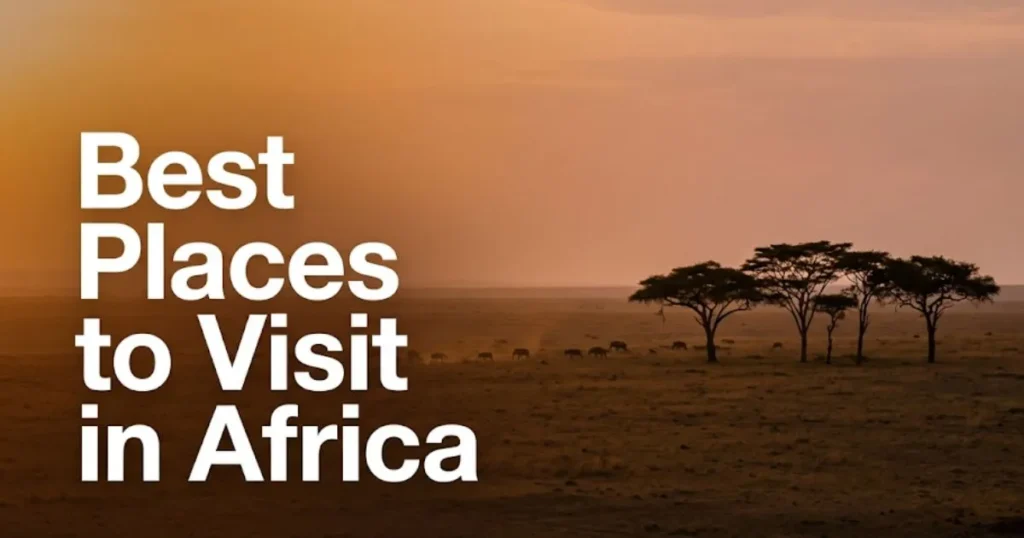
Kenya’s Masai Mara region has the densest network of mid-range safari camps on the continent. Travelers can experience the Big Five without the ultra-premium price structure required in Botswana.
Morocco’s Marrakech medina puts first-timers inside one of the world’s most intact medieval city structures within hours of landing. The Jemaa el-Fna square functions as a living performance space every evening.
Solo travelers will find Morocco’s established tourism infrastructure, riad guesthouse culture, and walkable medinas especially accessible. Kenya suits solo travelers comfortable with organized group safari structures.
Families with children over 8 will find Kenya’s safari camps increasingly accommodating. Morocco suits older children and teens with genuine interest in history and street culture.
According to the Kenya Tourism Board, the country welcomed record international arrivals in recent years, with Nairobi serving as the primary East African gateway for connecting itineraries.
Insider Tip:
- Morocco first-timers should hire a licensed local guide for the first full day in Marrakech’s medina. The souks are genuinely disorienting without orientation.
- Kenya first-timers should book a camp inside or directly bordering the Masai Mara National Reserve, not one 30 to 60 kilometers outside the reserve boundary. Proximity matters enormously for early morning game drives.
- Both destinations offer strong local alternatives to the most-photographed tourist experiences: Essaouira on Morocco’s Atlantic coast versus the Marrakech crowds; Amboseli National Park in Kenya versus Masai Mara for Kilimanjaro backdrop photography.
Best African Safari Destinations
The best African safari destinations for 2026 are Kenya’s Masai Mara National Reserve, Tanzania’s Serengeti National Park, Botswana’s Okavango Delta, and South Africa’s Kruger National Park.
Each of these four delivers the Big Five experience but at radically different price points, crowd levels, and ecosystem types.
| Safari Destination | Best Month | Cost Per Night (Lodge) | Crowd Level | Best Traveler Profile |
|---|---|---|---|---|
| Masai Mara, Kenya | July to October | $300 to $700+ per person | Moderate to High | First-timers, couples, photographers |
| Serengeti, Tanzania | June to October | $400 to $900+ per person | Moderate | Wildlife enthusiasts, photographers |
| Okavango Delta, Botswana | June to September | $800 to $2,000+ per person | Low | Premium luxury travelers, couples |
| Kruger NP, South Africa | May to September | $150 to $500+ per person | Moderate | Families, self-drive travelers, budget-conscious safari seekers |
| Chobe NP, Botswana | May to October | $350 to $800+ per person | Low to Moderate | Elephant enthusiasts, couples |
Kruger is Africa’s most accessible self-drive safari destination. Travelers can rent a vehicle and stay in South African National Parks (SANParks) rest camps at significantly lower nightly rates than private reserves.
The Okavango Delta delivers the most exclusive wildlife experience in Southern Africa. But its price point is genuinely prohibitive for most travelers: budget at least $1,500 to $3,000 per person per night at premium camps during peak season.
Families with children should target Kruger’s private reserves on its western border, where predator concentrations are high and family-friendly game vehicles are standard. Children under 6 are typically not permitted on open vehicle game drives at most Botswana camps.
The honest assessment: the Serengeti’s southern plains and Tanzania’s Northern Circuit offer comparable wildlife to the Masai Mara but with more logistical complexity and slightly higher costs. Kenya’s camps are easier to reach, often less expensive, and frequently deliver equivalent wildlife encounters during the Great Migration period.
Seasonal note: The Great Migration crosses into Kenya’s Masai Mara most reliably between July and October. Calving season on Tanzania’s Serengeti plains occurs between January and March, which is equally spectacular and far less crowded than peak Kenya season.
Key Takeaway: For first-time safari travelers, Masai Mara in Kenya delivers the most accessible, logistically straightforward Big Five experience at the best mid-range price point.
Best Beach Destinations in Africa
The best beach destinations in Africa in 2026 are Zanzibar (Tanzania), Diani Beach (Kenya), Cape Verde’s Sal and Boa Vista islands, and the Quirimbas Archipelago in Mozambique.
Each serves a completely different traveler profile and budget tier.
Zanzibar’s northern beaches, specifically Nungwi and Kendwa, combine clear Indian Ocean water, accessible mid-range accommodation, and the historic Stone Town UNESCO World Heritage Site as a cultural anchor. Many Tanzania safari itineraries end with three to five nights in Zanzibar. This combination is one of East Africa’s most effective trip structures.
Diani Beach, 30 kilometers south of Mombasa, is Kenya’s best standalone beach destination. It has a developed strip of mid-range to boutique hotels and reliable water sports infrastructure.
| Beach Destination | Water Clarity | Best Months | Cost Tier | Best For |
|---|---|---|---|---|
| Zanzibar (Nungwi/Kendwa) | Excellent | June to October, Dec to Feb | Mid-range | Couples, post-safari relaxation |
| Diani Beach, Kenya | Good to Excellent | Oct to March | Mid-range | Families, beach-focused travelers |
| Cape Verde (Sal/Boa Vista) | Excellent | Nov to June | Budget to Mid | European beach travelers, windsurfing |
| Quirimbas, Mozambique | Outstanding | May to October | Premium | Luxury couples, diving enthusiasts |
| Seychelles | Exceptional | April to May, Oct to Nov | Premium | Luxury honeymoon couples |
Cape Verde suits budget-conscious travelers from the US who want warm Atlantic water without sub-Saharan Africa’s logistical complexity. Flights from Lisbon or London connect efficiently to Sal Island’s Amilcar Cabral International Airport.
The honest note: Seychelles and Mozambique’s Quirimbas are genuinely world-class Indian Ocean destinations. But their price structure puts them firmly in the honeymoon and luxury travel category, not general beach travel.
Solo travelers will find Zanzibar’s Stone Town neighborhood the most socially engaging beach destination in Africa. Stone Town has a genuine local culture, Swahili architecture, and a restaurant scene centered on the Forodhani Gardens night food market that rewards independent exploration.
Couples on honeymoon should compare the Seychelles’ Anse Source d’Argent beach on La Digue Island (genuinely one of the world’s most photographed beaches) against Mozambique’s northern islands. Both require significant travel investment but deliver isolation and visual quality that Zanzibar’s northern beaches cannot match.
Best Cultural Destinations in Africa
Africa’s best cultural destinations are Marrakech (Morocco), Cairo (Egypt), Lalibela (Ethiopia), and Cape Town (South Africa).
Each offers a fundamentally different cultural experience. Morocco’s medinas are medieval Islamic city architecture still functioning as living commercial centers. Egypt’s Cairo anchors the ancient world’s most visited archaeological complex at Giza.
Lalibela in Ethiopia’s highlands contains 11 rock-hewn Christian churches carved directly into solid rock in the 12th century. The Bete Giyorgis (Church of Saint George) is the most photographed and most architecturally precise. Getting to Lalibela requires a domestic flight from Addis Ababa, typically on Ethiopian Airlines.
Cape Town is the most urbane and internationally accessible African city for US travelers. The V&A Waterfront, Bo-Kaap neighborhood, and the Cape Winelands within 60 kilometers offer a combination of contemporary culture, colonial history, and natural scenery that no other African city matches.
Cairo’s Pyramids of Giza, Egyptian Museum, and the Khan el-Khalili bazaar are the most visited cultural experiences in all of Africa. Egypt’s entry is among the most affordable on the continent, and hotel infrastructure in Cairo ranges from international chain standard to boutique luxury.
The overrated honest note: Marrakech’s Jemaa el-Fna is genuinely chaotic and rewarding. But the Majorelle Garden, while beautiful, has become so heavily trafficked that the meditative experience it promises is difficult to actually achieve during peak hours. Visit at opening time or in late afternoon to avoid the worst crowds.
Seniors and accessibility travelers will find Cairo, Marrakech, and Cape Town the most developed in terms of accessible hotel infrastructure. Lalibela’s terrain is demanding: the rock churches require navigating uneven stone surfaces and steep pathways. Mobility aids are not compatible with Lalibela’s site access.
According to the Egypt Tourism Authority, Cairo’s museum infrastructure has expanded significantly with the opening of the Grand Egyptian Museum near Giza, which now houses the most comprehensive collection of ancient Egyptian artifacts in the world.
Key Takeaway: Lalibela, Ethiopia is Africa’s most genuinely underrated cultural destination. Most US travelers have never heard of it. Those who visit consistently rate it among the continent’s most affecting experiences.
Adventure Travel Destinations in Africa
Africa’s top adventure destinations are Mount Kilimanjaro (Tanzania), Victoria Falls (Zimbabwe and Zambia), Sossusvlei (Namibia), and gorilla trekking in Rwanda or Uganda.
Each requires advance planning well beyond a standard hotel booking.
Mount Kilimanjaro is the highest peak in Africa at 5,895 meters. Most climbers attempt the summit via the Marangu or Machame routes, with the Machame route widely considered more scenic. Climbers must book through a licensed Tanzanian operator and should allow 6 to 9 days to maximize acclimatization success.
Victoria Falls can be experienced from both the Zimbabwean side (Victoria Falls town) or the Zambian side (Livingstone). Most visitors choose Zimbabwe for its more developed tourism infrastructure and better viewpoint access. The Devil’s Pool swim at the Falls edge is operational during low-water season (September to December) only.
| Adventure Experience | Physical Demand | Advance Booking Lead | Cost Range Estimate | Best Season |
|---|---|---|---|---|
| Kilimanjaro Climb (Machame) | Very High | 3 to 6 months | $2,000 to $4,000 per person | January to March, June to October |
| Gorilla Trekking Rwanda | Moderate to High | 3 to 12 months (permit) | $1,500+ for permit alone | Year-round, best June to Sept |
| Victoria Falls Bungee/White Water | Moderate | 1 to 2 weeks | $100 to $300 per activity | Sept to Dec (low water) |
| Sossusvlei Dune Climbing | Low to Moderate | 1 to 4 weeks | $100 to $300 park fees | May to September |
| Sahara Desert Camel Trek | Low | 1 to 2 weeks | $80 to $300 per night | Oct to April |
Gorilla trekking permits in Rwanda’s Volcanoes National Park are issued by the Rwanda Development Board and cost significantly per person per trek. Permits sell out months in advance, especially for peak season dates. Uganda’s Bwindi Impenetrable Forest National Park offers the same experience at a lower permit cost and with less demand, making last-minute bookings more feasible.
The honest note: Kilimanjaro’s summit success rate depends heavily on acclimatization time. Guides who sell 5-day routes are selling a faster but significantly less successful experience. Seven to nine days on the mountain is the right investment.
Solo travelers are well-served by adventure travel in Africa. Most operators run small group formats for Kilimanjaro climbs and gorilla treks, which eliminates the social isolation challenge while maintaining flexibility.
North Africa Travel Destinations
North Africa’s best travel destinations for 2026 are Marrakech, Fes, and the Sahara Desert in Morocco; Cairo and Luxor in Egypt; and Tunis in Tunisia.
Morocco and Egypt are the two strongest North African destinations for US travelers based on accessibility, infrastructure, and breadth of experience.
Fes el-Bali, Morocco’s best-preserved medieval medina, is the more authentic and less-visited alternative to Marrakech. The Chouara Tannery is Fes’s most iconic visual experience. Fes rewards slower travel than Marrakech and suits travelers who prioritize cultural immersion over resort infrastructure.
Luxor in southern Egypt contains the highest concentration of ancient Egyptian monuments outside of Cairo, including Karnak Temple, the Valley of the Kings, and Luxor Temple. A Nile cruise between Luxor and Aswan remains one of the most structurally satisfying travel itineraries in Africa.
Tunisia is one of North Africa’s most underappreciated destinations. The Medina of Tunis is a UNESCO World Heritage Site. The coastal resort area of Hammamet offers Mediterranean beach access without the crowds of Morocco’s Atlantic coast. Direct charter flights from several European cities keep Tunisia accessible.
Seasonal note: North Africa’s peak travel season for US visitors is October through April. June through August brings genuinely extreme heat to Saharan and desert regions, with temperatures in southern Morocco and Egypt regularly exceeding 100 degrees Fahrenheit. This is not comfortable travel for most visitors without specific desert experience.
Budget travelers will find Egypt the most affordable North African destination by a significant margin. Cairo’s hotel costs, restaurant prices, and entry fees to major sites are among the lowest on the continent relative to the quality of experience delivered.
Key Takeaway: Fes offers a more genuinely traditional medina experience than Marrakech, with far fewer tourists, lower prices, and a medieval street grid that is arguably the most intact in the Arab world.
East Africa Travel Destinations
East Africa’s essential destinations for 2026 are Kenya (Masai Mara, Amboseli, and Nairobi), Tanzania (Serengeti, Ngorongoro Crater, and Zanzibar), Rwanda (Kigali and Volcanoes National Park), and Ethiopia (Addis Ababa, Lalibela, and the Omo Valley).
The East African Community Tourist Visa covers Kenya, Uganda, Rwanda, and Tanzania in a single shared visa, simplifying multi-country East African itineraries for US travelers. Verify current participating countries and costs with the relevant embassies before booking.
Nairobi functions as the continent’s primary East African hub. Jomo Kenyatta International Airport connects to virtually every major East African destination via Kenya Airways and regional carriers. Most Kenya safari itineraries use Nairobi as an entry and exit point with domestic flights to safari airstrips.
The Ngorongoro Crater in Tanzania is one of Africa’s most dense wildlife viewing areas. The crater’s enclosed ecosystem concentrates the Big Five within a 20-kilometer-wide caldera. But the road access is rough, and visitor vehicle concentrations at peak season can make the experience feel busy rather than wild.
| East Africa Destination | Key Experience | Best Months | Flight from Nairobi | Cost Tier |
|---|---|---|---|---|
| Masai Mara, Kenya | Great Migration, Big Five | July to October | 45-minute charter | Mid to Premium |
| Serengeti, Tanzania | Migration, Northern Circuit | June to October | 1 to 2 hours via Dar or Kilimanjaro | Mid to Premium |
| Zanzibar, Tanzania | Indian Ocean beach | June to October, Dec to Feb | 1 hour from Dar es Salaam | Mid-range |
| Volcanoes NP, Rwanda | Gorilla trekking | June to September | 1 hour to Kigali | Premium |
| Lalibela, Ethiopia | Rock-hewn churches | Oct to May | 1.5 hours from Addis Ababa | Mid-range |
| Ngorongoro Crater, Tanzania | Dense wildlife, crater floor | June to October | Charter from Arusha | Mid to Premium |
Kigali, Rwanda’s capital, has become one of East Africa’s most livable and visitor-friendly cities. It is unusually clean, safe, and walkable by African city standards. The Kigali Genocide Memorial is one of the most important and sobering historical sites in Africa. Rwanda suits solo travelers especially well for its safety reputation and organized tourism infrastructure.
Families with children over 10 can construct excellent East Africa itineraries combining Amboseli’s Kilimanjaro backdrop with a Zanzibar beach finish. Keep the wildlife section to 5 to 7 nights maximum for children: early morning game drives across multiple consecutive days become exhausting for young travelers.
Southern Africa Travel Destinations
Southern Africa’s strongest destinations for 2026 are South Africa (Cape Town, Kruger, and the Garden Route), Botswana (Okavango Delta and Chobe), Zimbabwe and Zambia (Victoria Falls), and Namibia (Sossusvlei and Etosha).
Cape Town is Southern Africa’s most versatile destination. Table Mountain National Park rises directly above the city. The Cape Winelands (Stellenbosch and Franschhoek) are within 45 minutes by car. The Cape Peninsula drives past Boulders Beach (African penguin colony) and Cape Point within a single day.
Cape Town’s V&A Waterfront is the most tourist-concentrated part of the city. The better local experience is in neighborhoods like Woodstock, De Waterkant, and Observatory, where Cape Town’s creative and restaurant culture operates independently of tourism infrastructure.
Namibia rewards self-drive travelers more than any other African destination. The B1 highway runs the country’s length. Etosha National Park is accessible by self-drive rental vehicle. Sossusvlei’s red sand dunes are best climbed at dawn before heat makes the climb genuinely punishing.
The Garden Route between Mossel Bay and Storms River is Southern Africa’s most complete road trip framework. It passes through George, Wilderness, Knysna, Plettenberg Bay, and Tsitsikamma National Park within 300 kilometers. Most travelers need 5 to 7 days to cover it without rushing.
Budget travelers will find South Africa and Namibia the most accessible Southern African destinations. Botswana’s Okavango Delta is genuinely expensive and does not have a budget-accessible version without significant quality compromise.
Seniors and accessibility travelers will find Cape Town the most accessible Southern African city. Most major attractions have lift access, accessible transport options, and international-standard medical facilities nearby. Remote Botswana camps and Namibia’s desert sites have no emergency medical infrastructure nearby.
Key Takeaway: Namibia is Africa’s best self-drive destination. The road infrastructure, safety record, and visual variety between Etosha, Sossusvlei, and the Skeleton Coast make it ideal for independent road trippers with 10 to 14 days.
West Africa Travel Destinations
West Africa’s strongest destinations for independent travelers in 2026 are Senegal (Dakar and Saint-Louis), Ghana (Accra and Cape Coast), and Morocco’s Atlantic coast (covered separately under North Africa).
West Africa is Africa’s most underrepresented region in US travel media and offers some of the continent’s most distinct cultural experiences.
Dakar, Senegal’s capital, has a French colonial-influenced architecture, a strong music and visual arts scene, and the emotionally significant Goree Island, a 20-minute ferry from the mainland. Goree Island was one of West Africa’s primary slave trade departure points. The House of Slaves museum is one of the most historically important sites on the African continent for American travelers specifically.
Ghana’s Cape Coast Castle and Elmina Castle offer the same historical context on the coast east of Accra. Ghana’s 1000 Years Challenge campaign has successfully promoted diaspora travel from African-American communities in the US. Many travelers of African descent report these sites as transformative.
Accra has a growing creative economy, strong street food culture centered on Oxford Street in Osu, and an increasingly dynamic nightlife scene. The National Museum of Ghana covers the country’s pre-colonial history with context not available elsewhere in West Africa.
Seasonal note: West Africa’s best travel period is November through March, during the dry season. The harmattan season (December to February) brings dusty winds from the Sahara that reduce visibility but make temperatures bearable. Avoid April through October in most of coastal West Africa: heat and humidity are significant.
Solo travelers will find Dakar particularly rewarding. English is less widespread than in East or Southern Africa, but Senegal’s hospitality culture is extremely welcoming. French speakers will find Dakar especially accessible. Accra is English-speaking throughout, making Ghana arguably the most linguistically accessible West African destination for US visitors.
Best Time to Visit Africa
The best time to visit Africa depends entirely on which region you are targeting, because East, Southern, North, and West Africa have distinct and non-overlapping seasonal rhythms.
East Africa’s peak safari season runs from June through October, when the dry season concentrates wildlife around water sources and the Great Migration brings millions of wildebeest across the Masai Mara. This is also peak pricing and booking demand for camps in Kenya and Tanzania.
| Region | Best Months | Avoid | Reason |
|---|---|---|---|
| East Africa (Kenya, Tanzania) | June to October, Jan to Feb | April to May (long rains) | Dry season concentrates wildlife; January to February for calving season |
| Southern Africa (SA, Botswana, Namibia) | May to October | Nov to Feb in some areas | Dry season, cooler temperatures, thinner vegetation improves sightings |
| North Africa (Morocco, Egypt) | October to April | June to August | Extreme heat in desert regions; Sahara and Nile Valley become punishing |
| West Africa (Senegal, Ghana) | November to March | May to September | Harmattan dry season; rainy season brings flooding and heat |
| Rwanda (Gorilla Trekking) | June to September, Dec to Feb | March to May (heavy rains) | Drier trails make trekking more manageable |
The honest timing note: East Africa’s July to August peak coincides with US summer vacation windows. Camps book out 6 to 12 months in advance for this period. Travelers flexible enough to book May, June, or September safari trips will find equivalent wildlife quality, lower camp prices, and significantly fewer vehicles in the parks.
Families traveling with school-age children face the conflict between school calendars and optimal wildlife timing. December through January is the East African short dry season. It is a workable compromise: wildlife viewing is good, beaches are excellent, and US school winter breaks align with this window.
Budget travelers should target shoulder season travel specifically. May and June in East Africa, and April and September to October in Southern Africa, offer significant accommodation discounts relative to July to August peak pricing.
Key Takeaway: Africa’s best value safari window is May to early June in East Africa. Wildlife concentrations are strong, rains have ended, camps offer lower rates, and vehicle density in the parks is a fraction of July’s peak.
Budget Travel in Africa
The most affordable African destinations for US travelers in 2026 are Morocco, Egypt, Ghana, and Kenya (with budget safari options in Kruger or the Mara using tented campsites rather than private lodges).
Morocco offers the continent’s best combination of cultural richness and budget accessibility. Guesthouses (riads) in Fes and Marrakech’s medinas are available at genuinely low nightly rates. Street food at Marrakech’s Jemaa el-Fna and Fes’s food stalls runs to only a few dollars per meal.
Egypt remains one of the world’s most underpriced premium experiences relative to the quality of what is on offer. Cairo’s mid-range hotels cost a fraction of comparable international city prices. Entry to the Pyramids of Giza, the Karnak Temple complex, and the Valley of the Kings each carry separate admission costs, but even cumulatively remain accessible for budget travelers.
Budget safari reality: There is no genuinely affordable version of Botswana. Full stop. Budget travelers seeking safari experiences should target:
- Kruger National Park SANParks rest camps (self-drive, self-catering)
- Amboseli National Park Kenya budget tented camps
- Tarangire National Park Tanzania, which offers lower-cost alternatives to the Serengeti
- Mikumi National Park Tanzania, accessible by road from Dar es Salaam without charter flights
Profile note for budget travelers: Overland truck tours remain one of Africa’s most cost-effective multi-country travel formats. Operators like Oasis Overland and Dragoman run East and Southern Africa routes that cover multiple countries, include camping and some lodge nights, and provide built-in social structures for solo travelers. Research operator reviews carefully before booking.
The honest budget note: Africa is not Southeast Asia. Even budget travel in sub-Saharan Africa costs more than comparable-length trips in Thailand or Vietnam. Set realistic expectations before planning. Morocco and Egypt are the genuine exceptions where true budget travel is achievable.
Africa Travel for Families
South Africa’s Kruger region is Africa’s best family safari destination in 2026, offering the most developed child-friendly infrastructure, English-speaking service, and accessible self-drive options.
Kruger National Park and its adjacent private reserves (including Sabi Sands Game Reserve and Timbavati Private Nature Reserve) have the highest concentration of family-friendly lodge infrastructure in Africa. Many private lodges now offer dedicated family safari vehicles and junior ranger programs for children 6 and older.
| Destination | Min Child Age (typical) | Family-Friendly Features | Key Challenge |
|---|---|---|---|
| Kruger / Sabi Sands, SA | 6 (most lodges) | Family vehicles, junior ranger programs, accessible logistics | Longer flight from US; jet lag management |
| Masai Mara, Kenya | 8 (most camps) | Open vehicle game drives, cultural Maasai visits | Early morning schedules are tiring for young children |
| Zanzibar, Tanzania | All ages | Beach, shallow water, clear snorkeling, calm pace | Limited children’s activity programming |
| Cape Town, SA | All ages | Boulders Beach penguins, cable car, aquarium, beaches | Urban environment; requires transport planning |
| Morocco (Marrakech/coast) | 10+ recommended | Medina culture, food, history | Crowded medinas are overwhelming for young children |
Cape Town’s Two Oceans Aquarium at the V&A Waterfront is one of Africa’s best family attractions for children under 10. The Table Mountain Aerial Cableway is stroller-accessible and the views genuinely impress children and adults equally.
Families with toddlers should treat Africa honestly: remote safari travel with children under 5 involves significant planning around malaria prophylaxis, early wake times for game drives, and limited medical infrastructure in remote areas. Cape Town and Zanzibar’s beach resort areas are realistic family destinations at this age. Remote wilderness safari is better deferred until children are older.
The practical medical note: The Centers for Disease Control and Prevention recommends antimalarial medication for travel to sub-Saharan Africa. Specific medication recommendations vary by destination and child age. Consult a travel medicine specialist before traveling with children to malaria-risk areas.
Solo Travel in Africa
Morocco, Kenya, Rwanda, and South Africa are Africa’s strongest solo travel destinations in 2026, based on established tourism infrastructure, relative safety for independent travelers, and quality social travel options.
Morocco is Africa’s most established solo travel destination. Its riad guesthouse culture creates natural social settings. The hostel network in Marrakech and Fes is well-developed. Solo travelers on guided day trips from these cities connect easily with other independent travelers.
Rwanda is Africa’s safest country for solo travel by most assessments. Kigali is clean, navigable, and English-speaking. The Rwanda Development Board tourism infrastructure is organized and efficient. Solo gorilla trekking groups typically include 6 to 8 participants per permit slot, which creates natural shared experiences.
Safety note for solo travelers: The US State Department issues destination-specific travel advisories for African countries. Some areas within otherwise safe countries carry higher risk ratings. Verify current advisory levels at travel.state.gov before booking any destination.
- Urban areas in Nairobi (specifically around Tom Mboya Street and the city center at night) carry elevated petty theft risk. Nairobi’s Westlands and Karen neighborhoods are significantly safer for evening movement.
- Cairo’s major tourist areas are heavily policed. The concern is persistent vendor pressure and unofficial guide hassle, not violent crime. Firm but polite refusal is effective.
- Cape Town’s CBD after dark and the Cape Flats area warrant genuine caution. Tourists should use ride-share apps rather than street taxis and avoid CBD streets at night without local guidance.
Female solo travelers will find Morocco, Rwanda, and South Africa’s Garden Route the most comfortable options. Morocco does require awareness of street harassment in medina environments, particularly in Marrakech, and staying in reputable riads provides a buffer. Rwanda has the least harassment culture of any African destination for solo female travelers.
Africa Travel Safety and Practical Tips
Africa travel is safe for prepared travelers who research destination-specific conditions, verify current US State Department advisory levels, and take practical health precautions before departure.
The most important safety framework: Africa is not one country. A travel advisory for one nation has no bearing on an adjacent country. Verify each destination’s current status independently.
Key safety and practical facts every Africa-bound traveler must know:
- Yellow fever vaccination is required for entry to several African countries. Some countries require proof of vaccination if you are arriving from a yellow fever risk country. Verify specific requirements for your exact routing at the CDC or the destination country’s embassy website.
- Malaria prophylaxis is strongly recommended for sub-Saharan Africa travel. Consult a travel medicine clinic at least 4 to 6 weeks before departure. The appropriate medication varies by destination and individual health factors.
- Travel insurance with medical evacuation coverage is non-negotiable for remote safari areas. Standard travel insurance without evacuation coverage is insufficient. Medical facilities in remote park areas are limited or nonexistent.
- Gorilla trekking permits in Rwanda sell out 6 to 12 months in advance for peak season. Book through the Rwanda Development Board or a licensed in-country operator only.
- Cell service is limited or absent in most remote safari parks and wilderness areas. Download offline maps via Google Maps or Maps.me before departure. Inform your lodge of arrival logistics in advance.
- Currency exchange: US dollars are widely accepted in Kenya, Tanzania, Rwanda, and Botswana’s tourism sector. Morocco and Egypt require local currency (Moroccan Dirham and Egyptian Pound respectively) for most purchases. Exchange at airport banks or reputable city exchange offices.
- Driving: Left-hand traffic applies in South Africa, Kenya, Tanzania, Botswana, Namibia, and Zimbabwe. Right-hand traffic applies in Morocco, Egypt, Senegal, and Ghana. Confirm before renting a vehicle.
Contact the US Embassy in your destination country before departure. Register your trip through the US State Department’s Smart Traveler Enrollment Program (STEP) at step.state.gov for destination-specific safety alerts.
Frequently Asked Questions About the Best Places to Visit in Africa
What is the best place to visit in Africa for the first time?
Kenya is the best African destination for first-time visitors, combining accessible safari infrastructure, English-speaking tourism services, and direct flight connections via Nairobi.
Morocco is the strongest alternative, offering North African medina culture with excellent tourist infrastructure and lower costs than East African safari travel.
Both destinations have established networks of licensed guides, mid-range accommodation options, and organized day trip structures that make independent first-time Africa travel manageable.
What is the cheapest African country to visit?
Egypt and Morocco are the two most affordable African destinations for US travelers in terms of accommodation, food, and attraction costs.
Egypt in particular offers remarkably low hotel and restaurant prices relative to the quality and historical significance of experiences available.
Ghana and Senegal in West Africa are mid-range affordable options with lower tourism infrastructure costs than East or Southern Africa.
What is the best time of year to go on safari in Africa?
The best time for East Africa safari in Kenya and Tanzania is June through October, during the dry season, when the Great Migration is in Kenya and wildlife concentrates around water sources.
Southern Africa’s safari peak runs May through October, when Botswana, Namibia, and South Africa’s Kruger region offer optimal dry season game viewing.
January through February is calving season on Tanzania’s Serengeti plains, which delivers equally spectacular wildlife behavior with far fewer tourists than the July to August peak.
Is Africa safe to travel to as a solo traveler?
Africa is safe for solo travelers who choose destinations with established tourism infrastructure and verify current US State Department travel advisories before booking.
Rwanda, Morocco, Kenya, and South Africa’s Cape Town and Garden Route are the safest and most solo-traveler-friendly African destinations based on 2026 conditions.
Avoid solo independent travel in countries with active Level 3 or Level 4 US State Department advisories, and always register your trip with the Smart Traveler Enrollment Program at step.state.gov.
Do I need a visa to visit Africa?
Visa requirements vary by country. Morocco and South Africa allow US passport holders to enter visa-free for tourist stays of up to 90 days.
Kenya, Tanzania, Uganda, and Rwanda participate in the East African Community tourist visa system, which US visitors can apply for online before arrival.
Always verify the current visa requirements for your specific destination through the official embassy or the US State Department’s country information pages before booking.
What vaccinations do I need before traveling to Africa?
The Centers for Disease Control and Prevention recommends that travelers to sub-Saharan Africa be current on routine vaccinations and consider hepatitis A, typhoid, and malaria prophylaxis depending on the specific itinerary.
Yellow fever vaccination is required for entry to several African countries and for travelers arriving from yellow fever risk countries, even in transit.
Consult a travel medicine specialist at least 4 to 6 weeks before departure to receive destination-specific vaccination and medication recommendations based on your exact routing and health history.
Plan Your Africa Trip with Confidence
Africa’s best destinations reward travelers who commit to one region, research the right seasonal window, and book permit-required experiences well in advance. The single most impactful logistical decision you can make is choosing a focused itinerary over an ambitious multi-country hop.
Book gorilla trekking permits in Rwanda before anything else if that is your primary goal. Secure Masai Mara camp dates 6 to 9 months ahead if traveling July to October. All other logistics can follow.
Travel conditions across Africa, including entry requirements, visa systems, health recommendations, and permit availability, change regularly. Verify all key logistics directly with official tourism boards and the US State Department before departure. The traveler who plans carefully and verifies current conditions before leaving is the one who has the trip they actually planned.