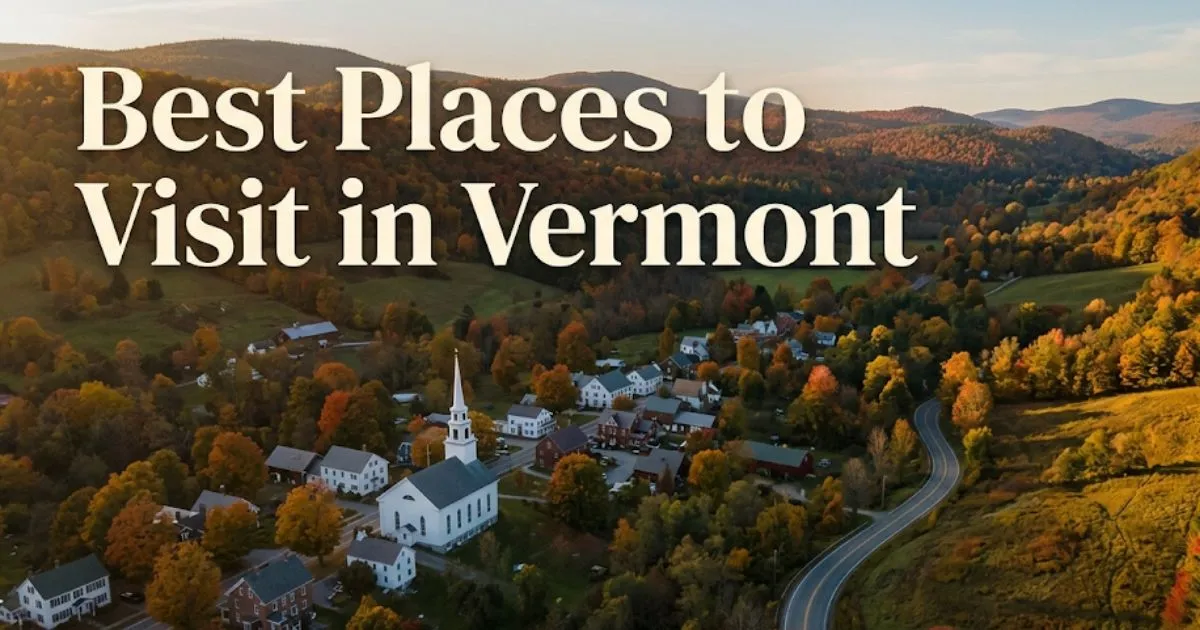
Best Places to Visit in Vermont in 2026: 16 Top Picks

The best places to visit in Vermont depend entirely on when you go and who you are traveling with. Vermont rewards the well-prepared traveler and frustrates those who show up in October without a plan.
Vermont covers just 9,616 square miles, yet packs in more distinct travel experiences per mile than almost any other New England state. Its character ranges from Burlington’s lakeside urban energy to the deliberately quiet villages of the Northeast Kingdom.
This guide covers 16 Vermont destinations with honest seasonal context, cost tiers, and traveler profile matching. You will finish it knowing exactly which Vermont town fits your 2026 trip.
Best Places to Visit in Vermont: How We Chose These Destinations
The best places to visit in Vermont were selected based on distinct character, year-round or strong seasonal appeal, verified practical access, and genuine differentiation across traveler types.
Every destination on this list earned its place by offering something specific. Generic “scenic towns” did not qualify unless they deliver a named, verifiable experience that other Vermont towns cannot replicate.
The Vermont Department of Tourism and Marketing identifies the state’s draw as centering on outdoor recreation, farm-to-table food culture, artisan crafts, and seasonal natural events. This guide takes that framework and adds the honest practical layer those official sources leave out.
The list spans the state geographically. Northwest Vermont anchors on Burlington and Shelburne. Central Vermont runs the Route 100 corridor through Stowe, Woodstock, and the Mad River Valley. Southern Vermont centers on Brattleboro and Manchester. The Northeast Kingdom stands alone in the northeast.
Insider Tip:
- Vermont’s most overrated time to visit is Columbus Day weekend in October. Crowds are maximum, prices are at their highest, and Route 100 becomes a parking lot.
- The smartest foliage window is late September to the first week of October in northern Vermont, or mid-October in the south.
- Budget travelers should note that most Vermont destinations are significantly cheaper in June and early September than in October or ski season.
Vermont Places to Visit by Traveler Type
Vermont’s destinations match specific traveler profiles better than most states. Choosing the wrong town for your travel style is the single most common Vermont planning mistake.
Use this comparison table before deciding where to go. It replaces the guesswork that sends couples to family-oriented towns and budget travelers to premium-priced resort villages.
| Destination | Best For | Cost Tier | Best Season | Primary Draw |
|---|---|---|---|---|
| Burlington | Solo travelers, couples, families | Mid-range | Year-round | Urban culture, Lake Champlain, food scene |
| Stowe | Couples, outdoor enthusiasts, skiers | Premium | Winter, Fall | Stowe Mountain Resort, village charm |
| Woodstock | Couples, history travelers | Premium | Fall, Summer | Marsh-Billings-Rockefeller NHP, village aesthetics |
| Brattleboro | Budget travelers, arts seekers, solo | Budget-Mid | Summer, Fall | Arts scene, local food, counterculture energy |
| Shelburne | Families, museum visitors | Mid-range | Summer | Shelburne Museum, Shelburne Farms |
| Montpelier | Budget travelers, solo, foodie travelers | Budget | Year-round | Smallest US state capital, local restaurant scene |
| Manchester | Couples, outlet shoppers, hikers | Mid-Premium | Fall, Summer | Green Mountain trails, designer outlets |
| Northeast Kingdom | Solo, outdoor, budget | Budget | Summer, Early Fall | Isolation, Hill Farmstead Brewery, cycling |
Families with children will find Burlington and Shelburne the most logistically friendly. Stowe and Woodstock suit couples but struggle to hold young children’s interest beyond a single afternoon.
Senior travelers and those with accessibility needs should prioritize Burlington, where the Church Street Marketplace and Burlington Waterfront are flat, paved, and accessible. Most other Vermont destinations involve uneven terrain, stairs in historic buildings, or gravel paths.
Best Vermont Towns for Fall Foliage
The best Vermont towns for fall foliage in 2026 are Stowe, Woodstock, and the Northeast Kingdom, each offering peak color in overlapping but distinct windows.
Vermont’s foliage season runs roughly from mid-September in the north to late October in the south. The Vermont Department of Tourism and Marketing maintains a weekly foliage tracker updated throughout the season; use it to time your visit to within a week of peak color.
Stowe sits at the base of Mount Mansfield. Its Route 108 corridor and the Stowe Recreation Path offer foliage views without the Route 100 traffic gridlock that hits other towns.
Woodstock gives you a compact, walkable village surrounded by working farms still running fall harvests. Billings Farm and Museum adds context to what you are seeing, with active demonstrations of Vermont agricultural heritage.
The Northeast Kingdom is where serious foliage travelers go to avoid crowds. Kingdom Trails in Burke draws mountain bikers through forest canopy that reaches peak color in early October.
Book foliage accommodations 4 to 6 months in advance. Popular inns in Stowe and Woodstock sell out their October weekends by May or June.
Insider Tip:
- Weekday foliage visits cut Route 100 traffic by roughly half compared to Saturday and Sunday.
- Grafton, a small village south of Woodstock, delivers comparable foliage scenery with a fraction of the crowd. Grafton Village Cheese makes it a worthwhile stop on its own.
- Couples should target Woodstock for a romantic foliage experience. Families should target Stowe, where the Recreation Path handles strollers and kids on bikes comfortably.
Burlington Vermont Things to Do
Burlington is Vermont’s most versatile destination and the only one in the state that functions well without a car as your primary base. The Church Street Marketplace, a pedestrian shopping and dining district, anchors the downtown and connects to the Burlington Waterfront in a flat, walkable corridor.
The ECHO Leahy Center for Lake Champlain on the waterfront delivers genuine engagement for families, not just a generic aquarium. Its Lake Champlain focus makes it regionally specific in a way most science centers are not.
The Island Line Trail extends north from the waterfront along a former railroad causeway, reaching a bike ferry crossing toward South Hero on the Lake Champlain Islands. Bike rentals are available at the waterfront from multiple outfitters; expect to spend roughly $25 to $45 per person for a half-day rental as of recent years.
Burlington’s food scene centers on Pine Street and College Street. Hen of the Wood Burlington consistently earns recognition as one of Vermont’s best restaurants for farm-to-table dinner. Vermont Pub and Brewery on College Street is the local alternative to downtown tourist dining.
Solo travelers find Burlington the easiest Vermont destination to navigate alone. The density of bars, restaurants, and cultural venues on Church Street means you never feel isolated.
Seniors and accessibility travelers will find Burlington’s waterfront and Church Street among the most accessible Vermont experiences. The terrain is flat, the sidewalks are well-maintained, and most venues are ground-floor accessible.
Burlington peaks in summer (June through August) for outdoor activity and festival energy. The Vermont Department of Tourism and Marketing notes Burlington’s year-round livability as unique among Vermont destinations. Winter brings a quieter city with the city’s restaurant scene still fully active.
Key Takeaway: Burlington is the one Vermont destination that works across every traveler profile and every season. Start here if you are undecided.
Stowe Vermont Visit Guide
Stowe is Vermont’s most recognizable resort town and its most thoroughly premium-priced destination. Stowe Mountain Resort on Mount Mansfield anchors the winter ski economy, but the village itself delivers a complete experience in every season.
The Stowe Recreation Path runs 5.3 miles along the West Branch River from the village center toward the mountain. It is paved, flat, and open to walkers, cyclists, and inline skaters, making it one of the most genuinely accessible outdoor experiences in Vermont.
Trapp Family Lodge, operated by the von Trapp family, sits on 2,500 acres above the village. Its network of cross-country ski and hiking trails is accessible to non-guests for a trail fee; verify current pricing before visiting. The lodge’s dining room is open to the public and delivers one of Stowe’s more memorable meal settings.
Alchemist Brewery in nearby Waterbury (10 minutes from Stowe) produces Heady Topper, one of the most recognized double IPAs in American craft brewing. Its taproom operates limited hours; check the current schedule before making it the centerpiece of your day.
Couples consistently rank Stowe as Vermont’s most romantic destination. The combination of mountain backdrop, village-scale dining, and spa culture at several resorts creates a genuinely intimate atmosphere, particularly on weekday visits.
Budget travelers should know honestly that Stowe is not a budget destination. Mid-range lodging during peak foliage runs $250 to $500 per night. Ski lift tickets at Stowe Mountain Resort run approximately $120 to $200 per adult per day as of recent seasons; verify current pricing before booking.
Woodstock Vermont Travel
Woodstock is the most aesthetically composed Vermont village and also its most deliberately curated. The central green, Federal-period architecture, and covered bridge at Middle Bridge create a scene that appears purpose-built for autumn photographs.
Marsh-Billings-Rockefeller National Historical Park is the only National Park Service site in Vermont. It covers 550 acres of managed forest and farmland around the Billings Farm estate. Billings Farm and Museum operates separately as a working dairy farm with public access; admission runs approximately $16 to $20 per adult as of recent years, with family pricing available.
The town has no chains, no franchise restaurants, and no big-box retail. That consistency of character is the point. The Prince and the Pauper restaurant on Elm Street is where Woodstock locals eat rather than the more tourist-visible spots on the green.
Simon Pearce in nearby Quechee (10 minutes east of Woodstock) adds a practical reason to extend your time in this corridor. The glassblowing studio overlooks the Ottauquechee River waterfall, and the on-site restaurant uses hand-blown glass from the studio.
Couples find Woodstock delivers the quintessential New England romantic weekend. The scale is intimate, the dining is serious, and the seasonal scenery is unmatched.
Families with young children will exhaust Woodstock’s child-specific appeal in about two hours. Billings Farm holds interest for ages 5 and up; the village shopping and restaurant scene is adult-oriented.
Brattleboro Vermont Destinations
Brattleboro is Vermont’s most authentically alternative destination and its most affordable gateway town. The downtown’s mix of independent bookshops, art galleries, vinyl record stores, and farm-to-table cafes reflects decades of counterculture settlement that never fully commercialized.
Brattleboro Museum and Art Center occupies a converted railroad depot and focuses on contemporary Vermont and regional artists rather than historical collections. Admission runs approximately $8 to $12 per adult as of recent years.
Main Street and Elliot Street form the commercial core. Mocha Joe’s on Main Street has operated as the town’s coffee culture anchor for decades. Its relationship with small-batch Ethiopian and Central American coffee producers makes it worth knowing specifically.
The Connecticut River runs along Brattleboro’s eastern edge. Retreat Farm on Linden Street reopened as a public green space and working farm with a weekly farmers market and walking trails accessible for free.
Budget travelers should specifically prioritize Brattleboro. Lodging costs are 40 to 60 percent lower than Woodstock or Stowe for comparable quality. The food scene delivers genuinely well-sourced meals without resort-level pricing.
Solo travelers find Brattleboro one of Vermont’s most welcoming destinations. The downtown’s density and the active arts community create natural opportunities for conversation and spontaneous discovery that more resort-oriented towns lack.
Fall is Brattleboro’s best season for the combination of foliage and active cultural programming. Summer brings the farmers market culture and the Connecticut River to full life.
Key Takeaway: Brattleboro is the most underrated Vermont town on this list. It delivers genuine local character at half the cost of Woodstock.
Shelburne Vermont Attractions
Shelburne is the destination for travelers who want Vermont’s farm and museum culture without Burlington’s urban pace. The town sits 7 miles south of Burlington on the Lake Champlain shoreline and functions as an ideal half-day or full-day add-on to a Burlington base.
Shelburne Museum is one of the most significant folk art and Americana collections in the United States. Its 45 acres hold 39 historic structures relocated from across New England, including a fully restored 220-foot steamship, the SS Ticonderoga. Plan three to four hours; rushing it means missing the textile and hat collections, which are the curatorial highlights.
Shelburne Farms operates as a working 1,400-acre farm on the Lake Champlain shoreline. It produces the farmhouse cheddar that Vermont culinary culture centers on. Farm tours run seasonally; verify the 2026 schedule directly with Shelburne Farms before visiting.
Families with children specifically will get more out of Shelburne than almost any other Vermont destination. Shelburne Farms’ children’s programming and the hands-on farm experience holds genuine multi-age interest.
The Inn at Shelburne Farms operates within the property and offers rooms across a range of pricing tiers. It is one of Vermont’s more distinctive accommodation options.
Shelburne’s peak season is summer through early fall. The museum and farm both operate reduced hours or close seasonally; confirm opening dates for your 2026 visit well in advance.
Montpelier Vermont Visit
Montpelier is the smallest state capital in the United States and one of the most genuinely local Vermont destinations on this list. With a population under 8,000, it functions as a working small city rather than a tourist village.
The Vermont State House, with its gold-domed capitol building on State Street, is the architectural anchor. Free guided tours run during legislative sessions; check the 2026 schedule with the Vermont Historical Society.
Vermont Historical Society Museum and Library occupies the Pavilion Office Building adjacent to the State House. Its permanent collections on Vermont’s founding, agricultural history, and social movements are the most substantive historical presentation in the state.
Montpelier’s restaurant scene punches far above its size. Sarducci’s on Main Street has served as the reliable local Italian benchmark for decades. Three Penny Taproom on Main Street focuses on Vermont craft beer and locally sourced bar food; it is the destination locals actually recommend rather than the more tourist-visible Montpelier spots.
Budget travelers will find Montpelier the most affordable full-service Vermont destination. Lodging, dining, and activity costs run meaningfully lower than Stowe, Woodstock, or Burlington.
Montpelier works in any season but is most rewarding when the Vermont legislature is in session (typically January through May), when the State House is at full activity and the town’s coffee shops and restaurants reflect a working civic energy.
Manchester Vermont Travel Guide
Manchester is Vermont’s shopping and outdoor hybrid destination, combining the Green Mountain outdoor corridor with a concentration of factory outlet stores that no other Vermont town matches. It suits travelers who want both a serious hike and a serious retail detour in the same weekend.
Equinox Mountain rises directly above the town. The Equinox Preservation Trust maintains a trail network that reaches the 3,848-foot summit. The climb is achievable for fit hikers in roughly three to four hours round trip from the trailhead on West Union Street.
The Orvis flagship store on Main Street operates the Battenkill River fishing school, teaching fly fishing on one of New England’s most respected trout streams. Guided lessons run approximately $300 to $500 per person for a half-day session; verify current pricing with Orvis directly.
Manchester Center’s outlet corridor along Route 7A includes Brooks Brothers, J.Crew, and Cole Haan among others. It is deliberately not a mall; the stores occupy individual historic buildings along the main road.
Couples find Manchester delivers a satisfying mix of outdoor ambition and town-scale dining and shopping. It avoids Woodstock’s premium pricing while offering comparable mountain scenery.
Families with older children (ages 10 and up) suit Manchester better than younger kids. The hiking is genuinely demanding and the outlet shopping is adult-oriented.
The American Museum of Fly Fishing on Seminary Avenue is the most specific and underrated Manchester attraction. It is free to enter and houses the fishing tackle collections of several US presidents.
Key Takeaway: Manchester is the best Vermont destination for travelers who want serious outdoor access and real shopping in the same weekend, at pricing below Stowe or Woodstock.
Outdoor and Nature Destinations in Vermont
Vermont’s outdoor destinations extend well beyond the ski resorts. The state’s most rewarding natural experiences are its gorges, long-distance trails, and remote cycling networks.
Quechee Gorge State Park delivers Vermont’s most accessible dramatic natural feature. The gorge drops 165 feet below the Route 4 bridge. A short trail from the parking area reaches the gorge rim in under five minutes; the full loop to the gorge floor and back runs approximately 1.5 miles. Parking fees apply; verify current state park rates with Vermont State Parks.
Camel’s Hump State Park offers the most rewarding summit hike in the state for serious hikers. The 4,083-foot summit requires a strenuous 7.5-mile round trip from the Couching Lion trailhead. Do not attempt this without proper footwear, water, and an early start; weather changes fast above treeline.
Kingdom Trails in East Burke is one of the premier mountain biking networks in the eastern United States. Over 100 miles of trails cover terrain from beginner flow tracks to technically demanding singletrack. Trail passes run approximately $25 to $35 per day as of recent seasons; confirm 2026 rates with Kingdom Trails directly.
The Island Line Trail in Burlington extends 14 miles north along Lake Champlain. A seasonal bike ferry connects the causeway to South Hero Island, making it one of Vermont’s most accessible long-day cycling experiences.
Seniors and travelers with limited mobility should focus on the Quechee Gorge rim trail and the Burlington waterfront path, both of which are paved and manageable for most mobility levels.
Best Vermont Destinations for Couples
The best Vermont destinations for couples are Stowe, Woodstock, and the Mad River Valley, each delivering a distinct version of the Vermont romantic experience at different price points.
Stowe suits couples who want resort amenity alongside natural setting. The combination of the Stowe Mountain Resort village, the Stowe Recreation Path at dusk, and dinner at a local restaurant creates a self-contained, high-quality romantic weekend.
Woodstock delivers the archetypal New England village romance. The scale of the town means you stay within walking distance of everything. The covered bridge at Middle Bridge is one of Vermont’s most reliably photographed locations, for reasons that hold up in person.
Mad River Valley, centered on the towns of Waitsfield and Warren, is the local alternative to Stowe for couples who want Vermont skiing and mountain scenery without Stowe’s premium pricing. Sugarbush Resort and Mad River Glen anchor the skiing. The Pitcher Inn in Warren is one of Vermont’s most distinctive boutique properties, with each room designed around a specific Vermont theme.
For couples who prefer culture over outdoors, Brattleboro offers a low-key romantic weekend grounded in art, food, and a genuinely local pace. It costs substantially less than Stowe or Woodstock.
Insider Tip:
- The Trapp Family Lodge in Stowe allows non-guests to cross-country ski or hike their trail network for a day fee. This is a far more interesting couples activity than the village shops.
- Book couple’s spa packages at Stowe’s Stoweflake Mountain Resort at least 4 to 6 weeks in advance during peak season.
Vermont With Kids: Best Destinations
The best Vermont destinations for families with children are Burlington, Shelburne, and Stowe in that order, based on child-specific activity depth and logistical friendliness.
Burlington gives families the most options per square mile. The ECHO Leahy Center for Lake Champlain engages children ages 4 and up for two to three hours with interactive lake science exhibits. The adjacent waterfront park has open green space, a playground, and lake views.
Shelburne Farms is the strongest single family destination in Vermont. The working farm’s seasonal programming includes hands-on cheese-making demonstrations, barn animal interactions, and trail access through fields above Lake Champlain. The experience holds children’s interest for a full half-day.
Stowe suits families with children ages 8 and up. The Recreation Path is genuinely kid-friendly on bikes. In winter, the ski school at Stowe Mountain Resort is well-regarded for beginners of all ages; verify 2026 lesson pricing directly with the resort.
Ben and Jerry’s Factory Tour in Waterbury (between Burlington and Stowe) is worth 90 minutes for families. Tours run approximately $6 to $8 per person as of recent years; verify current pricing before visiting.
Families should avoid Woodstock and Montpelier as primary destinations. Both are genuinely interesting for adults but lack the activity depth to hold children’s engagement for more than a few hours.
Stroller access in Vermont’s historic villages is frequently challenging. Woodstock and Manchester have uneven brick sidewalks. Burlington and the Shelburne Farm paths are the most stroller-friendly environments.
Budget Friendly Vermont Towns
The most affordable Vermont destinations are Brattleboro, Montpelier, and the Northeast Kingdom, each offering genuine Vermont character without the resort-season pricing that defines Stowe, Woodstock, and Manchester.
Brattleboro anchors the budget-friendly list. Lodging runs roughly $80 to $150 per night at quality independent properties outside of peak foliage weekends. The food scene delivers farm-sourced quality without white-tablecloth pricing.
Montpelier’s restaurant and coffee scene is surprisingly strong for its size. Three Penny Taproom and the rotating roster of small restaurants on Main Street provide memorable meals at genuinely local prices.
The Northeast Kingdom, centered on St. Johnsbury and the towns of Craftsbury, Greensboro, and East Burke, is Vermont’s most genuinely remote and affordable region. Hill Farmstead Brewery in Greensboro is worth the drive purely on its merits as one of the most respected craft breweries in the country. The taproom is open limited days and hours; verify the 2026 schedule directly with Hill Farmstead before planning your visit.
Budget travelers should time any Vermont trip outside October and ski season. The same lodging that costs $300 per night in peak foliage drops to $100 to $150 in June or early September.
Free Vermont experiences that deliver genuine value:
- Vermont State House guided tours (Montpelier)
- Quechee Gorge rim trail (parking fee applies, trail is free)
- Burlington Waterfront Park and Island Line Trail (free access)
- American Museum of Fly Fishing in Manchester (free admission)
- Church Street Marketplace (Burlington; free to walk, cost is optional)
Key Takeaway: Vermont on a budget is entirely achievable outside peak season. The Northeast Kingdom and Brattleboro deliver the most authentic local experience at the lowest cost.
Best Time to Visit Vermont and Seasonal Guide
The best time to visit Vermont for most travelers is late August through the first week of October or the first two weeks of June, when weather is favorable, crowds are manageable, and the landscape is at a natural peak.
| Season | Dates | Conditions | Crowd Level | Cost Tier |
|---|---|---|---|---|
| Early Summer | June to early July | Warm, green, lush | Low to moderate | Mid-range |
| Peak Summer | Mid-July to August | Warmest temps, festivals | Moderate | Mid-range |
| Early Fall | September | Color begins in north | Moderate, rising | Mid-rising |
| Peak Foliage | Late September to mid-October | Maximum color | Very high | Premium |
| Shoulder Fall | Late October | Southern color, quieter | Low to moderate | Lower |
| Winter Ski | December to March | Snow, cold | High at resorts | Premium |
| Mud Season | April to mid-May | Poor roads, limited services | Very low | Budget |
The worst time to visit Vermont for casual travelers is Columbus Day weekend in October. This single weekend compresses maximum crowds, maximum pricing, and minimum road speed into 48 hours across the entire central Vermont corridor.
Skiers should target January and February for the most reliable snow conditions at Stowe Mountain Resort, Sugarbush, and Killington. Early December is often limited by natural snow before snowmaking catches up.
According to the Vermont Department of Tourism and Marketing, Vermont’s foliage peak tracking has shifted slightly later in recent decades due to temperature patterns. September foliage in the northern Green Mountains now frequently outperforms early October in quality while significantly undercutting it in crowd density.
How to Get Around Vermont and Practical Travel Tips
Getting around Vermont requires a car for all destinations outside Burlington. Public transit stops at the Burlington city limits. Every destination on this list beyond Burlington’s waterfront district demands a vehicle.
Burlington International Airport (BTV) connects to major hubs including New York, Boston, Philadelphia, Washington D.C., and Chicago. Car rental is available at the airport. Booking rental cars 4 to 6 weeks in advance during October is strongly recommended; demand outstrips supply and prices spike significantly.
Amtrak’s Vermonter runs daily from New York Penn Station to St. Albans, Vermont, stopping in Brattleboro, White River Junction, and Montpelier along the way. It is a legitimate car-free option for reaching Brattleboro or Montpelier. Travel time from New York to Brattleboro runs approximately 5.5 to 6 hours; verify current schedules with Amtrak.
Route 100 is the scenic spine of Vermont, running north-south through Stowe, Waitsfield, Stockbridge, and Ludlow. In October, this road becomes the state’s primary traffic problem. Allow double your expected drive time on Route 100 during any October weekend.
A practical 2-day Vermont weekend itinerary from Burlington:
- Day 1 morning: Explore Church Street Marketplace and Burlington Waterfront. Rent bikes for the Island Line Trail.
- Day 1 afternoon: Drive south 30 minutes to Shelburne Museum. Allow three hours.
- Day 1 evening: Return to Burlington for dinner on Pine Street.
- Day 2 morning: Drive east on Route 2 to Montpelier (45 minutes). Tour the State House.
- Day 2 midday: Continue to Stowe via Route 100 (30 minutes from Montpelier). Walk the Recreation Path.
- Day 2 evening: Detour to Waterbury to visit Alchemist Brewery before returning to Burlington.
Safety warning: Vermont winter mountain driving demands preparation. Route 100 and the mountain gaps (Lincoln Gap, Appalachian Gap) are unplowed or impassable during heavy snowfall. All-wheel drive or snow tires are strongly recommended from November through March.
Cell service is limited or absent across much of the Northeast Kingdom and rural Green Mountain areas. Download offline maps before leaving Burlington or Montpelier.
Safety and Practical Warnings for Vermont Travel
Vermont’s most underestimated travel risk is its driving conditions, both in winter on mountain roads and in October when Route 100 traffic creates unexpected schedule disruptions.
Key safety and practical facts every visitor should know:
- Mountain gap roads (Lincoln Gap, Appalachian Gap, Hazen’s Notch) close seasonally, typically November through spring. Confirm road status before planning a crossing; Vermont Agency of Transportation maintains current road condition updates.
- Black bears are active across rural Vermont, particularly in the Northeast Kingdom and Green Mountain backcountry. Secure food in vehicles and use bear canisters on multi-day backcountry trips.
- Lake Champlain water temperature remains cold enough to limit safe swimming until late July in most years. Children should wear life jackets on any watercraft.
- Limited cell service across the Northeast Kingdom and rural areas means you cannot rely on GPS navigation or emergency calling. Carry a paper map and a fully charged battery bank.
- Trail conditions on Camel’s Hump and Mount Mansfield can include ice, mud, and high-wind exposure above treeline even in summer. Check current trail conditions with Vermont State Parks before departure.
- Mud season driving from April through mid-May can damage unpaved roads and strand vehicles in rural areas. Stay on paved routes unless you have confirmed conditions on dirt roads.
Vermont emergency services in rural areas have significantly longer response times than urban areas. If you are hiking remote trails, inform someone of your plans and expected return time.
Frequently Asked Questions About the Best Places to Visit in Vermont
What is the best place to visit in Vermont for fall foliage?
The best Vermont towns for fall foliage are Stowe, Woodstock, and the Northeast Kingdom’s East Burke area.
Stowe offers mountain backdrop foliage with the Stowe Recreation Path as a car-free viewing option.
Woodstock delivers a compact, walkable village surrounded by farmland at peak color, though October weekends are heavily crowded; aim for weekday visits.
How many days do you need to see Vermont?
A minimum of three to four days allows you to cover two or three distinct Vermont destinations meaningfully.
A weekend (two nights) is enough for one destination explored thoroughly, such as Burlington plus a day trip to Shelburne and Stowe.
Seven days allows a full north-to-south Vermont road trip covering Burlington, Stowe, Woodstock, Brattleboro, and Manchester without feeling rushed.
What is the best time of year to visit Vermont?
The best time to visit Vermont is late August through early October for optimal weather and foliage, or June for lush summer conditions with lower crowds.
Peak foliage in late September through mid-October draws the highest visitor numbers and premium pricing.
Mud season in April and early May brings the lowest prices but also road condition issues and limited service availability at many Vermont inns and restaurants.
Is Vermont worth visiting in winter?
Vermont is absolutely worth visiting in winter if skiing or cross-country snowshoeing is part of your plan.
Stowe Mountain Resort, Sugarbush, and Killington offer skiing that rivals many western mountain destinations for New England winters.
Non-skiers may find winter Vermont limited; most outdoor experiences are snow and cold-dependent, and many small restaurants and shops operate reduced hours from January through March.
What Vermont towns are best for families with kids?
The best Vermont towns for families with children are Burlington, Shelburne, and Stowe, in that order.
Burlington’s ECHO Leahy Center, waterfront park, and bike path infrastructure are the most logistically family-friendly in the state.
Shelburne Farms delivers the strongest single family experience, with hands-on farm activities that hold children’s genuine interest across a full half-day visit.
What is the most affordable town to visit in Vermont?
The most affordable Vermont destinations are Brattleboro, Montpelier, and the Northeast Kingdom towns of St. Johnsbury and East Burke.
Brattleboro combines low lodging costs with a genuine arts and food scene that does not require premium spending to access its best experiences.
Visiting any Vermont destination outside the October foliage peak and ski season drops costs dramatically; the same rooms that run $300 per night in October frequently cost $100 to $150 in June or early September.
Plan Your Vermont Trip With These Priorities
Start with the comparison table in this guide. Match your destination to your traveler profile, season, and budget before anything else.
Book October accommodations the moment you decide to go. Vermont’s foliage season is the single most competitive lodging market in New England; six months in advance is not excessive.
Travel conditions, operating hours, admission prices, and seasonal service schedules across Vermont change frequently. Verify all key logistics directly with the Vermont Department of Tourism and Marketing and individual venues before your 2026 departure.
Vermont rewards preparation more than almost any domestic destination. The travelers who enjoy it most are the ones who matched their expectation to the right town and the right season before they ever left home.