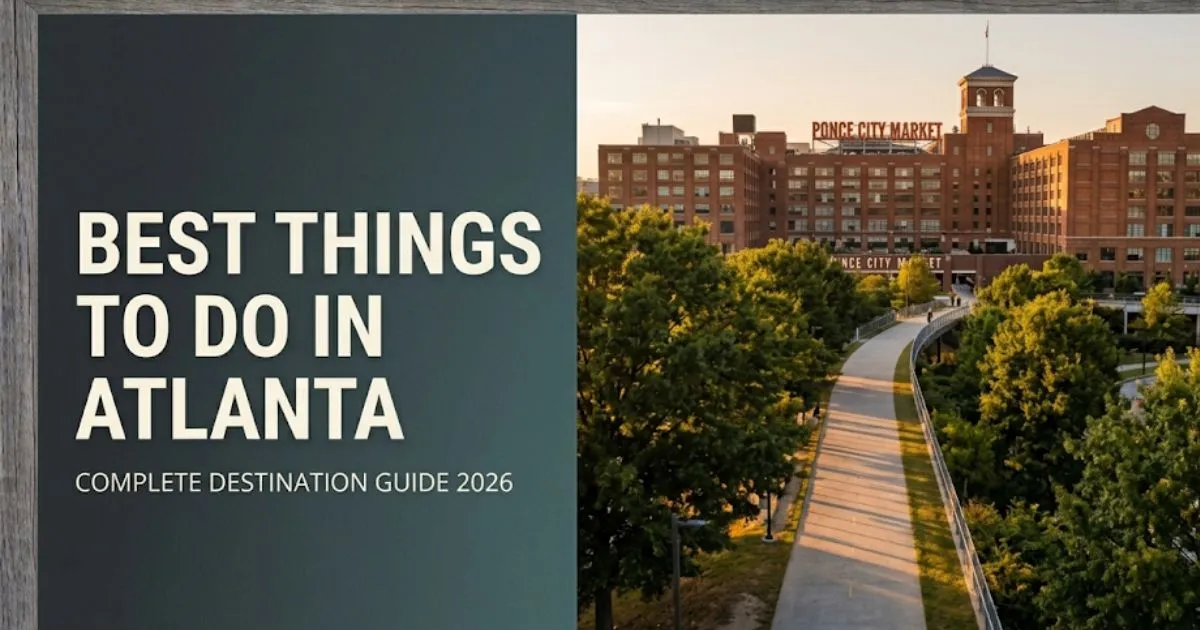
Best Things to Do in Atlanta, GA: The 2026 Local Guide

The best things to do in Atlanta are concentrated in its neighborhoods, not its tourist corridor. Atlanta rewards visitors who move through Inman Park, Old Fourth Ward, Sweet Auburn, and Virginia-Highland rather than shuttling between midtown hotel lobbies and downtown parking decks.
Visit Atlanta, the city’s official tourism organization, notes that Atlanta serves roughly 58 million visitors annually. But the experiences that define the city for repeat visitors have almost nothing to do with the most photographed itinerary stops.
This guide covers Atlanta’s top attractions, neighborhoods, food markets, outdoor spaces, civil rights history, and practical logistics. It distinguishes specifically between traveler types, addresses what is genuinely overrated, and names the local alternatives worth your time.
Best Things to Do in Atlanta: What Makes This City Worth Your Trip
Atlanta’s strongest travel identity is built on three pillars: civil rights history of genuine national significance, a food culture that extends far beyond Southern comfort cooking, and a walkable urban trail network that connects some of the best neighborhood eating and drinking in the American South.
Atlanta BeltLine Inc. describes the BeltLine as 22 miles of multi-use trails connecting 45 Atlanta neighborhoods. That corridor is where Atlanta’s daily life actually happens: morning runs in Reynoldstown, Saturday farmer’s markets in Inman Park, weekend dinner queues at Krog Street Market.
The city’s overrated trap is treating midtown as the destination. Midtown has the High Museum of Art and the Fox Theatre, both of which genuinely earn visits. But midtown as a neighborhood feels corporate and generic compared to the living texture of the Old Fourth Ward.
What Atlanta does better than most American cities its size: international dining diversity (Buford Highway is one of the most concentrated corridors of Asian, Latin American, and Eastern European restaurants in the Southeast), civil rights history with direct physical and emotional weight, and a beer and cocktail culture across a range of neighborhoods that prioritizes originality over theme-park branding.
Insider Tip:
- Stay within a 10-minute walk of the BeltLine Eastside Trail. This eliminates most of Atlanta’s traffic problem.
- Do the major cultural institutions (Georgia Aquarium, Martin Luther King Jr. NHS) on weekday mornings when crowds are manageable.
- Families get the most value from Georgia Aquarium plus Piedmont Park in a single day, with lunch from Ponce City Market’s ground-floor vendors.
Atlanta Attractions Every Visitor Should Know
Atlanta’s essential attractions divide cleanly into two tiers: those with genuine national significance that earn every ticket price, and those that are well-marketed tourist infrastructure.
The genuine tier includes Georgia Aquarium (the largest aquarium in the Western Hemisphere), Martin Luther King Jr. National Historic Site (a National Park Service site managed with exceptional interpretive depth), and the Atlanta History Center in Buckhead, which holds one of the most substantive Civil War and Southern history collections in the country.
The tourist infrastructure tier includes several downtown attractions that are heavily marketed but deliver significantly less than their entry price suggests. Verify current reviews and pricing directly before committing time and money.
| Attraction | Best For | Cost Range (Adult) | Advance Booking | Insider Note |
|---|---|---|---|---|
| Georgia Aquarium | Families, couples | $35-$45 est. | Yes, weekends | Whale shark exhibit is the genuine draw |
| MLK Jr. National Historic Site | All profiles | Free (NPS site) | No, but arrive early | Birth home tours sell out; book via NPS |
| Atlanta History Center | History travelers | $20-$25 est. | No | Swan House grounds alone worth the visit |
| World of Coca-Cola | Families, first-timers | $20-$30 est. | Yes | Overrated for adults; kids enjoy it |
| High Museum of Art | Couples, solo | $15-$20 est. | No | Free on select Sundays; verify schedule |
| Oakland Cemetery | Solo, history lovers | Free walking | No | One of Atlanta’s most undervisited sites |
According to the National Park Service, the Martin Luther King Jr. National Historic Site includes the birth home of Dr. King, Ebenezer Baptist Church, and the King Center. The NPS manages the site and offers ranger-led programs that provide context unavailable from self-guided visits.
Seniors and accessibility travelers should note that the MLK Jr. NHS is largely flat and accessible. Georgia Aquarium has elevator access throughout. The Atlanta History Center’s Swan House gardens involve uneven terrain on sloped grounds.
Top Things to Do in Atlanta for First-Time Visitors
First-time visitors to Atlanta should prioritize three experiences that cannot be replicated elsewhere: the civil rights history corridor of Sweet Auburn, the BeltLine Eastside Trail and its surrounding neighborhood dining scene, and a morning at Georgia Aquarium before weekend crowds arrive.
The most common first-visit mistake is spending two days driving between midtown, Buckhead, and downtown without ever walking a single neighborhood. Atlanta’s best experiences are pedestrian-scale within specific districts.
To build a first-visit day efficiently:
- Start at Martin Luther King Jr. National Historic Site in Sweet Auburn by 9am. Book the birth home tour through the NPS in advance.
- Walk the Sweet Auburn Historic District. The Sweet Auburn Curb Market on Edgewood Avenue has been operating since 1918. Stop for breakfast there.
- Take an Uber or MARTA to the Old Fourth Ward. Walk north on Irwin Street to access the BeltLine Eastside Trail.
- Lunch at Krog Street Market on Krog Street NE in Inman Park, accessed directly from the BeltLine trail.
- Afternoon at Ponce City Market on Ponce de Leon Avenue NE, either via the BeltLine or a short drive.
- Evening in Virginia-Highland along N. Highland Avenue for dinner and the neighborhood bar scene.
Budget travelers can do this entire day for under $40 per person, excluding dining. MLK Jr. NHS is free. The BeltLine is free. Market browsing costs nothing.
Key Takeaway: Atlanta’s best first-visit day happens on foot and by trail, not by car. Plan your accommodation near the BeltLine Eastside Trail.
Best Atlanta Neighborhoods to Explore
Atlanta’s most rewarding neighborhoods for visitors are concentrated east of downtown, connected by the BeltLine or short rideshare trips.
Old Fourth Ward sits northeast of downtown. It’s home to the BeltLine Eastside Trail’s main access points, Ponce City Market, the Fourth Ward Skate Park, and a dense concentration of restaurants from established names to new openings. The neighborhood’s combination of adaptive reuse architecture (Ponce City Market occupies a former Sears distribution center) and new residential development gives it an energetic, lived-in quality.
Inman Park, Atlanta’s first planned suburb, runs directly into Old Fourth Ward along the BeltLine. Krog Street Market anchors the neighborhood’s food identity. The Victorian residential streets around Euclid and Elizabeth Street are worth walking for their architectural detail and garden density.
Virginia-Highland on N. Highland Avenue between Ponce de Leon and University Drive is where Atlanta’s longtime residents eat dinner on weeknights. It is not a tourist neighborhood. Restaurants like Atkins Park (one of Atlanta’s oldest bars, opened in 1922) and newer spots along the corridor give it a genuine neighborhood-bar-and-restaurant personality that Buckhead’s louder strip cannot match.
Sweet Auburn is the city’s civil rights corridor and should be understood as a history destination, not just a neighborhood visit. The density of significance here, from the King birth home to Ebenezer Baptist Church to the APEX Museum, makes it one of the most important American history districts in any city.
| Neighborhood | Best For | Vibe | BeltLine Access | Parking |
|---|---|---|---|---|
| Old Fourth Ward | Food, culture, couples | Urban, energetic | Direct | Limited; use PCM deck |
| Inman Park | Couples, solo travelers | Residential, relaxed | Direct | Street parking available |
| Virginia-Highland | Foodies, adults | Neighborhood, local | Near (short walk) | Street parking |
| Sweet Auburn | History travelers, all profiles | Historic, significant | Nearby | Street and lots |
| Buckhead | Upscale travelers, shopping | Commercial, upscale | No | Ample paid parking |
| East Atlanta Village | Solo travelers, nightlife | Indie, local | No | Street parking |
Buford Highway, running northeast from the city into Doraville, is not a walkable neighborhood but is essential eating territory. It is one of the most ethnically diverse restaurant corridors in the entire American South, with Vietnamese, Korean, Chinese, Mexican, and Central American restaurants within a few miles of each other. This is where Atlanta food writers and restaurant professionals eat on their nights off.
Atlanta BeltLine and Outdoor Activities
The Atlanta BeltLine Eastside Trail is the best single outdoor experience in Atlanta, running approximately 3 miles through Old Fourth Ward, Inman Park, and Ponce City Market with direct access to restaurants, parks, street art, and the Fourth Ward Skate Park.
The full BeltLine trail network, managed by Atlanta BeltLine Inc., spans 22 miles and connects multiple Atlanta neighborhoods. The Eastside Trail is the most developed, best maintained, and most activity-dense segment for visitors. The Westside Trail offers a quieter, less commercial walking experience with more residential neighborhood character.
Piedmont Park on Piedmont Avenue NE in Midtown is Atlanta’s primary green space: 189 acres of open lawn, walking paths, and lake views. It connects directly to the Atlanta Botanical Garden on its northern edge. The Botanical Garden charges admission and is worth it, particularly for the Edible Garden section and the canopy walk.
Stone Mountain Park, approximately 16 miles east of downtown, is worth clarifying for hikers: it is a granite monadnock with a summit walk (the Walk Up Trail is roughly 1.3 miles each way) inside a large state park. The summit view of the Atlanta skyline is genuinely good. But it is a scenic park, not a wilderness destination. The Confederate carving on the rock face is the most politically controversial public monument in the state.
The Chattahoochee River National Recreation Area, managed by the National Park Service, sits northwest of the city and offers genuine hiking, tubing, and fishing along a real river corridor. It is significantly less crowded than the BeltLine on summer weekends.
Outdoor activity seasonal notes: The BeltLine is usable year-round but summer afternoons (typically June through August, above 90°F with high humidity) make outdoor activity genuinely uncomfortable. Plan BeltLine walks before 9am or after 6pm during summer. Spring and fall provide the best outdoor conditions, with mild temperatures and lower humidity.
Seniors and mobility travelers should note the BeltLine Eastside Trail is paved and largely flat. Piedmont Park has wide paved paths. Stone Mountain’s Walk Up Trail is uneven granite and not suitable for mobility aids.
Atlanta Food Scene and Best Markets
Atlanta’s food identity is more honest and more diverse than its tourist marketing suggests. The city’s best eating happens at Buford Highway, inside the BeltLine-adjacent markets, and in the Virginia-Highland and Inman Park restaurant corridors.
Ponce City Market on Ponce de Leon Avenue NE houses a mix of local restaurant concepts and national brands across its ground-floor food hall. Krog Street Market on Krog Street NE in Inman Park is smaller, more local in character, and consistently features stronger independent restaurant concepts. For serious eating, Krog Street beats Ponce City Market.
The Sweet Auburn Curb Market, operating since 1918 on Edgewood Avenue, is the most historically grounded food market in the city. It’s not a tourist destination primarily. It’s a working neighborhood market that happens to have exceptional soul food vendors and a butcher counter that Atlanta chefs use.
Fox Bros. Bar-B-Q on McLendon Avenue in Lake Claire is the address locals give when out-of-towners ask where to eat barbecue. It is not downtown. It is not in any tourist zone. The smoked brisket and the “Frito Pie” barbecue dish are worth traveling specifically for.
Staplehouse on Edgewood Avenue in Old Fourth Ward has James Beard Award recognition and a menu that changes based on what is available from Georgia farms. Reservations are required and book several weeks ahead for weekends.
For international eating without a specific restaurant recommendation: drive Buford Highway between Clairmont Road and Shallowford Road. Park anywhere. Walk into whatever looks busy. This method has produced some of the best meals in the city for decades.
According to the Southern Foodways Alliance, Atlanta’s position as the South’s largest city makes it the primary hub for the region’s evolving food culture, including a decades-long tradition of Vietnamese, Korean, and Chinese restaurant communities centered on the Buford Highway corridor.
Budget travelers can eat extraordinarily well in Atlanta. Buford Highway runs $8 to $20 per person for full meals. The Sweet Auburn Curb Market’s hot lunch counters run under $15. Krog Street Market’s lunch options average $12 to $18.
Key Takeaway: Skip the downtown hotel restaurant. Take a Lyft to Krog Street Market for lunch and Virginia-Highland for dinner. You will eat better and spend less.
Atlanta History and Culture Highlights
Atlanta’s historical significance is concentrated in its civil rights history, its role in the 1996 Olympics, and its antebellum and Civil War heritage. Each of these threads has a specific physical address where you can engage directly with it.
The Martin Luther King Jr. National Historic Site in Sweet Auburn is the starting point for understanding Atlanta’s global significance. The NPS site includes Dr. King’s birth home at 501 Auburn Avenue NE, Ebenezer Baptist Church, where three generations of the King family preached, and the King Center, which holds Dr. King’s tomb. Plan a minimum of three hours here. Rush it and you will miss the interpretive depth that makes it genuinely affecting.
The Atlanta History Center in Buckhead, at West Paces Ferry Road NW, holds the Swan House (a 1928 Palladian mansion on 33 acres) alongside museum galleries covering the Civil War, Atlanta’s urban development, and the 1996 Olympic Games. The Civil War collection is among the most substantive in the South.
Centennial Olympic Park, downtown on Andrew Young International Boulevard NW, opened for the 1996 Summer Olympics. The Fountain of Rings is its centerpiece. It connects to the Georgia Aquarium and World of Coca-Cola, making a logical physical cluster for a downtown morning. The park itself is free to enter.
Oakland Cemetery, on Oakland Avenue SE in Grant Park, is Atlanta’s oldest public park and the final resting place of Margaret Mitchell (author of Gone with the Wind) and golf legend Bobby Jones. The Victorian funerary architecture is remarkable. Free to enter and dramatically undervisited by tourists who don’t know it exists.
High Museum of Art on Peachtree Street NE in Midtown is the South’s leading art museum, with collections spanning European paintings, African art, photography, and design. Explore Georgia identifies it as one of the state’s primary cultural institutions. Free admission days occur periodically; verify the current schedule before visiting.
The Fox Theatre on Peachtree Street, a National Historic Landmark, hosts Broadway touring productions, concerts, and film screenings. The building’s Moorish Revival interior from 1929 is worth seeing even if you do not attend a performance. Tours of the building run periodically; check the current schedule.
Georgia Aquarium and World of Coca-Cola
Georgia Aquarium on Baker Street NW in downtown Atlanta is the largest aquarium in the Western Hemisphere, housing whale sharks, manta rays, beluga whales, and over 100,000 animals across multiple habitats. For families and first-time visitors, it is genuinely one of the best single-day attraction experiences in the American South.
Advance ticket purchase is strongly recommended. Weekend mornings between 10am and 1pm are the busiest periods. Arriving at opening time (typically 9am, verify current hours) gives you the best experience of the whale shark exhibit, which is the aquarium’s centerpiece: a 10-million-gallon tank with floor-to-ceiling viewing.
World of Coca-Cola on Baker Street NW sits directly adjacent to the aquarium and shares a plaza with it. Honest assessment: it is primarily a brand experience and marketing museum. Children under 10 tend to enjoy it. Adults interested in branding and design history will find some genuine interest. Most adult travelers without children find it thin for the admission price.
Purchasing a combination ticket for both attractions lowers the per-attraction cost. Verify current combination pricing directly with each attraction before visiting.
| Experience | Duration | Best Age Group | Crowd Level | Book in Advance? |
|---|---|---|---|---|
| Georgia Aquarium | 2.5 to 4 hours | All ages, especially families | High on weekends | Yes, strongly |
| World of Coca-Cola | 1 to 1.5 hours | Kids under 12, brand fans | Moderate | Recommended |
| Centennial Olympic Park | 30 to 60 minutes | All profiles | Low to moderate | No |
| Combined campus (all 3) | Half-day | Families | High in summer | Yes for paid venues |
Families should note that stroller access throughout Georgia Aquarium is good. The aquarium has a dedicated children’s section. The whale shark exhibit viewing gallery can feel genuinely crowded on peak weekend mornings; arriving at opening time makes a real difference.
Senior and accessibility travelers should know that Georgia Aquarium is fully wheelchair accessible with elevators throughout. The aquarium’s size (it’s large) means significant walking distance between exhibits. Plan for approximately 2 miles of walking on flat surfaces.
Free and Budget-Friendly Things to Do in Atlanta
Atlanta is one of the more affordable major American cities for budget travelers who know where to concentrate their time. Several of the city’s most rewarding experiences cost nothing.
Free experiences that deliver genuine value:
- Martin Luther King Jr. National Historic Site: Free admission to all NPS-managed areas including the King Center and Ebenezer Baptist Church. The birth home tour has capacity limits; book free tickets through the NPS in advance.
- Atlanta BeltLine Eastside Trail: Free to access at multiple entry points, including Irwin Street and the Ponce City Market area.
- Piedmont Park: Free to enter. 189 acres of green space with lake views and event programming.
- Oakland Cemetery: Free to enter. Self-guided tour maps available at the entrance.
- Centennial Olympic Park: Free to enter. The Fountain of Rings is free to experience; interactive water features are seasonal.
- Krog Street Tunnel: Free street art installation under the railroad tracks between Inman Park and Cabbagetown. One of Atlanta’s most distinctive urban art sites.
- Sweet Auburn Historic District: Free to walk and explore. The architectural and historical density is significant.
- Fernbank Forest: The 65-acre old-growth urban forest adjacent to Fernbank Museum is free to walk on designated paths.
Budget travelers doing the above list across two days can have a deeply satisfying Atlanta experience with zero attraction admission cost. Reserve the paid attractions (Georgia Aquarium, Atlanta History Center, High Museum of Art) for days when the budget allows or for specific traveler interests.
According to Visit Atlanta, the city offers more than 50 free public spaces, trails, and cultural access points that are consistently overlooked by first-time visitors who concentrate spending on the major paid attractions.
Key Takeaway: Atlanta’s free-to-access civil rights history corridor at Sweet Auburn delivers some of the most significant travel experiences in any American city, at zero cost.
Things to Do in Atlanta for Couples
Atlanta for couples works best when structured around neighborhood evenings rather than daytime attraction-hopping. The city’s restaurant and cocktail culture in Virginia-Highland, Inman Park, and Old Fourth Ward is genuinely suited to romantic dinners, evening walks, and lingering bar conversations.
Romantic dinner options with local depth:
- Staplehouse on Edgewood Avenue: James Beard-recognized. Intimate room. Reservation required weeks in advance for weekends.
- Tiny Lou’s in Hotel Clermont on Ponce de Leon Avenue: A 1950s French supper club aesthetic in one of Atlanta’s most architecturally interesting boutique hotels. The Hotel Clermont itself, a converted 1920s apartment building, is worth staying at for couples who want atmosphere over chain-hotel predictability.
- Beetlecat on Edgewood Avenue in Old Fourth Ward: Raw bar, natural wine, and a narrow room that feels genuinely intimate.
A couple’s day itinerary that works consistently: BeltLine Eastside Trail in the morning (less crowded before 10am), lunch at Krog Street Market, afternoon at the Atlanta Botanical Garden (particularly good in spring bloom and during the winter Garden Lights event), evening in Virginia-Highland for dinner.
Atlanta Botanical Garden is one of the most genuinely romantic daytime experiences in the city. The canopy walk and the Japanese garden sections are particularly well-suited to couples. The annual Garden Lights event from November through January transforms the garden with large-scale light installations; this is one of Atlanta’s best date-night experiences.
The Fox Theatre for a Broadway touring show or a concert is one of Atlanta’s most reliable couple’s evenings. The building’s 1929 Moorish Revival interior delivers an atmosphere that modern venues cannot replicate. Check the current 2026 season schedule directly with the Fox Theatre.
Couples who want a slower pace than the BeltLine corridor should consider a morning at Oakland Cemetery, followed by coffee and pastry at one of the Grant Park neighborhood cafes on Cherokee Avenue. It is genuinely one of Atlanta’s most overlooked and quietly beautiful experiences.
Things to Do in Atlanta with Kids
Atlanta for families is more specifically rewarding than most US cities its size. The combination of Georgia Aquarium, Piedmont Park, Ponce City Market, and the BeltLine gives families a mix of structured attraction time and open outdoor space that genuinely works for ages 4 and up.
Georgia Aquarium is the top family priority. It delivers for ages 3 through adult. The whale shark exhibit and the dolphin presentation are the highlights. Budget 2.5 to 3.5 hours. Purchase tickets online in advance; weekend walk-up queues are real.
Children’s Museum of Atlanta on Centennial Olympic Park Drive downtown is specifically designed for ages 2 to 8. It is not a major cultural institution. But for families with toddlers who need a structured indoor activity without the cost of Georgia Aquarium, it serves its purpose.
Piedmont Park works for families with children who need open space to run, a playground, and a lake view without structure or admission cost. The park connects to the Atlanta Botanical Garden, where the Children’s Garden section is specifically designed for young visitors.
Ponce City Market for family lunch: the ground-floor food hall has multiple vendor options. Families with picky eaters benefit from the variety. The rooftop amusement area, Skyline Park, has a small carnival-style attraction space and city views. Verify current seasonal operating hours before visiting.
Age-specific notes for families:
- Ages 2 to 5: Children’s Museum of Atlanta, Piedmont Park playground, Atlanta Botanical Garden Children’s Garden
- Ages 6 to 10: Georgia Aquarium, World of Coca-Cola (fun for this age), BeltLine Eastside Trail (manageable distance), Fernbank Museum of Natural History
- Ages 11 and up: All of the above plus Atlanta History Center, Stone Mountain Park summit walk, Chattahoochee River tubing in summer
Families should avoid the midtown hotel and restaurant corridor for dining with children. Better-priced, more relaxed family dining options exist in Inman Park, Ponce City Market, and along Moreland Avenue in Little Five Points.
Atlanta for Solo Travelers
Atlanta for solo travelers rewards curiosity and comfort with walking. The city’s social infrastructure (food halls with communal seating, a genuine craft brewery scene, neighborhood bar culture in Virginia-Highland and East Atlanta Village) makes solo dining and socializing natural rather than awkward.
East Atlanta Village on Flat Shoals Avenue SE is the most genuinely local neighborhood for solo travelers interested in Atlanta’s independent bar and music scene. The Earl on Flat Shoals is a reliable venue for live music and solo bar visits without the self-consciousness of quieter, couples-oriented restaurants. The neighborhood runs younger and more indie-oriented than Virginia-Highland.
Buford Highway solo eating: this is the ideal activity for a solo food traveler. Choose one restaurant per meal, arrive at the counter or a small table, and order whatever looks unfamiliar. The Vietnamese and Korean restaurants on this corridor are exceptionally well-suited to solo dining. Most have extensive single-dish menu items and counter or small-table seating.
Solo travelers on a budget can anchor a full day in the BeltLine and Old Fourth Ward corridor, eating at the Sweet Auburn Curb Market for breakfast ($8 to $12), walking the BeltLine, and having lunch at Krog Street Market ($12 to $18) without spending more than $35 on food and zero on activities.
Safety context for solo travelers: Atlanta’s downtown core east of Centennial Olympic Park and around Peachtree Center has areas of concentrated street homelessness and occasional aggressive panhandling. It is not dangerous in the serious sense. But solo travelers, particularly women traveling alone after dark, should use rideshare services rather than walking through those specific blocks at night. The BeltLine and neighborhood districts (Inman Park, Virginia-Highland, Old Fourth Ward) are safe and comfortable at night.
The High Museum of Art on Peachtree Street is one of Atlanta’s best solo afternoon experiences. The museum café has table seating. The gallery pace is entirely self-directed. Free admission days make it especially budget-friendly.
Key Takeaway: Solo travelers get Atlanta’s best value from the BeltLine-to-Krog Street-to-Virginia-Highland loop: free outdoor trail, market lunch, and neighborhood dinner in the same half-day.
Best Time to Visit Atlanta
The best time to visit Atlanta is mid-March through May or September through early November. These windows deliver comfortable temperatures, lower humidity than summer, and access to the city’s best outdoor programming.
Spring (mid-March through May): Temperatures typically range from the mid-60s to low 80s°F. The Atlanta Botanical Garden is at its visual peak during spring bloom. The Atlanta Jazz Festival takes place in late May in Piedmont Park and is one of the Southeast’s most significant free outdoor music events (verify 2026 dates directly with the organizers). Spring is the BeltLine’s best season for outdoor walking before summer heat arrives.
Fall (September through November): Temperatures drop steadily from summer highs into the 60s and 70s°F by October. Fall foliage in Inman Park and Grant Park is genuine and worth timing for. The city is less crowded than spring after the Dragon Con weekend (early September) passes.
Summer (June through August): Temperatures routinely exceed 90°F with humidity that makes outdoor activity genuinely uncomfortable from late morning through early evening. Atlanta’s summer is the worst time for BeltLine walking, Piedmont Park visits, or any extended outdoor time. Major attractions like Georgia Aquarium see their highest crowds during summer due to school holidays.
Winter (December through February): Atlanta winters are mild by northern standards (temperatures typically 35 to 55°F in January and February) but cold enough to reduce the appeal of outdoor activities. The Atlanta Botanical Garden’s Garden Lights event (typically November through January) is a genuine exception worth scheduling around.
| Season | Temp Range | Crowd Level | Best Activities | Avoid |
|---|---|---|---|---|
| Spring (Mar-May) | 60s-80s°F | Moderate-High | BeltLine, Botanical Garden, Jazz Festival | Weekend BeltLine afternoon crowds |
| Summer (Jun-Aug) | 85-95°F+ | High | Indoor attractions (Aquarium, museums) | Extended outdoor time mid-day |
| Fall (Sep-Nov) | 60s-75°F | Moderate | All outdoor activities, neighborhood dining | Dragon Con weekend (early Sep) |
| Winter (Dec-Feb) | 35-55°F | Low | Garden Lights, Fox Theatre shows, museums | Expecting beach-weather |
Hotel rates in Atlanta are typically lowest in January and February and highest during major convention weekends and summer school holidays. The city is a major convention destination; check the Georgia World Congress Center event calendar before booking to avoid convention-driven rate spikes.
How to Get Around Atlanta
MARTA (Metropolitan Atlanta Rapid Transit Authority) runs the Gold and Red rail lines directly from Hartsfield-Jackson Atlanta International Airport (ATL) to Five Points Station in downtown and north to Midtown and Buckhead. The airport-to-midtown ride takes approximately 20 to 30 minutes and costs a fraction of rideshare rates. For travelers staying in midtown or near a MARTA station, this is the most practical and least stressful arrival option.
Driving in Atlanta requires honest preparation. Interstate 285 (the Perimeter) and Interstate 85 through the city are among the most consistently congested highway systems in the South. Peak traffic hours run approximately 7am to 9:30am and 4pm to 7pm on weekdays. Planning any driving activity around these windows will save significant time.
Rideshare (Lyft and Uber) is widely available throughout Atlanta and is the practical option for reaching neighborhoods not served by MARTA, including Inman Park for Krog Street Market and Virginia-Highland for dinner. Expect surge pricing on weekend evenings after 9pm in entertainment districts.
Parking practical notes:
- Ponce City Market: Parking deck on-site. Validated with purchase.
- Georgia Aquarium and World of Coca-Cola: Multiple paid lots nearby on Baker Street and Ivan Allen Jr. Boulevard. Budget $15 to $25 for the day.
- Virginia-Highland: Street parking on N. Highland Avenue and residential side streets. Metered on main corridor.
- Krog Street Market: Small surface lot on-site; fills quickly on weekends. Street parking on Krog Street NE.
- Fox Theatre: Parking garages on Ponce de Leon and 15th Street. Budget $15 to $30 for an evening.
Cyclists can access the BeltLine’s entire developed trail network by bike. Atlanta Beltline Bikeshare (Relay Bikes) provides dock-based bike access at multiple points along the trail. Verify current station locations and pricing directly with the program.
Seniors and travelers with limited mobility should note that MARTA stations have elevators. Confirm elevator status before traveling, as maintenance closures occur. Rideshare drop-off at Georgia Aquarium and Ponce City Market is convenient and accessible.
Atlanta Day Trips and Weekend Itinerary
Within a 2-hour drive of Atlanta, three day trip options are worth specific mention. Savannah is 4 to 4.5 hours southeast; beautiful but too far for a day trip. Chattanooga, Tennessee is approximately 1.5 hours north via I-75 and makes a genuinely strong day trip for outdoor travelers (Tennessee Aquarium, Lookout Mountain, Rock City).
Kennesaw Mountain National Battlefield Park, approximately 30 miles northwest of downtown via I-75, is the most practical outdoor day trip for Atlanta visitors who want genuine hiking. The battlefield park has approximately 20 miles of hiking trails across Civil War earthworks. Admission is free (NPS site). Parking fills quickly on weekend mornings; arrive before 9am.
Dahlonega, Georgia, approximately 75 miles north of Atlanta in the foothills of the Blue Ridge Mountains, is a small gold rush town with wine country surrounding it. The drive on GA-400 north takes roughly 90 minutes. Wineries on the Dahlonega Plateau provide a quieter, more scenic alternative to in-city activities. Verify winery hours before visiting, as they vary seasonally.
Suggested 2-Day Atlanta Weekend Itinerary:
Day 1: Civil Rights History and BeltLine Culture
- 8:30am: Arrive at Sweet Auburn Curb Market for breakfast. Order from the soul food counter.
- 9:30am: Walk the Martin Luther King Jr. National Historic Site. Allow 2.5 to 3 hours. Book the birth home tour through NPS in advance.
- 12:30pm: Uber to Krog Street Market for lunch. Walk the BeltLine Eastside Trail north to Ponce City Market.
- 3pm: Explore Ponce City Market’s ground floor and rooftop (Skyline Park).
- 6pm: Walk or Uber to Virginia-Highland for dinner on N. Highland Avenue. Staplehouse or Tiny Lou’s for a special dinner; Atkins Park for a casual evening.
Day 2: Georgia Aquarium, History Center, and Neighborhood Exploration
- 9am: Georgia Aquarium at opening. Arrive at 8:45am to beat the entry queue. Allow 3 hours.
- 12:30pm: Lunch at one of the Centennial Olympic Park-area options, or Uber north to Buckhead for Atlanta History Center.
- 2pm: Atlanta History Center. Allow 2 hours for the main galleries and Swan House grounds.
- 5pm: Uber to East Atlanta Village or Inman Park for the evening. Dinner at Fox Bros. Bar-B-Q on McLendon Avenue if visiting Thursday through Sunday (verify current hours).
- Evening: East Atlanta Village bar circuit or return to the Virginia-Highland strip for a nightcap at Atkins Park.
Families should modify Day 2 by substituting the Atlanta History Center for the Children’s Museum of Atlanta and adding Piedmont Park after the aquarium.
Safety and Practical Warnings for Atlanta
Atlanta’s primary safety consideration for visitors is situational awareness in specific downtown blocks. The areas immediately east of Centennial Olympic Park and around Peachtree Center Station have elevated street-level activity that requires awareness, particularly at night.
Key safety and practical facts every visitor should know:
- Heat risk in summer: Atlanta’s summer heat and humidity can cause heat exhaustion for visitors unaccustomed to southeastern humidity. Plan outdoor activities before 10am or after 6pm from June through August.
- Driving and traffic: I-285 and I-85 through the city are genuinely dangerous during peak hours due to high-speed merging and heavy commercial traffic. Allow extra time and use navigation apps with real-time traffic data.
- Downtown night awareness: Rideshare from entertainment venues at night rather than walking through unfamiliar downtown blocks. The BeltLine and neighborhood districts are safe; isolated downtown blocks between venues are not always.
- BeltLine crowding: The Eastside Trail on weekend afternoons in spring can reach pedestrian densities that make cycling uncomfortable. Cyclists should use weekday mornings.
- Parking meter enforcement: Atlanta enforces parking meters aggressively in midtown and around entertainment venues. Verify meter operating hours on signage, including Sunday enforcement zones.
- Severe weather: Atlanta sits in a region with genuine spring thunderstorm and tornado risk, particularly from March through May. The National Weather Service Atlanta office provides current watches and warnings. Monitor forecasts during spring visits.
The closest major trauma center to midtown Atlanta is Grady Memorial Hospital on Jesse Hill Jr. Drive SE. In any genuine emergency, call 911.
Frequently Asked Questions About Atlanta
What are the best things to do in Atlanta for a first-time visitor?
First-time visitors to Atlanta should prioritize the Martin Luther King Jr. National Historic Site, the Atlanta BeltLine Eastside Trail, Georgia Aquarium, and a dinner in Virginia-Highland or Inman Park.
These four experiences cover Atlanta’s civil rights heritage, outdoor culture, world-class nature attraction, and genuine local dining in a logical two-day framework.
Book the Georgia Aquarium and the MLK Jr. birth home tour in advance to avoid time-wasting queues or sold-out slots, especially on weekends.
Is the Atlanta BeltLine worth visiting?
Yes, the Atlanta BeltLine Eastside Trail is one of the most genuine local experiences available to visitors in any major American city.
The trail connects Ponce City Market, Krog Street Market, Inman Park, and Old Fourth Ward across roughly 3 miles of paved, accessible trail with direct restaurant and bar access from the path.
Visit on a weekday morning or weekend evening rather than a weekend afternoon, when spring crowd density reduces the experience considerably.
How many days do you need in Atlanta?
Two full days is the practical minimum for Atlanta’s main attractions. Three days allows more neighborhood exploration and a day trip.
Two days covers Georgia Aquarium, the civil rights history corridor, the BeltLine, one market lunch, and evening dining in Virginia-Highland without feeling rushed.
A third day is best spent on Buford Highway for lunch, the Atlanta History Center, and either Stone Mountain or a Chattanooga day trip.
What is the best neighborhood to stay in during an Atlanta visit?
Staying in or near Old Fourth Ward, specifically within walking distance of the Atlanta BeltLine Eastside Trail, gives visitors the most efficient access to the city’s best dining, outdoor, and cultural experiences.
Midtown is the most hotel-dense area and has MARTA access, but it requires driving or ridesharing to reach the city’s best neighborhood experiences.
Inman Park and Ponce City Market-adjacent accommodations are ideal for visitors who want to walk rather than drive.
When is the best time to visit Atlanta?
The best time to visit Atlanta is mid-March through May or September through October, when temperatures are comfortable and outdoor activities are at their most enjoyable.
Summer (June through August) brings heat consistently above 90°F with high humidity, making the BeltLine and outdoor parks impractical during midday hours.
Winter is mild and low-crowd, suitable for museum and cultural visits, with the Atlanta Botanical Garden’s Garden Lights event providing a genuine seasonal draw from November through January.
What are the best free things to do in Atlanta?
The best free things to do in Atlanta include the Martin Luther King Jr. National Historic Site, the Atlanta BeltLine Eastside Trail, Piedmont Park, Oakland Cemetery, Centennial Olympic Park, and the Sweet Auburn Historic District.
These sites collectively cover Atlanta’s most significant civil rights history, best outdoor spaces, and most architecturally interesting walking districts without any admission cost.
The Atlanta Jazz Festival in late May in Piedmont Park is also free to attend; verify 2026 dates and programming directly with the organizers.
Plan Your Atlanta Trip with Confidence
Atlanta’s best experiences require choosing neighborhoods over tourist corridors. Book the Georgia Aquarium and the MLK Jr. birth home tour before anything else; both have capacity constraints that catch visitors off-plan.
Confirm hours, current ticket prices, and seasonal schedules directly with each venue before departing. Prices, hours, and programming change, and no travel guide, including this one, can substitute for current official information.
The reader who spends their Atlanta days on the BeltLine, in Sweet Auburn, and at a dinner table in Virginia-Highland will leave knowing the city. The reader who spent the same days in midtown traffic will leave knowing the parking situation. Pick your Atlanta deliberately.