
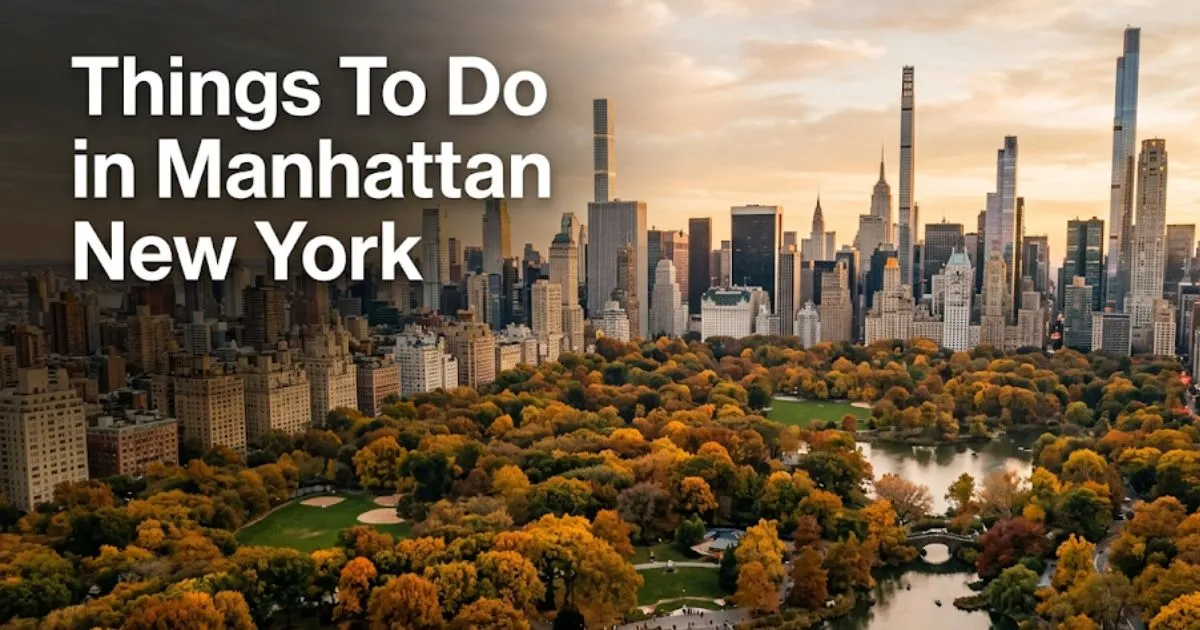
Best Things To Do in Manhattan New York (2026 Guide)

Manhattan rewards visitors who know where to look beyond Midtown. The best things to do in Manhattan New York span 13 miles of neighborhoods, each with a distinct character that no single tourist list captures.
The island receives over 60 million visitors annually, according to NYC Tourism + Conventions. Most of them cluster in a two-mile radius around Times Square and miss the rest entirely.
This guide covers the best Manhattan experiences by neighborhood, traveler profile, and budget. You will find honest crowd assessments, specific local alternatives, and the practical logistics to make a 2-day or 4-day trip actually work.
Things To Do in Manhattan New York: Why This City Rewards the Curious
Manhattan offers more distinct cultural experiences per square mile than almost any other American city. Within a 30-minute subway ride, you can move from a Harlem jazz club to a Tribeca art gallery to a Lower East Side Jewish deli that has been serving pastrami since 1888.
That density is the city’s most underrated quality. Visitors who treat Manhattan as a checklist of landmarks miss the actual texture of the place.
The real Manhattan lives in neighborhoods. The West Village’s quiet brownstone streets feel nothing like Midtown’s concrete and neon. SoHo’s cast-iron architecture district looks nothing like the Financial District’s granite canyon.
NYC Tourism + Conventions identifies over 300 distinct neighborhoods across the five boroughs. Manhattan alone contains more than two dozen that are genuinely worth exploring on their own terms.
Insider Tip:
- The Staten Island Ferry sails from Whitehall Terminal in the Financial District and delivers the best harbor view in the city. It is completely free, runs 24 hours, and passes within a quarter mile of the Statue of Liberty.
- Experienced Manhattan visitors use the ferry as a free alternative to the pricier Liberty Island boat tours for the harbor panorama.
- Solo travelers find the 25-minute crossing one of the most genuinely cinematic free experiences the city offers.
Plan around neighborhoods, not landmark checklists. A morning in the West Village plus an afternoon on the High Line is a more genuinely New York day than a morning at Times Square plus an afternoon at Rockefeller Center.
Best Things To Do in Manhattan: The Non-Negotiable Experiences
The best things to do in Manhattan include the Brooklyn Bridge, the Metropolitan Museum of Art, the High Line, and a walk through Central Park, all of which hold their reputation for specific and earned reasons.
The Brooklyn Bridge crossing from the Manhattan side takes about 20 minutes at a comfortable pace. Start from the entrance on Centre Street near City Hall for the best approach.
Walking toward Brooklyn at sunrise puts the Manhattan skyline behind you, lit by early light, with relatively few other pedestrians. By 10 a.m., the bridge pedestrian path is congested.
The Met on Fifth Avenue at 82nd Street is genuinely one of the great art museums on earth, holding over two million objects across 5,000 years. Suggested admission applies; the pay-what-you-wish policy historically applied to New York State residents.
| Experience | Best For | Cost Range | Time Required | Insider Note |
|---|---|---|---|---|
| Brooklyn Bridge Walk | All profiles | Free | 45 to 90 min | Go before 9 a.m. to avoid crowds |
| Metropolitan Museum of Art | Culture travelers, couples | Suggested admission ~$30 adult | Half day to full day | Thursday evenings are less crowded |
| The High Line | Couples, solo travelers | Free | 1 to 2 hours | Enter at Gansevoort St. for full north route |
| Staten Island Ferry | Budget travelers, families | Free | 50 min round trip | Stand on the right side going toward Staten Island for Statue of Liberty view |
| Central Park | Families, couples | Free to enter | Half day | Bethesda Terrace at midday is photogenic; north end is quieter |
Couples find the Brooklyn Bridge walk at dusk particularly compelling. The view of the lit Manhattan skyline from the midpoint of the bridge is one of the city’s genuinely romantic vantage points.
Families with children should know that the Met’s ground floor Egyptian collection, including the Temple of Dendur in its own glass-walled gallery, holds children’s attention significantly better than the European painting galleries.
The most overrated experience on most Manhattan lists: the Empire State Building observation deck. The view is iconic but the lines are long and it sits within the skyline rather than looking out at it. Top of the Rock at 30 Rockefeller Plaza offers a directly comparable view with the Empire State Building actually visible in the frame. Experienced repeat visitors consistently prefer it.
Cool Things To Do in Manhattan Beyond the Standard List
The coolest Manhattan experiences are often the ones that take you off the standard tourist circuit without requiring insider connections. The Cloisters, at the northern tip of Manhattan in Fort Tryon Park, is a medieval art museum built from actual European monastery architecture, transported stone by stone and reassembled above the Hudson River.
Most first-time visitors never make the 30-minute A train ride to 190th Street. That is exactly why it remains one of the most genuinely transporting experiences in the city.
The Tenement Museum on Orchard Street in the Lower East Side recreates the actual lives of immigrant families who lived in a preserved 1863 tenement building. Tours are ticketed, immersive, and run approximately 75 to 90 minutes.
It tells a more grounded and specific story about New York’s immigrant history than Ellis Island’s broader museum experience. First-time visitors who care about New York’s actual human history should prioritize this over the harbor tour.
The Vessel at Hudson Yards is a 16-story interactive structure of interconnected staircases designed by Thomas Heatherwick. Access has been periodically adjusted; verify current entry requirements before visiting.
Governors Island offers a genuinely different Manhattan experience. Reachable by ferry from Lower Manhattan, it operates seasonally (typically May through October) and contains car-free park space, art installations, and sweeping harbor views. Verify the 2026 season opening dates with the Governors Island Trust before planning.
Insider Tip:
- The Strand Bookstore at 828 Broadway near Union Square carries 18 miles of books on multiple floors. The outdoor rare books cart changes daily. Serious readers routinely spend two hours here without planning to.
- The Strand is a genuinely local institution that most tourist itineraries omit entirely.
- Solo travelers and couples who love books find this a reliable rainy-day option that costs nothing to browse.
Things To Do in Midtown Manhattan: Navigating the Tourist Core Honestly
Midtown Manhattan contains the city’s most iconic sights and its most tourist-saturated experience simultaneously. Times Square is genuinely worth seeing once; it is not a destination to linger in for a full afternoon.
The honest Midtown assessment: Grand Central Terminal is more architecturally significant and less crowded than its tourist reputation suggests. The Main Concourse ceiling, painted with a Mediterranean constellation map and lit by arched windows, is one of the finest interior spaces in the United States.
Arrive early morning when commuters fill the hall in natural light. This is the Grand Central most tourists never see because they arrive at midday.
Carnegie Hall offers guided tours several days a week at a cost significantly lower than concert tickets. The tour covers backstage areas, historic performance spaces, and the Rose Museum.
Rockefeller Center extends well beyond the Top of the Rock. The concourse-level architecture, the Channel Gardens, and the 30 Rock lobby are all accessible without purchasing observation deck tickets.
Midtown practical logistics: Most major Midtown attractions are clustered within a walkable grid between 42nd and 58th Streets, Fifth Avenue to Eighth Avenue. The B, D, F, M subway lines at 47th-50th Streets-Rockefeller Center station put you at the center of this corridor.
Families with children should know that Midtown’s pedestrian density during peak daytime hours (10 a.m. to 4 p.m.) can be genuinely overwhelming for young children. Stroller navigation on Midtown sidewalks during rush periods is difficult.
Budget travelers can experience most of Midtown’s iconic architecture for free. Grand Central Terminal, the Chrysler Building lobby, the Bryant Park grounds, and the exterior of the Flatiron Building cost nothing to visit.
Key Takeaway: Skip Times Square as a full-day destination. Grand Central Terminal, the Top of the Rock, and the Bryant Park area deliver more genuine Midtown character in less time with smaller crowds.
Things To Do in Lower Manhattan: History, Finance, and the Harbor
Lower Manhattan holds more American history per city block than any other district in the country. The 9/11 Memorial and Museum requires advance timed-entry tickets and should be booked well before your visit, particularly for spring and summer travel.
The Memorial pools, set in the footprints of the original Twin Towers, are accessible without museum admission during open hours. The museum requires a separate ticketed entry; budget two to three hours.
Wall Street and the New York Stock Exchange building at Broad Street are best experienced on a weekday morning, when the energy of the Financial District is genuine rather than staged for tourists. The NYSE exterior architecture is worth a deliberate visit.
One World Observatory at One World Trade Center sits on floors 100 to 102 and delivers a 360-degree city view. Advance tickets are recommended; expect to budget approximately $40 to $50 per adult as of recent years, but verify 2026 pricing directly.
The Oculus, Santiago Calatrava’s white ribbed transit hub adjacent to the World Trade Center, is free to enter and architecturally significant. The interior is among the most photographed public spaces in the city. It is also a functioning PATH train station, which makes it useful for travelers arriving from New Jersey.
Solo travelers find Lower Manhattan’s daytime energy excellent for independent exploration. The neighborhood is walkable, the streets follow a tighter pre-grid pattern than Midtown, and the historic layers are dense enough to reward deliberate slow walking.
Seniors and accessibility travelers: The 9/11 Memorial is ADA-accessible. The museum has elevator access throughout. Verify current specific accessibility details with the 9/11 Memorial and Museum directly before visiting.
The Staten Island Ferry departs from the Whitehall Ferry Terminal at the foot of Whitehall Street, three blocks from the Bowling Green subway station. It remains the single best free harbor view available anywhere in New York. No admission, no reservation, no waiting beyond the ferry schedule.
Things To Do in Upper Manhattan: Harlem, Washington Heights, and Inwood
Upper Manhattan above 110th Street is where most first-time visitors never go and where experienced Manhattan travelers routinely spend their most memorable hours. Harlem contains the Apollo Theater at 253 West 125th Street, active since 1934, with a legacy that includes Ella Fitzgerald, James Brown, and Stevie Wonder.
Amateur Night at the Apollo has run for decades and typically operates on Wednesday evenings. Ticket prices and schedules vary; verify 2026 programming directly with the Apollo Theater.
Marcus Samuelsson’s Red Rooster on Lenox Avenue in Harlem is the most visible restaurant in the neighborhood, but local food intelligence points to Melba’s on West 114th Street for fried chicken and waffles with a more neighborhood atmosphere.
The Schomburg Center for Research in Black Culture on Malcolm X Boulevard is a Smithsonian affiliate and one of the most significant African diaspora cultural archives in the world. Entry is free and the exhibitions rotate regularly.
Fort Tryon Park in Washington Heights contains The Cloisters, managed by the Metropolitan Museum of Art. The park itself, designed by Frederick Law Olmsted Jr., offers Hudson River panoramas that rival anything in Central Park. The combined Cloisters and park visit requires a half to full day and rewards a deliberate, unhurried pace.
Washington Heights has a deeply Dominican cultural identity centered on 181st Street, where food, music, and community life coexist with genuine local flavor. The J Hood Wright Park on Fort Washington Avenue overlooks the George Washington Bridge and is largely visitor-free.
Families with older children (ages 10 and up) who have an interest in American history and music will find Harlem significantly more engaging than a second lap through Midtown. The combination of Apollo Theater history and the neighborhood’s cultural legacy is specific and substantial.
Central Park Activities: What to Actually Do in 843 Acres
Central Park’s best activities depend entirely on which part of the park you use. The southern end around Sheep Meadow and Bethesda Terrace is the most visited and the most photogenic. The northern section above 96th Street is where New Yorkers actually go to run, picnic, and be left alone.
Bethesda Terrace and Fountain at the 72nd Street transverse is the architectural heart of the park. The terrace arcade ceiling tiles are among the finest examples of encaustic tile work in the United States. Most visitors walk through without looking up.
The Central Park Conservancy offers free guided walking tours on select dates throughout the warmer months. These are staffed by trained guides and provide architectural and horticultural context that self-guided visits miss entirely.
The Ramble, north of the 72nd Street transverse, is a 36-acre woodland area that functions as one of the most productive urban birdwatching sites in North America. During spring migration (late April through May), serious birders count hundreds of species in a single morning.
Tavern on the Green, adjacent to the West 66th Street entrance, is historically significant and consistently tourist-oriented. The Loeb Boathouse on the East Side of the park rents rowboats and has a sit-down restaurant with genuine lake views. The boathouse line is long on weekends. Arrive before 11 a.m.
| Central Park Area | Best For | What’s There | Crowd Level |
|---|---|---|---|
| Sheep Meadow (62nd to 69th St) | Picnics, sunbathing | Open lawn, skyline views | Very high in summer |
| Bethesda Terrace (72nd St) | Photography, architecture | Fountain, arcade, lake views | High year-round |
| The Ramble (73rd to 79th St) | Birding, quiet walking | Woodland paths, Gill stream | Low to moderate |
| North Woods (above 96th St) | Running, local atmosphere | Streams, waterfalls, no crowds | Low |
| Conservatory Garden (105th St) | Couples, spring blooms | Formal garden, lily pond | Low to moderate |
Couples should target the Conservatory Garden at 105th Street on the East Side. This formal garden is one of the most genuinely quiet and beautiful spaces in Manhattan. Almost no tourists visit it. It requires no admission.
Key Takeaway: Enter Central Park north of 96th Street for the experience New Yorkers actually have. The Conservatory Garden at 105th Street is the most underused beautiful space in Manhattan.
Free Things To Do in Manhattan: Genuine No-Cost Experiences
Manhattan’s free offerings are among the strongest of any major American city. The Staten Island Ferry, the High Line, Washington Square Park, the ground-level experience of Grand Central Terminal, and the Brooklyn Bridge walk all cost nothing.
The Metropolitan Museum of Art applies a pay-what-you-wish policy for New York State residents and full suggested admission for others. The museum’s fifth-floor rooftop garden is free to access during warmer months and delivers direct Central Park views with a changing contemporary art installation.
Several of Manhattan’s best museums offer free or reduced admission on specific days or evenings:
- MoMA: Free for members; general admission runs approximately $25 to $30 per adult (verify 2026 pricing)
- The Whitney Museum of American Art: Free on Friday evenings in a set time window; verify 2026 schedule
- The Frick Collection: Has historically offered free or reduced admission for young visitors; currently in a recently renovated building; verify current 2026 policy
- Museum of Arts and Design at Columbus Circle: Pay-what-you-wish on Thursday evenings (verify 2026 policy)
- The Schomburg Center for Research in Black Culture: Free admission
- National Museum of the American Indian at Bowling Green: Free admission (part of the Smithsonian Institution)
Budget travelers should note that the free experiences in Manhattan are not consolation prizes. The Staten Island Ferry harbor view, a sunset walk on the High Line, an afternoon in Central Park, and an evening in Washington Square Park watching street performers constitute a genuinely rich day at zero cost.
Families with children will find the American Museum of Natural History on Central Park West one of the best museum investments in the city. The dinosaur halls alone hold children’s attention for hours. Admission is pay-what-you-wish for New York State residents; verify 2026 out-of-state admission pricing directly with the museum.
Manhattan Museums: The Honest Assessment of What Is Worth Your Time
Manhattan’s museum density along Museum Mile on Fifth Avenue is unmatched in the Western Hemisphere. The Metropolitan Museum of Art, the Guggenheim, the Cooper Hewitt, the Neue Galerie, the Jewish Museum, and the Museum of the City of New York all sit within a mile of each other on the Upper East Side.
The honest ranking for first-time visitors: The Met is genuinely irreplaceable. Plan a minimum of three hours and accept you will see perhaps 10% of the collection. The Guggenheim’s Frank Lloyd Wright spiral building is an architectural experience independent of whatever exhibition is currently running.
The Museum of Modern Art (MoMA) in Midtown on 53rd Street is essential for modern and contemporary art. Its permanent collection includes works that defined 20th century art history, including Van Gogh’s “The Starry Night” and Picasso’s “Les Demoiselles d’Avignon.”
The most underrated museum in Manhattan: the Tenement Museum on Orchard Street. It operates through guided tour only, covers a specific and deeply human slice of American immigration history, and leaves most visitors more moved than any blockbuster museum experience. Tickets typically need to be booked days to weeks in advance.
According to NYC Tourism + Conventions, the New York CityPASS and New York Pass offer bundled admission to multiple top attractions at a discount versus individual ticket pricing. For visitors planning to visit four or more paid museums, these passes merit a direct cost comparison before purchasing.
Seniors and accessibility travelers: The Met has elevator access and wheelchairs available at the entrance. MoMA has full accessibility throughout its recently renovated building. The Guggenheim’s spiral ramp is fully accessible by elevator. Verify current specific accessibility details with each museum directly.
Best Restaurants in Manhattan: Where to Actually Eat
Manhattan’s restaurant scene is defined by its neighborhood identities more than any single cuisine. Katz’s Delicatessen on East Houston Street in the Lower East Side has been serving pastrami on rye since 1888. The lines are long, the ordering system is chaotic, and the pastrami sandwich justifies both.
The local alternative to Katz’s for the deli experience: 2nd Ave Deli on East 33rd Street in Murray Hill, which locals argue makes an equally serious pastrami with substantially shorter waits.
Via Carota on Carmine Street in the West Village consistently earns the respect of serious food writers for its Italian cooking that does not perform for tourists. The wait without a reservation can run 45 minutes to over an hour at prime dinner time.
Carbone on Thompson Street in Greenwich Village serves Italian-American food in a 1960s red-sauce supper club atmosphere. It is expensive, reservation-only well in advance, and the experience is theatrical as much as culinary. It is worth knowing about. It is not where most Manhattan visitors should base their food decisions.
For a more representative cross-section of Manhattan dining:
- Joe’s Pizza on Carmine Street: $3 to $5 slice, the benchmark New York street pizza
- Balthazar on Spring Street in SoHo: French brasserie, excellent brunch, reservations recommended
- Eataly Flatiron at 200 Fifth Avenue: Italian food market with multiple dining counters, no single reservation needed, good for groups
- Chelsea Market at 75 Ninth Avenue: Multi-vendor indoor market near the High Line with genuine quality variety
- Levain Bakery on West 74th Street on the Upper West Side: The cookies are worth the line
Budget travelers should know that Manhattan’s best affordable meals are often its most culturally specific: a falafel from Mamoun’s on MacDougal Street, a bowl from any of the Chinatown noodle houses on Mott Street, or a slice from Joe’s Pizza are among the most satisfying food experiences the city offers.
Key Takeaway: Eat at Joe’s Pizza on Carmine Street before any other Manhattan meal. It costs under $5 and tells you more about what New York actually tastes like than any reservation-required restaurant.
Manhattan Nightlife: Where the City Actually Goes After Dark
Manhattan’s nightlife is stratified clearly between tourist-facing and local-facing experiences. Times Square’s theater district closes at 11 p.m. on most weeknights. The actual New York night begins significantly later in other neighborhoods.
The Village Vanguard on Seventh Avenue South in the West Village has been running jazz continuously since 1935. It has hosted Miles Davis, John Coltrane, Bill Evans, and virtually every significant name in American jazz. Sets run approximately 80 minutes. Tickets sell in advance; reserve before arriving in New York.
The Blue Note Jazz Club on West 3rd Street in Greenwich Village is more tourist-accessible and more expensive than the Vanguard. The music quality is high. The atmosphere is more polished and less historically weighted.
For a more local bar experience: McSorley’s Old Ale House on East 7th Street in the East Village has operated since 1854 and serves two varieties of its own ale, light or dark. It is exactly what it appears to be, and it makes no concessions to contemporary bar trends.
Rooftop bars in Manhattan are worth one visit for the view and typically overpriced for every subsequent visit. The 230 Fifth Rooftop Bar in the Flatiron District delivers a direct Empire State Building view and honest midrange pricing relative to comparable spaces.
Solo travelers find Manhattan’s bar culture genuinely accommodating of solo visitors. The East Village has the highest concentration of bars where showing up alone is completely normal. The stretch of Avenue A from 6th to 10th Streets contains a range of bars covering dive, craft beer, and cocktail categories.
Couples seeking a specifically romantic evening should consider a pre-theater dinner in the West Village followed by a Village Vanguard jazz set. This combination is among the most genuinely New York evenings available.
Romantic Things To Do in Manhattan: Specific Recommendations for Couples
Manhattan’s most romantic experiences are almost entirely found outside Midtown. The West Village neighborhood, centered on Bedford Street and Commerce Street, has the brownstone architecture, intimate wine bars, and quiet side streets that couples consistently identify as the most evocative part of the city.
One if by Land, Two if by Sea on Barrow Street is one of Manhattan’s most persistently romantic restaurants, set in Aaron Burr’s former carriage house. Reservations are essential. It is expensive. The setting earns it.
A Sunday morning walk across the Brooklyn Bridge at 7 a.m., followed by breakfast in Brooklyn Heights at the Vineapple Café on Henry Street, is one of the genuinely unhurried couple experiences Manhattan rewards.
The Metropolitan Museum’s rooftop garden in late spring delivers cocktails, city views, and an art installation in a setting that is difficult to replicate anywhere else in the world. It operates seasonally; verify the 2026 opening schedule with the Met directly.
The Conservatory Garden in Central Park at 105th Street is free, almost never crowded, and contains a lily pond and formal European-style gardens. It photographs beautifully in May when the tulips bloom.
The Circle Line harbor cruise covers the full perimeter of Manhattan by water, taking approximately two to three hours. It is reliably romantic at sunset. Reserve in advance for the sunset departure.
Insider Tip:
- Book the Village Vanguard at least two weeks out for Friday and Saturday sets.
- The walk from the Gansevoort Street entrance of the High Line to 34th Street at dusk takes about 45 minutes and passes through some of Manhattan’s most architecturally layered urban scenery.
- Couples who prefer a meal outside Midtown will find the West Village and Tribeca restaurant scenes more intimate and less frenetic than Midtown equivalents.
Things To Do in Manhattan With Kids: Honest Age-by-Age Guidance
Manhattan with children works best when itineraries are built around neighborhood energy rather than attraction-to-attraction transfers across the entire island. Young children (under age 8) handle the American Museum of Natural History, the Central Park Carousel, the Central Park Zoo, and the High Line better than major museums with primarily adult-oriented collections.
The American Museum of Natural History on Central Park West is the most consistently child-engaging institution in Manhattan. The dinosaur halls, the blue whale in the Hall of Ocean Life, and the Hayden Planetarium (separate ticketed show) hold children’s attention in ways that keep the visit functional. Budget three to four hours.
Central Park’s Tisch Children’s Zoo near the East 65th Street entrance features farm animals and a small petting area. It is genuinely modest in scale. Children under six find it satisfying. Older children typically move through it in under 30 minutes.
The New York Transit Museum is technically in Brooklyn (at Burrard and Schermerhorn Streets in Brooklyn Heights), but the satellite gallery inside Grand Central Terminal provides a smaller version of the experience, including vintage subway cars that children can board. Children who love trains find this specifically excellent.
Older children and teenagers (ages 10 and up) respond well to the 9/11 Memorial, the Intrepid Sea, Air and Space Museum on the Hudson River at Pier 86, and the Brooklyn Bridge walk. The Intrepid holds a decommissioned aircraft carrier, a Concorde prototype, and the Space Shuttle Enterprise.
Families with strollers should know that the older sections of the MTA subway system present genuine accessibility challenges. Many stations lack elevators, and the gaps between train and platform can be significant. The MTA provides an accessible route planner at mta.info. Verify elevator status before traveling; outages occur frequently.
The Brooklyn Children’s Museum in Crown Heights, Brooklyn, is worth noting for families making a day trip across the East River and specifically designed for children under 10.
Key Takeaway: Build family days around the American Museum of Natural History plus Central Park as one combined half-day. The proximity makes it the most logistically practical family pairing in Manhattan.
Things To Do in Manhattan This Weekend: A 2-Day Framework
A 2-day Manhattan weekend works best when organized by geography rather than theme. Grouping activities by neighborhood eliminates the transit time that makes Manhattan feel exhausting to first-time visitors.
Day 1: Lower Manhattan to the West Village
- Start at 8 a.m. at the 9/11 Memorial pools before crowds arrive. Spend 45 minutes.
- Walk five minutes to the Oculus for coffee from any of the concourse vendors and a look at Calatrava’s architecture.
- Take the Staten Island Ferry from Whitehall Terminal at 9:30 a.m. for the harbor view. Return trip included. Total time: 50 minutes.
- Walk or subway to the High Line. Enter at the Gansevoort Street entrance. Walk north to 34th Street. Allow 90 minutes.
- Lunch at Chelsea Market at 75 Ninth Avenue. Multiple vendor options. Budget under $20 per person.
- Subway or walk south to the West Village. Explore Bedford Street, Commerce Street, and Bleecker Street. Allow 90 minutes.
- Dinner at Via Carota on Carmine Street. Arrive at 5:30 p.m. to beat the wait. No reservations taken.
- Evening jazz at Village Vanguard (pre-booked). First set typically at 8 or 9 p.m.
Day 2: Upper East Side to Central Park
- Start at 9 a.m. at the Metropolitan Museum of Art. Focus on two collections. Allow three hours.
- Exit on the Fifth Avenue side and walk south along Museum Mile to the Guggenheim at 88th Street. Allow 90 minutes.
- Enter Central Park at the Conservatory Garden at 105th Street if traveling as a couple. Or enter at 72nd Street for the Bethesda Terrace if traveling with children.
- Walk south through the park to the Loeb Boathouse for a late lunch.
- Exit the park at 72nd Street on the West Side. Walk south on Columbus Avenue through the Upper West Side.
- Subway south to Katz’s Delicatessen on East Houston Street for a late afternoon snack or early dinner.
- Evening in the East Village along Avenue A for bars suited to your preference.
How To Get Around Manhattan: Transit, Biking, and Walking
Getting around Manhattan requires almost no car use and significant reliance on the MTA subway, street-level walking, and situational use of Citi Bike or the NYC Ferry.
The MTA subway covers all of Manhattan and connects to all four outer boroughs. Pay using the OMNY contactless system by tapping your credit card, debit card, or phone directly at the turnstile. A MetroCard remains an option but OMNY is simpler for visitors.
Single-ride fares run approximately $2.90 as of recent years; verify 2026 pricing with the Metropolitan Transportation Authority directly. An unlimited 7-day MetroCard or OMNY weekly cap typically provides the best value for visitors staying four or more days.
Citi Bike dock-based bicycle share covers Manhattan, Brooklyn, Queens, and parts of the Bronx. Day passes and single-ride options are available. The High Line to Central Park corridor is the most pleasant and practical cycling route for visitors.
Walking is often faster than the subway for distances under 20 blocks in Midtown, where station spacing is frequent but platform transfers and waits can add significant time. Manhattan’s street grid makes navigation straightforward: avenues run north-south, streets run east-west, and numbers increase heading north and west.
Seniors and accessibility travelers: The MTA’s elevator coverage is improving but remains inconsistent. Many older station complexes lack elevators. Use the MTA’s Accessibility Trip Planner before building your day’s route. NYC Ferry is fully accessible and an excellent option for travelers who find subway stairs challenging.
Taxis and rideshare (Uber and Lyft) are reliable throughout Manhattan but peak-time surge pricing during rush hour and after major events can be substantially higher than subway fares. For airport transfers, the AirTrain JFK to subway combination typically runs $2.90 plus the AirTrain fare (verify current rates). A taxi or rideshare from JFK to Midtown Manhattan typically runs $55 to $80 or more depending on traffic.
Manhattan Travel Tips for First-Timers: What Most Visitors Get Wrong
The single most common mistake first-time Manhattan visitors make is spending their first two days entirely in Midtown. Times Square, the Empire State Building, and Fifth Avenue shopping constitute the Manhattan that the tourism industry promotes. They are not the Manhattan that makes the city genuinely extraordinary.
The most practical first-timer corrections:
- Book timed-entry for the 9/11 Memorial Museum, Top of the Rock, and the Empire State Building before you arrive. Walk-up lines at peak periods can exceed two hours.
- The subway is faster than a taxi for almost every Midtown daytime trip. Use it without hesitation.
- Do not eat within three blocks of Times Square. The restaurant quality in that corridor is uniformly oriented toward tourist throughput, not food quality.
- One World Observatory, the Empire State Building, and Top of the Rock are all legitimately impressive views. Visiting all three is redundant. Pick one, ideally Top of the Rock for the Empire State Building in the frame.
- Central Park is not a single experience. Know which part of the park you are going to before you enter.
- Tipping culture in Manhattan is firmly established. Budget 20% on all restaurant meals and 15% on taxi and rideshare fares as a baseline.
According to the NYC Department of Consumer and Worker Protection, ticket scalping and unofficial tour sales are illegal in New York. Purchase attraction tickets directly from official venue websites or the venue box office.
Seniors and accessibility travelers should note that Manhattan’s older sidewalks and street crossings are generally maintained, but construction-related sidewalk narrowing is common in Midtown and can affect wheelchair and mobility aid navigation. The MTA’s elevator outage tracker is worth checking the morning of any subway-dependent itinerary.
Budget travelers can complete a genuinely full Manhattan experience for under $75 per person per day by prioritizing free attractions, pay-what-you-wish museums, Joe’s Pizza and Chinatown noodle houses, and the subway over taxis.
Safety and Practical Warnings for Manhattan
Manhattan is one of the safest large American cities for visitors, with crime rates that have declined substantially over the past three decades. That context does not eliminate specific, practical concerns that first-time visitors should know.
Key safety and practical facts every visitor should know:
- Pickpocket risk is real in Times Square, on crowded subway platforms at major transfer stations (Times Square-42nd Street, Union Square, Grand Central-42nd Street), and on the Brooklyn Bridge pedestrian path during peak hours. Keep bags in front of your body and phones out of back pockets.
- Subway platform heat in summer (July through August) can be severe, particularly on platforms below grade. Heat-related illness risk is real for seniors, young children, and anyone with cardiovascular conditions. Carry water. Platform waits of 10 to 20 minutes in 95°F heat are not uncommon.
- Cell service is inconsistent on underground subway platforms and in some tunnel sections. Download offline subway maps before traveling. The MTA app works reliably above ground.
- Do not hail unmarked cars or respond to unsolicited transportation offers at JFK, LGA, or Penn Station. Use official yellow taxis, Uber/Lyft, or the AirTrain connection.
- Emergency services: Manhattan is fully covered by NYC Emergency Services. Dial 911 for all emergencies. The non-emergency police line is 311.
- Extreme weather: Winter storms can disrupt MTA service. Check MTA alerts the morning of any planned travel between December and February. Summer thunderstorms move quickly; most outdoor attractions including Central Park remain open but exposed.
Frequently Asked Questions About Things To Do in Manhattan New York
What are the best things to do in Manhattan for first-time visitors?
The best things to do in Manhattan for first-time visitors include the Brooklyn Bridge walk, Central Park, the Metropolitan Museum of Art, the High Line, and a free Staten Island Ferry crossing for harbor views.
Prioritize at least one experience outside Midtown, specifically a neighborhood walk in the West Village or Lower East Side, to see the side of Manhattan that tourist itineraries typically skip.
Book timed-entry tickets for the 9/11 Memorial Museum and any observation deck before arriving to avoid multi-hour walk-up lines during peak season.
How many days do you need to see Manhattan properly?
Three to four days gives most visitors a realistic introduction to Manhattan’s main neighborhoods and top attractions without feeling rushed.
Two days is workable if the itinerary is geographically organized, but you will need to make deliberate choices about which neighborhoods and experiences to prioritize.
Attempting to see all of Manhattan in one day produces a disjointed experience; most first-timers who try this spend the day in Midtown and miss the neighborhoods that define the city’s actual character.
What is free to do in Manhattan New York?
Free things to do in Manhattan include the Staten Island Ferry harbor crossing, the High Line park, the Brooklyn Bridge walk, Central Park, Washington Square Park, the National Museum of the American Indian at Bowling Green, the Schomburg Center for Research in Black Culture in Harlem, and the Grand Central Terminal main concourse.
Several major museums offer free or pay-what-you-wish evenings or specific admission windows; check individual museum websites for 2026 policies before visiting.
The ground-level architectural experience of Rockefeller Center, the Oculus, and the New York Public Library main branch on Fifth Avenue are all free to access.
What is the best neighborhood to stay in for Manhattan sightseeing?
The best neighborhoods to stay in for Manhattan sightseeing balance proximity to major attractions with reasonable hotel pricing, which points to the Upper West Side, Chelsea, or the Flatiron District.
Midtown hotels offer immediate convenience to Times Square, the Empire State Building, and Fifth Avenue, but they carry the highest nightly rates in the city and place you in the most tourist-saturated part of Manhattan.
The Upper West Side puts you one block from Central Park and a few subway stops from Museum Mile, with a more residential and less frenetic street energy than Midtown.
Is Manhattan safe for solo travelers?
Manhattan is generally safe for solo travelers, with the same practical street-awareness considerations that apply in any large American urban center.
Solo travelers should use standard precautions on late-night subway platforms, avoid displaying expensive electronics in crowded tourist areas, and stick to well-lit and populated streets in unfamiliar neighborhoods after midnight.
The East Village, West Village, and Upper West Side are all areas where solo travelers, including solo women travelers, report comfortable and navigable experiences during both daytime and evening hours.
What is the best time of year to visit Manhattan New York?
The best time to visit Manhattan is late September through early November or late April through early June, when temperatures are comfortable, hotel rates are moderate, and outdoor spaces including Central Park are at their most appealing.
July and August bring peak crowds, high hotel prices, and genuine heat and humidity that make prolonged outdoor sightseeing physically demanding, particularly for families with young children and senior travelers.
December can be magical for the holiday displays at Rockefeller Center and Bryant Park’s Winter Village, but hotel prices spike around Christmas and New Year’s, and outdoor activity is limited by cold temperatures.
Plan Your Manhattan Trip With Confidence
Manhattan’s best experiences in 2026 reward travelers who organize by neighborhood rather than by landmark checklist. Book timed-entry tickets for the 9/11 Memorial Museum, Top of the Rock, and any Broadway shows before you arrive. These sell out, and walk-up waits in peak season are genuinely long.
Start your first full day in Lower Manhattan and the West Village. Save Midtown for your second day, when you know how the subway system works and have a feel for the city’s rhythms.
Verify all pricing, hours, timed-entry requirements, and seasonal access directly with individual venues and the MTA before departure. Travel conditions, admission policies, and transit service change regularly and this guide reflects conditions as researched. The traveler who arrives with one confirmed restaurant reservation, pre-purchased observation deck tickets, and a neighborhood-organized day plan will have a significantly better Manhattan experience than the one who wings it.