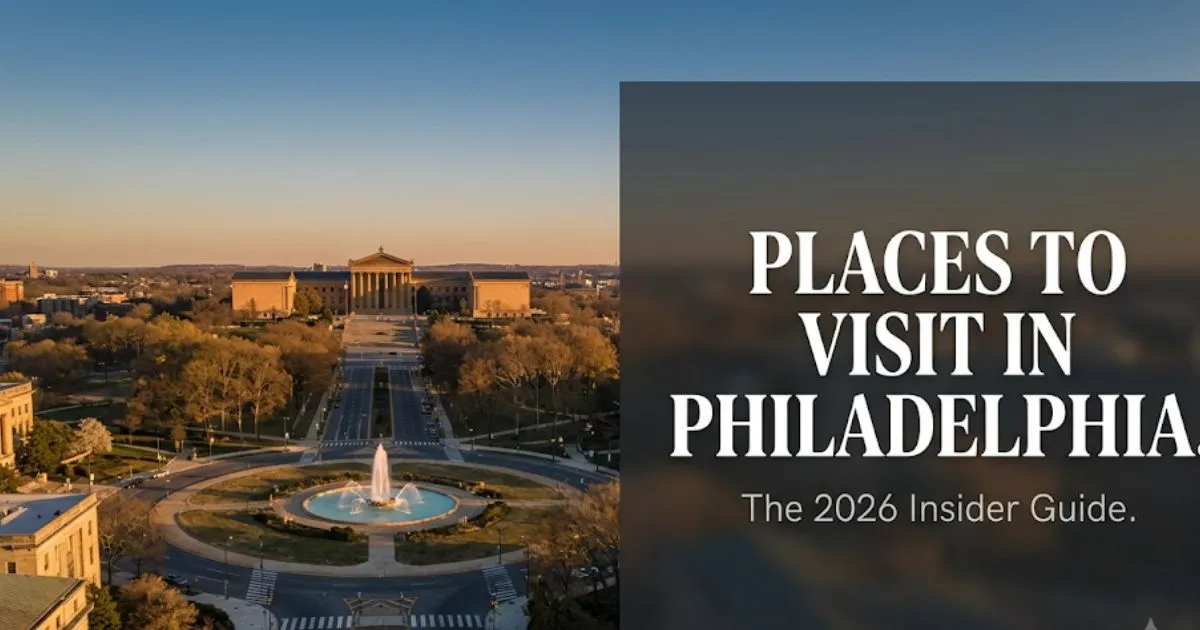
Best Places to Visit in Philadelphia: The 2026 Guide

Philadelphia delivers more per city block than almost any American destination its size. The places to visit in Philadelphia range from genuine colonial landmarks to a food market that changes how you think about lunch forever.
The city’s 1.5 million murals, world-ranked art museums, and a food culture that runs from Pat’s King of Steaks to James Beard-recognized Fishtown restaurants make it one of the most layered destinations on the East Coast.
This guide covers every major attraction, every essential neighborhood, and the practical logistics first-timers and repeat visitors both need. You will leave with a working itinerary, honest crowd assessments, and a clear picture of where the tourist circuit ends and the real city begins.
Places to Visit in Philadelphia: What Makes the City Worth Your Time
Philadelphia is the most underestimated major American city on the East Coast, and that reputation gap works entirely in your favor.
Visit Philadelphia, the city’s official tourism organization, notes that Philadelphia contains more public art, more colonial-era landmarks, and more miles of walkable waterfront than most American visitors realize. It sits in a genuinely walkable geography. Center City, Old City, the Benjamin Franklin Parkway museum corridor, and South Street are all within reasonable walking distance of each other or a single SEPTA train stop.
Philadelphia is also honest in a way that tourist-polished cities often are not. It has rough neighborhoods alongside elegant ones. It has overrated tourist traps alongside genuinely extraordinary experiences. Knowing the difference is the entire purpose of this guide.
Insider Tip:
- Book timed-entry passes for Independence Hall at least two weeks in advance from May through September. Walk-up passes run out by 10 a.m. on summer weekdays.
- The Philadelphia Museum of Art is free on the first Sunday of each month. Time your visit accordingly.
- Avoid renting a car within the city. SEPTA’s Market-Frankford Line and Broad Street Line cover the vast majority of tourist destinations.
| Traveler Type | Philadelphia Strength | One Honest Limitation |
|---|---|---|
| History enthusiasts | Independence National Historical Park, Elfreth’s Alley | Historic district feels saturated on summer weekends |
| Art lovers | Philadelphia Museum of Art, Barnes Foundation | Barnes requires advance ticket booking |
| Food travelers | Reading Terminal Market, 9th Street Italian Market | Best BYOB Fishtown spots require planning |
| Families | Franklin Institute, Philadelphia Zoo | Franklin Institute crowded on school weekday mornings |
| Budget travelers | Fairmount Park, murals, Rittenhouse Square | Museum admissions add up without planning |
| Seniors | Kelly Drive, Rodin Museum | Old City cobblestones are a genuine accessibility challenge |
Beautiful Places to Visit in Philadelphia
The most visually striking places to visit in Philadelphia are not all on Independence Mall. Benjamin Franklin Parkway from Logan Circle to the museum steps rivals any European boulevard for raw architectural presence.
Boathouse Row along the Schuylkill River is one of Philadelphia’s most underappreciated sights. The Victorian boathouses are outlined in thousands of lights after dark, a view best taken from the opposite riverbank near the Ellen Phillips Samuel Memorial on Kelly Drive.
Elfreth’s Alley in Old City claims to be the nation’s oldest continuously inhabited residential street, dating to 1702. The narrow cobblestone lane lined with 18th-century row houses is genuinely remarkable, though the beauty is best experienced early morning before tour groups arrive.
The Barnes Foundation’s exterior and the adjacent Rodin Museum on the Parkway both reward slow walking. Rodin’s “The Thinker” sits outside the Rodin Museum in a formal garden, viewable without purchasing admission.
Couples and romantic travelers will find the Parkway at golden hour, with the Philadelphia Museum of Art as backdrop, genuinely worth slowing down for. This stretch between 4:00 p.m. and 6:00 p.m. on a clear day rivals any photogenic city moment in the country.
| Location | Best For | Best Time of Day | Free to View? |
|---|---|---|---|
| Boathouse Row (lit) | Couples, photographers | After sunset | Yes, from Kelly Drive |
| Elfreth’s Alley | History visitors | Early morning | Exterior free; museum fee |
| Benjamin Franklin Parkway | All profiles | Late afternoon | Yes |
| Rodin Museum garden | Art lovers, couples | Any | Garden viewable free |
| Magic Gardens exterior | All profiles | Afternoon | Mosaic walls visible free from street |
Philadelphia Historic Sites and Old City
The best place to start any Philadelphia visit is Independence National Historical Park, which the National Park Service administers across multiple sites in a walkable Old City cluster.
Independence Hall, where both the Declaration of Independence and the U.S. Constitution were debated and signed, is the park’s centerpiece. Timed-entry ranger-led tours are free but require advance reservation through the National Park Service, especially from May through Labor Day. Walk-up passes disappear by midmorning on summer weekdays.
The Liberty Bell Center is adjacent and free to enter. The line moves quickly during weekday mornings. On summer weekend afternoons, expect 30 to 45 minutes of wait time.
Elfreth’s Alley, two blocks north, is free to walk and genuinely one of the most atmospheric colonial streetscapes in America. The Elfreth’s Alley Museum at No. 124 and 126 charges a small admission for interior access; verify current hours before visiting.
Seniors and accessibility travelers should know that most of Old City’s cobblestone streets are uneven and uncushioned. The National Park Service visitor center at 520 Chestnut Street has accessible routes and staff who can advise on the most mobility-friendly path through the historic sites.
Insider Tip:
- The best angle on Independence Hall is from Chestnut Street looking north through the courtyard. Most visitors photograph from the south lawn, which faces the wrong direction for morning light.
- Congress Hall and Old City Hall, flanking Independence Hall, are often empty of crowds and equally historic. Most visitors walk past them.
- The Betsy Ross House on Arch Street requires a small admission fee. The neighborhood context and the building’s 18th-century footprint are more interesting than the interior tour for most adults.
Philadelphia Neighborhoods to Explore
Philadelphia’s neighborhoods are where the city’s actual identity lives, and most first-timers never leave Old City to find them.
Rittenhouse Square is the city’s most elegant neighborhood: a Georgian park surrounded by independent restaurants, upmarket shops, and some of Philadelphia’s finest 19th-century residential architecture. Saturday mornings bring a high-quality farmers market to the square’s edge.
South Street runs as a commercial and entertainment corridor east of Broad Street, mixing record shops, vintage clothing, independent restaurants, and Isaiah Zagar’s Magic Gardens mosaic environment at 1020 South Street. It trends younger and louder west of 6th Street.
Manayunk, along the Schuylkill River northwest of Center City, offers Main Street dining and independent boutiques in a converted industrial setting. It is less visited by tourists, more used by locals on weekends. The Manayunk Canal towpath runs alongside the river for walking and cycling.
Budget travelers should note that Rittenhouse Square itself, the Reading Terminal Market, and the Italian Market on 9th Street all offer extended browsing and eating at very low cost per hour of genuine Philadelphia experience.
Couples will find Rittenhouse Square for a morning coffee-and-walk combination followed by lunch at Parc on 18th Street, one of the city’s best French bistros, an excellent half-day Philadelphia experience without a single museum ticket.
Fishtown Philadelphia
Fishtown is the neighborhood that best represents Philadelphia’s current identity, not its historical one.
Located along the Delaware River waterfront north of Old City, Fishtown has evolved over the past decade into the city’s densest concentration of independent restaurants, craft cocktail bars, live music venues, and art galleries. Frankford Avenue is the corridor to walk: a strip from Girard Avenue south to Fishtown Avenue that contains Suraya (a Lebanese-inspired restaurant in a converted warehouse), Wm. Mulherin’s Sons (a hotel and restaurant in a historic whiskey blending building), and Martha (a neighborhood bar with an outrageously good pizza program).
La Colombe Coffee Roasters on Frankford Avenue is a Philadelphia institution. The original Fishtown location is the brand’s flagship and significantly better than any of its urban outpost locations.
Solo travelers will find Fishtown the most socially comfortable Philadelphia neighborhood for dining alone. The bar-seat culture at spots like Johnny Brenda’s (live music, full food menu, easy to arrive solo) and Harp & Crown makes solo evenings genuinely enjoyable rather than awkward.
Fishtown gets busy on Friday and Saturday evenings from about 7 p.m. onward. For couples, a Tuesday or Wednesday dinner reservation at Suraya or Wm. Mulherin’s Sons provides the full experience without weekend noise levels.
Insider Tip:
- Many of Fishtown’s best restaurants operate as BYOB establishments. Pennsylvania’s BYOB culture means you can bring a quality bottle of wine and eliminate a significant portion of the bill. Check each restaurant’s current BYOB policy before visiting.
- The Fishtown Murals walking route begins on Frankford Avenue near Girard. Pick up a free map from any local shop or access the Mural Arts Philadelphia app for guided stops.
Key Takeaway: Book Independence Hall timed-entry tickets at least two weeks out in summer. Skip the Liberty Bell weekend afternoon line by arriving before 10 a.m. Fishtown’s Frankford Avenue corridor is the single best half-day addition to any Philadelphia first-timer’s itinerary.
Philadelphia Museum of Art and Barnes Foundation
The Philadelphia Museum of Art is one of the top five art museums in North America by collection size and quality, a fact that most casual visitors do not fully register until they are inside.
The museum’s permanent collection spans European paintings from the 12th through 20th centuries, an exceptional South Asian art wing, and American decorative arts rooms that are among the finest assembled anywhere. The Impressionist collection alone justifies a three-hour visit.
The famous Rocky Steps, the museum’s 99 granite steps leading to the main entrance on the Benjamin Franklin Parkway, attract visitors who run them and raise their fists for photographs. The photo op queue on weekend mornings can be 20 to 30 minutes long. Locals and experienced repeat visitors use the museum’s side entrances to skip it entirely.
The Barnes Foundation, four blocks east on the Parkway, houses one of the world’s greatest private art collections: 181 Renoirs, 69 Cézannes, and 59 Matisses assembled by Albert C. Barnes in a collection that does not follow conventional art-historical categories. Admission requires advance booking; walk-up availability is unreliable on weekends.
Art-focused travelers should budget a full day for the Parkway museum corridor: the Philadelphia Museum of Art in the morning, the Rodin Museum’s garden at lunch (free exterior, small admission for interior), and the Barnes Foundation in the afternoon.
Seniors and accessibility travelers should know the Philadelphia Museum of Art has elevator access throughout. The Barnes Foundation is fully accessible. Both have on-site cafes that work well as rest stops.
| Museum | Admission (approximate) | Advance Booking Required? | Best For | Time Needed |
|---|---|---|---|---|
| Philadelphia Museum of Art | $20–$30 adults; first Sunday free | No, but weekends are busier | All profiles | 2–4 hours |
| Barnes Foundation | $25–$35 adults | Yes, strongly recommended | Art enthusiasts | 2–3 hours |
| Rodin Museum | $10–$15 adults; garden free | No | Couples, art lovers | 45–90 minutes |
| Penn Museum | $15–$20 adults | No | History buffs, families | 2–3 hours |
Verify all current admission prices directly with each museum before visiting.
Reading Terminal Market and Philadelphia Food Scene
Reading Terminal Market is the single most essential food stop in Philadelphia, and it has been since 1893.
The market occupies a historic train shed at 12th and Arch Streets in Center City, one block from the Pennsylvania Convention Center. Approximately 80 vendors operate inside, covering Amish baked goods and produce from Lancaster County, DiNic’s Roast Pork (frequently cited as one of America’s great sandwiches), Beck’s Cajun Cafe, Flying Monkey Bakery, and Fisher’s soft pretzels. DiNic’s roast pork with sharp provolone and broccoli rabe is the order that every serious food traveler comes for. The cheesesteak is not DiNic’s specialty.
The Philadelphia cheesesteak question deserves an honest answer. Pat’s King of Steaks and Geno’s Steaks face each other on the corner of 9th and Passyunk in South Philly, and both are genuinely good. The tourist pilgrimage to their intersection is a real Philadelphia experience. Jim’s South St. on South Street and Tony Luke’s on Oregon Avenue are equally respected among locals and avoid the tourist-photo bottleneck of the 9th and Passyunk corner.
Budget travelers should know that the Reading Terminal Market offers some of the best per-dollar eating in any American city. A complete, excellent lunch costs approximately $12 to $18 per person.
The 9th Street Italian Market, Philadelphia’s oldest outdoor market running south from Washington Avenue along 9th Street, remains the most authentic shopping and eating street in the city. Di Bruno Bros. at 930 South 9th Street has been selling imported cheese and charcuterie since 1939.
Families with children find Reading Terminal Market easier than a sit-down restaurant: children can choose from multiple options while adults eat whatever they actually want.
Philadelphia Mural Arts and Street Culture
Mural Arts Philadelphia has produced over 4,000 murals across the city since 1984, making it the largest public art program in the United States.
The program began as an anti-graffiti initiative under Mayor Wilson Goode and evolved into a genuine civic arts institution that has commissioned work from nationally recognized artists alongside local talent. According to Mural Arts Philadelphia, over 100 neighborhoods contain commissioned murals, from massive building-scale works on North Broad Street to intimate alley pieces in Fishtown and South Philly.
North Broad Street between City Hall and Temple University contains some of the program’s most ambitious large-scale works. The “Common Threads” mural series along this corridor is best viewed from a car or the Broad Street Line subway.
Walking tours organized through the Mural Arts Program run from spring through fall and provide context that independent walking misses entirely. Check the Mural Arts Philadelphia schedule for 2026 tour dates and registration.
Budget travelers find this one of Philadelphia’s most rewarding free experiences. The self-guided walking route through Fishtown, using the Mural Arts Philadelphia app, takes approximately two hours and requires no admission.
Couples will find the twilight mural tours particularly atmospheric. The program offers select evening tours where murals are lit and the crowds are a fraction of daytime walking tour size.
Insider Tip:
- The “Big Picture” mural at Broad and Girard is one of the program’s largest and most photographed works. Arrive from the south on Broad Street for the full scale reveal.
- The Magic Gardens at 1020 South Street, while technically separate from the Mural Arts Program, represents a natural extension of the city’s public art identity. Artist Isaiah Zagar covered the interior and exterior of a South Street lot in mosaic tile over decades. Admission is charged for the interior; the exterior walls along South Street are free to view.
Key Takeaway: DiNic’s roast pork at Reading Terminal Market beats a cheesesteak as the definitive Philadelphia food experience for most serious food travelers. Arrive before noon to avoid the lunch-hour line.
Fairmount Park and Outdoor Places in Philadelphia
Fairmount Park is one of the largest urban park systems in the United States, covering over 2,000 acres along both banks of the Schuylkill River north of Center City.
The park’s most accessible section for visitors is Kelly Drive, the scenic road running northeast from the Philadelphia Museum of Art along the east bank of the Schuylkill. Boathouse Row, the row of 11 Victorian boathouses that serve as home base for Philadelphia’s competitive rowing clubs, lines the west bank of the river just north of the museum. The view of the illuminated boathouses after dark from the opposite bank near the Azalea Garden is one of the most genuinely beautiful sights in any American city.
The Schuylkill River Trail runs along both banks of the river and connects into a multi-use trail network extending well beyond the park. Cyclists and runners use it heavily. Rental bikes are available near Lloyd Hall at the southern entrance to Kelly Drive.
Families with children should note that the Philadelphia Zoo, technically separate from Fairmount Park but adjacent at 3400 W. Girard Avenue, is one of the oldest zoos in America. Admission runs approximately $25 to $35 per person; verify current rates. The zoo is best visited on weekday mornings in spring and fall.
Seniors and accessibility travelers will find Kelly Drive itself easily drivable for a scenic experience without significant walking. The Centennial Arboretum within Fairmount Park offers flat, paved paths appropriate for most mobility levels.
Eastern State Penitentiary and Specialty Attractions
Eastern State Penitentiary at 2027 Fairmount Avenue is one of the most architecturally and historically significant prison sites in the world, and it is also Philadelphia’s most effective specialty attraction for visitors who like their history unsanitized.
The penitentiary operated from 1829 to 1971 and pioneered the “Pennsylvania System” of solitary confinement that influenced prison design worldwide. Al Capone was once held here. The ruins are deliberately preserved in a state of arrested decay, and the effect is genuinely striking. Audio guide tours run throughout the day during regular season; verify current hours and admission before visiting, as seasonal schedules apply.
The Terror Behind the Walls Halloween event, which transforms Eastern State Penitentiary into one of the nation’s most elaborate haunted experiences every fall, sells out months in advance. If visiting in October 2026, book immediately.
The Franklin Institute, at 222 N. 20th Street on the Benjamin Franklin Parkway, is the city’s premier science museum and genuinely earns its reputation with families. The giant walk-through heart exhibit has been a Philadelphia institution for decades. The planetarium requires a separate ticket.
Solo travelers and adults traveling without children will find Eastern State Penitentiary significantly more rewarding than the Franklin Institute, which is primarily calibrated for school-age children.
Insider Tip:
- Eastern State Penitentiary’s most atmospheric time to visit is on a grey or overcast day. Bright sunshine removes the appropriate mood.
- The Mütter Museum at 19 S. 22nd Street, operated by the College of Physicians of Philadelphia, houses one of the world’s most unusual medical history collections. Not for the faint of stomach, but extraordinary for those who can handle it. Advance tickets required.
Franklin Institute and Family-Friendly Places in Philadelphia
The Franklin Institute is Philadelphia’s best family attraction for children aged 5 through 14, and it holds up for curious adults in ways that most science museums do not.
The museum’s permanent installations include a full-scale walk-through human heart (a Philadelphia landmark since 1954), a large-format planetarium, a train factory exhibit, and rotating temporary exhibitions that change annually. According to Visit Philadelphia, the Franklin Institute consistently ranks as the city’s most visited paid indoor family attraction. Admission runs approximately $20 to $30 per person; verify current pricing before visiting.
School field trip season from September through May means weekday mornings at the Franklin Institute are crowded with organized groups. Families visiting during school-year weekdays should arrive at opening time or plan a weekend visit.
The Philadelphia Zoo at 3400 West Girard Avenue remains one of America’s oldest zoos. The Zoo360 animal trail system allows animals to move through elevated tubes above visitor paths, a design feature genuinely engaging for younger children.
Please Touch Museum in Memorial Hall within Fairmount Park is specifically designed for children ages seven and under. It is often overlooked by families who default to the Franklin Institute, but for toddlers and very young children, it is the significantly better choice.
Families with children under five should prioritize Please Touch Museum over Franklin Institute. The Franklin Institute’s exhibits are calibrated for older children.
| Attraction | Best Age Range | Cost (approx.) | Advance Booking | Best Day/Time |
|---|---|---|---|---|
| Franklin Institute | 5–14 | $20–$30/person | Recommended on weekends | Weekday afternoons, weekends |
| Please Touch Museum | Under 7 | $20–$25/person | No | Weekday mornings |
| Philadelphia Zoo | All ages | $25–$35/person | No | Weekday mornings, spring/fall |
| Academy of Natural Sciences | 4–12 | $18–$25/person | No | Anytime |
Verify all current prices directly with each venue before visiting.
Key Takeaway: Families with children under seven should book Please Touch Museum in Fairmount Park’s Memorial Hall rather than defaulting to the Franklin Institute. It is a dramatically better experience for that age group.
Free Things to Do in Philadelphia
Philadelphia is one of the most genuinely free-friendly major American cities in the United States.
The full perimeter of Independence National Historical Park is free to walk, and the Liberty Bell Center has no admission charge. The National Park Service provides free ranger programs throughout the park on most days from spring through fall; check the current schedule at the park’s visitor center on Chestnut Street.
Fairmount Park, Kelly Drive, the Schuylkill River Trail, and the exterior of Boathouse Row cost nothing to visit. The mural arts walking routes throughout Fishtown and North Broad Street require only your feet and the free Mural Arts Philadelphia app.
Rittenhouse Square on a Saturday morning, when the farmers market sets up along the park’s west edge, is free entertainment and one of the most genuinely pleasant outdoor experiences in any American city.
Free experiences every visitor should know about:
- Philadelphia Museum of Art: Free admission on the first Sunday of each month
- Rodin Museum garden: “The Thinker” and the formal garden are viewable without purchasing museum admission
- The Italian Market on 9th Street: Free to walk and browse; eat affordably at the stalls
- Magic Gardens exterior walls: Isaiah Zagar’s mosaic exterior on South Street is visible from the sidewalk
- Washington Square Park: A peaceful colonial-era green space in Old City; free always
- Penn Treaty Park in Fishtown: A small Delaware River waterfront park with skyline views across the water
- Elfreth’s Alley exterior: Walk the street; exterior view costs nothing
Budget travelers should plan their Philadelphia museum visits around the first Sunday of the month and build the remaining days around the city’s genuinely extensive free outdoor and market experiences.
Places to Visit in Philly for Couples and Romance
Philadelphia works exceptionally well as a couples destination, primarily because it is a walkable city where the best experiences tend to unfold at a leisurely pace rather than in queue-and-rush tourist mode.
The Benjamin Franklin Parkway at golden hour, with the Philadelphia Museum of Art’s grand facade as a backdrop, is one of the most photographically and aesthetically rewarding evening walks in any American city. Walk from Logan Circle to the museum steps between 4:30 p.m. and 6:30 p.m. on a clear day.
Parc restaurant on Rittenhouse Square at 227 South 18th Street serves classic French bistro food in a setting that genuinely earns the romantic-dinner designation: a warmly lit room facing the square, professional service, and a wine list that rewards exploration. It is also one of the city’s best weekend brunch spots.
A date night in Fishtown works as follows:
- Begin with cocktails at Harp & Crown on 12th and Ludlow, a speakeasy-styled bar in a former bank vault beneath the Courtyard Marriott.
- Walk or take a rideshare to Frankford Avenue in Fishtown.
- Dinner at Suraya at 1528 Frankford Avenue (Lebanese-inspired, gorgeous space, reserve in advance).
- Walk the Fishtown murals in the early evening.
- End the night at Wm. Mulherin’s Sons bar for a final drink in a beautifully restored whiskey blending building.
Couples should avoid the cheesesteak stands at 9th and Passyunk as a romantic dinner experience. They are an interesting Philadelphia moment but not a romantic one.
Insider Tip:
- The Rodin Museum is almost always uncrowded. Couples who want a genuinely quiet art museum experience will find it far more intimate than the Philadelphia Museum of Art on a Saturday afternoon.
Philadelphia for Families with Children
Philadelphia for families works best when the itinerary focuses on the museum corridor and Fairmount Park rather than trying to cover the historic district and the neighborhoods in the same trip.
The Franklin Institute, Philadelphia Zoo, and Please Touch Museum form a natural family cluster, all within a short ride of each other along or near the Benjamin Franklin Parkway. A two-day family visit structured around this corridor, with the Reading Terminal Market for a first morning lunch, covers the city’s best family experiences without the walking fatigue that comes from chasing the entire tourist circuit.
Independence Hall ranger tours are appropriate for children aged eight and older who have some American history context. For younger children, the 45-minute ranger program is too long and too detailed to hold attention.
The Academy of Natural Sciences of Drexel University at 1900 Benjamin Franklin Parkway is often overlooked in favor of the Franklin Institute, but its dinosaur exhibit hall is one of the best in the region for children aged four through twelve.
Practical family logistics for Philadelphia:
- Stay in Center City or near the Benjamin Franklin Parkway to minimize daily transit logistics.
- Buy Franklin Institute tickets online in advance to skip the box office line.
- Visit the Philadelphia Zoo on a weekday morning in May, September, or October for the best weather and lowest crowd density.
- Use Reading Terminal Market for at least one group meal per day. Children can choose from multiple vendors while adults eat what they actually want.
- Avoid driving between sites. SEPTA and rideshares are significantly faster than searching for parking.
Stroller navigation note: Old City’s cobblestone streets, including Elfreth’s Alley, are difficult with strollers. The Franklin Institute, Barnes Foundation, and Philadelphia Museum of Art all have smooth floors and elevator access throughout.
Key Takeaway: Families should anchor their Philadelphia itinerary around the Benjamin Franklin Parkway museum corridor rather than Old City. The historic district is best saved for older children with some American history context.
Best Time to Visit Philadelphia
The best time to visit Philadelphia is mid-March through May or September through early November.
Spring brings mild temperatures, the Philadelphia Flower Show (typically held in March at the Pennsylvania Convention Center, though dates vary annually; confirm 2026 dates directly with the Pennsylvania Horticultural Society), and the reopening of outdoor seasonal programming across the city’s parks and waterfront.
Fall offers some of the most visually striking conditions Philadelphia produces. Kelly Drive along the Schuylkill River reaches peak foliage color typically in mid-October. Crowd levels are noticeably lower than summer, and hotel rates drop meaningfully after Labor Day weekend.
Summer (July and August) is the worst time to visit for most traveler profiles. Heat and humidity on the exposed plazas of Independence Mall and along the waterfront can be intense. Crowds peak in July. School groups descend on the Franklin Institute and Philadelphia Zoo in June. Hotel rates at their annual high.
Winter in Philadelphia (December through February) has one genuine upside: Dilworth Park adjacent to City Hall becomes an ice skating rink and holiday market from late November through early January. The historic district crowds are at their annual low. January and February offer the lowest hotel rates of the year but the coldest and most unpredictable weather.
| Season | Crowd Level | Hotel Rates | Weather Reality | Recommended For |
|---|---|---|---|---|
| Spring (Mar–May) | Moderate | Moderate | Best: 55–72°F, some rain | Most traveler profiles |
| Summer (Jun–Aug) | High to very high | High | Hot, humid; 85–95°F | Families on school schedules |
| Fall (Sep–Nov) | Low to moderate | Moderate to low | Best: 50–70°F, clear | Couples, food travelers, hikers |
| Winter (Dec–Feb) | Low | Low | Cold: 25–45°F, some snow | Budget travelers, holiday visitors |
Weather ranges are historical averages. Verify specific 2026 forecasts closer to your travel date.
One Day in Philadelphia Itinerary
One full day in Philadelphia, structured correctly, covers the historic district, the Parkway museum corridor, a proper lunch, and one authentic neighborhood experience.
This sequence minimizes backtracking and groups attractions by geography:
Morning (8:30 a.m. to noon):
- Begin at the National Park Service visitor center at 6th and Market. Collect your timed-entry Independence Hall ticket if not already reserved online.
- Walk Elfreth’s Alley before 9:30 a.m. to beat tour groups.
- Tour Independence Hall with the ranger program (approximately 45 minutes).
- Walk one block to the Liberty Bell Center (free; 20 to 30 minutes).
- Walk south to Washington Square Park for a brief rest before heading west.
Midday (noon to 2:00 p.m.):
- Take a rideshare or walk 15 minutes west to Reading Terminal Market at 12th and Arch. Lunch at DiNic’s Roast Pork (expect a line; it moves). Allow 45 minutes for the market.
Afternoon (2:00 p.m. to 6:00 p.m.):
- Walk or take SEPTA west to the Benjamin Franklin Parkway. The Philadelphia Museum of Art is approximately 1 mile from Reading Terminal Market.
- Climb the Rocky Steps if you want the photo. Then go inside. The Impressionist galleries and the American decorative arts rooms are the priority.
- Walk back east along the Parkway toward Logan Circle at golden hour (4:30 to 5:30 p.m.).
Evening (6:00 p.m. onward):
- Take a rideshare to Fishtown’s Frankford Avenue for dinner. Wm. Mulherin’s Sons or Suraya for a reservation dinner; Martha for a walk-in pizza and bar experience.
Two-day extension: Add the Barnes Foundation on morning two (advance booking essential), the 9th Street Italian Market at midday, and an afternoon walk through Rittenhouse Square with dinner at Parc.
Safety and Practical Warnings for Philadelphia Visitors
Philadelphia is a safe destination for tourists in its primary visitor areas, but specific practical awareness is required.
Key safety and practical facts every visitor should know:
- The Kensington Avenue corridor in the far north of Philadelphia is a documented no-go zone for tourists. Stay within Center City, Old City, Fishtown, South Philly, Rittenhouse, and Fairmount for all tourist activities.
- Old City’s cobblestone streets are genuinely uneven. Ankle injuries are common among visitors wearing inappropriate footwear. Wear stable, flat shoes for the historic district.
- Summer heat on Independence Mall is amplified by the open plaza design. There is almost no shade near the Liberty Bell Center or in the park between the two main buildings. Carry water in summer.
- Parking in Center City costs approximately $25 to $45 per day in garages. Street meter parking is scarce and often two-hour limited. SEPTA into 30th Street Station or 8th Street is significantly less expensive.
- Timed-entry reservation failure is the single most common planning error. Walk-up Independence Hall passes run out by 10 a.m. in peak season. Book online through the National Park Service system at least two weeks before visiting in summer.
- SEPTA safety: The Market-Frankford El is generally safe during daylight. Exercise standard urban awareness late at night, as you would on any major American city transit system.
For emergencies, Philadelphia Police can be reached at the non-emergency line; Independence National Historical Park rangers are stationed at the Chestnut Street visitor center during park hours.
Frequently Asked Questions About Places to Visit in Philadelphia
What are the best places to visit in Philadelphia for first-timers?
First-time visitors to Philadelphia should prioritize Independence Hall, the Philadelphia Museum of Art, Reading Terminal Market, and at least one neighborhood walk through Fishtown or Rittenhouse Square.
These four experiences cover Philadelphia’s historic identity, its world-class art collection, its food culture, and its contemporary neighborhood character.
Together, they form a coherent two-day itinerary that shows the full range of what the city offers beyond the standard tourist checklist.
How many days do you need to see the best places in Philadelphia?
Two full days is the practical minimum to cover Philadelphia’s essential places without rushing.
One day handles the historic district and the museum corridor. A second day adds a neighborhood experience, the Barnes Foundation, and the Italian Market.
Three days allows a relaxed pace with time for day-trip options to Valley Forge or Brandywine Valley.
What is free to do in Philadelphia?
Philadelphia’s free experiences include the Liberty Bell Center, the full perimeter of Independence National Historical Park, Fairmount Park, Kelly Drive, the Schuylkill River Trail, the Mural Arts walking routes, Rittenhouse Square, and the Philadelphia Museum of Art on the first Sunday of each month.
The 9th Street Italian Market is free to browse and very affordable to eat.
These free options collectively represent a full day of genuine Philadelphia experience at zero admission cost.
Is Philadelphia safe for tourists?
Philadelphia is safe for tourists who stay within the primary visitor areas: Center City, Old City, Fishtown, South Philadelphia, Rittenhouse Square, and Fairmount Park.
The Kensington Avenue area in far north Philadelphia is not appropriate for tourist visits and should be avoided entirely.
Standard urban awareness applies after dark on public transit and in less-trafficked areas; the same common sense that applies in any major American city.
What is the best neighborhood to stay in for visiting Philadelphia’s top places?
Center City between Walnut Street and Market Street, specifically near Rittenhouse Square or within a 10-minute walk of the Benjamin Franklin Parkway, is the most practical base for visiting Philadelphia’s top places.
This location puts Rittenhouse Square, the museum corridor, SEPTA transit, and the majority of the city’s best restaurants within walking distance.
Old City hotels put guests closest to the historic district but farther from the museum corridor and best food neighborhoods.
What is the most overrated place to visit in Philadelphia?
The Rocky Steps photo op at the Philadelphia Museum of Art is Philadelphia’s most overrated tourist experience, primarily because most visitors photograph the steps and leave without entering the museum.
The museum itself, with one of the finest art collections in North America, is the actual attraction. The steps are context, not the destination.
A close second: the competing photo ops at Pat’s and Geno’s at 9th and Passyunk. Both cheesesteaks are good. The tourist spectacle of photographing the signage is not a meaningful Philadelphia experience.
Plan Your Philadelphia Visit
Philadelphia rewards travelers who go beyond the Liberty Bell. The places to visit in Philadelphia that genuinely define the city, such as Fishtown’s restaurant corridor, the Barnes Foundation, the Reading Terminal Market, and the Mural Arts walking routes, require nothing more than advance planning and a willingness to cross a few neighborhood borders.
Book your Independence Hall timed-entry through the National Park Service system before anything else. Then reserve Barnes Foundation tickets. Everything else can be arranged as you arrive.
All prices, hours, seasonal schedules, and entry requirements mentioned in this guide are subject to change. Verify current conditions directly with each venue, with Visit Philadelphia at visitphilly.com, and with the National Park Service before departing for your trip. A 15-minute confirmation call before you leave home prevents the most common Philadelphia planning mistakes.