Best Places to Visit in Nashville TN: Your 2026 Guide

The best places to visit in Nashville go far beyond the honky-tonk corridor on Lower Broadway, though that corridor is where most first-timers begin. Nashville’s real identity lives in East Nashville’s independent music clubs, Germantown’s culinary scene, and the Gulch’s walkable urban energy.
According to the Nashville Convention and Visitors Corp, Nashville welcomed more than 15 million visitors in recent years. The city consistently outperforms expectations for travelers who push past the obvious tourist circuit.
This guide covers the 16 most important Nashville places, organized by experience type, neighborhood, traveler profile, and season. You will leave knowing exactly where to go and in what order.
Places to Visit in Nashville: What the City Actually Delivers
Nashville is a city of genuinely distinct neighborhoods, each with its own food, music, and character. Understanding which neighborhood serves which purpose is the most important thing a first-time visitor can know.
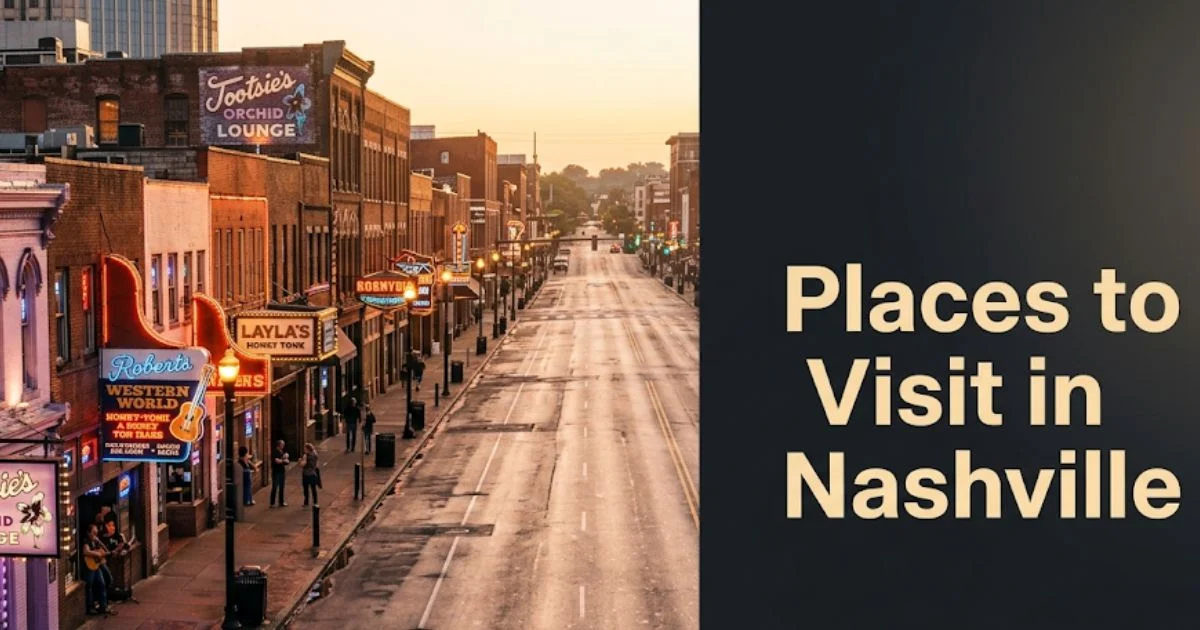
Lower Broadway is the most photographed block in the city. It is also the most bachelor-party-saturated experience Nashville offers.
The music you hear on Broadway is mostly cover bands playing for tourists. The musicians writing original work play East Nashville and Germantown.
Nashville’s food scene runs from Prince’s Hot Chicken to James Beard-recognized restaurants. Its arts infrastructure includes the Frist Art Museum, the National Museum of African American Music, and Cheekwood Estate and Gardens.
The city sits in Middle Tennessee at an elevation where summer heat is significant. Outdoor activities work best in spring and fall.
Insider Tip:
- Book the Ryman Auditorium tour or a show before any other activity. It sells out weeks in advance.
- The Bicentennial Capitol Mall State Park is free, walkable from downtown, and visited by approximately 5% of tourists who visit Broadway.
- Solo travelers find Nashville’s daytime neighborhood circuit easy to navigate alone. Broadway after 10 pm is a different environment entirely.
Nashville Best Places to Visit for First-Timers
First-time visitors to Nashville should anchor their trip around three zones: Lower Broadway for the iconic honky-tonk experience, East Nashville for local neighborhood character, and the Country Music Hall of Fame and Museum for the cultural depth the Broadway strip lacks.
The Country Music Hall of Fame, located at 222 Fifth Avenue South, takes a serious three hours to experience properly. Its rotating exhibits cover the full arc of country music history from the Carter Family through contemporary Nashville.
Budget approximately $25 to $35 per adult for admission, with discounts typically available for children and seniors. Verify current pricing directly with the museum before visiting.
Ryman Auditorium at 116 Fifth Avenue North is 10 minutes on foot from the Hall of Fame. A self-guided daytime tour runs approximately $25 to $35 per adult, though a ticketed evening show at the Ryman delivers a different quality of experience entirely.
3-Day Nashville Weekend Itinerary for First-Timers:
Day 1: Downtown and Broadway
- Arrive at BNA and check into the Gulch or SoBro for walkability.
- Visit the Country Music Hall of Fame in the late morning, budget 3 hours.
- Walk to Arnold’s Country Kitchen for lunch before the midday rush.
- Explore the Johnny Cash Museum on Third Avenue North, budget 90 minutes.
- Walk Broadway early evening before the 9 pm crowd surge.
- Catch an early set at Robert’s Western World (no cover charge).
Day 2: Neighborhoods and Music Culture
- Take a rideshare to East Nashville for morning coffee at Five Points.
- Walk the Shelby Bottoms Greenway along the Cumberland River.
- Return to Germantown for lunch at Henrietta Red or a nearby restaurant.
- Visit the National Museum of African American Music in the afternoon.
- Evening: Listening Room Cafe for a songwriters-in-the-round show.
Day 3: Culture and Day Trip Option
- Morning visit to Cheekwood Estate and Gardens or Radnor Lake State Park.
- Afternoon: 12South neighborhood walking, lunch, and independent shopping.
- Early evening: The Gulch for dinner and rooftop bar options.
- Fly out of BNA or extend with a Franklin Tennessee day trip.
| Activity | Best For | Cost Range | Time Required | Insider Note |
|---|---|---|---|---|
| Country Music Hall of Fame | All profiles | $25-$35 adult | 2.5-3 hours | Book online to skip lines |
| Ryman Auditorium Tour | Couples, culture fans | $25-$35 adult | 1-1.5 hours | Evening show beats daytime tour |
| Robert’s Western World | Budget travelers, music fans | Free (tip musicians) | 1-2 hours | Best before 9 pm on weekdays |
| Listening Room Cafe | Couples, solo travelers | $10-$20 cover varies | 2-3 hours | Advance reservations recommended |
| Cheekwood Estate | Families, couples | $20-$28 adult | 2-3 hours | Spring bloom season is peak |
| Radnor Lake | Outdoor enthusiasts, seniors | Free | 1.5-3 hours | Arrive early, parking fills fast |
| NMAAM | Culture travelers, families | $25-$30 adult | 2 hours | Closed some Mondays, verify hours |
| Arnold’s Country Kitchen | Budget travelers, food fans | $10-$15 per person | 45 minutes | Cash-friendly, closes by 2:30 pm |
Nashville Broadway Honky-Tonks: What to Expect Honestly
The honky-tonk bars on Lower Broadway are the most tourist-concentrated experience in Nashville, and they are worth one evening with clear expectations. They are not the place to discover Nashville’s music culture, but they are genuinely fun for two hours if you arrive before 9 pm.
Robert’s Western World at 416 Broadway is the most authentic of the main Broadway venues. It has maintained a real honky-tonk identity longer than its neighbors, with live traditional country music and an old-school boot shop attached.
Tootsie’s Orchid Lounge at 422 Broadway is the most photographed. It delivers exactly the Broadway experience tourists expect, with multiple floors, multiple stages, and wall-to-wall crowds from Thursday through Sunday.
Cover charges on Broadway are rare. Musicians work for tips, so bring cash and tip consistently if you stay for a set.
The crowd reality from 9 pm onward on Friday and Saturday nights is significant. Broadway becomes dense, loud, and oriented almost entirely around the bachelorette party economy.
Families with children should note that Broadway’s bar-heavy environment is unsuitable for children after early evening. The daytime honky-tonk experience is a different environment: mellower, less crowded, and actually more representative of what the strip has historically been.
Parking downtown on weekend evenings is expensive and limited. Rideshare drop-off on Second Avenue or Fifth Avenue and walking one block to Broadway is the practical solution.
The honest assessment: Broadway earns its reputation as an experience worth having once. It does not earn its reputation as the center of Nashville’s music culture, because it is not. The music lives elsewhere.
Local Alternative: Robert’s Western World is the local-preferred option within Broadway itself, but the real local alternative is the Station Inn in the Gulch, where bluegrass musicians play serious sets and the crowd is made up of actual music fans rather than tourists.
Nashville Music Scene Beyond Broadway
Nashville’s actual music scene lives at venues where locals consistently outnumber tourists and where original songwriting, not cover bands, is the primary product. The Station Inn at 402 12th Avenue South is one of the best small music venues in the American South.
The Station Inn specializes in bluegrass and acoustic Americana. Its capacity is approximately 200 people. Shows typically begin in the 8 pm to 9 pm range, and advance tickets run approximately $10 to $25 depending on the act.
Basement East in East Nashville at 917 Woodland Street books indie rock, Americana, and alternative country. It was rebuilt after the 2020 tornado and has become one of the most important mid-sized venues in the city.
The Listening Room Cafe at 217 Fifth Avenue South focuses on the songwriters-in-the-round format, where three or four songwriters sit in a circle and take turns performing original songs while explaining the stories behind them. This is the format that defines Nashville’s actual songwriting culture, and it has no equivalent anywhere else in American music.
Couples find the Listening Room Cafe format one of the most distinctly Nashville date experiences available. It is seated, quiet, and intimate in a way that Broadway is not.
According to the Nashville Convention and Visitors Corp, Music City hosts more than 180 live music venues across the city. Broadway accounts for perhaps a dozen of them.
Insider Tip:
- The 5 Spot in East Nashville (1006 Forrest Avenue) hosts free or low-cost shows on weeknights. It is where locals go.
- The Bluebird Cafe in Green Hills (4104 Hillsboro Pike) is Nashville’s most famous songwriter venue. Reserve tickets weeks in advance; they sell out for weekend shows.
- Solo travelers find the songwriter round format easy to enjoy alone. The seated, listening-focused culture means no awkward standing-alone-at-a-bar dynamic.
Key Takeaway: Book the Ryman Auditorium and Listening Room Cafe before anything else; both sell out weeks ahead.
Best Neighborhoods in Nashville for Tourists
Nashville’s best neighborhoods for tourists differ significantly by experience type. Downtown and SoBro are for walkability to Broadway and the major museums. East Nashville is for independent food, music, and neighborhood character. The Gulch is for upscale dining and the hotel-bar scene. Germantown is for culinary depth and historic architecture.
| Neighborhood | Best For | Walk Score | Vibe | Cost Level |
|---|---|---|---|---|
| Downtown/SoBro | First-timers, Broadway access | High | Tourist-forward | Higher hotel rates |
| East Nashville | Locals, repeat visitors, indie culture | Moderate | Neighborhood authenticity | Mid-range |
| The Gulch | Couples, upscale dining, rooftop bars | High | Trendy, walkable | Higher |
| Germantown | Food travelers, historic architecture | Moderate | Culinary, residential | Mid-range |
| 12South | Boutique shopping, brunch culture | Moderate | Instagram-friendly, local | Mid-range |
| Midtown/Music Row | Music history, Vanderbilt area | Moderate | Mixed tourist/local | Mid-range |
Germantown is Nashville’s oldest neighborhood and has become one of its most compelling food destinations. Chef Tyler Brown’s work at Josephine and other Germantown establishments helped establish this neighborhood as a serious culinary destination.
Budget travelers will find East Nashville the most cost-effective base. Hotel and Airbnb options are more affordable than the Gulch or SoBro, and the restaurant scene includes genuinely outstanding low-cost options.
Seniors and accessibility travelers should note that Broadway and the Gulch are the most accessible neighborhoods with flat, well-maintained sidewalks. East Nashville’s terrain is walkable but requires more navigational attention.
East Nashville Things to Do
East Nashville is the single most rewarding neighborhood in the city for travelers who want to experience Nashville beyond the tourist infrastructure. The area around Five Points (the intersection of Woodland Street, Meridian Street, and Clearview Avenue) is the neighborhood’s commercial and cultural heart.
Shelby Bottoms Greenway runs along the Cumberland River through East Nashville. It offers flat, paved multi-use trails covering approximately 10 miles. The greenway connects to Shelby Park, one of Nashville’s largest urban parks.
The Basement East venue anchors East Nashville’s music identity. Its outdoor stage hosts warm-weather shows, and its indoor space books acts ranging from emerging Nashville songwriters to nationally touring Americana artists.
East Nashville’s restaurant scene includes Henrietta Red, James Beard-nominated for its oyster-forward menu and serious cocktail program. It sits on Sixth Avenue North at the edge of Germantown, technically, but serves the East Nashville dining culture perfectly.
Solo travelers find East Nashville one of the most comfortable and socially navigable neighborhoods in the city. The coffee shops, bookstores along Gallatin Avenue, and neighborhood music venues are all solo-friendly in a way that Broadway is not.
East Nashville requires rideshare or a car from downtown. The trip runs approximately 10 to 15 minutes. Walking from Lower Broadway is not practical.
Insider Tip:
- The 5 Spot at 1006 Forrest Avenue runs free or low-cost theme nights on weeknights. Monday night events specifically have become a local institution.
- Ugly Mugs coffee shop on Woodland Street is the neighborhood’s longtime local gathering point. It is not Instagrammable, which is the point.
- Families with children will find Shelby Park’s playground infrastructure and open green space excellent for a morning break from the city’s denser attractions.
The Gulch Nashville
The Gulch is Nashville’s most walkable upscale neighborhood and the strongest option for travelers who want the city’s best dining and hotel scene without Broadway’s crowd density. It sits approximately 10 minutes on foot from Lower Broadway.
The Station Inn at 402 12th Avenue South is the Gulch’s most important venue for serious music travelers. It is the oldest bluegrass venue in Nashville and one of the most important small music rooms in the American South.
The Gulch’s hotel corridor includes several of Nashville’s highest-rated boutique and luxury properties. It is the preferred neighborhood for couples who want walkable access to upscale dining and music without staying in the Broadway tourist zone.
According to Tennessee Department of Tourist Development, the Gulch has seen significant development over the past decade and now anchors Nashville’s upscale urban tourism identity.
The Wings mural on 11th Avenue South is Nashville’s most photographed street art piece. It draws significant Instagram traffic and creates a line on weekend afternoons.
Budget travelers should note that the Gulch’s restaurants and hotels are at the upper end of Nashville’s price range. It is a visit-for-dinner neighborhood, not necessarily the most cost-effective base.
Insider Tip:
- The Station Inn’s Sunday night shows are an open secret among serious music travelers. They tend to be less crowded than Friday and Saturday performances.
- The Gulch’s walkability to 12South (via 12th Avenue South) makes these two neighborhoods a natural pairing for a full day’s exploring without a car.
Key Takeaway: The Station Inn in the Gulch is Nashville’s best live music room that most tourists never find; it is worth the trip over Broadway for any serious music traveler.
Nashville Food Scene and Hot Chicken
Nashville’s food identity is built around two pillars: the hot chicken tradition originating at Prince’s Hot Chicken Shack, and a broader Southern culinary scene that now includes some of the most respected restaurants in the American South. These two pillars coexist without contradiction.
Prince’s Hot Chicken Shack is the originator of Nashville-style hot chicken. The original location on Ewing Drive is not downtown. It is a drive from the tourist corridor, and that is entirely the point.
Prince’s operates with limited hours and a simple format: order at the counter, choose your heat level, and wait. Budget approximately $10 to $15 per person. The wait can be significant on weekends.
Hattie B’s Hot Chicken has multiple Nashville locations including one in Midtown that is far more accessible for downtown visitors. It delivers a consistent, high-quality product at a slightly more tourist-friendly format than Prince’s.
Bolton’s Spicy Chicken and Fish on Main Street in East Nashville is the hot chicken option that locals consistently name when asked which spot feels most authentic and least tourist-formatted.
Arnold’s Country Kitchen on Eighth Avenue South is Nashville’s most important meat-and-three restaurant. A meat-and-three is a Southern cafeteria-style format where you choose a protein and three sides from daily-prepared options. Budget approximately $10 to $15. It closes by mid-afternoon; verify current hours before going.
The Loveless Cafe at 8400 Tennessee Highway 100 is a Nashville institution 30 minutes from downtown. Its biscuits and country ham breakfast is the version that local Nashville families have cited for decades. It draws tourists now, but it earns the reputation.
Budget travelers can eat extremely well in Nashville for $10 to $20 per meal by focusing on meat-and-three restaurants and hot chicken spots. The mid-to-upscale dining scene in Germantown and the Gulch runs $40 to $80 per person for dinner with drinks.
Insider Tip:
- The best time to visit Arnold’s Country Kitchen is at 10:30 am when it opens, before the lunch crowd.
- Vegetarians and non-meat eaters will find Nashville’s mainstream meat-heavy dining culture limiting. East Nashville has the best plant-forward options.
- Families with children generally find Hattie B’s the most family-logistics-friendly hot chicken option, with space, seating, and a reliably kid-friendly environment.
Nashville Culture, History, and Arts
Nashville’s cultural infrastructure is significantly stronger than its Broadway-dominated reputation suggests. The National Museum of African American Music (NMAAM) at 510 Broadway is the city’s most important recent cultural addition and one of the strongest museum experiences in the American South.
NMAAM opened in 2021 and covers the full history of African American contributions to American music from gospel and blues through hip-hop and contemporary R&B. Admission typically runs approximately $25 to $30 per adult. Budget two to three hours.
The Frist Art Museum at 919 Broadway is Nashville’s premier fine art museum. It occupies a stunning 1930s Art Deco post office building and hosts rotating major exhibitions alongside its permanent collection. Admission typically runs approximately $15 to $20.
Cheekwood Estate and Gardens at 1200 Forrest Park Drive is Nashville’s finest historic estate property. The 55-acre botanical garden and art museum sits 20 minutes from downtown by car. Spring bloom season brings extraordinary flowering garden displays.
The Bicentennial Capitol Mall State Park on Charlotte Avenue sits directly north of the Tennessee State Capitol and is free to enter. Its 200-foot granite map of Tennessee and 31 fountains representing the state’s rivers make it one of Nashville’s most undervisited public spaces.
Seniors and accessibility travelers will find the Bicentennial Capitol Mall, Frist Art Museum, and NMAAM highly accessible. Cheekwood’s garden terrain involves some uneven paths but is largely manageable. Verify specific accessibility accommodations directly with each venue.
Families with children should consider the Adventure Science Center on Fort Negley Boulevard. It features hands-on STEM exhibits and a planetarium specifically designed for children ages 4 through 14.
Insider Tip:
- The Tennessee State Museum on Rosa L. Parks Boulevard is free and covers Tennessee history from prehistoric cultures through the 20th century. It receives a fraction of the tourist traffic it deserves.
- The Frist Art Museum’s first Sunday of each month offers free general admission. Verify this with the museum directly before planning your visit around it.
Key Takeaway: The National Museum of African American Music on Broadway delivers more cultural depth per dollar than any other Nashville museum and is visited by a fraction of the tourists who go to the Country Music Hall of Fame.
Outdoor Places to Visit in Nashville
Nashville’s best outdoor places are consistently undervisited by travelers who stay in the Broadway corridor. Radnor Lake State Natural Area at 1160 Otter Creek Road is the city’s most ecologically significant green space: a 1,332-acre wildlife sanctuary 7 miles from downtown.
Radnor Lake’s trail system covers approximately 6 miles of paths ranging from flat lakeside walks to moderate hillside climbs. Wildlife sightings including deer, herons, and wild turkeys are common. The park is free to enter.
Percy Warner Park in Belle Meade covers more than 3,900 acres with 10 miles of bridle trails and a series of hiking paths. It is one of the largest urban parks in the United States. The Mossy Ridge Trail is the park’s most rewarding hiking route for visitors seeking elevation and views.
Shelby Bottoms Greenway in East Nashville offers 10 miles of flat, paved trails suitable for cyclists, runners, and families with strollers. It follows the Cumberland River and connects Shelby Park to the greenway network.
Seniors and accessibility travelers will find Radnor Lake’s lakeside flat trail (approximately 2 miles) and Shelby Bottoms Greenway the most accessible outdoor options. Percy Warner Park’s terrain is more demanding.
Summer outdoor visits require preparation. Nashville summer temperatures regularly exceed 90°F with significant humidity. Midday outdoor activity between 11 am and 3 pm from June through August is physically demanding.
Insider Tip:
- Radnor Lake’s parking lot fills completely by 9 am on weekend mornings during spring and fall. Arriving before 8 am or after 4 pm is the practical move.
- Families with children will find the flat Shelby Bottoms Greenway the most manageable outdoor option. Radnor Lake’s hillside trails are too demanding for children under 8.
- The Natchez Trace Parkway enters Nashville from the southwest and offers scenic driving and cycling with minimal car traffic. Day rides and drives along its first 20 miles from Nashville are a genuine local favorite.
Nashville Places to Visit with Kids
Nashville works well for families with children when the itinerary is built around the right experiences. The Adventure Science Center at One Fort Negley Boulevard is the strongest child-specific attraction in the city, with interactive STEM exhibits and a planetarium that genuinely hold children’s attention for two to three hours.
Centennial Park at West End Avenue and 25th Avenue North contains Nashville’s full-scale concrete replica of the Parthenon. The replica houses a museum and a 42-foot statue of Athena. Children typically find the exterior impressive, while the interior museum engages older children and adults more than younger ones.
Cheekwood Estate and Gardens runs family-specific programming during school holidays and summer. Its garden train exhibit is specifically popular with children ages 3 through 10. Verify seasonal family programming with Cheekwood directly.
The Tennessee State Museum on Rosa L. Parks Boulevard has a children’s gallery covering Tennessee’s natural history. It is free and climate-controlled, making it a practical summer option when outdoor heat becomes limiting.
Families should plan their Broadway experience for early evening rather than nighttime. The honky-tonk strip is bar-forward after 9 pm. An early evening walk along the strip with dinner at a Broadway-adjacent restaurant is manageable for families.
Stroller access is good throughout downtown Nashville, the Gulch, and Germantown. East Nashville’s Five Points area is stroller-navigable but more uneven. Shelby Bottoms Greenway is fully stroller-accessible on paved paths.
Insider Tip:
- The Nashville Public Library on Church Street has a children’s programming room and is a free, air-conditioned mid-day break option.
- The Adventure Science Center is more demanding on children under 4. It works best for ages 5 and up.
- The Nashville Sounds minor league baseball team (Triple-A, MLB affiliate) plays at First Horizon Park in Germantown, with family-friendly ticket prices and a child-appropriate game-day experience.
Key Takeaway: Build a Nashville family itinerary around the Adventure Science Center and Cheekwood, not Broadway, and plan outdoor time before 10 am to beat summer heat.
Nashville for Couples
Nashville is one of the strongest short-break destinations in the American South for couples. The combination of live music, exceptional restaurants, walkable neighborhoods, and a rooftop bar scene gives it an urban romantic energy that competitors like Memphis or Chattanooga cannot quite match.
The Listening Room Cafe at 217 Fifth Avenue South is the single best date-night activity in Nashville. The songwriter round format means you sit, listen, and experience original music in an intimate setting that Broadway’s cover-band bars cannot replicate.
Cheekwood Estate and Gardens is Nashville’s strongest daytime couple experience. The estate’s grounds are beautiful across most seasons, and the sculpture garden and mansion tours offer a quieter, more intimate alternative to the city’s busier attractions.
The Gulch’s restaurant scene is Nashville’s strongest for a mid-to-upscale couples dinner. Josephine on 12th Avenue South delivers a refined Southern-American menu in a space that feels genuinely date-appropriate.
Rooftop bars in the Gulch and SoBro neighborhoods offer city views that make for a strong end to an evening. Most are accessible without reservations on weeknight visits. Weekend rooftop access during peak season sometimes requires advance reservations; verify with specific venues.
The Ryman Auditorium delivers one of the most consistently memorable couple experiences in Nashville when you attend an evening show rather than a daytime tour. The building’s acoustics are extraordinary, and the historic setting creates an experience that very few American music venues can equal.
Insider Tip:
- The Station Inn on Sunday nights is quieter and more intimate than Friday or Saturday. It is the couples option that Nashville music insiders recommend over almost anything on Broadway.
- A morning drive along the Natchez Trace Parkway south of Nashville is one of the most underused couple excursions in Middle Tennessee: no commercial traffic, minimal crowds, and genuine Tennessee landscape.
Nashville for Budget Travelers
Nashville can be experienced on a genuine budget if you know where the free and low-cost value is concentrated. The city’s live music scene on Broadway has no cover charge at most venues, making it one of the most affordable major-city live music experiences in the United States.
Free Nashville experiences worth prioritizing:
- Bicentennial Capitol Mall State Park: free, historically significant, and visited by a fraction of the tourists who walk Broadway
- Shelby Bottoms Greenway: free, 10 miles of paved trail along the Cumberland River
- Radnor Lake State Natural Area: free, Nashville’s strongest natural green space
- Percy Warner Park: free, one of the largest urban parks in the US
- Tennessee State Museum: free, covers Tennessee history with genuine depth
- Lower Broadway honky-tonks: no cover at most venues; tip the musicians well
Budget meal targets:
- Arnold’s Country Kitchen: approximately $10 to $15, one of the best meals per dollar in the state
- Bolton’s Spicy Chicken and Fish in East Nashville: approximately $10 to $15
- The 5 Spot in East Nashville: free or very low-cost music on weeknight theme nights
The honest budget reality: Nashville’s hotel prices downtown are not budget-friendly, particularly on weekends. East Nashville and areas along Murfreesboro Pike offer more affordable lodging options, but require a car or rideshare. Budget travelers who cannot split hotel costs face Nashville’s most significant financial friction here.
Solo budget travelers face the highest cost per night for accommodation. East Nashville Airbnb options and budget chain hotels on the airport corridor offer the most practical low-cost lodging solution.
Insider Tip:
- Visiting Nashville midweek rather than on a weekend cuts hotel rates by 30% to 50% at comparable properties. The music and restaurant scene is fully active Tuesday through Thursday.
- The Nashville Sounds baseball game at First Horizon Park in Germantown is one of the city’s strongest budget activity options, with tickets typically running $10 to $20 and a full game-day atmosphere.
How to Get Around Nashville
Getting around Nashville is most practical by rideshare for travelers staying downtown or in the Gulch. The city was designed around car infrastructure, and the distance between key neighborhoods makes walking-only navigation impractical for a full itinerary.
Uber and Lyft are widely available throughout Nashville. Airport trips from BNA to downtown typically take 15 to 20 minutes under normal traffic conditions. Budget $15 to $25 for this trip, with surge pricing possible during events.
WeGo Public Transit operates Nashville’s bus network. The WeGo Star commuter rail connects downtown to Donelson and Lebanon. For most tourist itineraries, WeGo’s bus routes serve core neighborhoods but require longer journey times than rideshare.
Parking downtown is expensive and limited on Friday and Saturday nights. Surface lots near Broadway charge premium rates during peak hours. The city’s parking garages near the Gulch and SoBro are more reliably available than street parking.
Walking works well within individual neighborhoods. Broadway to the Gulch is approximately a 10-minute walk. Broadway to Germantown is approximately 15 minutes. East Nashville and 12South require rideshare from downtown regardless of fitness level; neither is a reasonable walk from the core tourist corridor.
Seniors and accessibility travelers should note that downtown Nashville’s core tourist corridors have flat, well-maintained sidewalks and ADA-compliant curb cuts. The WeGo bus system has accessibility accommodations, but rideshare is generally faster and more practical for mobility-aid users.
Insider Tip:
- Rideshare surge pricing on Broadway after midnight on Friday and Saturday can be extreme. Walking three to four blocks away from the Broadway pickup zone before requesting a ride reduces wait times and prices.
- Renting a car is worth it specifically for visiting Radnor Lake, The Loveless Cafe, Percy Warner Park, or day trips to Franklin and the Natchez Trace.
Key Takeaway: Rideshare is the practical Nashville transport solution for the Broadway-to-neighborhoods circuit; a rental car is only necessary for day trips and outer-neighborhood destinations.
Best Time to Visit Nashville
The best time to visit Nashville is April through early June and September through October. Temperatures during these windows are comfortable, outdoor entertainment districts operate at their best, and hotel rates are lower than peak summer pricing.
Spring brings the Cumberland River Greenway into its best walking condition and fills Cheekwood’s gardens with blooms. The Tennessee Performing Arts Center and Ryman Auditorium announce their strongest lineups for these shoulder seasons.
CMA Fest in June brings extreme hotel price spikes and large crowds to the Broadway corridor and Nissan Stadium. If you are not specifically attending CMA Fest, June is Nashville’s most logistically complicated time to visit.
July and August are Nashville’s hottest months, with temperatures regularly exceeding 90°F and humidity making outdoor midday activity genuinely uncomfortable. Broadway’s indoor venues remain air-conditioned, but outdoor experiences suffer.
December through February brings colder temperatures that limit the outdoor honky-tonk experience. Hotel rates are at their lowest of the year during this period, making it the strongest budget season for travelers whose priority is restaurants and indoor music venues rather than outdoor neighborhood exploration.
Budget travelers should strongly consider January through February or mid-November visits. Hotel rates are lowest, crowds are minimal, and the indoor music and food scene operates at full capacity year-round.
Families with children will find spring school-holiday timing and fall October visits the most practical. Summer works for families who can handle midday indoor breaks and early-morning outdoor activity windows.
Insider Tip:
- The Americana Music Festival and Conference in September draws serious music industry professionals and genuine artists to Nashville venues across the city. It is one of the best weeks to experience Nashville’s real music culture.
- Nashville’s October weather is frequently the best of the year: mild, clear, and dry. It is the local secret for the best outdoor dining and neighborhood walking conditions.
Day Trips from Nashville
The best day trips from Nashville are to Franklin, Tennessee (20 miles south), the Jack Daniel’s Distillery in Lynchburg (75 miles southeast), and the Tennessee section of the Natchez Trace Parkway, which begins at milepost 444 just southwest of Nashville.
Franklin, Tennessee is a 30-minute drive from downtown Nashville. Its historic downtown square features well-preserved Civil War-era architecture, independent restaurants, and the Carter House and Carnton historic sites related to the 1864 Battle of Franklin. Budget a full day.
The Jack Daniel’s Distillery in Lynchburg is the world’s oldest registered distillery. Tours run approximately $20 to $25 per person with multiple options including basic facility tours and premium tasting experiences. Advance booking is strongly recommended, especially on weekends. Note that Moore County, where the distillery is located, is a dry county; purchases are available only through the distillery store.
Mammoth Cave National Park in Kentucky is approximately 90 miles north of Nashville, about a 90-minute drive. It is the world’s longest known cave system. The National Park Service offers ranger-led cave tours ranging from easy walking tours to physically demanding wild cave crawling experiences. Advance reservations through the NPS are highly recommended during spring and fall peak seasons.
The Natchez Trace Parkway is a 444-mile National Park Service scenic byway running from Nashville southwest to Natchez, Mississippi. Even a 20 to 40 mile drive along its northern section near Nashville delivers exceptional fall foliage and Civil War-era historical context with virtually no commercial traffic.
Families with children will find Franklin’s downtown and Carter House most accessible. Mammoth Cave’s easy walking tours work well for children ages 5 and up; the more demanding cave tours require minimum age and fitness considerations.
Insider Tip:
- The Natchez Trace Parkway prohibits commercial vehicles, making it one of the most peaceful scenic drives in the American South. It is genuinely worth an afternoon even if you only drive the first 30 miles.
- The Bell Witch Cave in Adams, Tennessee, 75 miles northwest of Nashville, is a genuinely distinctive regional attraction with historical Tennessee folklore significance. It is not for every traveler, but for those who find regional American history and folklore compelling, it has no equivalent nearby.
Safety and Practical Warnings for Nashville
Nashville’s most common safety concern for tourists is the crowded Broadway district on weekend evenings, where dense crowds in a bar-forward environment create pickpocket risk and navigational confusion.
Key safety and practical facts every visitor should know:
- Keep valuables secured in the Broadway corridor, particularly from 9 pm to 2 am on Friday and Saturday. Busy bar environments are where phone and wallet theft most commonly occur.
- Summer heat is a genuine physical risk. Temperatures regularly exceed 90°F from June through August. Carry water, wear sun protection, and plan outdoor activities for morning hours.
- Rideshare surge pricing at Broadway closing time (2 am) can be extreme. Walking several blocks from the strip before requesting a rideshare reduces both wait time and pricing.
- Radnor Lake’s parking lot has no overflow option. Arriving after 9 am on a spring or fall weekend often means no parking available. Arriving before 8 am is the practical move.
- Verify all admission prices, hours, and event schedules before visiting. Nashville’s restaurant and venue landscape changes regularly, and information found on third-party travel sites may be outdated.
- Downtown parking garages fill quickly on major event days, including Predators games at Bridgestone Arena and Titans games at Nissan Stadium. Check Nashville’s event calendar before planning a downtown visit on game days.
For medical emergencies, Vanderbilt University Medical Center on 21st Avenue South is Nashville’s primary Level I trauma center. Nashville’s emergency services number is 911.
Frequently Asked Questions About Places to Visit in Nashville
What are the best places to visit in Nashville for first-time visitors?
The Country Music Hall of Fame, Ryman Auditorium, and at least one evening on Lower Broadway are the essential first-timer experiences.
East Nashville’s Five Points neighborhood and the Station Inn in the Gulch round out a three-day first-time itinerary that moves beyond the tourist infrastructure.
Allow a minimum of three full days to cover the core places without feeling rushed.
Is Nashville worth visiting if you are not a country music fan?
Nashville is worth visiting regardless of your relationship with country music, because the city’s food scene, arts infrastructure, and neighborhood culture are independently strong.
The National Museum of African American Music covers soul, gospel, blues, hip-hop, and R&B. The Frist Art Museum, Cheekwood Estate, and Germantown’s restaurant scene have nothing to do with country music.
Travelers who dismiss Nashville as a country music destination are making a planning mistake that leaves a genuinely strong American city unvisited.
How many days do you need in Nashville to see the main places?
Three full days is the minimum to visit Nashville’s most important places without feeling rushed.
Four days allows for a day trip to Franklin or a more relaxed neighborhood exploration of East Nashville and 12South.
A long weekend (Friday evening through Monday morning) covers the core experiences if the itinerary is organized by geography rather than by attraction popularity ranking.
What is the best neighborhood to stay in when visiting Nashville?
The Gulch and SoBro (South of Broadway) are the most practical neighborhoods for first-time visitors who want walkable access to Broadway and the major museums.
East Nashville offers more authentic neighborhood character and lower accommodation costs but requires rideshare to reach Broadway and the Gulch.
Germantown is the strongest option for food-focused travelers who want proximity to Nashville’s best culinary neighborhood without Broadway’s weekend crowd density.
What is the best time of year to visit Nashville?
The best time to visit Nashville is April through early June and September through October.
These shoulder seasons offer comfortable temperatures, full access to Nashville’s outdoor entertainment districts, and hotel rates lower than the summer peak.
Avoid CMA Fest in June if you are not specifically attending the festival, as it creates extreme hotel pricing and crowd density across the entire downtown area.
Are there good free places to visit in Nashville?
Nashville has a strong collection of free attractions including the Bicentennial Capitol Mall State Park, Radnor Lake State Natural Area, Percy Warner Park, the Tennessee State Museum, and the Shelby Bottoms Greenway.
Lower Broadway’s honky-tonk bars have no cover charge at most venues, making Nashville one of the most affordable live music cities in the United States on a per-night basis.
Budget travelers who focus their itinerary on these free experiences, meat-and-three lunch spots, and East Nashville’s low-cost music venues can have a full Nashville experience for well under $100 per person per day excluding accommodation.
Plan Your Nashville Trip with Confidence
Nashville rewards travelers who move past the Broadway corridor. The city’s best experiences, its original music venues, its neighborhood restaurants, its arts institutions, and its green spaces, are accessible, specific, and genuinely worth the effort of finding them.
Book the Ryman Auditorium and Listening Room Cafe first. Both sell out in advance. Then build your itinerary outward from there using this guide’s neighborhood and day trip framework.
Travel conditions, admission prices, operating hours, and event schedules change. Verify key details directly with venues and the Nashville Convention and Visitors Corp before departure. The framework here holds, but the specifics should be confirmed before you arrive.
Nashville is a city that gives you exactly what you look for. Look beyond Broadway and you will find one of the most distinctly American cities on the continent.