Things To Do in Buenos Aires: The 2026 Insider Guide

Buenos Aires delivers one of South America’s most genuinely distinct urban experiences, and most first-time visitors only scratch its surface. This guide covers the specific neighborhoods, named venues, honest assessments, and practical logistics you need to plan an actual trip.
The Buenos Aires Tourism Board counts over four million international visitors annually, making it the most visited city in South America. That volume shapes everything from restaurant reservation lead times to which neighborhoods are safe at which hours.
This article covers the best things to do in Buenos Aires Argentina across every traveler type. From the exact milongas to book for tango through the neighborhoods to avoid after dark, you’ll have what you need to move from planning to packing.
Things To Do in Buenos Aires: What Makes This City Different
The single best thing to understand about Buenos Aires before you arrive is that it operates on a completely different daily schedule from North American cities.
Restaurants do not open for dinner before 8:30 PM. Locals eat closer to 10 PM. Nightclubs open at 2 AM.
Plan around this rhythm or you’ll spend three evenings eating alone in an empty room. The city rewards travelers who adapt, and punishes those who don’t.
Buenos Aires is organized into roughly 48 officially named neighborhoods called barrios. Visitors typically interact with six to eight of them.
The useful ones for most trips are San Telmo, Palermo, Recoleta, La Boca, Puerto Madero, and Belgrano. Each has a distinct character and a distinct safety profile.
Insider Tip:
- Book dinner reservations at least 48 hours in advance for top parrillas; Don Julio in Palermo regularly books out days ahead
- The SUBE transit card covers Subte metro and buses; load it at any kiosk or Subte station
- Carry small bills in Argentine pesos for street food and markets; card readers are unreliable at outdoor stalls
Best Things To Do in Buenos Aires Argentina: The Essential List
The best things to do in Buenos Aires Argentina fall into five distinct categories: tango culture, neighborhood exploration, performing arts, food and markets, and day trips.
Ranking any single activity above another depends entirely on who you are as a traveler. A food-obsessed solo traveler and a couple seeking architecture have different optimal itineraries.
Here is the activity-by-profile framework:
| Activity | Best For | Cost Range (USD approx.) | Time Required | Insider Note |
|---|---|---|---|---|
| Teatro Colón tour or performance | Couples, culture travelers | $15 to $80+ per person | 1 to 3 hours | Book tickets weeks in advance for evening performances |
| Cementerio de la Recoleta | All profiles | Free entry | 1 to 2 hours | Go before 11 AM to avoid afternoon crowds |
| Feria de San Telmo | Budget travelers, solo travelers | Free to browse | 2 to 4 hours | Sunday only; arrives by 10 AM before peak crowds |
| Don Julio parrilla | Couples, food travelers | $40 to $70 per person | 2 hours | Reserve online at least 3 to 4 days ahead |
| MALBA museum | Solo travelers, culture travelers | $10 to $15 per person | 2 to 3 hours | Wednesdays offer discounted admission |
| Milonga at Salon Canning or El Beso | Couples, solo travelers | $15 to $25 cover | 3 to 5 hours | Starts properly after midnight; arrive at 11 PM |
| Reserva Ecológica Costanera Sur | Families, seniors | Free | 2 to 3 hours | Best at dawn for birdwatching; closes at dusk |
| Tigre Delta day trip | Families, nature travelers | $20 to $40 round trip | Full day | Take the Tren de la Costa from Retiro station |
Top Things To Do in Buenos Aires: A 2-Day Framework
The top things to do in Buenos Aires are best organized by geography to avoid spending half your trip in taxis crossing the city.
Buenos Aires is large. Efficient visiting means grouping experiences by neighborhood zone.
Day 1: South Buenos Aires (San Telmo, La Boca, Puerto Madero)
- Start at Feria de San Telmo on a Sunday morning (arrive by 10 AM on Calle Defensa between Plaza Dorrego and Avenida San Juan)
- Browse Mercado de San Telmo for breakfast: medialunas and cortado coffee at one of the internal stalls
- Walk 25 minutes south to La Boca; stay on El Caminito and the immediately surrounding blocks only
- Return north to Puerto Madero for late afternoon walking along the waterfront promenade
- Dinner at 9:30 PM in San Telmo; Patagonia Sur on Calle Humberto Primo is a local favorite for regional Argentine cuisine
- Catch live tango at a peña or milonga after 11 PM; La Viruta in Palermo is accessible by Uber and welcomes beginners
Day 2: North Buenos Aires (Recoleta, Palermo, Belgrano)
- Arrive at Cementerio de la Recoleta at 9 AM when it opens; allow 90 minutes
- Walk to the nearby Museo Nacional de Bellas Artes (free entry, opens at 11 AM)
- Lunch in Palermo Soho; El Federal on Carlos Calvo serves a classic Argentine menu popular with locals
- Spend the afternoon in the Parque Tres de Febrero (Bosques de Palermo); rent a paddleboat on the lake
- Street art walk along Thames and Malabia streets in Palermo Soho
- Evening performance or guided tour at Teatro Colón; book the Coliseo Lighting Tour for a dramatic evening option
- Late dinner at a Palermo restaurant; El Preferido de Palermo on Jorge Luis Borges Street is a neighborhood institution
Unique Things To Do in Buenos Aires
The most unique things to do in Buenos Aires are the experiences that have no equivalent in North American or European cities.
Three stand out as genuinely irreplaceable: attending a proper milonga, visiting the Feria de Mataderos, and taking the Tigre Delta boat network.
Feria de Mataderos operates on Sunday afternoons in the far western barrio of Mataderos. It is a genuine gaucho culture market with folk music, payada singing contests, horse racing displays, and traditional food.
This is not a tourist show. The crowds are almost entirely local Porteños, and prices reflect it.
Getting there requires a 40-minute colectivo bus ride from the city center. Take Bus 55 from Palermo or the centro.
Salon Canning on Avenida Scalabrini Ortiz hosts milongas several nights per week. Experienced tango dancers from across South America and Europe travel specifically to dance there.
Sitting at Canning and watching an advanced milonga from the balcony is free or low-cost on many nights. It requires zero dance ability to appreciate fully.
Insider Tip:
- Feria de Mataderos is seasonal: primarily spring (September to November) and fall (March to May) Sundays; verify dates with the Buenos Aires Tourism Board before planning around it
- At a milonga, you request a dance with a subtle nod called a cabeceo; it is considered extremely poor form to verbally approach someone at the table for a dance
- Budget travelers: a Saturday morning at Feria de Mataderos with a choripán sandwich costs under $5 USD total
Key Takeaway: Buenos Aires rewards travelers who adapt to its schedule. Dinner before 9 PM and leaving a milonga before midnight means you’ll miss what the city actually is.
Buenos Aires Neighborhoods Guide
Buenos Aires’ neighborhoods are the real framework of the city, and understanding which barrio serves which purpose is the most practical planning decision you’ll make.
Each neighborhood has a distinct character. None of them are interchangeable.
| Neighborhood | Best For | Safety Note | Don’t Miss |
|---|---|---|---|
| San Telmo | Culture, antiques, weekend market | Safe on main streets; use care on quieter blocks at night | Feria de San Telmo (Sunday), Mercado de San Telmo |
| Palermo Soho / Hollywood | Restaurants, bars, boutiques, street art | Very safe; most popular expat zone | Thames street art, Jardín Japonés |
| Recoleta | Architecture, cemetery, museums | Very safe; upscale residential feel | Cemetery, Museo de Bellas Artes, Café La Biela |
| La Boca | El Caminito color, tango photo ops | Stay on tourist corridor only | El Caminito, La Bombonera stadium exterior |
| Puerto Madero | Waterfront walking, upscale dining | Very safe; new development zone | Ecological Reserve, walking bridge (Puente de la Mujer) |
| Belgrano | Local life, Chinatown (Barrio Chino), less crowded | Very safe; residential | Mercado de Belgrano, Sunday Barrio Chino market |
For first-time visitors, staying in Palermo or Recoleta puts you within Uber distance of every major site. San Telmo is an excellent choice for those who prioritize the weekend market and want a more atmospheric, older-city feel.
Families with children do best in Palermo, which has Parque Tres de Febrero, the Jardín Japonés, and the Buenos Aires Planetarium within walking distance.
Solo travelers thrive in Palermo Soho and Hollywood, where the density of bars, cafes, and co-working spaces creates an easy social environment.
Tango Buenos Aires: Where to Experience It Honestly
The best tango experience in Buenos Aires is not at a dinner tango show in a tourist restaurant. It is at a real milonga.
Dinner tango shows exist on a spectrum from passable to genuinely painful. The best ones, like Rojo Tango at the Faena Hotel, are technically impressive but function as theater, not culture.
Salon Canning, El Beso on Riobamba, and Club Gricel in San Telmo are the milongas where serious dancers go. The atmosphere at these venues is authentic in a way no dinner show replicates.
If you want to watch without dancing, arrive between 11 PM and midnight at any of these milongas. Sit at a table on the perimeter.
If you want to dance, take one group lesson first. Schools like DNI Tango in San Telmo offer beginner classes that give you enough foundation for a beginner practica.
For couples: attending a milonga together is genuinely one of the most romantic evenings Buenos Aires offers. Dress well; jeans and sneakers are not appropriate at traditional milongas.
Insider Tip:
- Club Gricel on La Rioja Avenue hosts a traditional milonga on weekends that attracts serious older dancers; it is one of the least touristy milonga venues in the city
- The Buenos Aires Tourism Board publishes a weekly milonga schedule at the Usina del Arte cultural center; check it for free or low-cost community tango events
- Seniors with limited mobility can enjoy milongas entirely from a seated observer position; the social ritual of watching the floor is considered its own pleasure
Teatro Colón Buenos Aires: What You Actually Need to Know
Teatro Colón is genuinely one of the great opera houses in the world, and the claim is not promotional. Acoustics experts and performing arts institutions rank it among the top five venues globally for opera and classical music.
The building itself, completed in 1908, contains six floors of seating, a stage with advanced fly tower technology, and original Belle Époque interiors. A guided tour covers all of it in roughly 75 minutes.
Two options exist: the guided daytime tour (approximately $15 to $20 USD per person) or attending an actual performance. The 2026 season typically runs March through December with opera, ballet, and symphony programming.
Book tickets directly through the Teatro Colón official website. The most affordable seats are in the upper paraíso (gallery level), which has excellent acoustic quality despite the height.
Visiting without a booking is possible for tours on quieter weekdays. Weekends and school holidays see significantly longer queues; advance booking is strongly recommended.
For budget travelers: the paraíso seats for major performances run approximately $20 to $40 USD. This puts a world-class opera performance within reach of any budget.
Families with children under 10: the tour is genuinely interesting for children curious about architecture and theater mechanics. A full evening performance is likely too long for children under eight.
Cementerio de la Recoleta: What to Expect Inside
The Cementerio de la Recoleta is free to enter and genuinely worth two hours of your trip. It functions as an outdoor museum of Argentine political and cultural history, not just a cemetery.
Eva Perón’s tomb is the most visited site inside. It is located in a relatively deep part of the cemetery; follow the map available at the entrance or look for directional signage from the gate.
The cemetery holds the remains of Argentine presidents, generals, Nobel laureates, and cultural figures across several city blocks of elaborate mausoleum architecture. Many of the structures are extraordinary examples of French and Italian funerary design.
Visit before 11 AM on any day to avoid peak crowd periods. The cemetery typically opens at 8 AM daily; verify current hours before visiting.
The neighborhood surrounding the cemetery, Recoleta, is one of the safest and most walkable in the city. Café La Biela directly across from the cemetery entrance has been a neighborhood institution for decades.
For seniors: terrain inside is stone-paved with some uneven surfaces. A cane is useful; wheelchairs can navigate the main corridors but some narrower sections are difficult.
Key Takeaway: The Cementerio de la Recoleta is free, opens early, and is consistently underestimated as one of Buenos Aires’ most genuinely interesting sites.
Buenos Aires Food Scene and Steakhouses
The Buenos Aires food scene is built on three pillars: the parrilla (Argentine steakhouse), the street food tradition, and a late-night café culture that has no real equivalent outside Argentina.
Don Julio on Guatemala Street in Palermo is the most internationally acclaimed parrilla in the city. The New York Times and Condé Nast Traveler have both cited it. Book three to five days ahead minimum.
The local alternative that experienced visitors prefer is La Carnicería on Thames Street in Palermo. It uses dry-aged beef and a more modern Argentine cuisine approach. Reservation lead time is shorter.
For a completely local experience at a fraction of the cost, the Mercado de San Telmo on Defensa Street has parrilla stalls inside where you can eat an excellent choripán or vacío for under $8 USD.
Argentine breakfast culture runs on medialunas (smaller, sweeter croissants) and café cortado. The best place to experience this ritual is at a traditional confitería; Café Tortoni on Avenida de Mayo is historic but tourist-heavy by midday.
For a more genuine café experience, Las Violetas on Avenida Rivadavia in Almagro is a stunning Belle Époque confitería where locals actually eat.
Budget travelers: Buenos Aires offers extraordinary value for food at 2026 exchange rates. A complete parrilla dinner with wine at a neighborhood restaurant outside Palermo typically runs $15 to $25 USD per person.
Free Things To Do in Buenos Aires
Buenos Aires is genuinely one of the most free-activity-rich major cities in South America. Multiple world-class experiences cost nothing.
Here is the complete list of free or near-free experiences:
- Cementerio de la Recoleta: free entry; one of the city’s top historical sites
- Museo Nacional de Bellas Artes: permanently free admission; holds South America’s largest collection of European and Argentine fine art
- Reserva Ecológica Costanera Sur: free entry; 865-acre urban nature reserve on the Río de la Plata; excellent birdwatching with over 300 recorded species
- Casa Rosada exterior and Plaza de Mayo: free to walk; the presidential palace’s famous pink facade and the historic plaza around it
- Parque Tres de Febrero (Bosques de Palermo): free entry; rose garden, Japanese garden exterior, lake, and weekend outdoor events
- Street art walking tour, Palermo Soho: free self-guided; Thames, Malabia, and Gurruchaga streets hold some of the city’s best large-scale murals
- Feria de San Telmo: free to browse; browse antiques, food stalls, and street performers on Calle Defensa every Sunday
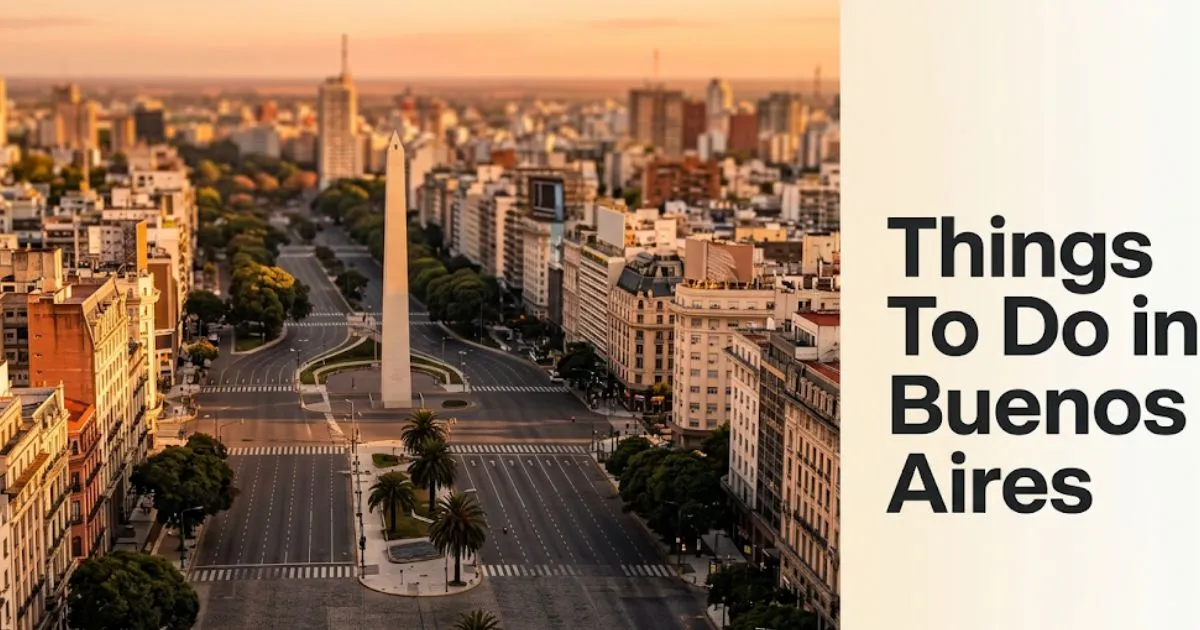
- Obelisco de Buenos Aires and Avenida 9 de Julio: free to walk; the central boulevard is one of the world’s widest; the Obelisco is the city’s most iconic structure
- MALBA: not free but offers heavily discounted Wednesdays and is free for children under 12
Budget travelers: a full day in Buenos Aires touching the cemetery, the Ecological Reserve, San Telmo market, and the Obelisco costs nothing in admission. Street food lunch keeps total daily spend well under $20 USD.
Things To Do in Buenos Aires at Night
Buenos Aires at night is categorically different from daytime Buenos Aires. The city’s nightlife culture is not an exaggeration; it is a structural reality of how Porteño social life works.
Dinner begins between 9 PM and 10 PM. Bars in Palermo Hollywood and San Telmo fill between 11 PM and 1 AM. Milongas reach peak energy after midnight. Clubs do not reach capacity before 2 AM.
For couples: Palermo Hollywood’s restaurant and cocktail bar corridor along Fitz Roy Street and Niceto Vega Street offers an excellent evening sequence. Dinner at Proper restaurant, cocktails at Frank’s Bar (ring the bell on Arangu
ren for entry), then a taxi to a milonga.
For solo travelers: the neighborhoods of Palermo, San Telmo, and Villa Crespo all have walkable bar districts where meeting other travelers is easy. Doppelganger Bar in Puerto Madero and El Federal in San Telmo both attract social crowds.
For budget travelers at night: many milongas charge modest cover fees. Free live music happens regularly at cultural centers including the Usina del Arte in La Boca (check their monthly schedule in advance).
Safety note at night: stick to Palermo, Recoleta, San Telmo’s main streets, and Puerto Madero after midnight. Constitución, La Boca beyond El Caminito, and Retiro bus station surroundings require extra awareness after dark.
Key Takeaway: Eating dinner before 9 PM in Buenos Aires puts you in an empty restaurant; the city’s nighttime social cycle simply does not begin until North Americans are thinking about bed.
Buenos Aires Day Trips
The best day trip from Buenos Aires is the Tigre Delta, accessible in under an hour from the city center without a private car.
Take the Tren de la Costa from Retiro station to Tigre town. From the Tigre dockside, local passenger boats (lanchas colectivas) navigate the Paraná Delta river channels. You can ride without a plan and simply disembark at a riverside café for lunch.
The second-best day trip is the crossing to Colonia del Sacramento in Uruguay. The Buquebus ferry operates from Puerto Madero’s Buquebus terminal. Travel time is roughly one hour by high-speed ferry.
Colonia is a UNESCO World Heritage Site: a small, immaculately preserved Portuguese colonial town with cobblestone streets and river views. It requires no planning beyond a ferry ticket and passport.
For a more local Buenos Aires day trip without crossing water, Tigre’s Mercado de Frutos on weekends is worth the journey. It sells regional crafts, woodwork, and food at prices lower than anything in the city.
Montevideo, Uruguay’s capital, is reachable by longer ferry (three hours) and makes an excellent overnight if your schedule allows. Buquebus operates multiple daily departures.
Families: the Tigre Delta is one of the best family day trips in the region. Children respond well to the boat travel, and riverside restaurants have outdoor seating with easy supervision.
Getting Around Buenos Aires
Getting around Buenos Aires is easier than the city’s size suggests, provided you understand which transit options actually work for tourists.
The Subte metro system is efficient, inexpensive, and covers central Buenos Aires well. Six lines (A through H, with gaps) connect major neighborhoods. The SUBE card loads at any Subte station or kiosk; a single ride costs under $1 USD at 2026 exchange rates.
Uber operates legally and reliably in Buenos Aires. It is the most practical option for cross-city trips or late-night returns. Drivers sometimes ask to be met around the corner from a pickup address due to ongoing tensions with taxi unions; this is normal.
Official radio taxis called through the app BA Taxi are safe and metered. Avoid unmarked taxis hailed off the street, particularly outside EZE airport.
Getting from EZE airport into the city: the Manuel Tienda León bus service runs from EZE to its terminal at Retiro station. Cost is approximately $15 to $20 USD. Journey time is 45 to 75 minutes depending on traffic. This is consistently the most reliable option.
Seniors and accessibility travelers: the Subte’s older lines (particularly Line A) have limited elevator access. Lines D and H are more modern with better accessibility infrastructure. Uber or radio taxis are more reliable for mobility-aid users.
Cycling: Buenos Aires has an extensive free public bike-share network called EcoBici. Registration is straightforward and the system covers Palermo, Recoleta, and the waterfront route comprehensively.
Buenos Aires Safety Tips
Buenos Aires is a safe city for tourists who apply basic urban awareness. It is not a city where caution can be completely relaxed in all zones.
The primary risks for tourists are phone theft and opportunistic pickpocketing in crowded markets and La Boca off the main Caminito corridor. Violent crime targeting tourists is uncommon in the neighborhoods most visitors frequent.
Key safety facts every visitor should know:
- La Boca beyond El Caminito: the surrounding streets transition quickly into a neighborhood where tourist infrastructure ends and safety risk increases sharply; do not wander off the designated tourist corridor, particularly after 5 PM
- Constitución train station area: the neighborhood around this terminal has a higher crime concentration; if passing through, be direct and aware
- Fake money changers (called arbolitos) operate near Florida pedestrian street in the city center; never exchange money on the street regardless of offered rates
- Phone visibility: keep phones in a pocket while walking; visible phone use on busy streets and in San Telmo market is the single most common theft trigger
- EZE airport taxis: only use the official taxi counter inside the arrivals terminal or pre-booked Manuel Tienda León service; unofficial taxi offers in the arrivals hall are a consistent scam vector
The US Department of State maintains a current travel advisory for Argentina. Check it at travel.state.gov before departure; the advisory level can change.
Solo female travelers: Palermo, Recoleta, and San Telmo are consistently rated as comfortable solo female travel zones. Night travel by Uber rather than walking after midnight is a reasonable precaution.
Key Takeaway: Buenos Aires’ main tourist risk is phone theft in crowded zones, not violent crime; keeping your phone pocketed in San Telmo and La Boca eliminates the majority of risk.
Things To Do in Buenos Aires for Every Traveler Type
Buenos Aires works differently depending on who you are. The same city serves completely different travelers in completely different ways.
Solo travelers have one of the best major-city solo travel experiences in South America here. The café culture, the co-working scene in Palermo, and the social milonga environment create natural connection points.
Couples find Buenos Aires genuinely romantic in ways that are specific to the city: the architecture, the late evening culture, the parrilla dinner experience, and the tango milonga option combine into something that few cities match.
Families with children under 10 face real considerations. The late-night city culture means children have limited access to the most authentic experiences. However, daytime is excellent: the Jardín Japonés, the Planetario Galileo Galilei, the Parque Tres de Febrero paddleboats, and the Tigre Delta boat trip are all genuinely engaging for children.
Budget travelers from the US and Canada benefit significantly from the current exchange rate environment. As of 2026, the favorable conversion means Buenos Aires is one of the most affordable major world cities for North American visitors. Verify current exchange conditions before traveling; Argentina’s currency dynamics change.
Seniors and accessibility travelers: Buenos Aires’ older neighborhoods have uneven sidewalks and limited elevator access in older buildings. The Subte’s newer lines and the extensive Uber network compensate well. The Reserva Ecológica Costanera Sur has flat, paved paths suitable for mobility aids.
Best Time To Visit Buenos Aires
The best time to visit Buenos Aires is September through November (Southern Hemisphere spring) or March through May (fall).
Both shoulder seasons offer mild temperatures between 15°C and 25°C (59°F to 77°F), manageable tourist crowds, and the city’s cultural calendar at full operation.
The worst time to visit for most travelers is January. Buenos Aires in January means Southern Hemisphere summer: temperatures regularly exceed 35°C (95°F) with high humidity. Many Porteño families leave the city for coastal resorts. Some restaurants reduce hours or close temporarily.
December and January also coincide with Argentine school holidays, meaning more domestic tourists and higher hotel prices in popular zones.
June through August (winter) brings cool temperatures between 8°C and 15°C (46°F to 59°F). Winter is low season: hotel rates drop, cultural programming at Teatro Colón is often at its best, and the city has a calmer atmosphere. It is not a bad time to visit; it simply lacks the outdoor energy of spring and fall.
The Buenos Aires Tourism Board identifies September through November as the primary recommended season for international visitors, citing the Jardín Japonés bloom period and the spring cultural festival calendar.
For budget travelers: winter (June through August) offers the lowest hotel rates with no meaningful reduction in the city’s core experiences.
For outdoor and nature travelers: spring in Parque Tres de Febrero and the Reserva Ecológica Costanera Sur is the city at its most visually alive.
Safety and Practical Warnings for Buenos Aires
Buenos Aires is navigable and generally safe in its main tourist zones, but several specific risks deserve direct attention before you arrive.
Key safety and practical facts every visitor should know:
- Sidewalk conditions in older barrios: San Telmo and La Boca have significant uneven paving; mobility aids require care and some routes are not reliably passable
- ATM access: use ATMs inside banks or large shopping centers rather than standalone street machines; withdraw during daytime hours
- Heat in summer (December to February): temperatures above 35°C (95°F) with high humidity; carry water, plan major outdoor activity before noon, and recognize heat exhaustion risk
- Currency exchange: Argentina’s official and unofficial exchange rates have historically diverged significantly; as of 2026, understand the current legal exchange environment before converting money; exchange only at authorized casas de cambio or banks
- Emergency number in Argentina: 911 covers police, fire, and ambulance in Buenos Aires; the tourist police line is maintained by the Buenos Aires Tourism Board for visitor-specific assistance
- Travel insurance: Buenos Aires has quality private medical facilities, but costs without insurance are significant for serious situations; travel medical insurance is strongly recommended
Frequently Asked Questions About Things To Do in Buenos Aires
What are the best things to do in Buenos Aires for first-time visitors?
The best things to do in Buenos Aires for first-time visitors are the Cementerio de la Recoleta, a Sunday at Feria de San Telmo, a parrilla dinner in Palermo, and an evening at a milonga.
These four experiences cover the city’s core cultural identity without requiring advance specialist knowledge.
Plan at least four days to give each experience the time it deserves without rushing.
Is Buenos Aires safe for tourists in 2026?
Buenos Aires is safe for tourists in the main visitor neighborhoods: Palermo, Recoleta, San Telmo on main streets, and Puerto Madero.
The primary risk is opportunistic phone theft in crowded markets and the La Boca tourist corridor.
Check the US Department of State’s current Argentina travel advisory at travel.state.gov before departure; advisory conditions can change.
How many days do you need in Buenos Aires?
Most first-time visitors need a minimum of four full days to cover the essential neighborhoods and experiences without feeling rushed.
Five to seven days allows for a day trip to Tigre or Colonia del Sacramento plus deeper neighborhood exploration.
Fewer than three days means sacrificing either the Palermo restaurant scene or the southern neighborhoods, which is a significant trade-off.
What is the best time of year to visit Buenos Aires?
The best time to visit Buenos Aires is September through November or March through May.
Both seasons offer mild temperatures, manageable crowds, and full cultural programming including Teatro Colón’s main season.
Avoid January if heat above 35°C and thinner local restaurant availability would negatively affect your trip.
What is the best neighborhood to stay in Buenos Aires?
The best neighborhood to stay in Buenos Aires for most first-time visitors is Palermo or Recoleta.
Both are safe, well-served by Uber and Subte, and within reasonable distance of every major site.
San Telmo is an excellent choice for travelers prioritizing the weekend market atmosphere and a more historic urban setting.
Is Buenos Aires expensive for US travelers?
Buenos Aires is one of the most affordable major world cities for US travelers at 2026 exchange rates.
A mid-range dinner with wine at a non-tourist parrilla typically costs $20 to $35 USD per person; budget meals run well under $10 USD.
Verify current Argentine peso exchange conditions before traveling; Argentina’s currency situation changes and directly affects your purchasing power.
Buenos Aires rewards the traveler who arrives with specific plans and flexible timing. Book Teatro Colón and Don Julio before you land; leave everything else loose enough to follow the city’s rhythm.
Verify entry requirements, exchange rate conditions, and neighborhood safety updates directly with the US Department of State and the Buenos Aires Tourism Board before departure. Prices, hours, and conditions in Argentina move quickly.
The traveler who eats late, sleeps a little less, takes the Subte with a loaded SUBE card, and finds their way to a genuine milonga will leave Buenos Aires having experienced something genuinely irreplaceable.