Best Things to Do in Sicily, Italy: 2026 Travel Guide

The best things to do in Sicily span ancient Greek temples, a live volcano, Baroque cathedral towns, and one of Italy’s most serious food cultures. No other Mediterranean island packs this range of distinct experiences into a single destination.
Sicily covers roughly 25,700 square kilometers, making it the largest island in the Mediterranean. According to the UNESCO World Heritage Committee, the island holds seven distinct World Heritage Sites, more concentrated per square kilometer than most European regions.
This guide covers the top activities, the best areas to explore, practical planning for 2026, and honest traveler-profile-specific guidance. It’s built for people ready to plan an actual itinerary, not just a Pinterest board.
Things to Do in Sicily: What Makes This Island Different
Sicily earns serious attention because no other destination in southern Europe combines Greek antiquity, Arab-Norman architecture, active volcanism, and genuinely distinct regional cuisine in one place.
Palermo reads like an architectural argument. Byzantine mosaics sit inside Norman palaces. Arab-influenced street food markets run beside Spanish Baroque churches. The city’s layered identity is not a marketing tagline. It reflects 2,700 years of consecutive conquest and cultural absorption.
The island functions more like a small country than a tourist circuit. Eastern Sicily around Catania and Taormina feels nothing like the Baroque belt of the southeast or the salt flats of the far west near Marsala.
Plan to move through distinct regions rather than trying to cover the whole island from one base. Each region offers its own character and merits at least two nights.
Insider Tip:
- Sicily’s road signs switch language between Italian and Sicilian dialect in some rural areas. Download offline maps before driving.
- The island’s western and eastern halves have genuinely different characters. Choose your base based on which region matches your interests, not just which airport has the cheapest flight.
- Seniors and travelers with mobility concerns should note that most of Sicily’s historic town centers involve steep grades and uneven cobblestone surfaces.
Best Things to Do in Sicily: The Experiences That Earn Their Reputation
The best things to do in Sicily include visiting the Valley of the Temples in Agrigento, exploring the ancient Greek theater in Taormina, walking the island district of Ortigia in Syracuse, and hiking the volcanic terrain of Mount Etna.
These are not interchangeable tourist checkboxes. Each delivers a genuinely distinct historical and experiential layer.
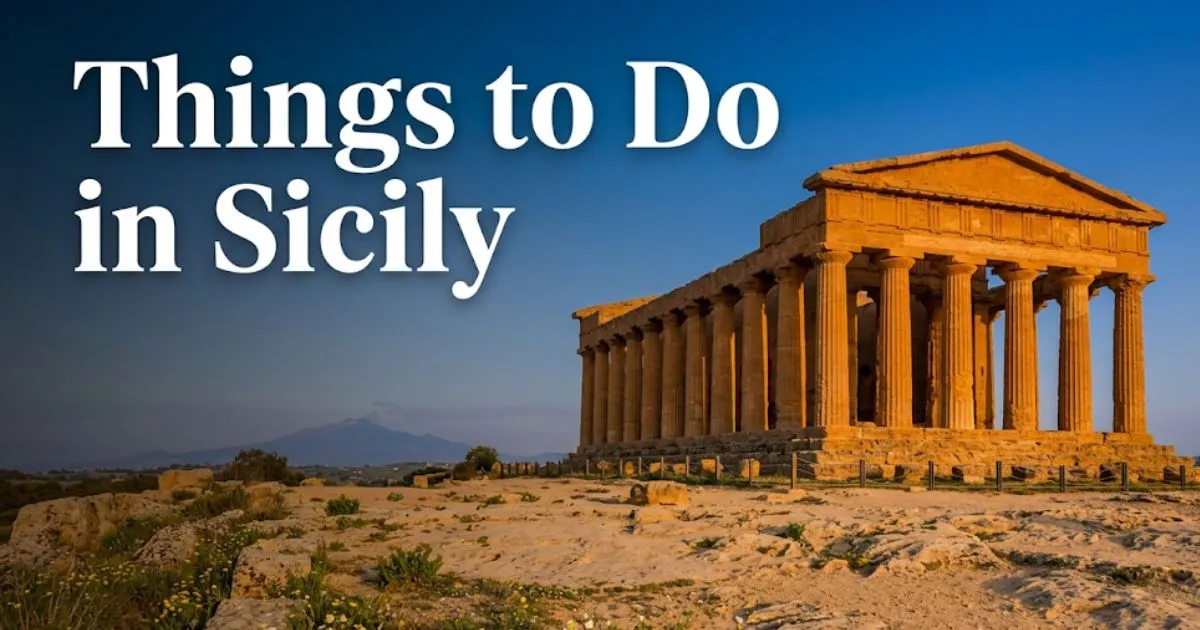
The Valley of the Temples is Europe’s largest and best-preserved Greek archaeological site outside of Greece itself. Seven Doric temples dating from the 5th century BCE stand in various states of preservation along a ridge above the modern city of Agrigento.
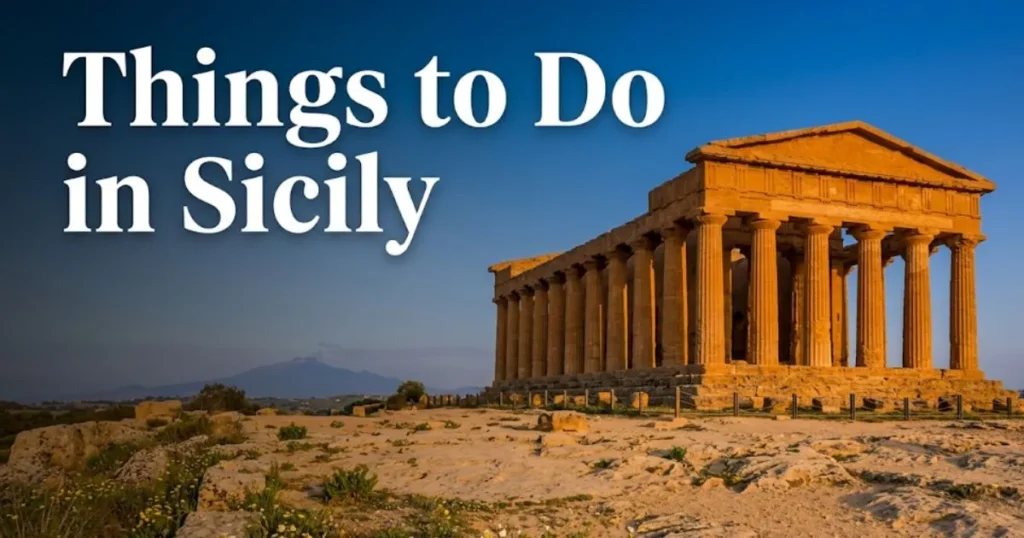
Visit at dawn opening time. By 10 AM in spring and by 9 AM in summer, the site is hot, crowded, and difficult to experience with any meditative depth.
Taormina’s Greek Theater sits with Mount Etna framing the stage. The view alone justifies the visit. But Taormina’s town center has become heavily commercialized. Experienced travelers spend one focused morning at the theater and the adjacent Palazzo Corvaja, then move on rather than lingering for the overpriced restaurant circuit.
| Experience | Best For | Cost Range (Approx.) | Time Required | Insider Note |
|---|---|---|---|---|
| Valley of the Temples | History enthusiasts, couples | €15-€20 per adult | Half-day minimum | Visit at opening time to avoid heat and crowds |
| Taormina Greek Theater | Couples, first-time visitors | €10-€15 per adult | 2 to 3 hours | Town itself is heavily tourist-commercial |
| Ortigia, Syracuse | Solo travelers, couples | Free to explore | Full day | Old town island is compact and walkable |
| Mount Etna summit area | Outdoor enthusiasts | €30-€70 with guide | Full day | Footwear and layers mandatory |
| Ragusa Ibla | Couples, architecture fans | Free to explore | Half-day | UNESCO Baroque town with fewer crowds than Noto |
| Zingaro Nature Reserve | Families, hikers | €5-€8 per person | Half-day to full day | No cars inside; arrive early in summer |
Top Cultural and Historic Sites in Sicily
Sicily’s cultural sites span three millennia and four distinct civilizations. Greek, Roman, Arab, and Norman layers are visible in a single morning walk through Palermo’s city center.
The Cappella Palatina inside the Norman Palace in Palermo is the most important room on the island. Byzantine gold mosaics cover every surface of this 12th-century private chapel. It requires advance booking and timed-entry tickets, particularly from March through October.
Nearby, the Palazzo dei Normanni itself functions as the Sicilian Regional Assembly chamber. Not all sections are open daily. Verify access schedules with the official site before planning your visit.
In Palermo’s outskirts, Monreale Cathedral holds mosaics covering 6,340 square meters of wall surface, the largest Norman mosaic cycle in existence. It sits 8 kilometers from central Palermo and is easily reached by local bus from Piazza Indipendenza.
According to ENIT, the Italian National Tourist Board, the Arab-Norman Palermo UNESCO World Heritage Site encompasses nine specific structures across the Palermo area, including the Cuba Palace and Zisa Palace. Plan a full day to cover even half of them meaningfully.
Profile note for families: The Cappella Palatina holds children’s attention for approximately 20 minutes. Build in an adjacent outdoor space like the Norman Palace gardens for breaks.
Profile note for budget travelers: Monreale Cathedral’s exterior and the cloister carry separate entry fees. The cloister’s 228 carved columns are the highlight. Budget for both, as the exterior alone does not convey the site’s significance.
Things to Do in Sicily Outdoors and Nature
Sicily’s outdoor experiences range from hiking the active craters of Mount Etna to swimming in the marine reserve at Ustica and walking the coastal trail of the Zingaro Nature Reserve in the northwest.
The Zingaro stretches 7 kilometers along a limestone coastline between San Vito Lo Capo and Scopello. The reserve has no roads inside. It offers a series of small cove beaches reachable only on foot, accessible from either the northern or southern entrance.
Entry fees apply and the reserve follows seasonal opening schedules, typically April through October, though this varies by year. Verify current opening dates before planning your Zingaro visit.
The Alcantara Gorge near Taormina is one of the more unusual natural experiences in Sicily. Basalt lava columns formed by a historic Etna eruption created a dramatic narrow gorge. Visitors can wade or swim through portions in summer, though the water runs extremely cold even in August.
Outdoor activity overview for each traveler profile:
- Solo travelers: Zingaro trail’s northern entrance to Cala Marinella cove is achievable in under 3 hours. Go early. The path is well-marked.
- Couples: Alcantara Gorge at dusk, after day-trippers leave, is notably more atmospheric.
- Families with children: Zingaro requires sturdy footwear and confident walking. Not suitable for strollers.
- Seniors: The lower section of Zingaro near Scopello’s southern entrance requires less elevation gain. The Funivia dell’Etna cable car eliminates most Etna climbing.
- Budget travelers: Zingaro entry is among the most affordable nature experiences on the island.
Key Takeaway: Plan your Sicily outdoors days around early starts. Heat above 30°C makes exposed archaeological and coastal hiking genuinely unpleasant by late morning from June through September.
Palermo Things to Do
Palermo is Sicily’s largest city and most complex destination. Its best experiences are concentrated in the historic center between the Quattro Canti intersection and the old harbor district of La Kalsa.
Start at Ballarò Market, Palermo’s oldest and largest street food market. It runs through the Albergheria neighborhood and opens most mornings. The market sells arancini, sfincione (the Palermitan pizza variant with onion, anchovies, and breadcrumbs), stigghiola (grilled lamb intestines), and fresh produce alongside clothing and household goods.
Capo Market runs along Via Cappuccinelle and specializes more heavily in food. It’s slightly calmer than Ballarò and better suited to those who want the food experience without navigating a full street market environment.
The Vucciria Market has changed significantly over the past decade. It now operates mostly as a nightlife area rather than a daytime food market. Some stalls persist in the mornings, but the experience is a shadow of its historic form. This is the overrated version of Palermo’s market culture. Ballarò is the genuine article.
The Oratorio di Santa Zita and the Oratorio del Rosario di San Domenico are two Baroque oratories with stucco relief work by Giacomo Serpotta that most visitors miss entirely while queuing for the more famous sites. Both require advance booking and offer an intimate, crowd-free alternative to the Cappella Palatina experience.
Profile note for solo travelers: Palermo’s historic center is safe for solo daytime exploration. The Vucciria area at night involves heavier drinking crowds. Navigate accordingly.
Taormina Things to Do
Taormina is Sicily’s most photographed town, perched on a cliff above the Ionian Sea with Mount Etna rising behind it. It earns its visual reputation completely. It does not earn its price tags.
The Teatro Greco di Taormina is the genuine reason to visit. Built by the Greeks in the 3rd century BCE and later modified by the Romans, it hosts the summer Taormina Film Festival and opera performances. If any live performance coincides with your visit, book tickets immediately upon planning.
The town’s main thoroughfare, Corso Umberto, runs the length of the historic center. It’s a pleasant walk but is lined almost exclusively with luxury shops and tourist-facing restaurants. Local Sicilians do not eat here regularly.
For a genuinely local dining alternative to Corso Umberto, walk down to the Spisone neighborhood below the cliff or take the cable car to the beach district at Isola Bella. Isola Bella itself is a small nature reserve connected to the shore by a narrow gravel bar. It’s one of the most photogenic spots in eastern Sicily.
Honest assessment: Taormina is worth one full day, maximum two. Travelers who stay longer than that in peak season spend most of their time competing with cruise ship day-trippers and paying resort prices for average food.
Profile note for couples: The terrace gardens at Villa Comunale overlooking the sea offer a genuinely romantic alternative to the crowded Corso. Enter from Via Bagnoli Croce.
Syracuse and Ortigia Things to Do
Syracuse (Siracusa) is the most intellectually rewarding city in Sicily and among the least tourist-crowded for its historical significance.
Ortigia, the small island that forms the old town of Syracuse, is entirely walkable in half a day and spends the rest of the time rewarding slow exploration. The Duomo di Siracusa is built directly around the columns of a 5th-century BCE Greek temple to Athena. The columns are still visible inside the Cathedral’s walls.
The Archaeological Park of the Neapolis sits on the mainland side of Syracuse and contains the Greek Theater of Syracuse (one of the largest and best-preserved in the ancient world), the Ear of Dionysius limestone cave, and a Roman amphitheater. The park charges entry and can be done in half a day for those moving quickly, or a full day for those engaging deeply.
The Museo Archeologico Regionale Paolo Orsi adjacent to the park holds the finest collection of Greek and prehistoric artifacts in Sicily. It’s often overlooked by visitors rushing through the archaeological park. Allow two hours minimum.
Profile note for families with children: The Ear of Dionysius genuinely captures children’s imagination. The acoustics inside the cave are dramatic and the limestone formations are unusual.
Profile note for budget travelers: Ortigia’s streets, the Duomo exterior, and the daily fish market at Piazza del Mercato del Pesce are free. The fish market runs weekday mornings and is one of the most authentic market experiences in southeastern Sicily.
Key Takeaway: Syracuse absorbs a full two days without exhausting its depth. Most visitors allocate one day and leave with the feeling they only scratched the surface. Budget two nights here.
Best Beaches in Sicily
Sicily’s best beaches span three distinct coastal types: the white-sand arc of San Vito Lo Capo in the northwest, the limestone white cliff formations at Scala dei Turchi near Agrigento, and the clear cove beaches of the Zingaro Reserve.
San Vito Lo Capo consistently ranks among Italy’s top beaches, with shallow turquoise water and fine white sand backed by a mountain reserve. The town itself is pleasant and has good fish restaurants. It becomes extremely crowded in July and August, with accommodation booking typically required 2 to 3 months in advance for summer travel.
Scala dei Turchi is one of the most photographed spots in all of Sicily. The white marl cliff staircase descending to the sea is genuinely spectacular. However: the smooth limestone surfaces are dangerously slippery when wet. Walk carefully and wear non-slip footwear near the water’s edge.
Mondello, 11 kilometers from central Palermo, is the city’s local beach and a legitimate half-day trip from the capital. It runs to mid-range beach club pricing in summer but has a free public beach section. Palermitans eat at the seafront fish restaurants here rather than treating it as a tourist destination.
Profile note for families: San Vito Lo Capo’s shallow, calm water makes it the safest beach option for young children on the island.
Profile note for seniors: Scala dei Turchi requires a walk across loose stone and uneven terrain. The descent to the base of the cliff is manageable but slow. Bring sun protection; there is no shade.
Sicily Food and Dining Experiences
Sicilian cuisine is one of the most distinctive regional food cultures in all of Italy. It owes as much to Arab, Spanish, and North African influence as it does to Italian tradition.
The essential eating experiences are specific and named. Arancini (fried rice balls, spelled arancine in Palermo) vary by city: Catania uses a cone shape, Palermo uses a round shape, and the fillings differ accordingly. Cannoli originated in Sicily and the best versions come from small pastry shops in Palermo and Catania, not tourist-facing cafes.
Granita in Sicily bears no resemblance to the thin ice-based versions served elsewhere. Catania’s granita culture is the most serious on the island. Start your day at Pasticceria Savia on Viale Regina Margherita in Catania, a long-established institution where granita is served for breakfast alongside a warm brioche bun. This is the local morning meal, not a dessert.
For wine, the most important Sicilian DOC wines are Nero d’Avola (the island’s signature red, produced primarily in southeastern Sicily around Noto and Pachino), Cerasuolo di Vittoria (the only DOCG in Sicily), and Marsala (the fortified wine produced near the western coast). Several wine estates near Vittoria and Noto offer direct tastings and are worth incorporating into a southeastern Sicily itinerary.
Profile note for budget travelers: Sicily’s street food markets are genuinely cheap and genuinely good. A full meal of arancina, a slice of sfincione, and a granita at Ballarò Market costs well under €10.
Insider Tip:
- Palermo and Catania have distinct food cultures. Try both cities’ versions of arancini to appreciate the difference.
- Pasta alla Norma (pasta with fried eggplant, tomato, and ricotta salata) is the signature dish of Catania. Eat it there, not in tourist-facing restaurants elsewhere.
- Caponata (sweet and sour eggplant relish) varies significantly by region. The Palermitan version includes olives and capers. Agrigento’s version is sweeter.
Mount Etna Tours and Activities
Mount Etna is Europe’s largest active volcano and one of the most accessible volcanoes in the world for non-technical visitors. It sits directly above Catania on Sicily’s eastern flank.
The Funivia dell’Etna cable car on the southern slope runs from approximately 1,900 meters to 2,500 meters. From the upper cable car station, 4×4 jeep transfers and guided hikes reach the Observatory area at around 2,900 meters. Summit crater access (above 3,300 meters) requires authorization and varies based on volcanic activity levels. Check current volcanic activity status with the Funivia dell’Etna operator before booking summit-level excursions.
Northern slope access via the Piano Provenzana area on Etna’s north face offers a different landscape: lava fields from the 2002 eruption and dense beech forest at lower elevations. The northern approach is less crowded than the southern route and better for hikers who want a full-day traverse experience.
How to plan an Etna day trip from Catania:
- Book a guided tour or cable car tickets in advance during April through October. Same-day availability is unreliable in peak season.
- Depart Catania by 7 AM to reach the southern base station before midday tour groups arrive.
- Layer clothing regardless of season. Summit temperatures run 15 to 20°C colder than Catania.
- Wear closed hiking boots. The volcanic terrain is uneven and sharp.
- Check the Etna Observatory (INGV Catania) volcanic activity status before your visit.
Profile note for seniors: The cable car makes the lower summit area accessible without serious physical demand. The 4×4 transfer adds additional altitude without walking. The final path to Observatory level involves uneven volcanic rock, not a formal trail.
Key Takeaway: Etna in the morning light with Catania below is one of the genuine visual rewards of all of Sicily. Build the full day around it rather than treating it as a half-day side trip.
Best Time to Visit Sicily
The best time to visit Sicily is April through early June or September through October. Both windows offer warm temperatures, manageable crowds, and the island’s best atmospheric conditions.
Spring (April to early June) brings wildflowers to the Valley of the Temples at Agrigento, pleasant hiking temperatures on Etna, and the famous Infiorata di Noto flower festival in late May, when Via Nicolaci in Noto is carpeted with elaborate flower petal designs. Accommodation prices are moderate and availability is good, though Easter Week requires early booking.
September to October delivers warm sea temperatures (the Mediterranean stays swimmable well into October), harvest season in the wine regions around Vittoria and Noto, and a significant drop in the heavy August crowds. Hotel rates fall noticeably after the first week of September.
July and August are Sicily’s worst months for most travelers. Heat regularly exceeds 35°C at low elevations. The Valley of the Temples and Agrigento’s ridge sites are fully exposed with minimal shade. Coastal accommodation prices double or triple. Popular beaches are severely crowded.
December to February offers the lowest prices and a quieter island. The Almond Blossom Festival in Agrigento typically falls in February and is genuinely worth planning around. However, some coastal businesses close entirely, ferry frequency to the Aeolian Islands drops sharply, and Etna’s higher elevations may be snow-covered and inaccessible.
Profile note for families: Spring is the strongest family season. Children handle the temperatures better and school-calendar family travel hasn’t peaked yet.
How to Get Around Sicily
Getting around Sicily independently requires a rental car for anything beyond Palermo and Catania city centers. The island’s public transit network is functional but slow and infrequent outside the two major cities.
By car: Sicily’s highway network (autostrade) connects Palermo, Catania, Messina, and Syracuse efficiently. Rural roads in the interior are narrower and slower. Palermo city center driving is extremely chaotic and parking is genuinely difficult. Use a hotel with parking or stay outside the ZTL restricted traffic zone and take local buses into the historic center.
By train: Trenitalia runs services between Palermo, Catania, Messina, and Syracuse. Journey times are slow. The Palermo-Catania train takes roughly 3 hours. The Palermo-Syracuse route takes approximately 3.5 to 4 hours. Rail is comfortable and scenic but should not be treated as fast transit.
By intercity bus: SAIS Trasporti, Interbus, and Flixbus Sicily operate between major destinations and are often faster than the train for specific routes like Palermo-Agrigento and Catania-Ragusa. The bus from Palermo to Agrigento runs approximately 2 to 2.5 hours.
By ferry: The Strait of Messina ferry connects Messina to Villa San Giovanni in Calabria on the Italian mainland. Aeolian Islands ferries depart from Milazzo (roughly 45 minutes west of Messina) and Palermo. Liberty Lines and Siremar operate Aeolian routes. Schedules reduce significantly from November through March.
Profile note for seniors: Sicily’s rental car option requires comfort with European roundabouts and narrow rural roads. Organized guided tours with driver transportation eliminate this challenge entirely and are worth the premium cost for travelers prioritizing ease of movement.
Sicily Itinerary for First-Time Visitors
A 7-day Sicily itinerary works best when structured as a one-way island circuit, flying into one airport and departing from the other. Fly into Palermo (PMO) and depart from Catania (CTA), or reverse it.
7-Day First-Timer Circuit:
Day 1: Palermo arrival and orientation
Check into accommodation outside the ZTL zone. Evening walk through the Quattro Canti and Piazza Pretoria. Dinner in the La Cala harbor area rather than the tourist-facing Vucciria strip.
Day 2: Palermo in depth
Morning at Ballarò Market for breakfast and street food. Timed-entry visit to Cappella Palatina (book before departure from home). Afternoon at Monreale Cathedral via local bus. Return to Palermo for the evening.
Day 3: Drive west to Cefalù
Morning drive east along the Tyrrhenian coast to Cefalù (approximately 1 hour from Palermo). Cefalù Cathedral mosaics and the Norman Norman tower. Afternoon at the town beach. Night in Cefalù.
Day 4: Agrigento and the Valley of the Temples
Full day at the Valley of the Temples. Arrive at opening time. Allow 3 to 4 hours for the archaeological park. Optional: afternoon at the Scala dei Turchi cliff formation 25 kilometers from Agrigento. Night in Agrigento or drive southeast toward Noto.
Day 5: Noto and Ragusa Ibla
Morning in Noto: Via Nicolaci, the Cathedral steps, and Caffè Sicilia for pastries. Afternoon drive to Ragusa Ibla for the Baroque church circuit and the staircase of San Giorgio. Night in Ragusa or drive toward Syracuse.
Day 6: Syracuse and Ortigia
Full day in Ortigia and the Archaeological Park of the Neapolis. Morning at the park, afternoon wandering Ortigia’s streets and the Cathedral interior. Evening aperitivo at one of the Ortigia waterfront bars.
Day 7: Etna and Catania
Morning Mount Etna cable car from the southern slope. Afternoon in Catania: the Piazza del Duomo, the Pescheria fish market, and granita at Pasticceria Savia. Evening flight from CTA.
Sicily Things to Do for Couples
Sicily is genuinely one of the strongest romantic destinations in all of the Mediterranean. The combination of historic towns, volcanic landscapes, exceptional dining, and warm sea water creates an environment that rewards slow, attentive travel.
The most specifically romantic experiences on the island are not the most photographed ones. Ragusa Ibla at dusk, when day-trippers have left and the golden light hits the Baroque churches, delivers a quality of atmosphere that Taormina’s crowded corso cannot match.
The Aeolian Islands off Sicily’s northeastern coast offer the kind of car-free, ferry-accessed, slow-paced island life that defines romantic Mediterranean travel. Salina is the most immediately livable of the seven islands, with vineyards producing Malvasia di Salina wine, good restaurants in the village of Santa Marina, and beaches that are not overwhelmingly crowded. Ferries from Milazzo run approximately 1.5 to 2 hours to Salina.
Stromboli adds volcanic drama: the active crater is visible from the ferry at night, with periodic lava flows down the Sciara del Fuoco. A guided night hike to the crater rim is one of the most striking experiences in all of southern Italy. Book guides through registered operators and verify the route is open before departure.
Profile note for couples: Ortigia in Syracuse has the best concentration of intimate restaurants in eastern Sicily. The island is small enough to walk entirely. Table reservations at smaller restaurants in Ortigia are advisable in peak season.
Sicily Things to Do for Families
Sicily works for families with children in specific ways and presents real logistical challenges in others. The island rewards realistic planning over aspirational itinerary building.
The Etna cable car and 4×4 jeep excursion is one of the genuinely child-friendly highlights. Kids respond to the volcanic landscape, the dramatic scenery, and the experience of being on an active mountain. The organized excursion format means children don’t have to hike in heat.
The Alcantara Gorge engages children immediately. The basalt formations are dramatic, and wading in the cold water is genuinely fun. Go early to beat heat and crowds. Bring water shoes.
The Valley of the Temples is a long, exposed walk on uneven ground in full sun. Children under 8 typically lose interest within 45 minutes. Pack snacks, water, and realistic expectations about pacing.
Mondello beach near Palermo is a practical family option. The shallow water is safe for young swimmers, the sand is clean, and the area has cafes and services nearby. It’s a local beach, not a resort beach, which keeps costs moderate.
Profile note for families: Sicily in July or August with young children is genuinely challenging. Heat above 35°C at archaeological sites creates safety and comfort issues for young children. Spring or early June travel is significantly more family-friendly.
Key Takeaway: Sicily rewards families who plan around the children’s genuine interests, not the standard adult attraction circuit. The volcano and gorge consistently outperform ancient ruins for under-12 engagement.
Sicily on a Budget
Sicily is one of the most affordable destinations in Western Europe when approached correctly. Palermo and Catania run at a significantly lower cost tier than Rome, Florence, or the Amalfi Coast.
Free and low-cost experiences are genuinely substantive, not consolation prizes:
- Ballarò Market in Palermo: free to walk, full meal under €10
- Ortigia island: free to explore, no admission for the street-level experience
- Palermo’s Piazza Pretoria, Quattro Canti, and Via dei Cassaro: free
- Mondello beach public section: free
- Noto’s Via Nicolaci: free
- Catania’s Piazza del Duomo and the morning Pescheria fish market: free
- The exterior walk at Cefalù Cathedral: free (interior charges a modest fee)
Paid experiences worth the entry fee, with approximate cost ranges as of recent years:
- Valley of the Temples: approximately €15 to €22 per adult. Among the most fairly priced major archaeological sites in Europe.
- Cappella Palatina: approximately €12 to €16. Timed entry required.
- Syracuse Archaeological Park: approximately €13 to €16.
- Etna cable car: approximately €30 to €35 for cable car alone. Guided summit excursions run higher.
Accommodation costs the most in Taormina and San Vito Lo Capo in high season. Staying in Catania and doing Taormina as a 45-minute day trip cuts accommodation costs dramatically without sacrificing the best of the experience.
Profile note for budget travelers: Public intercity buses cost significantly less than rental cars and tolls when traveling between Palermo, Agrigento, Catania, and Syracuse. For travelers sticking to those routes, the bus network is a legitimate budget-conscious option.
Safety and Practical Warnings for Sicily
Sicily is a safe destination for international travelers with standard urban awareness. Specific practical risks are worth knowing before arrival.
Key safety and practical facts every visitor should know:
- Heat risk at archaeological sites: The Valley of the Temples, Selinunte, and Agrigento’s ridge have no meaningful shade. Visiting between 10 AM and 3 PM in July and August poses genuine heat exhaustion risk. Carry water, wear a hat, and visit at opening time.
- Scala dei Turchi footing: The white marl limestone is dangerously slippery when wet or damp. Wear non-slip footwear and avoid the lower cliff edges during or after rain.
- Petty theft: Palermo’s markets, particularly the Vucciria area at night, are known pickpocket environments. Use a zip-closing bag and keep phones secured.
- Driving in Palermo: The city center has aggressive local driving culture and a ZTL (restricted traffic zone) enforced by cameras. Violations generate automatic fines sent months after the trip. Confirm your hotel is outside the ZTL before driving in.
- Etna volcanic activity: The summit area access changes with volcanic activity levels. Do not attempt crater approaches without current status confirmation from the Funivia dell’Etna operator or the INGV (Istituto Nazionale di Geofisica e Vulcanologia) Catania monitoring center.
- Swimming at remote beaches: Some cove beaches in the Zingaro Reserve have no lifeguard presence and limited emergency access. Non-swimmers should not wade into the water.
- Cell coverage: Rural interior Sicily has limited coverage in some areas. Download offline maps before driving in the Sicilian interior.
Emergency services in Italy are reached at 112.
Frequently Asked Questions About Things to Do in Sicily
What are the best things to do in Sicily for first-time visitors?
First-time visitors to Sicily should prioritize the Valley of the Temples in Agrigento, the Cappella Palatina in Palermo, and the Ortigia island district of Syracuse.
Mount Etna’s cable car and volcanic terrain experience adds a genuinely distinct layer that no other Mediterranean destination offers.
Allow at least 7 days to cover these highlights without feeling rushed across the island’s significant distances.
How many days do you need in Sicily to see the main highlights?
Seven to ten days is the realistic minimum for covering Sicily’s main regions without daily 3-hour drives.
A 7-day one-way circuit from Palermo to Catania (or reverse) covers the western, southeastern Baroque, and eastern volcanic regions in a manageable structure.
Travelers with fewer than 5 days should choose one region and go deep rather than attempting the whole island.
Is Sicily worth visiting in summer or should I avoid the peak season?
July and August deliver extreme heat, peak prices, and severe crowds at coastal areas and archaeological sites.
April through June and September through October are significantly better for comfort, value, and atmosphere at every major site.
Summer is the worst time to visit Sicily for most travelers unless you are based at a beach resort and not planning archaeological or volcano excursions.
What is the best base for exploring Sicily?
There is no single best base because Sicily is too large for one-location trip architecture.
Palermo works as a base for western Sicily; Catania works for eastern Sicily and Etna; Agrigento or Noto work for the southeastern Baroque and archaeological belt.
The most efficient approach is a circuit itinerary with 2-night stays in multiple locations rather than daily hub-and-spoke driving from one city.
How do you get around Sicily without a car?
SAIS Trasporti and Interbus intercity buses connect Palermo, Agrigento, Catania, Syracuse, and Ragusa on reasonably priced routes.
Trenitalia trains serve Palermo, Messina, Catania, and Syracuse but run slowly compared to driving.
Without a car, the Aeolian Islands, Zingaro Nature Reserve, Scala dei Turchi, and many rural interior areas become difficult or impossible to reach on public transit alone.
What food should you try when visiting Sicily?
Arancini (fried rice balls), cannoli, granita with brioche, pasta alla Norma, caponata, and sfincione are the essential Sicilian food experiences.
Eat granita for breakfast at a Catania pastry bar, buy arancini from street vendors in Palermo’s Ballarò Market, and seek out cannoli filled to order at small pastry shops rather than pre-filled versions sitting in display cases.
Nero d’Avola wine from the southeastern vineyards and Malvasia di Salina from the Aeolian Islands are the two Sicilian wines most worth seeking in local restaurants.
Plan Your Sicily Trip
Start booking Sicily by securing accommodation first, especially if you’re traveling between April and October. Palermo and Catania have good year-round availability. Cefalù, Taormina, and San Vito Lo Capo book out months in advance in summer.
Book timed-entry tickets for the Cappella Palatina and the Valley of the Temples before you leave home. Both require advance reservations in peak season. The Etna cable car and guided summit excursions similarly fill weeks ahead during summer.
Travel conditions, volcanic activity access levels, ferry schedules, and admission prices change. Verify current logistics directly with the Funivia dell’Etna, ASTA Sicilia, and individual site operators before departure. The traveler who confirms details two weeks before flying arrives with a workable plan. The one who assumes everything is as advertised arrives to closed attractions and sold-out excursions.
Sicily genuinely rewards careful planning. Put in that work and the island will deliver one of the strongest travel experiences in the Mediterranean.