
Best Things To Do in Charleston SC: 2026 Travel Guide

Charleston, South Carolina, rewards travelers who understand what it actually is: one of the most walkably historic, food-seriously, and architecturally specific cities in the United States, where the things to do in Charleston SC range from complex antebellum estate visits to some of the best oyster bars in the country, often within ten minutes of each other on foot. The city is not a beach destination that happens to have a historic district, and it is not a history-only destination that happens to have good restaurants. It is genuinely both, at a quality level that requires knowing which version of each experience you are getting into.
According to the Charleston Area Convention and Visitors Bureau, Charleston’s historic peninsula contains one of the largest intact collections of pre-Civil War architecture in the country, with over 1,400 buildings listed on the National Register of Historic Places. That concentration of history within a walkable area roughly two miles long is what makes the city’s scale rare, and what makes the planning decisions you make about where to spend your time matter more than in most American cities.
This guide covers the specific experiences worth your time and money in 2026, the ones that genuinely deliver on their reputation, the ones that sound impressive on a top-ten list but routinely underperform, and the practical logistics that most travel content glosses over. It addresses every major traveler profile honestly. It covers what the city looks like in both December and January, which surprises most first-time visitors. And it prepares you for the one logistical mistake that consistently derails Charleston trips before they get started.
Things to Do in Charleston SC: What the City Actually Delivers
Charleston, SC, delivers three things at a genuinely high level: walkable, specific, living history; an independent restaurant scene that ranks among the best in the American South; and coastal access to beaches and waterways within twenty to thirty minutes of the historic core. Everything else, the ghost tours, the carriage rides, the City Market shopping, is competent tourist infrastructure layered on top of those three genuine strengths.
Understanding this distinction matters for planning. If you spend your time optimizing for the tourist infrastructure layer, you will have a fine trip. If you spend it pursuing the three genuine strengths with some specificity, you will understand why travel editors keep putting Charleston on best-destination lists.
The city sits on a peninsula between the Ashley and Cooper Rivers, draining into Charleston Harbor, with the Atlantic coast visible from the southern tip at White Point Garden. That geography shapes everything: the heat in summer, the smell of saltwater throughout the year, the particular character of neighborhoods, and the logic of what to do in what order.
First-time visitors often arrive expecting a theme-park-neat version of an antebellum city. What they find is more textured than that. Some streets are immaculate and heavily photographed. Others, particularly in the Cannonborough-Elliotborough neighborhood, feel like a functioning residential neighborhood where someone has been restoring 19th-century houses for fifty years and is not quite done yet. The latter is actually more interesting.
| Traveler Profile | What Charleston Delivers Best | Honest Limitation |
|---|---|---|
| Couples | Historic district intimacy, high-quality dining, carriage rides, hotel quality | Peak-season weekend hotel prices are high |
| Families with older kids | Living history depth, beach proximity, aquarium | Summer heat is intense; very young children struggle with terrain and pacing |
| Solo travelers | Walkable dining scene, excellent bar culture, easy solo exploration | Solo costs scale poorly for boat tours and carriage rides |
| Budget travelers | Strong free attraction portfolio | Accommodation and dining costs are above average for the South |
| History and heritage travelers | Unmatched concentration of colonial and Civil War-era sites | Some plantation experiences prioritize aesthetics over historical depth |
Best Things to Do in Charleston SC Right Now
The best things to do in Charleston SC in 2026 concentrate around three activity types: walking the historic peninsula with specific neighborhood and architectural knowledge, spending serious time at one or two of the city’s best dining establishments, and getting onto or near the water in some form.
Walking tours of the historic district remain the single best value experience in the city if you choose the right operator. Free self-guided walking is possible using the Charleston Area Convention and Visitors Bureau’s downloadable walking tour routes, but the investment in a guided walking tour, typically $20 to $30 per person for small-group options, pays off in the specific architectural and social history context that makes what you are looking at meaningful. Most of the best-reviewed small-group walking tours operate out of the Visitor Center on Meeting Street.
Fort Sumter National Monument is where the Civil War began. The ferry ride across Charleston Harbor to the island fortification is itself part of the experience: the approach by water is the historically accurate way to understand the fort’s geography and its significance to the Confederate bombardment in April 1861. The National Park Service administers the site; admission includes the ferry and the monument. Advance booking is recommended from March through October. Allow approximately three hours for the full experience including transit.
The South Carolina Aquarium on the waterfront works well for families and anyone interested in Lowcountry marine ecosystems. It is not the largest aquarium in the country, but its great ocean tank and sea turtle hospital are genuinely worth the admission. Check current pricing and hours directly with the aquarium before visiting.
Key Takeaway: The Fort Sumter ferry, a walking tour of the historic district with a knowledgeable guide, and a serious dinner on Upper King Street are the three experiences that define a first Charleston visit at its best.
Top Things to Do in Charleston SC: The Non-Negotiables
The top things to do in Charleston SC depend on your traveler profile, but four experiences function as genuine non-negotiables for almost any first-time visitor with at least two days: the Fort Sumter ferry, a walk along Rainbow Row and down the Battery, a meal at one of the Upper King Street independent restaurants, and at least one hour spent in a Charleston neighborhood rather than on the main tourist corridor.
Here is a practical two-day framework:
Day 1:
- Start at the Charleston Visitor Center on Meeting Street. Park here if you are driving; the garage is the most reliable parking solution in the city. Pick up the CVB’s self-guided walking tour map.
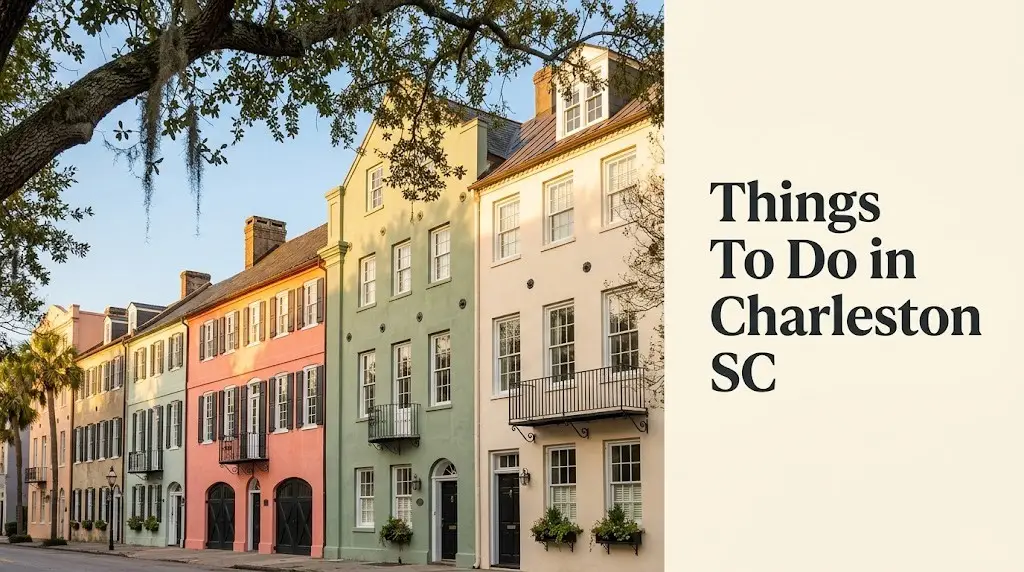
- Walk south through the French Quarter toward Church Street and St. Philip’s Episcopal Church (one of the most photographed streetscapes in the city). Turn east toward East Bay Street and walk Rainbow Row, the row of Georgian row houses painted in candy colors that appear in nearly every Charleston photograph. Allow 30 minutes here; it is genuinely beautiful and the photography is best in morning light.
- Continue south to White Point Garden and the Battery seawall. Walk the promenade. The views across the harbor toward Fort Sumter are clear on most mornings. Allow 45 minutes.
- Lunch: Head north along King Street. Below Broad Street, King Street runs through the city’s most concentrated antique shopping district. Above Broad, it transitions into the retail and dining core. 167 Raw on Chalmers Street is a small oyster bar with some of the freshest raw bar options in the city; lines form early. Arrive before 11:45 am or plan to wait.
- Afternoon: Take the Fort Sumter ferry from Liberty Square (book in advance). The afternoon departure gives you morning light for photography on the Battery and returns you to downtown by late afternoon.
- Evening: Dinner on Upper King Street. Husk, Edmund’s Oast, and Leon’s Oyster Shop each represent a different version of what Charleston’s food scene does well. More on each in the dining section.
Day 2:
- Morning: Choose one plantation estate. More detail on how to choose the right one in the plantation section.
- Midday: Drive or take a rideshare to Folly Beach (approximately 20 minutes from downtown). Walk the pier, swim if conditions are appropriate, and eat at one of the casual seafood spots on Center Street.
- Afternoon: Return to downtown. Walk through Cannonborough-Elliotborough on Spring and Rutledge Streets. This is the neighborhood where Charleston residents, not tourists, actually live, and where small coffee shops, independent bookstores, and uncrowded restaurants operate for the locals who are not on King Street.
- Evening: Ghost tour or carriage tour. Both are heavily touristed but genuinely add context to the city’s history after two days of more substantive exploration.
Charleston South Carolina Things to Do: Neighborhoods and Districts Worth Knowing
Charleston’s historic peninsula divides into distinct neighborhoods that offer different versions of the city, and choosing which ones to spend time in is one of the most consequential planning decisions you can make.
South of Broad is the wealthiest, most architecturally preserved, and least commercially developed neighborhood on the peninsula. The streets here, Legare, Meeting, Church south of Broad Street, contain some of the finest antebellum single houses (Charleston’s distinctive narrow, side-porch residential form) in the city. This is a residential neighborhood. Tourists walk through it; locals live in it. There is very little commercial activity, which is the point. Come here to walk, look, and understand the physical scale of pre-Civil War wealth in this city.
The French Quarter sits northeast of South of Broad and contains the highest concentration of the city’s historic commercial architecture. The City Market (a National Historic Landmark in its own right) runs through the heart of it. The market itself is primarily a tourist shopping experience today; the sweetgrass basket weavers in the market’s North Shed are the most culturally significant element and worth genuine attention. The baskets are not cheap, nor should they be: the Gullah Geechee weaving tradition they represent is a specific African-descended craft practice that survived enslavement and continues as a living cultural tradition.
Upper King Street (roughly from Calhoun Street north toward the Crosstown) is where Charleston’s independent restaurant and bar scene concentrates. This is the neighborhood that feels most like a city neighborhood rather than a preserved historic district, with converted storefronts housing cocktail bars, wine shops, and restaurants that genuinely compete at a national level.
Cannonborough-Elliotborough, west of King Street between Calhoun and Spring Streets, is the neighborhood that most approximates what living in Charleston actually looks like. Coffee shops, small yoga studios, neighborhood bars, and block after block of restored and semi-restored 19th-century residential architecture. Prices here, for food and drink specifically, run noticeably below the tourist core.
Fun Things to Do in Charleston SC Outdoors and on the Water
The best outdoor things to do in Charleston SC connect the city’s harbor and coastal geography to experiences that the historic peninsula itself cannot offer.
Kayaking Charleston Harbor is one of the most underused visitor experiences in the city. Several outfitters based in the downtown marina area and at Shem Creek in Mount Pleasant offer guided kayak tours of the harbor, the marsh creeks, and the tidal waterways of the ACE Basin to the south. A two-hour guided paddle through the marsh gives a completely different sense of the Lowcountry geography than anything available on the peninsula. Expect to pay approximately $40 to $65 per person for a guided tour; verify current pricing and availability directly with outfitters.
Waterfront Park on Concord Street offers one of the most accessible outdoor experiences on the peninsula: a public park on Charleston Harbor with the city’s iconic Pineapple Fountain, grassy areas, swinging benches overlooking the water, and views across the harbor toward Mount Pleasant. It is free to enter. It is almost never crowded before 9 am or after 6 pm. For couples and families, this is one of the best thirty-minute experiences in the city.
Folly Beach (approximately 20 minutes from downtown) is the closest beach to the city and the one with the most accessible, casual character. The pier at Folly Beach extends 1,045 feet into the Atlantic and is open to the public for fishing and walking; an entry fee typically applies. Folly’s surf is real enough that several surf schools operate here, and board rentals are available seasonally. Rip currents are a genuine risk at Folly Beach; swim only in lifeguarded areas and observe flag conditions strictly.
Isle of Palms (approximately 30 minutes northeast of downtown via the Isle of Palms connector) offers a wider, calmer beach with calmer surf than Folly, making it better suited to families with young children or anyone who wants beach time without significant wave activity.
For seniors and travelers with mobility considerations: Waterfront Park is fully accessible and flat. The Folly Beach pier has accessible sections; confirm current accessibility details with Charleston County Parks and Recreation Commission before visiting. Kayaking and paddleboarding require moderate core strength and the ability to board a low watercraft without assistance.
Key Takeaway: Kayaking the marsh creeks through a guided outfitter at Shem Creek gives you a version of Charleston’s coastal geography that no amount of historic district walking can replicate, and it is the outdoor experience most first-time visitors leave wishing they had made time for.
Best Things to Do in Charleston SC for Food and Dining
Charleston’s food scene has earned its national reputation, and the specific reason it ranks consistently among the best American food cities is the concentration of independently owned restaurants, the quality of local seafood supply, and the depth of a distinctly Lowcountry culinary tradition that no other American region shares.
Leon’s Oyster Shop on Upper King Street is one of the defining Charleston dining experiences: a converted auto shop turned oyster bar and fried chicken restaurant with an exceptional wine list and a deliberately casual format. Oysters here are sourced from regional producers; the selection rotates. Plan to wait for a table during peak hours on weekends. Prices are mid-range by national standards.
Husk, Sean Brock’s landmark restaurant on Queen Street, built its reputation around sourcing every ingredient from within the American Southeast and interpreting Southern culinary history through that constraint. It remains one of the most thoughtfully conceived dining experiences in the region, though it now operates as part of the Neighbourhood Restaurant Group rather than under Brock directly. Reservations are strongly recommended.
Rodney Scott’s Whole Hog BBQ on King Street brings whole-hog barbecue, a South Carolina and Eastern North Carolina tradition, to the heart of the city’s dining district. Scott is a James Beard Award winner; the food is the real version of a regional tradition that most barbecue restaurants outside the Pee Dee and Lowcountry regions approximate rather than deliver.
167 Raw on Chalmers Street is the best quick oyster bar experience in the city for travelers who want excellent raw bar quality without reservation logistics.
For budget travelers: Moe’s Crosstown Tavern in Wagener Terrace, Melfi’s for pasta at an accessible price point, and the food stalls at the Charleston City Market provide options well below Upper King Street pricing. Breakfast at basic diners in residential neighborhoods costs significantly less than the brunch spots on the main tourist corridor.
Unique Things to Do in Charleston SC
The most genuinely unique things to do in Charleston SC are the experiences that exist nowhere else in the country in the same form, and several of them are significantly underrepresented in standard travel content.
The Aiken-Rhett House Museum on Elizabeth Street is the most historically honest antebellum site in Charleston. Unlike the plantation estates, which have been restored and in some cases aestheticized, the Aiken-Rhett House has been maintained in a state of deliberate “preserved decay” by the Historic Charleston Foundation. Original wallpaper, paint layers, fixtures, and the intact outbuildings and enslaved people’s quarters behind the main house are all accessible as they were found. It is uncomfortable and intellectually demanding in exactly the way that antebellum history in Charleston should be. Admission is typically in the $12 to $16 per adult range; verify current pricing before visiting.
Sweetgrass basket weaving demonstrations at the City Market’s North Shed are a direct continuation of a West African coiled basketry tradition brought to the Lowcountry by enslaved Africans and maintained through Gullah Geechee communities on the South Carolina coast. Buying a basket supports a living cultural tradition. Prices reflect the hours of skilled work involved, not the tourist market baseline.
The Old Exchange and Provost Dungeon on East Bay Street is one of the most genuinely haunting historic sites in the city. The building served as a colonial customs house and exchange, and its basement dungeon held enslaved people awaiting sale and Patriots captured during the British occupation during the Revolutionary War. The guided tours are specific, historically grounded, and cover history that most Charleston tourist content passes over. Admission typically applies.
For solo travelers: all three of these experiences work perfectly alone, require no partner logistics, and deliver a quality of historical engagement that is more intellectually satisfying than most group tour formats.
Charleston Things to Do: Plantation Visits and Historic Sites
Plantation visits are one of the most significant decisions a Charleston visitor makes, and the right choice depends entirely on what you are looking for.
The four major estate options differ substantially in character:
| Plantation | Primary Draw | Historical Interpretation Depth | Best For | Approximate Adult Admission | Time Required |
|---|---|---|---|---|---|
| Drayton Hall | Unrestored authenticity, enslaved people’s history | Excellent: one of the most honest in the South | Heritage and history travelers, adults | $30 to $35 | 2 to 3 hours |
| Magnolia Plantation and Gardens | Gardens, wildlife, broader estate access | Moderate | Families, garden enthusiasts, nature visitors | $20 to $35 depending on add-ons | 2 to 4 hours |
| Middleton Place | Formal French gardens, rice culture history | Good, with specific Gullah history programming | Couples, garden and landscape travelers | $25 to $30 | 2 to 3 hours |
| Boone Hall | Most cinematic, filming location history | Light: primarily a scenic experience | Casual visitors, families, strawberry picking season | $25 to $30 | 1.5 to 2 hours |
Drayton Hall, administered by the National Trust for Historic Preservation, is the most serious and honest of the four. It is one of the only surviving pre-Revolutionary plantation houses in the country that has never been altered, modernized, or fully restored. The interpretive programs address the experience of the enslaved community with a directness and historical specificity that the garden estate experiences do not match.
Magnolia Plantation and Gardens delivers on its primary promise, which is extraordinary garden beauty, particularly in March and April when the azalea gardens are at peak bloom. Its wildlife attractions (alligators, herons, turtles on the plantation grounds) make it the most family-friendly option for younger children, though summer heat on the open grounds can be genuinely exhausting.
All verify-before-visiting advice applies here: admission prices, touring schedules, seasonal programming, and specific add-on attractions change. Check each estate’s official website before planning your day.
Key Takeaway: If you have time for only one plantation and you want the most historically honest experience available in the American South, Drayton Hall is the choice. If you have young children or primarily want natural beauty and garden scenery, Magnolia Plantation is the better fit.
Cool Things to Do in Charleston for Couples
Charleston genuinely delivers for couples in a way that few American cities of its size can match, and the specific reasons are architectural, culinary, and scaled for slow, deliberate exploration rather than efficient sightseeing.
An evening carriage ride through the historic district is a tourist experience, and it is one of the few tourist experiences in Charleston that earns its reputation for couples. The horse-drawn carriage routes through South of Broad and the French Quarter after dark, when the gas-lit street lamps illuminate the 18th-century streetscapes, offer an atmospheric perspective that daylight walking cannot replicate. Multiple operators work the City Market area. Routes are partially randomized by city regulation to protect residential streets from overuse; you may not get to choose your exact route.
Dinner at Husk or Middleton Place’s Carriage House Restaurant represents two very different versions of a romantic Charleston dinner. Husk on Queen Street operates in a restored antebellum building with candlelit interiors and a menu that functions as an essay on Southern culinary history. The Carriage House at Middleton Place is a quieter, more plantation-estate-specific experience with a longer history and a setting that benefits from the surrounding grounds at dusk.
The Charleston Wine and Food Festival (typically held in late February or early March) is one of the country’s best food and wine events and doubles as one of the best couple’s travel weekends in the Southeast. Hotel rates spike significantly during festival weekend; book at least three to four months in advance if this aligns with your travel dates.
For couples on a budget: an evening walk from Waterfront Park along the Battery at sunset, followed by dinner at Leon’s Oyster Shop or Melfi’s, delivers a high-quality Charleston evening without the carriage tour or tasting-menu price point.
Fun Things to Do in Charleston SC with Kids and Families
Charleston works well for families with children ages 8 and up, and requires more deliberate planning for families with younger children.
The South Carolina Aquarium on the waterfront is the most consistently child-appropriate attraction in the city. The sea turtle hospital, where injured sea turtles receive rehabilitation care, is genuinely compelling for children and adults. The great ocean tank provides the sensory experience that most young aquarium visitors respond to best. Allow two to three hours. The aquarium is located at the waterfront near the Fort Sumter ferry terminal; a combined visit to both in the same day is logistically sensible.
James Island County Park is where Charleston families with young children actually spend summer days. The park includes a climbing wall, rental bikes, a small water spray area, and tent and RV camping. It is operated by the Charleston County Parks and Recreation Commission and is significantly less expensive than any of the commercial attractions on the peninsula.
Magnolia Plantation and Gardens is the most family-accessible plantation option for younger children specifically because of the wildlife elements: alligators, egrets, and turtles are visible on the grounds without requiring children to sustain attention through interpretive history programming.
For families with strollers: the cobblestone streets of the French Quarter and the Battery area are genuinely difficult for stroller navigation. The sidewalks on King Street and in Cannonborough-Elliotborough are smoother and more manageable. Waterfront Park is flat and fully stroller-accessible.
Summer visit note for families: Heat and humidity in July and August routinely make extended outdoor activity genuinely uncomfortable for young children and potentially dangerous for infants. Plan outdoor activities before 10 am and after 5 pm. Build in an extended midday rest or indoor activity period during peak summer heat.
Key Takeaway: Families with children under 6 will have a significantly better time visiting Charleston in October, November, March, or April than in July or August. The heat in summer affects children more severely than adults and eliminates most of the outdoor experiences that make the city worthwhile.
Free Things to Do in Charleston SC
Charleston offers a genuinely strong portfolio of free experiences, most of which happen to be among the city’s most distinctive.
Free experiences in Charleston (confirm current status before visiting, as free admission policies can change):
- The Battery and White Point Garden: Always free. The seawall promenade, the Civil War-era cannons, the harbor views toward Fort Sumter, and the surrounding South of Broad streetscape are among the finest thirty-minute walks in the American South.
- Rainbow Row on East Bay Street: Free to walk and photograph. Best in morning light. It is genuinely one of the most visually distinctive residential streetscapes in the country; the description earns the visit.
- Waterfront Park and Pineapple Fountain: Free, public, and one of the best people-watching spots in the city on a clear afternoon.
- The City Market: Free to enter and browse. Shopping here is not free, but the historic market building and the sweetgrass basket weaving demonstrations in the North Shed cost nothing to observe.
- Walking tours via CVB self-guided routes: The Charleston Area Convention and Visitors Bureau provides free downloadable walking tour routes covering the historic district’s architectural highlights.
- Drayton Hall grounds walk (limited area): The grounds immediately outside Drayton Hall include an accessible river view and historic landscape visible without purchasing interior admission; confirm current access policy directly with the site.
- Church Street and French Quarter architecture: No cost. Walking the length of Church Street from Broad to Cumberland gives you a self-guided architectural survey of three centuries of Charleston building history.
For budget travelers, a full day in Charleston built around these free experiences plus a lunch at a non-tourist-corridor restaurant and a self-guided neighborhood walk through Cannonborough-Elliotborough can be genuinely satisfying and cost under $30 including food.
Things to Do in Charleston SC in December
Charleston in December offers one of the most overlooked versions of the city: quieter, cooler, with genuine holiday programming and far lower accommodation prices than spring peak season.
Holiday Festival of Lights at James Island County Park runs from late November through late December, typically, and involves an extensive drive-through and walk-through light display that draws from across the region. It is one of the most popular family events in the Charleston area during the holiday season. Advance ticket purchase is recommended; confirm 2026 dates and pricing with the Charleston County Parks and Recreation Commission before planning your visit around it.
December temperatures average in the low to mid 50s Fahrenheit for daytime highs, dropping into the low 40s at night. This is excellent walking weather for the historic district. The Battery promenade, Rainbow Row, and the French Quarter are all far less crowded in December than at any point between March and November.
Historic house tours and candlelight tours run specifically during the December holiday season, with many of Charleston’s historic properties opening to the public in decorated form. The Historic Charleston Foundation typically organizes candlelight tours of private historic homes during December; confirm the 2026 programming schedule directly with the foundation.
The plantation estates remain open in December with reduced hours at some locations; outdoor gardens at Magnolia Plantation are less dramatic in winter but the grounds are uncrowded and the cooler temperatures make walking the trails genuinely pleasant without summer heat pressure.
For couples: December is one of the best times for a romantic Charleston weekend. Hotel rates are substantially lower than spring, the historic district feels intimate rather than crowded, and the holiday decorations on the antebellum houses and gas-lit streets genuinely add to the atmosphere.
Things to Do in Charleston SC in January
January is Charleston’s quietest month, and for the right traveler profile, that is precisely the reason to go.
Accommodation rates in January drop to their annual low point in most of the historic district, with properties that run $350 or more per night in April sometimes available in the $150 to $200 range in January. This makes the city significantly more accessible for travelers who want the historic district experience without the spring pricing.
The Southeastern Wildlife Exposition (SEWE) typically runs in mid-February, and January is the ideal time to plan and book for it. SEWE is one of the largest wildlife art shows and conservation festivals in the country, centered on Charleston’s downtown venues and grounds. The 2026 event dates should be confirmed directly with the official SEWE organization; the festival draws significant attendance and lodging books early.
January outdoor activity: The average daytime temperature in January runs in the low to mid 50s Fahrenheit, which is cold for beach swimming but excellent for hiking, cycling, and extended outdoor walking. The ACE Basin, accessible as a day trip south of Charleston, is at its best in winter for birding; the Lowcountry’s wintering shorebird populations peak in this period.
The plantation estates and most historic sites maintain their regular operating seasons through January, though some reduce daily tour frequency. Verify current January operating schedules directly with each site before planning your itinerary around a specific tour time.
For budget travelers: January is the single best month to experience the historic district’s restaurants, hotels, and attractions at the lowest price point of the year. Restaurants that require booking weeks in advance in spring are often accessible with same-day or next-day reservations.
Key Takeaway: January is Charleston’s best-kept travel secret for adults traveling without school-schedule constraints. The city shows itself at its most local, most affordable, and most uncrowded, and the mild winter temperatures make outdoor exploration genuinely comfortable.
Best Things to Do in Charleston South Carolina: Day Trips Worth Taking
The best day trips from Charleston SC expand the Lowcountry experience in directions the city’s peninsula cannot provide: deeper wilderness, quieter coastal landscape, and historical context that illuminates what you saw in the city.
| Day Trip Destination | Distance from Charleston | Drive Time | Best For | One Reason to Go |
|---|---|---|---|---|
| Edisto Island | 45 miles south | 55 minutes | Nature travelers, families, solitude seekers | One of the least developed barrier islands on the South Atlantic coast; Edisto Beach State Park has cabin rentals directly in the live-oak maritime forest |
| Kiawah Island | 25 miles south | 35 minutes | Golf travelers, luxury resort visitors, beachcombers | Ten miles of largely undeveloped Atlantic beach accessible to the public at the Beachwalker Park county access point |
| Savannah, Georgia | 110 miles south | 1 hour 45 minutes | History and architecture travelers | The closest American city to Charleston in architectural character; a full day gives you the squares, the riverfront, and the Forsyth Park district |
| ACE Basin National Wildlife Refuge | 60 miles south | 1 hour 10 minutes | Birding, kayaking, nature photography | One of the largest undeveloped estuarine systems on the East Coast; spectacular in winter for shorebirds |
| Congaree National Park | 115 miles northwest | 1 hour 45 minutes | Hiking, old-growth forest, ecology | The largest intact expanse of old-growth bottomland hardwood forest in the United States; the boardwalk loop is accessible and flat |
Edisto Island is the day trip that most experienced Charleston visitors quietly consider the best coastal experience within reach of the city. The island’s lack of commercial development, its state park with direct beach and forest access, and its quiet character stand in deliberate contrast to the more resort-developed barrier islands.
Kiawah Island’s public beach access at Beachwalker County Park is the most important thing to know: the island itself is largely a private resort and residential community, but the county park provides public Atlantic beach access at the island’s western end. Parking fills early on summer weekends; arrive before 9 am or after 3 pm.
Charleston Fun Things to Do: Nightlife and Evening Experiences
Charleston’s evening and nightlife scene has grown significantly in the past decade, concentrated primarily on Upper King Street and in the Cannonborough-Elliotborough neighborhood.
Edmund’s Oast on Morrison Drive is the anchor of Charleston’s serious craft beer scene. The brewpub format allows you to taste through an extensive house-brewed selection alongside a full kitchen menu that holds up to the city’s better restaurants. It is not in the historic district core; the slight distance from the tourist circuit means it serves a primarily local clientele on weeknights.
The rooftop bar at the Vendue hotel on Vendue Range near the French Quarter offers harbor and city views that function as a legitimately useful end-of-day activity: drinks while watching the light change over Charleston Harbor, the Ravenel Bridge, and the Cooper River. It attracts both hotel guests and non-guests. Go before 7 pm on weekends to find space without waiting.
Ghost tours of the historic district run nightly from multiple operators. The quality varies considerably. Look for tours led by guides with specific historical training rather than primarily theatrical performance orientation. Small-group evening walking tours (maximum 12 to 15 people) consistently outperform the larger lantern-tour formats in terms of historical depth.
For solo travelers: Upper King Street’s bar scene is excellent for solo visits. The format of most bars here, counter seating at oyster bars and craft cocktail bars, makes solo attendance natural rather than awkward. The Cocktail Club on King Street and The Gin Joint on Fleming Street are specific options worth knowing.
For couples: The carriage tour followed by dinner and rooftop drinks is the classic Charleston evening sequence, and it earns its reputation. For a less scripted version, an evening walk through the gas-lit streets of South of Broad followed by dinner at a Queen Street restaurant accomplishes the same atmospheric effect without the tour group format.
Charleston Top Things to Do: Practical Logistics and Planning Tips
Getting the logistics right in Charleston makes the difference between a trip that works and one that spends too much of its time managing friction.
Parking: This is the most practically important logistics point for Charleston visitors. The historic peninsula has extremely limited street parking, and the blocks near the most popular attractions (City Market, Rainbow Row, the Battery) are consistently full by mid-morning on weekends. The most reliable solution is the Visitor Center garage on Meeting Street; parking here and walking or using the DASH trolley to reach destinations eliminates the circling problem entirely. Private surface lots near the City Market charge premium rates. Plan for parking as a deliberate part of your budget: $10 to $25 per day is realistic depending on the lot.
Getting around without a car: The CARTA (Charleston Area Regional Transportation Authority) bus system covers the peninsula. The DASH trolley historically ran a free loop through key downtown areas; confirm the current DASH route and operating status with CARTA before relying on it, as routes and hours are subject to change. Rideshare services (Uber and Lyft) operate throughout the city and Mount Pleasant. For the plantation estates on the Ashley River (Drayton Hall, Magnolia, Middleton Place), a car or rideshare is necessary; no reliable public transit connects downtown to these sites.
Best time to visit Charleston: Spring (March through May) and fall (September through November) offer the best combination of weather, full operation of all attractions, and event programming. Summer delivers peak crowds and heat. January through February delivers the lowest prices and fewest crowds. December adds holiday programming.
Booking ahead: Fort Sumter ferry tickets, popular restaurant reservations (Husk books weeks out during peak season), and carriage tours should all be reserved before arrival during any visit from March through October. In January and February, same-week booking is generally possible across all categories.
For seniors and travelers with accessibility considerations: The historic cobblestone streets in some areas of the French Quarter and South of Broad require solid footing. The Battery promenade is flat and paved. Waterfront Park is fully accessible. Most plantation estates have gravel and earthen paths; Drayton Hall and Magnolia Plantation have limited but available accessibility options. Confirm specific accessibility accommodations directly with each attraction.
Safety and Practical Warnings for Charleston SC
Charleston is a walkable, generally safe destination for visitors, but several specific practical and environmental risks warrant clear preparation.
Key safety and practical facts every visitor should know:
- Summer heat and humidity are serious. Daytime temperatures from June through August regularly reach 90 to 95 degrees Fahrenheit with humidity levels that make the effective temperature feel 10 degrees higher. Heat exhaustion risk is real during plantation ground tours and extended outdoor walks. Carry water, plan indoor breaks during midday hours (11 am to 3 pm), and do not underestimate the energy cost of walking the historic district in August.
- Rip currents at Folly Beach require active attention. Folly Beach experiences rip current conditions regularly. Swim only in areas with active lifeguard coverage during staffed hours. Observe flag conditions strictly: a red flag means no swimming regardless of how calm the water appears from the shore. Contact Charleston County Parks or check their official website for current beach conditions before visiting.
- Cobblestone streets cause ankle injuries. The streets in the French Quarter and around Rainbow Row are genuine 18th-century cobblestones, not decorative paving. Heels, unsupportive sandals, and footwear without ankle support create genuine injury risk. Wear flat, supportive shoes for any historic district walking.
- Hurricane season affects travel from June through November. South Carolina’s Atlantic coast sits within the zone of seasonal hurricane risk. Travelers planning visits between August and October in particular should monitor the National Hurricane Center advisories and purchase travel insurance that covers weather-related cancellations.
- Wildlife on plantation grounds is genuine wildlife. Alligators at Magnolia Plantation are not zoo animals and are not separated from visitors by barriers in some areas of the grounds. Maintain the distance instructed by staff. Do not approach, feed, or photograph wildlife from within 15 feet.
- Limited parking and traffic around popular attractions create safety concerns for pedestrians. The streets around the City Market and near the Fort Sumter ferry terminal on peak weekend days are congested. Use marked pedestrian crossings and assume vehicle traffic may not see you.
For immediate emergencies anywhere in South Carolina, contact 911. For wildlife emergencies at a state or county park, contact the South Carolina Department of Natural Resources emergency line.
Frequently Asked Questions About Things To Do in Charleston SC
What is the best time of year to visit Charleston SC?
The best time to visit Charleston SC is March through May or September through November, when temperatures are comfortable, all major attractions are fully operational, and the city’s outdoor spaces are at their most appealing.
Summer (June through August) brings intense heat and humidity alongside peak crowds, making extended outdoor activity genuinely uncomfortable.
December through February offers the lowest hotel rates and smallest crowds, with mild enough temperatures for historic district walking; January in particular is an underrated time to visit for adults with schedule flexibility.
How many days do you need in Charleston SC to see the main things?
Two full days covers the essential Charleston SC experiences for a first-time visitor: the Fort Sumter ferry, the historic district, one plantation estate, and a beach or waterway experience.
Three to four days allows you to add serious dining exploration on Upper King Street, a day trip to Edisto Island or Savannah, and a more thorough neighborhood walk through Cannonborough-Elliotborough and South of Broad.
One day is technically possible but forces you to choose between the history and the coastal experience rather than experiencing both.
Are the plantations in Charleston SC worth visiting?
Yes, but the right choice depends on what you are looking for. Drayton Hall offers the most historically honest and intellectually serious antebellum experience in the American South.
Magnolia Plantation is the best option for families and garden enthusiasts, with wildlife viewing and gardens that are genuinely striking in spring.
Boone Hall is the most cinematically appealing but the least historically substantive; it suits visitors primarily seeking photography and a scenic introduction to plantation architecture.
What are the best free things to do in Charleston SC?
The Battery and White Point Garden, Rainbow Row on East Bay Street, Waterfront Park and the Pineapple Fountain, and walking the streets of South of Broad and Cannonborough-Elliotborough are all free.
The City Market is free to enter and browse, and the sweetgrass basket weavers in the North Shed offer a culturally significant experience at no cost to observe.
The Charleston Area Convention and Visitors Bureau provides free downloadable self-guided walking tour routes for the historic district; confirm current availability before your visit.
Is Charleston SC good to visit in January or December?
Charleston is genuinely worth visiting in both January and December, with the quality of the experience depending on what you prioritize.
December offers holiday programming, including candlelight historic home tours and the Holiday Festival of Lights at James Island County Park, alongside lower hotel rates than spring.
January is the quietest and most affordable month of the year, with comfortable walking temperatures, uncrowded restaurants and attractions, and accommodation pricing that can run 40 to 50 percent below peak spring rates.
What neighborhood should I stay in when visiting Charleston SC?
The historic peninsula, specifically the French Quarter or Lower King Street area, puts you within walking distance of the Battery, Rainbow Row, the City Market, and the best restaurants, and is the most practical base for a first visit.
The Upper King Street area suits travelers who prioritize the dining and nightlife scene and want to walk to Edmund’s Oast and Leon’s Oyster Shop without a rideshare.
Mount Pleasant, directly across the Cooper River, offers lower accommodation rates and easy access to Boone Hall and the beach connector roads, but requires driving or ridesharing to reach the historic peninsula.
What to Do Before You Book Your Charleston Trip
Charleston rewards travelers who show up knowing the difference between the city’s genuine strengths and its tourist-facing surface. Book the Fort Sumter ferry as early as possible if you are visiting between March and October; it is the experience most likely to sell out before you arrive. Make restaurant reservations at least two weeks in advance for Husk and one week for Leon’s Oyster Shop during spring and summer weekends. If you are driving, commit to the Visitor Center garage strategy from the start rather than discovering the parking reality after an hour of frustration.
Travel conditions, prices, hours, ferry schedules, and event programming change from season to season. Confirm all logistics directly with the Charleston Area Convention and Visitors Bureau, individual attraction websites, and the National Park Service for Fort Sumter details before your departure date.
The traveler who leaves Charleston having spent time at Drayton Hall, eaten dinner on Upper King Street, walked the streets of South of Broad in the early morning quiet, and taken thirty minutes to watch the harbor from Waterfront Park will have seen what the city actually is. That version of the trip is specific, plannable, and genuinely worth the effort.