Things to Do in Washington DC: The 2026 Insider Guide

Washington DC offers more genuinely world-class cultural experiences at zero admission cost than any other major American city, making the question of what to do in Washington DC less about whether the city delivers and more about how to organize the remarkable amount it offers without wasting a day on poor planning. The challenge is real: with 19 free Smithsonian museums, miles of monument-lined National Mall, distinct neighborhoods ranging from the Federal grandeur of Capitol Hill to the independently-spirited energy of Adams Morgan, and one of the most functional urban transit systems in the country, first-timers and returning visitors alike often spend their first half-day figuring out a plan they should have arrived with.
According to Destination DC, the city’s official tourism organization, Washington DC welcomes more than 24 million visitors annually. What those visitor numbers don’t tell you is that roughly 80% of them spend the majority of their time within a half-mile of the National Mall, missing the neighborhoods, dining culture, and genuinely surprising experiences that make DC worth returning to. The National Park Service manages the Mall’s monuments and memorials at no charge, which is both a gift to travelers and, if they stop there, a significant limitation on what the city can offer them.
This guide covers everything from the monuments to the neighborhoods, the free museums to the booking-required experiences that sell out weeks in advance, the family-friendly logistics to the genuinely romantic options, and the honest seasonal and practical details that determine whether your trip to DC is memorable for the right reasons.
Things to Do in Washington DC: What Makes This City Worth the Trip
Washington DC earns its reputation as one of America’s most compelling destinations not because of any single attraction but because of the rare combination of genuine historical gravity, world-class cultural institutions accessible at no cost, walkable neighborhood character, and a food scene shaped by the city’s remarkable demographic diversity.
The city’s physical layout rewards the prepared visitor. Pierre Charles L’Enfant’s 1791 plan created a grid system punctuated by diagonal avenues and traffic circles, which means DC is genuinely walkable in ways that most American capitals are not. The National Mall stretches approximately two miles from the Lincoln Memorial to the Capitol building, lined with monuments, memorials, and the world’s largest museum complex. But the Mall is only the spine. The neighborhoods branching off from it hold the local character that makes DC worth more than a single day.
What separates DC from other American capital cities is the specificity of what it offers by category. For history, the depth is almost unmanageable in a short trip. For budget travel, it is without peer among major US cities. For food, the Ethiopian restaurant culture along 9th Street NW is as concentrated and authentic as any ethnic food corridor in the country. For architecture, the Library of Congress Thomas Jefferson Building contains some of the most extraordinary interior spaces in the hemisphere, and most visitors never enter because they don’t know to look for it.
The honest limitation: DC in midsummer is genuinely difficult. The National Mall has almost no shade, heat and humidity are extreme from late June through August, and the combination of school-group season and high temperatures makes the most popular sites genuinely uncomfortable between 10am and 3pm. Plan your Monument visits for early morning or evening. This is not a minor logistical note. It is the single most important planning decision you will make for a summer trip.
Best Things to Do in Washington DC: How to Prioritize Your Visit
The best things to do in Washington DC depend entirely on your traveler profile, your available time, and which of the city’s three distinct experience categories you prioritize: the civic and historical (monuments, Capitol, National Archives), the cultural and educational (Smithsonian museums, Kennedy Center, Library of Congress), or the locally-rooted (neighborhoods, independent restaurants, Eastern Market, the Wharf).
Most first-timers try to cover all three categories in their first visit, which is possible in 3 to 4 days with disciplined planning. A single day in DC is genuinely not enough to get below the surface. Two days allows you to cover the core civic and historical experiences on day one and two or three museums plus a neighborhood exploration on day two. Three to four days is the sweet spot for a first visit.
Best for budget travelers: The free Smithsonian and National Park Service experiences are among the best in the world. A budget traveler can spend three full days in DC at essentially zero admission cost and come away with a genuinely exceptional cultural experience.
Best for families with children ages 8 and up: The combination of the National Museum of Natural History (dinosaur hall, ocean hall, Hope Diamond), the National Air and Space Museum, and the monument circuit is genuinely age-appropriate and holds children’s interest across a full day.
Best for couples: The evening monument experience, specifically the Lincoln Memorial and the Reflecting Pool at night when the crowds thin and the lighting transforms the space, is one of the genuinely romantic experiences in any American city.
Here is a quick framework for prioritizing your DC visit by interest and time:
| Interest Category | Top Priority | Secondary | Skip if Limited on Time |
|---|---|---|---|
| History and Civics | Lincoln Memorial, Vietnam Memorial, WWII Memorial | National Archives, US Capitol | White House exterior only |
| Culture and Art | NMAAHC, National Portrait Gallery | Hirshhorn, Freer Galleries | National Building Museum |
| Family with kids | National Air and Space Museum | National Zoo, Natural History | Library of Congress (younger kids) |
| Couples | Lincoln Memorial at night, Tidal Basin walk | Georgetown waterfront, Kennedy Center | Large group-oriented museum halls |
| Budget travelers | All Smithsonians (free), Mall monuments (free) | Eastern Market, Union Market | International Spy Museum (paid) |
| Returning visitors | U Street Corridor, Shaw neighborhood | The Wharf, Navy Yard | Core Mall if already covered |
Top Things to Do in DC: Monuments and National Landmarks
The National Mall monuments represent the most directly powerful civic experience available to visitors in Washington DC, and the logistics of seeing them effectively are more specific than most planning guides acknowledge.
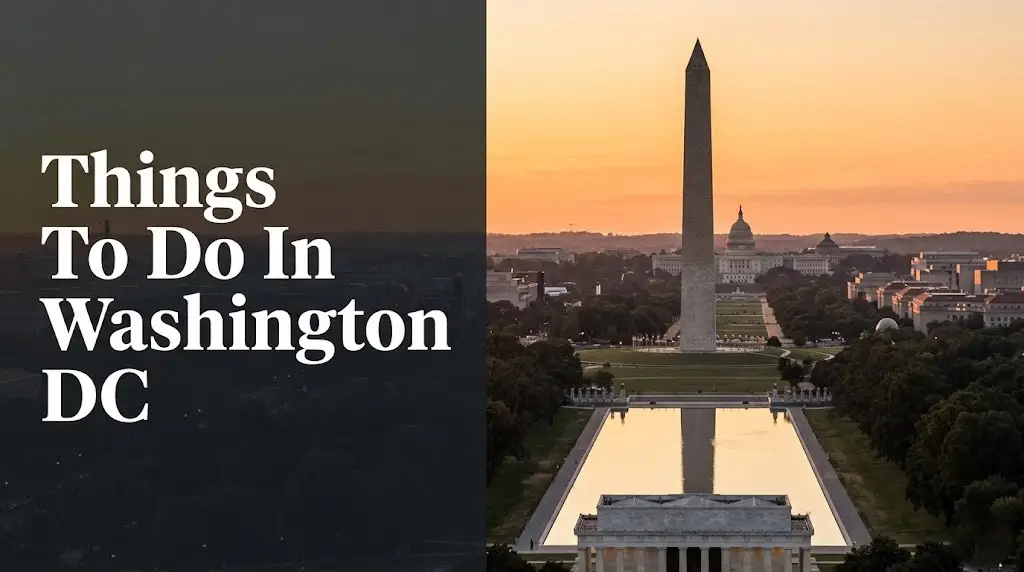
The Lincoln Memorial is the starting anchor of the western Mall. Its power comes from standing inside the chamber and reading the Gettysburg Address and Second Inaugural Address inscribed on the walls, which most visitors don’t do because they take their photos from the steps and leave. The view east from the steps toward the Reflecting Pool and the Washington Monument at dusk, particularly in October and early November when the air is clear and crowds thin relative to summer, is one of the genuine visual rewards of any DC visit.
The Vietnam Veterans Memorial, designed by Maya Lin and dedicated in 1982, requires a specific approach. Walk the full length of the wall from either end toward the vertex, where the names reach their greatest density. Don’t walk it quickly. The reflective surface showing your own image among the 58,000 names is the design working as intended. This is not an experience to rush through in five minutes.
The Washington Monument requires advance timed-entry tickets through the National Park Service’s reservation system. Tickets typically go quickly for peak dates, and same-day passes are sometimes available at the site but cannot be relied upon. The views from the observation level are exceptional and genuinely justify the booking effort.
The National Museum of African American History and Culture (NMAAHC) is technically a Smithsonian museum but deserves placement here because it is the most-demanded advance-booking experience in DC. Timed-entry passes are free but must be reserved well in advance, often weeks to months ahead for spring and summer dates. If your travel dates are flexible, build your DC schedule around pass availability rather than booking the pass around your schedule. The museum’s scope and emotional weight make it unlike anything else in the capital.
Insider Tip:
- Visit the Lincoln Memorial between 8pm and 10pm, when the crowds drop significantly and the illuminated monument creates a genuinely different experience from the daytime visit. The National Park Service maintains ranger presence at most major monuments around the clock.
- The Korean War Veterans Memorial and Martin Luther King Jr. Memorial are consistently less crowded than the Lincoln and Vietnam memorials, despite being equally compelling as design and historical experiences.
- Security screening at the Washington Monument adds 20 to 40 minutes to your visit during peak periods. Build this into your timing.
Key Takeaway: Book your NMAAHC timed-entry passes and Washington Monument tickets as soon as your DC dates are confirmed. These two experiences sell out weeks in advance and cannot be replicated by showing up without a reservation.
Free Things to Do in Washington DC
Washington DC’s most financially remarkable feature is that the Smithsonian Institution’s 19 museums and galleries in the District are all free to enter, making DC the only major American capital where a world-class cultural itinerary costs nothing in admission fees.
The Smithsonian Institution was established with a founding bequest from British scientist James Smithson in 1846, and today its DC campus spans museums from the National Mall to the Penn Quarter to Capitol Hill. The free admission policy applies to all of them. This is not “free on certain days” or “free with a suggested donation.” It is structurally free, every day, for every visitor. No comparable collection of institutions at this quality exists anywhere in the United States.
For budget travelers, this changes the economics of a DC trip fundamentally. A family of four spending three days in DC can visit the National Museum of Natural History, the National Air and Space Museum, the National Museum of American History, the National Portrait Gallery, and the Hirshhorn Museum and Sculpture Garden without spending a dollar on admission. Add the National Mall monuments (also free under the National Park Service), and you have a complete multi-day itinerary at zero admission cost.
The monuments and memorials on the National Mall are free and open to the public every day. The Lincoln Memorial, Vietnam Veterans Memorial, Korean War Veterans Memorial, World War II Memorial, Jefferson Memorial, and Martin Luther King Jr. Memorial all have no admission charge and no timed-entry requirement.
Free experiences worth knowing about that most visitors overlook:
- The Library of Congress Thomas Jefferson Building Great Hall is free to the public and is one of the most visually extraordinary interior spaces in the country. Most people on Capitol Hill never walk in.
- Eastern Market on Capitol Hill offers free entry, with fresh produce, artisan goods, and a community atmosphere that puts you in genuinely local DC on weekends.
- The National Zoo (part of the Smithsonian system) is free to enter, though parking is expensive and limited. The Metro’s Cleveland Park or Woodley Park stations provide walking access.
- The Sculpture Garden adjacent to the National Gallery of Art on the Mall offers a free outdoor art experience year-round, with an ice skating rink in winter (skating requires a rental fee).
Things to Do in Washington DC for First Time Visitors
First-time visitors to Washington DC make a consistent planning mistake: they list too many attractions and organize none of them by geography, which results in backtracking across the Mall, fatigue by early afternoon, and a sense that they’ve seen DC when they’ve actually only seen the surface of its most tourist-oriented mile.
The strategic approach for a first visit is to divide the city’s core into geographic zones and spend concentrated time in each zone rather than pinballing between attractions.
Zone 1: The Western Mall. Lincoln Memorial, Vietnam Veterans Memorial, Korean War Veterans Memorial, WWII Memorial, Reflecting Pool, Washington Monument. These cluster naturally and can be covered in a half-day with an early morning start (before 9am in summer, before crowds build).
Zone 2: The Eastern Mall and Museum Campus. National Museum of Natural History, National Museum of American History, National Air and Space Museum, National Gallery of Art. This zone is walkable from the Capitol end of the Mall and absorbs a full day easily.
Zone 3: Capitol Hill. The US Capitol Visitor Center, Library of Congress, Supreme Court exterior, and Eastern Market. This is a half-day zone that most first-timers skip and shouldn’t.
Zone 4: Penn Quarter and Chinatown area. International Spy Museum (paid admission), National Portrait Gallery (free), Smithsonian American Art Museum (free). Good for an afternoon with mid-range dining options nearby.
For first-timers traveling with a specific interest in political history, the National Archives in the Federal Triangle houses the original Declaration of Independence, Constitution, and Bill of Rights. The queue moves more quickly on weekday mornings, and the experience takes roughly 45 to 90 minutes depending on how long you spend in the exhibit galleries.
For first-timers specifically: Don’t attempt to see both the western monuments and multiple museums in one day. The walking distance is deceptive on a map and exhausting in practice, particularly in summer.
Best Neighborhoods in Washington DC to Explore
Washington DC’s neighborhoods are where the city’s actual character lives, and they differ from each other in ways that make understanding them essential to building an itinerary that goes beyond the tourist circuit.
| Neighborhood | Character | Best For | Signature Experience |
|---|---|---|---|
| Georgetown | Historic Federal-era architecture, independent boutiques, waterfront park | Couples, first-timers, leisurely walkers | C&O Canal towpath walk, Georgetown Waterfront Park at sunset |
| Dupont Circle | Literary cafes, LGBTQ+ friendly bars, art galleries, Sunday farmers market | Adults, solo travelers, culture seekers | Phillips Collection (modern art, paid admission), Sunday farmers market |
| U Street Corridor / Shaw | Historic Black Broadway, live music, independent restaurants, jazz bars | Adults, music and history enthusiasts | Live jazz at Blues Alley or Songbyrd, Ben’s Chili Bowl half-smoke |
| Capitol Hill | Victorian row houses, Eastern Market, Senate and House offices, neighborhood bars | First-timers wanting residential DC character | Eastern Market on a Saturday morning |
| Adams Morgan | Diverse, independent bar scene, Ethiopian restaurant row, vintage shops | Adults, nightlife seekers, food travelers | Dinner along the 18th Street Ethiopian restaurant corridor |
| The Wharf | Waterfront redevelopment, upscale dining, live music venues, water taxis | Couples, food-focused travelers | Outdoor dining along the Southwest waterfront |
| Navy Yard | Nationals Park area, emerging restaurant scene, modern development | Sports fans, young professionals, weekend evenings | Waterfront dining near Nationals Park |
Georgetown is worth knowing honestly: it has no Metro station. Getting there requires a bus from Foggy Bottom station on the Orange, Blue, and Silver lines, or a rideshare. The walk from Foggy Bottom is approximately 15 minutes and manageable, but travelers who do not know this in advance are surprised by it.
U Street and Shaw are where DC’s most historically significant African American cultural history lives. U Street was known as Black Broadway in the early 20th century, when Duke Ellington performed there and the street anchored one of the most important Black entertainment and civic cultures in America. Ben’s Chili Bowl on U Street has operated since 1958 and is one of the genuinely historically rooted dining experiences in the city, not a tourist invention.
Key Takeaway: Georgetown has no Metro station. Plan your transportation before making it a priority destination. The Foggy Bottom station is the closest Metro access point.
Cool Things to Do in DC Beyond the National Mall
The coolest things to do in DC that most visitor guides underserve are the experiences that put you in actual Washington rather than tourist Washington. The distinction matters because a trip built entirely around the Mall gives you a version of DC that is genuinely impressive but also genuinely incomplete.
The International Spy Museum in the Penn Quarter is one of DC’s few genuinely great paid-admission experiences. It’s not a children’s museum. The exhibition design is sophisticated enough for adults who have no prior interest in espionage history, and the depth of the Cold War and modern intelligence material is unlike anything available elsewhere in the city. Admission runs in the range of $24 to $30 per adult as of recent years; verify current pricing before visiting.
The C&O Canal towpath through Georgetown offers a historically significant and genuinely scenic walk or bike ride along a 184.5-mile National Historical Park that stretches from Georgetown to Cumberland, Maryland. You don’t need to walk anywhere near all of it to get the point. A 3 to 5 mile section through Georgetown and into the Palisades neighborhood gives you tree-canopied paths along the historic canal locks, largely empty on weekdays, and a setting that feels nothing like the monumental core of DC.
The Kennedy Center for the Performing Arts offers free Millennium Stage performances every evening at 6pm that are open to the public with no ticket required. This is one of the genuinely great free cultural experiences in Washington, delivering professional-quality performances in an iconic venue to an audience of 50 to 100 people who know to show up. The terrace views of the Potomac River from the building’s exterior are exceptional.
The Tidal Basin paddle boats are a genuine surprise. Renting a paddle boat and getting on the water gives you a view of the Jefferson Memorial, the Washington Monument, and the surrounding cherry trees from an angle that no photograph from the shore captures. Available seasonally, typically spring through fall; verify current rental availability directly with the concessioner.
For solo travelers specifically: the city’s independent coffee shop culture in Dupont Circle, Capitol Hill, and Petworth is strong, with neighborhood cafes that serve as genuine community gathering spots rather than tourist amenities.
Things to Do in Washington DC with Kids
Washington DC with kids works best for children ages 6 and up, and the city’s mix of free, educationally substantive, and genuinely interactive experiences makes it one of the stronger family destinations in the United States for school-age children.
The National Air and Space Museum on the Mall is consistently the most visited museum in the United States, and for children with any interest in flight, space exploration, or history, it earns that ranking. The Apollo 11 Command Module, the Wright Flyer, and the IMAX theater (paid separately) hold children’s attention across a full day. Budget 3 to 4 hours minimum.
The National Museum of Natural History offers the Hope Diamond, the dinosaur and fossil halls, the live butterfly pavilion (small additional fee), and the ocean hall in a configuration that genuinely works for children ages 6 to 14. It rarely underdelivers for this age group.
The Smithsonian’s National Zoo is free to enter, though parking near the zoo is limited and expensive. Metro access is the practical choice: the Red Line stops at both Cleveland Park and Woodley Park, both within a 10-minute walk. The zoo’s Asia Trail, featuring giant pandas, and the Elephant Trails area are the signature experiences. Plan 3 to 4 hours.
For families with younger children (ages 4 to 6): the monument circuit is physically demanding and the historical content is largely inaccessible to this age group. The Natural History Museum’s hands-on areas and the Zoo are the stronger choices for young children.
Practical family logistics for DC:
- The National Mall paths are stroller-friendly and paved throughout
- Most Smithsonian museums have family restrooms and stroller parking areas
- The Metro with strollers requires elevator access; not all stations have functioning elevators at all times. Check WMATA’s elevator alert system before traveling with a stroller or wheelchair
- Mid-afternoon crowd peaks at most Mall museums run from 11am to 2pm; arrive at opening or after 2:30pm for the most manageable experience
Things to Do in DC for Couples
Washington DC works genuinely well for couples because it offers a combination of romantic outdoor spaces, exceptional dining across every price tier, world-class cultural experiences, and evening atmospheres that most US cities can’t match for the combination of setting and substance.
The Lincoln Memorial at night is the single most recommended couples’ experience in DC among travelers who have done it. After 8pm, the crowds thin meaningfully. The floodlit columns, the quiet reflection pool, and the scale of the memorial create an atmosphere that is genuinely different from the daytime rush. Walk the full circuit from the Lincoln Memorial south along the Tidal Basin to the Jefferson Memorial and back. This takes approximately 90 minutes and covers some of the most visually distinctive public space in American civic architecture.
Georgetown for an evening is the most consistently romantic neighborhood option. Dinner along M Street or in the quieter restaurant blocks south of it, followed by a walk along the Georgetown Waterfront Park at the Potomac, gives you the combination of historic architecture, good food, and a waterfront setting that makes the neighborhood worth the Metro-plus-walk logistics.
The Kennedy Center is accessible for couples at all budget levels. Free Millennium Stage performances every evening at 6pm require no ticket. Main stage performances range from chamber music to Broadway touring productions; pricing varies by performance and can range from approximately $40 to $200 per ticket depending on the production.
The Wharf on the Southwest waterfront is DC’s newest major development and genuinely delivers on its design intent for a couples’ evening. Outdoor waterfront dining, a view of the marina, and multiple music and bar options in one walkable stretch make it the strongest evening destination for couples who want ambience without making elaborate reservations.
For couples who prefer cultural over outdoors: the Phillips Collection in Dupont Circle is one of the country’s finest private collections of Impressionist and modern art in a historic mansion setting. Admission applies; check current pricing. Less crowded than the Smithsonian galleries, more intimate, and more appropriate for a couples’ cultural afternoon than the large museum halls.
Top Things to Do in DC for Adults: Culture, Arts, and Evening Experiences
Washington DC’s cultural and evening experience is meaningfully deeper than the monument-and-museum circuit suggests, and returning visitors who have already covered the Mall find the city rewarding in a second and third visit through its performing arts, live music, and neighborhood dining culture.
The Kennedy Center for the Performing Arts consistently presents one of the strongest performing arts calendars of any American city, across opera, ballet, symphony, Broadway touring productions, and jazz. The National Symphony Orchestra performs regularly in the Concert Hall. The center’s three main stages operate simultaneously on most evenings, which means there is almost always a performance option regardless of your specific visit dates. Check the Kennedy Center’s calendar well in advance of your trip; popular productions sell out.
Live music in DC is concentrated in several specific areas rather than spread evenly across the city. The U Street Corridor has the densest cluster of music venues with genuine historical roots in Black musical culture. Blues Alley in Georgetown has operated as a jazz supper club since 1965 and presents national-level jazz acts in an intimate venue where no seat is far from the stage. Songbyrd on U Street is a more recent addition with a strong independent music focus. 9:30 Club in the Shaw area is one of the more respected mid-size music venues in the country, consistently booking artists before they graduate to larger venues.
The Capitol Hill neighborhood at night is one of the overlooked adult experiences in DC. The bars and restaurants along Barracks Row (8th Street SE) serve a mix of Hill staffers and residents in an environment that is as close to non-tourist Washington as you’ll find within walking distance of the National Mall.
For adults with an interest in American political history beyond the monument circuit: Ford’s Theatre operates as both a working theater and a National Historic Site where Abraham Lincoln was assassinated in 1865. The museum below the theater and the Petersen House across the street where Lincoln died are part of the same site. Admission applies; check current fees with the National Park Service. The combination of live theatrical programming and historical significance makes this unlike any other site in the city.
Key Takeaway: The Kennedy Center’s free Millennium Stage at 6pm every evening is one of the genuinely great free cultural experiences available in any American city. Show up 15 to 20 minutes early for the best position.
Interesting Things to Do in DC: History, Politics, and Unique Experiences
Washington DC’s political and historical layer is the one most visitors access least effectively, partly because the most interesting experiences in this category require either advance planning or knowledge that tourist guides don’t typically include.
The US Capitol Visitor Center offers free admission and covers the history of the Congress, the Capitol building’s construction, and its art and architecture in substantial depth. The underground facility is impressive on its own terms. To access the historic chambers and the Capitol dome, a guided tour is required; these are arranged through the Capitol Visitor Center’s advance reservation system online or through your Member of Congress’s office. Gallery passes for observing congressional sessions when Congress is in session are also arranged through congressional offices and are free.
The National Archives holds the original Declaration of Independence, Constitution, and Bill of Rights in the Rotunda for the Charters of Freedom. The documents themselves are faded significantly from their original state, but the experience of standing in front of the founding documents in their original form is one that many visitors describe as more affecting than they expected. Admission is free. Weekday morning visits avoid the largest crowds.
The Library of Congress Thomas Jefferson Building deserves extended attention. The Main Reading Room, visible from a public gallery above, is a space of extraordinary architectural ambition built between 1888 and 1897. The Great Hall is open to the public without charge. The library rotates special exhibitions from its collections of historic maps, photographs, and manuscripts. If you walk from the Capitol to Eastern Market and don’t enter the Library of Congress, you’ve made a planning mistake.
The Newseum permanently closed in 2019, which means any DC guide referencing it as a current attraction is outdated. Its former location on Pennsylvania Avenue is now occupied by Johns Hopkins University. Travelers looking for journalism and media history content should verify what has opened in the space before planning a visit around it.
One of the genuinely unusual experiences in DC: the Washington National Cathedral is a Gothic-structure cathedral whose construction was completed in 1990, making it one of the world’s largest and among the last great Gothic cathedrals built anywhere. It sits in the upper northwest of the city, outside the Mall circuit, and sees a fraction of the visitors that the Mall monuments attract. Admission is typically through a suggested donation. The gargoyle program that once included a Darth Vader grotesque in the northwest tower is a specific architectural curiosity worth noting if you’re visiting with older children.
Best Restaurants and Food Experiences in Washington DC
Washington DC’s food scene is built around the city’s remarkable demographic diversity rather than a single dominant regional cuisine, which makes it one of the more genuinely interesting dining cities in the country and one that rewards travelers who venture beyond the tourist-area restaurant corridors.
The 9th Street NW corridor in the U Street and Columbia Heights area has the highest concentration of Ethiopian restaurants in the United States. Washington’s Ethiopian community is one of the largest in the world outside Addis Ababa, and the restaurants along this stretch serve injera, tibs, and traditional stews with a quality and authenticity that match anything available in Ethiopia itself. For travelers unfamiliar with Ethiopian food, the communal platters designed for sharing make these restaurants genuinely accessible even without experience. Prices are typically mid-range or below.
Ben’s Chili Bowl on U Street has served its half-smoke sausage with chili since 1958. It survived the 1968 riots and the neighborhood’s decades of disinvestment. This is not a novelty tourist stop dressed up as local history. It is an actual institution with genuine historical roots, and the half-smoke with chili is the correct order. Budget range: under $15.
Old Ebbitt Grill near the White House is DC’s oldest saloon, operating since 1856 in its current form on 15th Street NW. It serves a reliably strong oyster program, a classic American bar menu, and one of the more atmospheric dining rooms in the city. Expect waits without a reservation at dinner. Mid-range to upscale pricing.
The Union Market neighborhood in northeast DC has become one of the city’s stronger food and hospitality corridors over the past decade, with independent restaurants and food vendors in a former produce market building. It sits outside the typical tourist circuit and gives you a more neighborhood-oriented dining experience than the Penn Quarter or Georgetown options.
For budget travelers specifically: DC’s food hall culture, including the Union Market vendors and the food options around Capitol Hill’s Barracks Row, allows for genuinely good meals in the $12 to $18 per person range. The city’s Ethiopian restaurants frequently offer weekday lunch specials in this same price bracket.
Things to Do Near Washington DC: Day Trips Worth Taking
The area surrounding Washington DC includes some of the most historically significant sites in the eastern United States, and any trip of three days or more should include at least one excursion beyond the District’s boundaries.
| Day Trip Destination | Distance from DC | Drive Time | Best For | One Reason to Go |
|---|---|---|---|---|
| Mount Vernon, Virginia | 16 miles south | 30 to 45 minutes | History enthusiasts, families | George Washington’s estate on the Potomac, with house tours and grounds |
| Annapolis, Maryland | 35 miles east | 45 to 60 minutes | Couples, history and sailing enthusiasts | Historic Colonial downtown, US Naval Academy, waterfront dining |
| Great Falls Park, Virginia/Maryland | 15 miles northwest | 30 to 40 minutes | Outdoor and nature travelers | Dramatic Potomac River falls viewable from accessible overlook trails |
| Harper’s Ferry, West Virginia | 65 miles northwest | 75 to 90 minutes | History enthusiasts, hikers | John Brown’s Raid site, Appalachian Trail access, historic town |
| Shenandoah National Park, Virginia | 75 miles southwest | 90 to 110 minutes | Hikers, couples, nature travelers | Skyline Drive, Blue Ridge Mountain views, accessible hiking from DC |
| Gettysburg, Pennsylvania | 80 miles north | 90 to 100 minutes | History enthusiasts, families with older children | Civil War battlefield, the most significant in American history |
Mount Vernon is the most consistently rewarding half-day trip from DC and the one that adds the most direct context to the National Mall’s founding-era content. The estate operates independently from the Smithsonian and National Park Service, which means admission applies. Current fees should be verified directly before visiting.
Shenandoah National Park is the strongest choice for outdoor travelers who want a genuine wilderness experience accessible from DC without extensive logistical planning. The park’s Skyline Drive runs 105 miles along the ridge of the Blue Ridge Mountains and is one of the more scenic drives in the eastern United States. The park operates on a fee system; verify current entry fees with the National Park Service before departing.
For travelers without a car: Annapolis is accessible by bus from the DC area via Maryland Transit Administration service, making it the most practical car-free day trip option outside the District.
Best Time to Visit Washington DC
The best time to visit Washington DC is either late September through November or mid-April through late May, when temperatures are comfortable, hotel rates are lower than peak summer, and the city’s outdoor spaces and monument circuit are at their most enjoyable.
Spring brings DC’s most photographed seasonal event: the National Cherry Blossom Festival, typically running from late March through mid-April, with peak bloom usually occurring in the first two weeks of April depending on winter temperatures. The Tidal Basin, ringed with approximately 3,000 Japanese cherry trees gifted to the United States in 1912, becomes one of the most visited outdoor spaces in America during peak bloom weekend. Be honest with yourself about crowds: peak bloom weekend brings hundreds of thousands of visitors to a relatively small basin area. Metro stations nearest the Tidal Basin are overwhelmed. If you visit during peak bloom, plan to arrive before 7am or after 5pm for any reasonable outdoor space.
Summer (mid-June through August) is DC’s most visited and least physically comfortable season. Temperatures regularly reach the upper 80s to low 90s Fahrenheit with high humidity, and the National Mall’s lack of shade makes midday monument visits genuinely exhausting. The city’s Smithsonian museums are air-conditioned and crowded. If a summer visit is your only option, restructure your day: monuments at 7am to 9am, museums from 10am to 3pm, neighborhoods and dining in the late afternoon and evening.
Fall (September through November) is the most overlooked season in DC. Hotel rates drop from summer peaks, crowds thin considerably, and temperatures in the 60s to 75 degrees Fahrenheit range make the full monument and neighborhood circuit comfortable. The city’s tree canopy shows fall color from mid-October through early November.
Winter (December through February) offers the lowest hotel rates and shortest monument lines, but cold temperatures limit the outdoor experience meaningfully. The indoor Smithsonian museums and the Kennedy Center calendar are genuinely strong reasons to visit in winter.
How to Get Around Washington DC
Getting around Washington DC without a car is not only possible but genuinely preferable, and travelers who drive to the National Mall specifically are creating obstacles for themselves that the Metro system eliminates entirely.
The Washington Metropolitan Area Transit Authority (WMATA) operates the DC Metro, a rail system with six lines serving most of the city’s major attractions and neighborhoods. Reagan National Airport (DCA) connects directly to the Metro via the Blue and Yellow lines, putting downtown DC stations approximately 15 to 20 minutes from the airport. This is the single most practical airport transit connection of any major US airport for getting directly into a city’s core.
Key Metro stations for tourists:
- Smithsonian (Orange, Blue, Silver lines): Walking distance to most National Mall museums and the Washington Monument
- Federal Triangle (Orange, Blue, Silver lines): National Archives, Department of Justice area
- Capitol South (Orange, Blue, Silver lines): US Capitol, Library of Congress, Eastern Market nearby
- Farragut North / Farragut West: White House area, K Street corridor
- Dupont Circle (Red Line): Dupont Circle neighborhood, Phillips Collection
- U Street / Cardozo (Green, Yellow lines): U Street Corridor, Ben’s Chili Bowl, live music venues
- Woodley Park or Cleveland Park (Red Line): National Zoo
Fares are distance-based and charged through a SmarTrip card, which can be purchased at any Metro station. Loading funds onto the card before riding is required; single-trip paper fare cards still exist at some stations but carry a surcharge. Fare ranges vary by distance and time of day; verify current rates with WMATA directly.
Parking near the National Mall is extremely limited. The handful of NPS-managed parking areas fill by 8am on summer and spring weekends. Private lots in the downtown core charge $20 to $40 or more per day. For most visitors staying in DC, driving to Mall attractions is the least efficient choice.
Rideshare (Uber and Lyft) operates throughout DC and is reliable for neighborhood-to-neighborhood travel, particularly Georgetown (which has no Metro station).
Washington DC Itinerary: How to Plan Your Weekend
A well-structured Washington DC itinerary separates the western Mall from the eastern Mall and Capitol Hill, prevents backtracking fatigue, and leaves space for neighborhood exploration that most first-timers regret skipping.
Day 1: Western Mall and Monument Circuit
- Arrive at the Lincoln Memorial by 8am (summer) or 9am (spring/fall). Walk the exterior steps, enter the chamber to read the inscribed addresses.
- Walk south to the Vietnam Veterans Memorial. Walk the full wall length. Allow 20 to 30 minutes minimum.
- Continue to the Korean War Veterans Memorial and the Martin Luther King Jr. Memorial along the Tidal Basin.
- Reach the Jefferson Memorial for views across the Tidal Basin. This is the least crowded major memorial despite being architecturally significant.
- Walk north back toward the Washington Monument. If you have a timed-entry ticket, ascend for the views. If not, the exterior and surrounding grounds are the context.
- Cross to the WWII Memorial at the east end of the Reflecting Pool.
- Afternoon: Transit to U Street or Shaw for a late lunch at Ben’s Chili Bowl or Ethiopian restaurants along 9th Street NW.
- Evening: Return to the Lincoln Memorial after 8pm for the night experience.
Day 2: Eastern Mall, Museums, and Capitol Hill
- Open at one of the main Smithsonian museums: National Museum of Natural History for families and general interest, National Museum of American History for cultural and political history depth, National Air and Space Museum for aviation and space focus.
- Midday: Walk east toward the National Gallery of Art Sculpture Garden for an outdoor break.
- Early afternoon: Walk to Capitol Hill. Enter the Capitol Visitor Center (reservation recommended). Walk to the Library of Congress Thomas Jefferson Building Great Hall.
- Late afternoon: Eastern Market on weekends for local atmosphere, fresh food, and artisan goods.
- Evening: Dinner on Barracks Row (8th Street SE) for a local Hill neighborhood experience. Or transit to Georgetown for waterfront dining and a canal walk at the C&O Canal.
Day 3 (if available): Neighborhoods, Culture, and Day Trip Option
- Morning: Dupont Circle neighborhood, Phillips Collection if the collection interests you, Sunday farmers market.
- Afternoon: The Wharf on the Southwest waterfront for lunch and waterfront time.
- Or: Drive or bus to Mount Vernon (30 to 45 minutes south) for the most historically layered half-day from DC.
Safety and Practical Warnings for Washington DC
Washington DC is a safe and well-traveled city for most visitors, but several specific and genuinely consequential practical realities affect trip quality if visitors don’t anticipate them.
Key safety and practical facts every visitor should know:
- Security screening at major monuments adds significant time. The Washington Monument and US Capitol both require security screening. During peak periods (spring and summer weekends), wait times of 30 to 45 minutes are common. Build this into your daily schedule or you will consistently run late on your itinerary.
- Summer heat on the National Mall is a genuine health risk for vulnerable visitors. The Mall offers almost no shade for its full two-mile length. Heat index values above 100 degrees Fahrenheit are common in July and August. Carry at least one liter of water per person, wear sun protection, and avoid scheduling all outdoor monument visits between 10am and 3pm in summer. For seniors, young children, and travelers with cardiovascular conditions: the summer mall heat warrants a significantly modified itinerary that concentrates outdoor time in the early morning.
- The National Museum of African American History and Culture requires advance timed-entry passes. Arriving without a pass on a popular date means you will not get in. Book as early as possible through the Smithsonian’s reservation system.
- Pickpocket awareness applies in crowded Metro stations and at major events. This is not unusual for any high-traffic urban environment, but the density near Smithsonian and Capitol South stations during peak periods warrants standard precautions (front pockets, bag awareness).
- Georgetown has no Metro station. Travelers who plan their Georgetown visit expecting Metro access will be surprised. The Foggy Bottom station on the Orange, Blue, and Silver lines is approximately a 15-minute walk to the Georgetown commercial area.
- Metro elevator outages affect accessibility travelers. WMATA’s elevator reliability has been variable. Check the WMATA elevator alert system before traveling with a wheelchair, mobility device, or stroller.
- Monument and mall demonstration events periodically close sections of the Mall or disrupt transit. Washington DC hosts a high volume of civic events, marches, and inaugurations. If your visit dates overlap with known large civic events, verify transit routing with WMATA before departing your hotel each morning.
For immediate emergencies in Washington DC, contact 911. The National Park Service maintains a presence at all major monuments and memorials and can assist with on-site medical situations or security concerns.
Frequently Asked Questions About Things to Do in Washington DC
What are the best free things to do in Washington DC?
The best free things to do in Washington DC include all 19 Smithsonian museums (including the National Museum of Natural History, National Air and Space Museum, and National Museum of American History), all National Mall monuments and memorials (Lincoln Memorial, Vietnam Veterans Memorial, WWII Memorial, Jefferson Memorial, and Martin Luther King Jr. Memorial), the Library of Congress Thomas Jefferson Building Great Hall, the National Zoo, and the Kennedy Center’s free Millennium Stage performances every evening at 6pm.
Washington DC is genuinely one of the most budget-friendly major cultural destinations in the United States precisely because of the scale of its free admission offerings.
Verify free admission status directly with each institution before visiting, as policies can change.
How many days do you need to see Washington DC?
Three to four days is the minimum for a first visit to Washington DC that covers the core monuments, at least two or three Smithsonian museums, a Capitol Hill experience, and one neighborhood beyond the Mall.
Two days is workable for focused visitors who prioritize the western monument circuit and one or two museums, but it leaves the city’s neighborhoods and deeper cultural layer uncovered.
A first-time visitor with five days has enough time to cover the Mall, Capitol Hill, Georgetown, U Street, and one day trip to Mount Vernon or Annapolis.
When is the best time to visit Washington DC?
The best time to visit Washington DC is September through November or mid-April through late May, when temperatures are comfortable, crowds are smaller than summer, and outdoor experiences on the National Mall are at their most enjoyable.
Summer (mid-June through August) brings the largest crowds and most extreme heat, with the National Mall offering almost no shade and heat index values regularly exceeding 100 degrees Fahrenheit.
Cherry blossom season (typically late March through early April) is beautiful but brings peak crowds to the Tidal Basin; arrive before 7am on peak bloom days.
Do you need tickets to visit the Smithsonian museums?
General admission to all 19 Smithsonian Institution museums and galleries in Washington DC is free, with no ticket required for walk-in access.
The National Museum of African American History and Culture is the exception: it requires free timed-entry passes that must be reserved in advance through the Smithsonian’s reservation system, often weeks or months ahead for popular spring and summer dates.
Some Smithsonian museums have paid special exhibitions or IMAX programs within the free-entry facility; check each museum’s specific offerings before visiting.
How do you get around Washington DC without a car?
The Washington Metropolitan Area Transit Authority (WMATA) Metro rail system connects Reagan National Airport directly to downtown DC and provides walking-distance access to virtually every major attraction and neighborhood in the city.
A SmarTrip card purchased at any Metro station is the most cost-effective way to pay Metro fares; load sufficient funds before your first trip.
Georgetown has no Metro station and requires either the Foggy Bottom station plus a 15-minute walk, a bus connection, or rideshare service.
What should I see in Washington DC if I only have one day?
With one day in Washington DC, prioritize the western National Mall circuit: Lincoln Memorial, Vietnam Veterans Memorial, WWII Memorial, and Washington Monument (with advance timed-entry tickets), in the morning before crowds and heat build.
Spend the afternoon at one Smithsonian museum, either the National Museum of Natural History or the National Air and Space Museum, which are the most broadly appealing single-museum options for first-time visitors of any age.
Return to the Lincoln Memorial after 8pm if your schedule allows, when the crowds thin and the illuminated monument creates an experience genuinely different from the daytime visit.
Plan Your DC Trip With Confidence
Washington DC rewards visitors who arrive with a clear sense of how to organize its volume of genuinely exceptional experiences. The monuments are the starting point, not the whole story. Book your National Museum of African American History and Culture timed-entry passes and Washington Monument tickets as soon as your dates are confirmed. These are the two reservations that most commonly derail DC trips when left too late.
Decide on your Metro strategy before you land. Reagan National Airport’s direct Metro connection means you can be at the Smithsonian station in under 25 minutes from the gate, with no rental car, no parking, and no traffic. That is the DC transit system working as designed.
Travel conditions, admission policies, hours, timed-entry pass availability, and Metro service schedules change throughout the year. Verify current details directly with the National Park Service, Smithsonian Institution, WMATA, and individual venues before your departure. Every detail in this guide reflects conditions as researched for 2026 travel planning; confirm key logistics closer to your trip date to ensure nothing has changed.