Things to Do in Siena Italy: The 2026 Complete Guide

The best things to do in Siena Italy stretch far beyond a single afternoon at Piazza del Campo. Siena is one of Europe’s most intact medieval cities, and it takes at least two full days to experience it honestly.
Siena’s historic center has held UNESCO World Heritage status since 1995. According to Toscana Promozione Turistica, the city draws over 300,000 international visitors annually, most of whom see far less than the city genuinely offers.
This guide covers every major attraction, the real food scene, contrade neighborhoods, day trips into Chianti and Val d’Orcia, and the practical logistics that other guides skip.
Things to Do in Siena Italy: What Makes This City Different
Siena offers a different version of Tuscany than Florence: less museum-dense, more livable, and far more legible as a medieval city.
Florence is extraordinary but exhausting. Siena operates on a human scale that lets you feel the city’s architecture and street life without competing for space at every corner.
The city is built across three hills. Each ridge holds one of the historic thirds, called terzi, with the neighborhoods, churches, and contrade of each territory still fiercely maintained.
Unlike Florence, Siena’s historic center is almost entirely car-free. The ZTL (Zona a Traffico Limitato) zone covers nearly the entire walled city.
For first-time visitors, this city rewards slowness. Rushing through it as a half-day stop is one of the most common and most costly planning mistakes.
Insider Tip:
- Enter the city on foot from Piazza San Domenico or Piazza Gramsci for the best orientation view across the roofline.
- The city’s main pedestrian spine runs along Via Banchi di Sopra and Via di Città, connecting all three terzi.
- Solo travelers find Siena exceptionally safe and easy to navigate on foot without a guide.
Best Things to Do in Siena: The Honest Ranked List
The single best activity in Siena is sitting in Piazza del Campo at different times of day and watching the city use its own living room.
Beyond the Campo, the Duomo complex is genuinely world-class in the density of art packed into a small area. The Pinacoteca Nazionale on Via San Pietro is consistently overlooked and consistently excellent.
| Activity | Best For | Cost Range (approximate) | Time Needed | Insider Note |
|---|---|---|---|---|
| Piazza del Campo | All profiles | Free | 30 min to 2 hrs | Go at dawn and again at dusk |
| Torre del Mangia climb | Couples, fit solo travelers | Moderate admission | 1 to 1.5 hrs | Capacity limited; arrive early |
| Duomo and OPA SI Pass | Culture travelers, couples | Moderate to higher bundle | 2 to 3 hrs | Book online; Biblioteca Piccolomini is the highlight |
| Pinacoteca Nazionale | Art and culture travelers | Low admission | 1.5 to 2 hrs | Rarely crowded; locals’ favorite |
| Enoteca Italiana | Wine lovers, couples | Free to enter; wine by glass | 1 to 2 hrs | Italy’s only national wine library |
| Contrade walking tour | All profiles | Free (self-guided) | 1 to 2 hrs | Best after 6 p.m. when day-trippers leave |
| Basilica di San Domenico | History and religious sites | Free entry | 30 to 45 min | Contains St. Catherine’s relics |
Budget travelers: Piazza del Campo, Basilica di San Domenico, the Fortezza Medicea gardens, and the Orto Botanico all cost nothing or nearly nothing to visit.
Seniors and accessibility travelers: The Pinacoteca Nazionale and Enoteca Italiana are among the most accessible major sites, with relatively level interior access compared to the climb-heavy Duomo complex and Torre del Mangia.
Siena Italy Attractions: The Overrated and the Underrated
The most overrated Siena experience is buying a €5 espresso at a café directly facing Piazza del Campo. The Campo itself is free; the table service premium is not worth it.
The most underrated attraction in Siena is the Biblioteca Piccolomini, inside the Duomo. It holds ten Pinturicchio fresco cycles from the 1490s that are technically finer than anything in the main nave, and most visitors walk straight past the entrance.
The Museo dell’Opera, located in the unfinished nave of the Duomo’s planned expansion, contains Duccio di Buoninsegna’s Maestà altarpiece. This is one of the most important early Italian panel paintings in existence, and it sits in a museum that rarely has a queue.
The Battistero di San Giovanni, beneath the Duomo apse, is included in the OPA SI Pass. Most visitors skip it. The baptismal font by Jacopo della Quercia, Donatello, and Ghiberti alone justifies the visit.
Families with children: The Campo’s open shell shape is genuinely fun for older children. The Duomo complex interior is spectacular but can lose younger children’s attention within 20 minutes.
Key Takeaway: Book the OPA SI Pass for the Duomo complex online before you arrive. Walk-up availability is limited from April through October.
Piazza del Campo Siena: How to Actually Experience It
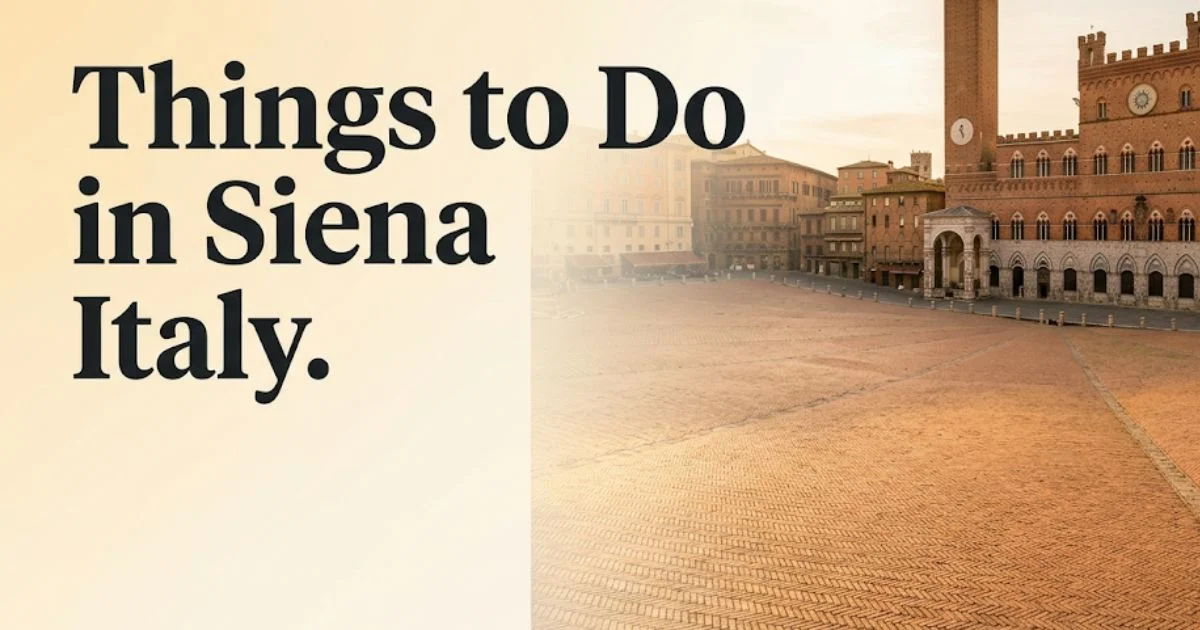
Piazza del Campo is the heart of Siena and one of the finest medieval public squares in Europe, shaped like a scallop shell sloping toward the Palazzo Pubblico.
The square is divided into nine segments by thin marble lines. This honors the Council of Nine who governed Siena during its medieval peak, from the late 13th to early 14th century.
The Campo functions as the city’s actual living room. Locals sit on the brick surface in the early evenings. Visitors tend to cluster at the café edges, which is exactly backwards.
The best time to experience the Campo is at sunrise before 8 a.m. The second-best window is after 7 p.m. when tour groups have departed for Florence.
Insider Tip:
- Sit directly on the Campo’s brick surface, as locals do. Bring a bottle of water from a nearby alimentari.
- The fountain at the upper edge, Fonte Gaia, is a 19th-century marble replica. The original Jacopo della Quercia panels are in the Museo Civico.
- Couples find the Campo most romantic at night. The medieval roofline is lit softly and the space feels genuinely intimate after 8 p.m.
Families with children: Young children enjoy the sloped open space. Strollers are manageable on the Campo’s surface but the surrounding streets leading to it are steep and cobblestoned.
Siena Duomo and Cathedral Complex: What You Need to Know
The Duomo di Siena (Cattedrale di Santa Maria Assunta) is among Italy’s finest Gothic cathedrals and requires significantly more time than most visitors allocate.
The cathedral facade alone, in white, green, and red marble, is a complete artistic education. The interior floor, covered by 56 inlaid marble panels depicting biblical and allegorical scenes, is extraordinary.
The OPA SI Pass bundles the Duomo, Museo dell’Opera, Battistero di San Giovanni, Cripta, and Biblioteca Piccolomini into one ticket. Purchase it online through Opera della Metropolitana di Siena before arrival.
From April through October, advance booking is strongly recommended. Walk-up tickets may be unavailable on busy days.
Allow a minimum of two hours for the full Duomo complex. Three hours is more realistic if you include Museo dell’Opera.
| Duomo Complex Site | Highlight | Accessibility Note |
|---|---|---|
| Cathedral nave | Marble inlaid floor, Nicola Pisano pulpit | Level entry; interior mostly accessible |
| Biblioteca Piccolomini | Pinturicchio fresco cycles (1490s) | Step access; not stroller-friendly |
| Museo dell’Opera | Duccio’s Maestà altarpiece | Multiple levels; elevator limited |
| Battistero di San Giovanni | Donatello and Ghiberti baptismal font | Down a full staircase from street level |
| Cripta | Rediscovered medieval frescoes | Step access; tight space |
Seniors and mobility-limited travelers: The cathedral nave is manageable. The Biblioteca Piccolomini, Battistero, and Cripta all involve steps that make them challenging for mobility-limited visitors. Confirm accessibility details with Opera della Metropolitana di Siena before booking.
Torre del Mangia and Palazzo Pubblico: Climbing Siena’s Skyline
Torre del Mangia rises 88 meters above Piazza del Campo and offers the clearest panoramic view of Siena’s roofline and the surrounding Tuscan hills.
The tower was completed in 1348, the same year the Black Death devastated Siena’s population and permanently altered the city’s trajectory. This historical weight makes the view genuinely affecting, not just scenic.
The climb involves approximately 400 steps with a narrow staircase. There is no elevator. Daily visitor capacity is limited.
To climb the tower in 2026, arrive at the Palazzo Pubblico ticket desk early, ideally before 9 a.m., or check for reservation availability through the Comune di Siena booking system. Verify current reservation procedures before visiting.
The Museo Civico inside Palazzo Pubblico is frequently overlooked by visitors who photograph the exterior but skip the interior. Simone Martini’s Maestà fresco and Ambrogio Lorenzetti’s Allegory of Good and Bad Government are inside, and these are among the most significant secular medieval frescoes in existence.
Insider Tip:
- Visit the Museo Civico before climbing the tower. The Lorenzetti frescoes provide essential context for understanding medieval Siena.
- Solo travelers and couples find the tower climb straightforward. Families with children under 8 may find the narrow staircase difficult to manage safely.
- The climb is physically demanding in summer heat. Go early morning or wait for evening when temperatures drop.
Seniors and mobility-limited travelers: Torre del Mangia is not accessible by any mobility aid. The Museo Civico ground floor frescoes are viewable without the full climb.
Key Takeaway: The Museo Civico’s Lorenzetti frescoes are among the most important medieval secular paintings in Italy, and most Siena visitors walk past them entirely.
Siena Contrade Neighborhoods: The City’s Hidden Structure
Siena is divided into 17 contrade, or historic neighborhood territories, each with its own symbol, colors, church, museum, and fountain, and each maintaining fierce civic pride that has lasted since medieval times.
These are not tourist constructs. The contrade baptize their members at birth, hold community dinners, maintain their own museums, and compete against each other in the Palio twice annually.
The three main city divisions are Terzo di Città (the oldest southern zone, including the Duomo quarter), Terzo di San Martino (the eastern third around Piazza del Campo), and Terzo di Camollia (the northern third leading toward the Florence gate).
Walking between the contrade at your own pace is one of the most rewarding free activities in Siena. Each contrade fountain is unique, and the small neighborhood churches are often unlocked and empty.
Insider Tip:
- Look for the contrade symbols embedded in street corners: ceramic plaques showing the eagle, snail, tortoise, giraffe, and 13 other symbols mark the territories.
- The Contrada della Tartuca (tortoise) museum on Via Tommaso Pendola occasionally opens for visitors; check with the local tourist office for current access.
- Experienced repeat visitors to Siena say the contrade neighborhoods after 7 p.m. are the truest version of the city, free of day-trip crowds and genuinely local in feeling.
Couples: Walking the contrade at dusk, with aperitivo stops at local bars along Via Banchi di Sotto, makes for one of the most romantic evenings available in any Italian city.
Palio di Siena: What You Need to Know Before Going
The Palio di Siena is a horse race held twice annually, on July 2 and August 16, in which 10 of the 17 contrade compete in three laps around Piazza del Campo.
It is one of the most genuinely dramatic public events in Italy and one of the most misunderstood by first-time visitors who arrive expecting a festival and find something far more intense.
The race itself lasts approximately 90 seconds. The preparations, pageantry, trial races, and neighborhood politics around the Palio consume three full days.
Standing in the center of the Campo (the free standing area) requires arriving hours before the race and remaining standing in dense heat with no exit option until after the event. Grandstand seats around the Campo perimeter require booking months in advance through local agencies; prices for 2026 seating should be researched through licensed Palio seat vendors.
Honest assessment: The Palio is extraordinary. It is also genuinely exhausting, extremely crowded, and logistically demanding in summer heat. Families with young children should reconsider attending. Seniors face significant physical challenges with the standing requirement and heat exposure.
Insider Tip:
- The trial races (prove) in the days before the actual Palio are less crowded and give a genuine feel for the event without the extreme crowd conditions.
- Attend a contrade dinner the night before the race for the authentic cultural context. Contact Siena’s official tourism office for current community dinner availability.
- If attending during Palio period, book accommodation at least four to six months in advance. Prices during Palio week represent the annual peak.
What to Eat in Siena Italy: The Real Food Guide
The definitive Siena dish is pici, a thick hand-rolled pasta resembling a fat spaghetti, typically served with cacio e pepe or wild boar (cinghiale) ragù.
Crostini toscani are the essential Sienese antipasto: chicken liver pâté on toasted bread, seasoned with capers and anchovy. They appear on nearly every serious local menu and should be your first order at any trattoria.
For sweets, ricciarelli (almond-based soft cookies dusted in powdered sugar) and panforte (a dense spiced fruit and nut cake) are both Siena originals with protected geographic indication status.
The best pici in the city can be found at Trattoria Papei on Piazza del Mercato, directly behind Palazzo Pubblico. It is a family-run trattoria with paper tablecloths and a menu that has not chased trend for decades.
For a more considered dinner, Osteria Le Logge on Via del Porrione is a long-standing local institution. It occupies a converted 19th-century pharmacy. Reserve in advance.
Budget travelers: Both Trattoria Papei and the market stalls around Piazza del Mercato offer genuinely affordable, genuinely local meals. Avoid the high-turnover restaurants directly on Piazza del Campo, where menu prices reflect location rather than quality.
Insider Tip:
- For gelato, seek out Gelateria Brivido near Piazza del Campo. It uses traditional methods and local seasonal ingredients.
- The best late-morning snack in Siena is a schiacciata (flat Tuscan bread) from any local forno (bakery). Via di Pantaneto and Via dei Rossi have good options.
- Couples: book Osteria Le Logge for dinner, not lunch. The evening lighting inside the old pharmacy setting is specifically romantic in a way that functions differently from the lunch crowd.
Key Takeaway: Eat pici at Trattoria Papei on Piazza del Mercato, not at a restaurant facing Piazza del Campo. The difference in price and quality is significant.
Siena Wine and Enoteca Italiana: A Different Kind of Tasting
Enoteca Italiana, housed inside the 16th-century Fortezza Medicea, is the only national wine library in Italy and one of the most underused resources in Siena.
The enoteca stocks wines from across all Italian regions, with a particular depth in Tuscan designations: Brunello di Montalcino, Chianti Classico, Vino Nobile di Montepulciano, and Vernaccia di San Gimignano.
Entry is free. You pay for what you drink, by the glass or by the bottle. This is a genuinely civilized arrangement that almost no visitor seems to know about.
The Fortezza Medicea surrounding the enoteca is open as a public park. Walking its ramparts in the late afternoon gives a different view of the city skyline than Torre del Mangia.
Wine travelers: The enoteca is an excellent briefing session before a day trip into Chianti or Val d’Orcia wine country. The staff can make specific producer recommendations for winery visits.
Budget travelers: A glass of quality Brunello at Enoteca Italiana costs significantly less than tourist-facing wine bars near the Campo. It is the highest quality-to-cost ratio for wine in the city.
Insider Tip:
- Visit the enoteca in the late afternoon, around 5 to 6 p.m. The crowd is lighter and the fortezza garden is at its best in the early evening light.
- According to Toscana Promozione Turistica, Siena is the ideal base for exploring five major Tuscan wine designations within a 60-kilometer radius. Use the enoteca to narrow which ones to prioritize.
Siena Day Trips: Chianti, San Gimignano, and Montalcino
Siena is the best base in Tuscany for day trips into the surrounding wine country and hill towns.
The three most practical day trips from Siena, in terms of accessibility and reward-to-travel-time ratio, are San Gimignano (tower town, 38 kilometers northwest), Montalcino (Brunello country, 40 kilometers south), and Pienza in Val d’Orcia (53 kilometers southeast).
| Day Trip | Distance from Siena | How to Get There | Primary Draw | Best For |
|---|---|---|---|---|
| San Gimignano | 38 km | Bus from Piazza Gramsci (about 1 hr 15 min) | Medieval towers, Vernaccia wine | Day-trippers, first-timers |
| Montalcino | 40 km | Bus (about 1 hr 20 min) or rental car | Brunello di Montalcino wineries | Wine travelers, couples |
| Pienza / Val d’Orcia | 53 km | Rental car recommended | UNESCO landscape, Pecorino cheese | Couples, photographers |
| Montepulciano | 65 km | Bus with connection or rental car | Vino Nobile, hilltop architecture | Wine travelers |
| Chianti Classico route | Variable | Rental car essential | Vineyard drives, village stops | Wine travelers, couples |
Honest note on San Gimignano: It is genuinely worth seeing for the towers and the Vernaccia wine. It is also one of the most tourist-saturated small towns in Italy. Visit in the morning before 10 a.m. or after 4 p.m. when day-trip buses have cleared.
Rental car note: The Chianti Classico drive along the Strada dei Vini del Chianti Classico requires a car. It cannot be done meaningfully on public transport. If you are not driving in Italy, prioritize Montalcino or San Gimignano, both accessible by bus from Piazza Gramsci.
Families: San Gimignano works reasonably well for families with older children. The town is compact and visually dramatic. Montalcino and Val d’Orcia are better suited to travelers whose primary interest is wine and landscape.
Key Takeaway: If you have one day trip from Siena and you can drive, the Val d’Orcia landscape between Pienza and Montalcino is among the finest in Europe.
Best Time to Visit Siena Italy
The best time to visit Siena Italy is late April through early June or September through October.
Spring brings mild temperatures between 16°C and 22°C (61°F to 72°F), green Tuscan hillsides, and manageable crowds. The Duomo complex and Campo are accessible without the competition of peak summer.
September and October layer in the grape harvest season. The Chianti and Val d’Orcia landscapes are at their most atmospheric. Temperatures drop to comfortable levels after the August peak.
July and August are the worst months for most visitors. Daily temperatures regularly exceed 35°C (95°F). The July 2 and August 16 Palio dates create the most extreme crowd and pricing spikes of the year. Accommodation availability around those dates requires six-month advance booking.
Winter (November through February) offers the lowest prices and fewest crowds. Some attractions have reduced hours. The city is cold and occasionally wet. For travelers prioritizing cost over weather, winter Siena is a legitimate option.
Couples: May and early October are the two most romantic windows. The light is warm, the crowds are manageable, and the surrounding countryside is visually at its peak in both seasons.
Budget travelers: November through February (excluding Christmas week) delivers significantly lower accommodation rates and no queue pressure at any attraction.
How to Get to Siena from Florence
The fastest and most practical way to get from Florence to Siena is the Sita Nord express bus, departing from the lower level of Santa Maria Novella station in Florence.
The direct bus takes approximately 1 hour 15 minutes to 1 hour 30 minutes and arrives at Piazza Gramsci on the northern edge of Siena’s historic center. Bus services run frequently throughout the day. Check the Sita Nord website for current 2026 schedules and pricing before travel.
The train alternative requires changing trains at Empoli and takes significantly longer than the bus, typically 1 hour 45 minutes to 2 hours or more. The train station in Siena is also located outside the historic center, requiring a further local bus connection.
Driving from Florence follows the Superstrada Firenze-Siena (SR2), approximately 1 hour without traffic. However, parking in Siena requires using designated lots outside the historic center walls. Parcheggio il Campo (accessible via Via Esterna di Fontebranda) and Parcheggio della Fortezza are the primary options.
Critical driving warning: The ZTL zone begins immediately inside the city walls and is enforced by automatic cameras. Rental car drivers who enter without authorization face significant administrative fines issued through their rental company. Do not drive into the centro storico without explicit authorization confirmed in advance.
Budget travelers: The Sita Nord bus is the most economical option. Current pricing should be verified on the Sita Nord website; fares are generally low and bookable online.
Getting Around Siena and Practical Logistics
Siena’s historic center is entirely walkable. Once inside the walls, you navigate on foot.
The city is built across three hills, which means almost every route involves either climbing or descending. This is not a flat city. Comfortable walking shoes with grip are not optional; they are essential, especially on wet cobblestones.
The main pedestrian spine connects Piazza Gramsci (north) through Via Banchi di Sopra, Piazza Tolomei, and Via di Città to the Duomo quarter. This route covers the essential city in about 15 minutes of walking, passing the Campo along the way.
Local city buses operated by Tiemme connect the train station, Piazza Gramsci, and Piazza San Domenico. Within the historic center, buses do not run. Walking is the only option.
Seniors and accessibility travelers: The terrain of Siena is among the most challenging of any major Italian historic center. Via di Città and most routes to and from the Campo involve substantial grades. Several adaptive routes exist on flatter stretches of Via Banchi di Sopra and around Piazza del Mercato, but full accessibility across the city is not realistic. Contact the Comune di Siena accessibility office before planning a Siena itinerary around mobility limitations.
Families with strollers: A stroller is technically possible on some routes but genuinely difficult on most. A front carrier or backpack carrier for young children is a more practical solution for Siena specifically.
One Day in Siena Itinerary: A Realistic Framework
One full day in Siena, structured well, covers the essential historic center without feeling rushed.
The single biggest mistake of a one-day Siena visit is starting at the Campo and staying near the Campo. The city’s depth is in the Duomo quarter and the Pinacoteca, both of which require intentional navigation away from the obvious center.
One Day in Siena: Suggested Sequence
- Arrive by 8 a.m. at Piazza Gramsci by the first morning Sita Nord bus from Florence.
- Walk south along Via Banchi di Sopra to experience the city before crowds build.
- Spend 30 minutes at Piazza del Campo in the morning light. Photograph and sit on the brick surface.
- Walk to Palazzo Pubblico and buy Torre del Mangia tickets immediately if climbing. Capacity limits mean early arrival matters.
- Visit Museo Civico (Lorenzetti and Martini frescoes) for 45 to 60 minutes.
- Walk west to the Duomo complex. Allow 2 to 3 hours for the OPA SI Pass bundle, prioritizing Biblioteca Piccolomini and Museo dell’Opera.
- Lunch at Trattoria Papei on Piazza del Mercato, directly behind Palazzo Pubblico.
- Afternoon: Pinacoteca Nazionale on Via San Pietro (1.5 hours; rarely crowded).
- Late afternoon: Enoteca Italiana in Fortezza Medicea for a glass of wine and the fortezza garden views.
- Return to Piazza del Campo for the evening light and a final sit on the brick surface before departing.
Two-day extension: Add a morning contrade walking tour in the Terzo di Camollia, an afternoon visit to Basilica di San Domenico, and a day trip to Montalcino or Pienza on day two.
Couples: Extend day one into the evening. Book dinner at Osteria Le Logge for 8 p.m. and walk the contrade after dinner when the city is essentially yours.
Key Takeaway: Buy OPA SI Pass tickets online before arriving. Walk-up availability at the Duomo complex disappears early on peak days, and no amount of arriving early fully replaces an advance reservation from April through October.
Siena Italy Travel Tips and What Most Visitors Get Wrong
The single most common mistake in Siena is treating it as a half-day stop rather than an overnight destination.
The day-trip version of Siena, from Florence and back in one day, is a legitimate choice for schedule-constrained travelers. It will show you the Campo and the outside of the Duomo. It will not show you the city.
Siena after 7 p.m. is categorically different from Siena at 11 a.m. The crowds disappear, the streets become quiet, the light on the medieval stone is warm and directional, and the Campo becomes what it actually is: a living public space used by the people who live there.
What to avoid:
- Restaurants on the perimeter of Piazza del Campo are priced for tourists and deliver tourist-level food. Walk two streets away for every category of meal.
- Booking a rental car and attempting to drive inside the historic center. The ZTL camera system is automated and the fines arrive by mail weeks after departure.
- Spending the entire Duomo visit in the cathedral nave without entering Biblioteca Piccolomini. It is the single most overlooked great thing in Siena.
- Planning the Palio as a casual stop. It requires serious logistical planning if you want a proper view.
What locals know:
- The Orto Botanico dell’Università di Siena on Via Pier Andrea Mattioli is a working botanical garden open to the public and essentially tourist-free. It provides the calmest 45 minutes available in the city.
- The Basilica di Santa Maria dei Servi in the southern Terzo di Città has a Cimabue-attributed painting and Lorenzetti’s Massacre of the Innocents in near-total quiet.
- Aperitivo hour in Siena runs from about 6 to 8 p.m. Join it at a bar on Via Banchi di Sotto rather than anywhere near the Campo for the most genuinely local experience.
Insider Tip:
- According to Lonely Planet’s Italy editorial coverage, Siena is among the five most atmospheric medieval cities in Europe. The detail they consistently underreport is the contrade culture, which is the most distinctly Sienese thing about the city and the hardest to experience without staying overnight.
- Book a local guide for a contrade-focused walking tour if this is your primary interest. Contextual knowledge transforms what looks like ordinary street signage into a 700-year civic drama.
Safety and Practical Warnings for Siena
Siena is a low-crime destination with no concentrated safety risk zones in the historic center.
The primary physical risks are environmental and terrain-related. Wet cobblestones on steep grades are a genuine fall hazard. Footwear with flat rubber soles is the specific practical requirement.
Key safety and practical facts every visitor should know:
- Summer heat warning: July and August temperatures in Siena regularly exceed 35°C (95°F). Carry water constantly. The open Piazza del Campo offers limited shade. Sun exposure risk is real, particularly for children and seniors.
- ZTL enforcement: Automatic cameras monitor all entry points to the ZTL zone. Rental car drivers who enter receive fines through their rental company. Verify your hotel’s location relative to ZTL boundaries before driving.
- Pickpocket awareness: Siena has a lower pickpocket risk than Florence or Rome. Standard precautions apply around Piazza del Campo during peak tourist hours: use a cross-body bag and keep phones secured.
- Torre del Mangia climb safety: The staircase is narrow and steep. It is not recommended for travelers with vertigo, heart conditions, or significant mobility limitations. The climb is physically demanding in warm weather.
- Medical facilities: The Azienda Ospedaliera Universitaria Senese (Policlinico Le Scotte) is Siena’s main hospital, located on Viale Mario Bracci outside the historic center. Emergency services number in Italy: 112.
Frequently Asked Questions About Things to Do in Siena Italy
How many days do you need in Siena Italy?
Two days is the minimum to experience Siena’s major attractions without rushing.
One day covers Piazza del Campo, the Duomo complex, and one museum at a brisk pace.
A second day allows contrade neighborhood exploration, Pinacoteca Nazionale, Enoteca Italiana, and a half-day trip to Montalcino or San Gimignano.
Is Siena worth visiting, or is it just a day trip from Florence?
Siena is worth a dedicated overnight stay, not just a day trip.
The city transforms after 7 p.m. when day-trippers depart and the medieval streets become quiet and genuinely local.
Day-tripping from Florence is a legitimate option for schedule-constrained travelers, but it shows you only the surface layer of a city with significant depth.
What is the best time of year to visit Siena?
The best time to visit Siena is late April through early June and September through mid-October.
Both windows offer mild temperatures, manageable crowds, and the most attractive Tuscan landscape conditions.
July and August bring extreme heat, peak prices, and the highest crowd density, with Palio dates on July 2 and August 16 representing the most intense visitor pressure of the year.
Do you need to book Siena attractions in advance?
The OPA SI Pass for the Duomo complex should be booked online in advance, particularly from April through October.
Torre del Mangia has limited daily climbing capacity and advance reservation is advisable during peak months.
Verify current reservation requirements directly with Opera della Metropolitana di Siena and the Comune di Siena before your visit, as booking systems for 2026 should be confirmed closer to your travel date.
Is Siena walkable, and can people with mobility limitations manage the city?
Siena is fully walkable but built across three steep hills with extensive cobblestone paving.
For most travelers, the terrain is manageable with proper footwear and reasonable fitness.
Seniors and travelers with significant mobility limitations face real challenges throughout the historic center. Flat accessible routes exist along Via Banchi di Sopra and around Piazza del Mercato, but full city access without physical difficulty is not realistic in Siena’s medieval topography.
What food should you definitely try in Siena Italy?
The essential Siena dishes are pici pasta (thick hand-rolled pasta with ragù or cacio e pepe), crostini toscani (chicken liver pâté on toasted bread), and panforte (dense spiced fruit and nut cake).
Ricciarelli almond cookies, Brunello di Montalcino wine, and local Pecorino cheese from nearby Pienza are the essential food and drink companions.
Eat pici at Trattoria Papei on Piazza del Mercato. Skip the restaurants on Piazza del Campo’s perimeter for everything except a coffee while standing at the bar.
Planning Your Siena Trip: The Practical Closing Framework
Siena rewards travelers who plan one specific thing in advance and leave the rest to the city itself. Book the OPA SI Pass for the Duomo complex online before you depart. That single reservation unlocks the cathedral, Biblioteca Piccolomini, Museo dell’Opera, and Battistero without queue pressure.
Arrive by bus from Florence, stay at least one night inside the walls, eat dinner away from the Campo, and plan to spend an evening hour simply sitting in Piazza del Campo after the day-trippers leave. That hour will tell you more about Siena than any attraction.
Travel conditions, operating hours, ticket prices, and booking systems for 2026 change. Verify current logistics directly with Opera della Metropolitana di Siena, Sita Nord, and Toscana Promozione Turistica before departure. The city is worth the planning it takes to experience it properly.