
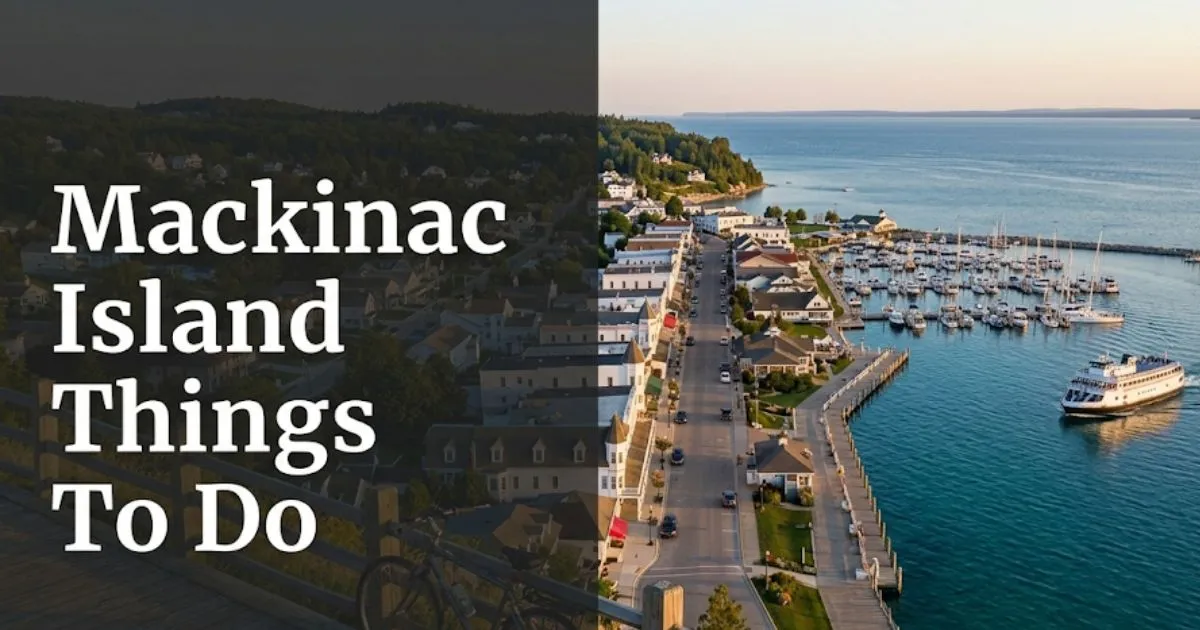
Mackinac Island Things To Do: The 2026 Complete Guide

Mackinac Island things to do range from cycling a car-free perimeter road above Lake Huron to touring a 19th-century military fort. This Michigan island packs more genuine historical and natural character into 3.8 square miles than most destinations manage in an entire county.
No cars are allowed here. That single fact shapes every activity, every pace of movement, and every decision you make from the moment the ferry docks.
This guide covers the best activities across every traveler type, the honest seasonal realities, the ferry logistics, and the one planning mistake that turns a great island visit into a crowded, expensive afternoon of fudge and regret.
What Mackinac Island Is Known For
Mackinac Island is known for three defining characteristics: a complete ban on motorized vehicles, exceptional 19th-century military and colonial history, and a fudge-making tradition so pervasive that the island is sometimes called the fudge capital of the world.
The vehicle ban has been in place since 1898. Every visitor, resident, and delivery operates by horse, bicycle, or foot.
Mackinac State Historic Parks, managed by the Michigan Department of Natural Resources, covers over 80 percent of the island’s land area. That means most of Mackinac Island is preserved state parkland, not commercial development.
The Victorian-era architecture along Main Street and the blufftop Fort Mackinac give the island a physical character unlike any other Great Lakes destination. These are not reconstructed facades.
Insider Tip:
- The fudge shops on Main Street are genuinely good, but the waterfront commercial strip is also the most crowded part of the island by far.
- Arrive by the first morning ferry and head immediately for the interior trails or the fort before crowds build.
- Solo travelers and couples who explore beyond the Main Street corridor get a fundamentally different, quieter island experience.
Best Things To Do on Mackinac Island
The best things to do on Mackinac Island in 2026 are cycling the 8.2-mile M-185 perimeter road, touring Fort Mackinac, hiking to Arch Rock, and exploring the inland trail network of Mackinac Island State Park.
Beyond those four, the island offers horse-drawn carriage tours, the Mackinac Island Butterfly House, fudge tasting, kayaking along the shoreline, and the experience of walking the Grand Hotel grounds.
| Activity | Best For | Approx. Cost | Time Required | Insider Note |
|---|---|---|---|---|
| Cycling M-185 | All profiles | $10-$30/hr rental | 1.5 to 2.5 hrs | Counterclockwise avoids steeper grades early |
| Fort Mackinac | Families, history travelers | $15-$25 adult | 2 to 3 hrs | Early morning visit skips the midday crowds |
| Arch Rock hike | Active adults, couples | Free with park entry | 45 min round trip | Take the trail, not the road, for best views |
| Grand Hotel grounds | Couples, seniors | Separate fee for non-guests | 1 hr stroll | Porch access has a dress code; no jeans |
| Butterfly House | Families, casual visitors | $8-$12 per person | 45 min to 1 hr | Best in the morning when butterflies are most active |
| Horse-drawn carriage tour | Families, seniors | $35-$50 per person | 1.5 to 2 hrs | Narrated tours cover more ground with less physical effort |
| Interior trail hiking | Experienced hikers, solo travelers | Free with park entry | 2 to 4 hrs | Sugar Loaf Rock and Skull Cave see a fraction of Arch Rock’s crowd |
According to the Mackinac Island Tourism Bureau, the island hosts approximately one million visitors annually, concentrated between Memorial Day and Labor Day.
Cycling and Biking on Mackinac Island
Cycling the M-185 perimeter road is the single most iconic thing to do on Mackinac Island. M-185 is the only state highway in the United States with a permanent ban on motor vehicles.
The full loop is 8.2 miles and takes most riders between 90 minutes and 2.5 hours, depending on pace and stops. The road hugs the shoreline almost entirely, with Lake Huron views throughout.
Bike rentals are available from multiple shops near the ferry docks on Main Street, including Ryba’s Bikes and Island Bicycle. Rental rates run approximately $10 to $30 per hour depending on bike type, with surrey bikes and tandems at the higher end.
Profile note for families: Children who can ride independently enjoy M-185 fully. Children too young to ride on their own require a tag-along trailer or surrey bike, which Ryba’s rents but at a premium and with availability limitations on peak weekends.
Profile note for seniors: The first half of M-185 heading west from the docks is relatively flat. The eastern section near British Landing and the south bluff involves more elevation. Electric assist bikes are available from select rental shops but supply is limited.
Insider Tip:
- Riding counterclockwise (west from the docks toward British Landing first) means tackling the flatter lakeside stretches before the hillier south sections.
- The 7 a.m. to 9 a.m. window on weekdays in shoulder season offers M-185 with almost no other cyclists.
- Stop at British Landing for the picnic area and lake views, which most riders speed past without pausing.
Avoid cycling M-185 between 11 a.m. and 3 p.m. on summer weekends. Bike density reaches a level that genuinely degrades the experience during those hours.
Fort Mackinac and Mackinac Island History
Fort Mackinac is the most historically substantive attraction on the island and one of the best-preserved frontier military forts in the entire Great Lakes region. It sits on a limestone bluff above the harbor with sweeping views of the Straits of Mackinac.
The fort was originally built by the British in 1780 and occupied by American forces after the War of 1812. Its 14 original buildings are all accessible, including the officer’s quarters, soldier barracks, and military blockhouses.
Admission runs approximately $15 to $25 per adult as of recent seasons, with reduced rates for children and family packages available through Mackinac State Historic Parks. The site is typically open daily from mid-May through mid-October, with seasonal hours that narrow in spring and fall.
Living history demonstrations run throughout the day during peak season, including cannon firings, rifle demonstrations, and period-costumed interpreters. These are genuinely engaging for children aged 6 and up.
Profile note for families: Fort Mackinac is one of the few island attractions that fully delivers on its appeal for children. The cannon firing demonstrations are timed, so check the daily schedule at the gate upon arrival.
Profile note for budget travelers: Fort Mackinac is worth the admission cost. It is one of the few attractions on the island where the price reflects genuine educational and historical depth, not just a scenic view or a souvenir opportunity.
Insider Tip:
- The tea room inside the fort serves lunch with harbor views and is significantly less crowded than the Main Street restaurant options.
- The Richard and Jane Manoogian Mackinac Art Museum is included with fort admission and is overlooked by most visitors.
- Arrive at fort opening to catch the first demonstrations without crowd competition.
Key Takeaway: Book your ferry in advance for any summer weekend visit. The ferry is the only way on or off the island, and sold-out morning departures are a real logistical problem.
Grand Hotel Mackinac Island
The Grand Hotel is the most photographed building on Mackinac Island and holds a legitimate historical reputation as one of the great Victorian resort hotels in the United States. Its 660-foot front porch is the longest in the world.
Non-guests pay an access fee to walk the grounds and porch, which runs approximately $10 to $15 per person as of recent years. The dress code is enforced for non-guests during evening hours: jeans and athletic wear are not permitted after 6 p.m.
The hotel’s Main Dining Room serves a formal five-course dinner requiring a reservation and appropriate attire. Lunch on the porch is a more accessible and less expensive option for visitors not staying overnight.
Accommodations at the Grand Hotel run at premium rates, typically several hundred dollars per night, with significant variation by room type and season. The property is a genuine landmark, but the experience of staying here is specifically calibrated for couples and celebratory occasions.
Profile note for couples: The Grand Hotel porch at sunset is one of the genuinely romantic experiences the island delivers on. Budget an evening here if the trip has a celebratory context.
Profile note for budget travelers: The access fee provides the porch experience without the room rate. Arriving mid-morning on a weekday in shoulder season means the porch is quiet and the views are fully available without the evening crowd.
The honest assessment: The Grand Hotel earns its reputation as a historic landmark. As a dining destination for a casual visitor, it is expensive and heavily reliant on formal dress requirements that catch some visitors off guard.
Mackinac Island State Park and Hiking Trails
Mackinac Island State Park covers over 1,800 acres and 70 miles of interior trails, making it one of the most extensive and least-utilized parts of the island for most visitors. The park was established in 1895, making it the second-oldest state park in the United States.
Interior trails reach natural limestone formations including Sugar Loaf Rock, Skull Cave, and Devil’s Kitchen. These see a fraction of the visitors that Arch Rock draws and offer genuinely quiet forest hiking within a 20-minute walk of the ferry docks.
Trails are unpaved and range from flat lakeside routes to moderately hilly interior paths. Most are accessible on foot or by bike. The terrain is not stroller-friendly beyond the main perimeter road.
Profile note for solo travelers: The interior trail network is where Mackinac Island genuinely rewards the traveler willing to go beyond the waterfront. Sugar Loaf Rock, a 30-foot free-standing limestone column, is 10 minutes from the downtown cluster and sees a fraction of Arch Rock’s crowds.
Profile note for seniors and accessibility travelers: The main perimeter road M-185 is paved and relatively flat on the western section. Interior trails involve uneven terrain and are not accessible for wheelchairs or mobility aids in most sections.
According to the Michigan Department of Natural Resources, Mackinac Island State Park’s interior trail network is free to access with no permit requirement. Most visitors never leave the commercial waterfront.
Insider Tip:
- The British Landing Nature Center on the north shore of the island offers free natural history interpretation and is almost never crowded.
- Skull Cave was used as a hiding place during the 1763 massacre at Fort Michilimackinac. The historical context is remarkable and the site receives almost no visitor attention.
- Bring water for any trail beyond 30 minutes. There are no water stations in the interior park.
Arch Rock Mackinac Island
Arch Rock is a natural limestone arch rising 146 feet above Lake Huron’s shoreline, formed by water erosion over thousands of years. It is the island’s most recognizable natural landmark and a National Natural Landmark.
The arch is accessible by hiking trail from downtown (approximately 20 to 30 minutes on foot), by bicycle along M-185 and connecting paths, or by horse-drawn carriage tour. There is no admission charge to view Arch Rock itself.
The viewpoint at the arch is a narrow platform that becomes crowded between 11 a.m. and 3 p.m. during peak summer season. The view across Lake Huron from 146 feet above the water is genuinely exceptional and earns its reputation.
Profile note for families: Children who are comfortable on hiking trails will enjoy the walk to Arch Rock. The path involves some steps and elevation. Strollers cannot be used on the trail approach.
Profile note for couples: Arriving at Arch Rock at 8 a.m. before the ferry crowds build means having the platform nearly to yourself. This is one of those cases where early access transforms a crowded tourist stop into a quiet, genuinely moving natural experience.
The local alternative: Most visitors who come to Arch Rock never hike another 10 minutes to Sugar Loaf Rock. Sugar Loaf is less dramatic visually but far more peaceful and offers a different geological character.
Key Takeaway: The interior trails and natural limestone formations beyond Arch Rock are where the island’s genuinely quiet, crowd-free experience lives. Most visitors never find them.
Mackinac Island Butterfly House
The Mackinac Island Butterfly House, operated under the name Wings of Mackinac, is a tropical butterfly conservatory located on McGulpin Street, a short walk uphill from the ferry docks. It houses hundreds of free-flying butterflies in a warm greenhouse environment.
Admission runs approximately $8 to $12 per person as of recent years, with children under 5 typically free. The facility is open seasonally, generally from mid-May through mid-October, with hours that vary by season.
The conservatory is genuinely engaging for children and a pleasant 45-minute stop for adults who enjoy natural history. It is not a landmark experience for adult visitors traveling without children.
Profile note for families: The Butterfly House works well for children between ages 3 and 10. Butterflies land on visitors, which creates memorable moments for young children. The indoor environment is temperature-controlled and provides a break from summer heat.
Profile note for solo travelers and couples: The Butterfly House is a pleasant add-on but not a primary reason to visit Mackinac Island. Combine it with a walk to Sugar Loaf Rock on the same morning.
Insider Tip:
- Butterfly activity is highest in the morning when the greenhouse is warmest.
- Wearing bright colors, particularly red, orange, and yellow, increases the likelihood of butterflies landing on you.
- The facility is small. Budget 45 minutes maximum and plan it between major activities rather than as a standalone destination.
Mackinac Island Fudge and Local Food
Mackinac Island fudge is a legitimate local tradition, not a manufactured tourist gimmick. The island’s candy shops have been making copper-kettle fudge since the late 19th century, and the craft has been practiced continuously for over 130 years.
Ryba’s Fudge Shops and Joann’s Fudge are the two most established names, each with multiple locations on Main Street and Market Street. Ryba’s tends to draw the largest tourist crowds. Joann’s has a loyal local following and slightly less foot traffic in its Market Street location.
The honest assessment of Mackinac Island dining: beyond fudge and a handful of mid-range restaurants, the island’s food scene is limited by its isolated geography and near-captive audience. Dining prices run higher than equivalent mainland options.
The Yankee Rebel Tavern on Astor Street serves reliable pub food in a less tourist-facing environment than the Main Street corridor. The Pink Pony at the Chippewa Hotel offers waterfront dining with harbor views and a lively bar scene during summer evenings.
Profile note for budget travelers: Packing your own lunch for the ferry ride and trail hiking is the most effective budget move on Mackinac Island. Grocery and deli options on the island are limited and priced at a resort premium.
Insider Tip:
- The fudge shops do free samples openly. Walking the length of Main Street and sampling is a genuine no-cost island experience.
- Joann’s Market Street location typically has shorter lines than Main Street locations on summer afternoons.
- The island’s breakfast options are limited. Eating before the ferry departure from Mackinaw City or St. Ignace saves time and money.
Key Takeaway: Joann’s Fudge on Market Street gives you the genuine Mackinac fudge experience with far less crowd pressure than the Main Street strip.
Horse-Drawn Carriage Tours Mackinac Island
Horse-drawn carriage tours are the defining transportation experience of Mackinac Island and the most practical way to cover significant island ground without cycling ability or extensive walking capacity. Mackinac Island Carriage Tours operates the primary narrated tour service, running horse-drawn carriages along a circuit that includes Fort Mackinac, Arch Rock, and several scenic overlooks.
Tours run approximately 1.5 to 2 hours and cover roughly 8 miles of the island. Pricing runs approximately $35 to $50 per adult as of recent seasons, with children’s rates available. Tours typically depart from the main docks area and run on a scheduled rotation during peak season.
Profile note for seniors and accessibility travelers: Horse-drawn carriage tours are the most accessible way to experience the island’s major attractions without significant physical exertion. Carriages accommodate mobility aids in most standard configurations, but verify specific accessibility needs directly with Mackinac Island Carriage Tours before booking.
Profile note for families: Narrated carriage tours work well for children ages 4 and up. Younger children may find the duration difficult. The educational commentary is designed to engage family groups.
The honest comparison: Carriage tours cover more ground with less physical effort than any other option. They do not, however, give you the freedom to stop, linger, or explore the areas that make the island genuinely remarkable. Pair a morning carriage tour with an afternoon of independent exploration.
Insider Tip:
- Book carriage tour spots in advance during peak summer weekends. Walk-up availability disappears quickly on busy Saturdays.
- The tour route passes through interior sections most cyclists skip, making it genuinely complementary to an M-185 bike ride rather than redundant.
Getting to Mackinac Island by Ferry
Getting to Mackinac Island requires a ferry crossing from either Mackinaw City on the Lower Peninsula or St. Ignace on the Upper Peninsula. Three ferry companies serve the island: Shepler’s Mackinac Island Ferry, Arnold Line, and Star Line Ferry.
All three companies operate from both Mackinaw City and St. Ignace. The crossing takes approximately 15 to 20 minutes from Mackinaw City and 12 to 15 minutes from St. Ignace. Round-trip adult fares run approximately $28 to $35 per person as of recent seasons, with children’s fares and vehicle parking fees additional.
Parking lots are available at both departure cities. Mackinaw City has more capacity and is typically the more convenient departure point for travelers coming from the south via I-75.
Booking guidance: Reserve ferry tickets in advance for any summer weekend, especially Memorial Day weekend, Fourth of July weekend, and Labor Day weekend. Walk-up availability exists during weekdays and shoulder season but is unreliable on peak Saturdays.
Profile note for families: Shepler’s and Arnold Line both accommodate strollers and child carriers on the ferry. Life jackets are available for children at no additional charge. The 15-minute crossing is manageable for most young children.
Profile note for budget travelers: Ferry pricing is nearly identical across all three companies. The competitive pricing structure means there is no significant cost advantage to choosing one over another, but schedules differ and frequency matters for day-trip timing.
To reach Mackinac Island by ferry efficiently:
- Drive to Mackinaw City via I-75 north and park in one of the main ferry company lots.
- Purchase round-trip tickets in advance online through Shepler’s, Arnold Line, or Star Line.
- Arrive at the dock at least 20 to 30 minutes before your departure.
- Board the ferry, stow larger bags, and choose an outdoor seat for the lake crossing views.
- Upon arrival at Mackinac Island’s Main Street dock, orient yourself immediately with a free island map from the information kiosk before starting your itinerary.
Best Time To Visit Mackinac Island
The best time to visit Mackinac Island is late May through early June and September through early October. These windows offer the full island experience with dramatically thinner crowds and lower accommodation rates than peak summer.
The Mackinac Island Lilac Festival runs annually in mid-June and celebrates the island’s famous lilac trees, which bloom abundantly throughout the village and state park. The festival brings crowds but also creates a genuinely beautiful visual and sensory atmosphere.
| Season | Crowd Level | Weather | Key Advantage | Primary Drawback |
|---|---|---|---|---|
| Late May to early June | Low to moderate | 55-70°F | Lilac Festival, green island, thin crowds | Some seasonal businesses just opening |
| July through August | Very high | 70-85°F | All attractions open, full ferry schedule | Crowded waterfront, premium pricing, capacity stress |
| September to early October | Low | 55-70°F | Fall color, quiet trails, lower rates | Some businesses close by early October |
| October to April | Closed/minimal | Cold to freezing | Near-solitude for serious travelers | Most attractions and businesses closed |
Summer peak (July through early August) is when the island hosts its largest crowds. The waterfront, fudge shops, and ferry lines all operate at or above comfortable capacity on peak weekends.
Profile note for couples: September is the best month for a romantic Mackinac Island trip. The fall color along M-185 is exceptional, accommodations are priced lower, and the island returns to a quieter, more intimate character.
Profile note for families: Late June, after the Lilac Festival crowds clear, through early July offers the widest range of open attractions with slightly less peak-season pressure than mid-July and August.
Key Takeaway: September on Mackinac Island offers fall color cycling, near-empty trails, and 30 to 40 percent lower accommodation rates compared to peak July. Most travelers never consider it.
Free and Budget Things To Do on Mackinac Island
Free things to do on Mackinac Island include hiking the state park interior trails, visiting Arch Rock, cycling M-185 with your own bike, swimming in Lake Huron at designated access points, and browsing the Main Street fudge shops for samples.
The state park land covering 80 percent of the island is freely accessible on foot or bicycle. Trails to Sugar Loaf Rock, Skull Cave, Devil’s Kitchen, and the British Landing area cost nothing beyond the effort to walk or cycle there.
Mackinac Island State Park charges no general admission fee. The fee-based experiences are Fort Mackinac, the Butterfly House, and Grand Hotel access for non-guests. The ferry is the unavoidable significant cost.
Free and low-cost activities:
- Hiking to Arch Rock via the Arch Rock Trail (free, 20-30 min on foot)
- Exploring Sugar Loaf Rock and Skull Cave (free, interior state park)
- Walking the entire Main Street and Market Street corridors for fudge samples
- Cycling M-185 with a rental bike (bike rental cost, no road fee)
- Visiting the British Landing Nature Center (free, north shore of island)
- Swimming at Lake Huron access points on the north shore near British Landing
- Viewing the Grand Hotel exterior from the road (no fee required)
Profile note for budget travelers: A budget-conscious Mackinac Island day trip is genuinely achievable. Pack your lunch, take the ferry, rent a bike for two hours, ride M-185, hike to Arch Rock and Sugar Loaf Rock, and spend an afternoon on the free trail network. The total cost beyond the ferry fare stays modest.
Mackinac Island Activities by Traveler Type
Mackinac Island suits couples, active adult travelers, history enthusiasts, and Michigan families making a classic regional trip particularly well. It requires honest planning adjustments for travelers with mobility limitations, families with infants, and budget travelers.
For solo travelers: The island’s walkable, self-paced structure suits independent exploration well. Solo cycling M-185, hiking the interior trails, and spending time at Fort Mackinac are all natural solo activities. The social scene is limited; the island is not a nightlife or bar-scene destination.
For couples: Mackinac Island delivers genuine romantic character: a car-free environment, historic Victorian architecture, the Grand Hotel porch, sunset views from Arch Rock, and quiet September cycling. It is one of the Great Lakes region’s most naturally romantic overnight destinations.
For families with children: The island works well for children ages 6 and up who can ride bikes independently. The cannon firings at Fort Mackinac and the Butterfly House are the most reliably engaging experiences for children. Families with children under 5 face logistical challenges in the car-free, trail-heavy environment.
For seniors and accessibility travelers: Horse-drawn carriage tours, the flat western section of M-185, and the Main Street and Market Street walking areas are the most accessible options. The island’s interior trails are not accessible for wheelchairs or walkers in most sections. Verify carriage tour accessibility accommodations directly with Mackinac Island Carriage Tours before arrival.
For budget travelers: The ferry is the unavoidable cost. Beyond that, the free state park access, self-guided hiking, and free fudge samples make a budget-conscious day trip workable. Avoid peak summer weekend pricing on accommodations unless a multi-day visit is the plan.
One Day Itinerary for Mackinac Island
A well-structured one-day Mackinac Island itinerary starts with the first morning ferry and ends on the last afternoon departure, covering the island’s core experiences without feeling rushed or missing the experiences that most day-trippers overlook.
Recommended One-Day Mackinac Island Itinerary:
- Take the 7:30 a.m. or 8 a.m. ferry from Mackinaw City. Book tickets in advance online.
- Rent a bicycle immediately upon arrival. Shops open early and inventory on peak days goes fast.
- Ride M-185 counterclockwise, stopping at British Landing for lake views and the nature center.
- Complete the full M-185 loop and return bikes by 11 a.m. before peak rental crowds.
- Walk or take a carriage to Fort Mackinac. Arrive by 11:30 a.m. to catch a midday cannon demonstration.
- Eat lunch at the Fort Mackinac tea room inside the fort for harbor views without Main Street crowds.
- Walk from the fort down to Arch Rock via the Arch Rock Trail (15 to 20 minutes on foot).
- Continue another 10 minutes to Sugar Loaf Rock after Arch Rock. Almost no one does this step.
- Return to Main Street by 3 p.m. for fudge sampling at Joann’s on Market Street.
- Board the 4:30 p.m. or 5 p.m. return ferry. This timing avoids the late-afternoon departure rush.
Two-Day Addition: Add an evening at the Grand Hotel porch, a morning visit to the Butterfly House, kayaking from the north shore, and deeper interior trail hiking toward Skull Cave and Devil’s Kitchen.
Profile note for families: Swap Step 8 for the Butterfly House in the mid-afternoon. Children’s energy and attention spans align better with the Butterfly House as an afternoon activity than a second geological formation.
Profile note for seniors: Replace the hiking segments with a full horse-drawn carriage tour in the morning and a leisurely Main Street and Market Street afternoon. The carriage tour covers Arch Rock, Fort Mackinac exterior, and the scenic overlooks in a single narrated circuit.
Safety and Practical Warnings for Mackinac Island
The most important safety reality on Mackinac Island is that emergency medical services are limited and serious medical situations require off-island evacuation. Travelers with significant health conditions should carry all necessary medications and be aware of this reality before departure.
Key safety and practical facts every visitor should know:
- Sun and wind exposure on the ferry crossing is real. The open-lake crossing creates wind-chill significantly cooler than air temperature, even in summer. Bring a layer for the ferry regardless of mainland temperatures.
- Lake Huron water temperature is cold even in peak summer. Swimming is possible at British Landing access points, but hypothermia risk exists for extended immersion. Supervise children closely near the water.
- M-185 bike traffic peaks between 11 a.m. and 2 p.m. on summer weekends. Cyclists of varying ability share the road, and congestion creates collision risk. Maintain consistent speed and stay to the right.
- Horses are working animals throughout the island. Do not approach horses without a guide’s direction. Sudden movements around carriage horses create genuine safety risk.
- Interior trail cell service is limited. Download an offline trail map before leaving the downtown area. The Mackinac Island State Park trail system covers significant interior terrain with no cell coverage in many areas.
- The Grand Hotel dress code is enforced at the door. Evening visitors in jeans or athletic wear will not be permitted entry. This surprises a meaningful number of first-time visitors every season.
Contact the Mackinaw City or St. Ignace Coast Guard stations for any on-water emergency during the ferry crossing or lake-adjacent activities.
Frequently Asked Questions About Mackinac Island Things To Do
How many days do you need on Mackinac Island?
One full day covers the core Mackinac Island experiences including cycling M-185, visiting Fort Mackinac, and hiking to Arch Rock.
Two days allows for the Butterfly House, Grand Hotel, deeper interior trail hiking, and a more relaxed pace that actually lets the island’s character register.
Three or more days suits travelers staying at the Grand Hotel, Mission Point Resort, or Island House Hotel who want to fully experience the island without a schedule.
Is Mackinac Island worth visiting for a day trip?
Mackinac Island is genuinely worth a day trip if you take the first morning ferry and use your time efficiently.
A day is enough to cycle M-185, visit Fort Mackinac, see Arch Rock, and experience the fudge shops without feeling like you missed the essential island experience.
Day-trippers who arrive on the 10 a.m. or 11 a.m. ferry lose several hours to the island’s most productive morning window and often leave feeling the visit was too rushed.
What is the best time of year to visit Mackinac Island?
The best time to visit Mackinac Island is late May through early June or September through early October.
These shoulder periods offer the full experience with far fewer crowds, lower accommodation rates, and more pleasant cycling and hiking temperatures than peak July and August.
July through early August is the busiest and most expensive period, with genuine capacity pressure on the ferries, bike rentals, and popular dining spots on summer weekends.
How do you get to Mackinac Island?
You reach Mackinac Island exclusively by ferry from either Mackinaw City on the Lower Peninsula or St. Ignace on the Upper Peninsula.
Shepler’s Mackinac Island Ferry, Arnold Line, and Star Line all operate the route, with crossing times of approximately 15 to 20 minutes.
Round-trip fares run approximately $28 to $35 per adult as of recent seasons. Advance booking is strongly recommended for summer weekends.
Are there free things to do on Mackinac Island?
Yes, a significant portion of the best Mackinac Island experiences are free or very low cost.
Hiking the interior trails of Mackinac Island State Park, visiting Arch Rock, walking to Sugar Loaf Rock and Skull Cave, exploring the British Landing Nature Center, and sampling fudge on Main Street all cost nothing beyond the ferry fare.
The only major paid attractions are Fort Mackinac, the Butterfly House, and the Grand Hotel access fee for non-guests.
Can you bring a car to Mackinac Island?
No. Private motor vehicles have been banned on Mackinac Island since 1898.
The island’s transportation options are limited to bicycles, horse-drawn carriages, horse-drawn taxis, and walking. Emergency vehicles are the only motorized exceptions.
Leave your car at the ferry company parking lots in Mackinaw City or St. Ignace, where daily and overnight parking is available for a fee.
Plan Your Mackinac Island Visit Now
Mackinac Island rewards the traveler who arrives early, goes beyond the Main Street fudge corridor, and takes the time to explore the 1,800 acres of state park that most visitors never see. The first ferry of the day and a counterclockwise M-185 bike ride before 9 a.m. delivers a version of this island that the midday crowd never experiences.
Book your ferry through Shepler’s, Arnold Line, or Star Line well before your travel dates for any summer weekend. For fall visits in September and early October, advance booking requirements relax, but confirming business hours for individual attractions matters more as seasonal closures begin.
All pricing, ferry schedules, attraction hours, and seasonal availability noted in this guide reflect general patterns from recent seasons and are subject to change. Verify current details directly with the Mackinac Island Tourism Bureau, Mackinac State Historic Parks, and your chosen ferry company before departure.