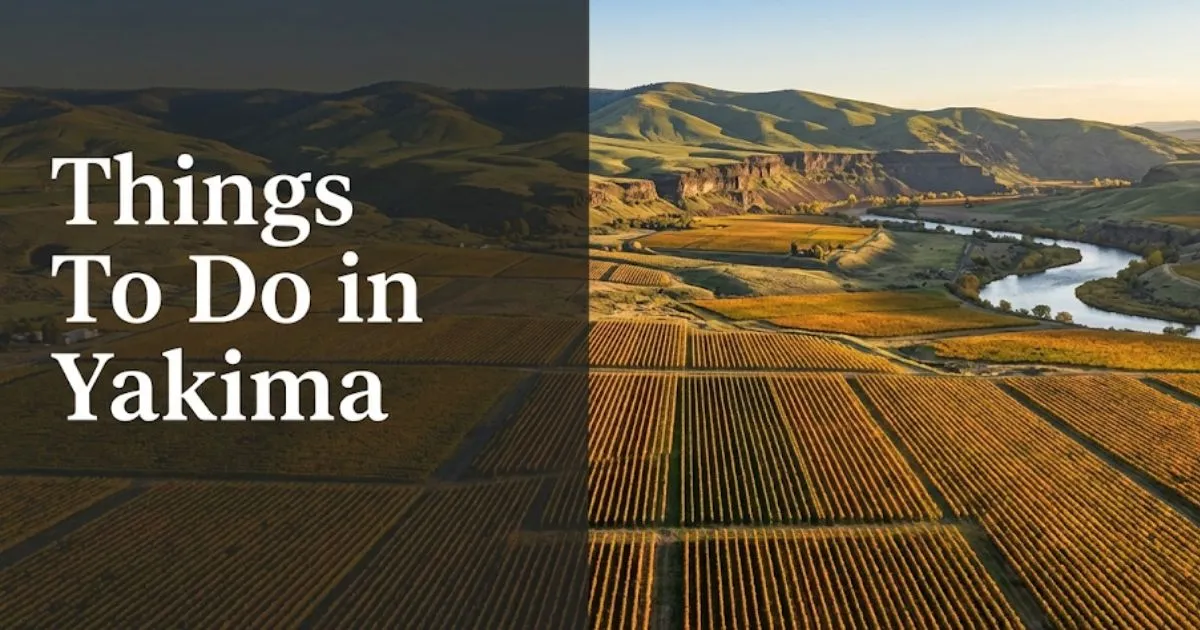
Best Things To Do in Yakima WA: Your 2026 Travel Guide

The best things to do in Yakima, WA span world-class wine tasting, dramatic canyon hiking, and agricultural experiences you simply cannot replicate anywhere else in the Pacific Northwest.
Yakima Valley produces more than 70 percent of all hops grown in the United States. It also grows more apples, pears, and cherries than almost any other county in the country.
This guide covers every major activity category, the best neighborhoods, a full 2-day itinerary, and the honest seasonal and logistical realities every visitor needs before they arrive.
Things To Do in Yakima: What Makes This Valley Worth the Drive
Yakima rewards travelers who engage with it on its own terms: a working agricultural valley that also happens to be a serious wine destination.
This is not a resort town. It is not polished or curated for tourism in the way Walla Walla or Hood River are.
What Yakima offers instead is genuine. Tasting rooms here are often run by the winemakers themselves.
Farm stands on Summitview Avenue sell fruit picked that morning. The craft beer poured on North Front Street is brewed from hops grown five miles away.
According to Visit Yakima Valley, the Yakima Valley AVA contains more than 120 wineries and is one of the oldest established wine appellations in Washington State, designated in 1983.
The valley sits in the rain shadow of the Cascades. That means over 300 days of sunshine annually, making outdoor activities viable well into October.
For couples, this is a serious wine-and-landscape weekend destination at a fraction of Walla Walla prices. For budget travelers, the value ratio is genuinely outstanding.
Insider Tip:
- Most visitors drive straight through downtown Yakima toward wine country. Stop first. North Front Street and the Yakima Greenway are worth a morning before you ever open a tasting room door.
- The fruit stands on Summitview Avenue often offer better produce quality than farmers markets, at lower prices.
- Solo travelers: the North Front Street area on Friday and Saturday evenings has a genuine local crowd and is the most social part of the city.
Yakima Washington Things To Do: The Full Activity Picture
Yakima Washington things to do fall into four genuine categories: wine and cider, outdoor recreation, agricultural tourism, and the urban core along North Front Street.
Most visitors only engage with the first category. That leaves significant value on the table.
The Yakima Greenway is a paved multi-use path system running approximately 10 miles along the Yakima River through the city. It connects the downtown core to Sarg Hubbard Park and Sherman Park.
Cowiche Canyon Trail, managed by the Cowiche Canyon Conservancy, is a 5.5-mile round-trip route through a dramatic basalt canyon just northwest of the city. It is free, well-maintained, and largely unknown to first-time visitors.
The Yakima Valley Museum on Tieton Drive covers the full agricultural and Indigenous history of the valley. Plan approximately 90 minutes for a thorough visit.
Capitol Theatre on North Third Street hosts performing arts, touring productions, and local performances throughout the year. Verify current programming at the venue’s official calendar before visiting.
| Activity Category | Named Example | Cost Range | Best For |
|---|---|---|---|
| Wine Tasting | Gilbert Cellars, Two Mountain Winery | $10-$25 per flight | Couples, wine enthusiasts |
| Hiking | Cowiche Canyon Trail | Free | Outdoor travelers, all profiles |
| Agricultural Tourism | Sundquist Fruit, U-pick farms | Varies by product | Families, food travelers |
| Urban Culture | Capitol Theatre, North Front Street | Free to $50+ | Solo travelers, couples |
| Craft Beer and Cider | Bale Breaker Brewing, Tieton Cider Works | $5-$15 per pour | All profiles |
Families with children should note that Sarg Hubbard Park on the Greenway has accessible playground equipment and direct river access that holds children’s attention reliably.
Yakima Wine Tasting: How To Actually Do It Right
Yakima wine tasting rewards strategy. The Yakima Valley wine corridor spans approximately 50 miles from the city of Yakima east to Benton City.
Attempting the entire corridor in one day is the single most common planning mistake visitors make. Pick one geographic cluster and stay within it.
Gilbert Cellars in downtown Yakima is the best starting point for first-time visitors. The tasting room is on North Front Street, walkable from downtown hotels, and the wines represent the Yakima Valley character well.
Tasting flights at most Yakima Valley wineries run approximately $10 to $25 per person. Many waive the fee with a bottle purchase.
Two Mountain Winery in Zillah and Naches Heights Vineyard northwest of the city are strong picks for travelers who want smaller-production wines with genuine winery character. Both typically operate tasting rooms Thursday through Sunday; verify hours before visiting.
Reservation requirements vary significantly. Many small-production operations require advance booking, especially on weekends. Check each winery’s website directly.
Couples will find the drive between Zillah-area wineries particularly scenic in spring and fall. The views across the valley toward the Cascades are genuinely worth the route.
Budget travelers: the Yakima Valley’s tasting fees are notably lower than Walla Walla equivalents. A well-planned wine day costs significantly less here.
According to the Washington State Wine Commission, Washington State is the second-largest premium wine producer in the United States, and the Yakima Valley AVA produces grapes used in many of the state’s most awarded wines.
Insider Tip:
- Visit tasting rooms early in the day. Most open at 11 a.m. and are quieter before 1 p.m.
- Friday afternoons during harvest season see the highest tasting room traffic. Go Saturday morning instead.
- For seniors or visitors with mobility considerations, Gilbert Cellars’ downtown location eliminates the need for rural road driving.
Best Wineries in Yakima and the Valley’s Sub-Appellations
The Yakima Valley AVA contains five notable sub-appellations, each producing distinct wine styles based on soil and microclimate differences.
Understanding the geography before you visit turns a pleasant wine day into a genuinely educational experience.
| Winery / Zone | Sub-Appellation | Signature Varieties | Reservation Required | Best For |
|---|---|---|---|---|
| Gilbert Cellars | Yakima Valley AVA | Cabernet Franc, Syrah | No | First-timers, walkable downtown |
| Two Mountain Winery | Yakima Valley AVA | Riesling, Cabernet Sauvignon | Recommended weekends | Couples, value seekers |
| Naches Heights Vineyard | Naches Heights AVA | Syrah, Grenache | Yes | Wine-serious travelers |
| Kiona Vineyards | Red Mountain AVA | Cabernet Sauvignon, Lemberger | Recommended | Red wine enthusiasts |
| Côte Bonneville | Yakima Valley AVA | Cabernet Franc, Bordeaux blends | Yes | Serious collectors |
Red Mountain AVA, located near Benton City at the valley’s eastern end, is Washington’s smallest and arguably most prestigious appellation. Kiona Vineyards, one of Red Mountain’s founding operations, is worth the drive from central Yakima for travelers serious about Washington Cabernet.
Plan approximately 45 minutes per tasting room. Factor 20 to 30 minutes driving time between clustered zones.
Rattlesnake Hills AVA, centered around Zillah and Outlook, clusters several well-regarded producers within a compact area. This zone is the most efficient for tasting multiple producers in one afternoon.
Solo travelers will find the Zillah cluster most manageable: several tasting rooms are within a few miles of each other, reducing driving between tastings.
Key Takeaway: Pick one wine zone per day, not the entire 50-mile corridor. Three well-chosen tasting rooms in one area beats seven rushed stops across the full valley.
Outdoor Things To Do in Yakima Beyond the Wine Trail
Outdoor things to do in Yakima include canyon hiking, river trail cycling, scenic byway drives, and wildlife viewing in the shrub-steppe landscape surrounding the valley.
Most outdoor experiences here are free to access and genuinely underused by visitors.
The Yakima River Canyon Scenic Byway runs approximately 30 miles along Highway 821 between Ellensburg and Yakima. The drive passes through dramatic basalt canyon walls with the Yakima River visible almost continuously.
Bighorn sheep are regularly spotted on the canyon walls. The US Bureau of Land Management Yakima Field Office manages this corridor and provides seasonal wildlife viewing guidance.
Cowiche Canyon Trail is the valley’s best hiking experience for most visitors. The 5.5-mile round-trip route through the canyon offers creek crossings, wildflower meadows in spring, and basalt geology found nowhere else this close to the city.
The trailhead is approximately 7 miles northwest of downtown Yakima. Parking is free at the Cowiche Canyon Conservancy trailhead lot.
Seniors and accessibility travelers: the Yakima Greenway’s paved path is fully wheelchair and mobility aid-accessible along its entire 10-mile length. The Cowiche Canyon Trail involves some uneven terrain and creek crossings that may challenge those with limited mobility.
Families: the Greenway’s flat paved surface works well for strollers and young cyclists. The Cowiche Canyon Trail is suitable for children aged 7 and older who can handle a few miles on foot.
Insider Tip:
- The Yakima River Canyon Scenic Byway is best driven north to south (Ellensburg toward Yakima) in the morning. The light quality at that angle before noon is significantly better for the canyon scenery.
- Bring binoculars for bighorn sheep viewing near mile marker 9 of Highway 821.
- Avoid any outdoor activity between 11 a.m. and 5 p.m. from late June through August. The heat is not minor; it is genuinely dangerous at sustained temperatures above 100 degrees Fahrenheit.
Hiking Near Yakima: The Best Trails By Difficulty
Hiking near Yakima ranges from flat river trail walks to strenuous ridge hikes with panoramic Cascade views.
The variety is broader than most visitors expect from what appears to be a primarily agricultural destination.
Easy Trails:
- Yakima Greenway Trail: 10 miles paved, flat, river-level. Starts at Sarg Hubbard Park. Suitable for all fitness levels.
- Cowiche Canyon Trail: 5.5 miles round-trip, moderate terrain, minimal elevation gain. Best in spring for wildflowers.
- Umtanum Creek Recreation Area: 6-mile round-trip canyon trail with a suspension bridge crossing. Managed by the BLM. Free access.
Moderate Trails:
- Ahtanum Ridge: Multiple access points, approximately 4 to 8 miles depending on route. Views across the entire valley toward Mount Rainier and Mount Adams.
- Wenas Wildlife Area trails: Good for birding and elk viewing in early morning. No formal maintained trails; navigation experience helpful.
Strenuous Options:
- Burbank Beach to Umtanum Ridge: Longer scramble routes for experienced hikers seeking elevation. Verify current trail conditions with the BLM Yakima Field Office before attempting.
All hiking near Yakima is best completed before 10 a.m. from June through September. Carry at least two liters of water per person per hour of activity in summer.
Solo travelers should leave a trip plan with someone before hiking more remote routes like Ahtanum Ridge. Cell service is limited in the canyon areas.
According to the Washington State Department of Ecology, summer temperatures in the Yakima Valley regularly exceed 100 degrees Fahrenheit for extended periods. Heat safety is not optional here.
Key Takeaway: Cowiche Canyon is Yakima’s most underrated outdoor experience. It is five miles from downtown, free, genuinely beautiful, and almost always uncrowded.
Downtown Yakima Things To Do in the Urban Core
Downtown Yakima things to do center on the historic blocks between Yakima Avenue and the North Front Street corridor, roughly from North First Street to North Sixth Street.
This is not a tourist district. It is an actual small city downtown with working businesses, a genuine arts presence, and the best entry point into Yakima’s non-wine identity.
Capitol Theatre on North Third Street is Yakima’s most significant cultural venue. The restored 1920 venue hosts national touring productions, local performing arts, and film events. Check the current season schedule directly with the box office before your visit.
Yakima Valley Museum at 2105 Tieton Drive is the most substantive museum in the city. Exhibits cover Yakima Nation history, agricultural heritage, and the hop industry. Budget approximately 90 minutes. Admission is typically in the $5 to $10 per adult range; verify current pricing before visiting.
The Central Washington Agricultural Museum in Union Gap, immediately south of Yakima, is a good secondary option for visitors interested in farming history. It is typically free or low-cost to enter.
Couples will find the Capitol Theatre’s evening programming a strong date-night anchor. Pair it with dinner on North Front Street.
Families: the Yakima Valley Museum has dedicated children’s exhibits and interactive displays that hold younger visitors’ interest. It is one of the few genuinely indoor, air-conditioned activity options during summer heat.
Budget travelers: the museum and the Greenway together form a full day of activity at minimal cost.
Insider Tip:
- The Yakima Farmer’s Market, typically operating Saturday mornings from late May through October in the Yakima Valley Museum parking area, is worth orienting your Saturday schedule around. Verify 2026 dates and hours with Visit Yakima before your trip.
- The Capitol Theatre’s exterior architecture is worth photographing even if you do not attend a performance.
North Front Street Yakima: Where the City Actually Gathers
North Front Street is where Yakima residents actually spend their leisure time, and it is the section of the city most visitors never find.
The street runs along the western edge of downtown, lined with brewpubs, restaurants, tasting rooms, and the kind of low-key social scene that makes a place feel genuinely inhabited.
Bale Breaker Brewing Company at 1801 Pomona Road, just east of the downtown core near the Yakima Chief Hops facility, is Yakima’s most significant craft brewery. They brew directly adjacent to the hop fields. The taproom has outdoor seating, food trucks on weekends, and pours that reflect the local hop character in ways you cannot experience anywhere else.
Tieton Cider Works on Tieton Drive offers Yakima Valley heritage apple varieties pressed into small-batch ciders. This is the other side of Yakima’s agricultural identity. The cider house has a working production visible from the tasting area.
Gilbert Cellars sits directly on North Front Street, making it the easiest winery access point from downtown. It functions as both a tasting room and a social gathering space on weekend afternoons.
Solo travelers will find North Front Street on a Friday or Saturday evening genuinely welcoming. It has a local bar energy rather than a tourist strip feeling.
Seniors: all North Front Street venues are street-level accessible. Parking is available on-street and in nearby surface lots.
Insider Tip:
- Bale Breaker’s taproom hosts food trucks on Friday and Saturday; specific vendors change weekly. Arrive by 5 p.m. for seating on busy weekends.
- The stretch of North Front Street between Yakima Avenue and Chestnut Avenue is the most concentrated section. You can walk it in its entirety in under 15 minutes.
Key Takeaway: North Front Street is Yakima’s real social center. Bale Breaker Brewing and Gilbert Cellars within two blocks of each other make it the best evening starting point for any visitor.
Yakima Restaurants and Craft Beer Worth Seeking Out
Yakima’s restaurant scene reflects its agricultural identity: fresh produce, valley-raised meats, and a straightforward approach to Pacific Northwest cooking that does not require a reservation three weeks in advance.
This is one of the practical advantages Yakima holds over more tourism-saturated Washington wine destinations.
Bale Breaker Brewing Company handles both the craft beer and casual dining categories simultaneously. Their hop-forward IPAs and seasonal releases use hops grown literally across the fence from the brewhouse.
Tieton Cider Works serves as the best introduction to Yakima Valley heritage apple varieties pressed as cider. The pours are well-made and the setting has genuine agricultural character.
For sit-down dining, Yakima’s most established quality restaurants cluster on Yakima Avenue and the surrounding blocks. Pricing at mid-range Yakima restaurants typically runs $15 to $35 per person for dinner, significantly below Seattle or Portland equivalents for comparable quality.
Crafted, when operating, has been one of the downtown’s better wine-and-small-plates options. Verify current operating status before visiting, as restaurant openings and closures shift seasonally in mid-sized cities.
Budget travelers should note that Yakima has a strong taqueria and Mexican food tradition reflecting the valley’s agricultural labor history. The stretch along East Yakima Avenue and South First Street offers genuinely good, affordable options.
Families: Bale Breaker’s outdoor taproom format is child-tolerant on weekend afternoons. Most Yakima casual dining restaurants accommodate families without difficulty.
Insider Tip:
- For the best quick lunch before wine tasting, grab food before leaving downtown. Tasting room food options in wine country are limited and inconsistent.
- The Mexican food concentration in Yakima reflects one of the valley’s most authentic food traditions. Do not skip it in favor of newer tourism-facing dining options.
Yakima Harvest Season and U-Pick Farms: The Valley at Its Peak
Yakima’s harvest season runs from approximately late August through mid-October, and it transforms the entire valley into something no other Pacific Northwest destination can replicate.
This is when Yakima is genuinely at its most compelling.
Apple, pear, peach, and grape harvests overlap across September and early October. Hop harvest, running from mid-August through early September, adds a sharp, resinous fragrance to the valley air that is unlike anything else.
Sundquist Fruit in Selah operates a roadside fruit stand with fresh-picked valley produce during harvest season. Specific operating dates vary by crop year; verify before visiting.
U-pick operations exist for apples and pears across the valley, particularly along Summitview Avenue west of the city and on rural routes through Wapato and Moxee. Visit Yakima Valley maintains a current u-pick directory on their official website; check it before your harvest season visit for updated listings and hours.
The Yakima Farmer’s Market reaches peak volume during harvest season. Expect the full range of valley produce alongside local honey, jams, and artisan goods.
Yakima Valley hop harvest is typically mid-August through early September. Yakima Chief Hops and other large hop operations do not offer regular public tours. However, driving through the hop yard areas east of the city during harvest is a visually striking and free experience.
Families will find u-pick operations the most reliably engaging harvest season activity for children. The hands-on element holds attention in a way that winery visits typically do not.
According to the Washington State Department of Agriculture, Yakima County is the top apple-producing county in the United States, accounting for a significant share of the country’s total commercial apple crop annually.
Insider Tip:
- Book accommodations at least 4 to 6 weeks in advance for harvest season weekends. September and early October is Yakima’s peak period and rooms fill.
- Arrive at u-pick farms by 9 a.m. The best fruit is picked quickly on busy weekends.
Key Takeaway: If you visit Yakima only once, make it September. The harvest season experience, from hop fields to u-pick apples to peak winery season, is what this valley is genuinely built around.
Family Things To Do in Yakima With Kids
Family things to do in Yakima with kids are more plentiful than the wine-country reputation suggests, but they require deliberate planning.
Do not build a family itinerary around winery visits and assume children will adapt. They will not.
Yakima Valley Museum is the strongest family-specific indoor destination. The children’s galleries have interactive exhibits on agricultural history and the Yakima Nation that engage elementary-school-age visitors meaningfully.
Sarg Hubbard Park, accessible from the Yakima Greenway, has a large playground, river access for wading, and open grass areas. It costs nothing to visit and handles a full morning of family activity.
Olmstead Place State Park Heritage Area, east of the city near Kittitas, is a working heritage farm with historic buildings and animals. It is a genuinely interesting half-day stop for children who find farm history tangible and engaging. Verify current visiting hours with Washington State Parks before your visit.
Central Washington State Fair, held annually in Yakima each September, is a significant regional fair with livestock, rides, food, and entertainment. If your visit coincides with fair dates, this is the most family-friendly event in the valley’s calendar. Verify 2026 dates with the fair’s official organizers.
For families with children under 5: the Greenway’s flat paved path is stroller-accessible throughout. Sarg Hubbard Park has shade trees and a paved lot for easy vehicle access.
For families with teens: Cowiche Canyon hiking and Yakima River Canyon scenic driving hold more engagement than museum visits for older children who want physical activity.
Insider Tip:
- Schedule any outdoor family activity before 10 a.m. from June through August. The midday heat is not manageable for young children.
- The Yakima Valley Museum’s parking lot Farmer’s Market on Saturday mornings adds a lively, accessible social element to a museum visit.
Free Things To Do in Yakima on Any Budget
Free things to do in Yakima are plentiful and some of the best the city offers. Many of the valley’s strongest experiences cost nothing at all.
This is one of Yakima’s most underappreciated qualities.
Free experiences in Yakima worth building into any itinerary:
- Yakima Greenway Trail: 10 miles of paved river trail, free parking at multiple access points, open year-round.
- Cowiche Canyon Trail: Free access, free parking at the conservancy trailhead, some of the best canyon scenery in central Washington.
- Yakima River Canyon Scenic Byway drive: No fee. Drive Highway 821 between Ellensburg and Yakima for 30 miles of basalt canyon scenery.
- Umtanum Creek Recreation Area: BLM-managed, free access, suspension footbridge, canyon walk.
- Olmstead Place State Park Heritage Area: Typically free day-use access; verify current fee status with Washington State Parks.
- Yakima Farmer’s Market: Free to browse. Shopping is obviously optional spending.
- Hop yard driving tour: Drive east of the city through Moxee and Wapato during hop season (August through early September) for a free visual and sensory experience.
- Yakima Valley Museum exterior and grounds: Free to walk the grounds; interior exhibit admission applies.
Budget travelers: Yakima may be the most generous value destination in the Pacific Northwest for the ratio of strong free experiences to total available activities.
Seniors: all free outdoor activities above include paved or well-maintained path options alongside more demanding terrain. Choose the Greenway for flat accessibility.
Families: the Greenway, Sarg Hubbard Park, and the scenic byway drive together form a full budget-friendly family day with zero admission cost.
Insider Tip:
- The Yakima River Canyon Scenic Byway at sunrise has almost no traffic and the canyon light is exceptional. It is worth setting an early alarm.
- Cowiche Canyon wildflower season peaks in April and May. The trail is at its visual best then and completely free to access.
Day Trips From Yakima Worth Building Into Your Itinerary
Day trips from Yakima connect easily to some of the Pacific Northwest’s most significant destinations within a two-hour drive.
The valley’s central location makes it a practical base for a broader regional itinerary.
| Destination | Drive Time from Yakima | Primary Draw | Best For |
|---|---|---|---|
| Ellensburg, WA | 35 minutes north on I-82/I-90 | Rodeo, antiques, college town character | Couples, solo travelers |
| Mount Rainier National Park (Paradise) | 2 hours west via Highway 12 | Wildflower meadows, glacier views, hiking | Outdoors travelers, families |
| Walla Walla, WA | 2 hours southeast on I-82 | Polished wine town, downtown dining | Wine-serious couples |
| Leavenworth, WA | 1.5 hours north on Highway 2 | Bavarian-themed village, hiking, skiing | Families, couples |
| Prosser, WA | 45 minutes east on I-82 | Eastern Yakima Valley wineries, Red Mountain access | Wine enthusiasts |
| Goldendale, WA | 1 hour south on Highway 97 | Maryhill Museum, Columbia River Gorge edge | Culture travelers, scenic drivers |
Mount Rainier National Park via the Chinook Pass or Paradise entrance is the most significant day trip from Yakima for outdoor travelers. The drive up Highway 12 and Highway 123 through the Cascades is itself a strong scenic experience.
Timed-entry permits are required for some Rainier entrance areas during peak summer months. Check the National Park Service Mount Rainier page for 2026 permit requirements well before your visit.
Families with children: Leavenworth is the most immediately child-friendly day trip, with walkable village streets, outdoor activities, and a contained geographic footprint that simplifies logistics.
Insider Tip:
- Ellensburg is Yakima’s most overlooked day trip. Its downtown has genuine antique stores, good coffee, and a character that rewards a slow morning of walking.
- Maryhill Museum near Goldendale has a Rodin sculpture collection in an unlikely setting. It is one of the more genuinely surprising cultural experiences within driving range of Yakima.
Key Takeaway: Mount Rainier day trips from Yakima require advance planning for timed-entry permits in summer. Book through the National Park Service reservation system before your trip.
Best Time To Visit Yakima by Season
The best time to visit Yakima is either late April through early June for spring scenery and uncrowded wineries, or September through mid-October for the full harvest season experience.
Every other season has specific tradeoffs that are worth understanding before you book.
| Season | Months | Weather | Crowds | Best Activities | Considerations |
|---|---|---|---|---|---|
| Spring | April-June | Mild, 60-75°F | Low | Cowiche Canyon wildflowers, wine tasting, Greenway | Some smaller wineries still on winter hours through April |
| Summer | July-August | Hot, 90-107°F | High | Morning hiking, Bale Breaker taproom evenings, early u-pick | Afternoon outdoor activities dangerous in heat; reserve accommodation early |
| Harvest Season | Sept-Oct | Warm days, cool evenings | Very High | U-pick farms, wine harvest events, Farmer’s Market | Most in-demand period; book 4-6 weeks ahead |
| Winter | Nov-March | Cold, 30-45°F | Very Low | Downtown dining, Capitol Theatre events, indoor wine tasting | Many small wineries reduce hours or close; verify before visiting |
Couples seeking a romantic and uncrowded experience should target May. The valley is green, wildflowers are in bloom at Cowiche Canyon, and tasting rooms have breathing room.
Budget travelers: winter and early spring offer the lowest accommodation rates. The wine tasting experience is still strong at larger operations that maintain full winter hours.
Seniors: spring and fall offer the most comfortable temperatures for extended outdoor activity. Summer heat should be avoided for any outdoor itinerary element beyond early morning.
Families: the Central Washington State Fair in September and the harvest u-pick season together make September the most activity-rich family period in the valley’s calendar.
How To Spend a Weekend in Yakima: A 2-Day Itinerary
A weekend in Yakima is best structured with one full day devoted to the Yakima Valley wine corridor and one day focused on the city’s outdoor and urban experiences.
Mixing the two too aggressively on either day creates a rushed, logistically inefficient trip.
Day 1: Wine Country and the Valley
- Start at Gilbert Cellars on North Front Street when the tasting room opens (typically 11 a.m.). This downtown location sets the context before you leave the city.
- Drive to the Zillah / Rattlesnake Hills zone (approximately 20 minutes east on I-82). Visit two tasting rooms in the Zillah cluster. Two Mountain Winery is a reliable anchor.
- Have lunch in Zillah or at a farm stand on the drive. Avoid skipping food; wine tasting on an empty stomach is unpleasant at best.
- Drive to Prosser (approximately 20 additional minutes east). Visit one or two Benton City area producers. Kiona Vineyards at Red Mountain is worth the extra 10-minute drive.
- Return to Yakima by 5 p.m. Dinner on North Front Street. End the evening at Bale Breaker Brewing Company or Gilbert Cellars’ later-evening social hours.
Day 2: City, Outdoors, and Agricultural Heritage
- Start with the Yakima Farmer’s Market on Saturday morning (verify current 2026 dates with Visit Yakima).
- Drive to the Cowiche Canyon Trail trailhead (approximately 15 minutes northwest of downtown). Complete the full 5.5-mile round-trip trail before midday heat builds.
- Lunch at a downtown Yakima restaurant. This is the right time to explore the taqueria options on East Yakima Avenue.
- Visit the Yakima Valley Museum on Tieton Drive in the afternoon. The air-conditioned interior is a genuine relief on warm days.
- Evening: Capitol Theatre event if programming aligns, or a return to North Front Street for a final dinner and local cider at Tieton Cider Works.
Seniors: on Day 2, replace Cowiche Canyon with the Yakima Greenway for equivalent outdoor time on fully accessible, flat terrain.
Families: swap Day 1’s wine country structure for Sarg Hubbard Park, Olmstead Place, and the Yakima Valley Museum, with Day 2 as a partial wine country scenic drive with a u-pick farm stop.
Things To Do in Yakima This Weekend: A Quick-Plan Guide
For a single weekend visit to Yakima without extended planning time, three anchor activities orient the entire trip efficiently.
Use these as the backbone and fill around them based on your interests.
The three anchors for a Yakima weekend:
- Anchor 1: Bale Breaker Brewing Company. This is where Yakima’s agricultural and craft identity converge in the most accessible, welcoming format. Start here Friday evening.
- Anchor 2: One focused wine zone. Choose either the Zillah cluster (Rattlesnake Hills AVA) or the Prosser/Red Mountain cluster. Do not attempt both in one weekend without a full day per zone.
- Anchor 3: Cowiche Canyon Trail or the Yakima River Canyon Scenic Byway. One outdoor element per weekend. The trail rewards walkers; the byway drive rewards everyone else.
Quick logistics for a Yakima weekend:
- Book accommodations on North Front Street or Yakima Avenue for walking access to the downtown corridor.
- Reserve tasting room visits in advance for any producer with fewer than 10 employees. Smaller operations fill quickly on Saturday afternoons.
- Pack layers. Even in summer, Yakima evenings drop significantly from daytime highs.
- Do not rely on ride-sharing between wine country stops. Coverage is inconsistent outside the city center.
Solo travelers: Friday evening at Bale Breaker taproom is the easiest entry point into Yakima’s social scene. The format is casual and the crowd is genuinely local.
Couples: the Yakima River Canyon Scenic Byway drive at sunset (drive north toward Ellensburg in the evening) is one of the more quietly beautiful experiences this valley offers.
Insider Tip:
- If your visit falls on a Saturday, the Farmer’s Market plus Cowiche Canyon plus a wine zone afternoon is a full and genuinely satisfying day that costs under $75 total per person including tasting fees.
Safety and Practical Warnings for Yakima Visitors
Summer heat in Yakima is the most underestimated risk for visitors from the Pacific Northwest’s western side, where temperatures above 80 degrees Fahrenheit are unusual.
Yakima regularly sees temperatures of 100 to 107 degrees Fahrenheit from late June through late August. This is not a background detail; it is a genuine physical safety consideration.
Key safety and practical facts every visitor should know:
- Heat safety: Complete all outdoor activity before 10 a.m. or after 5 p.m. from late June through August. Carry at least one liter of water per hour of outdoor activity. Never hike Cowiche Canyon or Ahtanum Ridge in midday summer heat.
- Driving in wine country: Rural agricultural roads through the valley are shared with farm equipment, especially during harvest season. Slow down on Summitview Avenue and fruit loop routes. Do not use the shoulder without visibility checks.
- Drinking and driving: Wine tasting naturally involves alcohol. Designate a driver, use a local car service, or book a guided wine tour that handles transportation. Enforcement of impaired driving laws in Yakima County is active.
- Sun exposure: The Yakima Valley has very low humidity and high elevation relative to Seattle. UV exposure is significantly more intense. Sunscreen is necessary even on cloudy days.
- Cell service: Cowiche Canyon, the Yakima River Canyon, and Ahtanum Ridge have limited to no cell coverage. Download offline maps before departing the city.
- Urban navigation: Stay oriented to the North Front Street, Yakima Avenue, and Tieton Drive corridor in the city. Areas south of Union Gap and east of the downtown core require awareness of your surroundings.
In a medical emergency in Yakima County, contact Yakima Valley Memorial Hospital or Virginia Mason Memorial, both located within the city. For trail emergencies in BLM-managed areas, the Yakima Field Office coordinates with Washington State Search and Rescue.
Frequently Asked Questions About Things To Do in Yakima
What is Yakima, Washington known for?
Yakima is known primarily for wine production, agricultural output, and its role as the hop capital of the United States.
The Yakima Valley AVA produces grapes used in many of Washington State’s most recognized wines, while the surrounding farmland grows the majority of the country’s commercial hops, apples, pears, and cherries.
The city also has a growing craft beer and cider scene centered on North Front Street, which reflects the valley’s agricultural identity in a directly drinkable form.
How far is Yakima from Seattle and is it worth the drive?
Yakima is approximately 140 miles southeast of Seattle, typically a 2 to 2.5 hour drive via I-90 east and I-82 south depending on traffic.
The drive itself is scenic, transitioning from the forested west slope of the Cascades through Snoqualmie Pass and into the dramatic rain-shadow terrain of central Washington.
For wine enthusiasts, outdoor travelers, or anyone interested in agricultural heritage, the drive is worth it; for travelers seeking a polished urban destination, Yakima will not replace a Seattle or Portland city weekend.
Do I need a car to visit Yakima wine country?
Yes. A car is essentially required for any meaningful wine country experience in the Yakima Valley.
Wineries are spread across a 50-mile corridor, public transit does not serve the tasting room zones, and ride-sharing coverage outside the city center is inconsistent.
If you plan to taste at multiple wineries, designate a driver, book a guided wine tour with transportation included, or stay at one zone’s accommodations and limit yourself to wineries within walking or short driving distance of your lodging.
When is harvest season in Yakima and what can I do during it?
Yakima’s harvest season runs from approximately late August through mid-October, with hop harvest peaking mid-August through early September and apple and grape harvests reaching full volume through October.
During harvest season, u-pick farms open across the valley, the Yakima Farmer’s Market reaches peak volume, and many wineries host harvest events and release new vintages.
Book accommodations at least 4 to 6 weeks in advance for September and early October weekends; this is the valley’s highest-demand period.
What are the best wineries in Yakima for first-time visitors?
Gilbert Cellars on North Front Street in downtown Yakima is the most accessible starting point for first-time visitors, with no rural driving required.
Two Mountain Winery in Zillah and Kiona Vineyards at Red Mountain offer excellent introductions to the valley’s two most distinct geographic zones.
Verify current tasting room hours and reservation requirements directly with each winery before visiting, as hours vary significantly by season and many smaller producers require advance booking on weekends.
Is Yakima a good destination for families with kids?
Yakima is a reasonable family destination if you plan around child-friendly activities rather than adapting a wine-focused itinerary.
The Yakima Valley Museum, Sarg Hubbard Park on the Yakima Greenway, Olmstead Place State Park Heritage Area, and u-pick farms during harvest season are all genuinely engaging for children.
The wine country component of a Yakima trip does not adapt well to young children; build a parallel outdoor and agricultural itinerary for family visits and treat winery stops as brief additions rather than the main event.
Plan Your Yakima Visit Before You Go
Yakima’s strongest experiences reward a small amount of advance planning. Book tasting room visits at smaller wineries before you arrive.
Confirm Farmer’s Market dates, u-pick farm operating periods, and Capitol Theatre programming through Visit Yakima and Visit Yakima Valley’s official channels before departure. Travel conditions, hours, tasting fees, and seasonal access change annually.
The single most useful logistical step: decide which wine zone you are prioritizing before you leave home. That one decision prevents the most common Yakima mistake, which is trying to cover the entire 50-mile valley in a single day and seeing it in a blur from a windshield.
Yakima gives back exactly what you bring to it. Come with a specific focus and a morning that starts before the heat builds, and this valley will surprise you