
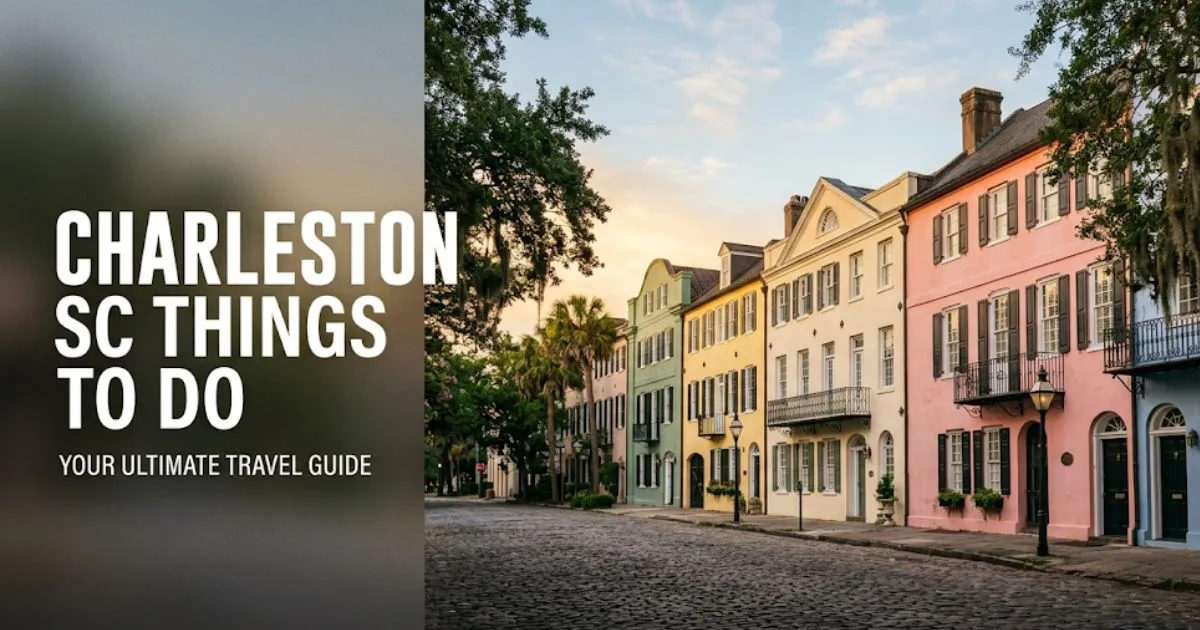
Charleston SC Things To Do: The 2026 Insider Guide

Charleston SC things to do span five distinct categories. History, Lowcountry food, waterfront access, plantation tours, and walkable neighborhood life form the city’s genuine identity.
The city’s peninsula covers roughly 5 square miles. That compact scale means most of Charleston’s best experiences sit within walking distance of each other.
This guide covers specific named activities by neighborhood, traveler profile, and season. It includes an honest two-day itinerary, a plantation comparison, and the practical logistics most Charleston guides skip entirely.
Charleston SC Things To Do: What Makes This City Different
Charleston SC things to do reward slow, deliberate travel over rushed attraction-checking.
The city earns its reputation as one of America’s most architecturally coherent historic districts. The Battery, Rainbow Row, and the pastel antebellum streetscapes of East Bay Street deliver genuine visual impact that holds up against the photographs.
What distinguishes Charleston from peer Southern cities is density. History, exceptional food, and genuine neighborhood character sit within a few blocks of each other on the peninsula.
It is not a theme park version of history. The city’s enslaved history is integrated into serious, ongoing public interpretation at multiple sites.
Couples and romantic travelers find Charleston’s scale nearly ideal. The city rewards two people walking slowly, eating well, and lingering over Lowcountry wine lists.
Budget travelers face honest challenges. Central Charleston hotels and restaurants trend premium. Savings come from timing visits outside peak spring season and prioritizing free historic district walking over paid tours.
According to Visit Charleston, the city’s official tourism organization, the peninsula historic district contains more than 1,400 historically and architecturally significant buildings. That density makes a self-guided walking approach genuinely productive.
Insider Tip:
- Start any first day on the peninsula by walking south from Marion Square toward White Point Garden. This route covers the city’s best architecture in roughly 45 minutes without paying for anything.
- The most photographed Charleston views require no admission. Rainbow Row and The Battery are public.
- Families with young children should plan this walk for early morning. Heat becomes a serious concern by 10 a.m. from June through September.
Best Things To Do in Charleston: Honest Rankings
The best things to do in Charleston are a self-guided historic district walk, a specific plantation visit, one Lowcountry meal at a serious restaurant, and at least one waterway experience.
That is not a list of twenty things. It is four categories that cover the genuine character of the city.
The Historic District deserves two to three hours on foot. Fort Sumter requires a half-day including the ferry crossing from Liberty Square. A plantation visit requires a dedicated half-day with travel time.
The tourist trap most worth skipping: Charleston City Market for shopping. The covered market is architecturally interesting but commercially generic. The handwoven sweetgrass baskets from Gullah Geechee artisans are genuinely worth seeing and purchasing. Everything else skews toward souvenir merchandise.
The local alternative: the Saturday Charleston Farmers Market at Marion Square is where locals shop and where the produce, prepared food, and artisan goods genuinely reflect Charleston’s food culture.
| Experience | Best For | Time Required | Cost Range | Honest Note |
|---|---|---|---|---|
| Historic District Walk | All profiles | 2 to 3 hours | Free | Best before 10 a.m. |
| Fort Sumter Ferry | History travelers, families | 3 to 4 hours | ~$25 to $35 per adult | Book advance ferry tickets |
| Plantation Visit | History and garden travelers | Half-day | ~$20 to $40 per adult | Choose only one per day |
| Lowcountry dinner | Couples, food travelers | 2 hours | ~$60 to $120 per person | Reserve weeks ahead for top spots |
| Folly Beach or Sullivan’s Island | Families, outdoor travelers | Half-day | Free beach access | Rip current risk: swim in flagged zones only |
Seniors and accessibility travelers should note that cobblestone streets on the peninsula’s oldest blocks are uneven and mobility-aid challenging. Meeting Street and East Bay Street have smoother surfaces than some of the side streets closer to the waterfront.
Charleston Historic District: Walking the Real City
The Charleston Historic District is the country’s most concentrated collection of colonial and antebellum architecture still in active residential and commercial use.
Walking it properly requires a framework. Start at White Point Garden at the southern tip of the peninsula. Walk north along East Battery past the pastel houses of Rainbow Row. Continue to Waterfront Park and its pineapple fountain, then cut west to Church Street toward St. Philip’s Episcopal Church.
St. Philip’s and St. Michael’s Episcopal Church at Broad and Meeting Streets are two of the oldest active churches in the American South. Both are visually significant from the street. St. Philip’s interior is worth the brief walk inside during open hours.
The intersection of Broad and Meeting Streets is locally called the Four Corners of Law. It represents federal, state, city, and church authority. The framing is a useful shorthand for Charleston’s historically layered character.
Solo travelers navigate this route easily and at their own pace. The district is safe during daylight hours. Evening walking tours (ghost tours run nightly) add a social component that solo travelers often find useful.
The Heyward-Washington House on Church Street and the Nathaniel Russell House on Meeting Street both offer interior tours run by the Historic Charleston Foundation. Admission runs approximately $12 to $18 per adult per site, as of recent pricing. Verify current rates directly with the Foundation before visiting.
Insider Tip:
- The best photo light for East Battery and Rainbow Row is early morning, before 8 a.m., when tour groups have not yet arrived.
- Cabbage Row on Church Street (the inspiration for Gershwin’s Catfish Row in Porgy and Bess) is unmarked. Most tourists walk past it. Look for number 89 to 91 Church Street.
Key Takeaway: Walk White Point Garden to Church Street before 9 a.m. for architecture without crowds and the best natural light.
Things To Do Near Charleston SC: Day Trips Worth Planning
The best things to do near Charleston SC include a day at Angel Oak Park on Johns Island, a half-day on Kiawah Island, and, for a longer excursion, the drive to Savannah, Georgia.
Angel Oak is a single Southern live oak tree estimated at 400 to 500 years old. It requires no admission and takes about 30 minutes. Johns Island is approximately 12 miles from downtown Charleston via the James Island Connector and Maybank Highway.
Kiawah Island offers 10 miles of beach with significantly lower crowds than Folly Beach or Sullivan’s Island. Day access to the beach is free, though resort facilities require guest status. Drive time from downtown is approximately 35 to 40 minutes.
Savannah, Georgia is 108 miles from Charleston, approximately 2 hours by car on I-95 South and US-17. Savannah’s historic squares make it a genuinely productive day trip for travelers already experienced with Charleston’s historic district. The two cities are different enough in character to justify the drive.
Patriots Point Naval and Maritime Museum in Mount Pleasant sits across the Arthur Ravenel Jr. Bridge from downtown. The USS Yorktown CV-10 aircraft carrier is the centerpiece. Budget three to four hours. Admission runs approximately $25 to $35 per adult as of recent pricing. Verify current rates before visiting.
Families with children get strong value from Patriots Point. The flight simulators and ship exploration hold children’s attention for the full visit in a way that most history sites do not.
- Angel Oak Park, Johns Island: free, 30 minutes, 12 miles from downtown
- Kiawah Island Beach: free beach access, 35 to 40 minutes from downtown
- Patriots Point, Mount Pleasant: paid admission, 3 to 4 hours, across the bridge
- Savannah, Georgia: full day required, 2-hour drive each way
- Edisto Island: uncrowded beach, Gullah Geechee cultural context, 45 minutes south
Charleston Neighborhoods Guide: Beyond the Tourist Circuit
Charleston’s neighborhoods operate as distinct zones with different characters, price points, and visitor appeal.
South of Broad is the city’s oldest and most architecturally significant residential area. The streets below Broad Street, bounded by the Ashley and Cooper Rivers, contain the densest concentration of historic private homes. Most are not open to the public. The neighborhood’s value is visual: a walking tour here feels like stepping into a preserved 18th-century city.
Upper King Street (roughly King Street from around Calhoun Street north to Spring Street) is where Charleston’s restaurant and bar scene operates. Edmund’s Oast, Xiao Bao Biscuit, Butcher and Bee, and Two Boroughs Larder all anchor this corridor. This is where locals and food-focused travelers spend evenings.
Cannonborough-Elliotborough is directly west of Upper King. It is a residential neighborhood with independent coffee shops, small art studios, and the kind of lived-in neighborhood energy that the historic district’s tourist core lacks. The Daily on Rutledge Avenue is a neighborhood breakfast institution.
Avondale in West Ashley sits across the Ashley River. It is more suburban in character but houses several locally-owned restaurants and bars that attract Charleston residents specifically because they are away from the tourist circuit.
Solo travelers feel most comfortable on Upper King Street in the evenings. The bars and restaurants here have a social character. Tables are designed for groups, but solo seating at bars is standard practice.
Couples should prioritize the South of Broad walking loop in the morning and Upper King Street dining in the evening. That sequence covers Charleston’s two most distinct moods in a single day.
Insider Tip:
- Cannon Street between King and Rutledge in Cannonborough-Elliotborough has three independent coffee shops within two blocks. It is a low-cost morning alternative to the tourist-heavy coffee spots near the City Market.
Charleston Plantations To Visit: The Honest Assessment
Choosing which Charleston plantation to visit requires understanding what each site actually prioritizes.
Magnolia Plantation and Gardens is the oldest public garden in the United States and focuses significantly on its landscape. The slavery interpretation has improved in recent years with a dedicated “From Slavery to Freedom” tour. The grounds include a nature tram tour, Biblical garden, and petting zoo. Admission runs approximately $20 to $40 per adult depending on add-ons, as of recent pricing.
Middleton Place is the most sophisticated interpretive site of the three major plantations. The Eliza’s House site interprets the lives of enslaved workers with genuine depth. The stableyards, formal gardens, and house museum are all high quality. Budget a full half-day. Admission runs approximately $30 to $45 per adult as of recent pricing.
Boone Hall Plantation is the most commercially oriented of the three. It is the setting used for numerous film productions and is aesthetically striking, particularly the Avenue of Oaks. The Gullah Theater on-site presents Gullah Geechee cultural interpretation. However, the overall slavery interpretation is thinner than Middleton Place.
| Plantation | Enslaved History Coverage | Gardens | Admission Range | Best For |
|---|---|---|---|---|
| Magnolia Plantation | Moderate, improving | Exceptional | ~$20 to $40 | Garden lovers, families |
| Middleton Place | Strong, most rigorous | Formal, historic | ~$30 to $45 | History travelers, adults |
| Boone Hall | Light, Gullah Theater | Avenue of Oaks | ~$25 to $30 | Film fans, first overview |
All three sites are located 10 to 20 miles from downtown Charleston. Do not schedule a plantation visit and a beach day on the same day. Both experiences are diminished by the rushing that combination requires.
Families with children get the most kid-appropriate experience at Magnolia Plantation, specifically for the petting zoo, tram tour, and swamp boardwalk.
Key Takeaway: Choose Middleton Place for the most historically rigorous plantation experience; choose Magnolia for gardens and family-friendly amenities.
Best Restaurants in Charleston SC: Where to Actually Eat
Charleston’s food scene is built on Lowcountry cooking traditions that predate the farm-to-table movement and were cooking locally sourced ingredients centuries before that phrase existed.
Husk on Queen Street represents the most cited version of modern Lowcountry cooking. Chef Sean Brock’s foundational philosophy of sourcing only from the American South has made it internationally referenced. Reservations are required weeks in advance for dinner.
FIG (Food Is Good) on Meeting Street is where serious Charleston food travelers eat on a second visit. The menu changes daily based on market availability. The dining room is quieter and more intimate than Husk. Reservations are essential.
Leon’s Oyster Shop on King Street is the most useful casual dining recommendation in Charleston. Raw oysters, whole fried chicken, and natural wine in a converted auto body shop. Walk-in lunch is generally possible. Dinner waits can be significant.
The Ordinary on King Street is the city’s best seafood hall format. The 1927 bank building space is architecturally impressive and the crudo and shellfish programs are serious. Mid-range for Charleston standards.
Callie’s Hot Little Biscuit on King Street handles breakfast without fuss. The biscuits are made from scratch. The line moves quickly. Budget travelers find this one of the best value-per-bite experiences in the city.
Budget travelers should eat lunch rather than dinner at most of these spots. Lunch menus at Husk and FIG offer similar quality at lower price points. The savings are meaningful.
Couples should plan the Husk reservation as an anchor for one evening. Plan the Leon’s visit as a casual counterpoint on another night.
According to Condé Nast Traveler, Charleston has been recognized among the top food cities in the American South for multiple consecutive years, citing the depth of its Lowcountry sourcing traditions.
Outdoor Things To Do in Charleston
The best outdoor things to do in Charleston center on the waterways, beaches, and live oak canopy that define the Lowcountry landscape.
Kayaking on Shem Creek in Mount Pleasant offers the most accessible introduction to Charleston’s tidal wetland ecosystem. Several outfitters offer rentals and guided tours along the creek and into the surrounding marshes. Paddling distance to the Charleston Harbor entrance is manageable for intermediate paddlers.
Folly Beach is 11 miles from downtown on James Island. It is the most surf-able beach near the city, with consistent waves and a beach town character that is more casual and locally attended than the resort beaches farther south. Free public beach access. Parking is paid and fills by mid-morning on summer weekends.
Sullivan’s Island is 10 miles north across the Cooper River via US-17 and SC-703. The beach here is quieter, the water clearer, and the residential character more intact than Folly Beach. The Fort Moultrie National Historical Park on Sullivan’s Island is a separate and undervisited historical site connected to the American Revolution and the Civil War.
The Cooper River Bridge Run takes place each spring and draws thousands of runners across the Arthur Ravenel Jr. Bridge. For non-runners, the pedestrian and bike lane on the bridge is open year-round and provides one of the best elevated views of the Charleston peninsula and harbor.
Seniors and accessibility travelers should prioritize the Waterfront Park waterfront path and the Marion Square green space. Both are level, paved, and do not require significant walking distance.
Insider Tip:
- The Pitt Street Bridge in Mount Pleasant is an old bridge converted to a walking pier. It extends into the marsh with views of the Intracoastal Waterway. No admission, rarely crowded, genuinely scenic.
- Schedule any outdoor activity before 11 a.m. from June through August. Afternoon heat and humidity in Charleston are not casual discomforts.
Key Takeaway: Kayak Shem Creek for the best Lowcountry nature experience closest to downtown; go to Sullivan’s Island for the quieter beach alternative to Folly.
Free Things To Do in Charleston SC
The best free things to do in Charleston SC are plentiful enough to build a full day around without any admission cost.
White Point Garden and The Battery are free, open daily, and represent the city’s most photographed outdoor space. The park occupies the southern tip of the peninsula where the Ashley and Cooper Rivers meet. Civil War-era cannons and artillery line the seawall path.
Rainbow Row on East Bay Street requires no ticket. The 13 pastel Georgian row houses between Tradd and Elliott Streets are the most frequently photographed block in the city. Walk there before 9 a.m. for minimal crowds.
Marion Square is the city’s central park and hosts the free Saturday Charleston Farmers Market from roughly April through November. The park also hosts free outdoor events throughout the spring and fall seasons.
The Gibbes Museum of Art is not free but charges reduced or free admission on certain days. Check the museum’s current schedule directly before visiting, as these programs change seasonally.
The following are reliably free:
- White Point Garden and The Battery (open daily)
- Rainbow Row walking (East Bay Street, between Tradd and Elliott Streets)
- Marion Square park and Farmers Market (Saturdays, seasonal)
- Waterfront Park and Pineapple Fountain (open daily)
- Pitt Street Bridge walking pier, Mount Pleasant
- Angel Oak Park, Johns Island (free admission, open daily)
- Cooper River Bridge pedestrian and bike lane (open daily)
- St. Philip’s and St. Michael’s Church exteriors and grounds
Budget travelers can spend a full first day in Charleston covering all of the above without spending money on admission. The food budget is harder to compress, but Leon’s lunch and a Callie’s biscuit morning provide quality eating at relatively low cost by Charleston standards.
Things To Do in Charleston SC With Kids
Charleston is genuinely family-friendly in structure. The historic district is walkable, most major sites have outdoor components, and the city’s museums are appropriately scaled for children.
The South Carolina Aquarium on the waterfront offers one of the better regional aquarium experiences on the East Coast. The Great Ocean Tank holds 385,000 gallons and includes a sea turtle recovery program. Admission runs approximately $25 to $35 per adult and $15 to $25 per child as of recent pricing. Verify current rates before visiting.
Magnolia Plantation’s petting zoo and tram tour is the most reliably engaging plantation experience for children under 12. The nature tram covers the cypress swamp and gives children a genuinely different visual environment from the city.
Patriots Point Naval Museum holds children’s attention through exploration rather than reading. The USS Yorktown’s flight deck, below-deck passages, and aircraft displays work well for ages 8 and above. Younger children may find the scale overwhelming.
Charles Towne Landing State Historic Site in West Ashley is one of the most underutilized family attractions near Charleston. It occupies the site of the first English settlement in Carolina (1670). There is an animal forest with native species, a replica 17th-century vessel, and extensive outdoor grounds. Admission runs approximately $10 to $12 per adult as of recent pricing.
Families with children should plan beach days for Sullivan’s Island rather than Folly Beach. Sullivan’s Island has calmer sections, slightly less commercial density, and the adjacent Fort Moultrie adds educational value for older children.
Insider Tip:
- Pack sunscreen and water for any outdoor activity between May and September. Heat exhaustion risk for children is real in Charleston’s summer climate.
- The horse-drawn carriage tours in the historic district work well for children ages 5 and up. Most tours run 45 to 60 minutes. Book in advance during spring.
Romantic Things To Do in Charleston SC
Charleston is one of the most functional romantic travel destinations on the East Coast. Its scale, architecture, food quality, and pace align closely with what most couples describe as ideal.
An evening walk along East Battery at sunset, with the harbor visible beyond the antebellum mansions, delivers the visual experience that drives Charleston’s romantic reputation. No admission required. No reservation needed.
Carriage tours through the historic district work well for couples who want a guided narrative without the physical demand of a walking tour. Most operators depart from the City Market area. Rates run approximately $25 to $30 per person as of recent pricing. Verify schedules and rates directly with operators before booking.
A dinner reservation at FIG or Husk anchors the most genuinely romantic evening Charleston offers. Both restaurants have intimate dining rooms. Both require advance reservations, particularly on weekends.
Middleton Place offers a specific romantic afternoon: the formal geometric gardens along the Ashley River are among the most visually distinctive formal garden spaces in the American South. The property also operates a small inn on-site for couples wanting to stay on the grounds.
Couples should note that Charleston’s most romantic experiences happen at human pace. A day that includes an early morning walk through South of Broad, a slow breakfast at Two Boroughs Larder, and an evening dinner reservation is more genuinely enjoyable than a day built around five attractions.
According to Travel + Leisure, Charleston has been voted among the top romantic city destinations in the United States in multiple reader surveys, citing its historic architecture, food culture, and coastal setting.
Key Takeaway: Book FIG or Husk reservations before you book your hotel. Both fill weeks out during spring and fall peak seasons.
Charleston City Market and Shopping
Charleston City Market on Market Street between Meeting and East Bay Streets is the city’s most-visited commercial space and one of its most frequently misread.
The covered market has operated on this site in some form since the 1790s. The architecture and layout are historically significant. What visitors find inside today is primarily tourist merchandise: T-shirts, jewelry, and souvenir goods. The exception is the Gullah Geechee sweetgrass basket weavers, who represent a living craft tradition specific to the South Carolina Lowcountry. Purchasing a basket directly from an artisan is meaningful. Purchasing a generic souvenir is not.
Lower King Street between Broad and Calhoun Streets is the city’s serious shopping corridor for antiques and home goods. Charleston’s antique district here has operated for generations and represents genuine commercial depth for collectors.
Upper King Street above Calhoun has seen significant retail development in recent years. The mix now includes independent boutiques, national brands, and several locally-owned shops between Spring and Cannon Streets.
Budget travelers should skip City Market shopping entirely (except sweetgrass baskets) and use the Saturday Charleston Farmers Market at Marion Square as their primary market experience.
Couples and solo travelers interested in independent retail should focus on the three-block stretch of King Street between Cannon and Spring for the densest concentration of locally-owned boutiques.
- Sweetgrass baskets: purchase directly from weavers at City Market, not from secondary retail sellers
- Antiques: Lower King Street corridor is the established zone
- Independent boutiques: Upper King Street, Cannon to Spring
- Farmers Market: Marion Square, Saturdays, April through November (verify current seasonal schedule)
Charleston Harbor Tours and Waterfront
Charleston Harbor is the working centerpiece of the city’s maritime identity and one of the most historically significant harbors in American history.
Fort Sumter National Monument sits in the harbor and is accessible only by ferry from Liberty Square on the Charleston peninsula or from Patriots Point in Mount Pleasant. The National Park Service operates the site. Ferry and admission run approximately $25 to $35 per adult as of recent pricing. Advance ticket purchase is strongly recommended during spring and summer. The ferry crossing takes about 30 minutes each way.
Several private operators offer harbor cruises ranging from dolphin-watching tours to evening cocktail cruises. Departure points cluster along the Charleston Harbor Resort Marina and the downtown waterfront near Waterfront Park. Cruise durations run from 90 minutes to two and a half hours.
The harbor itself is one of the deepest natural ports on the East Coast. Container ship traffic through the port is constant and visible from Waterfront Park and The Battery. Watching a container ship navigate the narrow channel into the Cooper River is a genuinely unexpected Charleston experience.
Families with children find dolphin tours the most reliably engaging harbor experience for children under 10. Bottlenose dolphins are year-round residents of the harbor.
Solo travelers can join scheduled group harbor cruises without social friction. Most operators welcome single bookings. Evening tours have a social atmosphere.
Insider Tip:
- The best free harbor view is from White Point Garden looking north toward Fort Sumter. The same view on a paid cruise costs $25 and includes the crossing.
- Fort Sumter is worth the ticket and the ferry time for anyone interested in Civil War history. The National Park Service interpretation is serious and well-maintained.
Best Time To Visit Charleston SC
The best time to visit Charleston SC is mid-March through May and mid-September through November.
Spring delivers mild temperatures (typically 65 to 80 degrees Fahrenheit), blooming azaleas in the plantation gardens, and the Spoleto Festival USA in late May and early June. Spoleto is a 17-day international performing arts festival that fills the city. If performing arts are a priority, book accommodations six months in advance for Spoleto.
Fall brings lower humidity, comfortable afternoon temperatures, and fewer peak-summer visitors. October is generally the most pleasant month in Charleston for outdoor activities. The MOJA Arts Festival in October celebrates African and Caribbean arts and is significantly underattended by out-of-town visitors relative to its quality.
Summer (June through August) is the worst time to visit for outdoor-focused travelers. Heat and humidity regularly exceed 95 degrees Fahrenheit with significant humidity. Hurricane season runs June through November, with peak threat in August and September. Beach visits are crowded. Hotel rates are at their annual high.
Winter (December through February) offers the lowest hotel rates and genuine quiet on the peninsula. Some restaurants reduce winter hours. Outdoor activities are limited primarily by cold and rain.
Seniors and accessibility travelers should specifically avoid July and August. Heat-related illness risk is genuine for travelers spending significant time outdoors in Charleston’s summer conditions.
Budget travelers find the best value in January and February. Hotel rates drop significantly compared to spring. Restaurant quality does not.
How To Get Around Charleston
Getting around Charleston is simplest on foot within the peninsula. The downtown historic district is compact enough that most visitors cover the core attractions without needing a car during the day.
The Charleston Area Regional Transportation Authority (CARTA) operates the DASH (Downtown Area Shuttle) system, which is free and covers major downtown stops. Routes connect the visitor center at Meeting and John Streets to the City Market and the southern historic district. Frequency varies and schedules should be confirmed directly on the CARTA website before relying on it.
Parking on the Charleston peninsula is expensive, limited, and a source of genuine frustration for first-time visitors. The Visitor Center at 375 Meeting Street has a large attached parking garage and is the most practical option for driving visitors. Parking near Rainbow Row and The Battery on weekends approaches impossible during peak season.
Rideshare services (Uber and Lyft) operate throughout Charleston and are the most practical solution for getting between the peninsula and outlying areas like Sullivan’s Island, Folly Beach, or the plantations.
Pedicabs operate in the historic district and provide short-trip coverage between the City Market and South of Broad. Useful for seniors or travelers with mobility considerations.
Bike rentals are available from several operators on the peninsula. Cycling is practical for flat peninsula routes. Avoid cycling on the cobblestone streets of the oldest blocks.
Seniors and accessibility travelers should note that some historic district sidewalks are uneven. The Waterfront Park and Marion Square areas have the most reliably accessible paved paths.
To navigate Charleston most efficiently:
- Park once at the Meeting Street Visitor Center garage on arrival.
- Use the DASH shuttle or walk for all historic district activity.
- Use rideshare for plantation visits and beach days.
- Return to the garage only when leaving the peninsula area entirely.
Key Takeaway: Park once at the Meeting Street Visitor Center garage and use DASH or rideshare for everything else. Trying to repark throughout the day wastes hours.
Charleston SC Itinerary for 2 Days
A two-day Charleston itinerary works best when Day 1 covers the peninsula on foot and Day 2 is dedicated to one off-peninsula priority.
Day 1: The Peninsula
- Morning (7:30 to 9:00 a.m.): Walk Rainbow Row on East Bay Street and White Point Garden before crowds arrive. This is the day’s best window for photographs and quiet exploration.
- Mid-morning (9:00 to 11:30 a.m.): Walk north through the historic district via Church Street. Visit St. Philip’s Church. Continue to the Charleston Museum (oldest museum in the United States, established 1773) at 360 Meeting Street.
- Lunch (noon to 1:30 p.m.): Leon’s Oyster Shop on King Street for raw bar and fried chicken. Arrive at noon to minimize wait.
- Afternoon (2:00 to 5:00 p.m.): Walk Upper King Street. Browse antiques on Lower King Street. Visit the Charleston City Market for the sweetgrass basket vendors specifically.
- Late afternoon (5:00 to 6:30 p.m.): Return to the hotel. Rest before dinner. Charleston’s best meals run late.
- Dinner (7:00 p.m.): Husk on Queen Street. Reservation required in advance.
Day 2: Choose One Off-Peninsula Priority
Option A (History): Middleton Place for plantation visit. Allow four to five hours including travel.
Option B (Outdoors): Morning kayak on Shem Creek followed by Sullivan’s Island beach afternoon.
Option C (Day Trip): Angel Oak on Johns Island followed by Kiawah Island beach.
Families with children should replace Day 2’s plantation visit with the South Carolina Aquarium in the morning and Patriots Point in the afternoon.
Couples should add an evening carriage tour on Day 1 between the afternoon shopping and dinner reservation.
Safety and Practical Warnings for Charleston
Charleston’s primary outdoor safety risk is heat and sun exposure from June through September.
Heat index temperatures regularly exceed 100 degrees Fahrenheit in July and August. Prolonged outdoor exposure without shade, water, and rest is a genuine health risk for elderly travelers, young children, and anyone with cardiovascular conditions.
Key safety and practical facts every visitor should know:
- Rip currents at Folly Beach and Sullivan’s Island are a documented risk. Swim only in areas with lifeguard coverage. Obey all flag warnings. If caught in a rip current, swim parallel to shore, not against the current.
- Hurricane season runs June through November. August and September carry the highest statistical risk. Monitor National Weather Service advisories if visiting during this period.
- Cobblestone street hazards are real. Several blocks in the historic district have uneven pavement that presents a genuine trip and fall risk, particularly in the dark after evening dining.
- Driving and parking near the City Market on weekends creates significant traffic congestion. Allow extra time. Use the Meeting Street Visitor Center garage and walk.
- Carriage tours book out weeks in advance during spring and fall peak seasons. Do not assume walk-up availability.
- Fort Sumter ferry tickets sell out during spring and summer. Book online at least 2 to 3 weeks before your visit.
The National Park Service operates the Fort Sumter National Monument and can be contacted directly for ferry scheduling, accessibility accommodations, and current site conditions.
Frequently Asked Questions About Charleston SC
What are the best things to do in Charleston SC for first-time visitors?
The most essential Charleston SC things to do for first-timers are a self-guided walk through the historic district, a visit to Fort Sumter via the harbor ferry, one Lowcountry dinner at Husk or FIG, and at least a half-day at one plantation.
These four experiences cover the city’s genuine identity: architecture, Civil War history, culinary culture, and antebellum history.
Reserve Fort Sumter ferry tickets and restaurant reservations before you arrive.
How many days do you need in Charleston SC?
Three to four days is the right amount of time for a complete Charleston visit.
Two days covers the peninsula and one off-peninsula experience. Three or four days allows plantation visits, a beach day, and a more relaxed pace through the food scene and neighborhoods.
One week is too long for most first-time visitors unless day trips to Savannah or Kiawah Island are included.
What is the best time of year to visit Charleston SC?
The best time to visit Charleston SC is mid-March through May and mid-September through November.
Spring brings azalea blooms, comfortable temperatures, and the Spoleto Festival USA in late May.
Fall offers lower humidity, pleasant outdoor conditions, and fewer visitors than the peak spring season.
Is Charleston SC worth visiting?
Charleston SC is worth visiting for travelers who care about history, architecture, food culture, and coastal character.
It is one of the most coherent small cities in the American South for that type of travel.
Travelers seeking a beach resort, nightlife hub, or budget destination will find Charleston less satisfying, as it skews toward premium experiences and is not primarily a beach or nightlife city.
What are the best free things to do in Charleston SC?
The best free things to do in Charleston SC include walking Rainbow Row and The Battery, exploring White Point Garden, visiting the Saturday Farmers Market at Marion Square, and walking the Pitt Street Bridge pier in Mount Pleasant.
Angel Oak Park on Johns Island is free and takes about 30 minutes.
The Cooper River Bridge pedestrian walkway is free, open daily, and provides the best elevated view of the harbor.
What should I not miss in Charleston SC?
The one experience most worth protecting in your Charleston itinerary is Fort Sumter.
It requires a ferry, advance tickets, and a half-day, but the on-site National Park Service interpretation of the Civil War’s first engagement is the most historically serious experience the city offers.
The second priority is one serious Lowcountry meal at FIG or Husk, which requires an advance reservation.
Plan Your Charleston Trip With Confidence
Charleston rewards travelers who plan two things before they arrive: a Fort Sumter ferry ticket and a dinner reservation at either FIG or Husk.
Both fill quickly during spring and fall peak seasons. Both define what this city genuinely offers.
Prices, hours, seasonal schedules, and event dates change. Verify all logistics directly with Visit Charleston at their official tourism website and with individual venues before departure.
The traveler who books the ferry, reserves the dinner, parks once at the Meeting Street Visitor Center, and walks the rest will get more out of Charleston in two days than most visitors get in four.