Things to Do in Smoky Mountains

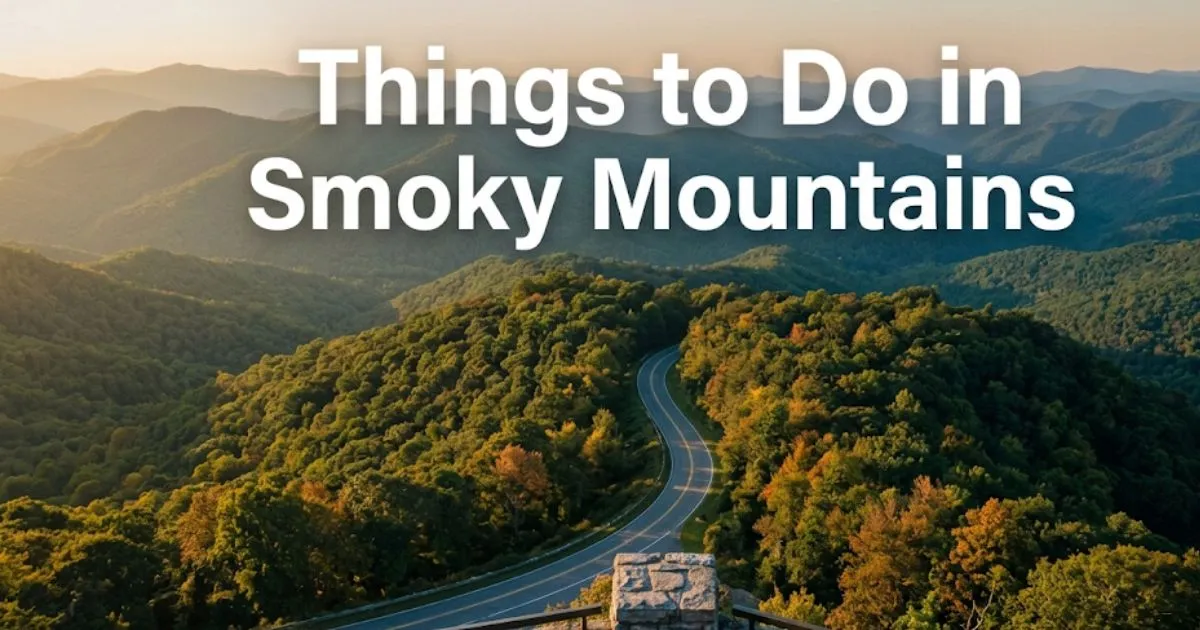
The national park splits its activities between a Tennessee side and a quieter North Carolina side connected by Newfound Gap Road.
You must anchor your day to one zone, not bounce between Gatlinburg and Cherokee.
The Tennessee section draws the most traffic into the park around Gatlinburg.
The North Carolina entrance near Cherokee offers far lighter visitation and quicker access to the park’s remote eastern sections.
Most first-timers burn two hours daily driving back to their hotel for lunch.
Pack a cooler, pick one road corridor per day, and stay inside the park boundary until evening.
Top Activity Zones by Geography
| Zone | Main Road | Best For | Crowd Level |
|---|---|---|---|
| Sugarlands to Newfound Gap | Newfound Gap Road | Summit access, high-elevation hikes | Heavy |
| Cades Cove | Cades Cove Loop Road | Historic structures, wildlife, biking | Gridlocked on weekends |
| Roaring Fork | Roaring Fork Motor Nature Trail | Waterfalls, old-growth forest | Moderate to Heavy |
| Elkmont | Little River Road | Wildflowers, fly fishing, ghost town | Moderate |
| Deep Creek | Deep Creek Road (NC) | Tubing, family-friendly waterfalls | Light |
| Cataloochee Valley | Cove Creek Road | Elk viewing, historic sites | Light |
Insider Tip:
- Enter Cades Cove no later than 7:00 AM on any day, and by 6:30 AM on October Saturdays.
- The Deep Creek and Cataloochee areas of the North Carolina side see one-tenth the visitors of Cades Cove but deliver equally memorable waterfalls and more reliable elk viewing.
Great Smoky Mountains National Park Things to Do
Clingmans Dome is the park’s highest peak and the single most famous viewpoint.
The observation tower delivers a 360-degree panorama stretching 100 miles on clear days.
The paved but steep half-mile path climbs 330 feet to the tower.
The thin air at 6,643 feet taxes anyone with respiratory or cardiac conditions.
Arrive before 9:00 AM to park legally.
The lot fills completely by 10:00 AM even on weekdays in summer.
Clingmans Dome Visitor Guide
| Factor | Detail |
|---|---|
| Time Needed | 1 to 2 hours |
| Cost | Free; parking tag required |
| Surface | Paved but steep (13% grade at points) |
| Best Time | September mornings for clearest air |
| Closure | Road closed December through March |
According to the National Park Service, air quality at Clingmans Dome is degraded by regional haze, reducing average visibility from 100 miles to 22 miles during summer months.
This means July and August deliver the worst views despite the warmest weather.
If the lot is full, skip it entirely and proceed to the Andrews Bald trailhead at the same parking area.
This 3.5-mile round-trip hike descends to a grassy bald with a view that rivals the tower, minus the concrete structure and the crowd.
Key Takeaway: Anchor every trip day to one single road corridor. You cannot hop between Cades Cove, Newfound Gap, and Roaring Fork in one afternoon without sitting in hours of traffic.
Smoky Mountains Things to Do
The park holds over 800 miles of maintained trails and more than 100 named waterfalls.
The biggest planning mistake is choosing a hike by its Instagram popularity rather than its actual fit for your group.
Laurel Falls is the park’s most heavily trafficked waterfall trail and the most overrated.
The 2.4-mile paved round trip draws stroller-pushing families and flip-flop hikers who bottleneck the narrow path.
Spruce Flats Falls near Tremont offers a superior waterfall experience with a fraction of the crowd.
The 1.4-mile round trip descends through a quiet cove forest to a multi-tiered 30-foot cascade.
Compare Top Smoky Mountain Hikes
| Trail | Distance | Difficulty | Best For |
|---|---|---|---|
| Alum Cave Trail | 4.6 miles RT | Strenuous | Experienced hikers seeking Mount LeConte summit access |
| Grotto Falls | 2.6 miles RT | Moderate | Families wanting a waterfall you walk behind |
| Charlies Bunion | 8 miles RT | Strenuous | Appalachian Trail section hikers |
| Andrews Bald | 3.5 miles RT | Moderate | High-elevation views without Clingmans Dome crowds |
| Spruce Flats Falls | 1.4 miles RT | Easy-Moderate | Budget and solitude seekers avoiding Laurel Falls |
Families with children under six do best on Grotto Falls via the Trillium Gap Trail.
The 2.6-mile round trip ends at the only waterfall in the park you can safely stand behind.
Solo travelers should target Charlies Bunion on the Appalachian Trail.
The strenuous 8-mile round trip filters out the casual crowd and delivers rock outcrop views from the spine of the range.
Key Takeaway: Substitute Spruce Flats Falls for Laurel Falls every single time. You trade Instagram recognition for an actual waterfall experience without strangers in every photo.
Things to Do in the Smoky Mountains
Cades Cove is an 11-mile, one-way loop road through a historic pioneer valley ringed by mountains.
It is the park’s single most popular destination and routinely becomes a parking lot on wheels from 10:00 AM onward.
The loop holds three restored churches, a working grist mill at the Cable Mill Historic Area, and more than a dozen pioneer log structures.
Early morning and the final hour before sunset produce the best wildlife viewing, especially for white-tailed deer and black bears.
Budget travelers should know that Cades Cove is one of the park’s most cost-effective full-day experiences.
Zero dollars beyond the parking tag, if you pack your own food and water.
Seniors and those with mobility limitations can experience the entire valley from the car.
Every historic structure is visible from the pull-offs, and the Cable Mill area has a flat, compacted-gravel walking loop.
Cades Cove Vehicle-Free Days
The park designates Wednesday mornings from early May through late September as vehicle-free on the loop road.
Only bicycles and pedestrians may use the road until 10:00 AM.
Bicycle rentals are available at the Cades Cove Campground Store during the operating season.
This single rule change transforms the experience from a traffic jam into a quiet, 11-mile pedal through a mountain valley.
Key Takeaway: Wednesday is Cades Cove’s best day. Arrive by 7:00 AM on other days. Never drive the loop on a Saturday in October.
Things to Do in Great Smoky Mountains National Park
The Roaring Fork Motor Nature Trail is a one-way, 5.5-mile scenic road that begins and ends in Gatlinburg.
It packs more waterfall access and old-growth forest per mile than any other drivable section of the park.
The trail’s two standout stops are Grotto Falls, the park’s walk-behind waterfall, and the Place of a Thousand Drips, a roadside cascade that requires zero hiking.
The narrow, winding road prohibits buses, RVs, and trailers, which eliminates an entire class of tour vehicle congestion.
Couples looking for a romantic, unhurried nature drive will find Roaring Fork superior to the more famous Cades Cove.
The dense canopy of hemlock and poplar feels intimate compared to the open pasture of the cove.
The road closes entirely from December through mid-March.
Check the operating status at Sugarlands Visitor Center before driving up, as the road is also subject to closure during high wind events when trees are at risk of falling.
According to the Great Smoky Mountains Association, the Roaring Fork corridor preserves some of the park’s oldest remaining eastern hemlocks, though the hemlock woolly adelgid has killed many mature trees here over the past two decades.
The standing dead trunks visible from the road are a documented part of that ecological shift.
A lesser-known local alternative for waterfall seekers is the Porters Creek Trail in the Greenbrier section of the park.
The 4-mile round trip passes historic farm sites and reaches a 60-foot cascade that sees a tenth of the visitation of Grotto Falls.
Key Takeaway: Drive the Roaring Fork Motor Nature Trail for the highest concentration of waterfall and forest scenery with zero bus traffic. Grotto Falls feels like a theme park line after 9:00 AM. Arrive at sunrise or visit on a weekday in May or September.
Fun Things to Do in the Smoky Mountains
Tubing Deep Creek on the North Carolina side is the single most purely enjoyable summer activity in the park that does not require hiking boots.
Three waterfalls sit within a two-mile walk of the Deep Creek Trailhead, and the creek itself is the park’s designated tubing river.
The water is cold, roughly 55 to 60 degrees Fahrenheit even in August.
Children under six and non-swimmers need a properly fitted life jacket, as the current is stronger than it looks from the gravel bank.
Deep Creek is accessed from Bryson City, North Carolina, not Gatlinburg.
The drive from downtown Gatlinburg takes approximately 90 minutes via Newfound Gap Road, making this a full-day commitment.
Deep Creek Day-Use Plan
- Arrive at the Deep Creek Trailhead by 9:00 AM before the lot fills.
- Hike the 2-mile loop to Juney Whank Falls, Tom Branch Falls, and Indian Creek Falls first.
- Rent a tube from one of the outfitters outside the park boundary on West Deep Creek Road for approximately $8 to $12 per person.
- Spend the afternoon floating the lower section of the creek, which takes about 90 minutes end-to-end.
- Dry off at the picnic area near the trailhead and exit before 5:00 PM to beat the mountain road traffic back.
Tubing and hiking together make Deep Creek the best single-day family destination in the park for hot June through August weeks.
Solo travelers will find the area less compelling outside of summer; the waterfalls are lovely but the social tubing scene is the real draw.
Things to Do Smoky Mountains
Elkmont Historic District preserves a 1920s-era Appalachian Club resort colony of deteriorating wooden cottages and the former Wonderland Hotel site.
It feels unlike anything else in the park and offers a strange, quiet walking tour through early 20th-century Southern mountain tourism.
The National Park Service has stabilized a selection of cottages while allowing others to weather naturally.
Walking the Elkmont ghost town loop takes about 45 minutes at a slow pace.
Elkmont is also the epicenter of the park’s world-famous synchronous firefly event.
Photinus carolinus fireflies blink in unison for a two-week mating window each year, typically peaking in late May or early June.
Winning a parking pass through the annual lottery is the only legal way to view the fireflies after dark at Elkmont.
The lottery opens in late April, and the park receives tens of thousands of entries for roughly 1,800 vehicle passes across the eight-night viewing period.
If you miss the lottery, the Cataloochee Valley and the area near the Foothills Parkway pull-offs sometimes produce decent firefly displays without the crowds or the permit system.
The synchronous behavior is never guaranteed at these alternative sites, but the experience is far more serene.
According to the National Park Service, the Elkmont firefly event is the largest congregation of synchronous fireflies in the Western Hemisphere.
The strict lottery system was implemented in 2022 after crowd sizes exceeded 5,000 people per night on an unprepared gravel road.
Key Takeaway: If you lose the synchronous firefly lottery, accept it and pivot to a weekday in Cataloochee Valley instead. A solo walk through the Elkmont ghost town at dawn, however, is open to everyone and delivers the same quiet sense of place with zero competition for a spot.
Things to Do Near Smoky Mountains
The Foothills Parkway is a national park service road running the western edge of the Smokies that delivers sweeping mountain panoramas without entering the congested interior.
Two completed segments, one between Walland and Wears Valley and another near Cosby, total approximately 33 miles of scenic driving.
The parkway’s newest section, the 16-mile Missing Link opened in 2018, features the Look Rock observation tower.
A half-mile paved trail leads to a concrete platform with a 360-degree view that rivals Clingmans Dome but typically serves fewer than fifty visitors on a weekday.
Couples and seniors who want the scenic Smoky Mountain experience without the foot traffic of the main park will find the Foothills Parkway a better match.
There are no major hiking trails, no visitor centers, and no crowds.
Budget travelers should use the parkway as a full afternoon outing.
All overlooks and the Look Rock trail are free, and no parking tag is required anywhere on the Foothills Parkway as of 2026.
Motorcyclists consider the Foothills Parkway one of the premier rides in the Southern Appalachians.
The sweeping curves, new pavement, and lack of commercial development make for a quieter, faster-moving experience than Newfound Gap Road inside the main park.
Smoky Mountains Tennessee Things to Do
Gatlinburg is the park’s primary Tennessee gateway, and most of its commercial attractions have nothing to do with a national park visit.
The main strip is a walkable but dense concentration of pancake houses, candy kitchens, and Ripley’s-branded attractions.
One genuinely worthwhile stop within the city limits is the Gatlinburg SkyPark.
A chairlift departs from the downtown strip and rises to the top of Crockett Mountain, where a suspension bridge spans a 680-foot-long valley at 140 feet above the ground.
The SkyBridge earned a distinction from the World Record Academy for being the longest pedestrian suspension bridge in North America at the time of its construction.
The view from the bridge overlooks downtown Gatlinburg and the park boundary ridgeline.
Families with children who need a break from hiking will get a two-hour diversion here for a price, roughly $30 to $40 per adult depending on ticket package.
Solo travelers and purists can skip Gatlinburg’s strip entirely and not miss a single genuine park experience.
Gatlinburg vs. Townsend for Overnight Stays
| Factor | Gatlinburg | Townsend |
|---|---|---|
| Vibe | Tourist-centric, crowded, walkable strip | Quiet, local, river access |
| Distance to Park | 5 minutes to Sugarlands Visitor Center | 5 minutes to Cades Cove entrance |
| Dining | Chain restaurants, pancake houses | Local BBQ, riverfront cafes |
| Best For | Families wanting constant activity | Couples and seniors seeking peace |
| Traffic | Heavy, especially Friday evening | Minimal |
The local alternative to Gatlinburg for overnight lodging is Townsend, Tennessee, known locally as the “Peaceful Side of the Smokies.”
It sits 20 minutes from Cades Cove and offers direct access to the Little River for fishing and swimming without the strip traffic.
Key Takeaway: Sleep in Townsend, eat breakfast in Townsend, and drive into the park from the west entrance. Use Gatlinburg strictly as a supply stop or SkyPark visit. The town’s pedestrian traffic on a summer Saturday is Times Square dense.
Unique Things to Do in Smoky Mountains
Cataloochee Valley is the most remote developed section of the park, accessible only via a winding gravel road from Interstate 40 near Maggie Valley, North Carolina.
It is the park’s primary elk reintroduction zone, and the herd that was released in 2001 now numbers over 200 animals.
Seeing an elk bull bugle during the September rut is the single most dramatic wildlife spectacle in the Southern Appalachians.
The valley’s historic structures include the Palmer House, a restored frame farmhouse, and the Palmer Chapel, a one-room church still used for occasional services.
Cataloochee requires a 20-minute slow drive on Cove Creek Road, a dirt and gravel surface, from I-40 exit 20.
The road is steep, winding, and not suitable for RVs or trailers over 25 feet.
Solo travelers and couples looking for the park’s most rewarding remote experience will find Cataloochee worth the drive.
The valley has no cell service, no food, and no fuel; bring everything with you.
September Elk Rut Viewing Tips
- Arrive at the valley before sunrise. Elk are most active at dawn and dusk.
- Set up with binoculars or a spotting scope at least 50 yards from any animal. Bulls are aggressive during the rut.
- Bring a folding chair and a thermos of coffee. The best viewing is in the open meadows near the ranger station.
- Stay until 9:00 AM when the elk typically retreat into the forest edge.
The park’s more famous wildlife viewing area is Cades Cove, but Cataloochee delivers a heavier concentration of elk and a fraction of the human traffic.
A Cades Cove deer jam can involve 200 cars; a Cataloochee elk jam rarely exceeds 15 vehicles.
Great Smoky Mountains Things to Do
The park’s waterfall safety record is grim.
The smooth, algae-covered rocks at the base of every major waterfall have been the site of more fatalities than any other park feature.
Rainbow Falls is one of the most dangerous waterfall areas in the park.
A carved social trail climbs the slick rock beside the 80-foot cascade, and visitors routinely attempt to climb it despite explicit closure signs.
The 5.4-mile round-trip hike to Rainbow Falls is a strenuous but legitimate trail with excellent payoff.
Stay on the designated observation area at the base, keep children within arm’s reach at all times, and never, under any circumstances, climb on the rocks.
Park Waterfall Safety
- Banned: Climbing, sliding, or jumping from any waterfall or adjacent rocks. Fines apply.
- Risk: Algae-slicked rock is as slippery as ice, even when dry in appearance.
- Temperature: Waterfall pools are 50 to 60 degrees Fahrenheit. Shock incapacitates in minutes.
- Children: Keep them physically restrained on short leashes or within a gripped hand at all waterfall overlooks.
The National Park Service reports that waterfall-related incidents account for the plurality of the park’s annual search-and-rescue operations.
The warning signs posted at Laurel Falls, Rainbow Falls, and Abrams Falls are placed there because of documented fatalities, not bureaucratic caution.
Couples and family travelers who want a waterfall experience without the risk should choose Tom Branch Falls in Deep Creek.
The viewing platform sits safely above the water, the trail is flat and wide, and the cascade is a gentle 80-foot slide that discourages dangerous climbing behavior.
Key Takeaway: Every park waterfall fatality occurred on a dry, sunny day when the hiker felt fully in control. Smooth wet rock does not offer second chances. Keep kids within arm’s reach and stay behind every railing and barrier you encounter.
Things to Do in Great Smoky Mountains
The Park It Forward parking tag system is the single most important piece of 2026 trip logistics that first-time visitors miss.
Every vehicle parked for more than 15 minutes anywhere in the park must display a valid tag.
A daily tag costs $5 as of recent guidance.
A weekly tag costs $15, and an annual tag costs $40.
Purchase tags online at recreation.gov before your trip or at automated machines at Sugarlands, Oconaluftee, and Cades Cove visitor centers.
Automated machines accept only credit and debit cards; no cash is taken.
The tag requirement applies to every trailhead, overlook, visitor center, and picnic area.
Driving through the park without stopping does not require a tag, but stopping at Newfound Gap for a five-minute photo does.
Parking Tag Quick Reference
| Tag Type | Cost (Approximate) | Best For |
|---|---|---|
| Daily | $5 | One-day transit through the park |
| Weekly | $15 | Standard vacation of 3 to 7 days |
| Annual | $40 | Repeat visitors, regional residents |
According to the Great Smoky Mountains Association, parking tag revenue directly funds trail maintenance, restroom cleaning, and ranger interpretive programming.
The park receives no general admission fee, unlike most major national parks, and relies on this revenue to manage the operational strain of 12 million annual visits.
Failure to display a valid tag results in a citation.
The enforcement rangers do not issue warnings, and claiming ignorance of the 2023-introduced system will not change the outcome.
Things to Do at the Smoky Mountains
Mingus Mill is a fully operational 1886 turbine-powered grist mill located a half-mile from the Oconaluftee Visitor Center in North Carolina.
A miller operates the machinery and sells freshly ground cornmeal and wheat flour inside the mill during the visitor season.
The mill uses a water-powered turbine instead of the more common overshot water wheel.
This engineering choice, preserved exactly as designed, makes Mingus one of the most historically specific 19th-century mill demonstrations in any national park.
The Mountain Farm Museum adjacent to the Oconaluftee Visitor Center is a collection of relocated 19th-century farm structures.
A log farmhouse, barn, apple house, springhouse, and blacksmith shop arranged as a working farmstead provide a self-guided walk through Southern Appalachian agricultural life.
Seniors and accessibility travelers will find the Mountain Farm Museum the most physically accommodating cultural site in the park.
The paths are level, gravel-surfaced, and dotted with interpretive signs.
Oconaluftee Cultural Half-Day Plan
- Start at the Mountain Farm Museum at Oconaluftee Visitor Center. Allow 45 minutes.
- Walk or drive the half-mile to Mingus Mill. Allow 20 minutes.
- Check with the visitor center desk for any ranger-led mill demonstrations scheduled that day.
- Drive the Newfound Gap Road north to the Collins Creek Picnic Area for lunch by the water.
- This entire loop sits within a 5-mile stretch and works perfectly for a relaxed morning.
The Tennessee-side equivalent to Mingus Mill is the Cable Mill in Cades Cove.
Cable Mill is far more crowded and only operates during demonstrations; Mingus Mill offers a quieter, more intimate historical encounter.
Things to Do in Smoky Mountains National Park
The park maintains 10 developed frontcountry campgrounds, and securing a reservation is competitive from May through October.
Elkmont Campground and Cades Cove Campground are the two largest and book out months in advance for peak-season weekends.
Reservations open on a rolling basis through recreation.gov.
For a July 2026 weekend, the booking window opens in January 2026, and the desirable sites are gone within hours of release.
Backcountry camping is free but requires a permit obtained online or at ranger stations.
The park’s 100-plus backcountry sites and shelters are spread across a vast trail network, including the Appalachian Trail shelters spaced roughly a day’s hike apart.
Campground Quick Selection
| Campground | Elevation | Best For | Seasonal Note |
|---|---|---|---|
| Elkmont | 2,150 ft | Families, river access, firefly proximity | Open year-round |
| Cades Cove | 1,807 ft | Cyclists, wildlife watchers | Open year-round |
| Smokemont | 2,198 ft | North Carolina base, horseback riding | Open year-round |
| Cosby | 2,459 ft | Solitude, Appalachian Trail access | Open April-October |
| Balsam Mountain | 5,310 ft | High-elevation cool summer camping | Open May-October |
Balsam Mountain Campground is the park’s highest and coolest frontcountry camp, sitting at 5,310 feet and providing relief from summer heat that can reach the 90s in Gatlinburg.
The road to Balsam Mountain is winding and narrow, and the campground is a 30-minute drive from any significant services.
Solo hikers targeting the Mount Sterling fire tower or the Benton MacKaye Trail use Cosby or Big Creek as the ideal backcountry access points.
These northeastern sections see dramatically lower human traffic than the Gatlinburg-area trailheads.
Key Takeaway: Book your campground the day reservations open, especially for Elkmont and Cades Cove. If you miss the frontcountry window, secure a backcountry permit for a quieter and equally beautiful alternative. You just have to carry everything on your back.
Things to Do in Smokey Mountains
An efficient Smoky Mountains itinerary is a geographic plan, not a list.
You divide your days by which road you will drive and which watershed you will hike into.
2-Day Geographically Efficient Itinerary
Day 1: The Newfound Gap High-Elevation Day
- Enter the park at Sugarlands Visitor Center by 7:30 AM. Buy or display your parking tag.
- Drive Newfound Gap Road south, stopping at Campbell Overlook for the classic Mount LeConte sunrise view.
- Arrive at the Alum Cave Trailhead by 8:15 AM. Hike the 4.6-mile round trip to Alum Cave Bluffs. Turn around here unless you have a full day and summit conditioning for Mount LeConte.
- Drive to Newfound Gap parking area. Walk to the Appalachian Trail crossing and the stone memorial. Allow 20 minutes.
- Continue south to Clingmans Dome parking. If the lot is full, pivot immediately to the Andrews Bald trailhead, which shares the same lot.
- Exit the park on the North Carolina side to Cherokee for a late lunch. Return to Tennessee via the same route, hitting any missed overlooks on the descent.
- Total driving time: 90 minutes spread across the day. Total hiking: 4.6 to 8 miles depending on Clingmans Dome vs. Andrews Bald choice.
Day 2: The Cades Cove and Tremont Watershed Day
- Enter the park via Townsend at the Townsend Wye entrance by 7:00 AM.
- Drive the 11-mile Cades Cove Loop Road immediately. Do not stop on the first lap. Make mental notes of wildlife locations and which cabins you want to visit.
- On the second lap, pull off at the Cable Mill area and the three historic churches. Allow 90 minutes total.
- Exit Cades Cove and drive back toward Townsend, turning onto Upper Tremont Road.
- Hike to Spruce Flats Falls, the 1.4-mile round-trip waterfall alternative described earlier.
- End the afternoon with a late lunch at the Peaceful Side Social in Townsend, a wood-fired pizza and craft beer stop.
- Total driving time: 75 minutes. Total hiking: 1.4 miles plus walking inside Cades Cove.
This two-day plan avoids the Gatlinburg strip traffic entirely except for the Sugarlands entry on Day 1.
It geographically clusters every activity within a single contiguous drive corridor each day.
Safety and Practical Warnings for the Smoky Mountains
Weather conditions on the summit of Mount LeConte can be 20 to 30 degrees Fahrenheit colder than the Gatlinburg trailhead temperature, with wind chills below freezing in any month of the year.
Hypothermia is a documented cause of injury and death in the park, even in July.
Key safety and practical facts every visitor should know:
- Waterfall rocks kill more visitors than any other park feature. Never climb on wet or dry rocks near any waterfall. The algae layer is invisible and frictionless.
- Black bears are present throughout the park. Maintain a 50-yard distance at all times. Store all food, coolers, and scented items in the vehicle’s trunk or a bear-proof storage locker. A bear obtaining human food is often euthanized due to subsequent dangerous behavior.
- Cell service does not exist in most of the park interior. Download offline maps in Google Maps or AllTrails before entering. Do not expect to call for help from a trailhead.
- Traffic on the Cades Cove Loop Road can reach complete gridlock on weekends in October. If you enter after 10:00 AM on a Saturday, expect a 3 to 4-hour drive to complete a single 11-mile lap.
- Yellow jacket wasp ground nests are aggressive from August through October. Carry an epinephrine injector if allergic. The park’s trail edges are dense with ground nests in late summer, and sting incidents spike during this window.
- Flash floods can occur in any month. Never wade into a stream rising faster than normal or turning muddy. The Little River and Deep Creek rise fast during upstream thunderstorms.
In an emergency, dial 911 if you have signal. Otherwise, send another hiker or cyclist to the nearest ranger station or visitor center with your exact location and the nature of the emergency.
Frequently Asked Questions About the Smoky Mountains
Is there an entrance fee for Great Smoky Mountains National Park?
There is no entrance fee to drive through or enter Great Smoky Mountains National Park.
A parking tag is required for any vehicle parked for more than 15 minutes anywhere inside the park boundary.
Tags cost approximately $5 daily, $15 weekly, or $40 annually as of 2026.
What is the best time of year to visit the Smoky Mountains?
Late April through May offers peak wildflower displays and the best moderate temperatures before summer heat arrives.
September through October delivers lower humidity, cooler hiking conditions, and the fall foliage transition at higher elevations.
July and August bring extreme heat, humidity, and the year’s heaviest crowds, making them the worst months for a visit.
How long does it take to drive through the Smoky Mountains?
Driving from Gatlinburg, Tennessee, to Cherokee, North Carolina, via Newfound Gap Road takes approximately 90 minutes without stops.
With stops at overlooks and Clingmans Dome, the same drive requires a half-day.
The Cades Cove Loop Road alone can take 90 minutes on a weekday and 3 or more hours on an October weekend.
Where can I see bears in the Smoky Mountains?
Cades Cove during the first two hours after sunrise and the final hour before sunset offers the most consistent black bear viewing.
The open meadows and forest edges of the loop road provide long sight lines for spotting bears at a safe distance.
Cataloochee Valley is a quieter alternative for wildlife viewing, though elk are the primary species seen there.
Do I need a reservation to visit the Smoky Mountains in 2026?
A parking tag is required but no general-entry reservation is needed.
The synchronous firefly event at Elkmont requires winning a lottery pass for legal after-dark viewing.
Frontcountry campgrounds require advance reservations through recreation.gov and book out months ahead for summer and fall weekends.
What is the most beautiful scenic drive in the Smoky Mountains?
The Newfound Gap Road from Gatlinburg to Clingmans Dome delivers the park’s most dramatic elevation change and widest summit panoramas.
Cades Cove Loop Road provides the best combination of historic structures and open wildlife viewing meadows.
The Foothills Parkway offers the best mountain views without entering the congested interior of the main park.
Know Before You Travel in 2026
Buy your parking tag online before you arrive and stick it to your windshield at home.
Arriving without one means finding the one kiosk near your entrance and hoping the card reader works.
Pick a single road per day and accept that you cannot see everything.
The people in gridlocked Cades Cove on a Saturday are the ones who tried.
Parking tags, lottery windows, road closure dates, and campground reservation release schedules are subject to annual change.
Verify current conditions at the National Park Service Smokies website and recreation.gov immediately before your departure.