Best Things To Do in Nashville, TN: 2026 Travel Guide

The best things to do in Nashville extend far beyond the Broadway honky-tonk strip most visitors photograph and leave thinking they’ve experienced the city.
Nashville is the city that produces more chart-topping country and Americana artists per square mile than nearly anywhere in the United States, according to the Nashville Convention and Visitors Corp.
This guide covers the city’s top attractions, its best neighborhoods, its most honest food recommendations, and the practical logistics most Nashville guides ignore completely.
Best Things to Do in Nashville: What the City Actually Offers
Nashville’s best experiences divide cleanly into two categories: the tourist infrastructure on Lower Broadway and the genuine city that locals actually use.
Both categories are worth your time. But understanding the difference is what separates a memorable trip from an expensive cliche.
The Broadway corridor delivers exactly what it promises: loud live music, cold beer, and a nonstop party atmosphere from noon until the early hours.
The neighborhoods beyond downtown, including East Nashville, Germantown, and 12 South, deliver the food, culture, and music that earned Nashville its global reputation.
Plan to spend time in both zones. Your first afternoon on Broadway will genuinely entertain you.
Your first morning in East Nashville’s Five Points corridor will make you want to extend your trip.
| Activity Category | Best For | Cost Range | Time to Allow | Insider Note |
|---|---|---|---|---|
| Broadway honky-tonks | Adults, nightlife, solo travelers | Free to enter, drinks $6-$12 | 2 to 4 hours | Go before 6pm to avoid cover charges |
| Ryman Auditorium | Music history fans, couples | $25-$40 per person for tours | 1 to 2 hours | Self-guided tour is underrated; concert tickets sell months ahead |
| East Nashville dining and bars | Solo travelers, couples, food lovers | $20-$60 per person for dinner | Half day to full day | Saturday morning at Five Points is the best version of this neighborhood |
| Cheekwood Estate and Gardens | Families, couples, seniors | $18-$25 per adult, $10-$15 for children | 2 to 3 hours | Spring bloom season is the strongest reason to visit |
| Percy Warner Park trails | Outdoor enthusiasts, solo travelers | Free | 1 to 3 hours | The 8-mile loop trail gives genuine Middle Tennessee forest experience |
| Country Music Hall of Fame | Music history fans, families | $28-$35 per adult | 2 to 3 hours | Combined tickets with Ryman tours offer meaningful savings |
Downtown Nashville Things to Do
Downtown Nashville is the city’s most visited zone and also its most misunderstood neighborhood.
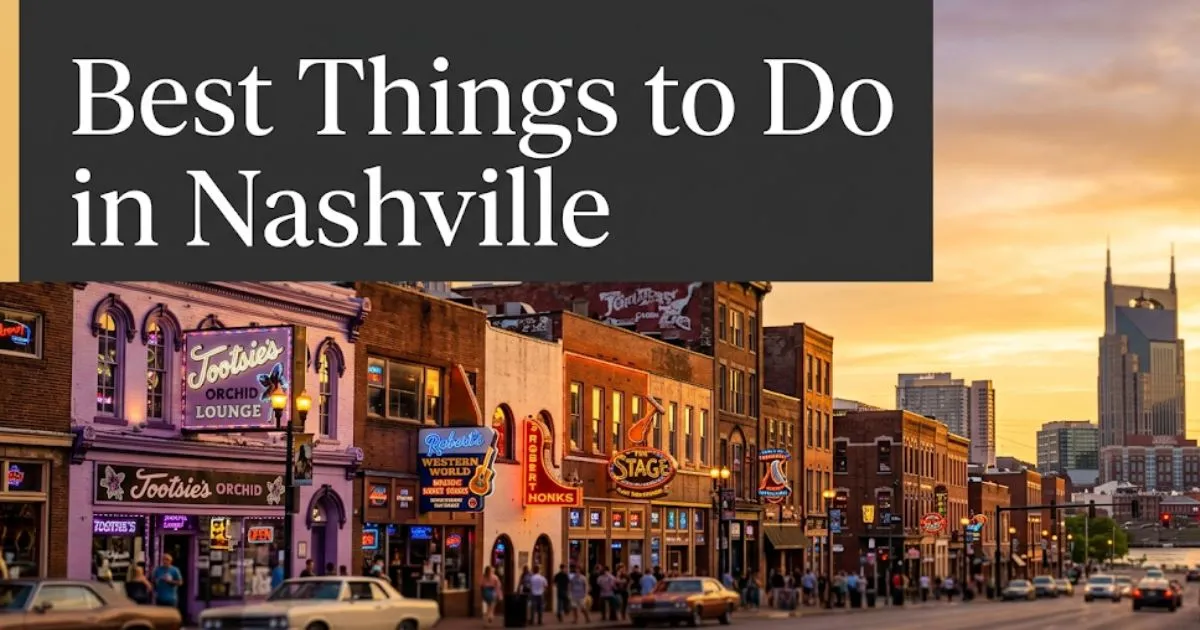
The tourist draw is Lower Broadway, a roughly six-block honky-tonk corridor running from 1st Avenue to 5th Avenue South.
Robert’s Western World on Broadway is the gold standard for authentic vintage country on this strip. It runs a real house band, serves a fried bologna sandwich, and has never installed a cover charge.
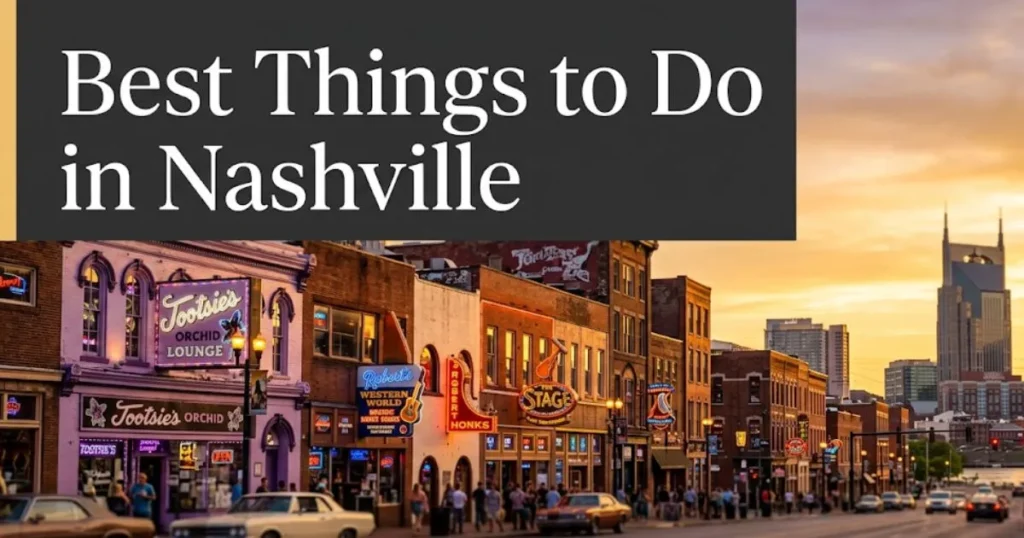
Tootsie’s Orchid Lounge, one block off Broadway on Commerce Street, has been operating since 1960 and has the walls to prove it. Both venues predate Nashville’s bachelorette economy by decades.
The rest of downtown’s walkable core includes the 5th and Broadway development, which houses retail and dining options in a format that families find significantly more accessible than the bar-heavy strip itself.
Couples will find Broadway genuinely energetic for an early evening visit but increasingly impractical after 10pm on weekends, when crowd density and noise reach levels that make conversation nearly impossible.
Budget travelers note that most Broadway venues charge no cover before approximately 6pm. Arrive between 3pm and 5pm to catch live music with no entry fee.
Insider Tip:
- Robert’s Western World operates no cover charge at any hour and has a vintage-country house band that runs most nights.
- The upper floors of Broadway bars offer the best photography angles and significantly lower noise levels than the ground floor.
- Solo travelers should note that Broadway on a Tuesday or Wednesday night is a genuinely different and far more approachable experience than Saturday.
Nashville Music Scene and Live Entertainment
Nashville’s music scene is the best things to do in Nashville argument that requires no selling, but the version most visitors experience is only the surface.
The tourist version is Broadway’s continuous live music. The real version lives at Ryman Auditorium, Station Inn, Basement East, and the Opry House in Opryland.
Ryman Auditorium, the “Mother Church of Country Music” at 116 5th Avenue North, hosts ticketed concerts nearly every night of the year. A show here is not a tourist experience. It is one of America’s genuinely great live music venues, with acoustics that justify the reverence.
The Station Inn on 402 12th Avenue South in the Gulch is Nashville’s most respected bluegrass and roots music venue. It operates most nights, charges a modest cover, and seats roughly 150 people. Locals consistently outnumber tourists.
Solo travelers will find the Station Inn’s intimate layout and table-seating format ideal for a genuine Nashville music night.
Basement East in East Nashville, at 917 Woodland Street, books indie, Americana, rock, and alt-country acts. It draws almost exclusively local Nashville audiences and visiting music industry professionals.
The Grand Ole Opry at the Opry House is a separate category entirely. It runs on Tuesday nights and most weekend nights with multiple acts per show. It is genuinely worth attending, particularly during the October to November fall season when the program frequently features significant artists.
Book Grand Ole Opry tickets at least four to six weeks in advance for weekend shows. Ryman concerts sell out regularly. Verify current programming through the Ryman and Opry official websites before departure.
Honky-Tonk Bars Nashville Broadway: The Honest Assessment
Broadway’s honky-tonk bars are the most photographed block in Nashville and also the most genuinely touristy experience the city offers. Both things are simultaneously true.
The case for going: the music is real, the atmosphere is unique, and there is nothing quite like it in any other American city. The case for managing expectations: by Saturday night, the ratio of bachelorette groups to genuine music fans is overwhelming.
Robert’s Western World remains the most legitimate music experience on the strip. The fried bologna sandwich costs around $5. The house band knows its repertoire. The clientele is broadly mixed.
Tootsie’s Orchid Lounge is a genuine historical venue but now operates primarily as a tourist bar. The upstairs stages occasionally have stronger acts than the ground floor. Explore before committing to a spot.
Luke’s 32 Bridge and FGL House (Florida Georgia Line’s bar) are the large multi-story venues that have come to define the Broadway experience for bachelorette tourism. Both deliver high energy and reliable entertainment. Neither delivers a local Nashville music experience.
The local alternative to Broadway’s entire honky-tonk corridor is a Tuesday or Wednesday night at Station Inn. The cover charge runs approximately $10 to $20. The music is exponentially more authentic. You will likely be the only tourist in the room.
Budget travelers should note that Broadway’s bars are designed to maximize drink sales. A night of live music can run $80 to $150 per person in drinks without any deliberate effort. Set a limit before you walk in.
Key Takeaway: Robert’s Western World is the single most honest honky-tonk experience on Broadway. Go before 6pm on a weekday to see the real version without the weekend crowd.
Best Neighborhoods in Nashville
Nashville’s best neighborhoods tell a more complete story than any single attraction. Each district has a distinct personality and a specific traveler type it suits best.
East Nashville is the city’s most interesting neighborhood for independent travelers. The Five Points intersection anchors a stretch of restaurants, bars, record shops, and coffee houses that feels genuinely local.
12 South is Nashville’s most walkable boutique shopping and dining district. Sevier Park anchors the residential side. The neighborhood runs along 12th Avenue South and attracts a younger professional local crowd alongside tourists.
Germantown sits north of downtown, roughly between Jefferson Street and the Cumberland River, and houses some of Nashville’s best independent restaurants. Germantown Cafe and the Nashville Farmers Market both anchor this neighborhood.
The Gulch is Nashville’s most polished urban neighborhood, developed almost entirely within the last 15 years. It houses upscale dining, the Pinewood Social venue (which combines a restaurant, coffee bar, bowling lanes, and a pool), and a stretch of hotel and retail development that appeals to design-oriented travelers.
Music Row, along 16th and 17th Avenues South, is the actual physical infrastructure of Nashville’s recording industry. Walking it gives you context that no museum quite replicates.
Couples find 12 South ideal for a relaxed afternoon. The boutique retail, coffee shops, and neighborhood restaurants there suit a low-key romantic afternoon better than the intensity of downtown.
Seniors will find Germantown the most physically accessible of Nashville’s interesting neighborhoods. The streets are flatter and less crowded than downtown or East Nashville.
Nashville Food Scene and Hot Chicken
Nashville’s food identity is built on two foundations: Nashville hot chicken and a broader Southern food tradition that has increasingly attracted James Beard-recognized chefs.
Hot chicken is the non-negotiable starting point. Prince’s Hot Chicken Shack, the original creator of the dish, operates at its North Nashville location on Ewing Drive. It is not conveniently located for most tourists. Go anyway. This is the origin point of a dish that has been replicated globally.
Hattie B’s Hot Chicken has multiple Nashville locations, including one in Midtown and one near the Gulch. It is more accessible than Prince’s and maintains genuine quality. Order the “Damn Hot” level only if you have a serious tolerance for capsaicin.
Beyond hot chicken, the Nashville Farmers Market in Germantown hosts an indoor food hall with rotating vendors covering a range of Southern and international cuisines. It operates most days; verify current hours before visiting.
The Germantown neighborhood holds some of Nashville’s strongest independent restaurant options. The dining scene there runs from elevated Southern cooking to Italian to contemporary American.
Budget travelers should note that hot chicken from Prince’s or Hattie B’s is genuinely affordable. A full meal with sides runs approximately $12 to $20 per person, making it among Nashville’s best value eating experiences regardless of budget.
Families with children will find Hattie B’s most practical due to its multiple locations and accessible format. Order mild for children; the seasoning scale at Nashville hot chicken restaurants is genuine.
Insider Tip:
- Prince’s Hot Chicken Shack has a significant wait, particularly on weekends. Arrive at opening or expect 30 to 45 minutes minimum.
- The Nashville Farmers Market food hall offers the city’s most varied quick lunch for under $15.
- For upscale dining, the Germantown and Gulch neighborhoods are where Nashville’s independent fine dining is concentrated.
Key Takeaway: Prince’s Hot Chicken Shack is the origin of Nashville hot chicken and the most legitimate version of the dish in the city. The inconvenient location is irrelevant. Make the trip.
Nashville Outdoor Activities and Parks
Nashville’s outdoor options are genuinely underrated and largely ignored by competitor guides that focus entirely on music and food.
Centennial Park, located along West End Avenue in Midtown, is the city’s most accessible urban park and home to a full-scale replica of the Parthenon. The replica houses an art museum with rotating exhibitions. The park itself is free to enter.
Percy Warner Park, west of downtown in the Belle Meade area, offers over 3,000 acres of Middle Tennessee hardwood forest with marked trail systems including an 8-mile outer loop trail. It is free to access and consistently uncrowded.
Radnor Lake State Natural Area, approximately 10 miles south of downtown, is one of the only designated natural areas within a major American city’s metropolitan limits. The 1,100-acre protected area has paved and unpaved trails suitable for a range of fitness levels. Free to enter; parking is available but fills on weekend mornings.
Solo travelers and outdoor-oriented visitors should plan a Radnor Lake morning alongside their downtown evenings. The contrast, quiet woodland trails at dawn versus honky-tonk Broadway at night, is uniquely Nashville.
Seniors and accessibility travelers will find the main Radnor Lake trail along Lake Trail Road largely paved and suitable for most mobility levels. Percy Warner Park’s steeper terrain requires more caution.
Spring and fall are the strongest seasons for Nashville’s outdoor spaces. Summer heat and humidity can reach conditions that make midday trail activity genuinely uncomfortable. Check the Tennessee State Parks website for current trail conditions before visiting.
Country Music Hall of Fame and Cultural Attractions
The Country Music Hall of Fame and Museum at 222 Rep. John Lewis Way South is Nashville’s most comprehensive music history institution and one of the most well-designed American music museums in operation.
Admission runs approximately $28 to $35 per adult as of recent years, with lower rates for children and seniors. Allow two to three hours minimum. Combined ticket packages with the Ryman Auditorium self-guided tour offer meaningful savings; verify current package options directly with the museum.
The Frist Art Museum at 919 Broadway is Nashville’s primary fine art institution and is frequently overlooked by first-time visitors focused on the music attractions. The building itself, a restored 1934 Art Deco post office, is worth visiting independently of whatever exhibition is running.
The Johnny Cash Museum at 119 3rd Avenue South is small relative to its reputation but densely curated and genuinely moving for Cash fans. Allow 60 to 90 minutes.
The Tennessee State Museum, on Rosa L. Parks Boulevard, covers Tennessee history from indigenous cultures through the Civil War and Reconstruction with particular depth. It is free to enter, making it one of Nashville’s most significant free cultural experiences.
Families with children ages 8 and up will find the Country Music Hall of Fame more engaging than younger children typically do. For families with younger children, the Adventure Science Center on Fort Negley Boulevard is purpose-built for the 4-to-12 age range.
According to the Nashville Convention and Visitors Corp, Nashville’s cultural institutions collectively attract over 14 million visitors annually, with the Country Music Hall of Fame among the top three ticketed attractions in the state of Tennessee.
East Nashville Things to Do
East Nashville is the neighborhood that repeat visitors and Nashville residents consistently rank above any single downtown attraction.
It sits across the Cumberland River from downtown, accessible by the Shelby Street Pedestrian Bridge on foot or by rideshare in roughly 10 minutes from Broadway.
Five Points is the commercial hub of East Nashville, at the intersection of Woodland Street, 11th Street, and Holly Street. The area holds record shops, vintage clothing stores, coffee houses, and some of the city’s best independent restaurants and bars.
Basement East at 917 Woodland Street is East Nashville’s flagship live music venue. It hosts acts across indie, Americana, and alternative country with a capacity that keeps shows genuinely intimate. Check their calendar before your trip, as shows sell out.
The east side’s restaurant scene rivals anything downtown offers. The neighborhood runs from quick-service breakfast spots to serious dinner restaurants with wine programs.
Solo travelers find East Nashville the most socially approachable part of the city. The bar and coffee shop culture there is oriented toward locals and welcomes single visitors without the group-dynamics pressure of Broadway.
Couples looking for a low-key Nashville evening away from the bachelorette corridor will find East Nashville’s restaurant and bar scene consistently better suited for actual conversation.
Insider Tip:
- Saturday morning in East Nashville’s Five Points area is one of the best people-watching and coffee experiences in the city.
- The Shelby Street Pedestrian Bridge walk at sunset provides a genuinely useful vantage point of downtown Nashville without requiring a car.
- East Nashville restaurants do not take reservations uniformly. Check OpenTable or call directly before a weekend dinner attempt.
Key Takeaway: East Nashville’s Five Points corridor is where Nashville’s local music, food, and social culture actually operates. No first-time visitor should leave the city without spending at least a half-day there.
Things to Do in Nashville for Free
Nashville offers a surprisingly broad range of free and low-cost experiences for budget-conscious travelers willing to plan deliberately.
The Tennessee State Museum is free to enter and provides one of the most substantive free cultural experiences in any American city. The collection’s Civil War and Reconstruction sections alone justify the visit.
Centennial Park is free to access and includes the exterior of the Parthenon replica, the park’s walking paths, and a consistently active community atmosphere. The interior Parthenon museum charges a modest admission; the park itself costs nothing.
Percy Warner Park and Radnor Lake State Natural Area are both free. Together they represent hundreds of miles of accessible trail through genuine Middle Tennessee landscape.
The honky-tonk bars on Broadway are free to enter before approximately 6pm on most nights. Arriving in the mid-afternoon gives budget travelers the full Broadway experience at zero entry cost, though drink purchases will still add up.
The Shelby Street Pedestrian Bridge is a free walk connecting downtown to East Nashville and provides one of the city’s best skyline views at zero cost.
Fort Negley Park, on Edgehill Avenue, is the site of the largest inland Civil War fortification ever built in the United States by the U.S. Army. It is free to visit and genuinely significant from a historical perspective.
Budget travelers should note that Nashville’s free cultural offerings skew heavily toward outdoor spaces and historical sites. The city’s major ticketed attractions (Country Music Hall of Fame, Ryman, Grand Ole Opry) are worth budgeting for separately if Nashville’s music history is a primary interest.
Nashville With Kids and Family Activities
Nashville with children requires deliberate itinerary planning because the city’s primary tourist infrastructure, Broadway, is genuinely adult-oriented and actively inappropriate for young children after dark.
The Adventure Science Center at 800 Fort Negley Boulevard is Nashville’s best family attraction for children between approximately 4 and 12 years old. The planetarium and hands-on science exhibits are purpose-built for this age range. Admission runs approximately $15 to $20 per person; verify current pricing before visiting.
Cheekwood Estate and Gardens at 1200 Forrest Park Drive in the Belle Meade area is the single strongest Nashville attraction for families with children of any age. The 55-acre estate combines formal gardens, woodland trails, a botanic garden, and a fine art museum in a setting that children can physically explore freely.
Spring at Cheekwood, when the estate’s tulip displays bloom across the hillsides, is the most visited period. Book tickets in advance for late March through April.
Nashville Sounds minor league baseball at First Horizon Park offers a family-affordable live sports experience in a stadium designed for families, with lawn seating and an accessible price point relative to major professional sports.
Families with strollers should note that East Nashville’s Five Points area has uneven sidewalks in sections. Germantown and the Gulch have more consistently accessible pedestrian infrastructure.
The Tennessee State Museum is free and family-appropriate for children over approximately age 8. Younger children will find the format less engaging.
According to the Nashville Convention and Visitors Corp, Cheekwood and the Adventure Science Center rank among the top five most frequently visited Nashville attractions by families with children.
Nashville for Couples: Romantic Experiences
Nashville for couples works best when the itinerary balances Broadway’s energy with the quieter, more intimate experiences in the city’s residential neighborhoods.
A Ryman Auditorium concert is arguably Nashville’s best date night. The venue’s intimacy, historical atmosphere, and acoustics create an experience that genuinely differs from any other American concert hall.
Cheekwood Estate and Gardens in spring is a specific recommendation for couples. The gardens are designed for slow, unhurried exploration. The on-site restaurant provides a lunch option that avoids the downtown dining scramble.
The Shelby Street Pedestrian Bridge walk at golden hour, roughly 30 to 60 minutes before Nashville’s sunset, provides a scenic and cost-free experience with unobstructed downtown skyline views.
Pinewood Social in the Gulch combines a restaurant, cocktail bar, coffee house, and vintage bowling lanes in one space. It is genuinely unusual and specifically good for couples who want a low-pressure activity alongside dinner and drinks.
The 12 South neighborhood suits a romantic afternoon very well. The boutique retail on 12th Avenue South, the coffee shops, and the neighborhood restaurant options create a relaxed setting without Broadway’s crowd intensity.
Couples on a budget will find East Nashville’s restaurant scene offers better value for a romantic dinner than the Gulch or downtown. The quality-to-price ratio in East Nashville is consistently higher.
Insider Tip:
- Book Ryman Auditorium concert tickets two to four months ahead for weekend shows. Last-minute availability is rare for headlining acts.
- A sunset walk across the Shelby Street Bridge followed by dinner in East Nashville is a zero-cost-to-modest-cost couple’s evening that outperforms most Broadway-adjacent dinner options.
Key Takeaway: A Ryman Auditorium concert followed by dinner in East Nashville is the most complete couples’ Nashville evening available. Book the Ryman first; everything else follows from that anchor.
Nashville Itinerary: One Day and Weekend Guide
A single well-planned Nashville day covers the Broadway corridor, the Country Music Hall of Fame, and one neighborhood beyond downtown.
A weekend allows you to add East Nashville, Cheekwood or Percy Warner Park, and a proper Nashville hot chicken experience.
One-Day Nashville Itinerary:
- Begin the morning at the Country Music Hall of Fame when it opens. Crowds are manageable before 11am.
- Walk to the Ryman Auditorium for a self-guided tour. The building’s interior is worth the admission independent of any show.
- Lunch at the Nashville Farmers Market in Germantown, approximately a 10-minute rideshare north of downtown. The food hall offers the city’s best quick mid-day meal.
- Return downtown and walk Lower Broadway from 1st Avenue to 5th Avenue. Arrive before 6pm to avoid cover charges at the honky-tonks.
- Stop at Robert’s Western World for live vintage country and the fried bologna sandwich.
- Evening dinner in East Nashville via rideshare. Book a restaurant reservation in Five Points before your trip.
- Close the night with a walk back across the Shelby Street Bridge toward downtown.
Weekend Addition (Day 2):
- Morning coffee and breakfast in East Nashville’s Five Points neighborhood.
- Mid-morning visit to Radnor Lake State Natural Area or Percy Warner Park for a trail walk.
- Lunch or early dinner at Hattie B’s Hot Chicken on a location accessible to your accommodation.
- Afternoon at Cheekwood Estate and Gardens if visiting in spring or fall.
- Evening Grand Ole Opry show if tickets are available; book well in advance.
Getting Around Nashville: Transportation and Parking
Getting around Nashville requires honest planning because the city is largely car-dependent and its downtown parking situation on weekends is genuinely difficult.
From BNA Airport: Nashville International Airport (BNA) is approximately 8 miles east of downtown. Rideshare (Lyft, Uber) is the most practical option, typically running $20 to $35 to downtown depending on time and demand. No direct rail connection exists between BNA and downtown Nashville as of 2026; verify with the Nashville MTA for any transit developments before travel.
Within Downtown: The Broadway corridor is walkable within itself. The distance from 1st Avenue to the Country Music Hall of Fame at 5th and Demonbreun is approximately a 15-minute walk. Centennial Park is approximately a 20-minute walk from Broadway along West End Avenue.
Broadway Parking Reality: Downtown parking garages near Broadway fill by 6pm on Friday and Saturday nights. The 5th and Broadway garage and the Public Library garage on 6th Avenue are among the more reliable options, but expect rates of $20 to $40 for an evening. Do not attempt to drive and park on Broadway after 7pm on weekends without a pre-booked garage reservation where available.
Rideshare Surge Warning: Lyft and Uber surge pricing on Broadway on Friday and Saturday nights between 11pm and 2am is significant. A ride that costs $8 at 9pm may cost $30 to $50 at midnight. Budget accordingly or plan to walk to a less congested pickup point one or two blocks off Broadway.
WeGo Public Transit operates bus routes throughout Nashville. For tourists, it is not a practical primary transit system for most itinerary needs, but Route 7 connects several key points.
Seniors and accessibility travelers should note that Nashville’s uneven downtown sidewalks, particularly the brick-paved sections near Broadway, present genuine mobility challenges. The Gulch and Germantown have more consistently accessible pedestrian infrastructure.
Best Time to Visit Nashville Tennessee
The best time to visit Nashville is April through early June and September through mid-October.
Spring brings comfortable temperatures, the blooming season at Cheekwood, and the Tin Pan South Songwriters Festival in late March or early April, one of the most unique music events in the calendar. Fall brings cooler air, fall foliage along Percy Warner Park and Radnor Lake trails, and lower crowd levels than summer peak.
Summer (June through August) is Nashville’s most crowded and most expensive period. CMA Fest, which runs for approximately four days in June at Nissan Stadium and various downtown venues, drives hotel rates to their annual high point. Week-of prices during CMA Fest can exceed $400 to $600 per night for standard downtown hotels. If CMA Fest is your reason to visit, book four to six months ahead.
Winter (December through February) offers the lowest hotel rates of the year and manageable crowds. However, Broadway’s outdoor appeal diminishes significantly in cold weather, and some smaller venues reduce their programming in January and February.
Budget travelers get the best value visiting Nashville in January, February, or early March, when hotel rates drop and crowds thin. The music venues still operate; the seasonal programming is lighter, but the city is fully functional.
Families will find late May and early September the most practical summer-adjacent options: school vacation alignment with lower crowd levels than peak July.
According to the Tennessee Department of Tourist Development, Nashville sees its highest annual visitation in June and October, with October increasingly competitive due to fall festival programming and football season.
Nashville Day Trips From Downtown
Nashville’s location in Middle Tennessee makes it one of America’s strongest day trip bases. Several genuinely significant destinations sit within a 90-minute drive.
Franklin, Tennessee, approximately 20 miles south of Nashville via I-65, is one of the South’s best-preserved Civil War sites and a well-maintained small city with independent dining, boutique retail on Main Street, and the Carter House and Carnton historic sites. Allow four to five hours minimum.
Jack Daniel’s Distillery in Lynchburg is approximately 80 miles southeast of Nashville via US-231. Tours run throughout the day on a first-come, first-served basis as well as with advance reservations. A visit with driving time requires a full day. Designated drivers are non-negotiable; plan accordingly.
Mammoth Cave National Park in Kentucky is approximately 90 miles north of Nashville via I-65. It contains the world’s longest known cave system. Cave tours require advance booking through the National Park Service reservation system, particularly in summer. Allow a full day.
Natchez Trace Parkway begins at milepost 0 near the Tennessee-Alabama border and runs north through Nashville, making it accessible for scenic drives toward the Duck River valley. The parkway is a National Park Service administered roadway with no commercial traffic and a 50-mph speed limit, making it one of America’s better scenic drives in the spring and fall.
Couples find the Franklin day trip easiest to execute from Nashville: short drive, walkable downtown, strong independent dining options for lunch or dinner.
Families with children should prioritize Mammoth Cave for its genuine educational and physical adventure value. Book cave tour tickets at least two to four weeks ahead during summer.
Safety and Practical Warnings for Nashville
Nashville is a generally safe major American city, but several specific conditions affect visitors in ways that standard travel guides do not address.
Key safety and practical facts every visitor should know:
- Broadway on Friday and Saturday nights between 10pm and 2am is extremely crowded. Pickpocket risk in dense crowd conditions is real. Keep wallets in front pockets and bags closed.
- Lyft and Uber surge pricing after midnight on Broadway weekends is significant. Budget for $30 to $60 rides in peak surge conditions or designate a walking pickup point off the main strip.
- Summer heat and humidity in July and August are severe. Outdoor activities scheduled during midday hours, including trail walks at Percy Warner or Radnor Lake, can be genuinely dangerous for children, seniors, and anyone with heat sensitivity. Schedule outdoor activities before 10am or after 5pm.
- Nashville’s uneven brick sidewalks in the Broadway corridor present real fall and mobility risks for seniors and travelers with limited mobility. The Gulch and Germantown have better pedestrian infrastructure.
- Driving downtown on weekend evenings is strongly discouraged. Parking is expensive and scarce. Rideshare is significantly more practical.
- CMA Fest week in June multiplies downtown crowd levels and Broadway congestion to a level that first-time visitors frequently find overwhelming. Plan arrival and departure logistics carefully around this event.
Nashville’s non-emergency police line is available through the Metro Nashville Police Department. For genuine emergencies, dial 911.
Frequently Asked Questions About the Best Things to Do in Nashville
What are the best things to do in Nashville for first-time visitors?
First-time visitors to Nashville should prioritize the Country Music Hall of Fame, a walk along Lower Broadway, the Ryman Auditorium, and at least one meal or afternoon in East Nashville’s Five Points neighborhood.
The Country Music Hall of Fame provides essential context for the city’s identity.
East Nashville provides the local experience that first-timers rarely discover and repeat visitors consistently cite as their favorite part of the city.
How many days do you need to see Nashville properly?
Three full days is the practical minimum for a complete Nashville experience.
One day covers Broadway and the downtown cultural attractions; a second day allows for East Nashville, Percy Warner Park, and a hot chicken experience; a third day accommodates a day trip to Franklin or Mammoth Cave.
Two days is sufficient for a focused music-and-food itinerary if you plan efficiently.
Is Broadway Nashville worth visiting or is it too touristy?
Broadway is worth visiting for two to four hours, particularly before 6pm on a weekday or in the mid-afternoon on weekends.
The music is real, the atmosphere is genuinely unique, and Robert’s Western World delivers authentic vintage country in a way that no other Broadway venue currently matches.
After 9pm on Friday and Saturday, the crowd density and bachelorette group concentration shift the experience toward tourist spectacle rather than music.
What is Nashville’s best neighborhood to explore?
East Nashville is the city’s most interesting neighborhood for independent travelers who want local culture, genuine restaurants, and a social atmosphere that reflects how the city actually lives.
12 South is the best neighborhood for boutique shopping and a relaxed afternoon.
Germantown is the strongest option for high-quality independent dining and the Nashville Farmers Market.
What is Nashville hot chicken and where should I get it?
Nashville hot chicken is a fried chicken dish seasoned with a cayenne-heavy paste that creates genuinely intense heat levels, served on white bread with pickles.
Prince’s Hot Chicken Shack in North Nashville is the original creator of the dish and remains the most authentic source.
Hattie B’s Hot Chicken offers a more accessible location and consistent quality that makes it a strong alternative, particularly for visitors who find Prince’s location inconvenient.
What is the best time of year to visit Nashville Tennessee?
The best time to visit Nashville is April through early June and September through mid-October.
Spring offers comfortable temperatures and Cheekwood’s bloom season; fall brings lower crowds, cooler weather, and fall foliage along the city’s parks and trails.
Summer brings CMA Fest and peak crowds with significantly higher hotel prices; winter is the quietest and most affordable season but offers limited outdoor appeal.
Plan Your Nashville Trip With Confidence
Nashville rewards visitors who plan beyond the Broadway corridor. Book your Ryman Auditorium concert or Grand Ole Opry tickets first; those anchor dates will structure everything else effectively.
Verify hours, admission prices, and seasonal programming for the Country Music Hall of Fame, Cheekwood, and any day trip destination directly with those venues before departure. Travel conditions, event calendars, and pricing change.
You have everything here to build a specific, honest, practically useful Nashville itinerary. The city will deliver on its reputation if you give it more than one city block.