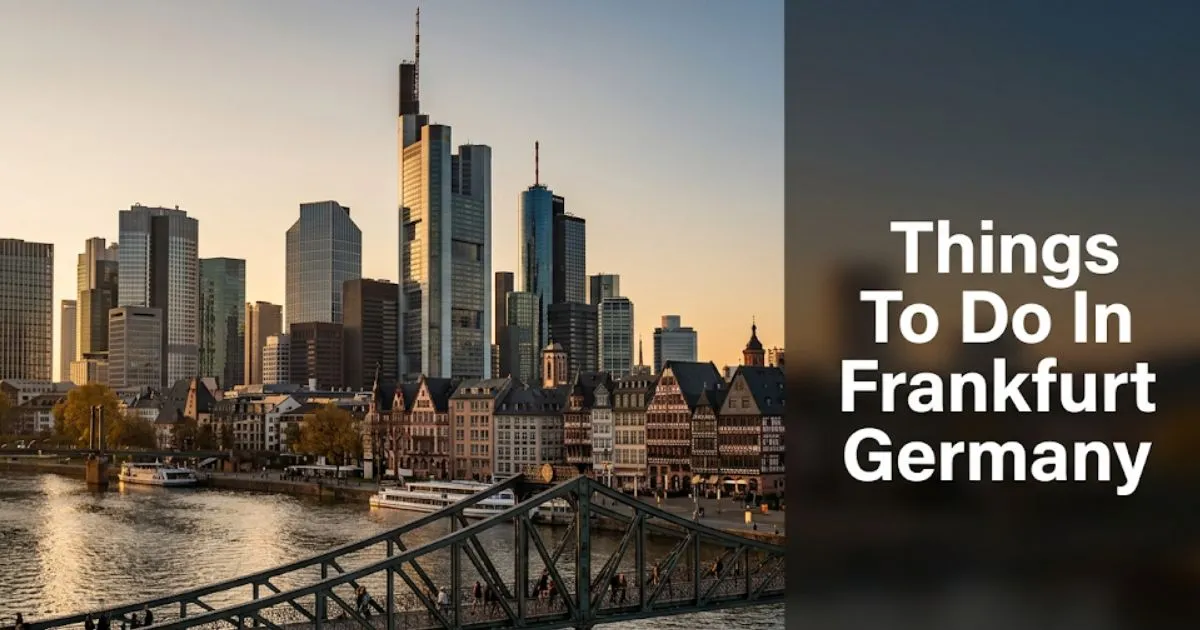
Things To Do in Frankfurt Germany: Complete 2026 Guide

Frankfurt Germany rewards travelers who look past its financial-hub reputation with one of Europe’s most concentrated museum corridors, a genuinely local apple wine culture, and a walkable riverfront.
The city’s Museumsufer district packs 15 museums into a single riverside mile, a density that rivals Munich’s Kunstareal. According to Tourismus+Congress GmbH Frankfurt, the city hosts over 8.5 million overnight visitors annually, yet its best neighborhoods remain largely unknown to first-time visitors.
This guide covers the top things to do in Frankfurt Germany across every traveler type. You will get specific named venues, honest crowd assessments, practical cost context, and a ready-to-use 2-day itinerary.
Things To Do in Frankfurt Germany: What Makes This City Worth Your Time
The best things to do in Frankfurt Germany sit across three distinct zones: the historic Altstadt, the Museumsufer riverside, and the local neighborhoods of Sachsenhausen and Bornheim.
Frankfurt is not a preserved medieval city. Allied bombing in 1944 destroyed approximately 80% of the old town. What visitors see at Römerberg today is a careful reconstruction, completed as recently as 2018 with the New Old Town (Dom-Römer-Areal) project.
That honesty matters for expectation-setting. Frankfurt’s authenticity lives in its culture, not its architecture.
The city genuinely earns its reputation as a museum city and as the birthplace of apple wine culture in Germany. Those two things alone justify a 2-to-3-day visit.
Solo travelers will find Frankfurt easy to navigate and socially accessible in the apple wine taverns of Sachsenhausen. Families will benefit from the child-friendly Senckenberg Museum and Frankfurt Zoo. Couples will find the Eiserner Steg iron bridge and riverside walks genuinely romantic without the manufactured romance of more tourist-polished cities.
Insider Tip:
- Frankfurt Airport (FRA) has a direct S-Bahn connection to the city center in roughly 11 minutes. The city is accessible for even a 6-hour layover.
- Most visitors waste their first two hours at Römerberg and then struggle to fill the rest of their time. The actual sequence should start at Kleinmarkthalle, cross the Eiserner Steg, and reach Sachsenhausen by early afternoon.
- This approach applies especially to transit travelers who have limited hours and need an efficient, rewarding circuit.
Top Things To Do in Frankfurt Germany: The Essential List
The top things to do in Frankfurt Germany, ranked by genuine local value rather than tourist popularity, span museums, markets, river walks, and neighborhood taverns.
| Activity | Best For | Cost Range (2026 Estimate) | Time Needed | Insider Note |
|---|---|---|---|---|
| Städel Museum | Couples, Culture Travelers | Approx. €16-€18 adult | 2-3 hours | Free every last Saturday of month |
| Kleinmarkthalle | All profiles | Free entry, food to purchase | 1-1.5 hours | Go before 1pm; closes early |
| Sachsenhausen apple wine tavern | Solo, Couples, Groups | €15-€30 per person | 2-3 hours | Zum Wagner is the local benchmark |
| Senckenberg Museum | Families, Solo | Approx. €10-€12 adult | 1.5-2 hours | Best dinosaur collection in Germany |
| Eiserner Steg walk | All profiles | Free | 30-45 minutes | Best at dusk |
| Frankfurt Zoo | Families | Approx. €12-€16 adult | 2-3 hours | Compact, walkable, manageable for young children |
| Main Tower observation deck | Couples, Solo | Approx. €9-€11 adult | 45-60 minutes | Only public skyscraper observation deck in Frankfurt |
| Berger Strasse stroll | Budget, Solo, Couples | Free | 1-2 hours | Best local neighborhood street in the city |
Verify all prices directly with each venue before visiting, as Frankfurt admission fees update annually and trade fair weeks can affect availability.
Seniors and accessibility travelers should note that Kleinmarkthalle has uneven stone flooring and minimal elevator access inside the market building. The Städel Museum and Senckenberg Museum both offer barrier-free access and elevator service.
Frankfurt Old Town and Römerberg: What to See and What to Know
Römerberg is Frankfurt’s historic heart and the starting point for almost every visit. It is a partially reconstructed medieval square anchored by the Römer, Frankfurt’s Gothic city hall, which dates to 1405.
The square itself is genuine and atmospheric. The surrounding half-timbered houses (the Ostzeile) are reconstructions from the 1980s. Knowing this prevents the mild disappointment many visitors feel when the “medieval” detail looks too perfect.
Walk through the adjacent Dom-Römer-Areal, completed in 2018. This is Frankfurt’s ambitious reconstruction of 35 historic buildings on their original footprints, including the lanes between Hühnermarkt and Markt streets.
Paulskirche (St. Paul’s Church), a five-minute walk away, is the site of Germany’s first democratically elected parliament in 1848. Entry is typically free and the interior is sobering in its historical importance.
Goethe-Haus (the birthplace of Johann Wolfgang von Goethe) is on Grosser Hirschgraben, a 10-minute walk from Römerberg. Admission runs approximately €7 to €10 per adult. The building was completely destroyed in World War II and meticulously reconstructed based on historical records.
Families should know the Römerberg area is highly walkable for young children. Stroller access is easy across the square itself. The Dom-Römer-Areal’s narrow lanes require folding compact strollers.
Local alternative: The tourist crowd at Römerberg thins significantly after 5pm on weekdays. Experienced Frankfurt visitors do the square at dusk when the lighting is better and the tour groups have departed.
Museumsufer and Frankfurt Museums: Europe’s Most Concentrated Museum Mile
The Museumsufer (Museum Embankment) is Frankfurt’s most underestimated asset. Fifteen museums line the south bank of the Main River within a single walkable stretch.
The Städel Museum is the anchor. Founded in 1815, it holds over 3,800 paintings spanning seven centuries, from Botticelli and Rembrandt to Richter and Bacon. According to Condé Nast Traveler, the Städel ranks among Europe’s essential art museums outside the top-tier capitals. Plan 2 to 3 hours minimum.
The German Film Museum (Deutsches Filmmuseum) on Schaumainkai is a serious cinephile institution with genuine international film history depth. Admission typically runs approximately €7 to €9 per adult.
The Museum of Applied Arts (Museum Angewandte Kunst) occupies a 15th-century villa extended by architect Richard Meier. Its permanent collection covers decorative arts from ancient Egypt to contemporary design.
For families, the Liebieghaus Skulpturensammlung (sculpture museum) directly beside the Städel has an exceptional collection of European sculpture that holds children’s attention better than most painting-heavy museums.
Budget travelers: The Museumsufer Festival (Museumsuferfest) typically held over three days in late August offers free or heavily reduced museum admission alongside outdoor performances. It is one of Frankfurt’s genuine crowd events and worth planning around.
Seniors and accessibility travelers will find the Museumsufer walk entirely flat along the river path. The Städel is fully barrier-free. Call individual smaller museums in advance regarding lift access, as heritage buildings vary.
Key Takeaway: Plan the Städel for a Tuesday or Wednesday morning to avoid weekend crowds, and combine it with the German Film Museum next door in the same afternoon.
Sachsenhausen Neighborhood Frankfurt: The City’s Local Soul
Sachsenhausen is where Frankfurt stops being a financial capital and starts being a real German city. Cross the Eiserner Steg from the north bank and you enter the city’s most authentic neighborhood.
The district is defined by its apple wine taverns (Apfelweinwirtschaften). These are traditional wood-panelled drinking halls serving Ebbelwei (Frankfurt’s regional pronunciation of apple wine) in ceramic pitchers alongside hearty local food.
Zum Wagner on Schweizer Strasse is the neighborhood benchmark. It opened in 1931 and remains family-owned. The apple wine is tangy and dry, nothing like commercial hard cider. Order a Schöppchen (a 0.25-liter pour) to sample before committing to a pitcher.
Adolf Wagner on Schweizer Strasse is the second major classic, slightly more known to tourists but still genuinely local in character. Both fill up by 7pm on Fridays and Saturdays. Arrive by 6pm or expect to wait.
Sachsenhausen also holds a portion of the Museumsufer along its northern edge, making a natural combination: museums in the afternoon, apple wine in the evening.
Solo travelers will find the communal table seating culture of Sachsenhausen’s taverns genuinely welcoming. It is normal and expected to share tables with strangers. This is one of the more naturally social dining environments in any European city.
Families with young children should note that traditional apple wine taverns are adult-oriented evening venues. The Sachsenhausen riverfront walk and the flea market along Schaumainkai (held Saturday mornings) are much better suited to children.
Frankfurt Food and Apfelwein Culture: What to Actually Eat and Drink
Frankfurt’s food identity is specific and regional. It is built around four things: apple wine, Frankfurter Grüne Soße (green sauce), Frankfurter Würstchen (the original Frankfurt sausage), and Handkäse mit Musik (a pungent marinated cheese with onions).
Frankfurter Grüne Soße is the city’s signature dish: a cold herbed sauce made from exactly seven herbs (borage, chervil, cress, parsley, salad burnet, sorrel, and chives) served over hard-boiled eggs or boiled beef. It appears on virtually every traditional menu in Sachsenhausen. The Wagner restaurants both serve versions worth ordering.
Frankfurter Würstchen are thinner and longer than the American hot dog that claims descent from them. The genuine article is sold at Kleinmarkthalle butcher counters and at street stands near Römerberg. Buy them boiled, not grilled, for the traditional preparation.
Handkäse mit Musik is an acquired taste. The “music” in the name refers colloquially to the digestive effects of the raw onion marinade. Order it once for the experience.
For drinking, apple wine is the correct cultural choice. Beer is available everywhere but is not the local tradition. Frankfurt sits in a wine and cider region, not Bavaria.
Budget travelers should know that a full traditional dinner with apple wine in Sachsenhausen, including bread, green sauce, and a main course, typically runs €18 to €30 per person. That is exceptional value for a European capital-class city.
Couples looking for a more curated dining experience will find Schweizer Strasse in Sachsenhausen and Berger Strasse in Bornheim both lined with quality mid-range restaurants beyond the traditional tavern format.
Key Takeaway: Order Grüne Soße at least once in a Sachsenhausen tavern. It is Frankfurt’s most specific culinary identity and genuinely delicious when made well.
Kleinmarkthalle Frankfurt: The City’s Best Morning Experience
Kleinmarkthalle is Frankfurt’s covered market hall on Hasengasse, a short walk from Römerberg. It is the single best morning activity in the city and the place where Frankfurt residents actually shop.
The hall has operated in its current form since 1954. Approximately 60 vendors sell cheese, sausage, fresh fruit, bread, olives, spices, pastries, and prepared foods across three floors. The upper gallery holds wine and specialty food stalls with bar seating.
Arrive between 9am and noon for the full experience. By 1pm on weekdays, vendors begin closing down, and Saturday crowds thin rapidly after midday. The market is typically closed Sundays.
Budget travelers will find the Kleinmarkthalle genuinely affordable. A breakfast of fresh bread, cheese, and coffee assembled from market vendors typically costs €5 to €9. The upper gallery wine bars are reasonably priced by Frankfurt standards.
Families should note the market aisles are narrow and not stroller-friendly during peak hours. A front carrier for infants works better. Older children who engage with food will find the vendor interaction genuinely interesting.
The local alternative to the Kleinmarkthalle for a secondary market experience is the Konstablerwache farmers market, held Thursdays and Saturdays outdoors on the square of the same name. It is less famous and more locally frequented.
Insider Tip:
- The upper gallery at Kleinmarkthalle has bar stools and serves wine and regional spirits from mid-morning. Locals use it as a casual pre-lunch stop.
- Ask the cheese vendors for samples. This is normal, expected, and how the market works.
- For solo travelers, the communal bar seating upstairs is one of the most naturally social daytime spaces in Frankfurt.
Main River and Outdoor Frankfurt: Walking, Cycling, and River Life
The Main River is Frankfurt’s best free attraction. Both banks offer wide, flat promenades that run for miles in both directions from the city center.
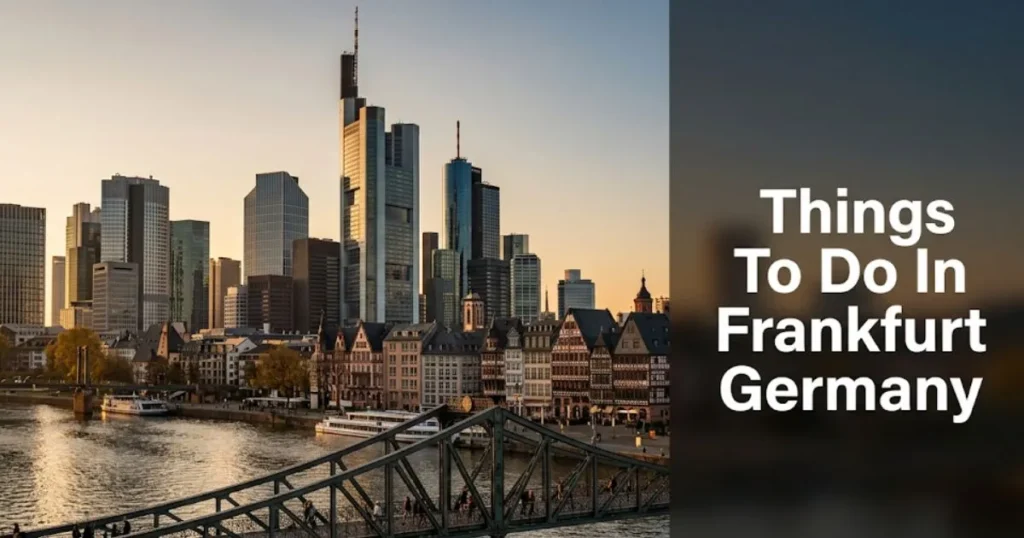
The north bank path from the Alte Brücke westward to the Holbeinsteg footbridge gives the best view of Frankfurt’s improbable skyline, nicknamed Mainhattan for its density of glass towers rising behind a medieval waterfront. This skyline view, looking north from the Museumsufer path, is one of Europe’s genuinely striking urban panoramas.
The Eiserner Steg (Iron Bridge), built in 1869, is the most photographed bridge in Frankfurt. Walk it at dusk for the best skyline view. It connects the Römerberg area directly to Sachsenhausen.
Cycling along both banks is popular and well-organized. Bike rental stations from Call a Bike (Deutsche Bahn’s bike-share system) are distributed throughout the city center. A riverside cycling route connects central Frankfurt to the Grüneburgpark in the Westend and further west toward Höchst.
Families will find the Main riverfront path ideal for young children. The path is entirely flat, wide, and car-free for long stretches. The Sachsenhausen riverbank near Schaumainkai has grass areas for picnics adjacent to the museum buildings.
The Palmengarten, Frankfurt’s botanical garden in the Westend district, offers 22 hectares of cultivated gardens including a large tropical greenhouse complex. It is one of Germany’s largest botanical gardens. Admission typically runs approximately €7 to €9 per adult.
Seniors and accessibility travelers will find the Main riverfront paths are the most accessible outdoor experience in Frankfurt. They are entirely flat, surfaced, and manageable with wheelchairs and mobility aids.
Best Neighborhoods in Frankfurt: Beyond the Tourist Center
Frankfurt’s best neighborhoods for genuine local experience are Bornheim, Nordend, Sachsenhausen, and the Bahnhofsviertel, each with a distinct character.
| Neighborhood | Character | Best For | Caution |
|---|---|---|---|
| Sachsenhausen | Apple wine, museum-adjacent, residential | Couples, Solo, Foodies | Touristy near river; authentic deeper in |
| Bornheim/Berger Strasse | Local cafes, indie shops, neighborhood life | Solo, Couples, Locals | 20-min walk or U-Bahn from center |
| Nordend | Quiet residential, parks, local restaurants | Couples, Seniors | Low on tourist sites; about atmosphere |
| Westend | Grand architecture, Palmengarten, upscale | Seniors, Couples | Expensive dining; few budget options |
| Bahnhofsviertel | Multicultural, food markets, edgy | Solo, Adventurous | Drug scene on Taunusstrasse; be aware |
| Römerberg/Altstadt | Tourist core, reconstructed old town | First-timers | Overpriced dining; crowds until 6pm |
Berger Strasse in Bornheim is Frankfurt’s most genuine local commercial street. It runs for over a kilometer through two neighborhoods, lined with independent cafes, bookshops, bakeries, wine bars, and restaurants frequented primarily by Frankfurt residents.
Take the U4 or U7 U-Bahn to Bornheim Mitte and walk the length of Berger Strasse toward Nordend. This is the single best neighborhood walk in Frankfurt for travelers who want to understand how the city actually lives.
Solo travelers will find Bornheim and Nordend the most naturally welcoming neighborhoods for daytime solo exploration. The cafe culture is strong and genuinely open to lone visitors.
Key Takeaway: If you have only one afternoon beyond the tourist circuit, spend it walking the full length of Berger Strasse from Bornheim Mitte to the Nordend end.
Frankfurt For Families: Honest Assessment of the Best Family Activities
Frankfurt for families works best as a 2-to-3-day destination built around the Senckenberg Natural History Museum, the Frankfurt Zoo, the Main River paths, and the Palmengarten.
The Senckenberg Naturmuseum on Senckenberganlage is the single best family attraction in the city. It holds the largest dinosaur collection in Germany, including mounted full skeletons that genuinely impress children of all ages. Admission typically runs approximately €10 to €12 for adults, with reduced rates for children. Plan 2 hours minimum.
The Frankfurt Zoo on Alfred-Brehm-Platz is compact and manageable for young children. Unlike large national zoo complexes, the Frankfurt Zoo covers a walkable footprint that prevents the “zoo fatigue” that sets in after four or five hours of endless walking. The nocturnal animal house is a particular draw for older children.
Römerberg is stroller-accessible across the main square but the Dom-Römer-Areal’s cobbled lanes require some navigation. The Dom (Frankfurt Cathedral) tower climb involves narrow spiral stairs and is not suitable for young children or stroller access.
Budget families will find Frankfurt’s parks and riverfront paths entirely free. The Günthersburgpark in Bornheim has a playground, open lawns, and a cafe, making it a genuine rest day option.
Families with teenagers should consider the Main Tower observation deck on Neue Mainzer Strasse for the Frankfurt skyline view. The deck sits at 200 meters. Admission typically runs approximately €9 to €11 per adult.
What sounds good for families but underdelivers: The Römerberg area’s tourist restaurants charge high prices for average quality. Eat at Kleinmarkthalle or a Bornheim cafe instead.
Fun Things To Do in Frankfurt Germany: A 2-Day Weekend Itinerary
Fun things to do in frankfurt germany are best organized by geographic logic rather than category. This 2-day itinerary minimizes backtracking and maximizes variety.
Day 1: Old Town, River, and Sachsenhausen
- Start at Kleinmarkthalle (9am to 10:30am). Breakfast from market vendors. Browse the cheese and sausage stalls.
- Walk to Römerberg (10 minutes on foot). Spend 45 minutes on the square and through the Dom-Römer-Areal lanes.
- Visit Paulskirche briefly for its historical context (typically free entry). Allow 20 minutes.
- Walk to the Eiserner Steg and cross to Sachsenhausen (10-minute walk from Römerberg).
- Walk the Museumsufer (Schaumainkai) path along the south bank westward. Choose one museum based on your profile: Städel for art, German Film Museum for cinema, Liebieghaus for sculpture.
- Late afternoon: return to Sachsenhausen streets, find a seat at Zum Wagner or Adolf Wagner (arrive by 6pm). Order Ebbelwei and Grüne Soße.
- Evening: walk the south bank riverfront at dusk for the Mainhattan skyline view.
Day 2: Neighborhoods, Museums, and Skyline
- Morning: Senckenberg Museum (opens typically at 9am). Allow 2 hours. Good for all profiles, excellent for families.
- Late morning: Walk or U-Bahn to Bornheim Mitte. Walk Berger Strasse for 1 to 1.5 hours. Coffee at a local cafe.
- Lunch in Bornheim at any cafe on Berger Strasse. Budget approximately €12 to €18 per person.
- Afternoon: Palmengarten if you want outdoor time, or Main Tower observation deck for the skyline.
- Late afternoon: Browse Schweizer Strasse shops in Sachsenhausen. This is a good street for independent boutique shopping.
- Evening: return to the north bank for dinner on Fressgass (Grosse Bockenheimer Strasse), Frankfurt’s upscale pedestrian food street.
Frankfurt Christmas Markets and Seasonal Events
Frankfurt’s Christmas market at Römerberg is among Germany’s oldest, with documented origins in the 15th century. The Frankfurter Weihnachtsmarkt typically runs from late November through December 22.
The Römerberg market is atmospheric precisely because of its setting. The half-timbered facades and Gothic Römer city hall create a backdrop that even the most cynical traveler finds genuinely striking at night under market lighting.
Secondary markets spread across the city center, including a market on Paulsplatz and a more alternative market near Konstablerwache. The Konstablerwache market skews younger and includes craft vendors alongside the standard mulled wine and bratwurst.
Crowds and booking: December weekends at Römerberg are extremely crowded, particularly Saturday afternoons between noon and 6pm. Visit on a weekday morning or evening for a more manageable experience. Frankfurt’s hotels charge peak rates during the Christmas market season. Book accommodation at least 2 to 3 months in advance for December visits.
Beyond Christmas: The Museumsuferfest in late August is Frankfurt’s largest street festival, typically spanning three days and drawing hundreds of thousands of visitors to the Museumsufer riverbanks. Museums offer free or reduced entry. Live music stages run throughout.
The Frankfurt Book Fair (Frankfurter Buchmesse) in mid-October is the world’s largest trade book fair. The public weekend offers genuine access to international publishing culture. Hotels sell out months in advance during Book Fair week.
Budget travelers should note that the Christmas market itself is free to enter. Spending is entirely at your own pace. A warm evening of mulled wine and market food typically costs €15 to €25 per person.
Key Takeaway: The Frankfurt Christmas market is genuinely worth planning around, but book your hotel at least two months ahead and visit on a weekday to avoid the worst Saturday afternoon crowds.
Best Time To Visit Frankfurt Germany
The best time to visit Frankfurt Germany is late April through early June or September through October. These shoulder months combine mild weather with manageable crowds and reasonable hotel rates.
April through June: Temperatures typically range from 12°C to 22°C (54°F to 72°F). The Palmengarten and outdoor riverfront are at their best. Trade fairs are lighter during this period, keeping hotel prices more stable.
September through October: Similar temperature ranges with the added draw of the Museumsuferfest (late August), the wine harvest season in the nearby Rheingau region, and the Frankfurter Buchmesse in October.
July and August: Frankfurt’s summer brings genuine heat, with temperatures occasionally exceeding 35°C (95°F). Air conditioning is inconsistent in older buildings including many traditional apple wine taverns and some museum spaces. Crowds peak. Hotel rates rise. The Main riverfront remains pleasant in the mornings.
November and December: Cold and grey outside of the Christmas market period. Many outdoor experiences lose their appeal. Indoor museum visits and the Weihnachtsmarkt remain worthwhile.
January and February: Frankfurt’s quietest and least expensive months. The city is cold and few major events animate the outdoor spaces. Trade fair season has not yet resumed. This works for travelers who specifically want low-cost, low-crowd museum access.
Families should note that German school holiday weeks (particularly July through August and Easter week) spike Frankfurt’s child-oriented attraction crowds noticeably. The Senckenberg Museum and Frankfurt Zoo see their longest wait times during these periods.
Budget travelers should target May or September for the best balance of pleasant weather, lower hotel prices, and no major trade fair conflicts.
Things To Do Near Frankfurt Germany: Day Trips Worth Making
Frankfurt’s position in central Germany makes it one of Europe’s best day-trip bases. The ICE train network and Autobahn access put several exceptional destinations within 45 minutes to 2 hours.
| Destination | Distance/Travel Time | Best For | Top Draw | Practical Note |
|---|---|---|---|---|
| Heidelberg | 80km / 50 min by ICE | Couples, Culture | Heidelberg Castle, old university town | Crowded in summer; visit weekdays |
| Rothenburg ob der Tauber | 130km / 80 min by car or train+bus | Families, First-timers | Best-preserved medieval walled town in Germany | Limited direct train; easier by car |
| Rüdesheim am Rhein | 70km / 45 min by train | Couples, Wine lovers | Rhine River wine region, cable car | Direct regional train from Frankfurt Hbf |
| Wiesbaden | 40km / 30 min by S-Bahn | Seniors, Couples | Spa culture, Kaiser Wilhelm architecture | Most accessible day trip from Frankfurt |
| Koblenz | 115km / 75 min by ICE | History, Outdoor | Deutsches Eck, Ehrenbreitstein fortress | Rhine cruise sections accessible from here |
| Marburg | 95km / 50 min by regional train | Solo, Culture | Historic university town, medieval castle | Less known than Heidelberg; fewer crowds |
Heidelberg is the default day trip for most Frankfurt visitors, and for good reason. The red sandstone castle ruins above the Altstadt (old town) and the pedestrian Hauptstrasse are genuinely impressive. But July and August bring crowd levels that reduce the experience significantly. Go on a Tuesday or Wednesday in May or September.
Rüdesheim is the correct choice for travelers who want Rhine River scenery without the full commitment of a multi-day Rhine cruise. The regional train from Frankfurt Hauptbahnhof to Rüdesheim takes approximately 45 to 75 minutes depending on connection.
Solo travelers interested in German university town atmosphere over tourist spectacle should consider Marburg over Heidelberg. It is smaller, less toured, and retains a genuine student-city character that Heidelberg has partially lost to tourism.
Getting Around Frankfurt Germany: Transit, Airport, and Practical Logistics
Getting around Frankfurt Germany is straightforward by European city standards. The RMV (Rhein-Main-Verkehrsverbund) transit network covers the entire city and surrounding region with S-Bahn, U-Bahn, tram, and bus services.
From Frankfurt Airport (FRA) to the city center: Take the S8 or S9 S-Bahn from the airport’s regional rail station (beneath Terminal 1) directly to Frankfurt Hauptbahnhof. Journey time is approximately 11 to 15 minutes. Trains run every 15 minutes during peak hours. A single fare typically costs approximately €4 to €5.50 in 2026 pricing zones; verify current fares with RMV before travel.
The Frankfurt Card offers unlimited transit plus museum discounts for 1 or 2 days. It can be a cost-effective option for visitors planning multiple museum visits. Evaluate against a standard RMV day ticket based on your planned activities.
Walking: Frankfurt’s city center is compact. The Römerberg to Sachsenhausen (via Eiserner Steg) walk takes 15 minutes. Römerberg to Kleinmarkthalle takes 8 minutes. The Museumsufer mile is entirely flat and walkable.
Cycling: The Call a Bike scheme operated by Deutsche Bahn offers short-term rental across the city. The Main riverfront paths and many city streets have dedicated cycling lanes. This is a practical option for travelers comfortable with European urban cycling.
Taxis and ride-share: Available but expensive by Frankfurt standards. Uber operates in Frankfurt. A taxi from the airport to the city center typically runs €30 to €45.
Driving: Unnecessary and inadvisable for city sightseeing. Frankfurt has a low-emission zone requiring an environmental sticker for entry. Parking in the center is expensive and limited. Use public transit.
Seniors and accessibility travelers will find Frankfurt’s transit system equipped with lifts at most major U-Bahn and S-Bahn stations, though some older stations still have limited elevator access. The RMV website provides accessibility information by station.
Frankfurt Budget Travel and Free Things To Do
Frankfurt budget travel is more accessible than the city’s financial-capital reputation suggests. Many of its best experiences cost little or nothing.
Free and low-cost experiences:
- Walking the Eiserner Steg and Main riverfront paths: free
- Exterior exploration of Römerberg and the Dom-Römer-Areal: free
- Paulskirche interior: typically free entry
- Berger Strasse neighborhood walk: free
- Saturday morning flea market on Schaumainkai: free to browse
- Grüneburgpark and Günthersburgpark: free
- Exterior view of the European Central Bank building: free
- Konstablerwache farmers market (Thursday and Saturday): free to browse
Paid experiences worth the price:
- Städel Museum: approximately €16 to €18 per adult (free entry on the last Saturday of each month, verify this policy remains in place for 2026)
- Senckenberg Museum: approximately €10 to €12 per adult
- Frankfurt Zoo: approximately €12 to €16 per adult
Where to save without sacrificing quality:
- Eat breakfast and lunch at Kleinmarkthalle instead of tourist restaurants near Römerberg. The price difference is significant on both quality and cost.
- Apple wine in Sachsenhausen is inexpensive by European capital standards. A full evening at Zum Wagner including food and several pitchers typically costs €20 to €30 per person.
- Use the RMV day ticket rather than individual journey tickets if you are making three or more transit trips in a day.
Budget travelers should specifically avoid eating in the restaurants immediately surrounding Römerberg square. These charge tourist-center prices for standard German food. Walk five minutes in any direction and prices drop noticeably.
According to Frankfurt Tourism, the city’s cultural infrastructure is deliberately priced to remain accessible. The Museumsufer’s annual festival model of offering free museum access reflects this orientation.
Safety and Practical Warnings for Frankfurt Germany
Frankfurt is a safe city by European standards, but specific zones and conditions require awareness.
Key safety and practical facts every visitor should know:
- Bahnhofsviertel (Central Station district): The streets immediately surrounding Frankfurt Hauptbahnhof, particularly Taunusstrasse, have a documented open drug use scene. This area is not violently dangerous for most daytime visitors, but it is confronting for first-time visitors and entirely unsuitable for families with young children. Walk directly to your hotel or transit connection without lingering.
- Pickpocket awareness: Römerberg, Zeil shopping street, and crowded Christmas market evenings carry standard European urban pickpocket risk. Front pockets, crossbody bags, and minimal cash exposure are the practical responses.
- Summer heat: Frankfurt summers have intensified. Days above 35°C (95°F) are no longer rare in July and August. Many older buildings, including traditional apple wine taverns and some museum spaces, lack air conditioning. Plan outdoor activities for morning hours during heat events.
- Trade fair disruptions: Frankfurt hosts some of the world’s largest trade fairs, including the Automechanika, IAA Mobility, and Ambiente events. During these periods, hotel prices triple or quadruple and the city center fills with business travelers. Check the Messe Frankfurt trade fair calendar before booking.
- Museum Monday closures: Most Frankfurt museums are closed on Mondays. Plan your visit days accordingly or your cultural itinerary will need significant restructuring.
- Timed entry: The Goethe-Haus and some smaller venues may require advance ticket purchase during peak summer weekends. Check directly with each venue before arrival.
Emergency contacts: European emergency number 112 works throughout Germany for police, fire, and medical emergencies.
Frequently Asked Questions About Things To Do in Frankfurt Germany
What are the best things to do in Frankfurt Germany for first-time visitors?
The best things for first-time visitors are the Römerberg old town, the Städel Museum, Kleinmarkthalle market, and an evening apple wine session in Sachsenhausen.
These four experiences cover Frankfurt’s historical core, world-class art, local food culture, and the neighborhood that defines the city’s authentic character.
Together they fill a full day comfortably and give first-time visitors an honest picture of what Frankfurt is actually about.
How many days do you need in Frankfurt Germany to see the highlights?
Two full days is the minimum for a meaningful Frankfurt visit that covers the main cultural and neighborhood experiences.
Three days allows for a day trip to Heidelberg or the Rhine Valley alongside the city highlights.
One day works only if you have a clear priority list and move efficiently between the Römerberg area, Kleinmarkthalle, and Sachsenhausen.
Is Frankfurt worth visiting or just a layover city?
Frankfurt is a genuinely worthwhile destination for 2 to 3 days, not just a transit hub.
The Museumsufer museum district, Sachsenhausen’s apple wine culture, and the Bornheim neighborhood offer experiences that hold their own against any comparable European city short break.
The layover reputation comes from visitors who only see the airport and the tourist zone around Römerberg, which is not a representative sample of what the city delivers.
What is the best neighborhood to stay in Frankfurt?
The Sachsenhausen and Bornheim districts offer the best combination of local character, walkability to major attractions, and reasonable hotel pricing.
The Römerberg/Altstadt area puts you in the tourist core but at higher prices with more noise, particularly on weekend evenings.
The Westend is quieter and upscale, well-suited to seniors and couples but requiring transit for most major attractions.
What should I eat in Frankfurt Germany?
The essential Frankfurt food experiences are Frankfurter Grüne Soße (cold herb sauce served over eggs or beef), Frankfurter Würstchen (the original thin Frankfurt sausage), and Handkäse mit Musik (marinated cheese with onions).
Drink Ebbelwei (apple wine) in a traditional Sachsenhausen tavern rather than beer, which is not Frankfurt’s local tradition.
For the best market food experience, Kleinmarkthalle provides the most authentic, affordable, and locally-sourced version of all these foods in one location.
What is the best time of year to visit Frankfurt Germany?
The best time to visit Frankfurt Germany is late April through early June or September through October.
These months offer mild temperatures, manageable crowds, more stable hotel pricing outside of trade fair periods, and full access to outdoor riverside and neighborhood experiences.
December is worth visiting specifically for the Römerberg Christmas market, but requires 2-to-3-month advance hotel booking and a preference for weekday visits over peak Saturday crowds.
Plan Your Frankfurt Visit With Confidence
Frankfurt rewards travelers who look past its financial-capital surface. The Museumsufer, Sachsenhausen apple wine culture, and Berger Strasse neighborhood life offer a depth that the tourist circuit around Römerberg barely suggests.
Book the Städel Museum and any timed-entry venues in advance. Check the Messe Frankfurt trade fair calendar before finalizing your hotel booking. Verify museum opening days (most close Mondays) and current admission prices directly with each venue, as these change annually.
Travel conditions, prices, entry requirements, and event dates shift year to year. Confirm all key logistics with Tourismus+Congress GmbH Frankfurt or directly with individual venues before you travel. The itinerary in this guide works for 2026 as written, but the city rewards the traveler who does a final check one week before departure.