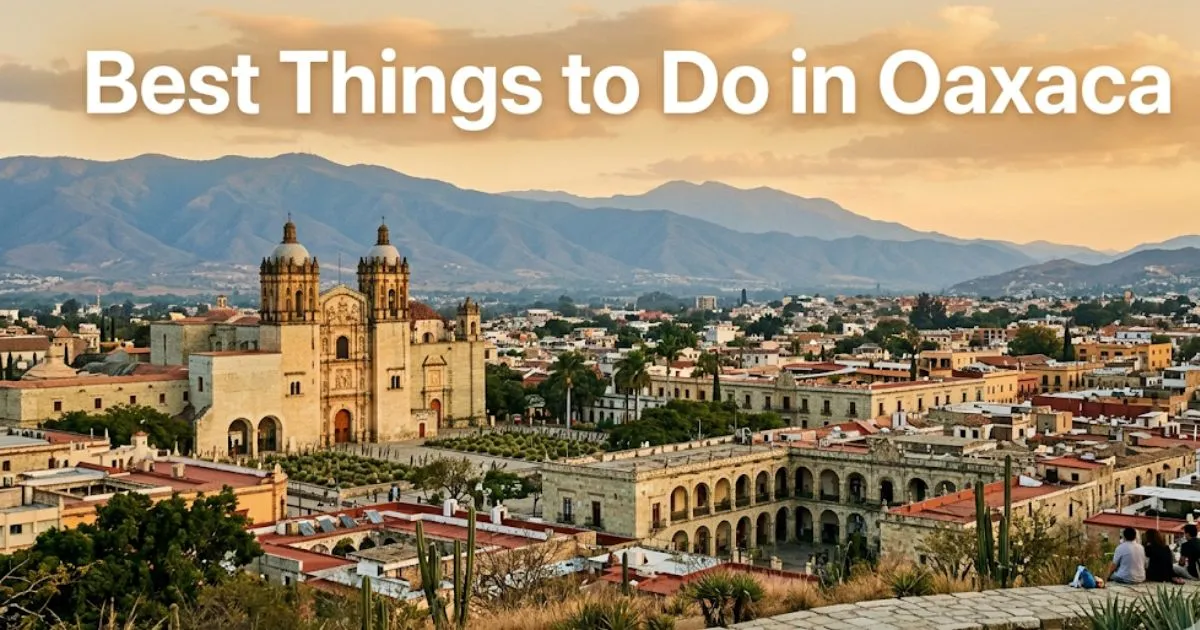
Best Things to Do in Oaxaca 2026: An Honest Travel Guide

Oaxaca rewards travelers who understand it is not a quick-stop destination.
The city demands at least five days to reveal its genuine depth.
Its UNESCO-listed center contains more cultural density than cities three times its size.
Monte Albán alone justifies the flight from any North American city.
This guide covers specific neighborhoods, named mezcalerías, artisan village logistics, and honest seasonal advice.
You will finish with a usable framework for building your actual Oaxaca itinerary.
Things to Do in Oaxaca
Oaxaca rewards travelers who divide their time between city exploration and day trips into the Valles Centrales.
The best approach mixes archaeological mornings with market afternoons and mezcal evenings.
Start with Monte Albán, the Zapotec capital perched on a flattened mountain above the valley.
It sits just 20 minutes by shuttle from the city center.
Spend afternoons walking the Andador Turístico on Calle Macedonio Alcalá.
This pedestrian corridor connects the Zócalo to the Santo Domingo complex.
The Jardín Etnobotánico behind Santo Domingo requires a guided tour for entry.
Tours run in English typically once daily, so book a day ahead at the entrance.
Solo travelers will find the walkable Centro easy to navigate independently.
Couples should book a rooftop dinner at Los Danzantes for one genuinely memorable evening.
Families should know that archaeological sites offer zero shade and minimal facilities.
Budget travelers can enjoy Oaxaca deeply on $40 to $60 per day including meals and activities.
Key Takeaway: Prioritize Monte Albán on your first full morning before heat and crowds build.
Best Things to Do in Oaxaca
The best things in Oaxaca cluster into four categories: archaeological mornings, market lunches, artisan afternoons, and mezcal evenings.
Skip the Zócalo tourist restaurants and walk three blocks in any direction for better food.
Monte Albán remains the essential archaeological experience, but Mitla offers intricate mosaic fretwork Monte Albán lacks.
Mitla sits 45 minutes east and pairs well with a Hierve el Agua visit.
The Museo de las Culturas inside Santo Domingo’s monastery houses the Mixtec treasure from Tomb 7.
Its collection is world-class and the building itself justifies the entry fee.
Cooking classes through Casa Crespo or La Olla teach mole preparation beyond what any restaurant meal provides.
Book these 48 hours ahead during high season.
| Activity | Best For | Cost Range | Time Needed | Insider Note |
|---|---|---|---|---|
| Monte Albán | History buffs, all profiles | $5 to $8 entry | 3 to 4 hours | Arrive at 8 AM opening |
| Museo de las Culturas | Culture travelers, seniors | $4 to $6 | 1.5 to 2 hours | Rooftop views of the valley |
| Cooking class | Food travelers, couples | $50 to $80 | 4 to 5 hours | Includes market tour |
| Mezcal tasting | Couples, solo travelers | $15 to $35 | 1 to 2 hours | Skip tourist-facing rooms |
| Artisan village tour | Craft enthusiasts, all | Transport only | Half to full day | Visit on village market days |
Solo travelers will appreciate that cooking classes function as social gatherings.
Couples should book private tastings at Mezcaloteca for a genuinely educational experience.
Families with children under 10 may find full-day archaeological visits physically demanding.
The heat at Monte Albán between 11 AM and 3 PM is intense and shade is nonexistent.
Key Takeaway: Book Monte Albán shuttle tickets the afternoon before from Calle Francisco Javier Mina.
Things to Do in Oaxaca City
Oaxaca City divides into distinct walking zones that make itinerary building straightforward.
Group activities by neighborhood to avoid crisscrossing the city unnecessarily.
Morning one: Walk the Andador Turístico from the Zócalo to Santo Domingo.
Stop at the Museo de Arte Contemporáneo on the way for its rotating exhibitions.
Afternoon one: Explore Barrio de Jalatlaco, the city’s most photogenic neighborhood.
Its cobblestone streets and street art murals make it the best area for an afternoon wander.
Morning two: Tour the Mercado de Abastos with a guide or with strong Spanish skills.
This is the largest market in the state and completely different from the Centro markets.
Evening two: Walk Barrio de Xochimilco for its historic aqueduct and quieter restaurant scene.
The neighborhood feels residential and offers escape from Centro crowds.
Three-Day Oaxaca City Framework:
Day 1: Monte Albán morning, Andador Turístico afternoon, rooftop dinner at Los Danzantes
Day 2: Santo Domingo and Museo de las Culturas, Mercado 20 de Noviembre lunch, Jalatlaco afternoon walk, Mezcaloteca evening
Day 3: Artisan village day trip to San Martín Tilcajete and Teotitlán del Valle, Xochimilco dinner
Solo travelers should stay in Centro or Jalatlaco for walkable access to everything.
Families may prefer the quieter streets of Xochimilco for accommodation with more space.
Budget travelers can eat every meal at markets for under $25 total per day.
Seniors should note that cobblestone streets throughout the city require stable footwear.
Key Takeaway: Oaxaca Centro is walkable and compact but group activities by neighborhood to avoid exhaustion.
Oaxaca Neighborhoods Guide
Oaxaca’s neighborhoods each offer distinct character and knowing which fits your travel style saves wasted hours.
The Centro Histórico is where most visitors stay, but the surrounding barrios often provide better value and atmosphere.
Centro Histórico centers on the Zócalo and stretches to Santo Domingo.
It contains the highest concentration of restaurants, museums, and hotels.
The Andador Turístico is beautiful but becomes a tourist corridor by midday.
Side streets like Calle Manuel Bravo offer quieter walking with the same colonial architecture.
Barrio de Jalatlaco sits just east of Centro and features the city’s best street art.
It is quieter than Centro, genuinely charming, and has excellent small cafes like Cafébre and Café Nuevo Mundo.
Jalatlaco works best for couples and solo travelers seeking atmosphere without Centro’s intensity.
Families will find fewer kid-specific amenities but more space and a residential feel.
Barrio de Xochimilco extends north of the Centro along the old aqueduct.
It is the most traditional neighborhood, home to the Iglesia de Xochimilco and small family-run restaurants.
Xochimilco suits travelers wanting a genuinely local experience away from tourism infrastructure.
The trade-off is a 15 to 20-minute walk to Centro attractions.
Colonia Reforma sits northwest and is where many middle-class oaxaqueños live.
It offers the best value in local food and has zero tourist markup.
| Neighborhood | Atmosphere | Best For | Average Hotel Cost | Walk to Centro |
|---|---|---|---|---|
| Centro Histórico | Tourist core, busy | First-timers, convenience seekers | $80 to $150 | 0 minutes |
| Jalatlaco | Artsy, quiet, photogenic | Couples, solo travelers, photographers | $50 to $100 | 10 minutes |
| Xochimilco | Traditional, residential | Repeat visitors, long stays | $40 to $80 | 15 to 20 minutes |
| Colonia Reforma | Local, no tourists | Budget travelers, cultural immersion | $30 to $60 | 20 to 25 minutes |
The most common visitor mistake is booking entirely in Centro and never leaving a six-block radius.
Walk ten minutes in any direction to discover where Oaxaca’s real character lives.
Key Takeaway: Stay in Jalatlaco for the best balance of atmosphere, value, and walking access to Centro.
Monte Albán Oaxaca
Monte Albán is the essential Oaxaca archaeological experience and deserves a full morning.
The Zapotec capital sits on a flattened mountaintop 1,300 feet above the valley floor.
The site opens at 8 AM and arriving at opening hour transforms the experience.
By 10:30 AM, tour buses arrive and the main plaza fills with groups.
The Gran Plaza stretches nearly 1,000 feet long with pyramids and platforms on all sides.
The South Platform offers the best panoramic view and the climb is moderate.
Building J’s arrow-shaped observatory is the site’s most architecturally unusual structure.
The Ball Court on the eastern edge shows the ritual game’s importance to Zapotec culture.
Entry costs approximately $5 per adult with an additional fee for video cameras.
Licensed guides wait at the entrance and charge $25 to $40 for a 90-minute tour in English or Spanish.
The shuttle bus departs from Calle Francisco Javier Mina near the Zócalo.
Buses leave when full, typically every 30 minutes, and cost $8 to $12 round trip.
Solo travelers and couples can easily navigate the site independently with a guidebook.
Families should know there is zero shade, one small snack stand, and no playground or child-specific infrastructure.
Seniors and accessibility travelers will find the site partially wheelchair-accessible with paved paths around the Gran Plaza.
The South Platform climb and many side structures require stairs and uneven terrain.
The site museum near the entrance is small but worth 30 minutes for its stelae collection.
Skip the overpriced on-site food and pack water, sunscreen, and a hat regardless of cloud cover.
Key Takeaway: Take the 8 AM shuttle and bring twice as much water as you think you need.
Hierve el Agua Oaxaca
Hierve el Agua delivers one of Mexico’s most surreal landscapes despite the challenging access logistics.
The petrified waterfall formations and infinity pools sit atop a cliff overlooking a vast valley.
The site features two calcified waterfall formations created by mineral-rich springs over millennia.
The larger cascade drops nearly 100 feet down the cliff face.
Two natural infinity pools offer swimming with views across the Sierra Madre mountains.
The water is cold and mineral-rich, refreshing after the dusty approach road.
Getting there independently requires a colectivo from Oaxaca to Mitla, then a second colectivo or shared truck up to the site.
Total travel time is approximately 90 minutes each way and the final road segment is unpaved.
Guided tours cost $25 to $50 and combine Hierve el Agua with Mitla, a mezcal distillery, and sometimes a weaving village.
Tours save logistical headache but lock you into a group schedule.
The site entry fee runs approximately $3 to $5, with additional fees for parking if driving.
Bathrooms and changing facilities are basic but functional.
Solo travelers should take the colectivo route for budget efficiency and schedule control.
The journey feels safe during daylight hours with basic Spanish for colectivo directions.
Families should know the cliff edges have limited barriers and require constant supervision of children.
The pools are safe for swimming but the rocks around them are slippery year-round.
Seniors and those with mobility limitations will find the descent to the lower viewing platforms strenuous.
The main viewing area near the entrance is accessible by vehicle but the pools require a downhill walk.
Rainy season from June through September makes the trails genuinely hazardous.
The petrified falls are most photogenic in November through February when the light is clear and air is crisp.
Key Takeaway: Visit on a weekday morning and skip the site’s mediocre food stalls entirely.
Oaxaca Markets Guide
Oaxaca’s markets form the city’s culinary and cultural backbone and no visit is complete without exploring at least three of them.
Each market serves a different purpose and knowing which to visit when saves time and money.
Mercado Benito Juárez sits one block south of the Zócalo and is the most tourist-accessible market.
Its interior houses handicrafts, textiles, and the famous chapulines vendors along the central aisle.
The market is best for souvenir shopping and a quick orientation to Oaxacan ingredients.
Prices are higher here than at other markets due to the tourist traffic.
Mercado 20 de Noviembre sits directly adjacent to Benito Juárez and is the city’s true food market.
Its pasillo de humo is a corridor of smoke from grilling meats where you select raw protein and women grill it on the spot.
The pasillo de humo experience costs $5 to $12 per person and is one of Oaxaca’s genuinely essential food experiences.
Point at what you want, pay by weight, and eat at communal tables with fresh tortillas.
Mercado de Abastos sits on the city’s western edge and is the largest market in the state.
It is chaotic, enormous, and requires strong Spanish or a guide to navigate effectively.
Abastos is where locals shop and where you will find the best prices on ingredients and everyday items.
Go for the scale and authenticity, not for a relaxed browsing experience.
Mercado Orgánico operates Friday and Saturday in Barrio de Jalatlaco.
It offers organic produce, prepared foods, and a community atmosphere popular with Oaxaca’s expat and artist community.
| Market | Best For | Days | Tourist Level | Food Quality |
|---|---|---|---|---|
| Benito Juárez | Souvenirs, chapulines | Daily | High | Moderate |
| 20 de Noviembre | Pasillo de humo, lunch | Daily | High | Excellent |
| Mercado de Abastos | Scale, local immersion | Daily | Very low | Variable |
| Mercado Orgánico | Organic produce, community | Fri-Sat | Moderate | High |
Solo travelers will find the pasillo de humo a comfortable solo dining experience at communal tables.
Families may find Abastos overwhelming for young children due to crowds and narrow aisles.
Budget travelers can eat every meal at markets for a fraction of restaurant prices.
Seniors should prioritize Benito Juárez and 20 de Noviembre for easier navigation and seating availability.
Key Takeaway: Eat lunch at Mercado 20 de Noviembre’s pasillo de humo at least twice during your stay.
Oaxaca Food Tour
Oaxaca’s food scene is arguably Mexico’s most sophisticated and a guided food tour accelerates your understanding significantly.
The city’s culinary identity rests on seven moles, countless street food variations, and ingredients found nowhere else in Mexico.
Street food tours typically run 3 to 4 hours and cost $35 to $65 per person.
They visit markets, street stalls, and small family-run spots tourists rarely find independently.
Memelas at Memelas Doña Vale in Mercado de Abastos are the city’s essential street breakfast.
Thick corn tortillas get topped with beans, cheese, and salsa and cost under $1 each.
Tlayudas at Tlayudas Libres near the Zócalo are Oaxaca’s signature street food dinner.
These oversized crispy tortillas get topped with beans, cheese, meat, and salsa and fold into a portable feast.
Lechoncito operates late night on Calle de los Libres near the Zócalo.
It serves roast suckling pig tacos that rival any restaurant dish at a fraction of the cost.
Restaurant dining at Criollo, Origen, or Los Danzantes demonstrates Oaxaca’s elevated culinary side.
These restaurants reinterpret traditional Oaxacan ingredients at prices from $20 to $50 per person.
Levadura de Olla on Calle Manuel García Vigil focuses on traditional techniques and heirloom corn varieties.
It is the best restaurant in Centro for understanding why Oaxacan corn is culturally significant.
Couples should book one splurge dinner at Criollo for its courtyard setting and tasting menu format.
Solo travelers will find street food and market dining more socially comfortable and budget-efficient.
Families with children should know that Oaxacan food can be complex for young palates but simple tacos and memelas work universally.
Budget travelers can eat exceptionally well for under $20 per day by sticking to market and street food options.
According to the Secretaría de Turismo de Oaxaca, the city’s food scene drives more return visitation than any other single factor.
Cooking schools throughout the city report that over 70% of students cite mole preparation as their primary motivation for enrolling.
Key Takeaway: Skip breakfast at your hotel and eat memelas at a market stall instead.
Oaxaca Mezcal Tasting
Mezcal tasting in Oaxaca ranges from tourist-facing shot rooms to genuinely educational tasting experiences.
Knowing the difference saves you from a hangover and teaches you nothing.
Mezcaloteca on Calle Reforma offers the city’s most respected educational tasting experience.
Reservations are essential, tastings run $25 to $40, and the focus is on understanding agave varieties and production methods.
The staff are certified mezcal educators who pour small, deliberate samples with detailed explanations.
This is a tasting, not a drinking session, and it is the best introduction to mezcal in the city.
Mezcalogía near Santo Domingo offers a more casual but still educational experience.
It works as a walk-in option when Mezcaloteca is booked solid.
Sabina Sabe on Calle 5 de Mayo combines a mezcal bar with creative Oaxacan cocktails.
It suits evenings when you want mezcal in mixed drinks rather than straight tasting.
The mezcalerías along Calle García Vigil near Santo Domingo are the most tourist-accessible.
Los Amantes and La Mezcalerita sit on this strip and offer decent selections in atmospheric settings.
These spots are fine for a casual drink but do not offer the educational depth of Mezcaloteca.
Prices run higher here due to the location and tourist traffic.
In Situ on Calle Morelos offers another serious tasting option with an enormous selection of small-batch mezcals.
The owner sources directly from palenqueros across the state.
Solo travelers will find the bar seating at Mezcaloteca and In Situ conducive to conversation and learning.
Couples should book a private tasting at Mezcaloteca for the most intimate educational experience.
Families should know that most mezcalerías are adult-focused environments in the evening.
Budget travelers can learn about mezcal affordably by visiting palenques during artisan village day trips.
Key Takeaway: Book Mezcaloteca two days ahead and treat it as a class, not a bar.
Oaxaca Artisan Villages
Oaxaca’s artisan villages are the cultural engine behind the city’s famous crafts and visiting them connects you to the region’s identity.
Each village specializes in a specific craft tradition passed down through generations.
San Martín Tilcajete is the home of alebrijes, the brightly painted carved wooden creatures Oaxaca is famous for.
Workshops line the main street and most families welcome visitors into their workspace to see the carving and painting process.
Jacobo and María Ángeles run the village’s most famous workshop with museum-quality pieces and prices to match.
Smaller family workshops offer more affordable pieces and equally authentic experiences.
Teotitlán del Valle specializes in handwoven wool textiles using natural dyes.
The village sits at the base of a sacred mountain and the weaving tradition here predates the Spanish arrival.
Visit El Tono de la Cochinilla workshop to understand how cochineal insects produce the deep reds and purples in Oaxacan textiles.
The demonstration is free and the education makes you appreciate every textile you see afterward.
Santa María Atzompa produces the green-glazed pottery known as barro verde.
The village is closest to Oaxaca City and pairs easily with a Monte Albán morning since Atzompa has its own smaller archaeological site.
San Bartolo Coyotepec specializes in barro negro, the black pottery fired in underground kilns.
The Museo Estatal de Arte Popular here provides context for the craft’s history and techniques.
Getting to artisan villages requires colectivos from specific pickup points around the city.
San Martín Tilcajete and Teotitlán del Valle depart from the Central de Abastos area colectivo stop.
Solo travelers can navigate the colectivo system with basic Spanish and patience.
Families may prefer a guided tour for the logistical ease of door-to-door transport between villages.
Budget travelers should take colectivos and buy directly from artisan families for the best value.
Seniors should note that artisan village workshops often have uneven floors, steps, and limited seating.
Key Takeaway: Visit San Martín Tilcajete in the morning when artisans are actively working, not during afternoon siesta.
Oaxaca Day Trips
Oaxaca’s day trip options extend well beyond the most famous artisan villages.
The Valles Centrales reward travelers willing to explore beyond the standard circuit.
The Mitla and Hierve el Agua combination is the most popular day trip and for good reason.
Mitla’s intricate geometric mosaic fretwork is unlike anything at Monte Albán.
The Ruta de los Pueblos Mancomunados offers hiking between eight Zapotec mountain villages in the Sierra Norte.
Hikes range from 4 to 20 miles with village-to-village lodging for multi-day treks.
This area sits 7,000 to 10,000 feet above sea level and temperatures stay cool year-round.
It is the best escape from Oaxaca City’s heat between March and May.
San Agustín Etla combines a converted textile factory turned arts center with mountain hiking trails.
The Centro de las Artes San Agustín hosts residencies and exhibitions in a stunning repurposed industrial space.
It sits 30 minutes north of Oaxaca City and makes an easy half-day trip.
The nearby Papalotepec trail offers a moderate hike to a hilltop with valley views.
Santiago Matatlán is the mezcal capital of the world and sits 45 minutes east of the city.
Dozens of palenques offer tours and tastings directly from producers at lower prices than city mezcalerías.
Cuilápam de Guerrero features a massive unfinished Dominican monastery with open-air chapel and mountain views.
It sits 20 minutes south and receives a fraction of the visitors of other day trip destinations.
| Day Trip | Travel Time | Best For | Cost Range | Combine With |
|---|---|---|---|---|
| Mitla + Hierve el Agua | 90 min each way | All profiles | $30 to $60 tour | Mezcal palenque |
| Pueblos Mancomunados | 90 min to trailhead | Hikers, outdoors | $50 to $100 | Multi-day option |
| San Agustín Etla | 30 min | Arts, half-day | $5 to $10 transport | Papalotepec hike |
| Santiago Matatlán | 45 min | Mezcal enthusiasts | $15 to $30 transport | Mitla |
| Cuilápam | 20 min | History, solitude | $3 to $5 transport | Santa María Atzompa |
Solo travelers can manage all these day trips independently with colectivos and basic Spanish.
Families should prioritize San Agustín Etla for its open spaces and arts programming that engages children.
Seniors will find Mitla more manageable than Monte Albán due to its compact, flat site layout.
Budget travelers can do any of these day trips for under $20 in transport costs using colectivos.
Key Takeaway: Skip the guided tour markup by taking colectivos, but confirm return schedules before departing the city.
Oaxaca Cooking Classes
Oaxaca cooking classes provide the deepest possible dive into the region’s culinary identity in a single half-day experience.
The best classes include a market tour where you select ingredients alongside the instructor.
Casa Crespo on Calle Allende offers the city’s most established cooking class experience.
Classes run 4 to 5 hours, cost $70 to $90, and include market tour, multiple dishes, and a mezcal tasting.
La Olla on Calle Reforma offers smaller class sizes and a rooftop kitchen with valley views.
Their mole-focused classes are especially strong and run $65 to $85.
El Sabor Zapoteco in Teotitlán del Valle offers a village-based cooking experience with a Zapotec family.
The class includes tortilla-making on a traditional comal and the recipes come from the family’s generational knowledge.
Market tours teach as much as the cooking itself.
You will learn to identify chiles, understand which mole paste to buy, and recognize quality ingredients by sight and smell.
Cooking classes suit couples as an ideal shared activity with a meal at the end.
Solo travelers will find classes social and a natural way to meet other travelers.
Families with older children who enjoy cooking will find classes engaging for ages 12 and up.
Classes are not suitable for young children due to open flames, sharp tools, and long duration.
Budget travelers should know that cooking classes are a splurge item but deliver education and a meal for the price.
The skills transfer to home cooking and the market knowledge improves every subsequent market visit.
Most classes require booking 24 to 48 hours in advance.
Morning classes typically start at 8:30 or 9 AM and finish by 1:30 PM.
Key Takeaway: Book a morning class early in your trip so you can apply the market knowledge to the rest of your stay.
Oaxaca Día de los Muertos
Oaxaca’s Día de los Muertos celebration runs from October 31 through November 2 and transforms the entire city.
It is the most visually spectacular and culturally significant annual event in Oaxaca.
The comparsas are neighborhood-based costumed parades with brass bands that surge through streets each night.
They start spontaneously from neighborhood gathering points and grow as they move.
Xoxocotlán cemetery hosts the region’s most famous candlelit vigil on the night of October 31.
Families decorate graves with marigolds, candles, and offerings while visitors observe respectfully from designated areas.
The cemetery is 20 minutes from Centro by taxi and the crowds are enormous.
Arrive by 8 PM for the best experience and be prepared for a two-hour wait to enter during peak hours.
San Felipe del Agua cemetery offers a smaller, less crowded alternative north of the city.
It lacks Xoxocotlán’s scale but provides a more intimate and less overwhelming experience.
Hotel rates triple during Muertos week and the best rooms book six to eight months ahead.
The city reaches maximum occupancy and restaurants require reservations for every meal.
Solo travelers will find Muertos intensely social with comparsas welcoming anyone who joins the parade flow.
Couples should book a Muertos photography tour for the best nighttime cemetery and street photography guidance.
Families with young children should avoid the Xoxocotlán crush and choose San Felipe del Agua instead.
Seniors should know that Muertos involves extensive nighttime walking on crowded, uneven streets.
The Mercado de Abastos is the place to buy marigolds and altar supplies if you want to build your own ofrenda.
Prices for flowers triple in the week leading up to October 31.
According to the Secretaría de Turismo de Oaxaca, hotel occupancy reaches 100% during Muertos week and the city receives over 100,000 visitors.
Book everything at least six months ahead if Muertos is your travel goal.
Key Takeaway: If Muertos is your goal, book hotels in January of the same year.
Best Time to Visit Oaxaca
The best time to visit Oaxaca is October through November for perfect weather and cultural events.
March through May offers warm, dry conditions with fewer crowds than winter holidays.
October and November deliver daytime temperatures in the mid-70s Fahrenheit and crisp evenings.
Día de los Muertos in early November is the cultural highlight of the year.
March through May brings temperatures in the low 80s with clear skies and blooming jacaranda trees.
The Guelaguetza festival preparations begin during this period though the main event is in July.
July through September is the rainy season with heavy afternoon downpours.
The rain turns Hierve el Agua trails muddy and can make the unpaved access road impassable after storms.
Late December through early January brings peak domestic Mexican tourism.
Hotel rates increase 50 to 100% and the Zócalo becomes genuinely overcrowded.
April and May are the hottest months with temperatures occasionally reaching the mid-90s.
Monte Albán becomes punishing between 11 AM and 3 PM during these months.
| Season | Months | Weather | Crowds | Hotel Rates | Best For |
|---|---|---|---|---|---|
| High (Muertos) | Late Oct-early Nov | Perfect, 70s | Maximum | Triple normal | Muertos, culture |
| High (Winter) | Dec-Jan | Cool, 60s-70s | High | Double normal | Holiday escape |
| Shoulder | Mar-May | Warm, 80s | Moderate | Normal | Comfortable exploring |
| Shoulder | Sep-Oct | Variable, 70s | Moderate | Normal | Green landscapes |
| Low | Jun-Aug | Rainy, 70s-80s | Low | Discounted | Budget, solitude |
Solo travelers should target shoulder seasons for the best balance of social atmosphere and manageable crowds.
Families should avoid Muertos week unless specifically seeking the festival experience.
Budget travelers will find the best accommodation rates during the rainy season from June through August.
Seniors should prioritize October through November for the most comfortable walking temperatures.
Key Takeaway: October delivers the best weather without Muertos-level crowds if you visit the first three weeks.
Getting Around Oaxaca Without a Car
Oaxaca City is genuinely walkable within Centro and the adjacent barrios.
The colectivo system handles all day trip destinations efficiently and affordably.
Colectivos are shared minibuses or sedans that run fixed routes to surrounding villages.
They depart from specific intersections around the city, not from a central station.
The colectivo stop for San Martín Tilcajete and Teotitlán del Valle is near the Central de Abastos on the city’s west side.
Colectivos for Mitla and Hierve el Agua depart from the Base de Mitla east of Centro.
Fares range from $1 to $5 depending on distance and colectivos leave when full, not on a fixed schedule.
Travel during morning hours for the fastest departures when demand is highest.
Taxis within Centro cost $3 to $5 for any trip within the city center.
Negotiate the fare before entering since taxis in Oaxaca do not use meters.
The ADO bus station serves intercity routes including Puebla, Mexico City, and Puerto Escondido.
It sits north of Centro and a taxi from the Zócalo costs approximately $4.
Ride-hailing apps operate in Oaxaca but with limited availability compared to Mexico City.
Taxis are more reliable for immediate transport needs.
Walking is the primary mode within Centro Histórico and to Jalatlaco.
Most attractions sit within a 20-minute walk of the Zócalo.
Solo travelers will find colectivos safe during daylight hours with basic Spanish for destination confirmation.
Families should consider taxis or private drivers for day trips to avoid colectivo wait times and crowded conditions.
Seniors should know that colectivos can be cramped and steps are often high.
Taxis provide more comfort at a still-affordable price point.
Key Takeaway: Walk within Centro and use colectivos for day trips, but confirm return schedules before departing.
Is Oaxaca Safe for Tourists
Oaxaca is among the safer destinations in Mexico for tourists who exercise standard travel awareness.
The city’s tourism infrastructure depends on visitor safety and the Centro maintains a visible police presence.
Violent crime targeting tourists is rare in Oaxaca City and the Valles Centrales.
Petty theft and pickpocketing represent the most common safety concerns, particularly in crowded markets.
The Mercado de Abastos requires heightened awareness of belongings due to dense crowds and narrow aisles.
Carry only what you need and keep valuables in a front-facing bag or money belt.
Walking alone late at night east of the Zócalo on streets like Calle de Manuel Doblado is not recommended.
The well-lit Andador Turístico and Calle Macedonio Alcalá are safe corridors at night.
The colectivo system and day trip routes are safe during daylight hours.
Avoid traveling rural roads at night due to limited lighting and occasional livestock on roadways.
Solo female travelers report feeling safe in Oaxaca Centro and Jalatlaco during daylight and early evening hours.
The same precautions that apply in any city apply here.
Protests and blockades occur periodically in Oaxaca and can affect road access to the airport and day trip destinations.
Check with your hotel about current conditions before departing on day trips.
Tap water is not safe to drink anywhere in Oaxaca.
Stick to bottled water and avoid raw produce that may have been washed in tap water at street stalls.
According to the U.S. Department of State, Oaxaca state does not carry the “Do Not Travel” advisory level that applies to several other Mexican states.
Travelers should still review current advisories before departure.
Solo travelers should share their day trip itinerary with their hotel or a contact back home.
Families will find Oaxaca Centro comfortable and safe with standard urban parenting awareness.
Key Takeaway: Oaxaca is safe for tourists but keep valuables concealed in markets and avoid dark empty streets late at night.
Safety and Practical Warnings for Oaxaca
Oaxaca presents specific safety and practical considerations that differ from beach resort destinations in Mexico.
Knowing these in advance prevents the most common visitor problems.
Key safety and practical facts every visitor should know:
- Sun exposure at Monte Albán is extreme with zero shade and reflective stone surfaces
- Bring SPF 50 sunscreen, a wide hat, and 2 liters of water minimum for any archaeological visit
- Altitude sickness affects some visitors since Oaxaca City sits at 5,100 feet above sea level
- Allow 24 to 48 hours for mild acclimatization before attempting strenuous activities
- Cobblestone streets throughout Centro are uneven and require stable closed-toe footwear
- Flip-flops and sandals with smooth soles are a sprained ankle waiting to happen
- Tap water is unsafe for drinking and for brushing teeth if you have a sensitive stomach
- Use bottled water for everything including rinsing your toothbrush
- Hierve el Agua cliff edges have limited barriers and the rocks around pools are slippery
- Supervise children constantly and avoid the edge areas entirely during rainy season
- Road blockades by local political groups can close highways without warning
- Build buffer days into your itinerary for potential transport disruptions
The Oaxaca State Civil Protection office monitors road conditions and posts updates during protest activity.
Your hotel front desk is the best real-time source for road status before day trips.
Frequently Asked Questions About Oaxaca
What is the best month to visit Oaxaca?
October is the single best month to visit Oaxaca for weather and cultural events.
Daytime temperatures hover in the mid-70s and the rains have stopped.
Muertos preparations begin mid-month and you can experience the buildup without November’s maximum crowds.
How many days do you need in Oaxaca?
Five to seven days is the minimum for Oaxaca City and the essential surrounding villages.
Three days covers Centro and Monte Albán but rushes the artisan villages and food exploration.
Travelers with less than three days should postpone until they can allocate more time.
Is Oaxaca safe for solo female travelers?
Oaxaca is safe for solo female travelers who exercise standard urban awareness.
Stay in Centro or Jalatlaco, avoid dark empty streets late at night, and use taxis after 10 PM.
Thousands of solo female travelers visit Oaxaca annually and report feeling comfortable and welcomed.
How do I get from Oaxaca City to Hierve el Agua?
Take a colectivo from the Base de Mitla east of Centro to Mitla town.
Transfer to a second colectivo or shared truck up the unpaved road to Hierve el Agua.
The total journey takes 90 minutes each way and costs under $10 round trip independently.
What are the best artisan villages to visit near Oaxaca?
San Martín Tilcajete for alebrijes and Teotitlán del Valle for wool textiles are the essential two.
Add Santa María Atzompa for green pottery if you have a third village day.
These three villages represent Oaxaca’s most distinctive craft traditions.
Is Oaxaca expensive for tourists?
Oaxaca is a budget-friendly destination by North American standards.
Street food meals cost $3 to $6 and mid-range restaurants run $10 to $20 per person.
Boutique hotels range $60 to $150 per night with excellent options at every price point.
Your Oaxaca Trip Starts with One Booking
Oaxaca rewards travelers who book their first three nights in a walkable Centro or Jalatlaco hotel.
Everything else flows from having a base in the right neighborhood.
Book Monte Albán for your first full morning and your cooking class for day two or three.
The archaeological site sets the historical context and the cooking class unlocks the food culture.
Verify colectivo pickup points, market days, and museum hours directly with venues before departure.
Oaxaca’s schedules are more fluid than North American travelers expect and official tourism office information provides the most current guidance.
This city delivers more cultural depth per day than destinations twice its price.
Start with the neighborhood that fits your travel style and let Oaxaca do the rest.