Best Things to Do in Williamsburg, VA (2026 Guide)

Williamsburg, Virginia is one of the most genuinely layered travel destinations on the East Coast, combining living history, world-class theme parks, serious wine culture, and exceptional tavern dining. The things to do in Williamsburg span 350 years of American history and satisfy travelers across every profile, from families with school-age kids to couples seeking a historically rich romantic weekend.
The Colonial Williamsburg Foundation oversees 301 acres of the most authentically preserved colonial-era city in the United States. According to the Virginia Tourism Corporation, the Williamsburg area draws more than four million visitors annually.
This guide covers every major experience, honest seasonal realities, practical logistics, and the one planning mistake most first-timers make. You will leave with a clear plan for two to three days in Williamsburg.
Things to Do in Williamsburg: What Makes This City Different
Williamsburg delivers something most American cities cannot: three genuinely distinct destination experiences within a 15-minute drive of each other.
Colonial Williamsburg is the living history district. Busch Gardens Williamsburg is a legitimately world-class theme park. And the Historic Triangle, including Jamestown and Yorktown, completes one of the most concentrated American history circuits anywhere in the country.
Most visitors treat Colonial Williamsburg as a single-afternoon experience. That is the single most common planning error in this city.
The historic area requires two full days to experience meaningfully. Rushing through in three hours means missing the Governor’s Palace, the Capitol Building interior tours, the colonial trades workshops, and the evening programming.
What separates Williamsburg from Colonial-era theme park imitations like Plimoth Patuxent in Massachusetts is the sheer geographic scale and architectural authenticity. Over 80 original structures remain on the Duke of Gloucester Street corridor.
The city also has a serious dining scene, a wine culture anchored by the Williamsburg Winery in the James City County countryside, and a craft brewing corridor that most travel content ignores entirely.
| Experience Zone | Primary Draw | Best For | Time Needed |
|---|---|---|---|
| Colonial Williamsburg | Living history immersion | History enthusiasts, families | 1.5 to 2 full days |
| Busch Gardens | Theme park rides, European villages | Families, thrill-seekers | 1 full day |
| Historic Triangle | Jamestown, Yorktown history | History enthusiasts, adults | Half to full day |
| Merchants Square | Dining, shopping, campus feel | Couples, casual visitors | 2 to 4 hours |
| Williamsburg Winery area | Wine, rural Virginia countryside | Adults, couples | 2 to 3 hours |
Insider Tip:
- The free Williamsburg Area Transit Authority (WATA) route connects the Colonial Williamsburg Visitor Center to Merchants Square. Use it to avoid parking across two zones.
- Duke of Gloucester Street closes to vehicle traffic during operating hours. Wear comfortable walking shoes; you will cover 2 to 4 miles on foot.
- First-time visitors consistently underestimate the time needed at the Governor’s Palace. Allow 90 minutes minimum.
Williamsburg Things to Do by Traveler Type
The best Williamsburg experiences vary significantly depending on who is traveling.
Families with children ages 6 to 12 get the most from a combination of one day at Colonial Williamsburg and one full day at Busch Gardens. Children under 5 often find the historic area too abstract.
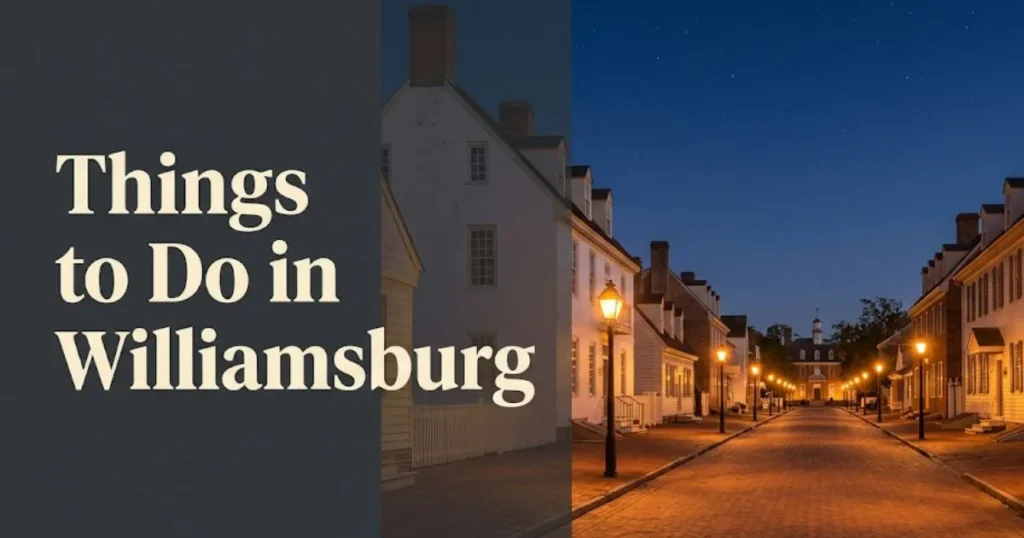
Couples seeking a romantic weekend do best focusing on Colonial Williamsburg’s evening programs, a tavern dinner at Christiana Campbell’s Tavern, and a morning at the Williamsburg Winery. The historic district is quieter after 4 PM, which is when the aesthetic is most atmospheric.
Solo travelers find Williamsburg extremely walkable and safe. The self-guided nature of Colonial Williamsburg suits independent exploration. Evening ghost tours organized by companies like Williamsburg Ghost Tours provide a social experience for solo visitors.
Budget travelers face the reality that Colonial Williamsburg’s base admission runs approximately $40 to $50 per adult as of recent years. The free programming outside the historic gates, however, is substantial. The Duke of Gloucester Street exterior and Merchants Square are entirely free to walk.
Seniors and accessibility travelers will find Colonial Williamsburg well-equipped with accessible paths across the main district, though some historic building interiors have period-appropriate stairs and limited wheelchair access. Verify specific building accessibility directly with the Colonial Williamsburg Foundation before visiting.
| Traveler Profile | Best Williamsburg Experience | What to Avoid |
|---|---|---|
| Families with kids 6-12 | Colonial WB + Busch Gardens combo | Rushing Colonial WB in one afternoon |
| Couples | Evening programs + tavern dinner + winery | July heat on Duke of Gloucester Street |
| Solo travelers | Self-guided historic area + ghost tour | Peak summer Saturday crowds |
| Budget travelers | Free exterior district + Merchants Square | Full-price single-day theme park tickets |
| Seniors | Morning Colonial WB + carriage rides | Midday July heat exposure |
Colonial Williamsburg Historic Area
Colonial Williamsburg is the most completely realized living history museum in the United States, covering 301 acres of the original 18th-century city with over 80 original structures and 400 reconstructed buildings.
The historic area’s core spine is Duke of Gloucester Street, running from the reconstructed Capitol Building at the east end to the College of William and Mary at the west. The Governor’s Palace sits one block north, accessed via Palace Green.
Admission runs approximately $40 to $50 per adult for the base ticket as of recent years. The base ticket covers all outdoor programming and most trade workshops but excludes certain premium evening programs.
Timed-entry reservations are required for the Governor’s Palace and Capitol Building interior tours. Book these through the Colonial Williamsburg Foundation’s reservation system at least two to three days in advance during peak season. Same-day availability is limited, especially on summer weekends.
The single most overrated approach here: buying a ticket, walking the street for two hours, and calling it done. The colonial trades workshops, including the blacksmith at the Anderson Blacksmith Shop, the cooper, the wigmaker, and the print shop, are where the genuine educational experience lives.
The single best alternative to the tourist rush: arrive when the historic area opens and go directly to the Governor’s Palace. Most visitors start at the Capitol Building end. Starting at the Palace puts you an hour ahead of the crowd.
According to the Colonial Williamsburg Foundation, the Governor’s Palace required approximately seven years to reconstruct based on original 18th-century floor plans. The interior detail is historically specific in a way that photographs cannot convey.
Insider Tip:
- The Colonial Williamsburg Visitor Center on Route 132 provides free parking with shuttle service to the historic district. Do not park on Duke of Gloucester Street; spots are limited and enforcement is active.
- Annual passes become cost-effective if you plan to spend two or more days. Compare single-day versus multi-day ticket pricing when booking.
- The evening “Cry Witch” dramatization and “A Revolutionary City” street theater programs are included with base admission and genuinely deliver — these are not children’s performances.
Busch Gardens Williamsburg
Busch Gardens Williamsburg consistently ranks among the best theme parks on the East Coast, structured around European village themes including England, Scotland, Ireland, France, Germany, and Italy.
The park’s roller coaster lineup is the legitimate draw. Loch Ness Monster, the park’s classic steel coaster, delivers a classic experience. Verbolten, themed through the Black Forest, is the park’s most technically sophisticated family coaster. InvadR, a wooden coaster near the New France section, suits riders who find steel coasters too intense.
Single-day tickets purchased at the gate run significantly higher than online prices. Budget approximately $60 to $100 per person for online advance purchase as of recent years, with pricing varying by date. Peak summer weekends hit the top of that range.
The park’s Christmas Town event, running from mid-November through early January, transforms Busch Gardens into one of the most elaborate holiday light installations in the eastern United States. Crowds are manageable before Thanksgiving. December weekends are busy.
Families with children under 48 inches have dedicated programming in the Sesame Street Forest of Fun and Da Vinci’s Garden of Inventions areas. Busch Gardens is genuinely more family-complete than many comparable parks.
Howl-O-Scream, the park’s Halloween event running select September and October nights, is adult-oriented. It is not suitable for young children. The scare zones require age-appropriate planning.
Insider Tip:
- The park’s least-crowded entry point is the France section near Griffon. Most visitors enter through the England gate, creating a bottleneck at the park’s most popular coasters before noon.
- Arrive at least 30 minutes before opening during summer. Verbolten and InvadR both reach 60-plus-minute waits by 11 AM on peak days.
- Water Country USA, Busch Gardens’ companion water park, shares ownership and sometimes bundles with Busch Gardens tickets. Verify combo ticket availability when purchasing.
Key Takeaway: Book Colonial Williamsburg timed-entry slots for the Governor’s Palace and Capitol Building first; these fill before noon on peak days and are the experiences most worth protecting.
Jamestown and Yorktown Historic Sites
The Jamestown Settlement and Yorktown Battlefield form the bookends of America’s founding story, with Jamestown representing the first permanent English settlement in 1607 and Yorktown marking the final major battle of the Revolutionary War in 1781.
Jamestown Settlement, operated by the Jamestown-Yorktown Foundation, sits adjacent to Historic Jamestowne, administered by the National Park Service as part of Colonial National Historical Park. These are two separate sites with two separate admission structures.
Jamestown Settlement admission runs approximately $18 to $24 per adult as of recent years. The museum covers the Powhatan Confederacy, English colonization, and the early colonial period through exhibition galleries and reconstructed ships and fort. Historic Jamestowne, the actual archaeological site on Jamestown Island, is covered by the America the Beautiful pass or a separate NPS fee.
Yorktown Battlefield, also NPS-administered, covers the siege positions, redoubts, and the Moore House where surrender terms were negotiated. The American Revolution Museum at Yorktown (formerly Yorktown Victory Center), adjacent to the battlefield, provides the contextual framework the battlefield grounds alone cannot convey.
History enthusiasts should budget a full day to experience both Jamestown and Yorktown meaningfully. Families with children under 8 may find the battlefield context difficult to engage. The Jamestown Settlement’s reconstructed ships and fort are excellent for children and make the experience more tangible.
The Colonial Parkway, the NPS-maintained scenic road connecting Jamestown, Williamsburg, and Yorktown, is one of the most visually dramatic drives in Virginia. No commercial development is visible from the parkway. Allow 20 minutes per segment and stop at the overlooks.
Insider Tip:
- The America the Beautiful National Parks Pass covers Historic Jamestowne and Yorktown Battlefield NPS admission. If you hold one, prioritize these over Jamestown Settlement for budget management.
- Visit Yorktown Battlefield early morning in spring and fall. Afternoon heat and afternoon tour bus crowds peak between noon and 3 PM.
Merchants Square and Downtown Williamsburg
Merchants Square is Williamsburg’s most walkable retail and dining district, a pedestrian-friendly block adjacent to the College of William and Mary’s historic Wren Building entrance on Duke of Gloucester Street.
The district runs along the intersection of Duke of Gloucester Street and Henry Street. Unlike the Colonial Williamsburg historic district, Merchants Square is entirely free to enter and explore. Shops, galleries, and restaurants operate here with no admission requirement.
Fat Canary Restaurant on Merchants Square is Williamsburg’s most consistently cited fine dining destination. Reservations are recommended for dinner, especially on Friday and Saturday evenings. The menu focuses on seasonal American cuisine with Virginia ingredients.
Blue Talon Bistro, also on Merchants Square, offers a more casual but still serious French-American menu. It is the better choice for a lunch or an early dinner with children, given its more flexible pace.
The College of William and Mary campus, accessed directly from Merchants Square, is among the oldest and most architecturally cohesive college campuses in the United States. The Sir Christopher Wren Building, dating to 1695, is worth 30 minutes of walking exploration. Campus access is free and unrestricted during daylight hours.
Couples find Merchants Square genuinely romantic in the evening, when the historic streetlights activate and foot traffic thins after 7 PM. The combination of the campus architecture, the Wren Building backdrop, and the scale of the square creates an atmosphere that the Colonial Williamsburg district does not replicate at night.
Insider Tip:
- Williamsburg Craft House on Merchants Square sells Colonial Williamsburg-licensed pottery and reproduction items. The genuine local alternative for Virginia artisan goods is the Virginia Arts Festival and local galleries along Nassau Street.
- The square’s free parking is limited on summer weekends. Use the WATA shuttle from the Colonial Williamsburg Visitor Center lot instead.
Key Takeaway: Busch Gardens crowds peak between 11 AM and 4 PM in summer; arrive at opening or plan for evening hours, when lines and temperatures both drop.
Outdoor Activities in Williamsburg VA
Williamsburg’s outdoor activity scene centers on the Colonial Parkway, the York River State Park, and the greenway trail network connecting the city’s historic districts.
York River State Park, located approximately 10 miles northwest of downtown Williamsburg on Croaker Road, offers 30 miles of hiking and mountain biking trails through tidal marshes and upland forest along the York River. The park’s Taskinas Creek Trail provides one of the most accessible and visually distinctive estuary walks in the Virginia Peninsula.
York River State Park admission runs a nominal vehicle fee as of recent years. The park is significantly less crowded than the historic attractions. It is one of the genuinely underused outdoor assets in the Williamsburg region.
Kayaking and canoe rentals are available at the park during warmer months. The tidal creeks accessible from the park launch provide a quiet alternative to the region’s more commercial waterfront experiences in Hampton Roads.
Waller Mill Park, owned by the City of Williamsburg, sits at the city’s edge off Airport Road and provides a 1.5-mile walking trail around Waller Mill Reservoir. It is the most accessible urban green space for visitors staying near the Williamsburg historic area.
Budget travelers and families will find both York River State Park and Waller Mill Park significantly more cost-efficient than the historic or theme park options. A half-day outdoors in this region costs very little and provides a natural counterbalance to the structured tourism experience.
Seniors and accessibility travelers should note that York River State Park trails vary in terrain difficulty. The Riverview Trail near the visitor contact station is relatively flat and accessible. Verify current trail accessibility status with York River State Park directly before visiting, as conditions vary seasonally.
Best Restaurants in Williamsburg VA
The best restaurants in Williamsburg extend well beyond the Colonial Williamsburg tavern circuit, with a serious dining scene concentrated in Merchants Square and along the Richmond Road corridor.
Fat Canary, at 410 West Duke of Gloucester Street on Merchants Square, consistently represents Williamsburg’s highest standard of cooking. The menu changes seasonally, leaning on Virginia ingredients and a wine program that references the regional wine culture specifically.
The Trellis, also on Merchants Square, has been a Williamsburg dining institution for decades. It delivers a more traditional American dining experience than Fat Canary but maintains serious kitchen standards.
Waypoint Seafood and Brew, on Richmond Road, anchors Williamsburg’s more casual dining scene with Virginia seafood executed competently and a draft beer selection that includes local Virginia craft options. It is the practical choice for families who want a real meal without the formality of Merchants Square’s best restaurants.
The Colonial Williamsburg taverns, specifically King’s Arms Tavern, Christiana Campbell’s Tavern, and Shield’s Tavern, serve period-appropriate menus in historically authentic dining rooms. These require advance reservations and run approximately $30 to $50 per person for dinner. They are worth doing once for the full immersive experience.
The honest assessment: the taverns are a singular experience, but they are not Williamsburg’s best cooking. Fat Canary and The Trellis outperform them on pure culinary terms. Plan one tavern dinner for the experience, then eat elsewhere.
Insider Tip:
- Christiana Campbell’s Tavern is the most historically significant of the three Colonial Williamsburg taverns; George Washington was a documented regular. It is also the most intimate and easiest to get a reservation at for lunch.
- Reservations at all three Colonial Williamsburg taverns book out weeks in advance during summer. Book dinner reservations the moment your travel dates are confirmed.
Williamsburg Winery and Adult Experiences
Williamsburg Winery, located at 5800 Wessex Hundred, is Virginia’s oldest and most established winery, producing over 60,000 cases annually from estate vineyards in James City County.
The winery offers both tasting room visits and the more structured Gabriel Archer Tavern dining experience on-site. Tastings run approximately $10 to $20 per person as of recent years and cover a selection of the winery’s estate wines. The Gabriel Archer Tavern serves lunch and dinner using local Virginia ingredients paired with estate wines.
Virginia wine has experienced substantial quality elevation over the past two decades. According to the Virginia Tourism Corporation, Virginia now operates more than 300 licensed wineries, making it one of the five largest wine-producing states in the country. The Williamsburg Winery represents the region’s most established expression of that growth.
Alewerks Brewing Company, at 189-B Ewell Road near the Williamsburg Premium Outlets, is the most established craft brewery in the area, known for its Chesapeake Pale Ale and Washington’s Porter, the latter a recipe researched from George Washington’s own brewing notes. Tours and tastings are available on-site.
Virginia Beer Company, at 401 Second Street in the Arts District east of downtown, produces a more experimental lineup and has become a local gathering point. Its taproom is the closest thing Williamsburg has to a genuine neighborhood bar.
Couples and adult travelers find the winery circuit provides a full half-day of activity. Combining a morning at the Williamsburg Winery with an afternoon tasting at Alewerks and a dinner reservation at Fat Canary is one of the best adult-focused day plans in the city.
Key Takeaway: Williamsburg’s colonial tavern dinners require reservations weeks in advance during peak season; book the moment your travel dates are confirmed or you will miss them entirely.
Things to Do in Williamsburg With Kids
Williamsburg is one of the best family destinations on the East Coast for children ages 6 and up, combining educational depth with genuine theme park entertainment within a 15-minute drive.
Children in the 6 to 12 age range get the most from Colonial Williamsburg. The colonial trades demonstrations, including the blacksmith at Anderson Blacksmith Shop and the printing press at the Print Office, engage children in hands-on ways that museum exhibits often do not. The dramatized street theater on Duke of Gloucester Street is designed to be physically interactive and age-appropriate.
The Junior Interpreter Program at Colonial Williamsburg allows children to participate in historically themed activities with costumed interpreters. The program is included with standard admission and runs throughout the day during peak seasons. Verify current program schedules with the Colonial Williamsburg Foundation before visiting.
Busch Gardens Williamsburg provides a full theme park day with age-stratified ride options. The Sesame Street Forest of Fun area serves children under 48 inches with gentler attractions. Older children (48 inches and above) can access most major coasters with an accompanying adult.
Children under 5 will find Colonial Williamsburg genuinely difficult. The historical context requires a developmental framework that most toddlers and preschoolers have not yet built. The exterior walks along Duke of Gloucester Street are stroller-accessible. The interior building tours are not.
Families should plan their Williamsburg itinerary as one day at Colonial Williamsburg (morning focus on trades workshops, afternoon on the Governor’s Palace exterior and street theater) and one full day at Busch Gardens. Adding Jamestown Settlement makes sense for children age 8 and above.
Insider Tip:
- The Jamestown Settlement’s reconstructed fort and ships are the single best hands-on history experience for children in the entire region, surpassing the Colonial Williamsburg interior tours for engagement with young visitors.
- Bring snacks and sunscreen for summer visits to Colonial Williamsburg. The outdoor campus has limited shaded areas, and the nearest convenience stores are outside the historic district gates.
Romantic Things to Do in Williamsburg
Williamsburg offers one of the most genuinely romantic settings on the East Coast for couples who connect through history, food, and unhurried exploration.
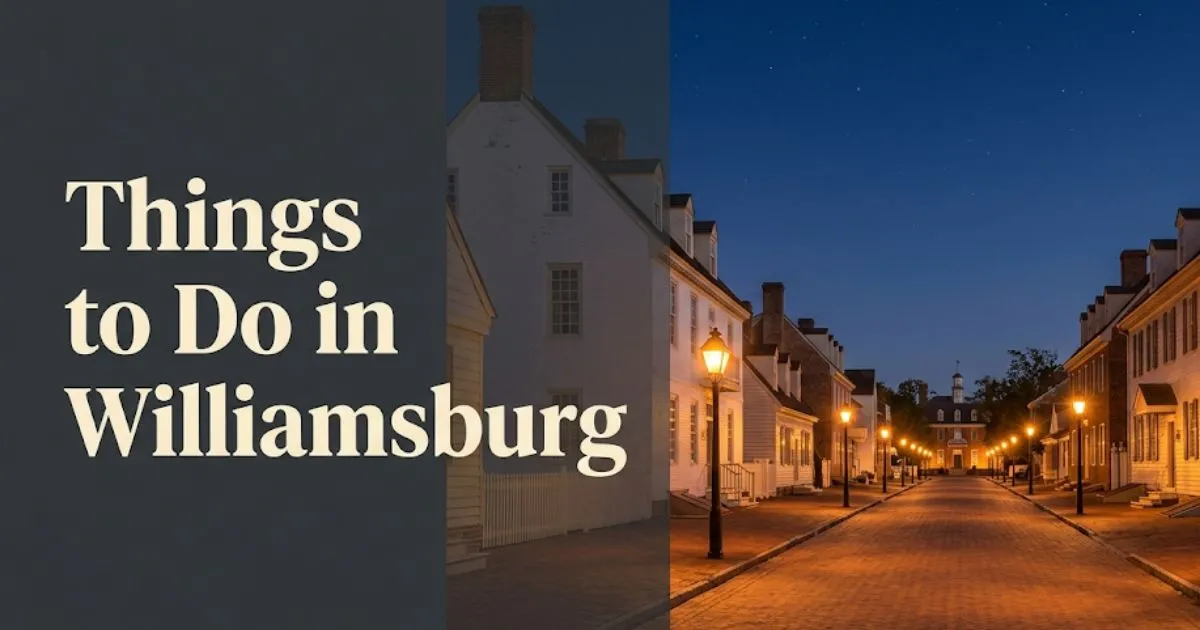
The most romantic single experience in Williamsburg is an evening at Colonial Williamsburg after the daytime crowds thin. By 5 PM, the Duke of Gloucester Street becomes quieter. The period streetlights activate at dusk. The scale and silence of the colonial streetscape in the late afternoon light is unlike any other American city.
A carriage ride through the Colonial Williamsburg historic area is available seasonally through the Colonial Williamsburg Foundation. Rides depart from near the Visitor Center and cover portions of the historic district. Book in advance; availability is limited, especially on summer and fall weekends.
The Williamsburg Winery provides a genuinely romantic half-day for couples. The vineyard setting in James City County, the Gabriel Archer Tavern’s quiet dining room, and the estate wine tasting experience are all calibrated to a pace that Colonial Williamsburg’s daytime tourist atmosphere does not offer.
Dinner at Fat Canary on Merchants Square, followed by an evening walk through the Merchants Square district to the Wren Building, is as close as Williamsburg comes to a classic romantic evening. The scale is intimate; the architecture is historic without being a costume party.
Couples looking for in-room luxury will find the Williamsburg Inn, operated by the Colonial Williamsburg Foundation, as the most atmospheric accommodation in the city. Rates are premium, especially on weekends. The Inn’s Tazewell Club lounge provides an evening drinks option that the broader city largely lacks.
Insider Tip:
- The ghost tours offered by Williamsburg Ghost Tours make for an unexpected romantic evening. Walking the colonial streets after dark with a knowledgeable guide is atmospheric in a way that daytime visits cannot replicate.
- Avoid planning romantic dinners at the Colonial Williamsburg taverns on summer Saturday nights without a reservation made six or more weeks in advance.
Free Things to Do in Williamsburg VA
Several of Williamsburg’s best experiences are genuinely free, and they are significantly underused by visitors who assume the city requires constant ticket purchases.
Walking Duke of Gloucester Street from the College of William and Mary entrance to the Capitol Building end is free. The exterior of every Colonial Williamsburg building, the historic streetscape, and the Duke of Gloucester Street itself are publicly accessible without admission.
The College of William and Mary campus is free to walk at any time during daylight hours. The Sir Christopher Wren Building, the oldest academic building in continuous use in the United States, can be viewed from the exterior. Campus grounds include significant colonial architecture spanning three centuries.
Free activities in Williamsburg:
- Walking Duke of Gloucester Street and the Colonial Williamsburg exterior
- Exploring the College of William and Mary campus and Wren Building exterior
- Walking the Colonial Parkway between Williamsburg and Yorktown (NPS, no fee)
- Merchants Square shopping district and window browsing
- Waller Mill Park walking trail at the reservoir (City of Williamsburg, no vehicle fee)
- Yorktown Beach and the Yorktown waterfront (free access, no admission)
- The Yorktown Visitor Center exhibits in the free lobby area (NPS)
Budget travelers can spend a meaningful full day in Williamsburg without purchasing any attraction tickets. The exterior Colonial Williamsburg walk, the Wren Building campus, and a lunch at a Merchants Square casual spot cost under $20 per person for food.
According to the National Park Service, the Colonial Parkway is one of the few scenic federal parkways in the eastern United States designed specifically to preserve a viewshed free of commercial development. Driving or cycling it costs nothing.
Insider Tip:
- The free exhibits in the Colonial Williamsburg Visitor Center, before you purchase any ticket, provide a solid 45-minute orientation to the historic area’s layout, history, and programming.
- Yorktown Beach on the York River is free to access and far less crowded than Virginia Beach on summer weekends. It is a genuine local alternative for families wanting a water experience without theme park pricing.
Key Takeaway: Walking Duke of Gloucester Street and the College of William and Mary campus is free, genuinely beautiful, and takes at least two hours; do not skip it to save time for paid attractions.
Best Time to Visit Williamsburg VA
The best time to visit Williamsburg is late March through May or September through October, when temperatures are comfortable, crowds are manageable, and the outdoor historic district is at its most enjoyable.
Spring visits, specifically April and early May, offer the additional visual reward of mature dogwood and redbud trees throughout the historic district. The Colonial Williamsburg Foundation programs its spring calendar with specific historical events. Temperatures in April average in the mid-60s Fahrenheit, making all-day outdoor walking comfortable.
Fall visits from mid-September through October bring reduced summer crowds, cooler temperatures averaging in the 60s to low 70s Fahrenheit, and the beginning of Busch Gardens’ Howl-O-Scream Halloween programming on select evenings.
| Season | Crowds | Temperature Range | Best For | Watch Out For |
|---|---|---|---|---|
| Spring (Mar-May) | Low to moderate | 50s to 70s°F | Historic district walking, families | Spring break weeks in late March spike crowds |
| Summer (Jun-Aug) | High to very high | 80s to 95°F | Busch Gardens, Water Country USA | Extreme heat on outdoor Colonial WB grounds |
| Fall (Sep-Oct) | Moderate | 60s to low 80s°F | All activities, best weather balance | October weekends book out fast |
| Winter (Nov-Feb) | Low | 30s to 50s°F | Colonial WB Grand Illumination in Dec, budget hotels | Some Colonial WB buildings operate reduced hours |
The worst time to visit for the Colonial Williamsburg experience is July and August on weekends. Heat and humidity make the outdoor campus physically draining by midday. Tour buses create significant Duke of Gloucester Street congestion between 10 AM and 2 PM.
December is genuinely worth considering. The Grand Illumination event, typically held the first weekend of December, lights the entire colonial district with over 12,000 hand-dipped candles placed in windows throughout the historic buildings. Hotel rates are lower than peak summer. Colonial Williamsburg’s winter programming is reduced but the aesthetic is exceptional.
Williamsburg Weekend Itinerary
A two-day weekend in Williamsburg works best when Day 1 focuses on the Colonial Williamsburg historic area and Day 2 covers Busch Gardens or the Jamestown-Yorktown circuit.
Day 1: Colonial Williamsburg and Merchants Square
- Arrive at the Colonial Williamsburg Visitor Center by 8:30 AM. Purchase or pick up your ticket. Board the shuttle to the historic area.
- Begin at the Governor’s Palace (pre-booked timed entry). Allow 90 minutes for the full tour including gardens.
- Walk south on Palace Green to Duke of Gloucester Street. Turn east toward the Capitol Building.
- Stop at the Anderson Blacksmith Shop, the Print Office, and the Raleigh Tavern on the walk east. Each stop takes 20 to 40 minutes.
- Reach the Capitol Building by mid-morning. Book a timed-entry interior tour if not pre-booked.
- Lunch at Christiana Campbell’s Tavern (reservation recommended) or grab food from the colonial tavern takeaway near the Visitor Center.
- Return west along Duke of Gloucester Street. Focus on the Courthouse, the Powder Magazine, and the Bruton Parish Church in the afternoon.
- Walk to Merchants Square by 4:30 PM. Browse the shops and explore the College of William and Mary campus.
- Dinner at Fat Canary or Blue Talon Bistro on Merchants Square. Reserve in advance.
Day 2: Busch Gardens or Historic Triangle
Option A (Families and Theme Park Visitors): Full day at Busch Gardens Williamsburg. Arrive at opening. Start in the France section to avoid England gate crowds.
Option B (History Enthusiasts and Adults): Morning at Jamestown Settlement and Historic Jamestowne. Afternoon at the American Revolution Museum at Yorktown and Yorktown Battlefield. Drive the Colonial Parkway between sites.
For three-day visits, do both Day 2 options and add a morning at the Williamsburg Winery before departing.
Day Trips From Williamsburg VA
Williamsburg sits at the center of the Virginia Peninsula, making it an effective base for day trips to Newport News, Richmond, the Northern Neck, and Virginia Beach.
Richmond, approximately 50 miles west on Interstate 64, is the most practical day trip. The Virginia Museum of Fine Arts, free to enter, holds one of the most significant permanent collections in the southeastern United States. Richmond’s Carytown shopping and dining district and the James River Kanawha Canal walk provide a sharp contrast to Williamsburg’s colonial atmosphere.
Virginia Beach, approximately 75 miles east, is a 75 to 90-minute drive depending on summer traffic. The Virginia Beach Boardwalk is the state’s most visited coastal attraction. Virginia Beach is genuinely better experienced as a separate trip rather than a day trip from Williamsburg. Traffic on I-64 east toward Hampton Roads on summer weekends can extend the drive to two hours or more.
Newport News is 20 miles east and houses the Virginia Living Museum, a natural history science museum with live native wildlife exhibits that children consistently rate above expectation. The Mariners’ Museum and Park, also in Newport News, holds the most significant collection of nautical history on the East Coast, including the recovered turret of the Civil War ironclad USS Monitor.
Day trip options from Williamsburg:
- Richmond: 50 miles, 50 to 60 minutes via I-64 West. Best for arts, dining, urban exploration.
- Newport News: 20 miles, 25 to 30 minutes. Best for families seeking science and maritime history.
- Yorktown: 14 miles, 20 minutes via Colonial Parkway. Best for completing the Historic Triangle.
- Jamestown Island: 10 miles, 15 minutes. Best for NPS history and archaeology.
- Virginia Beach: 75 miles, 75 to 100 minutes (traffic dependent). Best visited separately.
Insider Tip:
- The Colonial Parkway between Williamsburg and Yorktown takes 20 minutes and eliminates all commercial signage from view. It is one of the most scenic 14-mile drives in Virginia. Use it rather than the Route 17 alternate every time.
Key Takeaway: The Colonial Parkway between Williamsburg and Yorktown is free, takes 20 minutes, and is one of the most visually rewarding scenic drives in the mid-Atlantic; use it rather than the highway every time.
Practical Tips for Visiting Williamsburg
The most consequential planning decision for a Williamsburg trip is how many days to allocate, and nearly every first-time visitor underestimates this.
Colonial Williamsburg alone requires two full days for a meaningful experience. Add Busch Gardens and one day for the Jamestown-Yorktown circuit, and a complete Williamsburg trip is four days. Most visitors plan two days and leave feeling rushed.
Parking at Colonial Williamsburg: The primary visitor lot is at the Colonial Williamsburg Regional Visitor Center on Route 132 (Visitor Center Drive), off US Route 60. Parking is free. Shuttle service runs frequently from the lot to the historic area.
Do not attempt to park inside the historic district. The streets are narrow, parking is extremely limited, and the shuttle from the Visitor Center lot eliminates any advantage.
Getting to Williamsburg: Amtrak’s Northeast Regional service stops at Williamsburg station on the Norfolk-Washington corridor. Newport News/Williamsburg International Airport (PHF) serves limited regional routes. Most visitors drive via Interstate 64, exiting at Route 132.
Getting around Williamsburg: The Williamsburg Area Transit Authority (WATA) operates bus routes connecting major hotels, the historic district, Merchants Square, and the shopping corridor on Richmond Road. For visitors without a car, WATA covers the most-used routes between accommodations and attractions.
Safety and practical notes for Williamsburg:
- Summer heat is a genuine risk for elderly visitors and young children. Plan outdoor Colonial Williamsburg visits for morning hours and return to air-conditioned spaces by noon on days above 90°F.
- Colonial Williamsburg interior building tours require climbing period staircases without handrails in some structures. Visitors with mobility limitations should identify accessible building alternatives with Colonial Williamsburg staff at the Visitor Center.
- Cell service is consistent throughout Williamsburg. No wilderness access concerns apply.
- Advance reservations are required for Colonial Williamsburg tavern dinners, the Governor’s Palace interior tour, and some evening programs. Do not arrive expecting walk-in availability during summer or holiday weekends.
Insider Tip:
- The Colonial Williamsburg app provides real-time wait times and programming schedules for all events in the historic area. Download it before arriving, not while standing at the gate.
- First-time visitors consistently spend too much time inside retail shops along Duke of Gloucester Street. The shops are Colonial Williamsburg-licensed merchandise. The genuine historic content is in the buildings, the tradespeople’s workshops, and the dramatized street programming.
Safety and Practical Warnings for Williamsburg VA
The primary safety concern for Williamsburg visitors is summer heat and sun exposure during extended outdoor time at Colonial Williamsburg.
Key safety and practical facts every visitor should know:
- Summer heat warning: July and August temperatures regularly reach 90 to 95°F with high humidity. Extended outdoor time at Colonial Williamsburg without shade planning causes heat exhaustion, particularly for children and seniors. Carry water, wear light clothing, and plan midday indoor breaks.
- Traffic on Richmond Road (US Route 60): Summer weekend traffic between the Williamsburg Premium Outlets and the Busch Gardens exit corridor creates significant delays. Plan arrival before 10 AM or after 4 PM on peak summer weekends.
- Colonial Williamsburg building interior access: Several historic buildings have uneven flooring, low doorways, and stairways without modern handrails. Visitors with mobility limitations should confirm specific building accessibility with Colonial Williamsburg staff before each tour.
- Busch Gardens ride restrictions: All major roller coasters enforce height and health restrictions. Review the park’s published restrictions before purchasing tickets if a member of your group has relevant health considerations.
- Hurricane season: Virginia’s Atlantic coastal proximity means tropical weather can affect the Williamsburg region from June through November. Monitor National Weather Service forecasts when visiting during this period. Williamsburg itself is inland and lower-risk than coastal Virginia, but severe storms can close outdoor attractions.
The Colonial Williamsburg Foundation’s guest services line, reached through the Foundation’s main contact number, can assist with accessibility planning, emergency situations on the historic grounds, and program cancellations due to weather.
Frequently Asked Questions About Things to Do in Williamsburg
How many days do you need in Williamsburg VA?
Most visitors need at least two to three days in Williamsburg to experience the city’s main attractions without rushing.
A meaningful Colonial Williamsburg visit alone takes two full days. Adding Busch Gardens requires a third day, and the Jamestown-Yorktown circuit adds a fourth for history-focused travelers.
One day is enough only if you limit yourself to a single attraction; plan for two days minimum to avoid leaving the trip feeling incomplete.
Is Colonial Williamsburg worth the admission price?
Colonial Williamsburg is worth the admission price for travelers who engage actively with the trades workshops, interior building tours, and evening programming.
Visitors who walk Duke of Gloucester Street for two hours and return to their hotel will likely feel the ticket was overpriced. The value is in the Governor’s Palace tour, the colonial tradespeople interactions, and the dramatized street programming.
Arrive with a plan for specific buildings and programs; the experience scales dramatically with preparation.
What is the best time of year to visit Williamsburg VA?
The best time to visit Williamsburg is April through May or late September through October.
These shoulder seasons offer comfortable temperatures, smaller crowds, and full programming at Colonial Williamsburg and Busch Gardens.
Summer offers the broadest programming but the highest crowds, highest prices, and most intense heat; winter offers the lowest prices and the Grand Illumination holiday event in December.
Is Williamsburg VA good for young kids?
Williamsburg is excellent for children ages 6 and up, but genuinely challenging for children under 5.
The Jamestown Settlement’s reconstructed ships and fort, Busch Gardens’ Sesame Street area, and the Colonial Williamsburg trades workshops all engage school-age children effectively.
Toddlers and preschoolers often struggle with the historical context and the walking distances required across the Colonial Williamsburg campus.
What is free to do in Williamsburg VA?
Walking the Duke of Gloucester Street exterior, exploring the College of William and Mary campus, and driving the Colonial Parkway are all free.
Waller Mill Park, Yorktown Beach, and the Yorktown waterfront are also free to access. The Colonial Williamsburg Visitor Center has free exhibits in its lobby.
A complete day of Williamsburg’s outdoor and campus experiences costs nothing beyond food.
How far is Williamsburg from Virginia Beach?
Williamsburg is approximately 75 miles from Virginia Beach, a drive of 75 to 100 minutes depending on summer traffic on Interstate 64.
Summer weekends extend the drive significantly due to Hampton Roads tunnel congestion on I-64 East.
Virginia Beach is better experienced as a dedicated trip rather than a day trip from Williamsburg.
Plan Your Williamsburg Visit Now
Williamsburg rewards preparation more than almost any other American destination. Book Colonial Williamsburg’s Governor’s Palace and Capitol Building timed entries as soon as your dates are confirmed. Reserve tavern dinners at the same time.
The most important single action before departure is verifying current pricing, hours, and program schedules directly with the Colonial Williamsburg Foundation and Busch Gardens, since both update their programming seasonally and admission structures change between years. All pricing and hours referenced in this guide reflect general conditions as of recent years. Confirm everything directly with venues before your visit.
You now have the framework to build a two to four-day Williamsburg trip that goes well beyond the Duke of Gloucester Street tourist rush. The city’s depth is real, and it is available to every traveler who arrives with a plan.