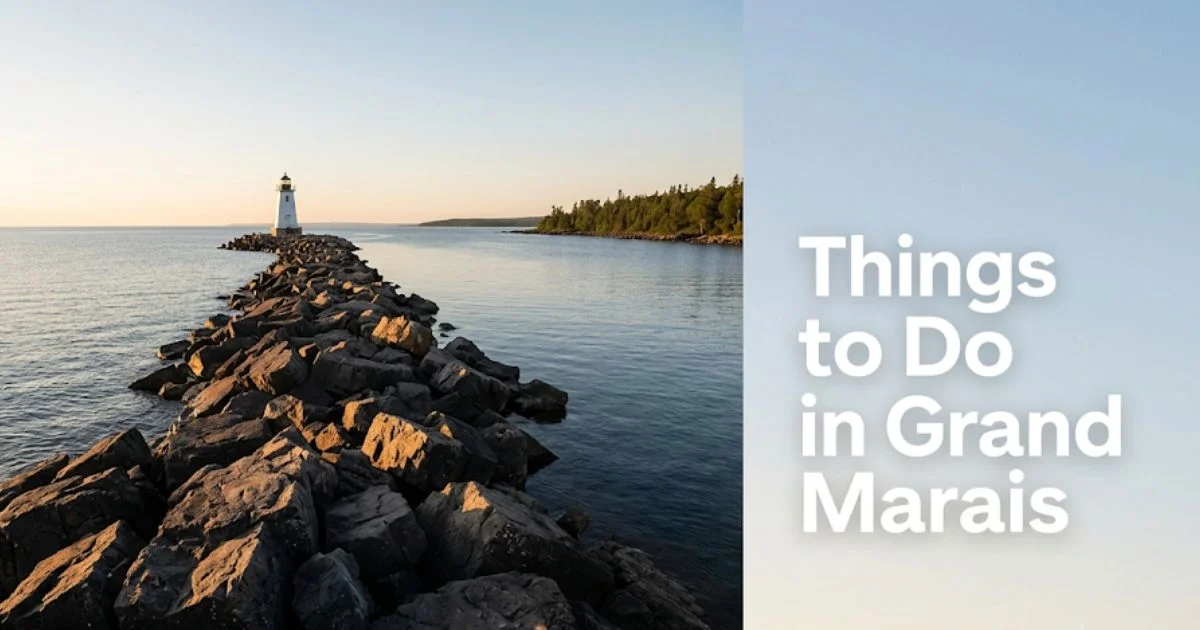
Things To Do in Grand Marais, MN: 2026 Complete Guide

The best things to do in Grand Marais, Minnesota span from Lake Superior shoreline walks at Artist’s Point to waterfall hikes in three state parks within 30 miles. This small Cook County harbor town of roughly 1,200 residents delivers one of the most complete outdoor and arts experiences available anywhere in the upper Midwest.
Explore Minnesota consistently ranks the North Shore drive among Minnesota’s top scenic routes. Grand Marais sits at its northeastern anchor, where the boreal forest meets the largest freshwater lake by surface area on earth.
This guide covers every major activity, honest seasonal guidance, traveler profile-specific advice, practical logistics, and what experienced North Shore visitors do differently from first-timers. You can start planning your actual itinerary right now.
Things to Do in Grand Marais, Minnesota: What This Town Actually Offers
Grand Marais offers an unusually rare combination for a small town: genuine wilderness access, a legitimate arts community, and a walkable harbor district within minutes of each other.
Most visitors arrive via the scenic Highway 61 drive from Duluth. The town’s compact downtown sits directly on Lake Superior, with Artist’s Point and the harbor lighthouse defining its visual identity.
What separates Grand Marais from other North Shore stops is depth. You can spend a weekend entirely within the town. Or use it as a base for the Boundary Waters, multiple state park systems, and the Gunflint Trail.
The town’s arts infrastructure, centered on the Grand Marais Art Colony and North House Folk School, gives it cultural substance most outdoor gateway towns completely lack. That combination of trail access and genuine local culture is rare at this scale.
Insider Tip:
- Park once downtown and walk to the harbor, Artist’s Point, and most galleries without moving your car.
- The town’s compact walkability is one of its best practical features and most visitors underuse it.
- Solo travelers especially benefit: the walkable core makes independent exploration easy without a second person to navigate with.
| Activity Type | Best For | Approx. Cost | Time Needed | Insider Note |
|---|---|---|---|---|
| Artist’s Point walk | All profiles | Free | 30 to 60 min | Go at sunrise to avoid crowds |
| Superior Hiking Trail | Solo, couples | Free to low | Half to full day | Carry water; no services on trail |
| North House Folk School | Couples, solo | Varies by class | Half to full day | Book courses weeks in advance |
| State park waterfall hikes | Families, couples | State park permit | 2 to 4 hours | Judge Magney is least crowded |
| Kayaking Lake Superior | Solo, couples | Rental or guided | 2 to 4 hours | Cold water: wear a wetsuit always |
| Gunflint Trail drive | All profiles | Free to drive | Half to full day | Gas up in Grand Marais first |
What Makes Grand Marais Worth Visiting
Grand Marais is worth visiting because it combines two things that rarely coexist at small-town scale: world-caliber wilderness and a functioning arts community with real craft and educational depth.
The North House Folk School teaches traditional northern crafts including birch bark canoe building, timber framing, and traditional boat building. It is not a tourist gift shop experience. It is a working educational institution drawing students from across the country.
The Grand Marais Art Colony has operated since 1947. It hosts nationally recognized instructors and serious workshops in painting, printmaking, and photography. These are not casual tourist diversions.
For outdoor travelers, the Superior Hiking Trail runs directly through and near Grand Marais, offering everything from a 2-mile scenic walk to a multi-day thru-hike. The Superior Hiking Trail Association maintains over 300 miles of trail in the corridor.
Local Alternative: Most first-timers photograph Artist’s Point. Experienced visitors head to Pincushion Mountain Trails instead, where the ridgeline views look down over the entire harbor and town from above, with far fewer people.
Artist’s Point and the Grand Marais Harbor
Artist’s Point is the rocky breakwater extending into Lake Superior at the eastern edge of Grand Marais harbor, and it is the single most photographed location in the town.
The walk along the breakwater to the lighthouse takes roughly 20 to 30 minutes. The rocks are uneven and require steady footing. The views looking back toward town show the classic Grand Marais harbor image that appears in nearly every North Shore travel feature.
Local Alternative: For a less-trafficked waterfront view, walk to the west side of the harbor near the commercial fishing dock area on Wisconsin Street. The angle across the harbor toward Artist’s Point and the lighthouse from the west is actually stronger photographically and almost always crowd-free.
Artist’s Point parking fills by mid-morning on summer weekends and fall color weekends. Arriving before 8 a.m. is genuinely the practical move.
For families with children, the smooth harbor-side path leading toward Artist’s Point is stroller-accessible, but the rocky breakwater itself is not. Young children should stay on the paved or packed-gravel harbor path rather than attempting the uneven rocks.
For seniors and accessibility travelers, the paved harbor walkway is accessible and scenic. The breakwater rocks themselves present significant mobility challenges and are not recommended for travelers with limited stability.
Key Takeaway: Arrive at Artist’s Point before 8 a.m. on weekends. Parking fills fast and the early light on Lake Superior is genuinely worth it.
Hiking Near Grand Marais: Superior Hiking Trail and Pincushion Mountain
The best hiking near Grand Marais follows the Superior Hiking Trail, which passes directly through the area and offers accessible day hikes from multiple trailheads within minutes of downtown.
Pincushion Mountain is the most accessible option for a first-timer. The trailhead sits approximately 2 miles northeast of downtown via County Road 12. Several loop options ranging from 1 to 5 miles give you boreal forest ridgeline views with Lake Superior visible in the distance.
The Pincushion Mountain trail system is also the primary Nordic skiing and snowshoeing network in winter, groomed by the local cross-country ski club. In summer, the same trails offer the clearest introduction to the boreal forest ecosystem of any hike near town.
For a longer day hike on the Superior Hiking Trail, the section heading northeast toward Kadunce River and Gauthier Creek offers river crossings, forested gorges, and significantly fewer hikers than the most popular waterfall parks to the southwest.
Insider Tip:
- The SHT trailhead at the east end of 8th Avenue in Grand Marais gives direct trail access without driving.
- Carry more water than you think you need. No water sources on many sections are reliable for filtering.
- Solo travelers should download offline trail maps before leaving cell range. Signal disappears quickly on the SHT north of town.
Couples find the Pincushion ridgeline section particularly rewarding for the combination of manageable terrain and superior views. It is challenging enough to feel like a real hike but not so demanding that it becomes a grueling march rather than a scenic experience.
State park entrance permits are not required for the Superior Hiking Trail itself. The trail is free to hike, though SHT Association memberships support maintenance.
Cascade River, Temperance River, and Judge Magney State Parks
Three state parks within 20 to 30 miles southwest of Grand Marais offer some of the most dramatic waterfall and gorge scenery in the Midwest, each with a distinct character worth understanding before choosing where to go.
Cascade River State Park, approximately 10 miles southwest of Grand Marais, features a dense concentration of waterfalls along the Cascade River as it drops toward Lake Superior. The 0.5-mile hike from the lower parking area to the main falls series is one of the most rewarding short hikes on the entire North Shore for the effort-to-payoff ratio.
Temperance River State Park, roughly 23 miles southwest of Grand Marais, offers a deeper gorge carved into dark basalt. The river disappears into narrow rock slots creating cauldron-like pools. The lower gorge trail is short and visually spectacular.
Judge C.R. Magney State Park sits 14 miles northeast of Grand Marais and contains Devil’s Kettle Falls, where the Brule River splits around a rock island and one half of the river disappears into a pothole with no confirmed outlet. This geological mystery draws serious curiosity and the 1.5-mile trail to reach it filters out casual visitors.
According to the Minnesota Department of Natural Resources, a Minnesota state park vehicle permit is required for day use at all three parks. Annual permits are available and cost-effective for multiple visits. Verify current permit pricing at dnr.state.mn.us before visiting.
Families with children find Cascade River’s lower falls the most accessible and rewarding. The trail is short, the falls are immediately visible, and there is enough visual drama to hold a child’s genuine attention.
Insider Tip:
- Judge Magney consistently has the fewest visitors among the three parks. Go there on busy fall weekends when Cascade and Temperance lots fill by 9 a.m.
- Arrive at Cascade River before 9 a.m. on fall color weekends or plan on a significant parking wait.
- Wear shoes with traction. Wet rock near all three parks is genuinely slippery.
Kayaking and Water Activities on Lake Superior
Kayaking Lake Superior from Grand Marais offers one of the most visually dramatic paddling settings in the continental United States. The harbor provides a protected launch point for beginners.
This is not a casual warm-water paddling experience. Lake Superior’s surface temperature stays in the low-to-mid 50s Fahrenheit even in July and August. Cold water immersion at those temperatures creates hypothermia risk within minutes. A wetsuit or drysuit is not optional; it is a safety requirement.
Local outfitters in and near Grand Marais offer guided kayak tours that include proper gear and safety briefings. Guided experiences are strongly recommended for anyone without prior cold-water paddling experience. Solo rental without guide supervision on Lake Superior is not advisable for inexperienced paddlers.
Couples find guided sunset kayak tours of the harbor particularly appealing. The harbor route stays in protected water with the lighthouse and Artist’s Point creating a genuinely scenic paddling environment.
Rock picking along Lake Superior’s shoreline is a free alternative water activity that children genuinely enjoy. Lake Superior agates, thomsonites, and smooth basalt stones are findable on gravel beaches. The shoreline near the harbor and along the Gunflint Trail corridor offers good picking spots.
Stand-up paddleboarding within the harbor is more accessible than open-lake kayaking and is available through local outfitters in summer. Harbor conditions are calmer than the open lake.
Budget travelers should note that rock picking costs nothing and provides 2 to 3 hours of genuine engagement along the shoreline. It is one of Grand Marais’s most underappreciated free activities.
Key Takeaway: Never kayak Lake Superior without cold-water gear. Water temperature stays dangerously low even in summer, regardless of air temperature.
Grand Marais Art Colony and Local Arts Scene
The Grand Marais Art Colony has been a working arts education center since 1947, making it one of the oldest continuously operating art colonies in the upper Midwest.
The Colony offers workshops in painting, drawing, printmaking, and photography taught by nationally recognized instructors. Week-long and weekend intensive formats run from late spring through fall. These are genuine learning experiences, not tourist activities. Registration typically opens months in advance for popular summer workshops.
The North House Folk School operates on the harbor near Artist’s Point and offers an entirely different arts experience: traditional northern crafts including birch bark canoe construction, blacksmithing, fiber arts, and wooden boat building. Day-long to week-long courses run from spring through early winter.
For visitors not enrolled in courses, the North House campus is worth walking through. The working boathouse and open workshop spaces are visible during active course sessions and offer genuine artisan craft atmosphere unavailable in a museum context.
The gallery presence on Wisconsin Street and Broadway Avenue in downtown Grand Marais includes several serious regional galleries representing local and northern Minnesota artists. Sivertson Gallery on Wisconsin Street is the most established, representing more than 30 regional artists with particular depth in North Shore landscape and Great Lakes subject matter.
Couples find the combination of North House Folk School enrollment and a Grand Marais long weekend to be a distinctive and genuinely memorable experience. It removes the usual resort-weekend passivity and replaces it with something you actually made.
Solo travelers find Art Colony workshops a natural social environment. Shared creative activity with a small group creates easy, genuine conversation without the forced social dynamics of group tours.
Where to Eat and Drink in Grand Marais
The best restaurant in Grand Marais is the Angry Trout Cafe, a waterfront spot on Wisconsin Street overlooking the harbor that sources fish from local commercial fishermen and vegetables from nearby farms.
The Angry Trout operates seasonally, typically from May through October. It books up quickly on summer evenings. Arrive early or plan to wait. The smoked fish plate and locally sourced lake trout are the dishes that define what North Shore dining does at its best.
Sven and Ole’s Pizza on Wisconsin Street is the town’s most beloved casual option, operating year-round when many restaurants reduce hours or close. The pizza is straightforwardly good and the place operates with a genuine local following that survives long after tourist season ends.
Gunflint Tavern downtown offers a more pub-style experience with a solid local beer selection and the kind of menu that works equally well for a casual solo lunch and a group dinner.
Voyageur Brewing Company, located on the west side of the harbor, is the town’s primary craft brewery. The taproom overlooks Lake Superior with a view that would earn the bar business regardless of what they served. The beer quality is legitimately good. The lakeside patio is the best outdoor drinking spot in town.
For coffee, Java Moose on Wisconsin Street is the local morning institution. Arrive early on weekends or expect a wait.
Budget travelers should note that the most affordable full meal in Grand Marais is Sven and Ole’s, where a pizza feeds two people for a fraction of the cost of a waterfront dinner. The Angry Trout is worth the splurge once per trip.
Insider Tip:
- The Angry Trout does not take reservations. Show up at 5 p.m. on weekdays to avoid the longest waits.
- Voyageur Brewing’s happy hour pricing on the patio is the best value per experience in town.
- Most Grand Marais restaurants close earlier than urban travelers expect. Kitchen closes at 8 or 9 p.m. is common.
Day Trips from Grand Marais: Boundary Waters and Grand Portage
The most significant day trip from Grand Marais runs up the Gunflint Trail, County Road 12, a 57-mile paved road that penetrates deep into the Superior National Forest toward the southern edge of the Boundary Waters Canoe Area Wilderness.
The Gunflint Trail drive itself, without stopping, takes approximately 90 minutes to the end. The drive through old-growth boreal forest with lakes visible through the trees at regular intervals is worth the time. Moose sightings are genuinely possible, especially in early morning and evening.
For day-trip entry into the Boundary Waters, paddlers can launch from Gunflint Lake at the end of the trail with a day-use permit. BWCAW permits are required even for day use. Reserve through Recreation.gov. Summer weekend permits sell out quickly; book weeks or months in advance.
Grand Portage National Monument sits approximately 40 miles northeast of Grand Marais near the Canadian border. The monument preserves the 18th-century fur trade depot that connected Lake Superior to the interior of the continent. The Grand Portage Heritage Center provides genuinely engaging context for the history. Entry fees apply; verify current pricing at nps.gov/grpo before visiting.
Grand Portage State Park, immediately north of the monument, contains the High Falls of the Pigeon River, Minnesota’s tallest waterfall at approximately 120 feet. The paved, accessible trail to the falls viewpoint is one of the few genuinely accessible waterfall experiences on the North Shore, making it a strong recommendation for seniors and accessibility travelers.
According to the National Park Service, Grand Portage is also the southern terminus for the ferry service to Isle Royale National Park, Michigan, operating seasonally. This is an entirely separate trip-planning consideration but worth knowing if Isle Royale is on your list.
Key Takeaway: Gas up in Grand Marais before driving the Gunflint Trail. There are no reliable gas stations for 57 miles once you leave town.
Grand Marais in Fall: North Shore Leaf Season
Fall color season on the North Shore typically peaks between late September and mid-October, with the exact peak varying by year depending on temperature and rainfall patterns through August and September.
This is Grand Marais at its most visually spectacular and its most crowded. Highway 61 traffic during peak fall weekends is heavy. Lodging books out 3 to 6 months in advance for prime October weekends. Parking at Artist’s Point, Cascade River, and Temperance River fills before 9 a.m. on peak weekends.
Explore Minnesota maintains a real-time fall color report updated weekly during the season. Check this before finalizing your travel dates rather than guessing by calendar. Peak color can shift by 10 to 14 days depending on the year’s conditions.
The combination of Lake Superior’s dark blue against the orange and yellow boreal forest canopy is genuinely one of the most spectacular fall color scenes in the continental United States. This is not promotional language; it is a geographic fact of contrast that photographers specifically travel to capture.
If you cannot book lodging in Grand Marais itself for prime fall weekends, Two Harbors and Duluth are reasonable alternatives with easier lodging availability, though they require commuting up Highway 61 toward Grand Marais each day.
Couples find fall the most romantic season in Grand Marais by significant margin. The cooler temperatures, dramatic color, and quieter evenings compared to peak summer create the clearest version of the intimate North Shore experience.
Insider Tip:
- Book fall lodging in Grand Marais by April for October weekends. Seriously. The good properties fill that early.
- Weekdays during fall color week are dramatically less crowded than weekends. If your schedule allows, Tuesday through Thursday visits offer the same color with a fraction of the people.
- The Gunflint Trail interior color often peaks 3 to 5 days before the lakeshore color. Check both.
Grand Marais in Winter
Grand Marais in January and February is cold, uncrowded, dramatically scenic, and completely unlike any other season here. Average high temperatures hover near 20 to 25 degrees Fahrenheit, with Lake Superior’s influence keeping temperatures slightly moderated compared to the interior.
Winter is the best season for northern lights viewing near Grand Marais. The low light pollution of Cook County, combined with the reflective surface of Lake Superior when partially frozen, creates exceptional aurora viewing conditions on clear nights. The University of Minnesota Duluth’s Natural Resources Research Institute recommends the Grand Marais and Cook County area as among the best aurora viewing locations in the contiguous United States.
Pincushion Mountain hosts groomed cross-country ski trails maintained by the Pincushion Ski Club. The trail network offers beginner through advanced options and connects to wilderness trail extensions for experienced skiers. Snowshoe rentals are available through local outfitters for the same trail network.
The North House Folk School operates year-round, and its winter programming emphasizes cold-weather crafts: ice fishing, traditional winter gear making, and northern survival skills. Winter classes often have better availability than summer equivalents.
Most Grand Marais restaurants reduce hours or close entirely from January through March. Sven and Ole’s Pizza remains reliably open. Verify restaurant hours before planning winter meals.
Budget travelers find winter Grand Marais significantly more affordable. Lodging prices drop substantially from peak season rates. Most outdoor activities cost nothing beyond basic gear. The trade-off is reduced service availability and the requirement for genuine winter preparation.
Grand Marais in Summer: What to Expect in Peak Season
Summer, from late June through August, is Grand Marais at its most active and most crowded. Daytime temperatures typically reach the mid-60s to low 70s Fahrenheit near the lake, making it one of the coolest summer destinations in the region.
That cool summer temperature is a genuine selling point when much of the Midwest is dealing with 90-degree heat. Grand Marais summer feels more like coastal Maine than midwestern August. Evenings routinely drop into the 50s and require a jacket.
Summer is the primary season for kayaking, sailing on the harbor, farmers market activity (typically Saturdays from late June through September, verify current schedule with visitcookcounty.com), and the full operating hours of seasonal restaurants like Angry Trout Cafe.
The Grand Marais Arts and Crafts Fair, typically held in late July at the Cook County fairgrounds, draws regional artists and craftspeople and represents the largest single-weekend crowd event outside of peak fall color. Verify 2026 dates directly with the Cook County/Grand Marais Tourism Bureau.
Families with children find summer the most practical season. The Gunflint Trail’s lakes are warm enough for swimming by mid-July. Rock picking is in full swing. Farmers market visits, lighthouse walks, and casual harbor-side afternoons create low-pressure family days without requiring intense logistics.
Highway 61 summer traffic is the single biggest logistical frustration in Grand Marais summer. The two-lane road slows considerably when multiple state park day-trippers are moving simultaneously. Build 25% extra drive time into any day with multiple stops.
Key Takeaway: Summer Grand Marais runs 15 to 20 degrees cooler than the Twin Cities. Pack layers regardless of the forecast.
Grand Marais with Kids and Families
Grand Marais is genuinely good for families with children ages 6 and up. It is logistically challenging for families with children under 3.
The best family activities are rock picking on the harbor shoreline, the short Cascade River lower falls hike, the High Falls trail at Grand Portage State Park (paved and accessible), the Grand Portage National Monument Heritage Center, and an afternoon at the Grand Marais harbor watching commercial fishing boats.
- Rock picking on Lake Superior shoreline: free, easily engaging for 2 to 3 hours, safe and flat
- Cascade River lower falls hike: 0.5 miles, dramatic payoff, appropriate for children ages 5 and up with supervision on wet rocks
- High Falls at Grand Portage State Park: paved trail, genuinely impressive waterfall, appropriate for all ages
- Grand Portage National Monument: the Heritage Center has genuinely engaging exhibits on fur trade history and Ojibwe culture, appropriate for children ages 8 and up
- Harbor watching: the working harbor with commercial fishing boats and kayak launches is naturally interesting to children for 30 to 60 minutes at no cost
The one experience that sounds ideal for families but routinely underdelivers for young children: the longer Superior Hiking Trail sections. Trails over 3 miles with significant elevation change on uneven terrain lose most children under 10 within the first hour. Stick to the shorter waterfall hike options.
Artist’s Point is walkable and visually engaging for older children. The uneven breakwater rocks are unsafe for toddlers without constant direct supervision.
Grand Marais for Couples
Grand Marais is one of the strongest couples destinations in the upper Midwest for travelers whose idea of romance involves scenery, shared experience, and genuine quiet rather than resort amenities.
The combination of a North House Folk School day course, an evening at Angry Trout Cafe, and a sunrise walk to Artist’s Point represents the archetypal Grand Marais couple’s day. It delivers because each element is specific and place-dependent rather than interchangeable with any other resort town.
The most romantically effective single activity in Grand Marais is the Voyageur Brewing Company patio at sunset. The combination of Lake Superior framed by the harbor, craft beer, and the particular quality of North Shore evening light is genuinely difficult to replicate anywhere else in Minnesota.
For couples who hike: the SHT section from the Pincushion trailhead toward Honeymoon Bluff, approximately 8 miles roundtrip with an out-and-back, offers one of the North Shore’s most scenic ridgeline walks and is specifically known among regional hikers for its panoramic Lake Superior views.
For couples who want something sedentary and memorable: book a North House Folk School day course together. Building something by hand in a working craftsperson’s environment creates shared memory in a way that sightseeing alone cannot.
Fall is the most romantic season here. Summer is more active. Winter is most intimate. Spring is underappreciated and significantly less expensive than summer or fall.
Budget Travel in Grand Marais: Free and Low-Cost Options
Grand Marais is more affordable than its scenic reputation suggests, with a substantial list of genuinely free activities anchoring any budget trip.
Free activities in Grand Marais:
- Walking Artist’s Point and the harbor breakwater
- Rock picking on Lake Superior shoreline
- Hiking all Superior Hiking Trail sections
- Walking Pincushion Mountain trail network
- Browsing downtown galleries including Sivertson Gallery (viewing is free, purchasing is optional)
- Watching the harbor from the public docks on Wisconsin Street
- Northern lights viewing from the harbor or Pincushion overlook (seasonal and weather-dependent)
- Swimming at Agate Beach east of the harbor (cold water; wetsuit or cold-water tolerance required)
Paid but low-cost:
- Minnesota State Park Vehicle Permit: one purchase covers all state parks for the calendar year; verify current fee at dnr.state.mn.us. If you visit more than one state park, the annual permit pays for itself immediately.
- Sven and Ole’s Pizza: one of the best value-per-quality meals in town
Where budget travelers overspend without realizing it: The Angry Trout Cafe is worth the cost once. Every subsequent evening dinner at comparable waterfront pricing adds up fast. Grocery shopping in Grand Marais at the local IGA or bringing food from home for breakfasts and lunches dramatically changes the trip budget.
Budget lodging reality: Grand Marais has limited hostel or budget motel infrastructure. Camping at Cascade River State Park or municipal campgrounds in and near Grand Marais is the most cost-effective overnight option. Verify campsite reservation availability through the Minnesota DNR reservation system before arriving.
Key Takeaway: Buy the annual Minnesota State Park Vehicle Permit on your first park stop. It covers all state parks and pays for itself by your second park visit.
Getting to Grand Marais and Practical Logistics
Grand Marais has no public transit connection. A car is required for every aspect of visiting, including getting there.
Driving from Minneapolis: The drive from the Twin Cities to Grand Marais runs approximately 260 miles, typically 4 to 4.5 hours via Interstate 35 north to Duluth and then Highway 61 northeast along the North Shore. Highway 61 from Duluth to Grand Marais is a two-lane road. Plan accordingly on busy weekends.
Driving from Duluth: Approximately 110 miles, typically 2 to 2.5 hours along Highway 61. The drive itself along the North Shore is worth treating as an activity rather than just a transit segment.
Flying: Minneapolis-Saint Paul International Airport (MSP) is the practical airport for most visitors. Duluth International Airport (DLU) is closer but has limited commercial service and may require a connection through MSP or Chicago. Renting a car at either airport is necessary.
To plan your drive efficiently:
- Fill your gas tank in Duluth or Two Harbors. Gas prices tend to rise as you move northeast on Highway 61.
- Allow time for at least one stop between Duluth and Grand Marais. Gooseberry Falls State Park and Split Rock Lighthouse State Park are the two most visited intermediate stops.
- Note that cell service becomes intermittent north of Two Harbors. Download offline maps before leaving Duluth.
- If visiting in fall, expect Highway 61 traffic delays of 20 to 45 minutes on peak color weekends.
- Arrive in Grand Marais with a full tank if you plan to drive the Gunflint Trail. No gas stations exist on the 57-mile road.
Parking in downtown Grand Marais is free but limited. The main parking area near Artist’s Point fills quickly on summer and fall weekends. Street parking on Wisconsin Street and adjacent blocks is the alternative.
Where to Stay in Grand Marais
Grand Marais lodging ranges from waterfront cabins and boutique lodges to standard motels and campgrounds. No major hotel chains operate in town.
The most requested lodging in Grand Marais is waterfront or harbor-view cabin rental. These book fastest and typically require the most advance reservation, especially for fall color weekends and summer holiday periods.
Gunflint Lodge on the Gunflint Trail at Gunflint Lake offers a full-service wilderness lodge experience approximately 50 miles from town. It is the most complete traditional Minnesota north-woods lodge experience in the area and worth considering for travelers who want resort-level service within a genuine wilderness setting.
For travelers who want to stay in the town itself, the Aspen Lodge and several independent motel properties on or near Highway 61 offer solid mid-range options with reasonable proximity to the harbor. Verify current availability and pricing directly with properties; rates vary significantly by season.
Camping options near Grand Marais:
- Grand Marais Municipal Campground: closest to town, some sites with Lake Superior views
- Cascade River State Park campground: forested sites near the park’s waterfalls, requires DNR reservation
- Gunflint Trail corridor: multiple Forest Service campgrounds along the route, some first-come, some reservable
For families, campground options with utility hookups are available at the municipal campground. Verify RV hookup availability in advance.
Budget travelers should book camping via the Minnesota DNR reservation system (mnreservations.com) as early as possible for summer weekends. Sites fill quickly, especially at Cascade River.
For fall color lodging: book by April for October weekends. This is not an exaggeration. Grand Marais proper has limited total lodging inventory and it genuinely fills months in advance during peak fall.
Safety and Practical Warnings for the North Shore
Lake Superior is beautiful and genuinely dangerous. Every visitor should understand these specific realities before arriving.
Key safety and practical facts every visitor should know:
- Lake Superior water temperature: Surface temperatures stay in the low-to-mid 50s Fahrenheit through most of summer. Cold-water shock and hypothermia risk begin within minutes of immersion. Never swim alone. Never kayak without appropriate cold-water gear regardless of air temperature.
- Cell service: Signal is unreliable north of Two Harbors on Highway 61 and essentially absent on much of the Gunflint Trail and surrounding wilderness areas. Download offline maps (Gaia GPS or AllTrails work well for the SHT) before leaving town.
- Highway 61 driving: Two lanes for 110 miles. Fall color weekends bring heavy traffic. Drive cautiously; the road has no shoulders in many sections and significant curves along cliff edges.
- Trail conditions: Superior Hiking Trail sections involve uneven, rocky terrain, root networks, and stream crossings. Appropriate footwear (trail runners or hiking boots, not sandals) is not optional.
- Black bears: Black bears are present in Cook County. Store food properly at all campgrounds. Never leave food in tents.
- Winter driving: Highway 61 and the Gunflint Trail require winter-rated tires and standard Minnesota winter driving preparation from November through April.
- Weather changes: Lake Superior generates its own weather patterns. Fog, wind, and temperature drops can occur rapidly regardless of morning forecasts. Carry a jacket on all outdoor activities.
For emergencies on the Gunflint Trail or surrounding wilderness areas, contact Cook County Sheriff’s Office. Cell service is limited; satellite communication devices are worth considering for backcountry travelers.
Suggested 2-Day Grand Marais Weekend Itinerary
Day 1: Harbor, Town, and Arts
- Start at Artist’s Point at sunrise. Walk the breakwater to the lighthouse. Allow 45 to 60 minutes.
- Coffee at Java Moose on Wisconsin Street. Arrive before 8 a.m. on weekends to avoid the wait.
- Walk the North House Folk School campus and browse the working boathouse. Free to walk through during business hours.
- Browse Sivertson Gallery and downtown galleries along Wisconsin Street. Allow 60 to 90 minutes.
- Lunch at Sven and Ole’s Pizza for a casual, affordable midday break.
- Afternoon: North House Folk School half-day course if booked in advance, or a guided kayak tour of the harbor.
- Evening: Voyageur Brewing Company patio for sunset over Lake Superior.
- Dinner at Angry Trout Cafe. Arrive at 5 p.m. to minimize the wait.
Day 2: Waterfalls, Gunflint Trail, and State Parks
- Drive southwest to Cascade River State Park (10 miles). Hike the lower falls loop. Allow 2 hours.
- Continue southwest to Temperance River State Park (23 miles from Grand Marais). Lower gorge trail. Allow 60 to 90 minutes.
- Return northeast to Judge C.R. Magney State Park (14 miles northeast of Grand Marais). Hike to Devil’s Kettle Falls. Allow 2.5 to 3 hours roundtrip.
- Drive the Gunflint Trail at least 20 miles for a boreal forest and lake interior experience. Moose watch at dawn or dusk.
- Rock pick on the harbor shoreline before dinner.
- Dinner at Gunflint Tavern downtown.
Frequently Asked Questions About Things To Do in Grand Marais
What are the best things to do in Grand Marais, MN in 2026?
The best things to do in Grand Marais in 2026 include hiking the Superior Hiking Trail, walking Artist’s Point, visiting Cascade River and Temperance River State Parks, kayaking the harbor, and attending a North House Folk School course.
Day trips up the Gunflint Trail to the Boundary Waters edge and northeast to Grand Portage National Monument and its High Falls complete the most well-rounded Grand Marais visit.
Plan for at least two full days to cover both the in-town experience and the surrounding state park and trail system without feeling rushed.
How far is Grand Marais from Minneapolis and how do you get there?
Grand Marais is approximately 260 miles northeast of Minneapolis, a drive of roughly 4 to 4.5 hours via Interstate 35 north to Duluth and then Highway 61 northeast.
No public transit serves Grand Marais. A car is required.
Flying into Minneapolis-Saint Paul International Airport (MSP) and renting a car is the most practical option for non-Minnesota visitors.
When is the best time to visit Grand Marais, Minnesota?
The best time to visit Grand Marais for first-timers is late June through early July, when services are fully operational and temperatures are comfortable without peak fall-season crowds.
Fall color season from late September through mid-October is the most visually spectacular period but requires booking lodging 3 to 6 months in advance for prime weekends.
Winter offers uncrowded trails and northern lights potential; summer offers the most activity options but the highest prices and fullest lodging calendar.
Is Grand Marais good for families with young children?
Grand Marais is well-suited for families with children ages 6 and up, with rock picking, short waterfall hikes at Cascade River, and the harbor area providing genuinely engaging activities.
Families with children under 3 will find the rugged terrain of most trails logistically difficult. The paved High Falls trail at Grand Portage State Park is the most accessible waterfall experience for young children.
Strollers work on the harbor path but not on the Artist’s Point breakwater or most hiking trails.
Do you need a permit to visit state parks near Grand Marais?
A Minnesota State Park Vehicle Permit is required for day use at Cascade River, Temperance River, Judge C.R. Magney, and Grand Portage State Parks.
Annual permits cover all Minnesota state parks for the calendar year and become cost-effective after two park visits. Daily permits are also available.
Verify current permit fees at dnr.state.mn.us before your visit, as pricing is subject to annual adjustment.
What should I know before visiting Grand Marais for the first time?
Book lodging well in advance, especially for fall color weekends when Grand Marais fills months ahead. Gas up before driving the Gunflint Trail.
Lake Superior’s cold water temperature requires proper gear for any paddling activity regardless of air temperature. Cell service is unreliable beyond the town itself.
Bring layers for all seasons, arrive at popular trailheads before 9 a.m. on weekends, and download offline maps before leaving cell range.
Final Notes on Planning Your Grand Marais Trip
Grand Marais is one of the clearest cases in upper Midwest travel where the destination fully delivers what it promises. The scenery is real. The arts community is genuine. The outdoor access is exceptional.
Book lodging first if fall color is your target season. Everything else can be arranged after you have secured a place to sleep. For summer visits, the same principle applies to campsite reservations via the Minnesota DNR system.
Verify hours, permit requirements, and seasonal closures directly with the Minnesota DNR, the Cook County/Grand Marais Tourism Bureau at visitcookcounty.com, and individual restaurants before departure. Conditions, prices, and schedules change between seasons and between years. The planning intelligence in this guide reflects 2026 general conditions; always confirm specifics before you travel.
The reader who arrives at Artist’s Point at 6:45 a.m. on a September morning, with a full tank of gas, a state park permit, and a North House Folk School course booked for the afternoon, is having the real Grand Marais experience. Go do that.