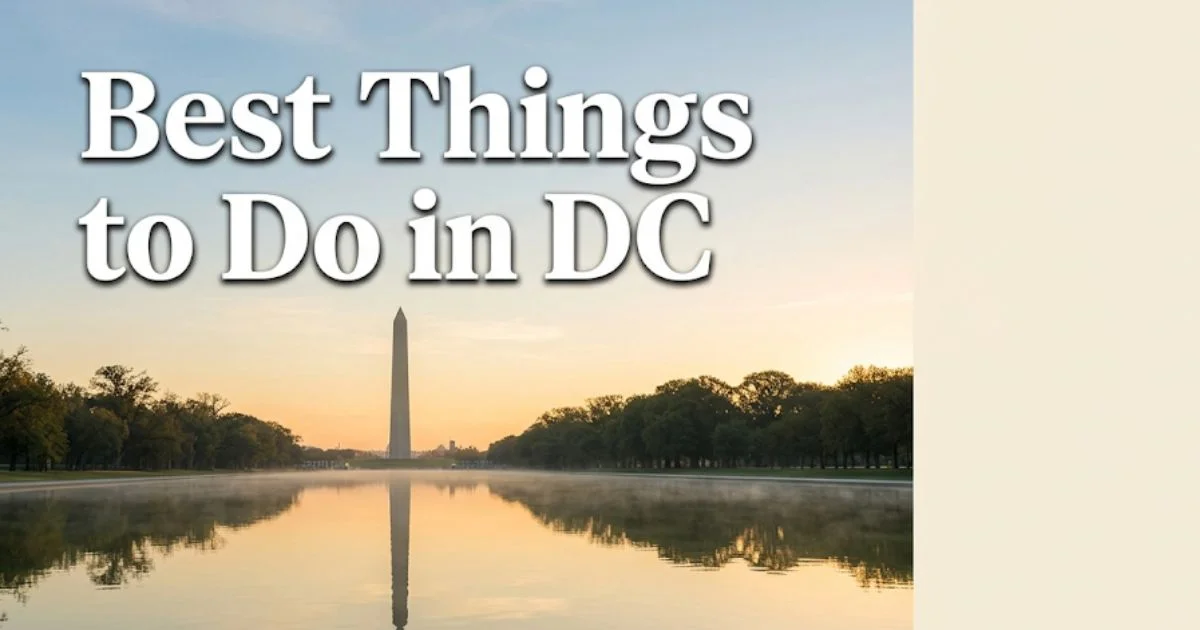
Best Things to Do in DC: The 2026 Insider Guide

The best things to do in DC span free world-class museums, iconic monuments, and neighborhoods that most tourists never reach. Washington DC is also one of the most genuinely budget-accessible major cities in the United States, with most of its core attractions costing nothing to enter.
According to Destination DC, the city’s official tourism organization, DC draws more than 24 million visitors annually. That number makes crowd strategy as important as your attraction list.
This guide covers monuments, museums, neighborhoods, dining, outdoor activities, itinerary frameworks, and honest seasonal advice. It also tells you which famous attractions are worth the hype and which are not.
Best Things to Do in DC: The Full Picture
The best things to do in DC divide into three distinct categories: the National Mall experience, the neighborhood experience, and the outdoor and dining experience.
Most visitors only complete the first category. That is the trip’s biggest missed opportunity.
The Mall runs roughly two miles from the Lincoln Memorial to the US Capitol. Walking its full length takes longer than most people expect, often 90 minutes each way with stops.
Beyond the Mall, neighborhoods like Shaw, Adams Morgan, Georgetown, and 14th Street NW carry the actual cultural weight of a city that houses more than 700,000 permanent residents.
Insider Tip:
- Arrive at the Lincoln Memorial before 8am to experience it without crowds. The reflection pool and memorial feel genuinely different with space to breathe.
- Book your National Museum of African American History and Culture timed-entry ticket weeks in advance. Walk-up availability is extremely limited.
- Solo travelers find DC especially navigable: the Metro connects most major sites, and the Mall is well-patrolled and safe throughout the day.
Top 10 Things to Do in Washington DC
The top 10 things to do in Washington DC include the Lincoln Memorial, NMAAHC, Eastern Market, the National Mall, Georgetown waterfront, Rock Creek Park, the Kennedy Center Millennium Stage, the Tidal Basin walk, the Library of Congress Great Hall, and an evening in Adams Morgan.
That list differs meaningfully from most published top 10 lists, which swap Eastern Market and the Kennedy Center Millennium Stage for the National Museum of Air and Space and Madame Tussauds.
| Attraction | Best For | Cost | Time Needed | Honest Note |
|---|---|---|---|---|
| Lincoln Memorial | All profiles | Free | 30 to 60 min | Go at dawn or dusk |
| NMAAHC | All profiles | Free (timed entry) | 3 to 4 hours | Advance booking required |
| Eastern Market | Couples, families | Free entry, vendors vary | 1 to 2 hours | Best Saturday mornings |
| Georgetown Waterfront | Couples, solo | Free | 1 to 2 hours | Skip in summer heat |
| Kennedy Center Millennium Stage | Budget, couples | Free (6pm nightly) | 1 hour | Reservations recommended |
| Rock Creek Park trails | Solo, families, seniors | Free | Half day | Less crowded than Mall |
| Library of Congress Great Hall | Solo, couples, seniors | Free | 1 hour | Massively undervisited |
| Tidal Basin Walk | All profiles | Free | 1 to 2 hours | Go during cherry blossom season or fall |
| Adams Morgan 18th Street NW | Solo, couples | Varies by dining | 2 to 3 hours | Best Thursday through Saturday evenings |
| The Wharf DC | Families, couples | Free access | 1 to 2 hours | Best for waterfront dining |
Families with children should prioritize the National Zoo, the National Museum of Natural History, and Eastern Market. Young children find the Mall’s open distances tiring very quickly.
Seniors should note that Rock Creek Park’s trails vary significantly in terrain. The paved multi-use trail along Beach Drive is accessible. The forested hiking trails are not.
Things to See and Do in Washington DC
Things to see and do in Washington DC extend well beyond the iconic monuments, though the monuments genuinely earn their reputation when visited strategically.
The Library of Congress Thomas Jefferson Building is one of the most architecturally extraordinary interiors in the United States. Its Great Hall is free, open to the public, and visited by a fraction of the crowds that queue at the nearby Capitol.
Entry is free and typically requires no advance reservation. Allow at least an hour, and verify current hours directly with the Library before visiting.
This is one of the strongest local-alternative recommendations in DC: experienced repeat visitors consistently cite it over the more crowded Capitol tour experience for sheer visual impact per minute inside.
According to the Smithsonian Institution, the museum system’s 19 DC museums collectively represent the world’s largest museum complex. All are free to enter.
The Pentagon Memorial in Arlington, Virginia, accessible via Metro’s Blue Line, is consistently undervisited and among the most moving sites in the Washington area. It sits outside DC proper but is easily reached in 20 minutes from the Mall.
Profile note for budget travelers: The combination of free Smithsonian museums, free monuments, free National Arboretum entry, and the Kennedy Center’s free Millennium Stage performances makes it genuinely possible to spend three full days in DC with near-zero attraction costs.
Key Takeaway: Book your NMAAHC timed-entry ticket weeks before your trip. Walk-up availability is severely limited and will ruin your schedule if you arrive without one.
DC Monuments and Memorials
The DC monuments and memorials on the National Mall form one of the most significant civic landscapes in the United States, but visiting them without a strategy results in exhaustion and disappointment.
The Mall’s major memorials are spread across roughly two miles. Planning to see the Lincoln Memorial, Vietnam Veterans Memorial, Korean War Veterans Memorial, World War II Memorial, Washington Monument, Jefferson Memorial, and Martin Luther King Jr. Memorial in a single half-day is common. It is also a recipe for physical misery in summer.
The Vietnam Veterans Memorial has a different emotional weight than any other monument on the Mall. The black granite wall, designed by Maya Lin, lists 58,279 names. It operates at full impact in quiet morning hours, not at peak midday traffic.
The Washington Monument requires timed-entry passes, available through the National Park Service’s recreation.gov system. Book well in advance, especially for spring and fall visits. Passes are typically free but capacity-limited.
To visit DC monuments efficiently:
- Start at the Lincoln Memorial at or before 8am.
- Walk east along the north side of the Reflecting Pool to the Vietnam Veterans Memorial.
- Continue to the Korean War Veterans Memorial before crowds arrive.
- Cross south to the Martin Luther King Jr. Memorial along the Tidal Basin.
- Walk east to the Jefferson Memorial before midday heat peaks.
- Return north toward the Washington Monument for your timed-entry window.
- Finish at the World War II Memorial near the Mall’s center before heading to museums.
Accessibility note: The Jefferson Memorial involves stairs. The elevator access on the south side of the memorial is available for mobility-limited visitors, but verify current access status with the National Park Service before visiting.
At night, the illuminated memorials take on an entirely different character. The Lincoln Memorial after dark is one of DC’s most genuinely affecting experiences. National Park Service rangers staff most memorials until 10pm; verify current staffing hours before an evening visit.
Best Museums in Washington DC
The best museums in Washington DC are predominantly free and run by the Smithsonian Institution, making DC’s museum offering unmatched by any other American city for value.
The standout single-visit choice is the National Museum of African American History and Culture, located on the north side of the Mall near the Washington Monument. Its permanent collection covers centuries of American history with a depth, specificity, and emotional intelligence that most American history museums do not approach.
Timed-entry reservations are required and frequently sell out weeks in advance during spring and fall. Check si.edu for current availability. Walk-up passes are released at 6:30am on the day of your visit in limited quantities.
The National Museum of Natural History is the right choice for families with children under 12. The Hope Diamond, the Hall of Human Origins, and the Ocean Hall hold genuine child-friendly wonder. Allow two to three hours.
The National Portrait Gallery, housed with the American Art Museum in the Old Patent Office Building in Penn Quarter, is the most undervisited of DC’s major Smithsonian museums. Its American Presidents gallery is the only place outside the White House to view an official presidential portrait collection. Free to enter, rarely crowded, and architecturally extraordinary.
Insider Tip:
- The National Air and Space Museum on the Mall is the most visited museum in the United States. It is worth seeing, but go in the morning or skip to its larger Steven F. Udvar-Hazy Center location near Dulles Airport, which has the Space Shuttle Discovery and far fewer crowds.
- The Freer Gallery of Art and Sackler Gallery (now collectively the Smithsonian’s National Museum of Asian Art) are almost always uncrowded and hold one of the finest Asian art collections in the Western hemisphere.
Washington DC Neighborhoods to Visit
Washington DC’s neighborhoods to visit reveal a city with a genuine local character that the National Mall experience does not represent.
Georgetown is the most famous neighborhood and the most logistically complicated. It is not served by the Metro, so reaching it requires a bus, rideshare, or a walk from Foggy Bottom station. The waterfront along the C&O Canal and the Georgetown Waterfront Park justify the trip. The shopping on M Street NW and Wisconsin Avenue NW is upscale and largely chain-dominated.
Adams Morgan, centered on 18th Street NW north of Dupont Circle, is the neighborhood for independent dining and nightlife. Tail Up Goat on Lanier Place NW is one of the most creatively distinct restaurants in the city. Ethiopian restaurants along 18th Street NW offer some of the finest Habesha cooking on the East Coast.
| Neighborhood | Best For | Metro Access | Vibe | Don’t Miss |
|---|---|---|---|---|
| Georgetown | Couples, shoppers | No direct Metro (walk from Foggy Bottom) | Upscale, historic | C&O Canal, waterfront |
| Adams Morgan | Solo, couples, food lovers | Woodley Park or Columbia Heights station | Independent, diverse, lively evenings | Tail Up Goat, Ethiopian restaurants |
| Shaw / U Street | Solo, couples, music lovers | Shaw-Howard U or U Street station | Historic, music-rooted, gentrifying | Ben’s Chili Bowl, venues on U Street |
| 14th Street NW | Foodies, couples | U Street or Columbia Heights station | Restaurant-dense, local | Bad Saint, many independent restaurants |
| Dupont Circle | Solo, couples, LGBTQ+ travelers | Dupont Circle station | Bookstores, cafes, international embassies | Kramerbooks and Afterwords, Embassy Row walk |
| Capitol Hill / Eastern Market | Families, couples, history | Eastern Market station | Residential, local market, historic | Eastern Market Saturday, Barracks Row |
The Shaw and U Street corridor carries DC’s historic African American cultural identity. Ben’s Chili Bowl on U Street NW has operated continuously since 1958. Its half-smoke is a genuine DC-specific food experience, not a tourist novelty. The surrounding blocks contain live music venues that shaped the city’s go-go music tradition.
Profile note for solo travelers: Dupont Circle is one of the most walkable and socially accessible neighborhoods for solo visitors. Independent bookstores like Kramerbooks and Afterwords on Connecticut Avenue NW are open late and double as gathering spots.
Key Takeaway: Georgetown has no Metro stop. Take the 30-series Metrobus from Foggy Bottom or use a rideshare. Many visitors waste 30 minutes looking for a nonexistent station.
Outdoor Activities in Washington DC
Outdoor activities in Washington DC extend well beyond the National Mall, with Rock Creek Park offering a genuine wilderness buffer inside the city limits.
Rock Creek Park, managed by the National Park Service, covers 1,754 acres of forested trails, a creek corridor, and paved multi-use paths. Its Beach Drive section is closed to vehicles on weekends, making it one of the best car-free cycling and running corridors in any American city. The park connects directly to the Capital Crescent Trail, which runs along the Potomac River toward Georgetown and Bethesda.
Capital Bikeshare stations are positioned throughout the city and near most major monuments and Metro stations. Day passes run approximately $8 to $15 depending on ride duration; verify current pricing at capitalbikeshare.com. Cycling the Mall perimeter and continuing to Georgetown via the C&O Canal towpath is one of the best half-day outdoor experiences in DC.
The Tidal Basin is the right place to be in spring. The 3,000 cherry trees planted as a gift from Japan in 1912 reach peak bloom typically between late March and mid-April. The National Cherry Blossom Festival runs concurrent with bloom season. Crowds around the Tidal Basin during peak bloom are extreme. Arrive before 7am or after 7pm for a manageable experience.
The United States National Arboretum in the Northeast quadrant of DC is dramatically undervisited. Its 446 acres include the National Bonsai and Penjing Museum, historic Capitol Columns, and extensive azalea and herb gardens. Free to enter. Best visited by car or rideshare due to limited transit access. Spring azalea season is the peak visit window.
Families with children find the National Arboretum’s open grounds easier to manage with young kids than the crowded Mall. The Capitol Columns, 22 original sandstone columns from the US Capitol building relocated to the arboretum’s grounds, provide an unexpectedly dramatic backdrop.
Best Restaurants in Washington DC
The best restaurants in Washington DC are concentrated on 14th Street NW, in Adams Morgan, and along the The Wharf DC waterfront, not near the Mall where tourist-facing dining dominates.
Bad Saint on Columbia Heights’ 11th Street NW is a 24-seat Filipino restaurant that regularly appears on national best-restaurant lists. Walk-in seating only, with waits of one to two hours on weekends. Arrive at opening or plan to wait with a drink from a nearby bar.
José Andrés operates multiple restaurants in DC. Jaleo in Penn Quarter is the most accessible entry point into his cooking, with a Spanish tapas format that works well for groups. His Minibar on Penn Quarter’s 7th Street NW is a tasting menu experience requiring advance reservations booked weeks out.
The 14th Street NW corridor between P Street NW and Florida Avenue NW concentrates more independently owned restaurants per block than any other stretch in the city. The dining options range from Ethiopian to Japanese to American wine bars, and the neighborhood has retained independent operators despite significant development pressure.
Eastern Market on Capitol Hill’s 7th Street SE is the right answer for breakfast or lunch on a weekend morning. The indoor market hall has operated since 1873. The outdoor flea market on weekends extends through the surrounding blocks. The South Hall’s prepared food vendors and the weekend farmer’s market outside the hall are the practical targets.
The Wharf DC along the Southwest Waterfront on Maine Avenue SW is DC’s most significant waterfront dining development. The Maine Avenue Fish Market, operating on this site for over a century, sells fresh and prepared seafood at outdoor stalls. It remains one of the most genuinely local eating experiences in the city.
Budget note: DC’s food truck concentration around Farragut Square and L’Enfant Plaza at lunchtime offers quality food for $10 to $15 per person. The truck lineups change daily; verify current locations through the DC Food Truck Association.
Key Takeaway: Bad Saint does not take reservations. Arrive at opening time or expect a significant wait. The food justifies both the wait and the cramped space.
Free Things to Do in Washington DC
Free things to do in Washington DC make the city genuinely exceptional among major American destinations: the core museum and monument experience costs nothing to access.
The Smithsonian Institution’s 19 museums in DC all offer free admission. That includes the National Museum of Natural History, the National Air and Space Museum, the National Portrait Gallery, the National Zoo, the National Museum of African American History and Culture, and all others in the system. No other city in the United States offers a comparable free museum portfolio.
The National Mall, all monuments on it, all memorials surrounding it, and the full Tidal Basin path are free. The National Arboretum is free. Rock Creek Park is free.
The Kennedy Center Millennium Stage hosts free performances nightly at 6pm in the Grand Foyer. Performances span classical music, jazz, world music, dance, and theater. No ticket required. Reserve a spot at kennedy-center.org to guarantee entry, though walk-in access is often available.
Free activities checklist:
- All Smithsonian museums (19 in DC)
- National Mall and all monuments
- Tidal Basin walk
- Rock Creek Park trails
- National Arboretum (free entry, parking available)
- Library of Congress Great Hall self-guided tour
- Kennedy Center Millennium Stage (nightly 6pm, free)
- US Supreme Court public areas (exterior and ground-floor exhibits)
- US Capitol grounds (exterior; interior tours require advance booking)
- Arlington National Cemetery (entry free; verify parking fees)
- Embassy Row walk on Massachusetts Avenue NW
- Eastern Market exterior and outdoor flea market (free entry)
Profile note for budget travelers: A 3-day DC trip focused on free attractions is entirely viable. The single largest cost outside accommodation is food. Packing lunch for Mall days and targeting Eastern Market and food trucks reduces daily food costs significantly.
Things to Do in DC for Families
The best things to do in DC for families with children center on the National Mall’s interactive museums, the National Zoo, and Eastern Market, all of which hold children’s attention genuinely well.
The Smithsonian’s National Zoological Park, located in the Woodley Park neighborhood and served directly by the Woodley Park-Zoo Metro station, houses giant pandas on extended loan from China (verify current panda availability as loan terms change), along with big cats, great apes, and 1,800 other animals across 163 acres. Entry is free. Parking is available at a cost.
The National Museum of Natural History’s Ocean Hall and dinosaur fossil hall hold genuine child-appropriate wonder. Children under 10 reliably respond to both. The Live Butterfly Pavilion charges a separate admission fee and requires advance reservations; verify current pricing and availability at naturalhistory.si.edu.
Pacing is the most critical factor for family visits to the Mall. The walk from the Lincoln Memorial to the National Museum of Natural History is approximately 1.5 miles. Children under 7 reach physical limits faster than parents typically expect.
A practical family day structure:
- Start at the National Museum of Natural History at 10am (closest Mall museum to the Metro’s Federal Triangle station).
- Lunch at the museum’s cafeteria or walk to the National Gallery of Art cafeteria.
- Visit the National Air and Space Museum in the afternoon.
- Exit at L’Enfant Plaza Metro station.
- Save monuments for a separate day to avoid combining museum and walking fatigue.
Families with children over 10 have more flexibility and can combine a morning museum visit with a late-afternoon monument walk if departure is from the Lincoln Memorial end.
Eastern Market on a Saturday morning, with its food vendors and outdoor artisan market, is one of the best family-paced DC experiences outside the Mall environment.
Things to Do in DC for Couples
The best things to do in DC for couples combine the city’s architectural grandeur with neighborhood-level dining and the understated romance of its waterfront and garden spaces.
A morning at the Tidal Basin during cherry blossom season is genuinely the most visually memorable experience DC offers a couple. The basin path encircles water with the Jefferson Memorial as a backdrop. Outside bloom season, the path is peaceful and uncrowded at most hours.
The Georgetown waterfront along the C&O Canal and then the Potomac-facing Georgetown Waterfront Park is the right choice for an evening walk. The canal towpath south of Georgetown connects to the Thompson Boat Center, where kayak and canoe rentals are available seasonally. Verify current rental availability and pricing before visiting.
The Kennedy Center’s main stage performances offer a genuinely elegant evening option. The Grand Foyer views over the Potomac are dramatic at night. Even if the Millennium Stage free performance is the only ticketed option in budget, arriving early and walking the Grand Foyer terrace overlooking the river is free.
Romantic options by price tier:
- Free: Tidal Basin at dawn, Lincoln Memorial at dusk, Library of Congress Great Hall, Embassy Row evening walk
- Under $50 per person: Adams Morgan dinner at multiple independent restaurants on 18th Street NW, Eastern Market Saturday morning brunch
- $50 to $100 per person: Dinner at Tail Up Goat, The Wharf DC restaurants, Old Ebbitt Grill near the White House
- $100-plus per person: Minibar tasting menu (advance reservations required weeks ahead), Inn at Little Washington (outside DC in Washington, Virginia, accessible by car)
The single honest caveat for couples: DC during summer is not romantic. The Mall in July and August is hot, crowded, and physically draining. Spring and fall deliver the DC that couples actually enjoy.
Key Takeaway: The Kennedy Center Millennium Stage is free every night at 6pm. It is one of the best date options in the city that costs nothing and consistently surprises visitors who show up expecting a minor performance.
Washington DC One Day Itinerary
A one-day Washington DC itinerary should be built around a single geographic zone, not an attempt to cover the entire city. Choose either the Mall and monuments or neighborhoods and dining.
One-Day Mall-Focused Itinerary:
- 7:30am: Lincoln Memorial. Arrive early. Walk the steps. Read the inscriptions inside. Allow 45 minutes.
- 8:30am: Vietnam Veterans Memorial and Korean War Veterans Memorial. Walk the black granite wall slowly. Allow 30 minutes total.
- 9:15am: Martin Luther King Jr. Memorial along the Tidal Basin. Allow 20 minutes.
- 9:45am: Walk the Tidal Basin path toward the Jefferson Memorial. Allow 30 minutes.
- 10:30am: Washington Monument (timed-entry required; book in advance via recreation.gov). Allow 45 minutes including wait.
- 11:30am: Walk east to the National Museum of Natural History. Allow 2 hours inside.
- 1:30pm: Lunch at the National Gallery of Art Sculpture Garden Café or carry lunch from a food truck on the Mall perimeter.
- 2:30pm: National Portrait Gallery in Penn Quarter (15-minute walk or Metro to Gallery Place). Allow 90 minutes.
- 4:30pm: Walk or Metro to the Shaw-Howard U station. Walk to Ben’s Chili Bowl on U Street NW for a half-smoke.
- 6:00pm: Kennedy Center Millennium Stage free performance (25 minutes by rideshare or Metro via Foggy Bottom).
Two-Day Extension:
Day 2 adds Georgetown in the morning (C&O Canal walk, Georgetown Waterfront Park), NMAAHC in the afternoon (timed entry required), and Adams Morgan for dinner on 18th Street NW in the evening.
Profile note for seniors: The above itinerary involves approximately 3 to 4 miles of walking on Day 1. Seniors with mobility concerns should reduce the monument sequence to the Lincoln Memorial, Vietnam Veterans Memorial, and World War II Memorial only, then take a rideshare to Penn Quarter for the museum portion.
Best Time to Visit Washington DC
The best time to visit Washington DC is April through early May and mid-September through October, when temperatures are comfortable and crowds are lower than summer peak.
Spring is the city’s most celebrated season. The National Cherry Blossom Festival typically runs for approximately three weeks between late March and mid-April, with exact peak bloom dates tracked annually by the National Park Service. Peak bloom at the Tidal Basin brings some of the largest crowds of the year. If cherry blossoms are the priority, book accommodation three to four months in advance.
Seasonal breakdown:
| Season | Months | Weather | Crowds | Cost |
|---|---|---|---|---|
| Spring | March to May | 50 to 75°F, occasional rain | Very high during bloom; moderate otherwise | Premium during cherry blossom peak |
| Summer | June to August | 85 to 95°F, high humidity | Peak crowds at monuments | High hotel rates |
| Fall | September to November | 55 to 75°F, comfortable | Moderate; lower than spring or summer | Mid-range |
| Winter | December to February | 25 to 45°F, occasional snow | Low crowds | Lower hotel rates |
Summer is when most families visit due to school schedules. July and August on the open National Mall are genuinely uncomfortable: full sun, no shade, and humidity that makes the two-mile monument walk feel significantly harder than it does in October.
The local alternative seasonal recommendation: October is when DC’s experienced repeat visitors return. The weather is mild, hotel rates drop from summer peaks, the Mall crowds thin considerably, and the city’s tree canopy turns along Rock Creek Park and the C&O Canal towpath.
Winter, despite its reputation, is an underrated time for museum-focused visits. Indoor Smithsonian museums are warm, less crowded than in summer, and free. The monuments are cold but striking in overcast winter light.
Getting Around Washington DC
Getting around Washington DC is most efficiently done via the WMATA Metro system, which directly serves most major monuments, museums, and neighborhoods with 91 stations across six lines.
A SmarTrip card, reloadable at any station kiosk, is the standard payment method. Single-trip fares vary by distance and time of day; budget approximately $2 to $4 per trip for most journeys within central DC. Day passes and 7-day passes are available and cost-effective for visitors making multiple daily trips. Verify current fare structures at wmata.com before visiting.
Metro does not serve Georgetown, Adams Morgan directly, or the National Arboretum. Capital Bikeshare fills the gap for Georgetown and much of Northwest DC. Rideshare (Uber and Lyft) operates widely throughout the city for areas Metro does not reach.
Driving in DC is not recommended for tourists. Street parking is extremely limited in most central neighborhoods. Parking garages near the Mall are expensive. Traffic patterns around the Capitol and downtown corridors are frequently disrupted by events, motorcades, and security protocols. Arrive by Metro or rideshare whenever possible.
Airport access:
- Reagan National Airport (DCA): Yellow and Blue Metro lines; approximately 20 minutes to downtown. Closest airport and the preferred choice for visitors staying in central DC.
- Dulles International Airport (IAD): Silver Line Metro to Wiehle-Reston East, then Silver Line to downtown; approximately 60 to 75 minutes total. Less convenient but serves more airlines and international routes.
- BWI Airport: MARC Penn Line commuter rail or Amtrak to Union Station; approximately 45 to 60 minutes. Shuttle buses connect the airport to the rail station.
Accessibility note: WMATA stations vary in elevator availability. Some older stations have single elevators that are occasionally out of service. Mobility-limited travelers should check wmata.com for current elevator status before planning a Metro-dependent route.
Key Takeaway: Fly into Reagan National (DCA) whenever possible. Metro access from DCA to downtown is direct, fast, and eliminates the need for an expensive airport car service or rideshare.
Day Trips from Washington DC
The best day trips from Washington DC include Old Town Alexandria, Annapolis, and Shenandoah National Park, all reachable within one to two hours.
Old Town Alexandria, Virginia is the easiest day trip from DC: 15 minutes by Metro’s Blue or Yellow Line to the King Street station. The waterfront on the Potomac, the historic King Street corridor, and the Torpedo Factory Art Center on the waterfront make for a half-day trip. The Torpedo Factory houses more than 80 working artist studios open to the public. Entry is free.
Annapolis, Maryland is approximately 35 miles from DC and best reached by car in 45 minutes to an hour (longer in traffic). The United States Naval Academy offers guided tours requiring advance booking through the USNA Visitor Center. The City Dock area, the Maryland State House (the oldest state capitol building still in legislative use in the US), and the sailing culture of the Chesapeake Bay define the visit. No Metro or rail connection exists; car or organized tour is required.
Shenandoah National Park in Virginia’s Blue Ridge Mountains is approximately 75 miles from DC. Skyline Drive, the park’s 105-mile scenic road, begins at Front Royal, Virginia. The drive to the park entrance takes approximately 90 minutes to two hours without traffic. Old Rag Mountain is the park’s most famous hiking destination and requires a recreation permit purchased in advance through recreation.gov during the busy season (March through November). Verify current permit requirements before visiting.
| Day Trip | Distance from DC | Best Transit | Time Needed | Don’t Miss |
|---|---|---|---|---|
| Old Town Alexandria | 8 miles | Metro (Blue/Yellow Line) | Half day | Torpedo Factory, King Street waterfront |
| Annapolis | 35 miles | Car | Full day | Naval Academy, City Dock, Maryland State House |
| Shenandoah National Park | 75 miles | Car | Full day | Skyline Drive, Old Rag Mountain (permit required) |
| Mount Vernon | 16 miles | Car or boat from Georgetown | Half to full day | Washington’s estate; verify tour hours |
| National Harbor | 10 miles | Car or water taxi from The Wharf | Half day | Capital Wheel, The Awakening sculpture |
Mount Vernon, George Washington’s estate on the Potomac River in Fairfax County, Virginia, is accessible by car (30 minutes from DC) or seasonally by riverboat from Georgetown’s waterfront. Admission is charged; verify current pricing at mountvernon.org. Allow three to four hours for the grounds, house tour, and museum.
Washington DC Budget Travel Tips
Washington DC is one of the most genuinely budget-friendly major cities in the United States for travelers willing to use the city’s free infrastructure deliberately.
The Smithsonian Institution’s 19 museums cost nothing to enter. The monuments and memorials on the National Mall are free. Rock Creek Park, the National Arboretum, and the Tidal Basin require no admission. The Kennedy Center Millennium Stage is free nightly.
The biggest budget variables in DC are accommodation and food. Hotels near the Mall run premium rates, particularly on weekends and during spring and fall travel peaks. Neighborhoods like Columbia Heights, Petworth, and Shaw offer lodging options with Metro access at lower price points than downtown and Penn Quarter hotels.
Budget optimization strategies:
- Stay in a Capitol Hill or Columbia Heights hotel for lower rates with Metro access.
- Use Capitol Bikeshare day passes for transportation instead of rideshare.
- Pack lunch for Mall days. No food allowed inside most museums but outdoor Mall benches and the National Gallery Sculpture Garden are good lunch spots.
- Eat at Eastern Market vendors on weekends for quality food at lower price points than restaurants.
- Visit Ben’s Chili Bowl for an authentic and affordable DC meal ($12 to $18 per person for a full meal with a half-smoke).
- Attend free Kennedy Center Millennium Stage performances instead of ticketed events.
- Use WMATA Metro day passes for unlimited rides if making more than three trips daily.
According to Destination DC, a significant portion of DC’s most popular attractions have no admission cost. This makes DC unusual among major American cities, where museum admissions routinely run $20 to $35 per adult.
Profile note for families: A family of four can spend a full day on the National Mall visiting two to three museums and all monuments for zero attraction costs. The only expenditure is food and transit.
Key Takeaway: Washington DC’s free museum and monument system is unmatched by any American city. Three full days of world-class cultural experiences are available at zero attraction cost.
Safety and Practical Warnings for Washington DC
Washington DC is safe for tourists in its primary visitor areas but requires awareness of a few specific conditions that most competing guides omit entirely.
Key safety and practical facts every visitor should know:
- Summer heat on the National Mall is a genuine physical risk. The Mall is fully exposed with minimal shade. In July and August, temperatures regularly reach 90 to 95°F with high humidity. Carry water, apply sunscreen, and take breaks in air-conditioned museum lobbies. Heat exhaustion is a real risk, particularly for children and seniors.
- Walking distances are consistently underestimated. The full Mall from Lincoln Memorial to the Capitol is approximately 2.1 miles. Planning to walk it multiple times in a day in summer heat is a serious planning error.
- Pickpocket risk exists in crowded tourist areas, including the Mall during peak season and Metro platforms at busy stations like Gallery Place and Union Station. Standard urban awareness applies.
- The Metro closes overnight, typically around midnight on weekdays and slightly later on weekends. Hours change seasonally and for special events. Verify current hours at wmata.com before planning a late-night return trip.
- NMAAHC walk-up availability is severely limited. Arriving without a timed-entry reservation, particularly during spring and fall, almost certainly means being turned away.
- Capitol tours require advance booking through the congressional office of your representative or senator. Same-day walk-in access exists for the Capitol Visitor Center exhibits but not for guided interior tours.
- Cell service inside Metro tunnels is available at many stations but may be limited in older tunnel sections. Download Metro maps and offline navigation before going underground.
In case of medical emergency anywhere in DC, call 911. DC Fire and EMS operates throughout the district. The National Mall and monument areas are patrolled by US Park Police, who are the primary law enforcement contact for any incident on federal land.
Frequently Asked Questions About Things to Do in DC
What are the best free things to do in Washington DC?
The best free things to do in Washington DC include all 19 Smithsonian museums, every monument and memorial on the National Mall, the Tidal Basin walk, Rock Creek Park, the National Arboretum, and the Kennedy Center Millennium Stage free nightly performances at 6pm.
No other major American city offers a comparable free cultural infrastructure.
The Library of Congress Great Hall self-guided tour is also free and consistently undervisited.
How many days do you need to see Washington DC properly?
Three days is the minimum to see Washington DC’s core monuments, two to three major museums, and at least one local neighborhood properly.
Two days works only if the itinerary is tightly focused on either the Mall and monuments or the museum and neighborhood circuit, not both.
Five days allows a genuinely complete visit including NMAAHC, Georgetown, Adams Morgan, a day trip to Old Town Alexandria or Annapolis, and unhurried time at multiple Smithsonian museums.
What is the best time of year to visit Washington DC?
The best time to visit Washington DC is April through early May and mid-September through October.
Spring brings the National Cherry Blossom Festival, with peak Tidal Basin bloom typically in late March to mid-April; book accommodation three to four months ahead for this window.
Fall offers comfortable temperatures, lower hotel rates than summer, and noticeably thinner crowds at the Mall’s most popular monuments.
Do you need reservations to visit the Smithsonian museums?
Most Smithsonian museums in DC do not require advance reservations and accept walk-in visitors during operating hours.
The National Museum of African American History and Culture is the critical exception: it requires a timed-entry reservation, available at si.edu, and walk-up passes are extremely limited.
Always verify current reservation requirements directly at si.edu before your visit, as policies are subject to change.
Is Washington DC safe for solo travelers?
Washington DC is generally safe for solo travelers within its primary tourist and residential neighborhoods.
The National Mall, Capitol Hill, Dupont Circle, Georgetown, Adams Morgan, and Shaw are all well-trafficked, well-lit, and safe for solo visitors at most hours.
Standard urban awareness applies: keep valuables secure in crowded Metro stations, use rideshare rather than walking alone in unfamiliar areas after midnight, and stay aware of surroundings in less-trafficked blocks east of the Capitol complex.
What is the best neighborhood to stay in Washington DC?
The best neighborhoods to stay in Washington DC depend on your priorities: Penn Quarter and Downtown for Mall proximity, Dupont Circle for walkability and neighborhood character, Capitol Hill for a local residential feel with Monument access, and Adams Morgan for independent dining and nightlife access.
Georgetown is scenic and central but lacks Metro access, making it inconvenient for visiting the Mall.
Budget travelers should consider hotels in Columbia Heights or Shaw, which offer Metro access at lower nightly rates than Mall-adjacent properties.
Planning Your Washington DC Trip
Washington DC is one of the best-value major destination trips in the United States, but only if you plan it strategically rather than trying to cover everything at once.
Book your NMAAHC timed-entry ticket first. Do this before booking anything else. This single reservation shapes the rest of your itinerary more than any other factor.
Plan monument visits for early morning and save museums for midday and afternoon. Split your days between the Mall and the neighborhoods. The city you find on 14th Street NW and Adams Morgan is as interesting as the one on the National Mall.
Travel conditions, museum hours, Metro schedules, timed-entry availability, and event-driven logistics change regularly. Verify all key logistics directly with Destination DC at washington.org and with individual venues before you depart. The itinerary you book three months out will benefit from a quick confirmation check in the week before you arrive.