16 Best Places to Visit in France in 2026 for Every Traveler

France has more distinct regions worth visiting than most travelers realize. The best places to visit in France extend far beyond Paris into thirteen culturally separate worlds, each with its own cuisine, architecture, landscape, and pace.
Atout France, the country’s official tourism development agency, reports that France received over 100 million international visitors annually in recent pre-2026 years. Most of those visitors saw only a fraction of what the country actually contains.
This guide covers 16 specific French destinations with honest seasonal guidance, traveler-profile matching, and practical logistics. You’ll finish knowing exactly which region suits your trip, not just which ones photograph well.
Places to Visit in France: How to Choose the Right Region
The most practical way to approach the places to visit in France is by geographic circuit, not by a ranked list.
France is roughly the size of Texas. Crossing it efficiently requires a plan. Combining Paris, Provence, and Bordeaux in one week means spending more time in TGV seats than in actual places.
Three logical circuits exist for most American travelers:
- Northern Circuit: Paris, Loire Valley, Normandy, Alsace (accessible by TGV from Paris in 1 to 2.5 hours per leg)
- Southern Circuit: Lyon, Provence, French Riviera, Avignon (best based from Lyon or Nice)
- Southwest Circuit: Bordeaux, Dordogne, Basque Country (best with a rental car)
Choose one circuit per trip. Do not attempt to combine circuits unless you have 14 or more days and strong tolerance for travel days.
Regional Comparison Table:
| Region | Best For | Cost Tier | Best Season | Primary Draw |
|---|---|---|---|---|
| Loire Valley | Couples, history | Mid-range | May to June, Sept | Châteaux, gardens |
| Normandy | History, families | Mid-range | May to Sept | D-Day sites, Mont Saint-Michel |
| Alsace | Wine lovers, winter travelers | Mid-range | June to Oct, Dec | Wine route, Christmas markets |
| Lyon/Burgundy | Food and wine lovers | Mid-range to premium | May, Sept to Oct | Gastronomy, wine cellars |
| Provence | Couples, photographers | Mid-range to premium | June, Sept | Lavender, hill towns |
| French Riviera | Couples, luxury travelers | Premium | May, June, Sept | Coast, Nice Old Town |
| Bordeaux/Dordogne | Wine tourists, budget travelers | Budget to mid | May to June, Sept to Oct | Wine châteaux, medieval villages |
| Brittany | Families, budget travelers | Budget | June to Aug | Coast, prehistoric sites |
| Annecy/Alps | Outdoors, couples | Mid-range | June to Sept, Dec to Mar | Lake, hiking, skiing |
| Basque Country | Couples, food lovers | Mid-range | May to Oct | Surf culture, cuisine |
Budget travelers find the best value in Brittany, the Dordogne, and Basque Country. Seniors and accessibility travelers should prioritize cities with flat old towns: Lyon’s Presqu’île, Nice’s Promenade des Anglais, and Bordeaux’s city center all have strong accessibility infrastructure compared to hilly Provençal villages.
Top Places to Visit in France Outside of Paris
The top places to visit in France outside of Paris include Lyon, Bordeaux, Strasbourg, Nice, Annecy, and Colmar, each offering a distinctly different version of French life.
Most American travelers arrive in Paris and stay. That is the single most common planning mistake in France travel. Paris is extraordinary, but it is also the most crowded, most expensive, and least distinctly French experience the country offers.
./
The case for skipping additional Paris days:
- A third or fourth day in Paris costs as much as two nights in Bordeaux
- TGV trains from Paris Gare de Lyon reach Lyon in two hours
- TGV trains from Paris Montparnasse reach Bordeaux in about two hours
- Paris Gare de l’Est reaches Strasbourg in under two hours by TGV
For solo travelers: Lyon and Bordeaux have active young populations, strong café cultures, and hostels in central locations. Both cities are significantly safer and easier to navigate alone than central Paris.
For families with children: Normandy’s outdoor sites and Brittany’s beaches offer far more physical space and child-appropriate pacing than any Paris museum circuit. Children under ten typically disengage from art museums within 40 minutes.
According to Atout France, the Loire Valley, Normandy, and Lyon consistently rank among the most visited French regions by international tourists. They earn that attention genuinely.
Best Regions in France for First-Time Visitors
The best regions in France for first-time visitors who want a complete picture of French culture are the Loire Valley, Lyon, and Provence, in that order of practical accessibility and range of experience.
First-timers often ask whether Paris should anchor the trip. The answer depends on trip length.
For trips of 7 days: Keep Paris to 2 nights maximum. Add one region. The Loire Valley is 1.5 hours from Paris Austerlitz station and delivers France’s most cinematic landscapes without the tourist density of Paris or the Riviera.
For trips of 10 to 14 days: Paris plus one full circuit. The northern circuit (Loire, Normandy, Alsace) is the most diverse and most logistically efficient by train from Paris.
First-timer profile notes by traveler type:
- Couples on a first trip: Loire Valley and Provence together, with a south-of-France base in Avignon
- Solo travelers on a first trip: Lyon as a base, with day trips to Beaune and Vienne
- Families on a first trip: Brittany in summer or Loire Valley in May, both with strong outdoor space and manageable pacing
- Budget travelers on a first trip: Lyon and the Dordogne Valley, where accommodation costs roughly 30 to 50% less than Paris equivalents
Insider Tip:
- First-timers often book accommodations in city centers and miss the countryside experience entirely. Book one night in a chambre d’hôtes (French bed and breakfast) in the Loire Valley or Dordogne for the single most memorable accommodation moment of the trip.
- Arrive in France on a Thursday or Friday to catch weekend markets in most regional towns.
- Families with children should note that the Loire Valley châteaux offer outdoor grounds children can run in, unlike most urban Paris attractions.
Key Takeaway: Choose one French regional circuit per trip. Attempting to combine north and south France in under 12 days means traveling more than experiencing.
Loire Valley Châteaux and Historic Towns
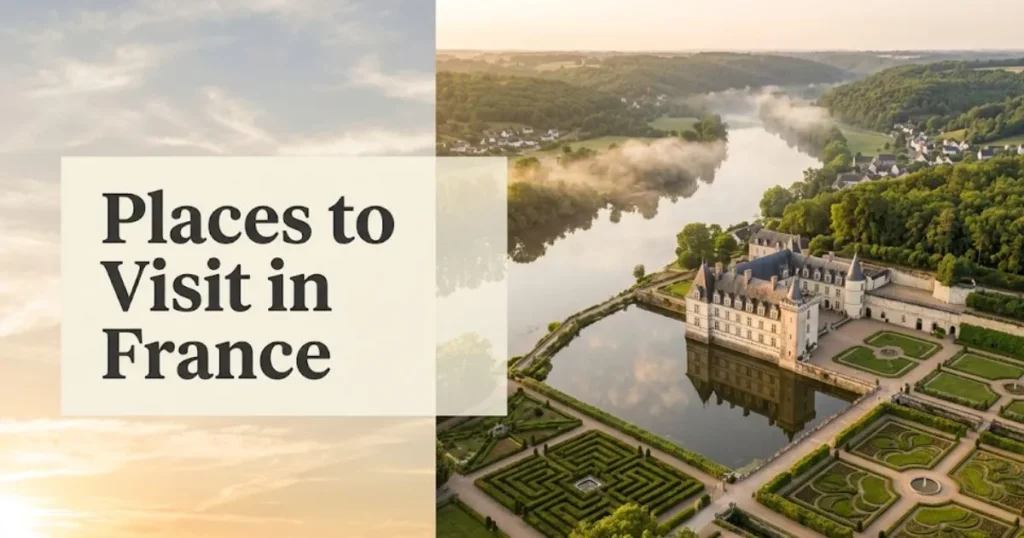
The Loire Valley is France’s most concentrated collection of Renaissance châteaux. It holds UNESCO World Heritage Site designation covering 280 kilometers of river valley between Chalonnes and Sully-sur-Loire.
Château de Chambord is the region’s architectural centerpiece. Its double-helix staircase, attributed in part to Leonardo da Vinci’s influence, is one of the most extraordinary interior architectural features in France. Admission runs approximately 14 to 17 euros per adult as of recent years. Verify current pricing before visiting.
Château de Chenonceau, spanning the Cher River on a series of arches, is the most photographed château in France after Versailles. It is significantly more intimate than Chambord. The garden is genuinely worth two to three hours of unhurried exploration.
The local alternative to Versailles-style crowds: Château de Chaumont-sur-Loire hosts a garden festival each summer with contemporary art installations throughout its grounds. It draws a fraction of Chambord’s visitor numbers but offers an equally rich experience.
Best Loire Valley towns beyond the châteaux:
- Amboise: 15th-century royal town with the Clos Lucé, Leonardo da Vinci’s final home. Admission approximately 17 to 20 euros per adult. Verify before visiting.
- Chinon: Medieval hilltop fortress overlooking the Vienne River. Wine caves built into the tufa rock face offer free or low-cost wine tastings from the Chinon appellation.
- Tours: Regional capital with an old city of medieval half-timbered houses on the Place Plumereau. Strong restaurant scene. Best base for exploring the western Loire Valley by bicycle.
For families with children: Loire Valley châteaux grounds give children genuine outdoor space. The flat, well-maintained towpaths along the Loire River are ideal for family cycling rentals from Loire à Vélo, France’s premier river cycling route.
Seasonal note: May and early June offer the best combination of mild temperatures and uncrowded grounds. July and August bring tour bus saturation at Chambord and Chenonceau. Arrive before 9:30 AM to beat group tours.
Normandy Coast and D-Day Historical Sites
Normandy is France’s most emotionally significant historical destination for American travelers. The D-Day landing beaches of June 6, 1944 stretch across 80 kilometers of coastline.
The American Cemetery and Memorial at Colleville-sur-Mer, overlooking Omaha Beach, is administered by the American Battle Monuments Commission. Entry is free. It contains 9,388 American graves on 172 acres of clifftop ground above the beach where the bloodiest American landings occurred.
Specific sites every history-focused visitor should include:
- Pointe du Hoc: Preserved German bunkers and bomb craters above the cliff face. One of the most striking preserved WWII landscapes in Europe. Free entry.
- Utah Beach Museum: Immersive multimedia museum at the Utah Beach landing zone. Admission approximately 7 to 9 euros per adult as of recent years.
- Overlord Museum near Colleville-sur-Mer: One of Europe’s largest private WWII collections. More operationally detailed than many official sites.
The non-history draw: Mont Saint-Michel
Mont Saint-Michel is one of France’s most iconic silhouettes. The medieval abbey sits on a tidal island connected to the mainland by a causeway. Shuttle buses run from the mainland parking area. Walking the island takes under two hours. Abbey admission runs approximately 11 to 14 euros per adult. Verify current pricing.
The honest assessment of Mont Saint-Michel: It genuinely earns its reputation visually. The interior of the abbey rewards the climb. However, the island’s commercial street is one of the most aggressively tourist-oriented retail experiences in France. Arrive before 9 AM or after 4 PM to experience it with manageable crowds.
For families: Normandy’s wide beaches and open clifftop landscapes give children room to move. The D-Day history is more appropriate for children over ten. Younger children are better served by the beach town of Honfleur, a 17th-century port with working harbor that genuinely captures the imagination of young travelers.
Seasonal note: May through September is optimal. The Normandy coastline is fully exposed and cold from October through March. Summer weekends see significant French domestic tourism. Book accommodation in Bayeux or Caen rather than directly on the beach to reduce costs by roughly 30%.
Alsace Wine Route and Medieval Villages
Alsace is France’s most German-influenced region and produces some of the country’s finest white wines. The Route des Vins d’Alsace covers 170 kilometers from Marlenheim south to Thann along the foothills of the Vosges mountains.
Colmar is the most visually concentrated Alsatian town. Its Petite Venise district, a network of canals lined with half-timbered houses painted in terracotta, rose, and ochre, is one of the most photographed streetscapes in France. It earns the photographs. Morning light before 8 AM transforms the canal reflection into something genuinely extraordinary.
Strasbourg, Alsace’s capital, holds its own as a major destination. The Strasbourg Grande Île is a UNESCO World Heritage Site. The Cathédrale Notre-Dame de Strasbourg, with its single Gothic spire, is one of the tallest medieval buildings in the world.
Best wine villages along the Route des Vins d’Alsace:
- Riquewihr: Arguably the best-preserved medieval wine village in France. Almost entirely pedestrianized. Dozens of caves offering Riesling and Gewurztraminer tastings.
- Ribeauvillé: Three ruined hilltop châteaux visible from the village square. Less tourist-dense than Riquewihr on weekdays.
- Eguisheim: Circular medieval village with concentrically arranged half-timbered houses around an 8th-century castle courtyard. Smaller and quieter than Colmar.
For wine lovers: Alsace produces Riesling, Pinot Gris, Gewurztraminer, Pinot Noir, and Muscat. Most domaines (wine estates) along the route offer free or low-cost tastings without prior reservations. This is fundamentally different from Bordeaux and Burgundy, where estate visits often require advance booking.
The December advantage: Alsace hosts the oldest Christmas markets in France. Strasbourg’s Christkindelsmärik dates to 1570. Colmar’s Christmas market is smaller but more intimate. If you visit in December, book accommodation at least 6 to 8 weeks in advance. Demand exceeds availability significantly.
For accessibility travelers: Colmar’s old town involves uneven cobblestones throughout. The canal district is the most challenging area for mobility aids. Strasbourg’s Grande Île, by contrast, has more level streets and better wheelchair-accessible routes.
Key Takeaway: Alsace in December is one of France’s most specific and genuinely rewarding seasonal experiences. Colmar’s Christmas market is smaller and more intimate than Strasbourg’s, which draws enormous crowds on weekends.
Lyon and Burgundy: France’s Culinary and Wine Heartland
Lyon is the most underrated major city in France for American travelers. UNESCO designates Lyon a Creative City of Gastronomy, one of only a handful of cities with that designation globally.
Vieux Lyon, the city’s Renaissance old quarter on the west bank of the Saône River, is a UNESCO World Heritage District. Its traboules — narrow covered passageways connecting buildings through interior courtyards — are the city’s most specific local discovery. Many are unmarked. Finding them requires local knowledge or a guided walking tour booked through the Lyon City Card program.
Where to eat in Lyon like a local:
- Bouchon lyonnais restaurants serve traditional Lyonnaise cuisine: quenelles, salade lyonnaise, andouillette, and tarte aux pralines. The best bouchons are found on the streets of the Croix-Rousse neighborhood and around Place Carnot.
- Daniel et Denise Saint-Jean in Vieux Lyon is widely regarded by local food professionals as one of the finest traditional bouchons in the city. Budget approximately 30 to 50 euros per person for a full meal with wine.
- Les Halles de Lyon Paul Bocuse is the city’s indoor market, named for Lyon’s most famous chef. Over 50 vendors sell cheese, charcuterie, wine, and prepared foods. It is open Tuesday through Sunday, with Saturday morning being the peak market experience. Verify hours before visiting.
Burgundy add-on from Lyon:
Beaune, 40 minutes north of Lyon by TGV, is the wine capital of Burgundy. The Hospices de Beaune, a 15th-century Gothic hospital, is the town’s architectural centerpiece and hosts one of the world’s most famous wine auctions each November. The surrounding Côte de Nuits and Côte de Beaune appellations include some of the most expensive wine-producing land on earth: Domaine de la Romanée-Conti sits along a quiet road between Vosne-Romanée and Nuits-Saint-Georges.
For budget travelers: Lyon’s public transit system, TCL (Transports en Commun Lyonnais), covers the city comprehensively. A 48-hour pass costs approximately 5 to 6 euros. Several of Lyon’s best bouchons offer a three-course menu du jour at lunch for approximately 20 to 25 euros, far below dinner prices.
For solo travelers: Lyon’s food market culture makes it an exceptional solo destination. Eating at a market counter at Les Halles on a Saturday morning is one of the most genuinely social French travel experiences available without organized group tours.
Provence: Lavender Fields, Hill Towns, and the Gorges du Verdon
Provence’s most specific draw for international visitors is the lavender plateau. The Valensole Plateau between Riez and Valensole village produces some of the densest lavender coverage in France. Peak bloom typically runs from late June through late July, varying by altitude and weather in any given year.
What most visitors get wrong about Provence lavender: The photographs showing deserted lavender rows in brilliant light were almost certainly taken at dawn, on a weekday, in early July. Arriving at the Valensole Plateau at 10 AM on a Saturday in mid-July means sharing it with several hundred other visitors and significant parking difficulty.
Arrive before 7:30 AM or after 6 PM for usable light and manageable crowd levels.
Specific hill towns with distinct identities:
- Les Baux-de-Provence: Ruined citadel perched above white limestone cliffs. The views into the Alpilles mountains are specific and genuinely extraordinary. The village commercial street below is tourist-saturated but brief. Visit the castle ruins above it. Admission approximately 10 to 14 euros per adult.
- Gordes: The most photographed Provençal hill town. The view from the D15 road approach is legitimately spectacular. The interior of the village, however, is entirely given over to luxury boutiques and restaurants. Better to photograph it from outside and spend your time in Roussillon, the ochre-pigment village 12 kilometers east.
- Roussillon: Built into and from bright orange, red, and ochre-colored clay rock. The village and surrounding Sentier des Ocres (Ochre Trail) offer the most unique natural color landscape in Provence.
The Gorges du Verdon:
The Gorges du Verdon, nicknamed the “Grand Canyon of Europe,” cuts through limestone cliffs up to 700 meters deep. The Lac de Sainte-Croix at its western end is the region’s most spectacular swimming location, with turquoise glacial water in a natural mountain setting.
Practical warning: The Gorges du Verdon is accessible only by car. In July and August, the D952 and D23 roads along the rim experience significant traffic. Parking at the major viewpoints fills by 8 AM on summer weekends. Bold warning: Drowning risk in the Gorges itself is real. Follow posted swimming restrictions.
For couples: Provence is France’s most consistently romantic regional experience, specifically in May, June, and September when crowds are manageable and temperatures are in the 20s Celsius.
French Riviera: Nice, Antibes, and Èze
The French Riviera, or Côte d’Azur, is France’s most expensive destination outside Paris. Nice is the best base.
Nice’s Vieux-Nice (Old Town) is the neighborhood most visitors miss while walking the Promenade des Anglais seafront. The old town’s market square, Cours Saleya, hosts a flower and produce market every morning except Monday. This is where Nice’s actual culinary identity lives: socca (chickpea flour pancake), pissaladière (onion and anchovy flatbread), and pan bagnat (the local tuna sandwich).
The honest assessment of the French Riviera: In July and August, the beach in Nice is almost unusable for anyone who does not enjoy being packed within inches of strangers on a narrow strip of smooth stones. The sea is beautiful. The beach experience is not. May, June, and September are when the Riviera is genuinely worth visiting at this price point.
Specific Riviera destinations beyond Nice:
- Antibes and Juan-les-Pins: Antibes has a genuinely preserved medieval old town and the Musée Picasso, housed in the Château Grimaldi where Picasso worked in 1946. Admission approximately 7 to 9 euros per adult. Far less crowded than Nice’s main waterfront.
- Èze: The most dramatically positioned village on the Riviera, perched at 427 meters above sea level between Nice and Monaco. The Jardin Exotique d’Èze cactus garden at the village summit looks directly down onto the Mediterranean. Admission approximately 6 to 8 euros per adult.
- The local alternative to Monaco: Most visitors default to Monaco for the glamour. Menton, 10 kilometers east of Monaco on the Italian border, has pastel-colored harbor architecture, a famous lemon festival each February, and a fraction of Monaco’s visitor numbers. It is also significantly more affordable.
For budget travelers: The French Riviera is genuinely difficult to do affordably in July and August. Budget travelers should either visit in May or September, or redirect entirely to the Calanques National Park near Marseille, which offers comparable Mediterranean scenery with a fraction of the Riviera’s costs.
Key Takeaway: The French Riviera in May or September delivers everything July promises without the crowds, the premium accommodation rates, or the beach-sharing experience that makes August genuinely uncomfortable.
Bordeaux, Sarlat, and the Dordogne Valley
Bordeaux is France’s wine capital and one of its most architecturally cohesive cities. The entire historic city center holds UNESCO World Heritage Site designation as an 18th-century urban ensemble.
The Bordeaux wine experience requires specific logistics:
Most of the great châteaux of the Médoc, Saint-Émilion, and Pomerol appellations require advance reservations for visits. Showing up at Château Margaux or Pétrus without an appointment accomplishes nothing. Book estate visits 4 to 6 weeks in advance through the Bordeaux Tourism Office or the estates directly.
The local alternative to formal château visits: Saint-Émilion village itself is a medieval UNESCO Wine Landscape town where the wine estates surround the village and tastings at local négociants (wine merchants) on the Rue Guadet require no appointment. The Catacombs of Saint-Émilion and the Monolithic Church, carved entirely from limestone beneath the town, are genuinely unique. Guided tours of the underground sites cost approximately 7 to 11 euros per person.
The Dordogne Valley, 1.5 to 2 hours east of Bordeaux by car:
Sarlat-la-Canéda is the best-preserved medieval town in southwest France. Its Saturday market fills the old city streets with local producers selling foie gras, truffles, walnuts, and cèpes (porcini mushrooms). The town itself requires only a half-day but rewards an overnight stay to experience the evening atmosphere without day-trippers.
Lascaux IV, the high-quality replica of the original Lascaux cave near Montignac, provides the most complete accessible experience of 17,000-year-old Paleolithic cave art in Europe. The original caves are permanently closed to preserve the paintings. The replica is exceptionally well executed. Admission approximately 13 to 20 euros per adult. Book in advance during summer.
For families with children: The Dordogne is one of France’s best family destinations. Canoe rental on the Dordogne River between Beynac and La Roque-Gageac takes children past riverside châteaux without requiring any hiking. Rental costs approximately 15 to 25 euros per canoe.
Seasonal note: The Dordogne in May and June has near-perfect weather. July and August bring significant French domestic tourism. The vendange (grape harvest) season in Bordeaux runs typically from mid-September to mid-October and is one of the best times to visit wine estates.
Brittany’s Coastal Towns and Prehistoric Sites
Brittany is France’s most Celtic region, with its own language, cuisine, and cultural identity distinctly separate from the rest of the country.
Saint-Malo is Brittany’s most dramatic coastal town. The Intra-Muros (walled city), entirely rebuilt after WWII bombing, sits on a peninsula with the sea visible from its ramparts on three sides. Walking the full circuit of the city walls takes approximately one hour and is free. The view from the ramparts at high tide is one of the finest coastal perspectives in northern France.
The prehistoric draw: Carnac
The Carnac megalithic alignments in the Morbihan department are one of the largest prehistoric stone monument complexes in the world, with over 3,000 standing stones arranged in parallel rows across three main fields. They predate Stonehenge. Most of the fields are now fenced to protect them from erosion, but viewing from designated access points is free. Guided walking access to the enclosed fields requires booking through the Carnac Maison des Mégalithes.
Brittany’s culinary identity:
Brittany’s most specific food contribution to French cuisine is the galette: a buckwheat flour savory crêpe filled with cheese, ham, eggs, or local seafood. The best galettes in the region are found in Cancale (the oyster capital) and Rennes (the regional capital). A full galette lunch with a bowl of cidre bouché (sparkling Breton cider) costs approximately 12 to 18 euros.
For families with children: Brittany in July and August is one of France’s premier family beach destinations for French families. The Côtes-d’Armor and Finistère coastlines have some of the best child-appropriate beaches in the country. Perros-Guirec and the Pink Granite Coast (Côte de Granit Rose) near Tréguier are among France’s most visually unique coastal landscapes.
For budget travelers: Brittany is consistently the most affordable coastal region in France. Accommodation costs roughly 40 to 60% less than comparable Riviera options in summer. Restaurants serving the menu du jour at lunch keep food costs manageable.
Accessibility note: Saint-Malo’s rampart walk involves uneven stone surfaces. The interior streets of the walled city are more accessible. Vannes, another Breton walled city in the Morbihan, has a flatter town center and is more accessible for mobility aid users.
Key Takeaway: Brittany offers France’s best coastal experience for families and budget travelers in summer. Saint-Malo’s walled city and Carnac’s prehistoric stones together make a genuinely compelling circuit with almost no competition from other visitors outside French school holiday weeks.
Annecy and the French Alps
Annecy is consistently cited among the most beautiful lake towns in Europe, and the label is earned. The Old Town of Annecy sits at the point where the Thiou River drains Lake Annecy, creating a canal network of flower-lined bridges and pastel-painted facades.
What makes Annecy different from other Alpine towns: It functions year-round rather than purely as a ski or summer resort. The Saturday market on the canal between the Palais de l’Île and the Hôtel de Ville is one of France’s finest regional markets. The Palais de l’Île, a 12th-century island prison in the middle of the Thiou River, is Annecy’s most photographed landmark. Admission approximately 3 to 5 euros per adult.
Lake Annecy itself is among the cleanest large lakes in Europe. Swimming is possible from several free public beaches on the eastern shore. The Plage d’Albigny on the northern shore and Plage Impérial near the Hôtel Impérial are the main public access points.
Chamonix and the Mont Blanc circuit:
Chamonix-Mont-Blanc, 40 minutes north of Annecy by car or 90 minutes by combination of train and bus, is France’s premier alpine destination. The Aiguille du Midi cable car ascends to 3,842 meters. On clear days, the view covers Mont Blanc, the Matterhorn, and the surrounding glaciers simultaneously.
Cable car tickets for the Aiguille du Midi run approximately 55 to 75 euros per adult for the full ascent as of recent years. Verify current pricing. Book in advance: In July and August, tickets sell out days ahead online.
For couples: Annecy offers the most romantic Alpine experience in France without the logistical complexity of a full ski resort. A cycle or walk around the lake on the dedicated path takes approximately three to four hours.
For seniors and accessibility travelers: The lakeside promenade and canal district of Annecy are largely flat and well-maintained. The Aiguille du Midi cable car is accessible by gondola without hiking. Note that altitude adjustment may affect some travelers above 3,000 meters.
Seasonal note: June through September for lake swimming and hiking. December through March for skiing at Le Grand Bornand (smaller, more local) or the connected Portes du Soleil resort area. Annecy itself is accessible year-round.
Basque Country: Biarritz and Saint-Jean-Pied-de-Port
French Basque Country, in the southwest corner of France bordering Spain, has a cultural identity so distinct from mainstream France that many visitors feel they have entered a separate country. The local Euskara language appears on street signs alongside French.
Biarritz is France’s surf capital. The Grande Plage in the center of town is the main beach. The Côte des Basques beach, a 10-minute walk south, is where surfing in Europe effectively began in the 1950s when American director Peter Viertel introduced the sport. Surf schools operate along the Côte des Basques from May through October. Lessons run approximately 30 to 50 euros per two-hour session.
Basque cuisine is France’s most specific regional food identity:
- Pintxos (Basque tapas) served at bars throughout Saint-Jean-de-Luz and Biarritz represent a completely different food culture from French restaurants
- Axoa d’Espelette: veal stew with the region’s signature piment d’Espelette pepper, grown exclusively in the village of Espelette 20 kilometers inland
- Gâteau Basque: the region’s dense almond or cherry pastry, available at every boulangerie
Saint-Jean-Pied-de-Port is the traditional starting point of the Camino de Santiago’s French route across the Pyrenees to Spain. Even for non-hikers, the medieval citadel and the old city’s position at the foot of the Pyrenees make it one of the most atmospheric small towns in southwest France.
For couples: The Basque Country in May through June and September through October offers the best combination of weather, surfable waves, uncrowded beaches, and active restaurant culture without August’s domestic crowd surge.
For solo travelers: Biarritz has a strong surf community culture. Independent travelers integrate easily into the surf school social scene without group tours. Solo dining is entirely comfortable in pintxos bar culture.
Best Time to Visit France by Region
The best time to visit France overall is May through mid-June or September through mid-October, when weather across most regions is favorable and crowd levels at major sites are significantly lower than summer peaks.
Region-specific seasonal guidance:
| Region | Best Months | Avoid | Reason |
|---|---|---|---|
| Paris area | Apr–June, Sept–Oct | Aug | Locals leave; tourist density peaks |
| Loire Valley | May–June, Sept | July–Aug | Tour bus saturation at major châteaux |
| Normandy | May–Sept | Nov–Mar | Cold, limited services, rough coastline |
| Alsace | June–Oct, Dec | Jan–Feb | Christmas markets in Dec; winter closures in Jan–Feb |
| Lyon/Burgundy | May, Sept–Oct | Aug | Vendange season adds harvest interest in Sept |
| Provence | June, Sept | July–Aug | Peak tourist density; extreme heat; Gorges du Verdon parking gridlock |
| French Riviera | May–June, Sept | July–Aug | Beach crowds unbearable; premium accommodation costs peak |
| Bordeaux/Dordogne | May–June, Sept–Oct | Aug | Harvest season in Sept is the optimal wine visit window |
| Brittany | June–Aug | Oct–Apr | Main beach season; family-friendly in summer |
| Annecy/Alps | June–Sept, Dec–Mar | Apr–May (off-season) | Between ski and summer seasons; limited activity access |
| Basque Country | May–Oct | Aug | August domestic French tourism at peak |
Lavender season specifics: Peak bloom in the Valensole Plateau typically falls between late June and late July. Exact peak dates vary by 10 to 14 days annually depending on winter rainfall and spring temperatures. Check Atout France’s seasonal bloom reports as your visit approaches.
For budget travelers: The most effective cost reduction strategy in France is visiting in September and October. Hotel rates drop by 20 to 40% from peak summer in most regions. Restaurant demand decreases. TGV ticket prices are more accessible on advance booking.
Key Takeaway: September is France’s best-kept timing secret. Lavender is done, harvest is beginning in wine regions, temperatures are 18 to 24 Celsius across most of the country, and accommodation rates drop significantly from August peaks.
How to Get Around France by Train
France’s TGV (Train à Grande Vitesse) high-speed rail network connects Paris to every major regional city and is consistently the most efficient and affordable inter-city transport option for travelers covering multiple French regions.
Core TGV journey times from Paris:
- Paris to Lyon: approximately 2 hours
- Paris to Bordeaux: approximately 2 hours
- Paris to Marseille: approximately 3 hours 15 minutes
- Paris to Strasbourg: approximately 1 hour 45 minutes
- Paris to Rennes (Brittany): approximately 1 hour 25 minutes
- Paris to Nice: approximately 5 hours 30 minutes
Book through SNCF Connect (the official SNCF booking platform). The earliest prices on TGV trains are released approximately 90 days in advance. Booking 4 to 6 weeks ahead typically secures prices 40 to 60% lower than booking within a week of travel.
The Eurail France Pass reality: A France rail pass is cost-effective for travelers making five or more long-distance journeys in a short period. For travelers making fewer journeys, individual advance-purchase tickets on SNCF Connect are almost always cheaper. Verify pass costs against your specific itinerary before purchasing.
Rental car guidance by region:
- Necessary for: Gorges du Verdon, Dordogne Valley, Route des Vins d’Alsace between smaller villages, Carnac and rural Brittany, Basque Country’s inland villages
- Not necessary in: Paris, Lyon, Bordeaux city, Nice, Strasbourg
- International Driver’s Permit: Recommended for US license holders renting in France. Obtain through AAA (American Automobile Association) before departure.
Practical warning: Driving in Paris is unnecessary, expensive, and logistically punishing. Park at a suburban station on arrival and use the Métro (Paris Metro) and RER (Regional Express Network) exclusively within the city.
France Travel Tips for First-Time American Visitors
Americans visiting France for the first time face several practical realities that standard travel content does not address with sufficient specificity.
ETIAS (European Travel Information and Authorization System):
As of 2026, Americans planning to visit France require an ETIAS authorization before boarding flights to any Schengen Area country. ETIAS is not a visa. It is an online pre-travel screening authorization valid for multiple entries over three years. The application costs approximately 7 euros. Processing is typically under 24 hours but can take up to 30 days in edge cases. Apply at least 2 weeks before departure. Verify current ETIAS requirements on the official EU ETIAS website and the US Embassy in France before booking.
Language reality: French people in major tourist cities are significantly more English-comfortable than the cultural stereotype suggests. In rural areas, particularly the Dordogne, inland Brittany, and the Massif Central, English is less prevalent. Learning five to ten basic French phrases is practical courtesy, not optional politeness.
Payment and tipping:
- Credit cards are widely accepted in cities. Rural markets and smaller restaurants often require cash.
- Tipping is not expected in France the way it is in the US. Rounding up or leaving 5 to 10% at sit-down restaurants is generous by local standards.
- Bold practical warning: Carry 20 to 40 euros in cash at all times for rural markets, toll roads, and parking meters.
Pharmacy culture: French pharmacies (identified by the green cross sign) function as a front-line healthcare resource. For minor medical issues, a French pharmacist provides professional guidance without an appointment and at no consultation cost. This is the fastest resource for travelers with minor ailments.
Pickpocket risk: High around the Eiffel Tower, on the RER B line between CDG airport and central Paris, in Montmartre, and around major Paris Metro interchanges. Use a crossbody bag. Keep phones in front pockets. Do not display expensive camera equipment in crowded areas without awareness.
For senior and accessibility travelers: France’s historic city centers involve significant cobblestone surfaces that challenge wheeled mobility aids. Bordeaux’s city center, Lyon’s Presqu’île, and Nice’s Promenade des Anglais are the most accessible flat-surface historic areas. The SNCF offers a dedicated assistance service called Accès Plus for travelers with reduced mobility, bookable through SNCF Connect.
Safety and Practical Warnings for France Travel
France is a safe country for travelers by European standards. Specific risk areas and practical warnings require awareness before departure.
Key safety and practical facts every visitor should know:
- Pickpocket risk is high in central Paris, particularly around the Eiffel Tower, Champs-Élysées, Sacré-Coeur in Montmartre, and on the RER B line. Treat these areas the way you would treat Times Square in New York: be aware of your surroundings and secure your belongings actively.
- Extreme heat risk in Provence, the Dordogne, and the French Riviera during July and August. Temperatures regularly exceed 38°C. Seniors and young children are at higher risk. Carry water, schedule outdoor activities before 11 AM, and identify air-conditioned spaces at each destination.
- Drowning risk in the Gorges du Verdon and along the Atlantic coast of Brittany and Basque Country. Follow posted swimming restrictions in the Gorges. Check surf conditions and rip current flags at Biarritz beaches before entering the water.
- Driving risk on the D952 and D23 roads along the Gorges du Verdon rim. The roads are narrow and precipitous. Drive cautiously and avoid them in heavy traffic conditions.
- Limited cell service in rural areas of the Massif Central, inland Brittany, and the upper Pyrenees. Download offline maps via Google Maps or Maps.me before entering remote areas.
- Medical infrastructure: Major French cities have university hospitals with English-speaking staff. Rural areas have significantly more limited emergency medical infrastructure. Travel insurance with medical evacuation coverage is recommended for travelers with significant health conditions.
- ETIAS compliance: Attempting to board a Schengen-bound flight without a valid ETIAS authorization will result in boarding denial. Do not delay this application.
The US Embassy in Paris can be reached at their emergency citizen services line for Americans experiencing serious difficulty. The number is available on the official US Embassy website. Save it before departure.
Frequently Asked Questions About Places to Visit in France
What are the best places to visit in France for first-time visitors?
The best places to visit in France for first-time visitors are the Loire Valley, Lyon, and Normandy, combined with a two-night Paris stay.
These three regions together deliver the full range of French culture: Renaissance architecture, world-class cuisine, and profound historical significance.
All three are accessible from Paris by TGV in under two hours, making them practical additions to any first France itinerary without requiring a domestic flight.
What places in France outside of Paris are worth visiting?
The places in France outside of Paris most worth visiting include Lyon, Bordeaux, Nice, Strasbourg, Annecy, and Colmar.
Each delivers a fundamentally different French experience: Lyon for gastronomy, Bordeaux for wine, Nice for Mediterranean coast, Strasbourg and Colmar for Alsatian culture, and Annecy for Alpine scenery.
Choosing among them depends on your travel priorities: every one of these cities outperforms Paris in at least one specific category while costing significantly less.
What is the best region in France to visit in 2026?
The best region in France to visit in 2026 depends on your interests, but Provence in June or September offers the broadest combination of scenery, food culture, wine, and historic towns.
The Loire Valley is the best single-region option for first-time visitors who want to combine architecture, history, outdoor activity, and accessible logistics from Paris.
Alsace in December is the strongest case for a seasonal-specific trip, with Christmas markets that genuinely justify the journey.
How many days do you need to visit France properly?
A minimum of 10 days allows meaningful exploration of one French regional circuit beyond Paris.
Fourteen days is the realistic target for covering two circuits, such as northern France (Loire Valley, Normandy, Alsace) and a southern base in Lyon or Provence.
Attempting to cover all of France in 7 days results in a train-heavy schedule where the actual destinations receive 4 to 6 hours each, which is insufficient for any of them.
What is the cheapest region in France to travel through?
Brittany and the Dordogne Valley are consistently the most affordable regions in France for accommodation, food, and activities.
Both regions have strong local cuisine traditions that keep restaurant prices reasonable, free or low-cost outdoor attractions, and accommodation costs 40 to 60% below French Riviera or Paris equivalents.
Lyon is the most affordable large French city, with a world-class food scene accessible at reasonable prices through its lunch-menu culture at traditional bouchon restaurants.
When is the worst time to visit France?
The worst time to visit France’s most popular destinations is July and August.
Provence, the French Riviera, Normandy, and the Loire Valley reach their peak tourist density during these months. Accommodation prices peak, parking at major sites can be impossible by mid-morning, and the quality of the experience at famous sites drops significantly.
The exception is Brittany, where July and August represent the main beach season and are actively the best time to visit for coastal activities.
Planning Your France Trip: Final Guidance
France genuinely rewards travelers who commit to a region and stay in it long enough to discover what is not on any tourism board list. Book your train tickets through SNCF Connect at least 4 to 6 weeks in advance for the best TGV fares.
Apply for ETIAS authorization well before your departure date. Verify the current application status and requirements on the official EU ETIAS website, as processing timelines and system availability can change. Check all attraction admission hours and prices directly with official venues before you leave, since this article reflects general guidance current to 2026 and specific details change.
The traveler who arrives in France having chosen a circuit, pre-booked their trains, and identified three specific named places per destination will have a fundamentally better experience than the traveler who arrives with a map of highlights and no plan. France will reward the preparation.