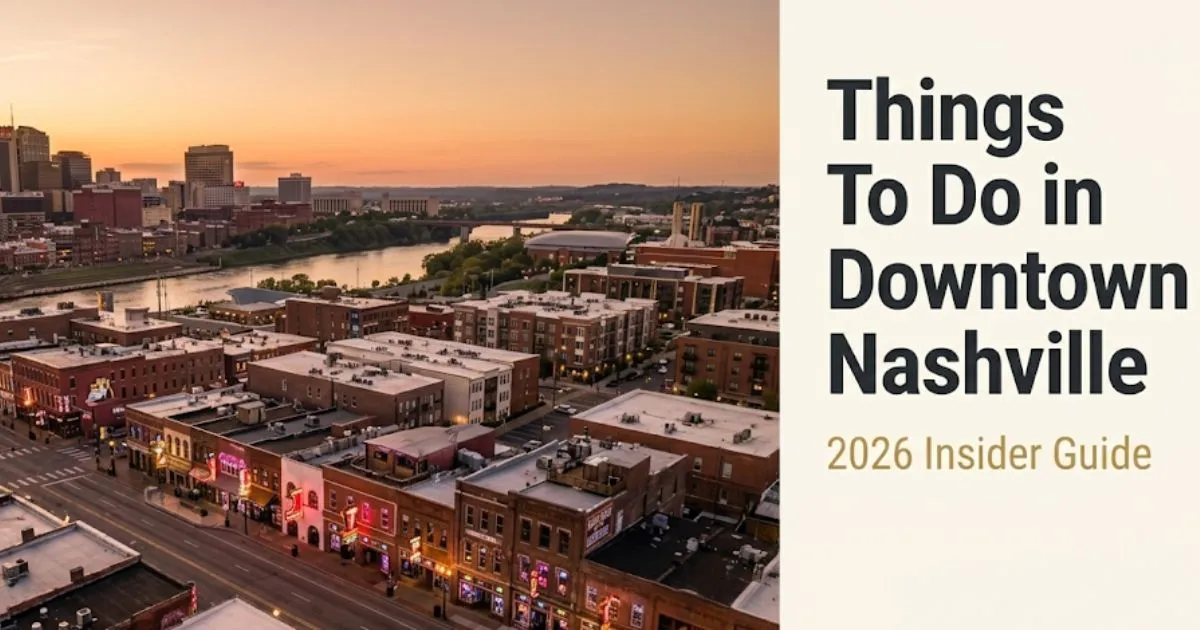
Best Things To Do in Downtown Nashville (2026 Guide)

Downtown Nashville rewards visitors who look past the Broadway tourist strip. The city’s things to do in downtown Nashville span world-class live music history, genuine Southern culinary traditions, and walkable neighborhoods with distinct personalities.
The Nashville Convention and Visitors Corp reports that Music City hosts more than 15 million visitors annually. A meaningful share of them never leave Lower Broadway, which means the rest of downtown is, by default, far less crowded.
This guide covers 2026’s best activities by neighborhood, traveler profile, and time of day. You will find honest assessments of what earns its reputation, what does not, and what experienced visitors choose instead.
Things to Do in Downtown Nashville: What the City Actually Delivers
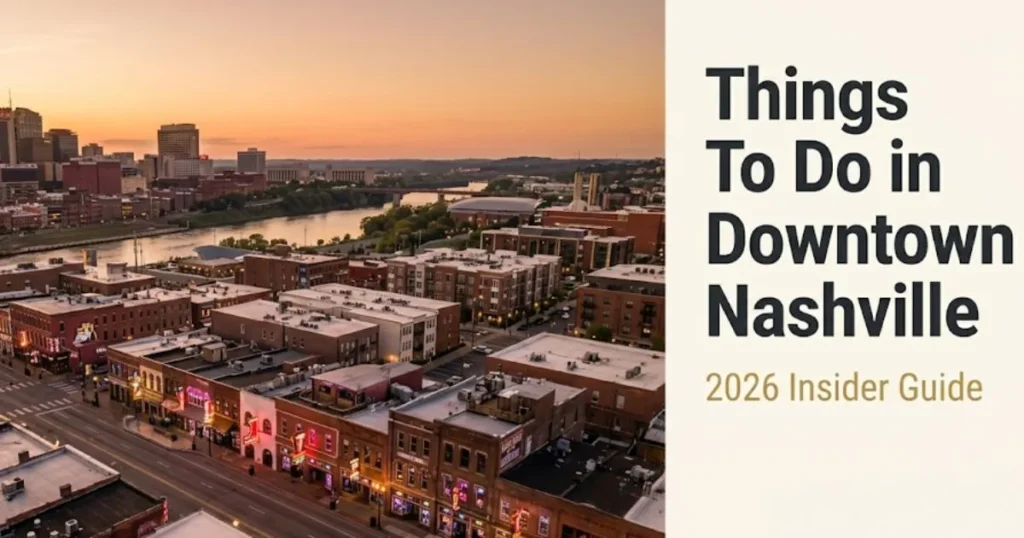
Downtown Nashville in 2026 is one of America’s most distinctive urban entertainment districts, built around live music, Southern food culture, and walkable neighborhood variety.
Lower Broadway is the postcard. The honky-tonk bars run from 1st Avenue to roughly 5th Avenue South, stacked with live country music from midmorning until 3 a.m. daily.
But Broadway is one layer of a city with genuine depth. The Gulch offers contemporary dining and boutique retail. SoBro (South of Broadway) holds the major cultural institutions. Germantown, north of downtown, delivers a quieter, local-facing restaurant scene.
The Cumberland River defines downtown’s eastern edge. The John Seigenthaler Pedestrian Bridge crosses it to East Nashville, a neighborhood worth a half-day on any visit.
Downtown is compact enough to walk most of it. The core Broadway-to-Gulch-to-Riverfront triangle covers roughly two miles at its widest.
Honest assessment: Downtown Nashville is genuinely excellent for music fans, culinary travelers, and those who enjoy a high-energy urban environment. It is a poor fit for travelers seeking quiet or nature-focused experiences.
Best Things to Do in Downtown Nashville
The best things to do in downtown Nashville in 2026 span six distinct categories, each suited to different traveler profiles and time budgets.
| Activity | Best For | Cost Range | Time to Allow | Insider Note |
|---|---|---|---|---|
| Lower Broadway honky-tonks | Music fans, groups | Free entry, drinks extra | 2 to 4 hours | Weeknights beat Saturday crowds significantly |
| Ryman Auditorium tour or show | Music history lovers | $25 to $30 (tour); $40 to $150+ (show) | 1.5 to 3 hours | Book touring shows 2 to 3 months ahead |
| Country Music Hall of Fame | First-timers, families | $25 to $30 per adult | 2 to 3 hours | Morning arrivals avoid afternoon school groups |
| Tennessee State Museum | History fans, budget travelers | Free | 1.5 to 2 hours | Consistently undervisited; zero crowds most days |
| Frist Art Museum | Couples, arts travelers | $15 to $20 per adult | 1.5 to 2 hours | One of the South’s finest mid-size art museums |
| John Seigenthaler Pedestrian Bridge | All profiles | Free | 30 minutes | Best downtown skyline view at golden hour |
| Hattie B’s Hot Chicken | Culinary travelers | $10 to $18 per person | 45 minutes to 1 hour | Expect a line; weekday lunch is fastest |
| Station Inn (live music) | Serious music listeners | $10 to $20 cover | 2 to 3 hours | Bluegrass royalty plays here; locals outnumber tourists |
Solo travelers will find Broadway manageable and social on weeknights. Weekend nights pack the sidewalks so densely that solo navigation becomes genuinely uncomfortable.
Couples should prioritize the Frist Art Museum, a Ryman show, and a Gulch dinner for a genuinely memorable Nashville weekend without the Saturday Broadway chaos.
Downtown Nashville Neighborhoods Guide
Downtown Nashville is not one neighborhood. It is four distinct zones within walking distance of each other, each with a different character and traveler appeal.
Lower Broadway and SoBro form the tourist core. Broadway holds the honky-tonks, neon, and bachelorette groups. SoBro holds the Country Music Hall of Fame, Bridgestone Arena, and the Music City Center convention complex.
The Gulch sits southwest of Broadway, roughly centered on Pine Street and 11th Avenue South. It draws a local dining and boutique hotel crowd. Adele’s Nashville and The Southern Steak and Oyster anchor its restaurant scene.
Germantown sits north of downtown, clustered around Monroe Street and 5th Avenue North. It is Nashville’s most European-feeling neighborhood: walkable, independent restaurant-heavy, and almost entirely local in its clientele.
Printer’s Alley, between 3rd and 4th Avenues downtown, is a surviving stretch of Nashville’s mid-century entertainment district. It is smaller and quieter than Broadway but genuine in its historic identity.
Families with children will find Germantown and the waterfront areas far more manageable than Lower Broadway, especially in the evenings when Broadway’s alcohol culture fully surfaces.
Seniors and accessibility travelers should note that The Gulch has uneven sidewalk terrain in sections. Germantown’s streets are flatter and more accessible for mobility aid users.
Things to Do in Downtown Nashville During the Day
Daytime is genuinely the best time to experience most of downtown Nashville’s non-music attractions, before Broadway crowds build and summer heat peaks.
The Tennessee State Museum on Rosa L. Parks Boulevard is the strongest daytime call. It covers Tennessee’s full history from prehistoric cultures through the 20th century with genuine curatorial depth. Entry is free.
The Bicentennial Capitol Mall State Park, directly adjacent to the Tennessee State Capitol building, is a civic green space with a detailed history walk embedded into its design. It is uncrowded even on peak tourist weekends.
| Daytime Activity | Hours Context | Cost | Walk Time from Broadway |
|---|---|---|---|
| Tennessee State Museum | Typically Tue to Sun | Free | 12 minutes |
| Bicentennial Capitol Mall | Open daily, dawn to dusk | Free | 14 minutes |
| Country Music Hall of Fame | Typically daily | $25 to $30 per adult | 3 minutes |
| Frist Art Museum | Typically Tue to Sun | $15 to $20 per adult | 8 minutes |
| John Seigenthaler Pedestrian Bridge | Open 24 hours | Free | 10 minutes |
| Riverfront Park | Open daily, dawn to dusk | Free | 5 minutes |
Verify current hours directly with each venue before visiting, as seasonal and holiday schedules apply.
Budget travelers should structure their daytime around the three free institutions: the Tennessee State Museum, Bicentennial Capitol Mall, and Riverfront Park. A full and genuinely satisfying Nashville day is possible without paid admission before dinner.
Insider Tip:
- The Tennessee State Museum sees peak attendance in the early afternoon. Arrive between 10 a.m. and noon for the best experience.
- The Bicentennial Capitol Mall’s granite map of Tennessee embedded in its walkway is one of the most underappreciated civic design features in the American South.
- For families with children under 10, Riverfront Park’s open green space provides genuine play time between Nashville’s more structured cultural stops.
Broadway Nashville and the Honky-Tonk Scene
Lower Broadway is the honky-tonk heart of Nashville, with live country music starting as early as 10 a.m. and running until last call, seven days a week.
The single most important thing to know: Saturday night on Broadway in summer is the most tourist-saturated experience Nashville offers, with crowd densities that make simple sidewalk navigation a challenge. Weeknight visits from Sunday through Thursday deliver the same music at a fraction of the crowd.
Robert’s Western World at 416 Broadway is the most authentic honky-tonk on the strip. It books traditional country music, sells fried bologna sandwiches, and feels genuinely different from the flashier, newer bars competing for bachelorette groups. No cover, ever.
Tootsie’s Orchid Lounge, directly behind the Ryman at 422 Broadway, has the strongest historical credibility. Willie Nelson, Kris Kristofferson, and countless others played here early in their careers. The upstairs patio offers a rare outdoor view of the Broadway scene.
Legends Corner at the corner of Broadway and 1st Avenue reliably books some of the strip’s strongest live musicians. The talent level is consistently higher than at the bars that spend more on their signage.
Solo travelers find Broadway accessible and naturally social. The open-floor-plan honky-tonks make meeting other travelers easy. Solo visitors should be aware that bar tabs on Broadway climb quickly.
What is overrated: The multi-story rooftop bars that have opened along Broadway since 2018 are optimized for Instagram, not music. Lines are long, drinks are expensive, and the music quality is secondary to the view.
Ryman Auditorium: What to Know Before You Go
The Ryman Auditorium at 116 5th Avenue North is one of America’s most historically significant music venues, and it earns that status on pure acoustics and atmosphere alone.
Built as a tabernacle in 1892, it served as the home of the Grand Ole Opry from 1943 to 1974. The Ryman is listed on the National Register of Historic Places. Walking into the original pew seating with the stained glass behind the stage is a genuinely affecting experience.
Two ways to experience the Ryman:
- Daytime self-guided tour: Runs most days when no show is scheduled. Admission runs approximately $25 to $30 per adult, less for children, with a discounted rate for backstage access. Allow 1.5 to 2 hours.
- Evening touring show: The Ryman books major country, Americana, folk, and roots artists throughout the year. Tickets range from roughly $40 to $150 and above depending on the artist. Sell-out frequency is high for top-name acts.
To book a Ryman show correctly:
- Check the Ryman’s official schedule at least 2 to 3 months before your visit for peak-season shows.
- Purchase directly from the Ryman’s box office or the official Ticketmaster listing to avoid secondary market markup.
- Note that the original pew seating has no cup holders and limited legroom. This is authentic, not a flaw.
- Arrive 30 minutes before showtime. The building fills quickly and pre-show atmosphere is part of the experience.
- Check whether the show is general admission or reserved seating before purchasing tickets.
Families with children should know the Ryman’s original pews make young children restless during long shows. The daytime self-guided tour is better suited to families than evening performances.
Local alternative: For a smaller-venue acoustic music experience without the Ryman’s ticket price and tourist volume, the Station Inn at 402 12th Avenue South in the Gulch offers bluegrass and Americana from musicians of comparable caliber at a $10 to $20 cover.
Country Music Hall of Fame Nashville
The Country Music Hall of Fame and Museum at 222 5th Avenue South is the definitive archive of American country music, and it is the one Nashville tourist attraction that consistently earns its reputation across every traveler profile.
The museum covers roughly 350,000 square feet of permanent and rotating exhibits. The permanent collection spans country music from its Appalachian folk roots through contemporary Nashville pop-country. Costumes, instruments, original recordings, and handwritten lyrics give the collection genuine material depth.
Practical logistics:
- Admission typically runs approximately $25 to $30 per adult, with reduced rates for children and seniors. Verify current pricing directly with the museum before visiting.
- Allow 2 to 3 hours minimum. Many music fans spend 4 or more hours on their first visit.
- Advance ticket purchase is recommended on weekends and during peak summer season. The museum regularly sells out on Saturday afternoons.
- The museum connects via a covered, climate-controlled walkway to the Ryman Auditorium and to Historic RCA Studio B tours (Studio B is located separately on Music Row, with shuttle transport from the museum).
According to the Nashville Convention and Visitors Corp, the Country Music Hall of Fame and Museum is consistently Nashville’s top-ranked paid attraction by visitor volume and repeat visitor rate.
Families with children will find the museum surprisingly engaging for children over age 8. Interactive elements and the sheer visual variety of the costume and instrument collection hold attention well. Younger children typically lose interest within 45 minutes of the permanent galleries.
Seasonal note: Summer (June through August) brings the highest volumes of school tour groups, which concentrate in the morning hours. Afternoon visits in summer give a slightly less crowded experience. Spring and fall visits are notably less congested.
Insider Tip:
- The museum’s rotating special exhibitions often outperform the permanent collection for repeat visitors. Check what is on before booking your visit.
- The Historic RCA Studio B add-on tour (an additional charge) is essential for serious music fans. Elvis Presley, Dolly Parton, and the Everly Brothers all recorded there.
- Budget travelers should note that a combined ticket for the Hall of Fame and Studio B tour offers better value than purchasing separately.
Key Takeaway: Nashville’s three non-negotiable stops (Ryman Auditorium, Country Music Hall of Fame, and Tennessee State Museum) span from $30 per person to completely free. Plan them for morning and early afternoon to avoid peak crowd windows.
Nashville Live Music Beyond Broadway
The best live music in Nashville in 2026 is not on Broadway. It is at a small number of dedicated listening rooms where the talent level is often higher and the experience is genuinely focused on the music.
Station Inn at 402 12th Avenue South in the Gulch is Nashville’s premier bluegrass and Americana listening room. It holds roughly 200 people, has no bad sight lines, and books musicians of national and international caliber most nights of the week. Cover runs approximately $10 to $20. Locals consistently outnumber tourists on any given Tuesday.
Bluebird Cafe at 4104 Hillsboro Pike (in the Green Hills neighborhood, about 6 miles from downtown) is worth the trip for serious music fans. The songwriter-in-the-round format means you hear writers perform songs before major artists recorded them. Tickets are required and sell out quickly. Book 3 to 4 weeks ahead for weekend shows.
Printer’s Alley downtown offers a smaller-scale, lower-key live music experience compared to Broadway. Bars like Bourbon Street Blues and Boogie Bar and The Fiddle and Steel Guitar Bar book local artists in an environment that feels genuinely less manufactured than the Broadway strip.
Basement East at 917 Woodland Street in East Nashville focuses on indie, rock, and Americana. It is primarily a local venue. Tourists rarely find it, which means it consistently delivers an authentic Nashville music experience.
Solo travelers will find Station Inn and Bluebird Cafe both welcoming for solo visits. Both have communal seating that makes conversation with fellow attendees natural and easy.
Budget note: Broadway honky-tonks are free to enter. Station Inn shows run $10 to $20. Bluebird Cafe shows require ticket purchase. Basement East show tickets vary widely by artist.
Nashville Hot Chicken and Downtown Dining
Nashville’s culinary identity is built around hot chicken, but the downtown dining scene in 2026 extends well beyond the city’s signature dish into a genuinely strong range of Southern and contemporary American cooking.
Hot chicken is not a trend in Nashville. It is a local food tradition with roots in the African American community going back decades. Prince’s Hot Chicken Shack (multiple Nashville locations, including a location on Dickerson Road that is the original operation) is the originator of the dish. The experience is a counter-service, cash-friendly, no-frills operation that delivers the most historically authentic version of the dish.
Hattie B’s Hot Chicken at 112 19th Avenue South (and a Broadway-adjacent downtown location) is the more visitor-accessible version. Quality is genuine. Lines at lunch are real. The downtown location cuts wait times somewhat compared to the midtown original.
For a broader downtown dining picture:
- The Southern Steak and Oyster at 150 3rd Avenue South in SoBro covers the gap between casual and fine dining well. Biscuits, oysters, and a thoughtful whiskey list.
- Martin’s Bar-B-Que Joint at 410 4th Avenue South is the best downtown option for Nashville-style whole-hog barbecue. The pulled pork sandwich is the order.
- Adele’s Nashville in The Gulch represents the city’s more contemporary restaurant voice. Seasonal menu, professional service, appropriate for a date-night dinner.
- Acme Feed and Seed at 101 Broadway is the Broadway bar with the best food program. The rooftop has Cumberland River views. Order the noodle bowls, not the bar food.
Budget travelers should treat Hattie B’s or Martin’s as their primary meal. Both deliver genuine quality for under $20 per person.
Couples should book Adele’s in advance for a Gulch dinner. Weekend reservations fill 7 to 10 days out.
Things to Do in Downtown Nashville at Night
Downtown Nashville at night centers on Lower Broadway, but the full nighttime picture includes distinct experiences for every traveler type and energy level.
Lower Broadway runs loudly until 3 a.m. The honky-tonks do not close. The Friday and Saturday crowd on Broadway between 9 p.m. and midnight is the city’s maximum energy moment and its maximum chaos moment simultaneously.
For a quieter nighttime alternative to Broadway, Printer’s Alley offers a genuine bar-hopping option with significantly less crowd density. The alley’s compact layout makes it easy to walk and sample multiple venues in an hour.
Bridgestone Arena at 501 Broadway hosts the Nashville Predators (NHL) and major touring concert acts. A Predators game night is one of the most genuinely fun Nashville nighttime experiences and a local favorite that tourists routinely overlook. Check the 2026 schedule ahead of your visit.
Station Inn in the Gulch runs until midnight on most show nights. A Station Inn show followed by a late whiskey at a nearby Gulch bar is the local’s preferred Nashville evening.
According to Travel + Leisure, Nashville’s nightlife ranks among the top five most energetic urban bar districts in the American South, with Broadway specifically cited for its unmatched concentration of live music per linear block.
Families with children should avoid Broadway after 8 p.m. The alcohol culture, noise levels, and crowd density make it genuinely inappropriate for young children and actively stressful for parents managing them.
Seniors and accessibility travelers should note that Broadway’s crowded sidewalks after 9 p.m. on weekends are physically demanding and present genuine mobility challenges. A Thursday or Sunday evening visit delivers a meaningfully more navigable experience.
Key Takeaway: A Predators game at Bridgestone Arena on a Friday night gives you Nashville’s nighttime energy without the Broadway weekend crowd. Book ahead and wear gold.
Free Things to Do in Downtown Nashville
Downtown Nashville offers a genuinely strong lineup of free experiences, enough to fill a full day without spending a dollar on admission.
Tennessee State Museum on Rosa L. Parks Boulevard is the strongest free attraction in downtown Nashville. The collection covers Tennessee’s full arc from pre-Columbian cultures through 20th-century civil rights history. It is free to all visitors and consistently undervisited.
Bicentennial Capitol Mall State Park on 6th Avenue North is a 19-acre civic park built to honor Tennessee’s bicentennial. A 200-foot granite map of Tennessee is embedded in the walkway. The Tennessee State Capitol is visible from multiple points within the park.
Free experiences that cost nothing:
- Walking Lower Broadway and listening to live music from the street (no purchase required to hear music through the open bar fronts)
- Crossing the John Seigenthaler Pedestrian Bridge for the best free skyline view in Nashville
- Spending time in Riverfront Park along the Cumberland River, especially at sunset
- Walking the Music Row area (near 16th and 17th Avenues South) to see the recording studios and publisher buildings that have defined the industry
- Exploring Germantown’s streetscape along Monroe Street for Nashville’s most architecturally intact 19th-century commercial district
Budget travelers can structure an entire Nashville day around these free options and spend their actual budget on two quality meals. The Tennessee State Museum plus a Broadway walking hour plus the Pedestrian Bridge at sunset is a full and satisfying day with zero admission cost.
Families with children will find the Bicentennial Capitol Mall’s open lawns and the Riverfront Park green spaces excellent for unstructured play time between more structured stops.
Family-Friendly Things to Do in Downtown Nashville
Downtown Nashville is genuinely workable for families with children, but it requires deliberate planning to route around the adult-oriented Broadway scene that dominates the evening hours.
Best family-specific daytime activities:
- Country Music Hall of Fame and Museum: Engaging for children over 8. Interactive elements and the visual spectacle of the costume collection hold younger attention spans better than most history museums.
- Tennessee State Museum: Free and genuinely educational. The prehistoric Tennessee and Civil War sections engage older children (10 and above) well.
- Riverfront Park: Open green space along the Cumberland River with a playground area and easy waterfront access. Good for resetting energy between structured stops.
- John Seigenthaler Pedestrian Bridge: A genuinely thrilling walk for children. The views down the river and back toward downtown are memorable for all ages.
- Bicentennial Capitol Mall State Park: The embedded Tennessee map and the bells-on-the-hour time capsule installation are both genuinely interesting for curious children.
What to avoid with children:
- Broadway after 8 p.m. The alcohol culture is dominant and the crowd density is genuinely stressful with children in tow.
- Multi-story Broadway rooftop bars. Not designed for children, and the wait times and noise levels make them uncomfortable for families.
- Saturday afternoon Broadway visits during summer. The crowd density at peak hour makes stroller navigation nearly impossible.
Families with infants and toddlers should concentrate their downtown time between 9 a.m. and 2 p.m., then retreat to their hotel before the afternoon Broadway crowd builds. Most downtown Nashville museums are stroller-accessible throughout, but verify elevator availability at individual venues before visiting.
Romantic Things to Do in Downtown Nashville
Downtown Nashville offers a genuinely strong romantic weekend, provided couples route away from the bachelorette-heavy Broadway corridor and into the neighborhood experiences that define the city’s character.
Best romantic Nashville experiences:
- Ryman Auditorium evening show: A seated show at the Ryman in the original pew seating, with the right artist on the bill, is one of the most atmospheric concert experiences in the American South. Book 2 to 3 months ahead for top acts.
- Adele’s Nashville dinner in The Gulch: The strongest date-night restaurant downtown. Seasonal menu, warm interior design, and a wine and cocktail program that matches the food quality. Reserve at least a week in advance.
- John Seigenthaler Pedestrian Bridge at sunset: A free, 15-minute walk that delivers the Nashville skyline at its most photogenic. Timed with late-afternoon golden hour (roughly 6:30 to 7:30 p.m. in summer, 4:30 to 5:30 p.m. in winter), it is genuinely memorable.
- Frist Art Museum: Rotating major exhibitions in a beautifully restored 1930s post office building. A Friday evening visit feels genuinely romantic, especially during the Frist’s periodic evening event programming.
- Station Inn on a weeknight: Two people sharing a small table at Station Inn watching a bluegrass master play to an audience that actually knows the songs is a Nashville experience that no Broadway bar replicates.
What sounds romantic but underdelivers: Broadway rooftop bars market themselves as romantic view experiences. In practice, noise levels, wait times, and the surrounding bachelorette energy make them significantly less intimate than the marketing suggests.
Couples visiting in spring (April and May) should consider a late-afternoon walk through Germantown followed by dinner at one of Monroe Street’s independent restaurants. The neighborhood is quieter, more beautiful, and more genuinely Nashville than anything on Broadway.
Key Takeaway: The most romantic Nashville evening in 2026 is a Ryman show followed by a walk across the John Seigenthaler Pedestrian Bridge and a late whiskey at a Gulch bar. Book the Ryman first.
Parking and Getting Around Downtown Nashville
Parking in downtown Nashville on a weekend evening is the single most underestimated logistical challenge for first-time visitors.
The honest parking reality: Surface lots and garages near Broadway cost approximately $20 to $40 for evening parking during peak periods. Spaces within two blocks of Broadway fill by 7 p.m. on Friday and Saturday. The walk from remote available parking to Broadway can exceed 20 minutes on a busy weekend night.
The better approach:
- Take rideshare (Uber or Lyft) from your hotel or from a drop-off point outside the immediate Broadway zone for all evening Broadway visits.
- If driving, the Nashville Music City Center garage on 5th Avenue South and the 505 Church Street garage provide reliable downtown parking at mid-range rates. Verify current pricing before visiting.
- Arrive before 5 p.m. if you insist on driving to a Broadway evening. Spots within walking range are still available in the late afternoon.
- For daytime sightseeing at the Tennessee State Museum, Bicentennial Capitol Mall, and the Frist Art Museum, parking is significantly more available and less expensive than in the Broadway zone.
- The John Seigenthaler Pedestrian Bridge and Riverfront Park are walkable from most downtown hotels without requiring a car.
WeGo Public Transit (Nashville’s Metropolitan Transit Authority, operating as WeGo) connects downtown to some Nashville neighborhoods. Service is functional but not frequent. Transit is not a practical solution for time-sensitive evening plans.
Downtown Nashville is walkable for most of its core attractions. The Broadway-to-Gulch-to-Riverfront triangle is manageable on foot. The Tennessee State Museum and Bicentennial Capitol Mall are a 12 to 15 minute walk north of Broadway.
Seniors and accessibility travelers should note that Nashville’s downtown grid is mostly flat. The Gulch has some uneven sidewalk sections. Rideshare remains the most reliable access solution for mobility-limited visitors.
One-Day Downtown Nashville Itinerary
A single well-planned day covers downtown Nashville’s essential experiences without wasting time on crowds or parking.
One-Day Downtown Nashville Plan:
- 8:30 a.m. – Tennessee State Museum (Rosa L. Parks Blvd). Start when it opens. Spend 90 minutes in the free permanent collection before tourist crowds arrive.
- 10:15 a.m. – Walk to Bicentennial Capitol Mall. A 3-minute walk from the museum. Spend 20 to 30 minutes on the Tennessee map walkway and the Capitol view.
- 11:00 a.m. – Country Music Hall of Fame and Museum. Purchase tickets in advance online. Allow 2 hours minimum. The permanent collection and a rotating special exhibition together fill 2.5 hours easily.
- 1:30 p.m. – Lunch at Hattie B’s or Martin’s Bar-B-Que Joint. Both are within walking distance of the Hall of Fame. Expect a short wait at Hattie B’s. Arrive by 1:15 p.m. to beat the peak lunch queue.
- 2:45 p.m. – Ryman Auditorium self-guided tour. Pre-purchase tickets. Allow 1.5 hours. The building alone justifies the admission. Stand on the Ryman stage and understand why this room has mattered for 80 years.
- 4:30 p.m. – Walk to John Seigenthaler Pedestrian Bridge. A 10-minute walk east from the Ryman. Cross into East Nashville, spend 20 minutes, and return for the best downtown skyline view of the day.
- 6:00 p.m. – Dinner at The Southern Steak and Oyster or Adele’s Nashville. Make a reservation in advance. Allow 1.5 hours.
- 8:00 p.m. – Lower Broadway. Start at Robert’s Western World for traditional country, then walk to Tootsie’s for the historical context, then judge each remaining bar by the quality of the musician currently playing, not the height of the building.
- 10:30 p.m. – Optional: Printer’s Alley. A 5-minute walk north of Broadway for a lower-key wind-down with live music and a fraction of the Broadway crowd.
Budget version: Replace the Country Music Hall of Fame with extra time at the Tennessee State Museum and Bicentennial Capitol Mall. Replace dinner at The Southern with Martin’s. Skip the Ryman tour and spend that time on Broadway, where live music is free to hear from the sidewalk.
Nashville Downtown Tips Most Visitors Miss
The single most common mistake in downtown Nashville is spending a Saturday night on Broadway and concluding that was Nashville. It was one version of Nashville, and not the most interesting one.
Practical intelligence most first-timers never learn:
- Weeknight Broadway is better. Sunday through Thursday, the same bars, the same music, half the crowd, cheaper Uber rides, and room to actually move through the bar.
- The Tennessee State Museum is better than most visitors expect. It is free, uncrowded, and covers Tennessee’s history with genuine depth. Most Nashville visitors skip it entirely.
- Station Inn is the city’s best live music venue by acoustic quality and talent level. Most tourists never find it. It is 7 minutes on foot from Broadway, past the Gulch’s restaurant row.
- Hattie B’s line moves faster than it looks. The line typically moves one full rotation in 20 to 30 minutes. Arrive with patience; it is worth it.
- The Ryman sells out. If there is a specific artist you want to see at the Ryman, purchase tickets the moment they go on sale. Waiting until arrival is a reliable way to find the show sold out.
- Bridgestone Arena on a Predators game night is the most local Nashville nighttime experience available to visitors. Tickets are relatively affordable for regular season games and the crowd energy is genuine.
- Hotel rates in downtown Nashville spike dramatically during CMA Fest (typically June), New Year’s Eve, and major Broadway events. Booking 3 to 4 months ahead for summer travel is not excessive.
According to the Nashville Convention and Visitors Corp, downtown Nashville hotel occupancy exceeds 90% during peak summer weekends. Planning flexibility on hotel choice dramatically widens your budget options.
Seniors and accessibility travelers should know that most Nashville museums have elevator access and accessible restrooms, but the Broadway sidewalks on busy nights are neither physically comfortable nor mobility-aid-friendly. Morning visits to cultural institutions followed by evening rideshare to a specific show or restaurant represent the most comfortable Nashville framework for this traveler profile.
Safety and Practical Warnings for Downtown Nashville
Downtown Nashville is a safe urban environment by US city standards, but specific conditions require awareness for every visitor type.
Key safety and practical facts every visitor should know:
- Summer heat is a genuine health risk. July and August daytime highs regularly reach 90 to 95 degrees Fahrenheit with high humidity. Stay hydrated, wear sun protection, and plan indoor activities during midday hours if visiting in summer.
- Broadway sidewalk crowding on weekend nights is extreme. Large groups, pedal taverns, and bachelorette parties create sidewalk congestion that is physically difficult for elderly visitors, those with mobility challenges, and parents with strollers.
- Alcohol consumption on Broadway is very high on weekend nights. Standard urban awareness applies. Keep your belongings aware and maintain situational awareness.
- Parking garage safety: Use well-lit, attended garages rather than unattended surface lots after dark. The Music City Center garage and major hotel garages are reliable options.
- Cumberland River flooding: Nashville’s Cumberland River has a history of significant flood events. The Riverfront Park area can close during high-water periods. Check local conditions during spring visit windows (March through April) when rainfall is highest.
- Heat and outdoor event planning: The CMA Fest and other outdoor events in summer generate outdoor crowd conditions with limited shade. Sunscreen, hydration, and planned breaks in air-conditioned spaces are not optional in July.
In a weather or medical emergency in Nashville, dial 911 for city emergency services. The Vanderbilt University Medical Center at 1211 Medical Center Drive is the region’s primary trauma center.
Frequently Asked Questions About Things to Do in Downtown Nashville
What are the best things to do in downtown Nashville for a first-time visitor?
The best downtown Nashville starting points for first-timers are the Country Music Hall of Fame and Museum, a walk along Lower Broadway to hear live honky-tonk music, and a self-guided tour of the Ryman Auditorium.
Add the Tennessee State Museum for free historical depth and cross the John Seigenthaler Pedestrian Bridge at sunset for the best skyline view the city offers.
Plan your Broadway visit on a weeknight rather than a Saturday night to experience the music without the peak crowd intensity.
Is downtown Nashville walkable?
Downtown Nashville is highly walkable for most of its core attractions. The Broadway-to-Gulch-to-Riverfront triangle covers roughly two miles at its widest.
The Tennessee State Museum and Bicentennial Capitol Mall are approximately 12 to 15 minutes on foot north of Broadway.
The Gulch neighborhood is about 10 minutes southwest on foot from Broadway’s western end, making most of downtown’s primary attractions reachable without a car or transit.
How much does it cost to spend a day in downtown Nashville?
A single day in downtown Nashville can range from under $20 per person (relying on free museums, free Broadway music, and a Hattie B’s lunch) to $150 or more per person including paid museum admissions, a Ryman tour, and dinner at a Gulch restaurant.
The Tennessee State Museum and Bicentennial Capitol Mall are free. The Country Music Hall of Fame runs approximately $25 to $30 per adult.
Budget travelers can structure a full Nashville day for under $50 per person, including food, by prioritizing free attractions and mid-range dining.
What is the best time of year to visit downtown Nashville?
The best time to visit downtown Nashville is April through early June and September through October.
Temperatures are comfortable, outdoor spaces are at their best, and crowds are present but not at summer peak saturation levels.
July and August bring genuine heat (average highs of 90 to 92 degrees Fahrenheit), maximum crowds, and hotel rate peaks. December through February offers lower rates but cold weather that limits the Broadway outdoor experience significantly.
Is downtown Nashville good for families with kids?
Downtown Nashville is good for families with children during daytime hours, particularly at the Country Music Hall of Fame, Tennessee State Museum, Riverfront Park, and the John Seigenthaler Pedestrian Bridge.
Broadway after 8 p.m. is adult-oriented in character. The alcohol culture, noise levels, and crowd density make it genuinely uncomfortable for families with young children.
Families are best served by a morning-to-early-afternoon downtown itinerary, retreating before the evening Broadway crowd builds.
What should I do in downtown Nashville during the day?
The best daytime activities in downtown Nashville are the Tennessee State Museum (free), the Country Music Hall of Fame and Museum, a Ryman Auditorium self-guided tour, and a walk to the John Seigenthaler Pedestrian Bridge.
The Bicentennial Capitol Mall and Riverfront Park are both free and best experienced in morning light before summer heat peaks.
Save Lower Broadway for evening, when the honky-tonk scene is at full energy, and plan your daytime around Nashville’s cultural institutions, which are universally more manageable before 2 p.m.
Plan Your Downtown Nashville Visit with Confidence
Downtown Nashville in 2026 rewards the visitor who treats it as a layered city, not a single street. Book the Ryman show first if there is a specific artist you want to see. Secure Country Music Hall of Fame tickets online before your arrival weekend. Plan your Broadway evening for a Tuesday through Thursday if your schedule allows.
Verify all admission prices, operating hours, and event schedules directly with each venue before your visit. Hours and pricing change seasonally and annually. The Nashville Convention and Visitors Corp at VisitMusicCity.com is the most reliable central source for current visitor logistics.
Nashville has built its reputation on music, and that reputation is earned. The city’s best experiences sit just past the most photographed block. Find them, and you find the actual Nashville.