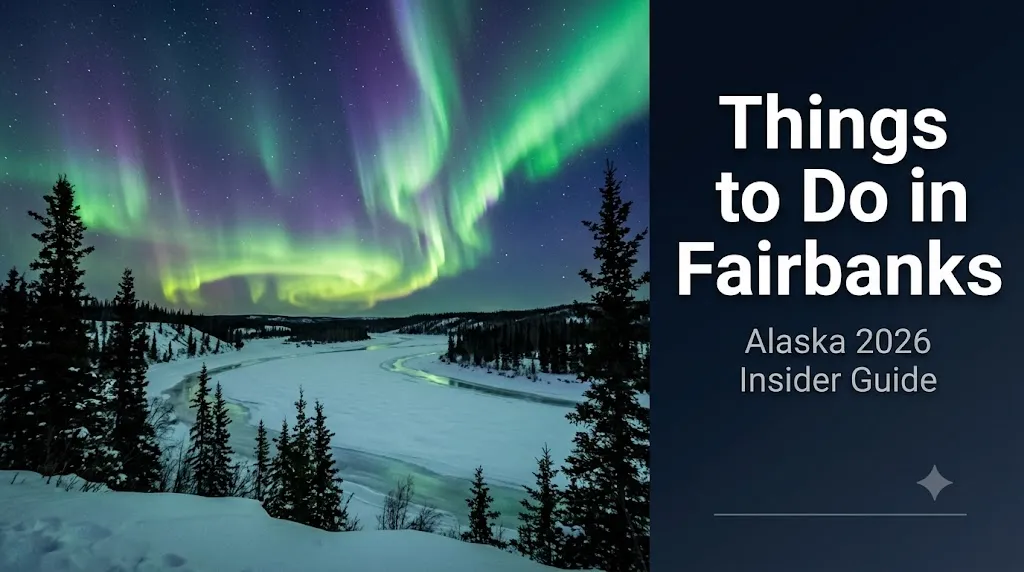
Things to Do in Fairbanks Alaska: 2026 Insider Guide

The things to do in Fairbanks, Alaska split sharply between two completely different worlds. Winter brings aurora hunting, dog mushing, and temperatures that can reach minus 50°F. Summer delivers midnight sun hikes, gold panning, and river days where darkness simply never comes.
Fairbanks sits 358 miles north of Anchorage in Alaska’s interior, well above the aurora oval. The Fairbanks Convention and Visitors Bureau identifies it as one of North America’s most reliable aurora viewing locations outside of northern Canada.
This guide covers every major experience across both seasons. It gives you cost context, specific named venues, honest crowd assessments, and a two-day itinerary framework you can actually use.
Things to Do in Fairbanks Alaska: Understanding the City Before You Arrive
Fairbanks rewards travelers who understand what it is before they show up. It is a small sub-Arctic city of roughly 32,000 people, not a polished resort town.
Downtown Fairbanks centers on the intersection of Cushman Street and First Avenue, near the Chena River. The practical footprint is compact, but most major attractions require a vehicle to reach.
Couples and solo travelers chasing a specific Alaska experience will find Fairbanks deeply satisfying. Travelers expecting urban variety or refined hospitality equivalent to Seattle or Denver will leave underwhelmed.
The honest tourist-vs.-local ratio matters here. Most attractions are genuinely worth visiting, but the experience quality varies enormously by season, operator, and how much you plan.
Rent a car. The Metropolitan Area Commuter System (MACS) bus service exists but covers limited routes. Almost everything worth doing requires independent mobility.
Insider Tip:
- Book accommodations three to four months in advance for January through March aurora season. Properties within 20 miles of the city fill completely.
- The Aurora Express Bed and Breakfast, located on a hillside north of the city, offers sleeping cars that include aurora wake-up calls when activity spikes.
- Budget travelers should know that Billie’s Backpackers Hostel near downtown remains one of the only hostel-format options in interior Alaska.
Things to Do in Fairbanks in Winter
Winter in Fairbanks is the destination’s defining season, running from late September through mid-April. Activities center on aurora viewing, dog mushing, ice sculpting, and soaking in geothermal hot springs.
The World Ice Art Championships at Growden Memorial Park typically runs mid-February through late March. It is one of the largest ice sculpting competitions globally, and evening illuminated viewing is genuinely dramatic.
| Winter Activity | Best For | Approx. Cost Per Person | Time Needed |
|---|---|---|---|
| Aurora viewing tour | Couples, solo travelers | $80 to $200 | 4 to 6 hours (overnight) |
| Dog mushing tour | Families, couples | $100 to $400 | 1 to 3 hours |
| World Ice Art Championships | All profiles | $10 to $20 admission | 2 to 3 hours |
| Chena Hot Springs soak | All profiles | $15 to $25 admission | Half day |
| Permafrost tunnel tour | History travelers, solo | $15 to $25 | 1 to 1.5 hours |
Families with children can participate in most winter activities, but temperatures below minus 20°F require careful preparation. Most reputable dog mushing operators provide insulated outerwear for participants.
Seniors and accessibility travelers should know that ice art venue paths are compacted snow. Mobility devices work with reasonable care, but extreme cold creates additional physical demand that should not be underestimated.
Insider Tip:
- The Yukon Quest International Sled Dog Race, typically starting in Fairbanks in early February, is free to watch at the start line and provides one of the most authentic Alaska sled dog culture experiences available anywhere.
- Verify 2026 Yukon Quest dates directly with the race organization, as scheduling can shift.
Things to Do in Fairbanks in Summer
Summer Fairbanks runs from late May through August and delivers a completely different experience. The midnight sun means near-continuous daylight near the June solstice, and the city’s outdoor recreation season opens fully.
Creamer’s Field Migratory Waterfowl Refuge is free to enter and sits minutes from downtown on College Road. It hosts thousands of sandhill cranes during August migration, and its farm history trail is accessible and genuinely interesting.
The Georgeson Botanical Garden, operated by the University of Alaska Fairbanks, showcases plants adapted to sub-Arctic growing conditions. It is free to enter and far less visited than the major paid attractions.
Families with children get the best value from summer Fairbanks. Gold panning, river floats on the Chena, and evening softball games under the midnight sun provide experiences unique to interior Alaska.
Budget travelers can build an entire summer day using only free attractions: Creamer’s Field, the Georgeson Botanical Garden, the Morris Thompson Cultural Center, and the Trans-Alaska Pipeline viewpoint at Fox.
Key summer activities and honest assessments:
- Midnight sun hiking at Chena River State Recreation Area: Best June through July; trails from easy riverside walks to strenuous ridge routes
- Gold panning at Gold Dredge 8: Genuinely educational; the guided tour is more engaging than self-service panning alternatives; budget $40 to $60 per adult
- Chena River kayaking and canoeing: Rental outfitters operate seasonally; expect a half-day minimum for a meaningful float
- Tanana Valley State Fair: Typically August; a genuine local event, not a tourist attraction; admission runs approximately $10 to $15 per adult
- Fairbanks Summer Arts Festival: Typically July; workshops and performances at the University of Alaska Fairbanks campus
Northern Lights Fairbanks: How to Actually See Them
The best time to see the northern lights in Fairbanks is from late August through late March, with January through February offering the longest dark windows. Clear skies are the only non-negotiable requirement.
Fairbanks sits directly under the auroral oval, a ring of maximum aurora activity encircling the Arctic. This geographic position gives Fairbanks a statistical advantage over more famous aurora destinations like Iceland.
NOAA’s Space Weather Prediction Center publishes 30-minute, 1-hour, and 3-day aurora forecasts at no cost. Check the Kp index. A reading of 3 or higher produces visible displays from Fairbanks in clear conditions.
Do not book a single-night Fairbanks trip specifically for the aurora. This is the single most common and costly mistake first-time visitors make. A minimum three-night stay dramatically improves your odds across variable weather.
Solo travelers and couples dominate the aurora tour market. Most commercial aurora tour operators drive guests 20 to 40 miles outside the city to reduce light pollution. Expect departure times between 10 PM and midnight.
Local alternative to the major tour operators: Drive north on the Elliott Highway past Fox, Alaska, pull off at a dark shoulder, and watch from your vehicle with the engine running for warmth. This is exactly what many long-term Fairbanks residents do.
Insider Tip:
- The Aurora Borealis Lodge on Murphy Dome Road sits at 2,400 feet elevation with 360-degree views. Advance reservation is essential for January through February. It books out three to four months ahead in peak season.
- A Kp index of 5 or higher produces aurora displays visible even through moderate city light pollution from downtown Fairbanks.
Chena Hot Springs Fairbanks: What to Expect
Chena Hot Springs Resort sits 60 miles east of Fairbanks on Chena Hot Springs Road and offers geothermal hot springs, the Aurora Ice Museum, and overnight accommodations. Day visits are common and practical.
The drive on Chena Hot Springs Road takes approximately 90 minutes each way. The road passes through boreal forest with legitimate moose sighting opportunities, particularly in early morning and evening.
Hot spring pool admission for day visitors runs approximately $15 to $25 per adult as of recent seasons. Verify 2026 pricing directly with the resort before visiting.
The Aurora Ice Museum, maintained year-round at a constant 25°F inside, houses ice sculptures and an ice bar serving cocktails in ice glasses. Admission is separate from hot spring entry and runs approximately $15 to $20 per adult.
Couples consistently rate Chena Hot Springs as one of the best Fairbanks-area experiences. Soaking outdoors in geothermal water while watching aurora displays above is a genuinely distinct experience not replicated elsewhere in the contiguous US.
Families with children should note the resort’s outdoor rock lake pool is open to all ages. The indoor pool has age minimums for certain times. Verify child policies before booking.
The overrated element at Chena: The resort dining is functional but not destination-worthy. Eat in Fairbanks before or after the drive rather than relying on resort food service for a quality meal.
Key Takeaway: Book aurora-season Chena Hot Springs accommodations four to six months ahead; day-visit hot spring access is easier to secure, but winter weekends still require advance planning.
Dog Mushing Fairbanks Alaska: Finding the Real Experience
Dog mushing in Fairbanks is not a manufactured tourist attraction. It is a living cultural practice with deep roots in Alaska Native and gold rush history. Fairbanks is one of a handful of places in the world where you can experience this authentically.
The Yukon Quest International Sled Dog Race start line in downtown Fairbanks is free to witness. The race typically runs in early February. Watching 150-plus sled dogs staging for a 1,000-mile race to Whitehorse is unlike anything in the continental United States.
Commercial dog mushing tours range from one-hour kennel tours and short sled rides ($80 to $150 per person) to full-day mushing experiences where you drive your own team ($200 to $400 per person). Reputable operators near Fairbanks include kennels in the Two Rivers community, approximately 20 miles southeast of downtown.
Families with children over age five are generally welcome on sled ride experiences. Most operators provide cold-weather gear. Confirm age and weight minimums when booking.
Budget travelers can see genuine sled dog culture for free by attending the Yukon Quest start or by visiting the Morris Thompson Cultural Center, which includes exhibits on mushing heritage. The paid tour experience, however, delivers a depth of contact with working dogs and their handlers that the free options cannot match.
To book a dog mushing tour in Fairbanks in 2026:
- Research operators through the Fairbanks Convention and Visitors Bureau listings for current licensed operators
- Book at least six to eight weeks ahead for January through March dates
- Confirm what cold-weather gear the operator provides versus what you bring
- Clarify whether the tour includes actual driving or only riding in the sled
- Ask whether the kennel offers a post-ride meet with the dogs, which most operators include and most travelers consider the highlight
Gold Panning Fairbanks: The Honest Assessment
Gold panning is one of Fairbanks’ most-marketed activities, and it genuinely has historical authenticity. The Fairbanks gold rush of the early 1900s shaped the city’s entire existence. That said, the tourist panning experience varies significantly by operator.
Gold Dredge 8, a National Historic Landmark on Old Steese Highway about eight miles north of downtown, offers the most complete gold rush experience. The guided tour of the dredge itself provides genuine historical context that pure panning operations do not.
Tour admission at Gold Dredge 8 typically runs approximately $40 to $60 per adult and includes seeded panning material. You will find flakes. You will not find enough gold to cover your tour cost. That is not the point, and the best operators are upfront about it.
Families with children find gold panning genuinely engaging for ages six and up. The tactile process holds attention for the right age range. The historical narrative surrounding the dredge adds adult interest that keeps parents from being bored.
Solo travelers and budget travelers should weigh whether the Gold Dredge 8 tour price is justified versus the free historical exhibits at the Morris Thompson Cultural Center, which cover the same era with more interpretive depth.
Local alternative: Drive the Steese Highway northeast of Fairbanks toward Central, Alaska. Historical gold mining dredges visible from public roads provide context without tour admission costs.
Insider Tip:
- Gold Dredge 8 operates seasonally, typically May through September. Verify 2026 operating dates directly with the attraction before planning your itinerary around it.
- The El Dorado Gold Mine, a separate operator, offers a narrow-gauge train ride as part of the experience, which families with young children often prefer over Gold Dredge 8.
University of Alaska Museum of the North
The University of Alaska Museum of the North on the UAF campus is the most substantively rewarding museum in interior Alaska. Its architecture alone, a flowing white building designed to evoke Alaska’s landscapes, is worth a photograph before you even enter.
The museum’s collection spans Alaska Native art and cultural artifacts, Arctic natural history, paleontology, and geology. The aurora gallery uses a sound installation to replicate the experience of aurora watching in an interior setting.
Admission typically runs approximately $14 to $19 per adult as of recent seasons. The museum is operated by the University of Alaska Fairbanks and typically closes on major holidays. Verify 2026 hours and admission directly with the museum.
Seniors and accessibility travelers will find this one of Fairbanks’ most physically accessible major attractions. The building is fully accessible, climate-controlled, and provides substantial seating throughout the galleries.
Solo travelers consistently rate this museum as a highlight. Plan two to three hours minimum to engage meaningfully with the collections. The gift shop carries Alaska Native art from specific named artists, which provides a meaningful alternative to generic souvenir shops.
Families with children under age eight may find the natural history sections engaging but will likely exhaust interest in the art galleries within 30 minutes. The paleontology exhibits, which include genuine Alaskan mammoth specimens, are a genuine draw for children.
Key Takeaway: The UAM of the North is not a minor local museum. It holds one of the finest Alaska Native art collections publicly accessible in the state, comparable in quality to major urban natural history institutions.
Morris Thompson Cultural Center
The Morris Thompson Cultural Center in downtown Fairbanks is free to enter and is one of the most underutilized resources by first-time visitors. Most tourists walk past it on the way to paid attractions. That is a mistake.
The center functions as a combined visitor center, cultural museum, and Alaska Native heritage institution. The exhibits on Interior Alaska Native cultures, specifically the Athabascan peoples of the Yukon-Kuskokwim region, provide context that makes every other Fairbanks experience more meaningful.
According to the Fairbanks Convention and Visitors Bureau, the Morris Thompson Cultural Center serves as the primary official visitor information hub for the Fairbanks region. Staff members are trained specifically in current local conditions, seasonal activity guidance, and real-time recommendations.
The center is adjacent to the Chena River on Dunkel Street, near the pedestrian bridge that connects to the river trail system. Combine a visit with a short riverside walk.
Budget travelers should make this their first stop in Fairbanks. It is free, provides orientation, and its exhibits cover enough content to eliminate the need for several paid cultural experiences elsewhere.
Families with children will find the interactive Alaska Native cultural exhibits age-appropriate for children eight and older. Younger children will benefit from the staff’s orientation role before family activities begin.
The local alternative to paying for separate cultural tours: Spend 90 minutes at the Morris Thompson Cultural Center. You will leave with a richer understanding of Fairbanks than travelers who paid $50 for a generic city tour.
Pioneer Park Fairbanks
Pioneer Park, a 44-acre free-admission heritage park on Airport Way, is Fairbanks’ most genuinely local landmark. It holds a collection of historic gold rush and early Fairbanks-era buildings relocated to a single site, a sternwheeler steamboat, an art gallery, and seasonal evening shows.
The park is sometimes called by its historical name, Alaskaland, which older Fairbanks residents still use. The grounds are free to enter. Individual attractions and dining within the park charge separately.
The Nenana, a restored National Historic Landmark sternwheeler, is moored at Pioneer Park and provides a tangible connection to the era when riverboats were interior Alaska’s primary transportation. Access to the boat’s interior is included in general park admission during operating seasons.
Families with children rate Pioneer Park highly for its scale and variety. Children can roam the historical buildings, visit a small carousel, and eat at the park’s seasonal concessions over a half-day without exhausting interest.
Budget travelers appreciate that the park’s free admission allows extended time without financial pressure. The optional paid experiences within the park are genuine additions rather than the only way to access value.
Seasonal note: Pioneer Park operates fully in summer. Winter hours are significantly reduced, and some attractions close entirely. Verify 2026 operating seasons directly with the park administration before building your itinerary around it.
Insider Tip:
- The Palace Theatre and Saloon within Pioneer Park presents a live Alaska history musical revue in summer evenings. It is corny by design and genuinely entertaining as local entertainment, not as serious theater.
- The park’s art gallery rotates exhibitions by Alaska artists and is free to enter year-round when the building is open.
Key Takeaway: Pioneer Park is the single best free half-day in Fairbanks for families and budget travelers; skip it only if you have very limited time and are prioritizing paid experiences like Chena Hot Springs or dog mushing.
Chena River State Recreation Area Hiking
Chena River State Recreation Area, stretching along Chena Hot Springs Road from mile 26 to mile 51, offers the most accessible wilderness hiking within striking distance of Fairbanks. It requires no permits for day use and charges no entry fee.
The Angel Rocks Trail, at mile 48.9 of Chena Hot Springs Road, is a 3.5-mile loop with significant granite tor formations at the summit. It requires moderate fitness and delivers genuine Alaskan wilderness views without technical skill.
The Granite Tors Trail, a 15-mile loop beginning at mile 39, is the area’s most demanding and rewarding full-day hike. Allow seven to ten hours for the complete loop. Bring bear spray and carry sufficient water.
Solo travelers hiking the Chena recreation area should tell someone their itinerary and expected return time. Cell service is minimal along Chena Hot Springs Road. This is standard practice in interior Alaska, not an overreaction.
Seniors and accessibility travelers will find the Chena River Nature Trail at mile 39.5 the best option. It is a short, relatively flat trail along the riverbank with interpretive signage.
Summer hiking season runs May through September. Snow can persist on higher elevations through June. Always check current trail conditions with the Alaska Department of Natural Resources before departure.
| Trail | Distance | Difficulty | Best For | Season |
|---|---|---|---|---|
| Angel Rocks Trail | 3.5 miles (loop) | Moderate | Most adult profiles | June through September |
| Granite Tors Trail | 15 miles (loop) | Strenuous | Fit adults, solo hikers | June through August |
| Chena River Nature Trail | 2 miles (out-back) | Easy | Families, seniors | May through September |
| Tors Trail Campground Area Walks | Variable | Easy | Families with young children | May through September |
Where to Eat in Fairbanks
Fairbanks has a limited but honest dining scene. Manage expectations: this is a small sub-Arctic city, not a culinary destination. What it does well, it does genuinely.
The Pump House Restaurant and Saloon at 1.3 Mile Chena Pump Road is Fairbanks’ most atmospheric dining venue. Set in a converted gold rush-era water pumping station on the Chena River, it serves Alaska seafood and prime cuts. Budget $40 to $70 per person for dinner. It is the correct choice for a single celebratory meal.
Pike’s Landing on Airport Way offers a river deck setting that is Fairbanks’ best option for casual summer dining with a view. Local fish dishes and Alaskan seafood are the menu strengths.
Lavelle’s Bistro on First Avenue is the city’s most consistent dinner option in terms of preparation quality and ingredient sourcing. It operates in a boutique hotel setting downtown. Expect mid-range pricing of $25 to $45 per person.
Silver Gulch Brewing and Bottling Company in Fox, Alaska, 11 miles north of downtown, is the northernmost brewery in the United States. The pub food is solid, the beer is genuinely good, and the atmosphere is authentically local rather than tourist-oriented.
Lemongrass Thai Cuisine on Old Steese Highway is one of the most consistently praised restaurants among Fairbanks residents across multiple years of local review cycles. Thai cuisine may seem incongruous in interior Alaska, but the quality speaks for itself.
Budget travelers should know that grocery options are more limited than in larger Alaska cities. Fred Meyer on Airport Way serves as the primary full-service grocery store and deli option for self-catering travelers.
Things to Do Near Fairbanks
North Pole, Alaska, about 14 miles southeast of Fairbanks on the Richardson Highway, maintains a year-round Christmas theme. Santa Claus House is a genuine retail attraction and local landmark, not a theme park ride. It is worth 30 minutes if you have children or simply appreciate the peculiarity.
Ester, Alaska, a former gold mining community four miles southwest of Fairbanks on the Parks Highway, is a genuine historic community that hosts a small cluster of artists and a seasonal community hall. The Ester Gold Camp has historically offered summer performances; verify 2026 programming directly.
The Trans-Alaska Pipeline System viewpoint at Fox, 11 miles north of Fairbanks on the Steese Highway, is free, accessible from a paved pull-off, and provides an educational signage installation explaining one of the 20th century’s most significant engineering projects. It takes 20 minutes and is genuinely worth those 20 minutes.
The Denali National Park and Preserve connection from Fairbanks is a two-hour drive south on the Parks Highway. Fairbanks makes a viable northern base for a Denali trip, but the park requires advance planning. Timed-entry permits and bus tour reservations for the Denali Park Road fill months in advance for peak summer months. Book directly through the National Park Service reservation system as early as possible.
Delta Junction, 100 miles southeast on the Richardson Highway, marks the official end of the Alaska Highway. The visitor center at the confluence of the Richardson and Alaska Highways is free and historically interesting as a road trip milestone.
Couples and solo travelers using Fairbanks as a base for multi-day Alaska exploration should note that the Dalton Highway to the Arctic Circle begins 84 miles north of Fairbanks at the Dalton Highway junction on the Elliott Highway. Driving to the Arctic Circle and back is a full-day commitment requiring a high-clearance vehicle and serious preparation.
Key Takeaway: Fairbanks is the best northern Alaska base for combining aurora viewing, dog mushing, and a Denali day trip in one itinerary, but Denali bus tour reservations must be secured months in advance.
Getting Around Fairbanks Alaska
Getting around Fairbanks requires a rental car for any serious exploration. The Metropolitan Area Commuter System (MACS) operates local bus routes within the city, but routes do not reach Chena Hot Springs, Pioneer Park effectively, or most trailheads.
Fairbanks International Airport (FAI) is served by Alaska Airlines and Delta Air Lines from Seattle, Anchorage, and Minneapolis. Most travelers arrive via Anchorage connection or direct from Seattle.
Rental car availability at FAI is reliable but limited during peak aurora season (January through March) and peak summer (late June through August). Reserve a vehicle when you book flights, not after. Winter rental vehicles should be confirmed to have been maintained for extreme cold. Ask specifically about cold-weather tires and whether the vehicle has a block heater.
| Getting Around Option | Range | Cost Estimate | Best For |
|---|---|---|---|
| Rental car | Citywide and regional | $60 to $120 per day | All traveler profiles for regional access |
| MACS bus | City core only | Under $5 per ride | Budget travelers, downtown-only activities |
| Taxi and rideshare | City only | Variable | Short trips without a rental |
| Tour operator transport | Specific venues | Included in tour cost | Aurora tours, Chena Hot Springs tours |
| Personal vehicle | Unlimited | N/A | Alaska Highway road-trippers |
Seniors and accessibility travelers should specifically request a vehicle with running boards or step-assist features when renting in winter. Climbing into a standard SUV wearing heavy cold-weather gear and bulky boots is physically more demanding than it sounds.
Parking in Fairbanks is not a meaningful challenge. The city’s scale means most venues have adjacent parking. This is one logistical advantage Fairbanks holds over larger Alaska cities.
Winter driving in Fairbanks requires cold-weather preparedness: always carry a survival kit in your vehicle including mylar blanket, hand warmers, water, and a charged power bank. Temperatures can drop to minus 50°F or colder. A breakdown outside the city in those conditions is a genuine safety situation.
Best Time to Visit Fairbanks Alaska
The best time to visit Fairbanks depends entirely on what you want to experience. There is no single best month that serves all traveler types.
For aurora viewing: Late August through March offers the necessary darkness. January and February provide the longest dark windows but also the most extreme cold. September and March offer milder temperatures with still-sufficient darkness and often clearer skies than deep winter.
For summer experiences: Mid-June through late July delivers the midnight sun at its peak, wildflower blooms throughout the boreal landscape, and full access to every outdoor recreation option. The Fairbanks Summer Arts Festival (verify 2026 dates) typically occupies two weeks in July and fills hotels.
The worst time to visit Fairbanks is late October through mid-November. Darkness increases rapidly, but temperatures are cold without reaching the dramatic extremes that characterize January. Aurora activity is present but skies are frequently cloudy. Summer recreation is closed. It is the lowest-value window for most traveler types.
| Season | Highlights | Honest Drawbacks | Best Traveler Profile |
|---|---|---|---|
| Sept to Oct | Early aurora, fall colors | Cold onset, variable skies | Aurora hunters, solo travelers |
| Nov to Dec | Long nights for aurora | Frequent cloud cover, cold | Committed aurora chasers only |
| Jan to Feb | Peak aurora window | Extreme cold risk, minus 40°F possible | Prepared winter travelers, couples |
| March | Aurora plus daylight returning | Cold but improving | Most manageable winter option |
| May | Spring opening, long days | Muddy trails, limited services | Road-trippers passing through |
| June to July | Midnight sun peak, all activities open | Highest prices, peak crowds | Families, first-time Alaska visitors |
| August | Summer closing, early aurora possible | Wildfire smoke risk | Best all-around summer month |
Budget travelers should target May or September, when prices drop significantly below peak summer and peak aurora season rates. Both months offer genuine activity windows at lower costs.
Suggested 2-Day Fairbanks Itinerary
This framework works for a winter or summer visit with modifications noted.
Day 1: Cultural Foundation and City Orientation
- Begin at the Morris Thompson Cultural Center on Dunkel Street. Allow 90 minutes. It is free. The context it provides makes everything else richer.
- Walk the Chena River pedestrian bridge and riverside trail. 30 minutes. Free.
- Drive to the University of Alaska Museum of the North. Allow two to three hours. The aurora gallery and Alaska Native collections are the priority sections.
- Lunch at Lavelle’s Bistro downtown or a grocery stop at Fred Meyer on Airport Way for budget travelers.
- Drive to the Trans-Alaska Pipeline viewpoint at Fox. 20 minutes. Free. Combine with dinner at Silver Gulch Brewing.
- Winter visitors: Return to accommodations by 9:30 PM to check aurora forecasts. If Kp index is 3 or higher and skies are clear, drive the Elliott Highway north of Fox for dark-sky viewing.
- Summer visitors: Evening kayak rental on the Chena River or a hike at the Chena River Nature Trail near mile 39.5 of Chena Hot Springs Road.
Day 2: Signature Experiences Outside the City
- Depart by 8:00 AM for Chena Hot Springs Resort (60 miles, 90 minutes). Drive Chena Hot Springs Road slowly; moose sightings are common at dawn.
- Visit the Aurora Ice Museum on arrival. Allow 45 minutes.
- Soak in the Chena Hot Springs outdoor rock lake. Allow 90 minutes minimum.
- Lunch at the resort (functional, not destination-worthy; set expectations accordingly).
- Return to Fairbanks via Chena Hot Springs Road. Stop at Angel Rocks Trail (mile 48.9) for a 90-minute hike if energy permits.
- Dinner at Pump House Restaurant and Saloon for the full Fairbanks atmospheric experience.
- Winter visitors: Aurora tour departure with a licensed operator, or self-guided Elliott Highway viewing if skies are clear.
- Summer visitors: Pioneer Park evening visit for the summer cultural show.
Safety and Practical Warnings for Fairbanks Alaska
Fairbanks presents genuine safety considerations that no other major Alaska tourism destination matches in severity. Winter cold in interior Alaska is categorically different from cold in the continental United States.
Key safety and practical facts every visitor should know:
- Temperatures can reach minus 50°F or colder in January and February. Exposed skin can experience frostbite in under five minutes at those temperatures. Every outdoor activity requires layered insulation, face covering, and insulated footwear rated to minus 40°F or below.
- Always carry a vehicle survival kit in winter. Include: mylar emergency blanket, hand warmers (chemical, not battery-powered), water, high-calorie snacks, a charged power bank, and jumper cables. A breakdown outside the city at those temperatures is a genuine emergency.
- Cell service is unreliable outside of Fairbanks city limits. Along Chena Hot Springs Road and on the Dalton and Elliott Highways, you may have no service for extended stretches. Download offline maps before departure.
- Summer wildfire smoke can significantly affect air quality in Fairbanks from late July through August. Check the Alaska Department of Environmental Conservation air quality index before planning outdoor activities during this period.
- Wildlife awareness is required on all trails. Bears, moose, and in remote areas wolves are present in the Chena River State Recreation Area and surrounding boreal forest. Carry bear spray on all trail hikes and understand how to use it.
- Aurora tours run late at night in extreme cold. Dress warmer than you think necessary. Multiple layers of synthetic base, mid, and outer insulation. Cotton is dangerous in those conditions.
- Fairbanks Memorial Hospital is located on Cowles Street in the city. It is the primary medical facility for interior Alaska. For wilderness emergencies, the Alaska State Troopers dispatch line covers interior Alaska.
Always tell someone your itinerary before driving Chena Hot Springs Road, the Elliott Highway, or any route outside the city in winter. This is not an overreaction. It is standard local practice.
Frequently Asked Questions About Things to Do in Fairbanks
What are the best things to do in Fairbanks Alaska?
The best things to do in Fairbanks Alaska include viewing the aurora borealis, soaking at Chena Hot Springs Resort, dog mushing with a Two Rivers area kennel, visiting the University of Alaska Museum of the North, and hiking the Angel Rocks Trail in Chena River State Recreation Area.
The specific best experience depends entirely on your season. Winter visitors should anchor their itinerary to aurora viewing and dog mushing. Summer visitors should prioritize midnight sun hiking and gold panning at Gold Dredge 8 or El Dorado Gold Mine.
How many days do you need in Fairbanks?
Three to four days is the minimum for a meaningful Fairbanks visit that covers the city’s core experiences without rushing.
Winter visitors chasing the aurora should plan a minimum of three nights to account for variable cloud cover, since no single night can be guaranteed clear. Summer visitors can accomplish the primary attractions in two full days but benefit from a third day for day trips to Chena Hot Springs or Denali.
Is Fairbanks worth visiting in winter?
Fairbanks in winter is worth visiting specifically if you are committed to the aurora borealis experience and prepared for extreme cold. It is one of the most statistically reliable aurora viewing locations in North America.
It is not worth visiting in winter if you are not genuinely prepared for temperatures as low as minus 50°F, or if you expect a range of activities comparable to a summer Alaska itinerary. The winter experience is singular and specific.
What is the best time to see the northern lights in Fairbanks?
The best time to see the northern lights in Fairbanks is January through February, when nights are longest. September and March offer the most manageable cold temperatures while still providing sufficient darkness for aurora viewing.
Clear skies are the only condition that guarantees a display. The NOAA Space Weather Prediction Center publishes free real-time aurora forecasts showing the Kp index. A reading of 3 or above typically produces visible aurora from Fairbanks under clear conditions.
What should I know before visiting Fairbanks Alaska?
Rent a car: public transit does not reach most major attractions. Book accommodations and aurora tours at least two to three months ahead for January through March visits, when the city fills. Pack insulation rated to minus 40°F for any winter visit, regardless of what the forecast shows at booking time.
The Morris Thompson Cultural Center downtown is free, provides the best orientation for new visitors, and is skipped by most tourists, which is a genuine planning mistake. Start there before going anywhere else.
Is Fairbanks Alaska good for families?
Fairbanks is a genuinely good summer family destination offering gold panning, dog sled kennel visits, Pioneer Park, and midnight sun experiences unique to interior Alaska. Winter family visits work well for families with older children who can manage extreme cold.
Families with children under age five should approach winter Fairbanks carefully. Temperatures that require full face covering and layering systems are not manageable for very young children during extended outdoor activities. Summer visits are far more family-accessible across all age ranges.
Plan Your Fairbanks Trip With Realistic Expectations
Fairbanks rewards travelers who arrive knowing what it genuinely offers: one of the world’s most reliable aurora locations, living sled dog culture, gold rush history with real roots, and wilderness access unlike anything in the lower 48 states.
Book aurora-season accommodations at least three months ahead, secure your Chena Hot Springs day visit before departure, and check the NOAA aurora forecast starting the night you land. That single logistical habit saves most first-time visitors their biggest Fairbanks regret.
Travel conditions, event dates, tour pricing, and operating hours in Fairbanks change seasonally and year to year. Verify all logistics directly with venues and the Fairbanks Convention and Visitors Bureau before departure. The information in this guide reflects general patterns through early 2026 and is designed as a planning framework, not a substitute for direct confirmation.